Tag: Basil Sydney

Hamlet (1948)

Laurence Olivier makes Shakespearean cinematic history in Hamlet

Director: Laurence Olivier

Cast: Laurence Olivier (Hamlet), Basil Sydney (Claudius), Eileen Herlie (Gertrude), Jean Simmons (Ophelia), Felix Aylmer (Polonius), Noman Wooland (Horatio), Terence Morgan (Laertes), Peter Cushing (Osric), Stanley Holloway (Gravedigger), Anthony Quayle (Marcellus), Esmond Knight (Bernardo), Russell Thorndike (Priest), Harcourt Williams (Player)
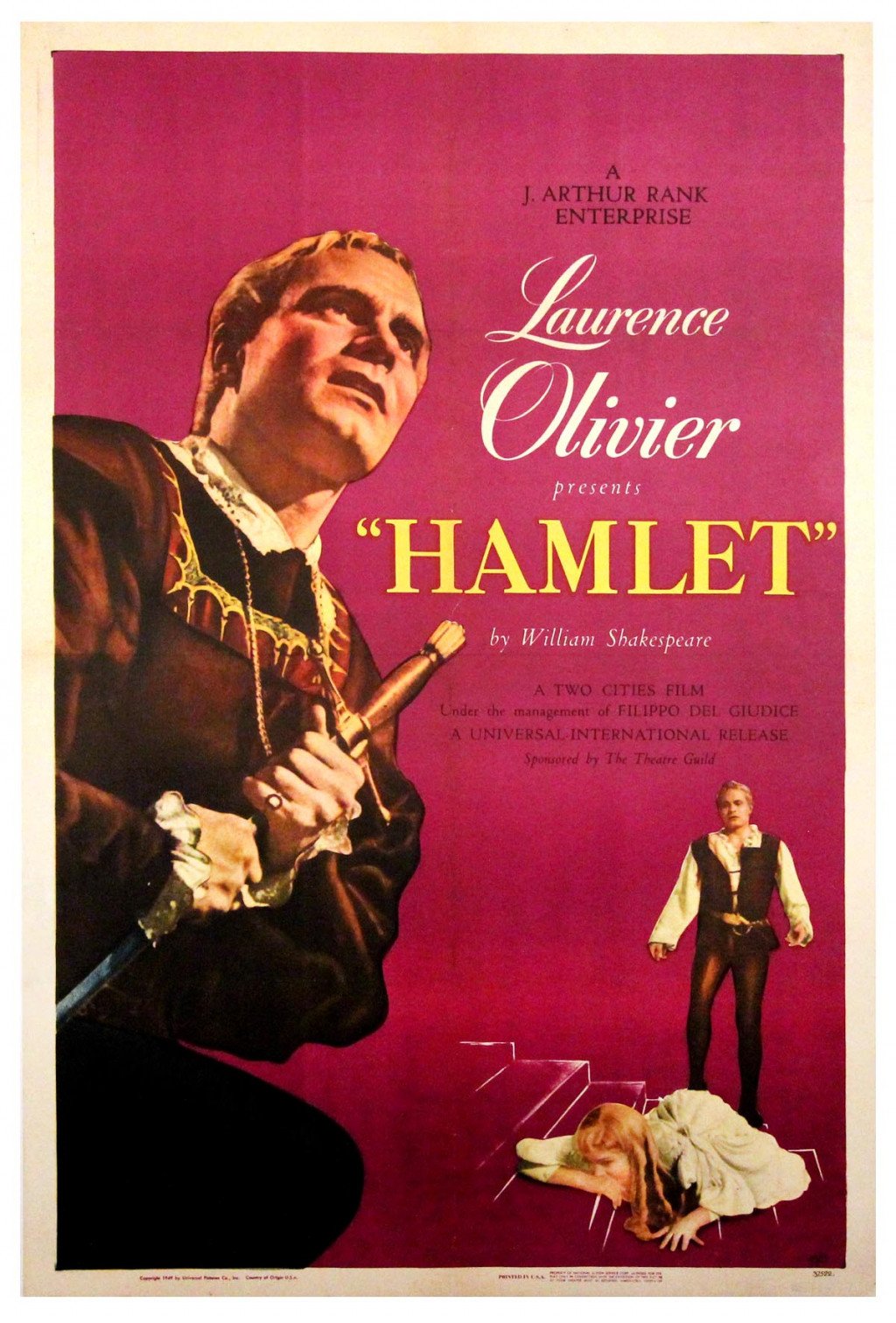
Close your eyes and picture Hamlet – chances are you will see an image inspired by Olivier. Olivier’s second Shakespearean directing outing coated him in plaudits. He became the only actor to win an Oscar for Shakespeare (and, until Roberto Benigni, the only actor to direct himself to an Oscar) and the film itself became the first non-American film to win Best Picture. Hamlet will live forever, a corner-stone production of the play and a part of Shakespearean and cinematic history. It skilfully weaves together theatre and cinema and still works as a cracking production of the play.

To bring it to the screen, Olivier made some big calls. Smaller parts were cut to ribbons (particularly the Player King) or in many cases (I’m looking at you Rosencrantz and Guildenstern) excised all together. Over half the dialogue cut, with the focus being bought onto domestic tragedy (the politics of Fortinbras is never mentioned). This is a family tragedy, and a Hamlet-centric production, where Claudius is a jovial villain and Gertrude a mother with confused feelings for her son.

Oliver set this in a sprawling medieval castle using the best elements of theatre and cinema. The sets are beautifully constructed: winding corridors, towering halls and imperious battlements provide the sort of realist set Olivier could only dream of in the theatre. But Olivier (and photographer Desmond Dickinson), lights this with the moody intensity of film noir. Shadows dominate the castle and the frame, frequently provide hiding places. Olivier’s debt to Wyler (and Welles) can be seen in his pictorial framing and use of deep focus, while domestic tragedy in a grand house has more than a few calls backs to Hitchcock’s Rebecca. Frequently shots show an actor in the foreground, being observed in long shot by a second actor in perfect focus.

It also takes inspiration from expressionist cinema, especially in its mist-laden battlements, with some neatly surreal touches. The Ghost (whose voice, heavily distorted, is also Olivier’s) is a shadowy demonic figure, emerging shrouded in mist. A wonderful series of shots sees the camera seem to soar away from the throne room steps where Ophelia weeps, through the castle towers, into the sky and then down towards Hamlet staring at the waves at the foot of the cliff, passing through his skull where the image of the crashing waves is overlaid across the interior of Hamlet’s skull. It’s a more effective use of visuals than the film gets credit for.

For all its traditional trimmings – cod-pieces and men-in-tights abound – it’s easy to forget how influential this was. It cemented for years a view of Hamlet as a man wracked by indecision and made it standard to see Gertrude and Hamlet locked in Freudian-inspired Oedipal lust. The first idea came from the opening narration’s reductive phrase “This is a tragedy of a man who could not make up his mind”. It’s an odd statement to make – especially as Olivier’s Hamlet hardly seems wracked by indecision – but it matched a perception of the play so, true or not, it stuck.

That relationship between Hamlet and Gertrude adds a perverted romantic twist to the bedroom scene between the two (you can sense the inspiration of Wyler’s Wuthering Heights), with the film frequently framing the encounter with romantic angles. Eileen Herlie, for all the unflattering make-up and filming, looks all too much like Hamlet’s contemporary rather than mother (Herlie was in fact nearly 12 years younger than Olivier). While the scene does have a little too much heavy-breathing – and Olivier overplays the heart-beat soundtrack as white noise – it’s an effectively unsettling balance of intimacy and incest. It also runs through the production – from Gertrude kissing Hamlet on the lips, to her conscious decision to drink the poison and protect Hamlet.

The production – partly driven by cuts – is fiercely Hamlet-centric. Olivier speaks most of the dialogue (all of Olivier’s films revolve around massive star-roles for himself, fitting his competitive dominance). His Hamlet is beautifully thoughtful, but also dynamic and energetic (not much doubt there). Olivier perfectly captures the intellectual, as well as the humanity, grace and charm. Some of the nuance of the soliloquies is lost by Olivier’s decision to deliver them in voice-over (although Olivier does a good job reacting along to the narration) – but fortunately “To Be or Not To Be” and his speech on Yorick’s skull remain delivered ‘live’, and coated in emotional honesty.
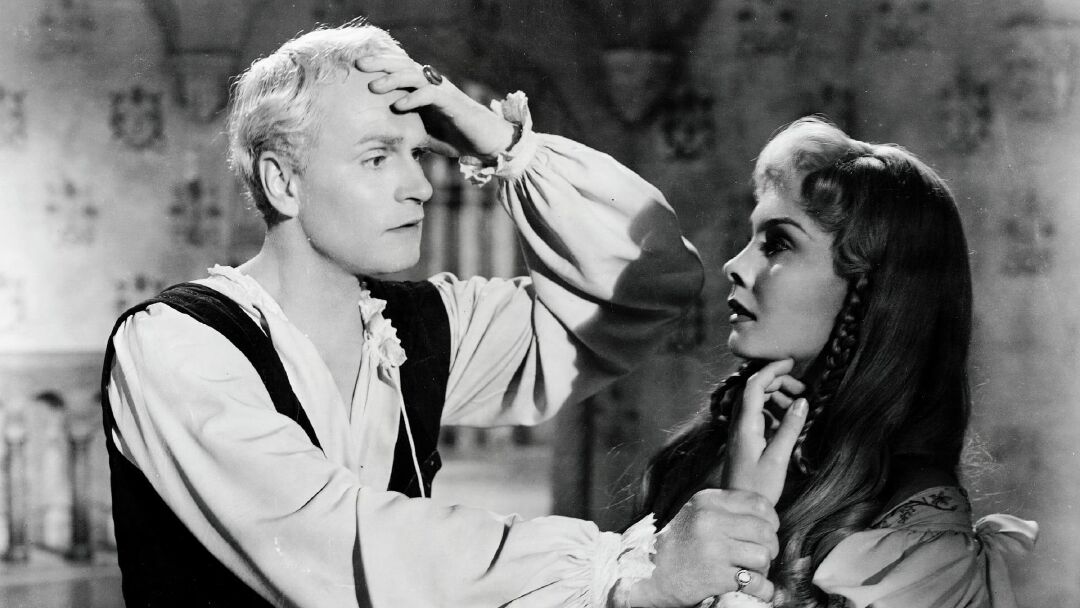
The rest of the cast are relegated. Sydney’s Claudius is little more than a scowling villain, Herlie has little presence. Norman Wooland makes a great deal of the loyal Horatio (a famously dull role), while Peter Cushing adds some comic energy as a foppish Osric. The best non-Hamlet moments go to Polonius and his children: Aylmer is the portrait of a doddering interferer nowhere near as smart as he thinks he is, while Morgan has a matinee idol energy as Laertes. Best of all is Jean Simmons, wonderfully heart-felt and fragile as Ophelia, whose gentleness dooms her.

Olivier might give himself most the best moments, but he allows plenty of directorial flourish elsewhere. There is a wonderful shot at Yorick’s tomb, where Hamlet’s shadow is cast over the skull, the skull seeming to become the shadow’s head. While a crane shot during Claudius-Laertes scheming is unwisely used twice in quick succession (more likely to raise chuckles), there is an impressive amount of camera movement and tracking shots. The production ends with a knock-out sword fight – and of course only Olivier would cap that with a life-and-limb risking dive from a platform. Olivier’s charisma is used brilliantly in these scenes, and while it’s not always quite clear emotionally what Hamlet is considering in these moments, his forceful presence drives the action and adds great weight to his final speech.

Because, this isn’t a film about a man not making up his mind. Sure, he’s a thinker – and one of the final shots brings us back to Hamlet’s chair, now empty – but when action is needed, this Hamlet grabs it. Just as Olivier grabbed the tools of cinema to create a production of the play that feels like a film. Some critics at the time were horrified that Hamlet should even be in the crude medium of film (Olivier took to calling it an “essay” on Hamlet) but today it stands quite rightly as both a great film and a key example of how to bring Shakespeare to the screen.

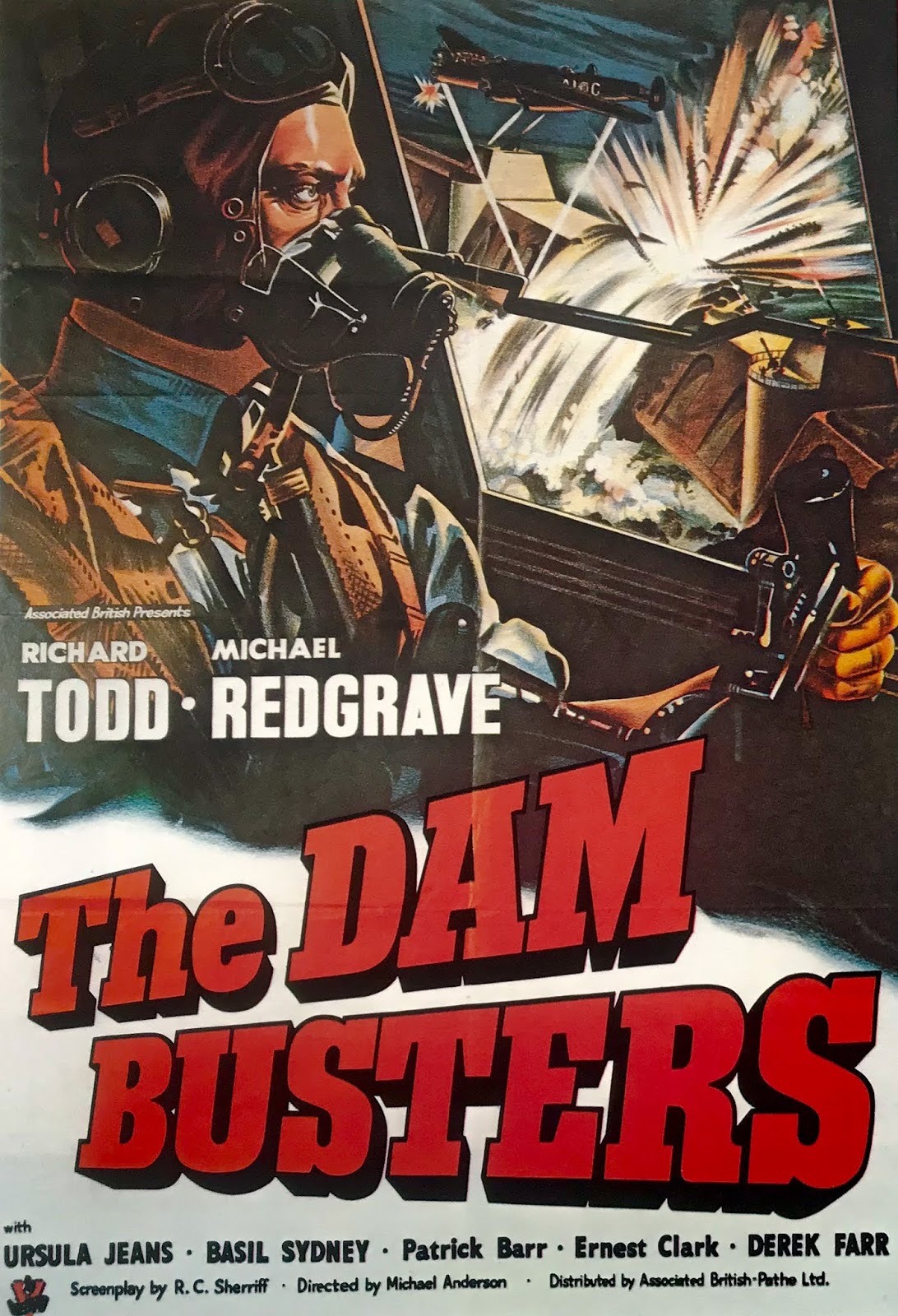
The Dam Busters (1955)

Richard Todd leads the most famous bombing raid ever in The Dam Busters

Director: Michael Anderson

Cast: Richard Todd (Wing Commander Guy Gibson), Michael Redgrave (Barnes Wallis), Ursula Jeans (Mrs Molly Wallis), Basil Sydney (Air Chief Marshal Sir Arthur Harris), Patrick Barr (Captain Joseph “Mutt” Summers), Ernest Clark (Air Vice-Marshal Ralph Cochrane), Derek Farr (Group Captain John Whitworth)

It’s famous for its stirring theme. Those bouncing bombs. The fact that George Lucas, while still completing the special effects, spliced in the final bombing runs into his first cut of Star Wars. But where does The Dam Busters sit today as a film? 

In 1942, aeronautical engineer Barnes Wallis (Michael Redgrave) is working on a plan to take out the German dams on the Ruhr, a strike that could cripple German heavy industry. Conventional bombs can never cause enough damage, and the dams are protected from torpedo attack. So Wallis has a crazy idea – to build a bouncing bomb that will skim the top of the water, hitting the dam, with its top spin taking it down to the base of the dam for detonation. It’s a crazy idea – but it finally wins favour, with Wing Commander Guy Gibson (played by real-life World War II paratroop veteran Richard Todd) given command over an operation that promises to be risky and dangerous beyond belief.

The Dam Busters doesn’t really have much in the way of plot, being instead a rather straight-forward, even dry in places, run through of the mechanics involved in planning the operation and overcoming the engineering difficulties that stood in the way of the operation. Throw into that our heroes overcoming the various barriers and administrative hiccups put in the way by the authorities and you have a pretty standard story of British pluck and ingenuity coming up with a left-field solution that saves the day. (Though Barnes Wallis denied he faced any bureaucratic opposition like the type his fictional counterpart struggled with for most of the first forty minutes).

Of course, the film is also yet another advert for the “special nature” of the British under fire, a national sense of inherent destiny and ingenuity that has frequently done as much harm as good. Made in co-operation with the RAF, it’s also a striking tribute to the stiff-upper-lipped bravery of the RAF during the war, and the sense of sacrifice involved in flying these deadly missions.  

In fact it’s striking that the film’s final few notes are not of triumph after the completion of the operation, and the destruction of the two dams, but instead the grim burden of surviving. After 56 men have been killed on the mission, Barnes Wallis regrets even coming up with the idea. The final action we see Gibson performing is walking quietly back to his office to write letters to the families. Anderson’s camera pans over the empty breakfast table, set for pilots who have not returned, and then over the abandoned belongings of the dead still left exactly where they last placed them. It’s sombre, sad and reflective – and probably the most adult moment of the film.

Because other than that, it’s a jolly charge around solving problems with a combination of Blue Peter invention, mixed with a sort of Top Gear can-do spirit. Michael Redgrave is very good as the calm, professorial, dedicated Barnes Wallis, constantly returning to the drawing board with a reserved, eccentric resignation to fix yet another prototype. The sequences showing the engineering problems being met and overcome are interesting and told with a quirky charm that makes them perhaps one of the best examples of such things made in film. 

The material covering the building of the flight team is far duller by comparison, despite a vast array of soon-to-be-more-famous actors (George Baker, Nigel Stock, Robert Shaw etc.) doing their very best “the few” performances. Basically, generally watching a series of pilots working out the altitude they need to fly at in training situations is just not as interesting as watching the boffins figure out how to make the impossible possible.

The flight parts of the film really come into their own in the final act that covers the operation itself. An impressive display of special effects at the time (even if they look a bit dated now), the attack is dramatic, stirring and also costly (the film allows beats of tragedy as assorted crews are killed over the course of the mission). The attack is brilliantly constructed and shot by Michael Anderson, and very accurate to the process of the actual operation, in a way that fits in with the air of tribute that hangs around the whole film.

All this reverence to those carrying means that we overlook completely the lasting impact of the mission. “Bomber” Harris (here played with a solid gruffness by Basil Sydney) later considered the entire operation a waste of time, money and resources. Barnes Wallis begged for a follow-up to hammer home the advantage, but it never happened. The Germans soon restored their economic capability in the Ruhr. Similarly, today it’s more acknowledged the attack killed over 600 civilians and over 1000 Russian POWs working as slave labour in the Ruhr. Such things are of course ignored – the film even throws in a moment of watching German workers flee to safety from a flooding factory floor, to avoid showing any deaths on the ground.

And of course, the film is also (unluckily) infamous for the name of Gibson’s dog. I won’t mention the name, but when I say the dog is black and ask you to think of the worst possible word to use as its name and you’ve got it. It does mean the word gets bandied about a fair bit, not least when it is used as a code-word for a successful strike against the dam. Try and tune it out.

The Dam Busters is a solid and impressive piece of film-making, even if it is low on plot and more high on documentary ticking-off of facts. But it’s also reverential, a little dry and dated and avoids looking at anything involved in the mission with anything approaching a critical eye. With its unquestioning praise for “the British way”, it’s also a film that reassures those watching it that there is no need for real analysis and insight into the state of our nation, but instead that we should buckle down and trust in the divine guiding hand that always pulls Britain’s irons out of the fire.

Ivanhoe (1952)


Robert Taylor and Elizabeth Taylor (no relation) fighting for Good Old England

Director: Richard Thorpe

Cast: Robert Taylor (Sir Wilfred of Ivanhoe), Elizabeth Taylor (Rebecca), Joan Fontaine (Rowena), George Sanders (Sir Brian De Bois-Guilbert), Guy Rolfe (Prince John), Emlyn Williams (Wamba), Robert Douglas (Sir Hugh De Bracy), Finlay Currie (Sir Cedric of Ivanhoe), Felix Aylmer (Isaac of York), Norman Wooland (King Richard), Basil Sydney (Waldemar Fitzurse), Harold Warrender (Robin Hood)

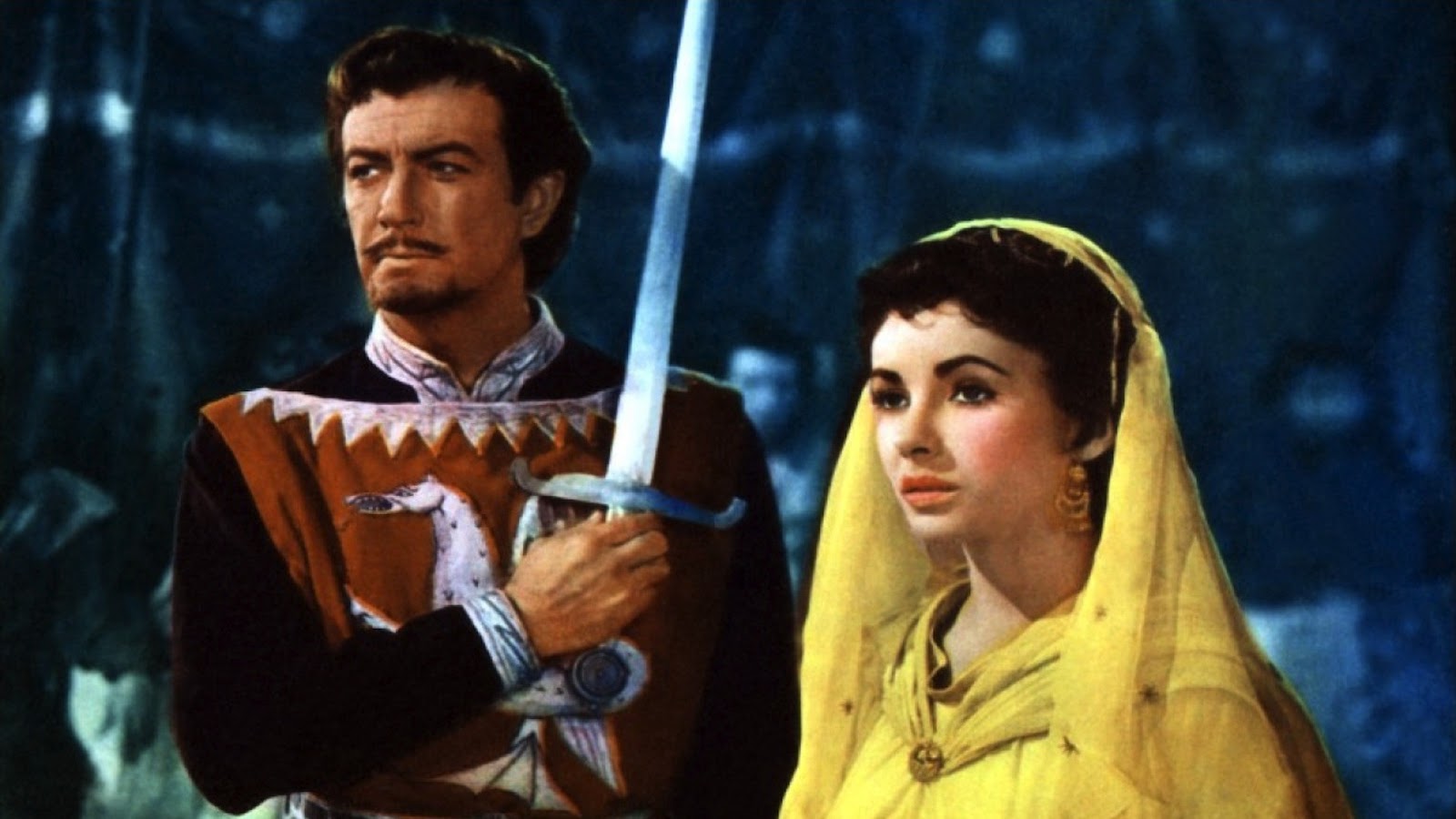
Adapted (very loosely) from Sir Walter Scott’s novel, Ivanhoe was another instalment in Hollywood’s battle to drag people away from their new-fangled TV sets. This rivalry meant technicolour spectacles like this were the most valued animals in a studio’s stable, which probably explains why Ivanhoe was the MGM film nominated for Best Picture in 1952, while The Bad and the Beautiful (which set a record for most Oscar wins for a film not nominated for Best Picture) and, almost unbelievably, Singin’ In the Rain were overlooked.

Noble knight Ivanhoe (Robert Taylor) finds Richard the Lionheart (Norman Wooland) locked up in Austria. Returning to England, he looks to raise funds to rescue the King – mostly by putting the gentle squeeze on Jewish banker Isaac of York (Felix Aylmer) while flirting with his daughter Rebecca (Elizabeth Taylor). He must also reconcile with his father (Finlay Currie) and his sweetheart Rowena (Joan Fontaine), and prevent wicked Prince John (Guy Rolfe) and his sidekick Sir Brian (George Sanders) from taking control of the Kingdom.

Bless, this film looks quite dated now. The bright primary colours of the costumes are endearingly sweet, with our heroes dressed in capes and tights with all the delight of primary school children in a play. You need to tune into its simplicity – failing to do so means you’ll struggle to watch the final battle scenes as characters go toe-to-toe with all-too-obviously bouncy rubber swords (at one point, a sword literally bends and snaps back into place after a strong blow). The film is crammed with fights, jousts, sieges and battles – there is precious little room for plot, dialogue or character, but at least you get a maelstrom of action (even if it rarely makes much sense).

At the centre of it all is Robert Taylor as Ivanhoe. As in his other roles, Taylor is as stiff and lifeless as a board, while his transatlantic vowels clang with even more painful obviousness amongst the cut-glass and ‘ever-so-’umble’ accents from the cast of jobbing British actors. Taylor squares his jaw and does his best with the derring-do – although, as per usual, he makes Ivanhoe such a dull person, you can hardly raise the slightest interest in him. Inexplicably every woman in the film (i.e. both of them) are head-over-heels in love with him.

But then all the heroes in this film are stick-in-the-muds. Harold Warrender is the most arrogant, least fun Robin Hood you’ll ever see. Finlay Currie gives swagger as Ivanhoe’s father, but is basically a pompous windbag. Emlyn Williams as comic relief “Wampa” is so tiresome you’ll breathe a sigh of relief when he burns to death in a fire. Joan Fontaine is so saintly opposite the balsawood Taylor that you find it unlikely that we will ever hear the pitter-patter of little Ivanhoes.

The bright spots are the villains. Guy Rolfe has huge fun as a moustachio-twirling, scheming Prince John. George Sanders gets the most out of Ivanhoe’s rival Sir Brian (can you think of any other film with a villain called Brian?), although the part (and the film) is far beneath him.

Brian is of course infatuated with the Jewish Rebecca (played with a radiant charisma by a very young Elizabeth Taylor). If the film has any claim to being a more than just a gaudy knight’s tale, it’s in its treatment of its Jewish characters and careful exploration of anti-Semitism in medieval England. Taylor and Felix Aylmer (as her father) give sensitive performances as put-upon, civilised people, ill-used by those around them and expected to lend support at the drop of a hat. Ivanhoe’s assumptions that they (a) have tonnes of money and (b) will feel duty-bound to help Richard are met with a quiet regret and a pointed comment that Richard’s own anti-Semitism track-record is hardly that good. Later Rebecca is placed on trial, her Jewishness central to accusations of sorcery. Persecution is an underlying theme of the film – and although it ends with all right as rain, the threat of it throughout much of the action makes the film feel more substantial than it is.

The main problem is it’s not made with any inspiration. Thorpe is a mediocre director, and the editing flashes through some parts of the story almost too fast to follow what’s happening. The ending suffers in particular from this economy: suddenly we cut from Brian and Ivanhoe fighting to the death, to Richard arriving with an army of knights, Brian being killed largely off-camera, a quick dying speech from him, then Richard announcing everything is fine in the kingdom. It’s all so sudden, it feels like they just ran out of film so needed to wrap it up quickly.

Still, Ivanhoe is fairly good fun despite all of this. It doesn’t require any concentration – and is hardly a minor-classic, let alone any other form of classic – and it has some truly hit-and-miss performing, but it barrels along ago. It may be workmanlike in the extreme, but its bright primary colours mean there’s always something to look at.