Tag: Benecio del Toro

The Phoenician Scheme (2025)

The Phoenician Scheme (2025)

Anderson marries heart, truth and a genuinely engaging and compelling plot with his unique quirk

Director: Wes Anderson

Cast: Benecio del Toro (Zsa-Zsa Korda), Mia Threapleton (Sister Liesl), Michael Cera (Bjorn Lund), Riz Ahmed (Prince Farouk), Tom Hanks (Leland), Bryan Cranston (Reagan), Mathieu Amalric (Marseilles Bob), Richard Ayoade (Sergio), Jeffrey Wright (Marty), Scarlett Johansson (Hilda Sussman), Benedict Cumberbatch (Uncle Nubar), Rupert Friend (Excalibur), Hope Davis (Mother Superior), Bill Murray (God), Charlotte Gainsbourg (Korda’s late wife), Willem Dafoe (Knave), F. Murray Abraham (Prophet), Stephen Park (Korda’s pilot), Alex Jennings (Broadcloth), Jason Watkins (Notary)
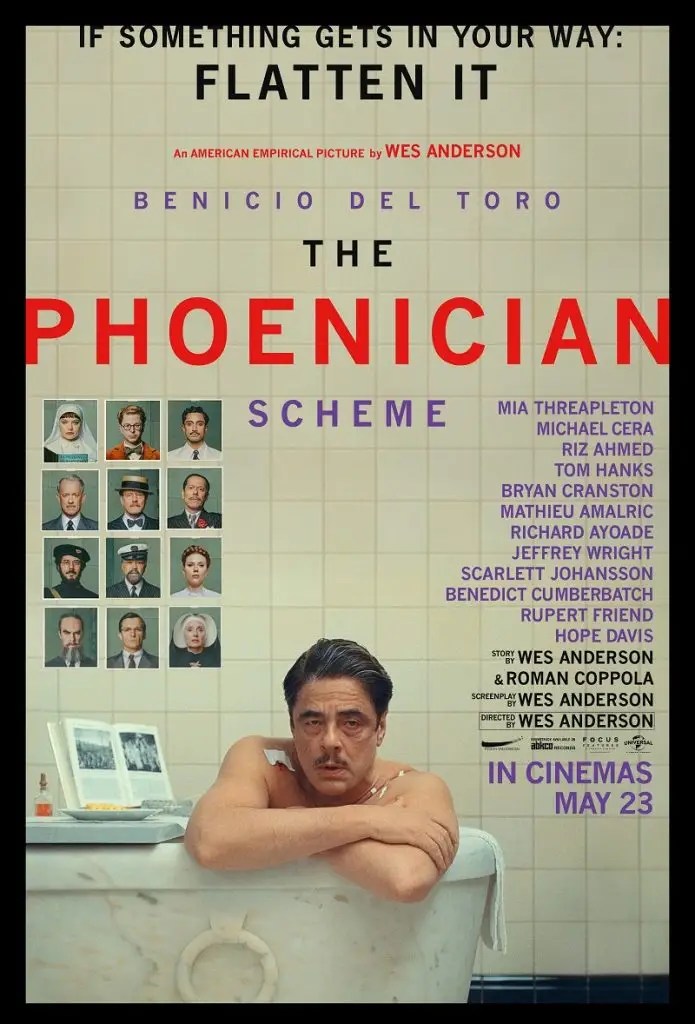
Wes Anderson is one of those directors I often sit on the fence about, with a style so distinctive it can in become overwhelming. But when it works, it works – and The Phoenician Scheme is (aside from his superb Netflix Dahl adaptations) his best work since his masterpiece The Grand Budapest Hotel. In this film, Anderson finds an emotional and story-telling engagement that adds depth to all the stylised invention. It’s a film I’ve found more rewarding the longer I’ve thought about it.

Set in an Anderson-esque 1950s (Andersonland?), notorious industrialist and arms trader Zsa-Zsa Korda (Benecio del Toro) spends his life dodging assassins. After one attempt gets close, he decides to try and repair his relationship with estranged daughter Liesl (Mia Threapleton), a novice nun who suspects her father might have had her mother murdered (he denies it). With governments, business competitors and others on his tail, Korda throws together a complex scheme for one last success in Phoenicia, a massive new development built with slave labour. As Korda juggles rivals and investors, will he repair his relationship with his daughter? And how will he fare in his recurrent visions of standing at the (noir) Gates of Heaven, being judged for entry?

Anderson’s film, of course, is another superb example of his visual style, constructed like an intricately layered work of art. Each shot could probably hang in an art gallery, framed to perfection with gorgeously sublime colours that soak off the screen. The elaborate set design and vintage costume work are striking as always, with every piece perfectly placed and every feature expertly judged. Within this, his carefully selected cast deliver the wry, dry and arch Anderson-dialogue with aplomb, embracing every moment (of many) where Anderson allows the characters to share a raised eyebrow or a pithy aside to the camera.

In other words, it might all be as you expect – a formula that started to feel a bit tired after intricate, insular films like The French Dispatch and Asteroid City, which felt so personal to Anderson that they were virtually impenetrable to everyone else. But what elevates The Phoenician Scheme is that Anderson embraces both a surprisingly tense plot-line – the closest he can probably get to a thriller, laced throughout with satire, humour and more than a fair share of the ridiculous – and gives a genuine emotional force to a father and daughter struggling to recognise what (if anything) could bring them together. Throw in questions around life, death and what constitutes making a life ‘worth living’ and you’ve got a rich, intriguing and rewarding film that could stand even without the Anderston scaffolding.

Perhaps only Anderson could mix an unscrupulous businessmen targeted by assassins (some of these are delightfully, blackly, comic – not least an opening plane bomb that sees Korda ejecting his pilot for refusing to attempt a crazy hail-Mary manoeuvre to survive an inevitable crash) with Korda closing vital deals (in a deliberately, impenetrably complex scheme) by shooting hoops with a pair of baseball-fanatic brothers (Tom Hanks and Bryan Cranston, both hilarious), taking a bullet for a fez-wearing gangster (Matheiu Almaric, wonderfully weasily) and forcing an eccentric naval captain (Jeffrey Wright, perfectly deadpan) during a blood donation to sign with a bomb. And spin out a joke where Korda hands over custom-made hand grenades to business associates like they are branded pens. All while dodging a shady government cabal (fronted by Rupert Friend’s Transatlantic Arthurian-nick-named Excalibur).

But The Phoenician Scheme works because under this comic twist on spy thrillers, it has a real heart. Anderson’s finest films are where he works with an actor who can bring depth and feeling to the quirk. And here, he might just have brought out the best from an actor prone to a little quirk himself. Benecio del Toro gives Korda a world-weary cynicism but also a subtle fragility. There is nothing that won’t flummox Korda, a guy tipped off on attempts on his life because he frequently recognises assassins he’s hired himself in the past. But he’s also quietly afraid his life has been for nothing: that he is, in fact, not a rogue but an out-and-out villain ruining countless lives. And that God (in the form of, who else, Bill Murray) isn’t going to be welcoming up there.

It motivates a careful dance of reconciliation and grooming to take over his business with his estranged daughter Liesl, delightfully played by Mia Threapleton (with just the right mix of dead-pan flair for the dialogue, while giving it an arch warmth). Liesl imagines herself as distant from Korda as can be – the novice (literally) to his expert manipulator – but she turns out to have far more talent for Korda’s mix of chutzpah, disregard for rules and ruthless improvisation. Watching the relationship – and recognition – between these two (beautifully played by both actors) is very funny and also surprisingly sweet (you know its Anderson when a nun suddenly pulling a small machete out of her wimple is both oddly endearing and absolutely hilarious).

This sense of emotional development and personal and dramatic stakes is improved further by the celestial semi-trial (cue Willem Dafoe as an advocate angel), in a black-and-white heaven that mixes Powell and Pressburger’s Matter of Life and Death (surely the name Korda is no coincidence) and the imagery of Luis Buñuel. This all leads into a surprisingly gentle but affecting tale of redemption and second-chances, including an ending that feels surprising but also somehow completely, wonderfully inevitable and fitting,

The Phoenician Scheme may even be slightly under-served by its Andersonesque framing and design: after all it’s become easy to overlook the depths when the display is as extraordinary as this. When Anderson unearths a deeper meaning, working with masterful performers who can imbue his quirky, witty dialogue with heft, he can be one of the best out there. And do all that without sacrificing an air of charming whimsy, and building towards the most hilarious fist fight since Bridget Jones’s Diary (between del Toro and Cumberbatch’s tyrannically awful Uncle Nubar). Not a lot of directors can pull that off – and it’s a lovely reminder that Anderson at his best is an absolutely unique, wonderful gem in film-making.
One Battle After Another (2025)

One Battle After Another (2025)

Fabulously made film, a brilliant merging of half-a-dozen genres is one Andersons’s finest

Director: Paul Thomas Anderson

Cast: Leonardo DiCaprio (Pat Calhoun/Bob Ferguson), Sean Penn (Colonel Steven J Lockjaw), Benicio del Toro (Sergio St Carlos), Regina Hall (Deandra), Teyana Taylor (Perfidia Beverly Hills), Chase Infiniti (Willa Ferguson), Wood Harris (Laredo), Alan Haima (Mae West), Paul Grimstad (Howard Sommerville), Shayna McHayle (Junglepussy), Tony Goldwyn (Virgil Throckmorton), John Hoogenakker (Tim Smith)

What is revolution – changing the world or just the relentless grind of One Battle After Another? It’s as hard to define as it is to define Paul Thomas Anderson’s incredibly striking Thomas Pynchon adaptation. Look at it one angle, and it’s a sharp political commentary on America; from another it’s a satire on the insular, self-defeating rules of secret societies; from a third it’s a pulpy chase-thriller; from a fourth a touching coming-of-age story of a daughter growing closer to her dad. Anderson’s skill here is that it’s basically all these and more at the same time, an electric, frequently laugh-out loud funny, hugely eccentric film that defies all categorisation.

Pynchon’s novel Vineland saw the radicals of the 1960s pulled, clumsily, back to life in the 90s. Anderson keeps the time skip, but moves the start to the late 00s and the destination to today. Pat (Leonardo DiCaprio) is a dishevelled, but true-believing, junior member of The French 75, a radical Atifa-style organisation on a wave of armed anti-government action. He’s in love with Perfidia (Teyana Taylor), an adrenalin-fuelled militant whose radicalism is often secondary to the rush she gets from guns and bombs. She’s the source of perverted sexual obsession for bottled-up, socially-striving US army officer Stephen Lockjaw (Sean Penn). After Perfidia makes a terrible choice, 16-years later the disillusioned, frequently doped-out, Pat (now living under the alias of Bob Ferguson) is raising their teenage daughter Willa (Chase Infiniti) when Lockjaw explodes back into their life, desperate to clean up his past indiscretions in case they imperil his acceptance into a secretive Neo-Nazi organisation of wealthy American, ‘the Christmas Adventures Club’. Cue a wild and crazy chase.

Anderson’s film bowls along with a whipper-cracker pace, over-flowing with confidence that it doesn’t need to spoon-feed us timelines, details or locations but trusts us to go with narrative flow. Which I for one really did. It’s a film that throws you straight into the mix – a French 75 raid on an immigration detainment facility – and barely lets up from there. Within the first half an hour we’ve seen a wave of direct action events from blowing up campaign offices (after warning phone calls) to sabotaging a city’s electricity supply – alongside Pat and Perfidia overcome with giddy, sexual thrills at thumbing their nose at the system. It’s a great way of grasping what an addictive rush fighting the man can be, something that’s all too-clear in the excited whooping, cheering and bombastic speechifying of many of its members.

These good times can’t last, but Perfidia wants to enjoy them as long as she can. In a blistering, force-of-nature performance from Teyana Taylor, Perfidia acts completely on impulse, thrilled with her life of action, pulling the naïve Bob in her slipstream. Danger of all sorts is addictive, from bombs to risky liaisons. She’ll spontaneously attempt to sexually humiliate Lockjaw on their first encounter (essentially ordering him to ‘stand to attention’ for her), then throw herself into an off-the-books sexual relationship with him (after he obsessively tracks her down for more humiliation) seemingly for kicks. She embodies the risky, thrilling excitement of the revolutionary world.

She’s also what leads to its destruction (her fellow revolutionaries are reduced to frightened shadows of themselves when, during a bank raid. Perfidia actually uses the lethal force everyone else has just talked about). Anderson’s film, after its propulsive start (assembled like an extended montage across an entire act), jumps to a very different future, where the thrills and spills of the underworld are subtly undermined, firstly by the hilarious dark comedy of all communication being managed through obsessive codeword rules and then by comparison with a far more quiet, but far more effective, underground railroad for migrants run by Benecio del Toro’s (underplaying brilliantly, his natural charisma flowing off the screen) Latin community leader and Taekwondo-sensei.

It’s also clear how hard it is to keep the revolutionary fire-burning. One Battle After Another superbly exploits the vulnerability and anxiety that underpins many of DiCaprio’s best performances. For all his involvement with radical violence, Pat/Bob is a sensitive, true believer starry-eyed, but with an appreciation for every-day duties that his fellow revolutionaries lack. It’s him who believes family and their daughter should come first (Perfidia, in the midst of post-natal depression, even admits she’s jealous of her daughter for absorbing so much of Pat’s love and attention).

DiCaprio brilliantly finds in Bob a good heart, whose desire to do the right thing is undermined by his own incompetence. In disappointment, he’s become a paranoid grouch, grumbling about pronouns, like any other middle-aged man adrift in the modern world. DiCaprio burns through the desperate energy of the part, but mixes it with a rich vein of black comedy at Bob’s frequent inability to cope with his situation. It’s a perfectly judged performance of loyalty and love, mixed with exasperation, panic and frequent well-meaning poor judgement.

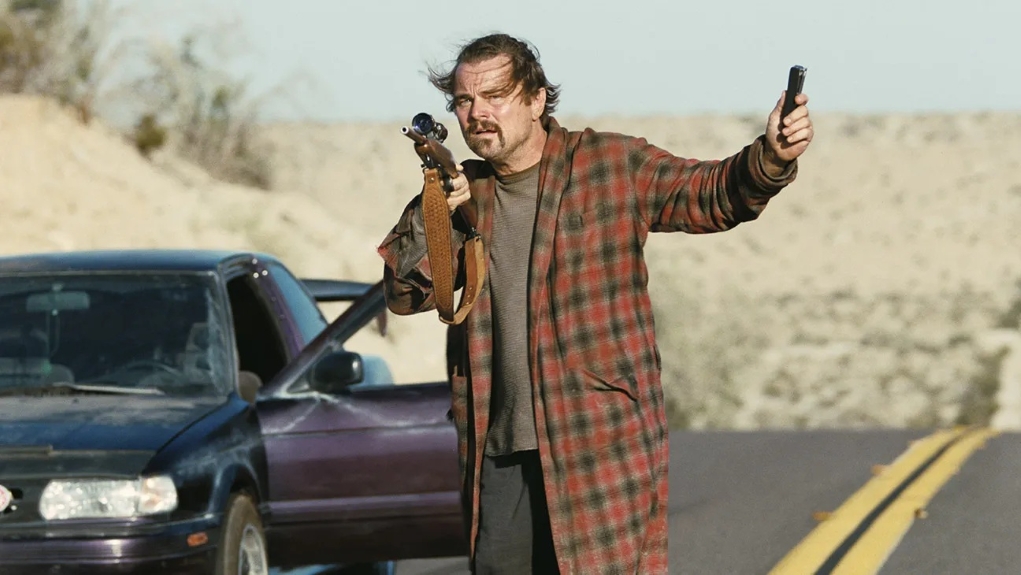
The second-act leans into the satirical comedy of these middle-aged revolutionaries, bought crashingly to life. In a neat comic touch, Bob spends most of the film on the run, desperately trying to find Willa, while dressed, Arthur Dent-style, in the same scuzzy dressing-gown he was wearing before Lockjaw’s raid. Time-and-time again, he’s reduced to swearing impotently down a phone-line like any other middle-aged consumer fed-up with unhelpful customer service, as he repeatedly fails to dredge vital codewords up from his stoned memory. During his escape, he’ll fall off a roof while evading the law, blanch at jumping from a moving car and spectacularly bungle a shoot-out. But what never waivers is his determination to help his daughter. One Battle After Another plays at times like a version of Taken where Neeson’s character had let himself get out of shape but still threw himself into the chase.

Anderson has fun with the bombastic self-importance of revolutionaries and the intricate insularity of their world. But he also has respect for their underlying desire to change the world for the better, even if the film suggests that the carefully, unflashy work being carried out by del Toro’s railroad is a better approach. Among the revolutionaries, there is a genuine warmth and feeling, embodied by Regina Hall’s loyal and humane Deandra (another superb performance in a film packed with them). There is a loyalty and protectiveness among the revolutionaries that bonds them together. And Sergio – del Toro outstanding as a never-fazed Sensei, a performance bubbling with dry wit – has built a community founded on mutual respect and looking out for each other.

And One Battle After Another has no respect at all for the alternative. The Christmas Adventures Club, the bizarre neo-Nazi group Lockjaw dreams of joining, shares the ridiculous language of secret knocks, handshakes and codewords. But it’s repellent in its instinctive racism and treats its members not as allies to be protected, but assets to be exploited and disposed of as needed. And their insidious extremism of its powerful white guys, with their hands on the gears of power, poses a far more dangerous threat.

Lockjaw is superbly played by Sean Penn as a ball of righteous, inadequate anger – from his ludicrous hair (which he frequently combs into an aggressive thrust), his tight t-shirts to accentuate his muscles to the lifts in his shoes to make him taller. Lockjaw is desperate to be a somebody, after a lifetime of social insecurity. Lacking any sense of imagination, with the emotional maturity of a disgruntled teen, Penn makes Lockjaw the embodiment of angry male entitlement trying to grab what power they can.

Anderson fuses all these elements into a film that takes us through several propulsive acts, from it’s French 75 prologue, to Bob’s desperate attempt to evade Lockjaw’s troops to a dusty road-chase that superbly carries an air of Mad Max. But Anderson does this, while never letting the film’s focus slip from the twisted family relationships at its centre: from Bob’s genuine, protective fatherly love, to Lockjaw’s incel jealousy and their twisted struggle for Willa (beautifully played by Chase Infiniti, in a star-making turn, as young woman finding a strength and idealism within herself that surprises her). It finds space for a genuinely moving series of personal relationships, just as it also skilfully shows Willa’s self-belief and social imagination flourishing under insane circumstances.

It’s part of a compelling, exciting, blackly comic and compelling film, which is not afraid to go to extreme, satirical lengths one moment and then pull you up with a scene that is gentle, earnest and heartfelt the next. It also avoids the trap of too directly preaching about America today, while asking several searching (and uncomfortable questions) about where we are now. Superbly acted across the board, it again shows Anderson is one of the finest directors working.

The Usual Suspects (1995)

The immortal gang in legendary twist thriller The Usual Suspects

Director: Bryan Singer

Cast: Stephen Baldwin (Michael McManus), Gabriel Byrne (Dean Keaton), Benicio del Toro (Fred Fenster), Kevin Pollak (Todd Hockney), Kevin Spacey (Roger “Verbal” Kint), Chazz Palminteri (Agent Dave Kujan), Pete Postlethwaite (Kobayashi), Suzy Amis (Edey Finneran), Giancarlo Esposito (Jack Baer), Dan Hedaya (Sergeant Jeff Rabin)

SPOILERS: If you have been living in a cave since 1995, don’t read on as I discuss the twist at great length…

“Convince me”. That’s what Customs Agent Dave Kujan (Chazz Palminteri) says as he begins his interrogation of limping, low-time crook “Verbal” Kint (Kevin Spacey). That’s certainly what Kint does – and it’s what the whole film is aiming to do in this, the most famous confidence trick in movies. The Usual Suspects is one of those once-in-a-blue-moon films where everything comes together perfectly. It’s also a sleight-of-hand movie that remains hugely engaging and entertaining even when (as surely most people now do!) you know exactly what the magician has up his sleeve. Its solid gold entertainment factor even survives today, despite the slightly queasy presence of both Kevin Spacey and Bryan Singer in its credits.

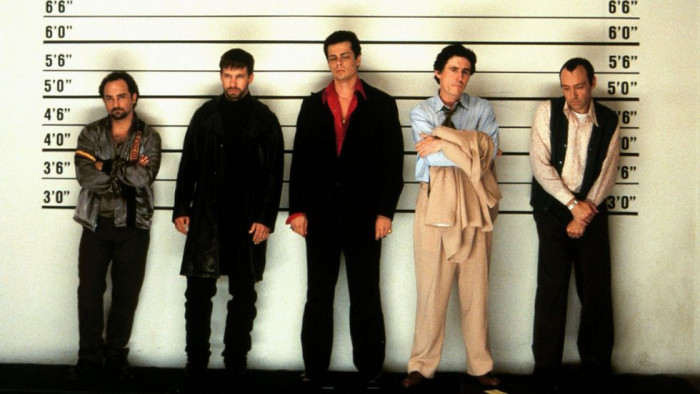
Told in flashback, the film follows the coming together of a bunch of regular criminals, pulled in for a line-up and deciding to team up. Along with Verbal, the others include McManus (Stephen Baldwin), Fenster (Benecio del Toro), Hockney (Kevin Pollak) and ex-cop turned criminal Dean Keaton (Gabriel Byrne). After a successful series of heists, the gang are conscripted by suspicious lawyer Kobayashi (Pete Postlethwaite) to take on a dangerous hijacking job for shadowy – possibly legendary – master criminal Keyser Soze, the bogeyman of the criminal classes. We know the job will go wrong – after all Verbal is banged up telling the whole story, the only survivor of the job – but how? And who is the shadowy Soze – or is he even real at all?

The Usual Suspects takes what you know about movies and then works double time to use it against you. With a structure inspired by classic noir crime films from the 1940s – the whole operation has a touch of The Asphalt Jungle while the interrogation has more than a hint of Double Indemnity – mixed in with a lot of Rashomon, it’s a movie that has you primed so much for a reveal and a twist that it skilfully misdirects you into expecting the wrong thing. Because how could you guess that perhaps the whole movie is a spun-out-of-the-moment invention by Verbal, and that possibly almost nothing we see during the course of its run time even happened. 

But how can we guess? From the very first scenes with Kujan and Verbal, Kujan is shot dominating the frame, always taller, always filling the screen. Verbal is sitting, meek, trapped by the frame, the camera frequently looking down at him. Every shot subliminally tells us that he is weak. The story has to be dragged out of him, with the investigation outside of the room forcing Verbal to expand on issues he doesn’t want to touch on. Like Kujan we invest in what we are finding out, because it looks like Verbal doesn’t want to tell it to us. That’s how they get you.

Because Verbal, in his story, is sprinkling in just the twist that Dave (and the audience) is probably expecting – that Gabriel Byrne’s Dean Keaton, the guy who claimed to have gone good, who just wanted out, was bad the whole time and was the criminal mastermind this whole time. Christopher McQuarrie’s ingenious script primes us for this: Dave Kujan is casting doubt on Keaton’s “death” right from the start, and as the audience surrogate figure we want to be as smart as he is. So what does it matter that we ”see” Keaton shot in the opening sequence of the film? Surely that was an illusion, and we’re as clever as Kujan in seeing through it.

The film even gives us a brilliantly assembled “reveal” series of edited flashbacks, in which every small moment and hint that has existed in the film is replayed for us (John Ottman’s editing is flawless here – and he should also have credit for composing the film’s hauntingly classical score) to convince us, beyond a shadow of a doubt that, yup, poor simple Verbal was taken in all the time by dastardly Keaton, the guy who looks like a film star. Only of course it’s bollocks. That charred corpse that Singer jump cuts to at the start of the film as police investigate the boat massacre is indeed Keaton. And the clever twist we thought we were working out, turns out to be a mass distraction laid out for us by Verbal and the film.

So we get a second brilliantly edited reveal sequence as it hits Kujan while he studies that most famous notice board in film, that everything he thought he had worked out had been spun out of hints and clues off the board – from asides and anecdotes to entire locations and characters. And Kevin Spacey limps and then walks away, shrugging off the skin of timid, weak Verbal to transform into the chillingly amoral Soze. It’s a trick that worked especially well when Spacey was an almost unknown actor at the time (today it’s less of a surprise to find out that Spacey could be a creep). There is possibly no better reveal in Hollywood.

But the film continues to entertain even when you know it because Singer’s film is stuffed with richly layered characters, scintillating scenes and some rich and spicy dialogue from McQuarrie. It’s a brilliant combination and provides every scene with a clear and electric dynamism that makes it impossible to tear your eyes away. There are some truly striking scenes – not least the iconic line-up scene – and the film carries an improvisational energy (that line-up scene is a magic use of outtakes, as the actors couldn’t keep a straight face during the sequence).

Part of the magic of it comes from the brilliant clash of a group of vastly different actors bouncing off each other: the self-consciously method Baldwin, the edgy energy of Pollack, the chilly technique of Spacey and the classically trained professionalism of Byrne, who pulls off with aplomb a difficult job of playing a decoy protagonist and antagonist in one. And that’s not mentioning the wild card of Del Toro who, working out his character was a one-note plot device, throws in an eccentric chic and impenetrable mumbling accent that is part affectation (the sort of thing that made the actor more trying later in his career) and part jaw-dropping show of confidence. And backing them up is a collection of actors as eccentric as Palminteri channelling Law and Order with a smile and Postlethwaite as a sinister limey lawyer with an accent that sounds like it hails from the Raj.

Singer’s direction is flawlessly confident, creating a rich tapestry that you could lazily call Tarantinoesque, but actually reminds you of John Huston in its carefully framed mise-en-scene. It’s a very classical movie in its way, that loves clever wipes, slow build ups, brilliantly edited and surprisingly low key in much of its framing and shooting. Everything is perfectly placed to help build up the illusion. Singer never touched these heights of confidence and control again. It’s also superbly edited throughout by John Ottman, each beat landing perfectly, each transition perfectly judged. It wouldn’t seem out of pace to see Cagney playing Kint (with Bogart surely as Keaton). 

The devilish trickiness of the plot is kept largely under wraps until late on – Soze isn’t even mentioned until nearly halfway through the film – and the film’s confident misdirection suggests this might just be the gang aiming too high and getting burned rather than a shadowy mastermind manipulating it all. It’s a brilliantly judged change of pace, and all part of the impish delight of the film. It’s a clever game, but has more than enough force and invention in its story telling to keep you gripped time and time again. McQuarrie and Spacey won Oscars – and the film hinges so much on Spacey’s ability to both tell an anecdote and also not push his acting lame – and the film lives on forever in the memory as one of the finest twists. But it does so because the twist grows so organically from the film, and the film’s delight in tricking you is completely infectious.

Star Wars: The Last Jedi (2017)


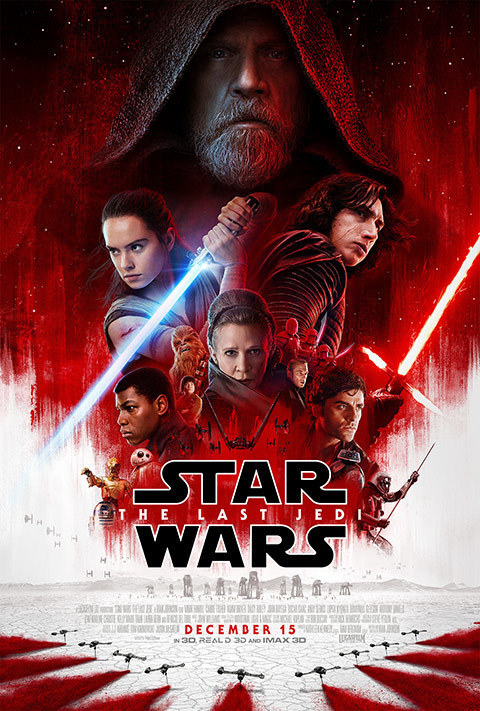
Could Daisy Ridley be The Last Jedi in this controversial new Star Wars chapter

Director: Rian Johnson

Cast: Mark Hamill (Luke Skywalker), Carrie Fisher (General Leia Organa), Adam Driver (Kylo Ren), Daisy Ridley (Rey), John Boyega (Finn), Oscar Isaac (Poe Dameron), Kelly Marie Tran (Rose Tico), Andy Serkis (Supreme Leader Snoke), Lupita Nyong’o (Maz Kanata), Domhnall Gleeson (General Hux), Laura Dern (Vice Admiral Amilyn Holdo), Benecio del Toro (DJ), Gwendoline Christie (Captain Phasma), Anthony Daniels (C-3PO), Frank Oz (Yoda)

Spoilers! OK I’m really trying my best to not have too many spoilers in here, but you know it’s pretty much impossible. So you should do what I do and go to the see the film knowing almost nothing about it. That would be much better than reading any reviews!

It’s pretty clear the Star Wars franchise is going to be with us for some time. So eventually it’s going to have to move past telling similar stories, with familiar characters, in very familiar settings, and branch out into something new and a bit more daring. Star Wars: The Last Jedi is an attempt to do this. Is it completely successful? No, probably not. Does it try and push the franchise into a slightly new direction? Yes it does.

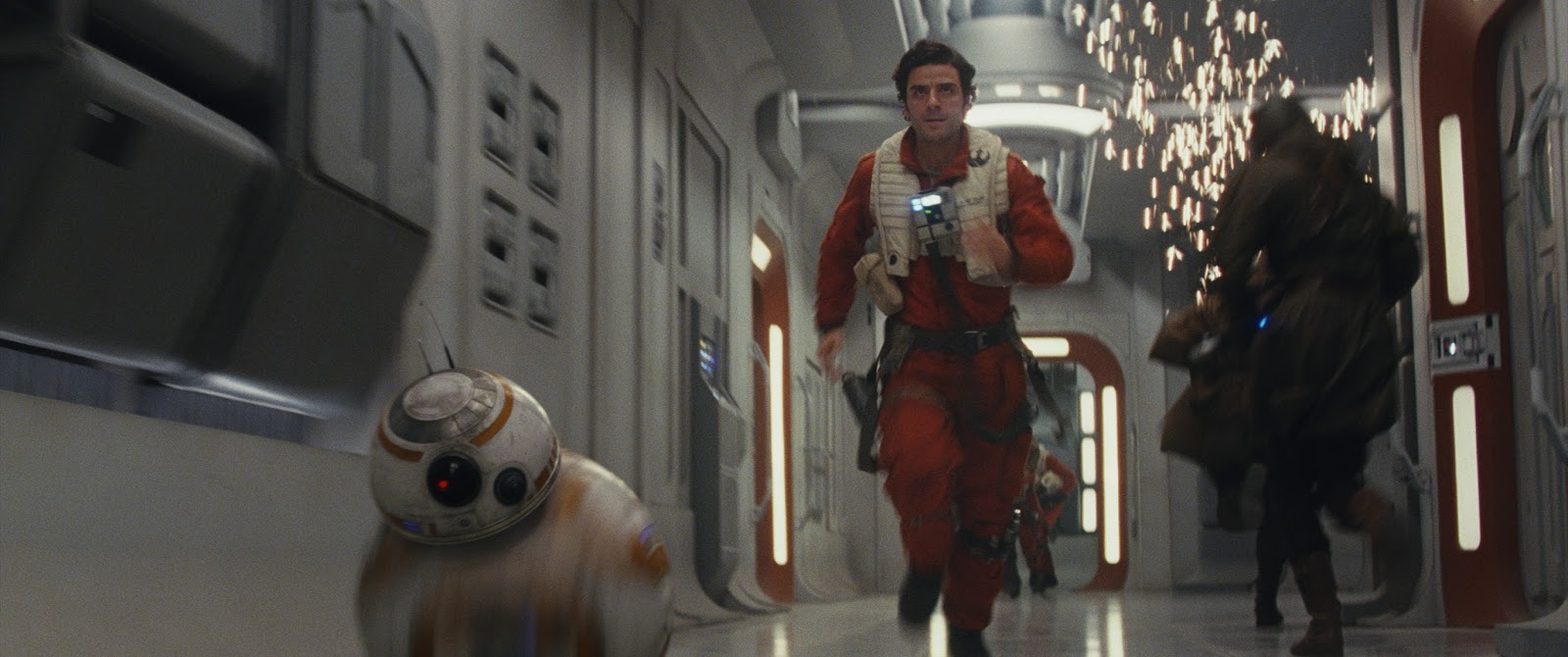
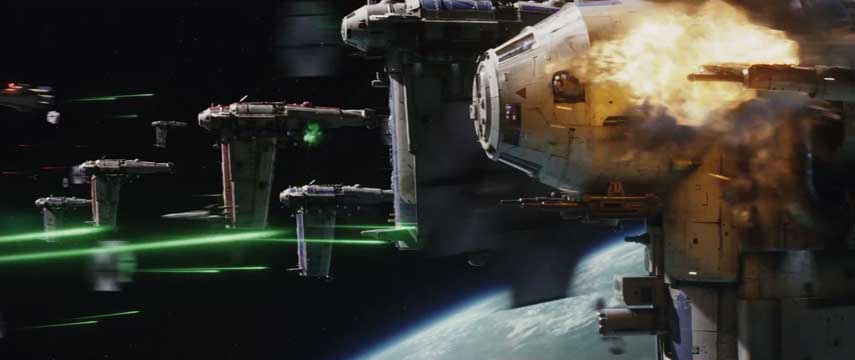
The film starts moments after the end of The Force Awakens. Rey (Daisy Ridley) has met with Luke Skywalker (Mark Hamill) on the remote planet he has spent the past decade hiding on. She believes (as do we!) that he will train her in the ways of the Jedi – instead he tells her to leave, and firmly states that the Jedi are a failed organisation that don’t deserve to continue. Meanwhile, during a speedy evacuation of the resistance base – covered by a suicidally reckless military operation by Poe Dameron (Oscar Isaac) that costs the lives of dozens of resistance ships and pilots – General Leia Organa (Carrie Fisher) is incapacitated, and the surviving rebel ships find themselves relentlessly pursued by the First Order. While the new leadership of the resistance seems to be offering no alternatives, Poe and Finn (John Boyega) hatch a plan to travel to a distant planet and recruit a codebreaker, to help them hack into the First Order flagship and disable the tracker it’s using, allowing the fleet to escape.

The Last Jedi is a film that has had a mixed reception from the fandom. After spending a couple of days thinking about it, this might be because the film so completely inverts expectations and refuses to play it safe. It’s a film about loss and disillusionment, but also about hope against adversity. It would have been very easy to transform Luke into a new Yoda, to make Poe and Finn heroic guys whose actions save the rebellion over the heads of their stuffed-shirt commanders. To build Kylo Ren further towards a redemption arc. These are all things you could expect – none of them happen.

Subverting these expectations has angered a lot of people – fascinatingly the same people who complained The Force Awakens was too similar to Star Wars. So I guess that kinda shows you can’t keep the Internet happy – so why even try. The main issue has been the re-imaging of Luke Skywalker. The man the first trilogy presented as the universe’s bright-eyed-boy, our new hope: here he’s a bitter, depressed man who has lost hope and his love for the Jedi. He’s a man who confesses to dark thoughts, who it transpires considered acts of murder, who has failed at almost everything he’s touched since the conclusion of Return of the Jedi. This is a big turnaround for the franchise’s hero, and yes it is jarring. Is this what people expected after the end of Force Awakens? It sure ain’t.

But, after the play-it-safe Rogue One and the thrilling remember-what-you-used-to-like-before-the-prequels joy of The Force Awakens, the franchise needed something like this. A shake-up, a repositioning of the universe. It’s not always bright and hopeful, and our heroes are flawed people who make huge mistakes. It’s in many ways a logical extension: if Rey is the new hope, than something must have gone wrong with the old hope. Luke has failed totally in the same way both his mentors (Yoda and Obi-Wan) did – he encouraged and honed the viper-in-the-nest.

As that viper-in-the-nest, we’ve got the terrifically complex Kylo Ren. Ren’s path in this film is the most inverted, unexpected and unusual development in the series so far. Adam Driver was superb in Force Awakens, and he’s great here once again as a very different type of villain. Ren is strong in the force, but in almost every other way he’s hugely weak: a sullen, moody man-child, straining for greatness, a tearful brat easily led, driven by his emotions, trying to take on a mantle of greatness he is psychologically ill-equipped for. He seems barely aware of what he wants from life, except for a vague wish to pull the world down – like any teenager, angry at his parents, which is what he is.

Pulling the world down seems to be Rian Johnson’s aim as well. An early attack wipes out the resistance leadership – Admiral Ackbar! No! – and the resistance itself is eventually reduced to a single ship, desperately running from the far stronger First Order. Never mind Empire Strikes Back, the resistance has never been so pummelled, its military achievements so minor. Even their one victory in the film – the destruction of a fearsome First Order ship – carries such a huge cost of men and equipment that Leia strips Poe of his rank for even attempting it. Thereafter, the only victory the resistance can hope for is to survive. No other Star Wars film has ever allowed such monumental failure to be the main plotline for our heroes. Johnson is clearing the decks and resetting the tables – he even wraps up lingering mysteries from The Force Awakens with such abruptness you wonder if he wanted to kill parts of the Internet dead.

Failure also ekes through the Poe/Fin subplot. Every single decision these characters take in this film is wrong, misguided, hugely costly or all three. If the film does have a major flaw it’s that Finn’s journey to the gambling planet is a cul-de-sac of plot development, that could have easily hit the cutting room floor and probably cost the film very little indeed. It never really goes anywhere, other than to allow Johnson to make some points about arms traders selling weapons to both the First Order and the resistance. It also introduces into the mix Benecio del Toro’s fantastically annoying, overly-twitchy performance as the hacker DJ – Del Toro seems to be getting more and more prone to “Deppism”, where a good actor succumbs to twitches and quirks rather than acting.

What is most interesting about this plot-line though is its very pointlessness. The plan (major spoiler here) doesn’t work at all, in fact it leads to many, many, many more resistance lives being lost, and wrecks Hondo’s secret plan which would have saved everyone’s lives. The film doesn’t quite have the courage to pin the blame for this disaster directly on Poe and Finn. In fact the film gets a bit confused here about the message it wants Poe to learn – it’s something about costly actions in war not being worth mindless sacrifice, but then this is a film that at its conclusion celebrates another character making a huge sacrifice. Unclear? A bit. Anyway: the point however is: you can’t imagine previous Star Wars films allowing our characters to so completely fuck up here as Poe and Finn do – and give them no moment of triumph to make compensation later in the film. 

What this does though, is Rey to be repositioned at the real hope – although the film goes about inverting her as well, with several suggestions that she is far more open to the dark side of the force might have thought. Daisy Ridley is very good as Rey, juggling conflicting pulls on her personality, her desire to redeem both Ren (and there is a great sexual chemistry between these two) and Luke, and the different directions these desires pull her in. Rather than seeing the force as a binary good/bad thing, Rey seems to want to find a balance between the two of them. Johnson explores this via a number of visually interesting scenes, not least Rey in a cave from the dark side, full of endless reflections. It’s an unexpected re-working of the Luke/Yoda relationship and works very well.

The Last Jedi is not a perfect film. For all its interesting inversion of old tropes, and the lack of triumph it allows our characters, it’s way too long. It could easily have been cut down by half an hour at least. Although some plots are designed to be expectation-defying dead-ends, they still end up feeling less than interesting (and ripe for fast forwarding on later viewings). Despite an attempt to include some scenes of deliberate humour, the film has less spark and joie de vivre than many of the other entrances in the franchise. Structurally, it’s not always clear what the timeline of events is between the different locations (weeks seem to go past for Rey, while only hours go by in the rebel fleet), and some of the points the film wants its characters to learn are unclear or hard to understand (I genuinely don’t know what Poe was supposed to have learned by the end of this film).

Its strength though are the characters – building on the groundwork from The Force Awakens(and very differently from Rogue One) this film is full of characters we care about. John Boyega and Oscar Isaac continue to excel as Finn and Poe (and still have great chemistry, shippers…) – Boyega in particular is quite the star. Ridley and Driver are superb. Hamill was never the strongest actor in the world, but he gives his most complex performance yet as Luke. The film mostly rattles along very nicely, and has plenty of action and excitement as well as “race against time” structure that works very well. Interestingly, its main handicaps are that it defies expectations almost a little too much (so it demands second viewing and reflection) and that it’s overlong and at times unclearly structured. But as a step forward for the franchise it’s still a good thing. A new hope indeed.

Coda: The film’s main sadness is the premature death of Carrie Fisher. One problem watching the film was that two or three times I was convinced that the film was about to show us Leia’s death. Johnson avoids changing the film from its original plan (Episode IX was intended to be “The Leia film” after films focusing on Han Solo and Luke), but it does seem a shame that Fisher’s good work wasn’t crowned by the sort of iconic final scene she deserves. The Episode IX planned will now never happen – but it would have been great to see Fisher really head centre stage in that film. RIP.