Tag: Bernard Lee

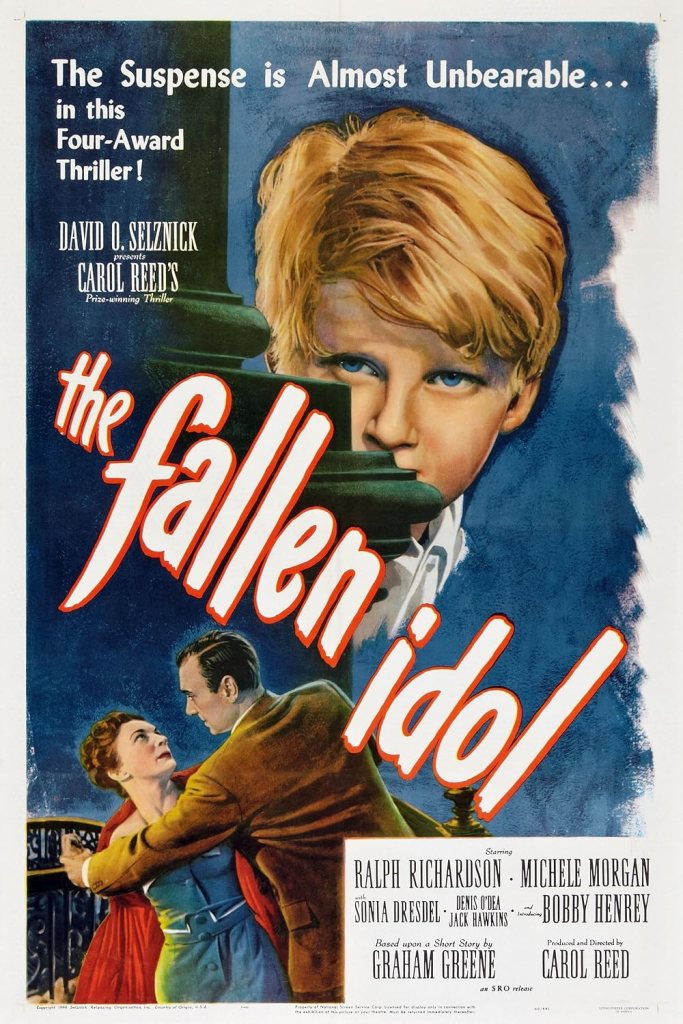
The Fallen Idol (1948)

The Fallen Idol (1948)

Brilliant thriller about how hard the world is for a child to understand

Director: Carol Reed

Cast: Ralph Richardson (Baines), Michèle Morgan (Julie), Sonia Dresdel (Mrs Baines), Bobby Henrey (Philippe), Denis O’Dea (Chief Inspector Crowe), Jack Hawkins (Detective Amos), Walter Fitzgerald (Dr Fenton), Dandy Nichols (Mrs Patterson), Geoffrey Keen (Detective Inspector Davis), Bernard Lee (Inspector Hart), Dora Bryan (Rose), Karel Stepanek (First Secretary), Torin Thatcher (Constable)
We’ve all had heroes we worship haven’t we? Few hero worships burn as brightly as a child’s. Eight-year-old Philippe (Bobby Henrey), son of a foreign ambassador in London, is awe-struck by the embassies English butler Baines (Ralph Richardson), a kind, decent man with a twinkle in his eye who enjoys spinning stories for Phil about his exciting life in India. The highlight of Phil’s day is spending time in Baines’ parlour. For Baines though, his highlights are the snatched moments of release from his domineering, unloving wife (a masterfully tough-to-like Sonia Dresdel) that he spends with embassy secretary Julie (Michèle Morgan).

The affair is obvious to us in seconds. But Phil – from whose perspective we see large amounts (but, crucially, not all) of the film play-out – is of course oblivious, readily accepting Baines awkward assurance Julie is just his niece. The Fallen Idol – the middle film in Reed’s astonishingly high-quality run of films that includes Odd Man Out and The Third Man – is a brilliantly tense, very moving story of how adrift children feel in the adult world, how easily they misinterpret signals and misread social cues. Superbly filmed, with a wonderful script by Graham Greene (from his own novel) it’s a masterclass in how the simplest situation can lead to the most intense drama.

It revolves around a fatal trap for Baines. Believing his wife is away for the weekend (she has in fact concealed herself in the embassy mansion), Baines treats himself to a day and night with Julie. Discovered, the confrontation leads to Mrs Baines dead at the bottom of the stairs. The argument is partially witnessed by Phil – but crucially, only glimpses of it as he runs down the exterior fire escape, peering in through windows as he goes – but in full by the viewer. It’s clearly a terrible accident, taking place after Baines had left. But Phil is convinced he has witnessed a murder – and so passionate is his hero worship of Baines (and loathing of Mrs Baines), he decides to do everything he can to protect the butler.

The genius of Reed’s The Fallen Idol is that we are always know more than any of the characters. Just as we can tell immediately from witnessing Baines and Julie’s whispered, Brief Encounter-ish meeting in a London coffee shop that they are in the midst of a passionate affair, so we also know much faster than any character that Mrs Baines is still in the house and that her death is a clumsy accident. We can also see, in ways Phil cannot, that his desperate lies only undermine Baines honest version of events. We know all the details well ahead of the police, watching them misinterpret clues and behaviour in the worst possible light. The entire film shows how damning circumstances and coincidences can fold up into a vice-like trap from which there is almost no escape.

The Fallen Idol is a film awash with lies. In many ways it’s a heartbreaking reveal of how quickly the compromises and selfishness of the adult world corrupts the child’s. At the heart of these lies is Baines himself. The role is beautifully played by Ralph Richardson, utilising his eccentric cuddliness to exceptional effect, but also perfectly capturing the selfishness, weakness and cowardice of Baines. Because Baines is a liar – not only to his wife, but also to Julie (he spectacularly lacks the guts to ask his wife for a divorce, despite what he tells Julie) and, walking Phil back after he has crashed Baines’ tea-time meeting with Julie, urgently instructs him to lie if he is ever asked about what happened that afternoon. Baines doubles down on his duplicity by using the unwitting Phil as a shield to cover a zoo-trip date with Julie, and even his adventure stories to Phil are all slightly self-aggrandizing tall tales.
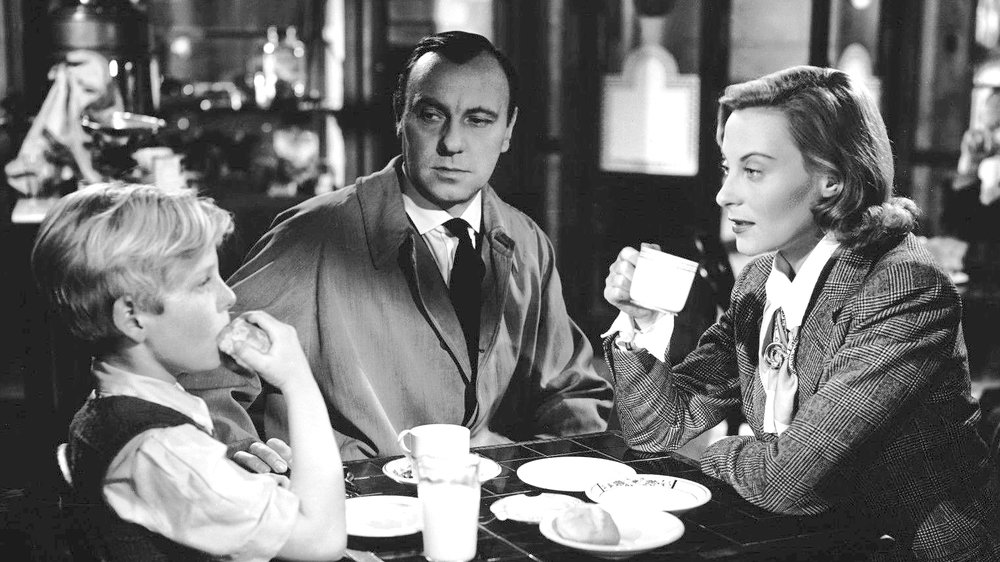
One of the toughest things about The Fallen Idol is that hero-worship is a confused one-way street, especially when children are involved. Baines is fond of Phil but often treats him with distracted affection out-of-kilter with the earnest, devoted adoration Phil pours on him. This devotion from Phil is so great, even his belief that his hero is a murderer makes no impact on him. Having taken his idol’s lessons to heart, about what to do when questioned about anything to do with Julie, Phil lies and lies to the investigating officers, corrupting himself (he believes, after all, he is helping a killer) while also making the innocent Baines seem guiltier-and-guiltier with every word.

Carol Reed draws a superbly natural performance from Bobby Henrey, in a performance utterly lacking in childish, mannered acting tricks. It’s a hugely natural performance, over-flowing with innocence making Phil a character we end up deeply caring for. The early half of the film throws us perfectly into the excited world of a child with a whole mansion to run around in, cuddling his pet snake close to his chest. Reed also brilliantly captures how a moment of trauma confuses and terrifies an innocent into not knowing what action to take. Fleeing the house barefoot – clearly terrified and heartbroken – immediately after the death, Phil is petrified when he encounters a policeman not because he is intimidated, but because he fears inadvertently betraying his idol.

Reed superbly captures the desperate vulnerability of children, the nightmare of not having your voice listened to as adults talk over and around you. The Fallen Idol (with its careful use of disjointed angles and God-like, wide-angle shots from above) has a superb sense of the horror of being caught in a situation you neither fully understand or can influence. It’s echoed perfectly by Baines’ increasingly defensive panic as each denial falls on all-too-obviously deaf ears. Phil also misinterprets almost everything he is told in the film, right up to when the sympathetic Julie (a lovely, warm performance from Michèle Morgan) begs him that only the truth can help Baines.

The Fallen Idol spices this up with superb moments of comedy. Dora Bryan has a delicious cameo as a ‘lady of the night’, called upon to by the flummoxed policemen at the station Phil has fled to, to try and draw some words out of the stubbornly silent child – and who can only fall back on the cliches of her profession (‘Can I take you home dearie?’). An Inspector (a lovely cameo from Bernard Lee) called in to translate in the embassy is begged by the first secretary to drop his inept schoolboy French. A tense interrogation of Baines is interrupted when a pedantic embassy staffer insists he must be allowed to check the clocks in the room (Reed wittily shows the characters revolving, clockwork like, impatiently on the spot in the background while this interminable check goes on).

But the great strength of The Fallen Idol is how it captures the joyful innocence of childhood and the Kafkaesque confusion the adult world can have on a child. Poor Phil never really understands anything that goes on (although the film ends with a sweet irony of Phil being the only person who perhaps understands a vital ‘clue’ only to be completely ignored) while we are always in complete understanding. Reed’s direction is faultless, both from his work with actors to his masterful use of camerawork and editing to really capture the confusing, unreadable adult-world from a child’s perspective. It’s a masterful, gripping, heart-rending film – a small scale classic that perfectly mixes tension and wit.
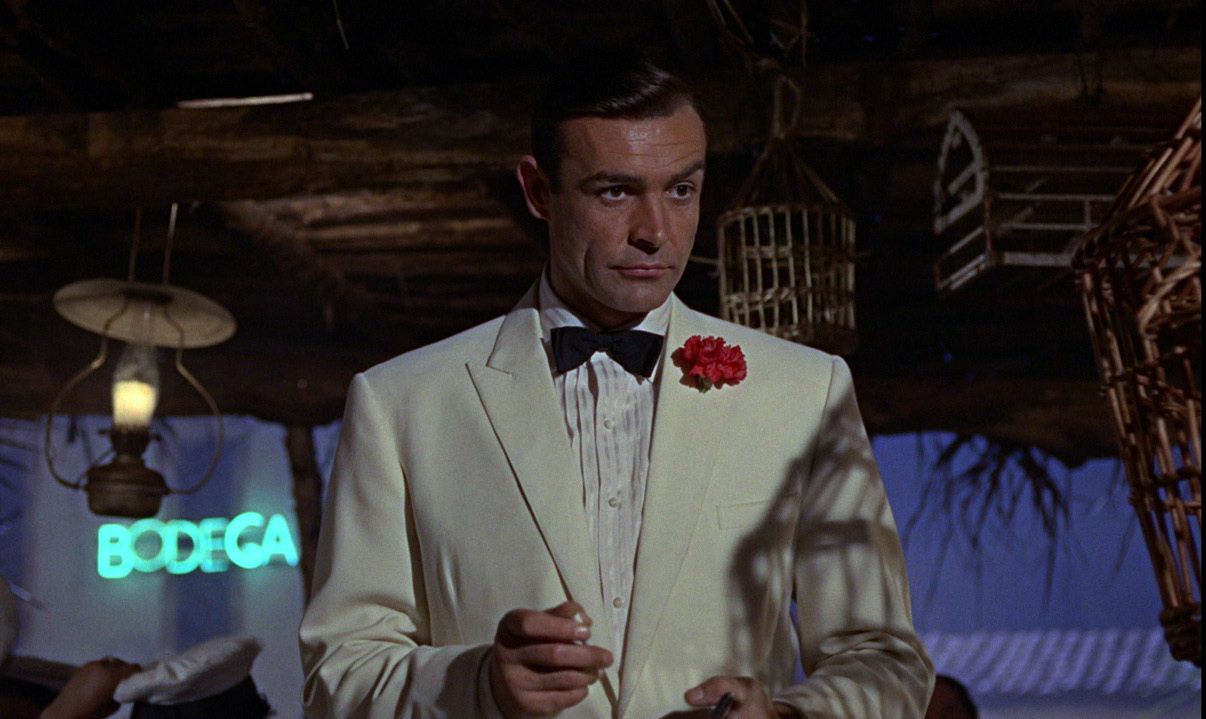
Goldfinger (1964)

Goldfinger header
Sean Connery defines Bond forever in Goldfinger

Director: Guy Hamilton

Cast: Sean Connery (James Bond), Honor Blackman (Pussy Galore), Gert Fröbe (Auric Goldfinger), Shirley Eaton (Jill Masterson), Tani Mallet (Tilly Masterson), Harold Sakata (Oddjob), Bernard Lee (M), Martin Benson (Mr Solo), Cec Linder (Felix Leiter), Lois Maxwell (Miss Moneypenny), Desmond Llewelyn (Q), Burt Kwouk (Mr Ling), Richard Vernon (Colonel Smithers), Bill Nagy (Mr Midnight)

It took three films, but Goldfinger was when they got the James Bond formula spot-on. So spot-on, that all the James Bond films that followed would employ elements introduced here. This is where we got for the first-time: the pre-credits action sequence, Q, a gadget filled Aston Martin, a bizarre assassination tool, a villainous henchman with a bizarre skill, an outlandish scheme and Bond delaying being saved at the end for a few more moments of rumpy-pumpy. It’s Connery at the height of his powers, has a knock-out song, one brilliant sequence after another and marks the moment where Bond wisely severed any connection with the real world, like a laser slicing through gold towards our hero’s crotch.

On vacation in Miami, James Bond (Sean Connery) has a run in with Auric Goldfinger (Gert Fröbe), gold bullion millionaire and card cheat. During this his romance with Jill Masterson (Shirley Eaton) is cut short when she is killed by being covered completely in gold paint (a fatal case of the not-actually-real ailment “skin suffocation”) by Goldfinger’s silent steel-rimmed hatted manservant Oddjob (Harold Sakata). Bond is hungry for revenge when he is tasked by M (Bernard Lee) to find out how Goldfinger is smuggling Gold bullion. He finds out Goldfinger has an even more fiendish plan in the works, involving Chinese agents, a nasty gas, an all-female flying circus headed by Pussy Galore (Honor Blackman) and the US gold reserve at Fort Knox.

Goldfinger was a massive hit and pretty much lands somewhere near the top of any poll of the greatest ever Bond films. That’s because it’s just a massive explosion of cool fun. It’s exciting, funny, perfectly paced and has one scene after another that are so perfect, Bond films for the next fifty years would more-or-less repeat them again and again (taking it even further, A View to a Kill is virtually a remake of Goldfinger and even Quantum of Solace has a homage to death-by-gold-paint). Goldfinger takes place in a heightened reality of thrills and spills – unlike From Russia with Love or Dr No there is not even the slightest pretence espionage might work something like this – and barrels along with such pace and momentum it becomes a thrill ride you don’t want to get off.

The plot is actually rather close to Fleming’s original. Goldfinger’s plan has been tweaked, but the film still finds time for the classic “Bond takes on the cheating villain at a gentleman’s sport”, with Bond duelling with Goldfinger in a round of match-play golf (I like to think this is where Connery’s real-life obsession with the sport began, cunningly swopping the cheating Goldfinger’s ball on the final hole for default victory). But the film adds a playful, tongue-firmly-in-cheek quality. It manages to mix thrills with not taking itself too seriously, becoming a grandly entertaining thrill ride.

The re-working of the elements of the novel for the screen created an indelible template for Bond. Oddjob became a walking icon, his shadow instantly recognisable, invulnerable with a killing method – a steel rimmed hat he throws with Olympian accuracy – that’s a perfect mix of just-about plausible and utterly ridiculous. And also, of course, perfect to playfully imitate a home. What you can’t imitate is bombing around hill roads in a gadget-stuffed Aston Martin, but you can dream. The car chase is not only a show case for cool driving, it also lets you see each of the super-cool enhancements introduced by Q one-after-another (a pattern the series would follow time and again whenever a gadget-stuffed car appeared) and hammers home Bond’s super-cool confidence.

Connery was of course perfect for conveying that. In Goldfingerhe was still interested, clearly enjoying some of the best quips he got as well as just enough acting challenges – from Bond’s sad regret at anger at the death of no less than two Mastersons, to his terror at the prospect of being unmanned by a laser. That sequence has of course gone down in film history – from the striking image to the classic exchange “You expect me to talk?” “No Mr Bond I expect you to die!” – but a lot of it is sold from Connery’s desperate search for the right words to turn that machine off. Connery is cool but still just about vulnerable, cunning, smart and witty but also human. Who wouldn’t want to be so unshakeably cool that he can emerge from a wet suit (with a model seagull on his head!) unzip to reveal a tux, light a nonchalant cigarette while a factory explodes behind him, seduce a woman and then off a killer with a bathtub and a heater (“Shocking!”) – and that’s just the first five minutes!

Every scene in Goldfinger is a doozy. The playful cool of Bond outsmarting Goldfinger in Miami then getting his comeuppance (Connery is so cool in the film btw you forget that Bond is such a staunch conservative, he cheekily disparages the Beatles – that other icon of Swinging Sixties Brit Cool – to Jill as casually as he offs villains). That golf game in Kent (capped by a decapitated statue). Hillside driving with Tilly (with extra dodged bullets). Late night gadget-filled car chase. The first meeting with Pussy Galore (“I must be dreaming…”). Goldfinger’s briefing (his offing of all the attendants makes the whole thing even more funny, since its clearly just Goldfinger enjoying a bit of showing off). Bond dragging a nuclear bomb around an epic Fort Knox set. Oddjob surviving everything but a million volts. Goldfinger earning his wings in the film’s climax. It’s all terrific.

And it all works because it’s got the balance spot-on between cartoon and reality. You can see it come together in Ken Adam’s set for Fort Knox: the inside was all made up (no one would stack gold that high!) but people believed it was the real thing, because it felt like the Fort Knox we shouldhave. Goldfinger is a scowlingly wicked villain, with a little kid’s delight in his own naughtiness. Honor Blackman doesn’t appear until the film is halfway through, but is an assured, forceful, brilliant presence, more than a match for Bond (we’ll gloss over the slightly dated way Bond seems to ‘convert’ her from implied Lesbianism to – well perhaps bisexuality). The briefing sequence with a grumpy, unimpressed Q was so good Desmond Llewelyn would essentially repeat it another 13 times (only OMHSS and Live and Let Die would skip the “Now pay attention 007” sequence between this and TWINE). All of this has the bright, primary colour fun of a rollicking graphic novel.

You can watch Goldfinger about a million times – and anyone who has written a Bond film probably has, it was such a template for the next seventeen films that followed – and it would still thrill, excite and entertain you. Connery’s interest after this went downhill, and the magic wasn’t always recaptured – but this when Bond went from being a cool spy to a cultural phenomenon. Bond became the box-office franchise that would dominate cinemas for decades, the ultimate spy caper that others would be compared to. Goldfinger mixed silliness and seriousness perfectly, thrills and laughs, action and comedy. It’s a superb and hugely influential film. It’s one of the Best Bonds ever: it clearly has the Midas touch.

Thunderball (1965)

The most memorable moment of Thunderball – and it happens in the first few minutes

Director: Terence Young

Cast: Sean Connery (James Bond), Claudine Auger (Domino), Adolfo Celi (Emilio Largo), Luciana Paluzzi (Fiona Volpe), Rik Van Nutter (Felix Leiter), Guy Doleman (Count Lippe), Molly Peters (Patricia Fearing), Martine Beswick (Paula Caplan), Bernard Lee (M), Desmond Llewelyn (Q), Lois Maxwell (Miss Moneypenny), Roland Culver (Home Secretary), Paul Stassino (Francois Derval/Angelo Palazzi)

By 1965 no one bigger than James Bond – and the films had to reflect that. Thunderball had more money spent on it than all the previous Bond films put together. I suppose you can see that on the screen, but it doesn’t change the fact I’ve always found Thunderball one of the most meh of all Bond films. I always fail to get really engaged in it, and it’s stuffed with the sort of high-blown set-pieces where it feels the producers were so pleased at the possibility of doing something, they never stopped to think if there was an actual reason to do it.

Thunderball’s plot is the first example of what would become a pretty standard Bond trope: the swiping of nuclear missiles by criminals to hold the world to ransom (the principle would be repeated again in You Only Live Twice, Spy Who Loved Me and Moonraker). In this case it’s Spectre agent Emilio Largo (Adolfo Celi), who steals a British nuke-carrying jet and demands £100 million ransom to return it. All the 00 agents are scrambled, but of course James Bond (Sean Connery) has the only lead – helped by the fact he was staying at the same health farm where the hijacker was being surgically altered to replace the jet’s pilot. Bond heads to the Bahamas to follow his lead, the pilot’s sister Domino (Claudine Auger) – only to find out she’s Largo’s girl! Will Bond get those missiles in time and dodge sharks, heavies, red-headed femme fatales and deadly street parades?

Well of course. After all, Nobody Does It Better. Thunderball is big, expensive and has several high-octane fights. But it’s also strangely slow and ponderous, takes ages to get started and has the distinct whiff of everyone going through the motions. Compared to Goldfinger and From Russia with Love there is a noticeable lack of spark and wit. All the invention seems to have gone into some of the gadgets – look Bond has a jet pack! – and none into the script which presents a series of plug-and-play characters and a plot set-up that lacks any real sense of quirk.

It also doesn’t help that what feels like vast reams of the film are filmed underwater. The producers were obviously thrilled by the invention of underwater cameras, so were eager to throw as many action sequences down there as possible. Problem is an underwater action sequence is devoid of sound and, due to the breathing apparatus, it’s nearly impossible to see anyone’s face. All this makes for some slow-paced action sequences where it’s rather hard to tell what’s going on and who is on what side.

The score tries to compensate for this by hammering up the musical intensity. Everything in the film is trying desperately to tell you this is thrilling, but you eventually realise all you are really watching are a group of wet-suit clad stuntmen moving slowly around trying to hit each other. All this in a silence only broken by the occasional ‘dead’ character floating away in a burst of despairing oxygen bubbles. Nothing that happens underwater in Thunderball sticks in the mind, for all the money spend on it.

But that’s kind of the case for the whole film. It’s a huge spectacle, but also one of the hardest Bonds to recall. The opening sequence is overshadowed by Bond’s brief escape via jet pack (where does he get it from? How does he find the time to put it on when he’s being chased? Don’t ask) but is still a witty bit of fun as Bond works out that the widow at the Spectre agent’s funeral he’s observing, is in fact the widow in disguise. But the film from here takes a very long time to get going again, with Bond pottering around a health farm. The investigation into the missiles is cursory even by Bond standards, and the only sequence that really stands out is Bond limping bleeding through a street party and using the femme fatale as a human shield.

It’s all very competently, if rather lifelessly, directed and looks great. The sight of Largo’s boat splitting into two and one part zooming away is still impressive. Sharks get a healthy workout – sharks in Bond films are always about twenty seconds away from ripping people apart. But it’s all got an air of duty about it. Its a massive box-ticking exercise. It doesn’t even have a proper ending: Bond and Domino are literally air-lifted away without a word a few seconds after Largo’s death, as if the scriptwriters hit their page count and didn’t bother putting anything else down (future films would not miss up the chance for a bit of double entendre laced shagging while waiting for rescue).

Sean Connery looks like he might have had enough (this was his fourth Bond film in about four years), heading towards the autopilot that would become even more pronounced in You Only Live Twice. There are sparks of the old cheek and charm – and he does the final fight scene with a physical viciousness that I don’t think he displayed in any other film – but his mind is elsewhere. Not much comes from the rest of the cast, almost exclusively made up of European actors all-too-clearly dubbed. Largo is the most non-descript Bond villain on record, Domino a character so forgettable the scriptwriters don’t even remember to have Bond sleep with her. Luciana Paluzzi makes the best impression as the femme fatale Fiona Volpe (although she later claimed she was never taken seriously as an actress again).

Thunderball is reasonably entertaining, but it’s the most missable background playing of all the Bond films. There is nothing in here that really stands out, no moment that dominates the clip shows, nothing that you can put your finger on that makes it really unique. It’s not even terrible like some of the other films. It’s dominated by dull underwater sequences and has a cast of largely forgettable characters. It’s a film made to order but with no love.

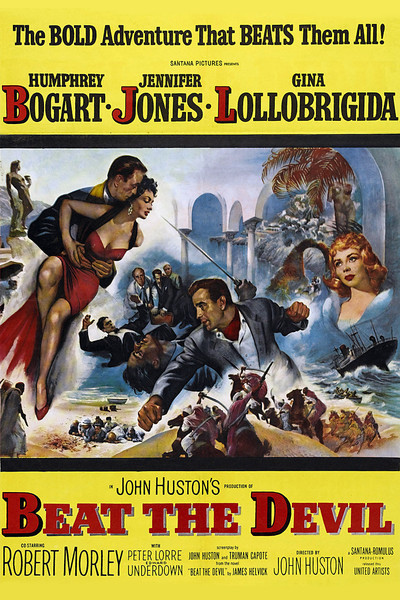
Beat the Devil (1953)

Jennifer Jones, Gina Lollobrigida and Humphrey Bogart in the tongue-in-cheek Beat the Devil

Director: John Huston

Cast: Humphrey Bogart (Billy Dannreuther), Jennifer Jones (Gwendolen Chelm), Gina Lollobrigida (Maria Dannreuther), Robert Morley (Peterson), Peter Lorre (Julius O’Hara), Edward Underdown (Harry Chelm), Ivor Barnard (Major Jack Ross), Marco Tulli (Ravello), Bernard Lee (Inspector Jack Clayton)

Beat the Devil is a curious beast. You could argue it was ahead of its time. Huston and Bogart had started out with the intention of making a straight crime mystery, a sort of Maltese Falcon in Europe. But when they arrived on location, obviously something in the weather got to them and Truman Capote flown in to help redraft the script on a daily basis to turn it into a sort of satirical comedy. For audiences expecting a hard-boiled crime mystery, it left heads scratched and cinema seats empty. Bogart lost a packet on the film – and later claimed to hate it – and it only existed in a badly cut-about version until it was restored in 2016.

The slightly surreal plot hardly really matters. A crowd of unusual people gather in a run-down port in a small Italian town, waiting to take the ship to East Africa. Gwendolen (Jennifer Jones) and Harry Chelm (Edward Underdown) are seemingly upper-class Brits (or are they?). American Billy Dannreuther (Humphrey Bogart) and his European wife Maria (Gina Lollobrigida) might also once have been something, but they sure ain’t now. Peterson (Robert Morley) and his associates the suspiciously un-Irish Julius O’Hara (Peter Lorre), rat-faced bully Major Jack Ross (Ivor Barnard) and nervous Ravello (Marco Tulli) are almost certainly all criminals on their way to a big score in Africa. Thrown together, this unlikely grouping end-up in a heady cocktail of betrayals, schemes, affairs and lies that spools out like a demented shaggy-dog story.

Beat the Devil is really more of an experience, a series of gags and light-hearted scenes played with a grin and a wink. Nothing in it is meant to be taken seriously, and this semi-surreal group of events becomes ever more absurd as it goes on. By the time the cast are abandoning a sinking ship, trudging up a beach to be captured by Arab officials who eventually allow them to row back to port where they find their ship didn’t actually sink…you really should just decide to go with the flow.

Instead the film is about shuffling up familiar tropes from hard-boiled noir with Oscar Wildeish farce. Certainly the Chelms seem to have wandered in from something totally different (not least since Gwendolen’s name is reminiscent of Importance of Being Earnest). Harry (a superbly stiff-upper lipped Edward Underdown) is a blithely unaware would-be English gentleman, pompously aware of his social class and blithely unaware that his wife seems to immediately start an affair with Billy. Gwendolen is the exact sort of character you might expect to see in Wilde, a dreamer tipping into fantasist, who blurts out things she shouldn’t and falls instantly in love with Billy. She’s also whipper-smart – more than capable of defeating Harry at chess without looking (“usually he’s a wonderful loser” she tells Billy, by way of apology for Harry’s strop).

Billy and Gwendolen embark on an immediate affair (although of course, in deference to the Hays Code, its just kept this-side-of-implicit). Mind you the film has a zingy wife-swop feel to it, since it’s pretty clear that Maria is far more interested in the British reserve of Harry (“Emotionally I’m English” she says before eulogising tea and crumpets) than she is in the ordinary-Joe cunning of her husband (although perhaps Harry is just as oblivious to this as everything else around him).

Billy is Bogart deliberately at his most Bogart-ish, channelling every grimy-but-smart dubious-hero the star ever played. Bogart plays the entire film with a grin on his face and delights in lines like “Fat Guys my best friend, and I will not betray him cheaply”. He also sparks delightfully with Jennifer Jones, who seems to having the time of her life as a character so flighty and unpredictable that even she looks like she hasn’t a clue what she is going to do (or feel) from one moment to the next.

The supporting cast of creeps and freaks Dannreuther is conspiring with to make a fortune (its something to do with land and uranium) similarly seem to have walked in from a side-ways Dashiel Hammett universe. For all their dirty deeds – and it seems Petersen had ordered a hit in the UK, although never for a minute would you believe this looking at Robert Morley’s puffed up bluster – they are a rather sweetly naïve and incompetent. Morley’s Petersen, a sort of galloping major, carries no real threat. Peter Lorre is very funny as a suspiciously German sounding Irishman (“Many Germans in Chile have come to be called O’Hara” he comments), prone to flights of verbal fancy and a chronic lack of focus. Ivor Barnard is as close as the film comes to threat as the aggressively incompetent Major Ross, a chippy bully who resents his shortness and eulogises Hitler at the drop of a hat. These heavies are each ridiculous figures.

And it makes sense, since the plot is a great inflated balloon of nonsense. There are chases, sinking ships that stay unsunk, a moment where two major characters are briefly believed dead, obsessive conversations about hot water bottles and reveals that puncture any sense of grandeur for each character. It’s the sort of aimless story you could imagine natural raconteurs like Huston and Capote finding absolutely delightful, and the whole film feels like a dramatization of a dinner-table anecdote.

Take it on those terms and its all rather good fun, even if it makes no sense. The cast look like they are having a whale of a time, and the total lack of seriousness about the whole enterprise generally makes it glide by with ease. Take a couple of drinks, sit back, don’t think about it too much and enjoy the jokes.

The Third Man (1949)

Orson Welles is the dark heart of The Third Man

Director: Carol Reed

Cast: Joseph Cotton (Holly Martins), Alida Valli (Anna Schmidt), Orson Welles (Harry Lime), Trevor Howard (Major Calloway), Paul Hörbiger (Karl the porter), Ernst Deustch (“Baron” Kurtz), Erich Ponto (Dr Winkel), Siegried Breuer (Anna), Bernard Lee (Sergeant Paine),Wilfrid Hyde-White (Crabbin)

It’s regularly held up as one of the cornerstones of classic 1940s film-making – and it has frequently won polls of the Greatest British Films of all time. Does The Third Man live up to expectations? No it excels them. I doubt there has been a film more perfectly assembled than this, one where all the component parts click together to make one perfect whole. No matter how many times you see The Third Man, it weaves its spell every time.

In immediate post-war Vienna, the city is divided into four zones, each run by a different great power (the UK, US, France and USSR). The black market is rife between the zones. Into this city arrives pulp Western writer Holly Martins (Joseph Cotton), here to visit his old school friend Harry Lime (Orson Welles) – only to find on arriving that Lime died in a traffic accident, with British policeman Major Calloway (Trevor Howard) insisting that he was a black marketeer. Holly can’t believe Harry was a crook, and decides to investigate himself – on the way falling in love with Harry’s girlfriend Anna (Alida Valli) and finding that nobody’s story on what happened to Harry matches up. Could the accident actually be a murder?

Carol Reed’s atmospheric film is beautifully, perhaps flawlessly directed – so well made that for years there were fevered efforts to assign its brilliance to Welles himself. Which was studiously unfair to Reed, a director at the top of his game in the 40s.  The Third Man was the crowning glory of a run of superbly stylish thrillers that matched thought provoking themes with striking film-making. The film is soaked in the atmosphere of post-war Vienna, a city half shelled out of existence. The film was shot on location, and Reed’s camera captures the “bombed about a bit” shambles of the city, its long shadows, cobbled streets and mysterious alleys.

The Third Man’s filming style also plays into this truly distinctive look. Working with (Oscar-winning) cinematographer Robert Krasker, the film is shot with a luscious almost German impressionistic style, with murky shadows and noirish lighting. Reed uses huge numbers of Dutch Angles to constantly present both this shattered city, and it mysterious story, from disconcerting angles. This visually represents the uncertainty and mystery that drip from every scene, making Vienna look like some sort of sinking ship, disappearing into a mire of crime and guilt. Reed’s camera fills the edges of the frames with tramps, beggars, the dispossessed and the plain scared – a brilliant snapshot of post-war Europe unsure about the future and ripe for exploitation.

The film looks simply stunning, with Reed’s visuals throwing up images that have stuck in film heritage, from fingers poking through a sewer grill, to the iconic entrance of Harry Lime itself (possibly the most famous entry ever). Shadows loom with gigantic proportions over the streets. A final sewer chase seems to take place in a nightmare world of water, false turns and foreboding architecture. And that final shot! Sublime cinema, the stillest shot in the film, and also a superb capturing of the film’s themes of loyalty, duty and betrayal.

The film was scripted by Graham Greene, and occupies a wonderful corner of Greene-land. His original concept was for Holly (or Rollo in the original script) and Harry to be British public schoolboys – a plan rejected when Hollywood co-funding came to call – but it did allow Holly to be transformed into a naïve American, lost in the cold realities of post-war Europe. Holly believes in the world of black and white, and writes stories where good triumphs over evil in the Wild West. He’s adrift in a Europe where everyone lies habitually, morality is flexible, and nothing is as it seems.

Holly is bound by old chains of loyalty to Harry – but how far does that loyalty stretch? What price personal loyalty when confronted with the impact of what a person has done? Joseph Cotton’s performance is pitch perfect, a middle-ranker who has orbited his whole life around brighter stars like Harry. How one-way was the relationship? Can Holly ever think for himself? 

And is the right thing to do to walk away or try and correct the wrongs done by another?This divide is shown in the relationship between Cotton’s Holly and Alidi Valli’s sensational turn as Harry’s ex-girlfriend. A woman who has seen the harshness of the world, and been through a war-torn life that Holly would struggle to even comprehend, she’s a woman to whom personal loyalty trumps all things. Should you be loyal to the man you know, your experience of him – or do you have a higher loyalty that trumps that? Anna is firmly of the belief that she knows all that she needs to know of Harry and she needs to learn no more. It’s the sort of European post-war compromise that Holly can’t adapt to, the ideas of morality becoming mired in shades of grey.

It’s a world he struggles to adapt to, but is a cold hard reality for Trevor Howard’s Major Calloway – a superb performance of cool reserve that hides a strong sense of justice. Howard’s wry half-smile and control is perfect for the film, and his disgust at the actions of black marketeers is subtly and brilliantly conveyed by both the actor and Reed’s restrained direction – a visit to a children’s ward full of victims of Lime’s penicillin, is notable for leaving everything to our imagination and communicating another loss by showing a Teddy bear being dropped into a box.

And the cause of all this suffering? Why it’s none other than Harry Lime himself. No film ever captured Orson Welles’ impish charm as well as this, his shy grin and air of an enfant terrible turned terrible are brilliantly captured in the boyishly young but demonic Harry. A Mephistopheles placed on earth to tempt men like Holly, Lime argues what do a few people (or dots) here and there really matter in the long run? After all governments sacrifice them all the time – look at Vienna! – why shouldn’t we? What’s the problem? Lime grins and casually outlines a demonic view of the world, casually uses a cheap historical justification or two, and then saunters off never suspecting that he could lose the argument. Like Welles himself, he has all the glamour and magnetism that we could never have, and to live a few moments in his shadow, as Holly and Anna do, is to live a lifetime.

So Holly has to make a choice – the friend he knew, or the strangers he has seen harmed. The film charts the slow passage to making this hard choice, presenting us with a man who refuses to believe his friend could be anything other than the victim of persecution, to the man who is destined to turn him in. With the framework of Carol Reed’s superb filmmaking, it’s still an absolute treat.

And finally, The Third Man is blessed with perhaps the most perfect film score of all time. Recorded by Anton Karas – literally discovered playing the zither on the streets of Vienna – the score is jaunty, lyrical, schoolboyish even but can switch subtly to something quite disconcerting. It perfectly captures the schoolboy bravado of Holly and the childish lack of morals of Lime. As a match with the bombed out Vienna and its rundown, cynical citizens, it’s perfect. Like all things with The Third Man, it just works better than you could ever have hoped.

The Spy Who Came In From the Cold (1965)

Richard Burton lands in Cold War trouble in classic Le Carre adaptation The Spy Why Came In From the Cold

Director:  Martin Ritt

Cast: Richard Burton (Alec Leamas), Claire Bloom (Nan Perry), Oskar Werner (Fiedler), Sam Wanamaker (Peters), George Voskovec (East German Defence Attorney), Rupert Davies (George Smiley), Cyril Cusack (Control), Peter van Eyck (Hans-Dieter Mundt), Michael Hordern (Ashe), Robert Hardy (Dick Carlton), Bernard Lee (Patmore)

Spy stories fall into two camps. You get the wham-bam blast of James Bond and then you also get the grimy, isn’t-this-a-damn-dirty-trade stories that John Le Carré helped to turn into a major alternative. The book that really kicked off Le Carré’s career was The Spy Who Came in From the Cold, a slim, brilliantly written story of spies working exclusively in shades of grey. The book was a smash, the film was inevitable, and a damn fine film it turned out to be.

Richard Burton plays Alec Leamas, a former head of Berlin Station for the British Secret Service, who is recruited by the services’ leader Control (Cyril Cusack) as part of an elaborate scheme to discredit the cunning and dangerous head of the Stasi office in Berlin, Hans-Dieter Mundt (Peter van Eyck). Leamas will go through a pretence of disgraced dismissal, alcoholism, jail time and half a dozen other indecencies to attract the attention of the East German defector recruiters in the UK. But will the relationship he develops during his disgrace with librarian and idealistic communist Nan Perry (Claire Bloom) endanger the whole mission?

The Spy Who Came in From the Cold is shot in a grimy, gloomy black-and-white which is completely appropriate for the morally questionable escapades its characters get up to. Like Le Carré’s novel, the ends justify any means here, and questions of morality and justice are best benched. Characters who can’t let themselves to forget justice are doomed in this film. Genuine shows of real emotion and feeling are generally signs in this film that a person is doomed.

Martin Ritt’s literate script captures the style and tone of Le Carré extremely well – this is still one of the best, truest and most faithful capturing of Le Carré on the screen – and his direction also has a wonderful mixture of shabby kitchen-sink realism and classic Hollywood film noir class that makes for a brilliantly involving package. The pace of the film holds pretty well, beautifully carrying us through a parade of agents recruiting Leamas for the East Germans (each of which are dismissed with a shocking curtness by the next one along), and the final court room trial of Mundt (with its intricate exploration of the complex plotting of the novel) is extremely involving.

The film also has the benefit of a number of terrific performances, led by Richard Burton in the lead. By this stage of his career, Burton was already felt by many to be lost to serious acting in favour of big budget, Liz Taylor-starring pictures and Hollywood entertainment. But he rouses himself here to give one of his best ever performances. Leamas is a shabby, beaten down, little man (despite being played by Burton!) whose chippiness, dissatisfaction and aggression make him perfect as a possible defector. Ritt’s camera often focuses on Burton’s unflinching stares, his eyes seem to bore into the person he’s talking to, little oceans of anger and resentment.

Burton’s Leamas is deep down sick and tired of the world of spying, its betrayals and lies, and sickened with self-disgust at his own involvement in it. Burton skilfully underplays the role throughout, largely ignoring any temptation for grandstanding or big acting moments – instead he is as compromised, grey and lost as the rest of the film, in a superb performance of cynical disaffection. Bunched up, his grand voice dialled down, his eyes flickering with resentment – a great performance.

Claire Bloom is rather affecting as Nan (hilariously, her name was changed from Liz in the book as the producers feared she would be confused with the rather more famous Liz in Burton’s life) and Oskar Werner gives the film a major burst of energy just as it is flagging from one interrogation of Leamas too many, as a chippy, eager, sharp Stasi officer, who is determined to see justice done. The rest of the cast are filled out with some classy Brit character actors, who excel from suave (Robert Hardy) to seedy (Michael Hordern), while Cyril Cusack brings “Control” to cynical life and Rupert Davies gets to the be the first actor to play George Smiley on screen (even if he is only really an extra here).

Spy is a film of atmosphere. Frequently it trusts the viewer to catch up the plot as they go. Leamas actions are not always explained until late on – and we are constantly suspecting that we are only seeing half the story. Its a film that plays its cards close to the chest. This might alienate some, but it’s a true representation of Le Carre – and fits perfectly with the weary sense Leamas has of not being in control of his own life.

But what Ritt does so well is keeping that tonal sense of there always being another shady, compromising twist around the corner. All is never what it seems, and the film ends with an especially bleak series of footnotes as we find out just how ruthless both sides are prepared to be in this soulless chess game of Cold War politics. It’s the moments like this that Spy Who Came in From the Cold really nails. For Le Carré fans the film is a must: for those less interested in the world of espionage, they may find it takes a little too much time.

The Spy Who Loved Me (1977)

Bond finds himself in another pretty pickle in The Spy Who Loved Me

Director: Lewis Gilbert

Cast: Roger Moore (James Bond), Barbara Bach (Anya Amasova), Curd Jürgens (Karl Stromberg), Richard Kiel (Jaws), Caroline Munro (Naomi), Walter Gotell (General Gogol), Bernard Lee (M), Desmond Llewelyn (Q), Lois Maxwell (Miss Moneypenny), Geoffrey Keen (Frederick Gray), Robert Brown (Vice-Admiral Hargreaves), George Baker (Captain Benson), Michael Billington (Sergei Barsov), Vernon Dobtcheff (Max Kalba), Nadim Sawalha (Fekkesh)

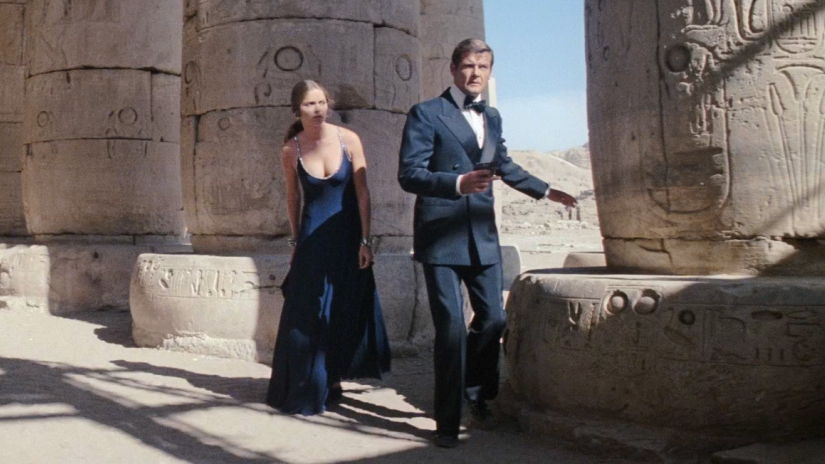
Roger Moore had made two Bond films before he made The Spy Who Loved Me – but this is the one when he finally hit upon the formula that works for him. It’s also probably the moment where the Bond films became – once for all – comedy adventure capers. It was but a few more degrees from here until Bond was telling a tiger to “sit” or racing past a double-taking pigeon in the middle of St Mark’s Square. And the public loved it. For better or worse, Moore’s Bond here helped define the franchise for a whole generation.

Anyway, the story. It’s eerily familiar in many ways to Thunderball and You Only Live Twice: a power-crazed lunatic (Karl Stromberg) running a secret organisation wants to destroy the world. His plan? To capture one American and one Soviet submarine and use them to fire nuclear missiles at the nation’s two capitals, to kickstart a nuclear war, leaving only his underwater kingdom intact. Just as well then that an over-keen Stromberg (Curd Jürgens) first captures a British sub, meaning James Bond (Roger Moore) is called in to investigate. Bond will work with the USSR’s finest agent – Anya Amasova, Triple X (Barbara Bach) – to find out what’s going on and why.

TSWLM is a lot of fun, possibly the ultimate expression of what a lot of people think Bond is. It’s hugely silly, rather exciting and has almost no connection with reality whatsoever. Moore goes through the whole thing with his eyebrow forever arched, tipping the wink at the audience – “You do know, dear boy, this is all dreadfully silly stuff”. Sometimes in Bond this humour gets a bit much – but here it’s pretty much pitched perfectly. And Moore looks like he is having the time of his life.

The film is crammed with action set pieces in striking locations: the Alps! The pyramids! A converted oil tanker base! Nothing is left to the imagination, and everything is thrown at the screen. It gets the sense of excitement right from the pre-credits sequence, with Bond’s high-speed ski chase across the alps from Russian would-be hitmen. Fools – what chance did they have? I don’t know what I like most about this scene: is it the wild ski stunts? The way music and camera action combine so well? The fact that it’s crystal clear Moore probably spent precisely zero days on location for this sequence? What am I talking about, it’s got to be that insane parachute jump at the end – with the camera leaving it just long enough for you to start to think “is Bond going to get out of this one?”. (Spoilers he does.)

That’s almost nothing compared to the famous Lotus-turned-submarine car chase, which pretty much set the standard for all the car-based action (not to mention gadget filled cars) that would follow in the franchise. The idea of a car that turns into a submarine: it’s both brilliant and so overwhelmingly silly that, like Bond at its vibrant best, it seems to transcend class and logic into a higher plane of excitement.

And all this with a plot that is almost staggeringly stupid. Jurgens has a lot of arch, naughty fun as scheming monomaniac (with subtle webbed hands) Stromberg, a pompous arsehole and a great villain. Of course he wasn’t a physical threat – hence the invention of Jaws, surely the most popular henchman ever invented for Bond. Jaws is a lunking, vicious but strangely endearing brute – it’s hard to put your finger on why he’s strangely likeable, maybe it’s just the totally absurd idea of a hitman whose killer tools are metal teeth. Maybe it’s because Richard Kiel has such a dorky sense of humour – and is as good at the glance at the camera as Moore himself is.

Of course it is a dated film – and it’s always the women that show it. If this set a lot of good Bond archetypes, then it also helped to cement a few bad ones. Anya Amasova is (allegedly) the greatest agent Russia has. Not that you would know it, as she stumbles in this film from moments of staggering incompetence and stupidity to victimhood and damsel-in-distress. There is a hint of character development – Bond offs her boyfriend in that alpine chase literally without a backward glance – but that’s soon forgotten by the end under Bond’s charms. The poor woman can’t even drive stick (“That’s reverse, let’s try again shall we” says Bond with smackable smugness) and by the end of the film she’s bikini-clad and being rescued by Bond. It says a lot when the strongest thing about her character is that her name isn’t an innuendo.

But you can let it go, because the rest of the film is such good fun. Everything is nonsense of course, and you could steer a submarine through the plot holes. If Stromberg only needs two submarines to start his evil plan, why on earth does he grab a third one at the start of the final act? (Just as well he does, of course, as otherwise Bond would never get on board his base.) Stromberg is ruthless enough to eliminate three underlings and to set up a nuclear war to wipe out the world – but those captured submarine crews he keeps alive, imprisoned, with a small guard, next to the armoury on his base. Ooops. His plan is almost effortlessly undone with a radio message from Bond. But never mind. It doesn’t matter.

The point is that this is all great fun and basically set the tone for the next ten years of Bond films – until Dalton shifted gears. Moore is really good in it, as a sort of ringmaster of silliness – and he’s clearly enjoying it wildly. The Spy Who Loved Me is his best film – and for all its dumbness, its leaning into cheap humour, its ludicrous plot and sexist attitudes, it’s still up there at the top of the franchise. Because for a lot of people, all those negatives are exactly what they now expect from Bond.

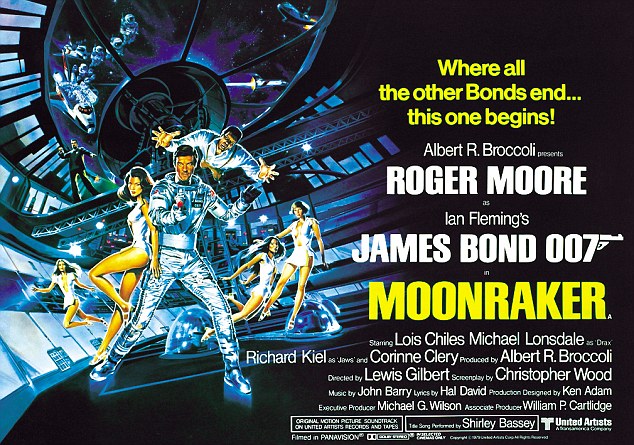
Moonraker (1979)


Roger Moore is James Bond…IN SPACE!!!!

Director: Lewis Gilbert

Cast: Roger Moore (James Bond), Lois Chiles (Holly Goodhead), Michael Lonsdale (Hugo Drax), Richard Kiel (Jaws), Corinne Clery (Corinne Dufour), Bernard Lee (M), Geoffrey Keen (Defence Minister), Desmond Llewelyn (Q), Lois Maxwell (Miss Moneypenny), Emily Bolton (Manuela)

After The Spy Who Loved Me, the Bond producers had finally found a format that suited Roger Moore’s take on the role:  a comedic, tongue-in-cheek style, with Moore leaning on the fourth wall, winking at the audience. In fact, SWLM made so much money that this one feels almost like a remake rather than a new film – it’s got the same basic concept, the final sequence is pretty similar, the opening sequence again revolves around a daring parachute stunt, even Jaws pops up again. For a film that heads into truly unchartered physical territory for Bond (space!), it’s as familiar and derivative as Bond gets.

Bond (Roger Moore) investigates Hugo Drax (Michael Lonsdale), a shady businessman whose operations are expanding into space. After a string of exotic locales (a chateau in France! Venice! Mexico City! Brazil!) an evil scheme to destroy the world from space clicks into place. Bond has to take to the stars to take down Drax. Despite the criticism that will follow, this is probably near the end of Moore’s high point in the role – and in none of his future films was he quite as debonair and dashing as he is here.

If you ever needed evidence that the James Bond franchise looked at whatever was popular in the cinema at that moment in time and then ripped it off as quickly as possible in their next film, then it’s Moonraker. Surely never in anyone’s lifetime would they expect to see a film that could be tagged “James Bond…in SPACE!” but after the success of Star Wars that is exactly what they were served up. The idea is so completely silly that people wonder if you’ve made it up.

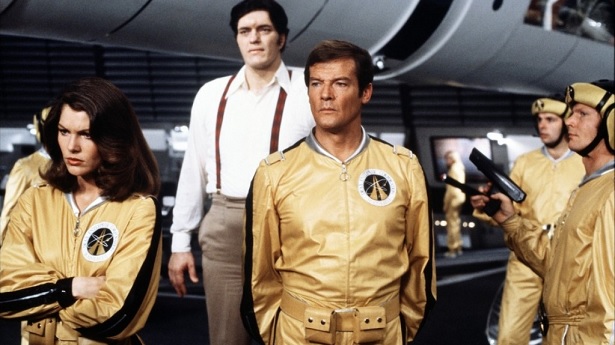
But, sigh, that’s what we get here. And it is beyond silly. The film climaxes in a space battle between the NASA Marines (don’t ask) armed with laser cannons (yes you read that right), duking it out with Drax’s own personal guard also armed with cannons (it really is as silly as it sounds). All this against a backdrop of Drax’s own personal Death Star. Afterwards, Bond has to shoot down three deadly missiles that will wipe out the population of the Earth. Naturally, his targeting computer doesn’t work for the final one, so Bond has to basically “use the force” to target and shoot it down. Star Wars in all but name right? Had the producers no shame?

It doesn’t help that Moonraker amps up the already jokey tone of SWLM to an overbearing degree. At least it was a formula that works with Moore, but so little is treated seriously that when they do something violent it sticks out tonally like a sore thumb. This is probably the only film I can think of in which a woman is ripped apart (off screen) by a horde of hounds, followed shortly afterwards by a pigeon performing a comic double take after an amphibious gondola sails through the middle of St Mark’s Square (don’t even ask). It’s a film that has no discipline, no control and no real consistency. It dances all over the place with no logic at all. It gets the balance wrong and instead of being tongue-in-cheek often comes across as overblown, heavy-handed and ludicrous.

In fact the plot, such as it is, is hard to follow because it’s almost an afterthought. It’s effectively a reheat of SWLM (repopulate the planet with a chosen elite), while the space battles are similar to the slow motion fights of Thunderball. Bond moves from location to location with only the barest logical links. Drax identifies Bond as a threat early on – but then continues to pull out a series of bizarre and unreliable schemes to eliminate him. The action sequences feel like versions of previous films in the series – and don’t get me started on the fact Bond still hasn’t learned that punching Jaws in his metal mouth is a bad idea (he does it three or four times in this movie). Everything moves forward with a restless momentum that never allows us to connect with anything that happens.

There is some decent potential here. The fight on the ski lift is pretty good. Michael Lonsdale has a psychotic chill about him that, in a better film, might have made him a memorable villain. In fact, Lonsdale is so grounded as a villain he feels wrong for a film that’s so silly. And it’s all the more surprising he has such an outlandish scheme – or that he hangs around with such a pantomime villain as Jaws. Jaws clearly returns due to popularity – and has been thoroughly neutered as a threat here. Even before he falls in love with a girl with pigtails and switches sides, he’s already an almost comic buffoon – even bashful about knocking off a Bond aide in front of witnesses.

It’s a film that can’t decide if it’s a thriller or a comedy. It probably leans more towards comedy – which is a shame as it’s not that funny. The hideously overplayed gondola sequence tells you everything you need to know about the film’s lack of wit. Its comedy is as overplayed and heavy-handed as some of the action can be – more likely to get you rolling your eyes than holding your sides. Saying that, it does have possibly the best final punchline of any of the films (“I think he’s attempting re-entry sir”) – the sort of joke you probably didn’t get when you first watched the film aged about 10. Other than that it’s like a series of gags told by people who aren’t really that funny.

Moonraker is the sort of bizarre freak of nature that you almost can’t believe exists. Leaving aside its amping up of the tongue-in-cheek formula into the realms of the bizarre, it’s basically a bit too stupid and unbelievable for even this franchise to pull off. Lasers? Space-stations? Space marines? Bond in space? I mean really? As a rip off of Star Wars it leaves a lot to be desired – and so long as these films take place in a world that is even vaguely linked to our own, plots like this just have the stench of bullshit.

On Her Majesty's Secret Service (1969)


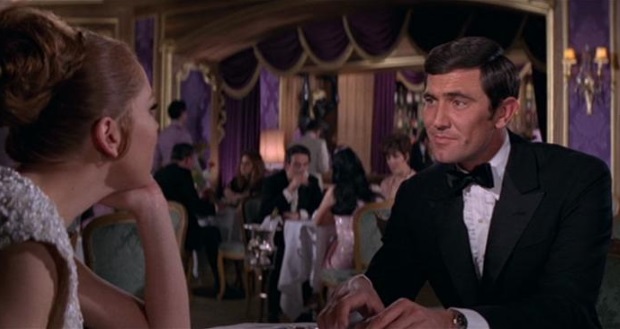
George Lazenby flirts with Diana Rigg. If only he was James Bond.

Director: Peter R. Hunt

Cast: George Lazenby (James Bond), Diana Rigg (Tracy di Vicenzo), Telly Savalas (Ernst Stavro Blofield), Gabriele Ferzetti (Marc-Ange Draco), Ilsa Steppat (Irma Bunt), Bernard Lee (M), Lois Maxwell (Miss Moneypenny), George Baker (Sir Hilary Bray), Bernard Horsfall (Shaun Campbell)

After You Only Live Twice, Sean Connery was through with Bond. Despite the producer’s pleas, Connery was off. The producers were hit with a conundrum – should they recast and start again? Or recast and pretend nothing has changed? They went with the second option and spread the net among the world’s actors, and hired… a man whose only screen work was in a chocolate advert.

Bond (George Lazenby) is on the hunt for villainous SPECTRE head Blofield (also played by a new actor, Telly Savalas). Following a lead, he meets and begins to fall in love with daughter of a Count, Tracy di Vicenzo (Diana Rigg), before infiltrating Blofield’s alpine HQ disguised as an expert in heraldry (seriously that is the plot). There he uncovers a plot for world domination that involves a dozen attractive young women, a deadly virus and the usual collection of inept SPECTRE henchmen.

It’s become a bit retro-cool to reassess OHMSS as the finest James Bond film. This always seemed odd to me: this series, more than any other, is so closely tied in with the personality and skills of the lead actor – and this film has the weakest of the lot. But compared to the two slightly tired films that came before it (YOLT and Thunderball), this one does have more narrative ambition and offers a freshness and sweep in its filming, as well as a compellingly filmed series of action pieces.

Really though you can’t talk about OHMSS without mentioning the Lazenby-sized elephant in the room. Poor George. Watching Lazenby you can never forget this is a guy who landed Bond on the basis of (a) he looked good in a tuxedo and (b) he broke a stuntman’s nose when he auditioned.  But let’s start with the positives. Well he can fight – jeez louise this guy can fight. Lazenby’s Bond is possibly the most physically aggressive until Craig. He’s totally at his ease in the fast-paced fisticuffs that fill the movie. He looks very believable when he’s asked to do anything athletic or dangerous looking. I’ll also cut him some slack that he is given a terrible wardrobe of clothes here (could he look more camp?) and that he spends a significant chunk of the film disguised as a camp heraldry expert.

It’s just a shame that anything involving acting is a bit too much of a stretch for him. His delivery of his dialogue is flat and lifeless. For a large chunk of the film, his voice is all too obviously dubbed (by George Baker). He’s frankly not that funny, despite having several gags (including of course “This never happened to the other fellow”) which are actually pretty good. He can’t bring any real emotional depth to the romance. His chemistry with Diana Rigg is pretty middling, although he does a decent job of his grief at her (spoilers!) death. But it’s the voice that you keep coming back to. It’s grating – flat, dull and monotone. Even though the material makes Bond more human than ever, Lazenby’s underwhelming performance doesn’t make us feel any closer to him.

The producers were clearly aware of the problem, so crammed the film with as many references back as they could manage, as if to reassure audiences “Yes Connery has gone, but don’t worry it’s still Bond!”. So we get a scene of Bond flicking through a desk full of knick-knacks from previous films (the film even plays snatches of the scores). M, Q and Moneypenny work overtime to treat Bond exactly the same. All this attention to continuity of course only goes so far – despite the fact they both spent a fair bit of time with each other in the previous film, Blofeld doesn’t even remotely recognise Bond when he rocks up at Blofeld’s base pretending to someone else, disguised by nothing but a pair of glasses. For a film determined to hammer home the continuity more than any other in the series (until Spectre) this doesn’t make a lot of sense.

So the real question: can you have a great Bond film, when Bond himself in it is pretty dreadful? Can you really enjoy the film when the whole time you almost force yourself to picture any of the other Bonds in place of the one you’re actually watching? Well OHMSS gets pretty close to success despite the fact it has a black hole at its centre, which is a tribute to it. This one feels closer to Ian Fleming than almost any other film in the series. It’s the straightest adaptation of the source since From Russia With Love. Lazenby’s more human take on the role (sentimental, scared at times) does feels closer to Fleming’s Bond than Connery’s Ubermensch. This doesn’t mean the plot isn’t utter bobbins – but at least it’s very Fleming-esque bobbins.

In fact the producers threw everything except the kitchen sink at this one. There’s a car chase (in the middle of a car rally), a helicopter-led storming of a SPECTRE base, no end of punch-ups, a barrage of battles, ski-chases down the alps, a final battle in a toboggan (surely the only film until Cool Runnings to build up to a climatic encounter in a winter-sports event). Many of these sequences are terrific, and Hunt films everything with a grounded realism (despite the ludicrousness of so much that happens) that makes everything immediate and exciting. He also combines this with an ability to shoot moments of epic action with sweep and majesty.

It’s also quite refreshing in how it treats its romantic lead. Diana Rigg is not only (by far and away) the best actress to play a Bond girl until the Craig years, but she is allowed to create a character who feels a worthy partner to Bond. Tracy is brave, determined, can take care of herself, rescues Bond at one point and gets to do all the driving (and is extremely good at it). Sure the film has its old-fashioned moments (when her father encourages Bond to court her, he charmingly states: “What she needs is a man… to dominate her! To make love to her enough to make her love him! A man like you!”. Okay…), but as far as it goes this is pretty advanced stuff for Bond at the time.

The plot is nonsense of course, and Telly Savalas feels like a strange choice for Blofeld (he’s far too gritty, aggressive and, above all, American!) but the action is really well counterpointed with the relationship between Bond and Tracy. Tragically, this film has exactly the rich, deep and emotional material Connery was crying out for. The love story – despite Lazenby’s limitations – feels genuine and sweet and the final tragic ending is, by far and away, the best bit of acting Lazenby gives in the entire film. But you keep imagining what it would have been like if Connery had been in this film, or indeed anyone who could actually act (even Moore could have made a lot more of this material).

That’s the problem with OHMSS. Bond films depend on their Bond – and when the Bond lacks any real charisma and struggles to deliver on anything other than the physical side of the business, your film is always going to be in trouble. Which is a real shame, because nearly everything else about this film is actually really good. It feels fresh, exciting and real in a way others felt tired and over familiar. It’s got some excellent action and excitement. It’s shot and edited with real vibrancy. The action set pieces are exciting. It’s got a sweet romance at its centre. You just don’t really connect with or care about the hero. And for a film series that rests so heavily on the lead, that is pretty terminal.

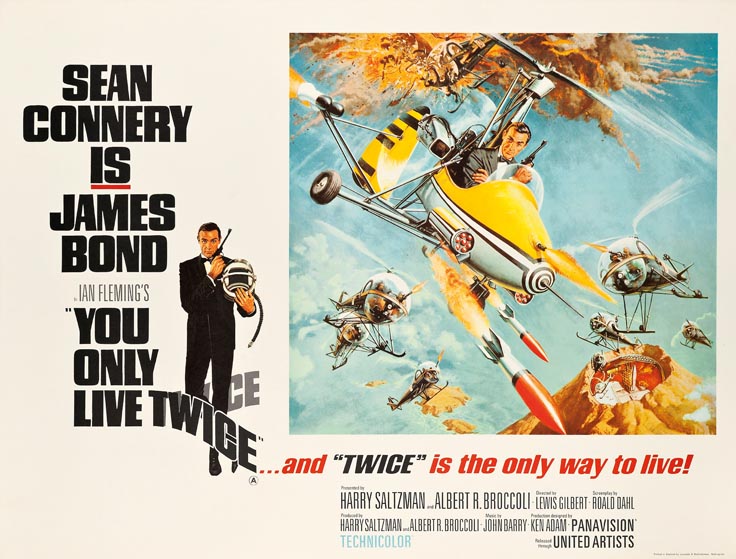
You Only Live Twice (1967)


I feel Connery’s attitude to the film comes across well in this image…

Director: Lewis Gilbert

Cast: Sean Connery (James Bond), Akiko Wakabayashi (Aki), Mie Hama (Kissy Suzuki), Tetsurō Tamba (Tiger Tanaka), Teru Shimada (Mr. Osato), Karin Dor (Helga Brandt/No. 11), Donald Pleasence (Ernst Stavro Blofeld), Bernard Lee (M), Lois Maxwell (Miss Moneypenny), Desmond Llewelyn (Q), Charles Gray (Dikko Henderson)

James Bond films: always fun, even when not that good. You Only Live Twice is probably the prime example. For many, many reasons, it isn’t actually very good but still remains strangely enjoyable just because, well hell, it’s Bond. 

Anyway YOLT revolves around naughty super villains SPECTRE nabbing US and USSR space missions, hoping to provoke a nuclear war between the two superpowers. Apparently they will profit handsomely from this – but how they see that happening in a nuclear wasteland isn’t clear. Anyway, James Bond (Sean Connery) fakes his own death and heads to Japan to investigate. Events peddle around Japan for ages, giving filmgoers the chance for some vicarious sight-seeing, before culminating in an all-out attack by Bond and a gang of ninjas on the hollowed-out volcano base of SPECTRE chief Blofield (Donald Pleasance).

YOLT is the moment Bond started to head full tilt towards the Moore-era of overblown, fantasy silliness. The plot is total bobbins (despite being repeated in The Spy Who Loved Me, Moonraker etc.) with both Russians and the US naturally continuing to suspect each other, even when each side loses a spacecraft (though I did like the fact that the actual astronauts together in captivity are shown to have far more in common than not). There is no logical reason for them to behave like this, even at the heart of the Cold War.

There is plenty of other nonsense here. Bond’s death is faked early doors for no reason (only the hopeless SPECTRE is in any way fooled). Bond meanders around Japan with even less subtlety than usual, with a series of clashes, fights and chases that make little real narrative sense at all. Later, again for no reason, (and almost unbelievable to watch today) he disguises himself as a Japanese man (PC alert ahoy, as Bond cuts his hair with a bowl and tans his skin. At least he doesn’t tape his eyelids back…). He also finds a kindred spirit in Tiger Tanaka, both of them treating a host of female servants as a shopping list for rumpy-pumpy.

As per many Bond films, the franchise clambers on top of a current fashion to feel hip and cool (but actually manages to feel fusty and stuffy). This time it’s the samurai craze, as Bond joins a sword-swinging, ninja training school. Yes, you read that right. But of course Bond also needs to get married before the attack: again why? His wife is of course offed seconds later, and Connery just about manages to look put out at this coitus interruptus (more on Connery later…)

SPECTRE themselves are hilariously incompetent. They are hoodwinked like children by Bond’s ludicrous faked death. They practically signpost their location by bumping off anyone who gets within about five miles of the place. Later, poor Blofield not only carefully talks Bond through the self-destruct button for his rocket, he also lets Bond take back his clearly gadget-concealing smoking case, blows away two sidekicks (one right in front of Bond) rather than eliminate Bond himself, then caps it all with sending the base itself to kingdom come. SPECTRE’s agents are equally useless, with Brandt too attracted to Bond to finish him off (and then deciding to tie him up in a plane, detonate a grenade in it and then parachute out to leave the plane to crash with Bond in it – needless to say Bond lands the plane with ease).

The terrific volcano set

The volcano base, however, is a triumph of production design – it’s staggering to think that everything you see on screen was built for real. It’s huge and iconic – and the battle scene between the aforementioned ninjas and SPECTRE goons that fills the final act of the film is hugely exciting, despite almost every single thing making virtually no sense. Incidentally the final battle’s structure is lifted almost completely for a similar sequence in The Spy Who Loved Me.

The problem is that everything else leading up to this feels like all involved are going through the motions – as if there wasn’t really anything fresh left to do or say in the Bond-verse. Need a glamourous location. Never been to Japan have we? Need some scuffles – not sure we‘ve done a roof top fight in long shot, let’s chuck that in. How about we kill Bond off for a few seconds – yeah never done that before. A super gadget needed? Bring on suitcase-assembled helicopter, Little Nellie. The final reveal of Blofeld is fun, but when you come back to watching the film you realise he’s as bland and identikit as Largo or Dr No – a pompous windbag who fucks everything up.

Stumbling through all this is a clearly bored Sean Connery. By this time, Connery was sick of the part (“I’ve always hated that damned James Bond, I’d like to kill him” he was to later say), and money was the only thing tempting him back. Connery coasts through the whole movie with the air of a man who would rather be anywhere else. There is no sparkle at all, just a weary going through the paces. He can barely raise a smirk, let alone a glimmer of interest in the events around him.

Bond turns Japanese. No they really did do this.

It’s the atmosphere of the whole film. Roald Dahl (yes that Roald Dahl) did the script – but he felt the book was pretty awful (one of Fleming’s duller efforts) so spiced it up with some new content. Problem was the suits basically demanded a certain quota of set pieces and a certain number of Bond girls. Trying to deviate from this template too much was far too difficult a challenge. Lewis Gilbert’s direction is professional but pretty uninspired: it sums up the whole movie.

Most of the acting is pretty non-descript. Donald Pleasance at least deserves some credit for making Blofield’s appearance iconic and for doing a nice line of whispering menace. Charles Gray is pretty good fun as a camp British contact (“That’s stirred, not shaken. Is that right?”) – though SPECTRE (true to form) confirm all his suspicions by knocking him off after less than minute or two on screen. Everyone else blends into one.

So, anyway, YOLT is really nothing special – a tired entry into a tired franchise, with an all too obviously disillusioned star and action beats that largely feel like retreads of things we’ve seen before (done better) in the series. But yet, but yet… Somehow enough of the old Bond magic keeps you watching. Sure Connery is indifferent and the action more a travelogue than a thriller – but the final sequence is exciting, Blofeld (for all his ineptitude) makes a decent enough villain, and while no-one really gets het-up about it, the stakes do feel fairly high. Stretches of the film are dull – but others work very well. You may only watch twice, but it will be fun enough.