
Tag: Bill Milner

Sex & Drugs & Rock & Roll (2010)


Andy Serkis and Bill Milner recreate the 1970s in this mixed bag Ian Dury biography

Director: Mat Whitecross

Cast: Andy Serkis (Ian Dury), Bill Milner (Baxter Dury), Naomie Harris (Denise), Ray Winstone (Bill Dury), Olivia Williams (Betty Dury), Noel Clarke (Desmond), Toby Jones (Hargreaves), Ralph Ineson (The Sulphate Strangler), Mackenzie Crook (Russell Hardy), Michael Maloney (Graham), Luke Evans (Clive Richard), Tom Hughes (Chaz Jankel), Arthur Darvill (Mick Gallagher)
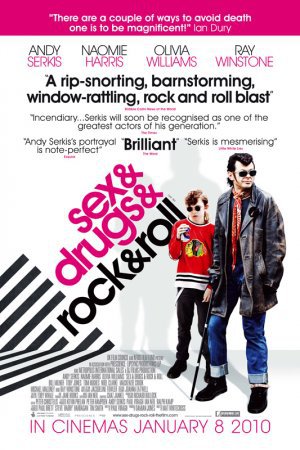
Ian Dury, one of the leading new wave British musicians of the late 70s, has his life brought to the screen in an eclectic and inconsistent film with flashes with genius. The film covers Dury’s life, from his early polio to initial success and later revitalisation. Front and centre is the effect disability has on Dury’s life, and the relationship with his son, wife and girlfriend.

The film’s main claim to fame is Andy Serkis’ brilliant performance as Dury. The role is a perfect match for Serkis’ vocal range and physicality. As a reconstruction of Dury’s style and manner it is triumphantly perfect (he has a standing invitation from the Blockheads to tour with them as Dury). What Serkis does really well here though is to delve into the heart and mind of Dury, to bring out the emotional confusion, pain and mixed desires within him – to believably present someone confusingly in love with two people, but causing both of them great pain. A man who can idolise the relationship his late father had with him, but confusingly repeat many of the mistakes of his isolated later childhood with his own children. Serkis burns up the screen, and motors the film – he’s the heart, the lungs and most of the brain as well.

It needs this ­tour-de-force of committed resurrection from Serkis, boiling with righteous indignation and cheeky charm, as the film itself is a little uninteresting to anyone not already into this era of British pop. In fact, I’d go so far as saying some initial study of Dury is pretty much essential to understand what is going on – and above all to understand the impact of various moments on the wider world. The film is rather confused in explaining the impact of this band on the cultural scene, and tends to fly too quickly over events.

It’s also stylistically an odd film. It starts with a fantastic device of Dury presenting the film like a compere at a surreal lecture, or music gig. Filmed in a concert hall, Dury runs through the events and even drags onto stage at times, like props or exhibits, moments from his past. It’s a rather avant garde idea, returned to only sporadically throughout – I suspect limited access to the filming location may have had something to do with it – but it sets up an expectation of a film that will be a bit more thematically and structurally daring than it eventually becomes. The film has a scattergun range of filmic styles, from animation to surrealist recreation, as if the director had a host of ideas about how to make the film, and threw them all in, rather than make something tonally consistent.

Away from the stylistic flourishes, you are constantly reminded that this film follows a pretty familiar series of music biog tropes: the early struggles, the success, the drugs, the loss of form, the triumphant return. The film does mine some interesting material from the relationship between Dury father and son, but even this is fundamentally a “Dad and Lad” story we have seen before.

So what makes the film stand out is the performances. Naomi Harris is heartfelt and sweet as Dury’s lover, while Olivia Williams is excellent as his understanding, undervalued wife. There are decent supporting turns from the rest of the cast, while Bill Milner underlines his promise as a performer with an intelligent turn as a son pushed into being a rebel.

It’s a decent rock biography, but depends too much on you already knowing the story – and forgiving the fact that it’s not nearly as different from other films as it likes to think it is.

Anthropoid (2016)


Jamie Dornan and Cillian Murphy plan to remove The Butcher of Prague

Director: Sean Ellis

Cast: Cillian Murphy (Jozef Gabčík), Jamie Dornan (Jan Kubiš), Anna Geislerová (Lenka Fafková), Harry Lloyd (Adolf Opálka), Toby Jones (Jan Zelenka-Hajský), Charlotte Le Bon (Marie Kovárníková), Alena Mihulová (Mrs Moravcová), Bill Milner (Ata Moravec), Vaclav Neuzil (Josef Valcik), Andrej Polak (Jaroslav Svarc), Sam Keeley (Josef Bublík)

Reinhard Heydrich, Head of the SD, Reichs-Protector of Bohemia and Bavaria (the new German name for Czechoslovakia) and the architect of the Final Solution, was the only leader of the Nazi party to be assassinated by Allied forces during the Second World War. In revenge for his death, German soldiers destroyed the town of Lodz, executing the entire adult male population and sending the rest of the population to concentration camps. The reprisals eventually numbered over 5,000 people.

This film covers the build-up and planning of the assassination (code-named Operation Anthropoid), the assassination itself and the eventual fates of the assassins. It begins with Jozef Gabčík (Cillian Murphy) and Jan Kubiš (Jamie Dornan) parachuting into Czechoslovakia, with orders to plan and execute the assassination of Heydrich. With the assassination at the half way point of the film, the second half then focuses on the immediate aftermath and the fates of those involved.

Anthropoid was a box-office disappointment when released. Personally I think a large part of this was connected to its terrible title. Anthropoidis a word that means nothing to people watching and gives you no idea what the film is about – it sounds more like a sci-fi film than anything else. It’s also a film without big-name stars, with a fantastically downer ending, and about an event many people have not heard of. It’s a shame though, as this deserved an audience.

It’s a tense, tightly structured film, sharply directed, that has events as its primary momentum over character. The characters in the film are primarily defined by their purpose within the plot. Saying that, there is scope allowed for characterisation. Cillian Murphy’s Gabčík begins the film as a man who believes himself willing to sacrifice anything for the cause. However, when the losses begin to happen, he is the man who most quickly succumbs to anger and sentiment. Conversely Jamie Dornan’s Kubiš begins as hesitant about the taking of lives, but becomes the most effective soldier among the group.

The film is actually fairly even-handed in its portrayal of the resistance members, not afraid of showing that they were not always a unified group willingly sharing a purpose. Many of the members of the resistance are hesitant about the effect the plan will have on their already decimated ranks. Others, such as Harry Lloyd’s Opálka seem almost obsessively dedicated to their duties as soldiers, at the expense of any other considerations. Even the eventual traitor is shown to be motivated at least partly by fear for the fate of his family. Similarly the film is not afraid to show the somewhat haphazard planning of the assassination, or its bungled execution (expertly reconstructed).

There is a definite mood shift after the assassination. If the first half of the film is a subdued men-on-a-mission tale, the second half is a brutal depiction of the onslaught of retribution. Ellis’ direction is crisp, taught and unflinchingly truthful, recording the actions of the police state with honesty and no sensationalism – from doors kicked in to some brutal torture scenes (the torture of one character in particular is tough to watch, without ever being graphic). The final stand of the assassins in the church is similarly brilliantly filmed and difficult to watch, a blazingly tight and bloody display of gunplay and violence, in which doomed men determine to take as many of the enemy down with them as they can.

However, as it goes on, I think the film becomes so seduced by the courage and bravery of its characters, that it stops questioning the value of their actions. From the start, many members of the Czech resistance are shown to question the worth of the plan when balanced against likely reprisals. This is an issue the film loses sight of in its second half. It is not completely surprising, considering the immense bravery of the assassins during their final stand, that the film doesn’t wish to undermine this by probing the reasoning behind their actions. But it’s a point that needs to be made and the film, in the end, dodges it: was killing Heydrich worth sacrificing 5,000 innocent Czechs in return? I’d argue probably not. The allies at the time certainly decided it wasn’t – no other attempt would be made to assassinate a leading Nazi during the war – and the question needed to be asked more in  this film. Killing Heydrich didn’t stop anything he had set in motion and had little overall impact on the outcome of the war.

Instead the film ends on a note of optimism, stressing Heydrich’s vileness and the fact that the successful assassination made the Czechs more recognised as members of the Allies. It is understandable, considering the tragic ending of the film, that its makers didn’t want to end with any doubt about the righteousness or value of their actions. And there is no doubt that Heydrich deserved his fate. But the film avoids truly addressing the collateral damage to the Czech population. It’s a single question mark over other an otherwise gripping and tense dramatisation.