Tag: Bill Murray

The Phoenician Scheme (2025)

The Phoenician Scheme (2025)

Anderson marries heart, truth and a genuinely engaging and compelling plot with his unique quirk

Director: Wes Anderson

Cast: Benecio del Toro (Zsa-Zsa Korda), Mia Threapleton (Sister Liesl), Michael Cera (Bjorn Lund), Riz Ahmed (Prince Farouk), Tom Hanks (Leland), Bryan Cranston (Reagan), Mathieu Amalric (Marseilles Bob), Richard Ayoade (Sergio), Jeffrey Wright (Marty), Scarlett Johansson (Hilda Sussman), Benedict Cumberbatch (Uncle Nubar), Rupert Friend (Excalibur), Hope Davis (Mother Superior), Bill Murray (God), Charlotte Gainsbourg (Korda’s late wife), Willem Dafoe (Knave), F. Murray Abraham (Prophet), Stephen Park (Korda’s pilot), Alex Jennings (Broadcloth), Jason Watkins (Notary)
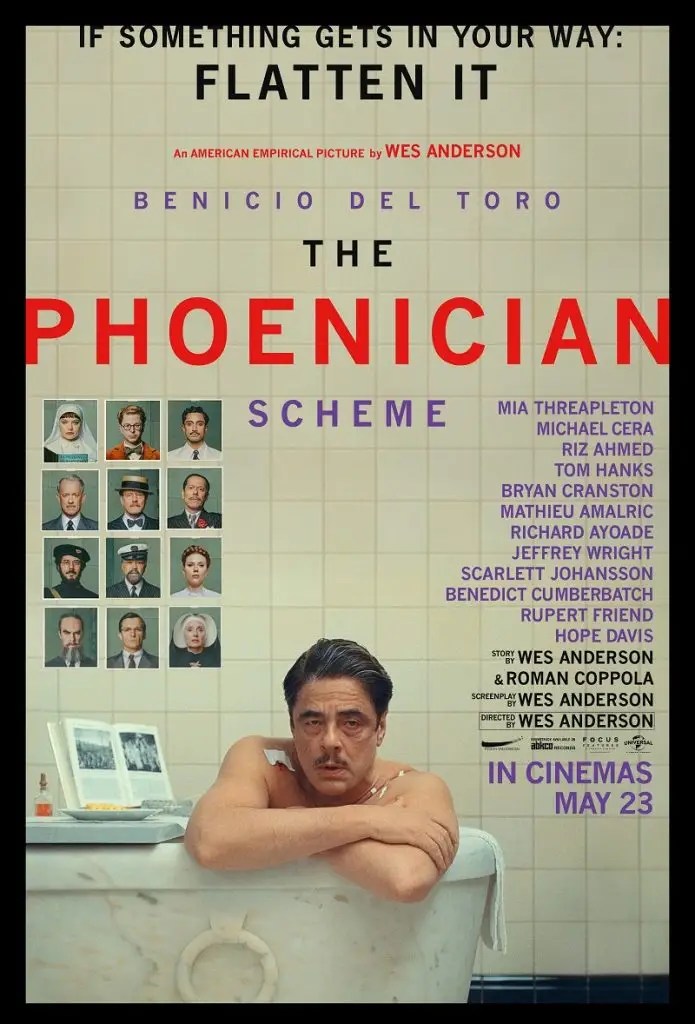
Wes Anderson is one of those directors I often sit on the fence about, with a style so distinctive it can in become overwhelming. But when it works, it works – and The Phoenician Scheme is (aside from his superb Netflix Dahl adaptations) his best work since his masterpiece The Grand Budapest Hotel. In this film, Anderson finds an emotional and story-telling engagement that adds depth to all the stylised invention. It’s a film I’ve found more rewarding the longer I’ve thought about it.

Set in an Anderson-esque 1950s (Andersonland?), notorious industrialist and arms trader Zsa-Zsa Korda (Benecio del Toro) spends his life dodging assassins. After one attempt gets close, he decides to try and repair his relationship with estranged daughter Liesl (Mia Threapleton), a novice nun who suspects her father might have had her mother murdered (he denies it). With governments, business competitors and others on his tail, Korda throws together a complex scheme for one last success in Phoenicia, a massive new development built with slave labour. As Korda juggles rivals and investors, will he repair his relationship with his daughter? And how will he fare in his recurrent visions of standing at the (noir) Gates of Heaven, being judged for entry?

Anderson’s film, of course, is another superb example of his visual style, constructed like an intricately layered work of art. Each shot could probably hang in an art gallery, framed to perfection with gorgeously sublime colours that soak off the screen. The elaborate set design and vintage costume work are striking as always, with every piece perfectly placed and every feature expertly judged. Within this, his carefully selected cast deliver the wry, dry and arch Anderson-dialogue with aplomb, embracing every moment (of many) where Anderson allows the characters to share a raised eyebrow or a pithy aside to the camera.

In other words, it might all be as you expect – a formula that started to feel a bit tired after intricate, insular films like The French Dispatch and Asteroid City, which felt so personal to Anderson that they were virtually impenetrable to everyone else. But what elevates The Phoenician Scheme is that Anderson embraces both a surprisingly tense plot-line – the closest he can probably get to a thriller, laced throughout with satire, humour and more than a fair share of the ridiculous – and gives a genuine emotional force to a father and daughter struggling to recognise what (if anything) could bring them together. Throw in questions around life, death and what constitutes making a life ‘worth living’ and you’ve got a rich, intriguing and rewarding film that could stand even without the Anderston scaffolding.

Perhaps only Anderson could mix an unscrupulous businessmen targeted by assassins (some of these are delightfully, blackly, comic – not least an opening plane bomb that sees Korda ejecting his pilot for refusing to attempt a crazy hail-Mary manoeuvre to survive an inevitable crash) with Korda closing vital deals (in a deliberately, impenetrably complex scheme) by shooting hoops with a pair of baseball-fanatic brothers (Tom Hanks and Bryan Cranston, both hilarious), taking a bullet for a fez-wearing gangster (Matheiu Almaric, wonderfully weasily) and forcing an eccentric naval captain (Jeffrey Wright, perfectly deadpan) during a blood donation to sign with a bomb. And spin out a joke where Korda hands over custom-made hand grenades to business associates like they are branded pens. All while dodging a shady government cabal (fronted by Rupert Friend’s Transatlantic Arthurian-nick-named Excalibur).

But The Phoenician Scheme works because under this comic twist on spy thrillers, it has a real heart. Anderson’s finest films are where he works with an actor who can bring depth and feeling to the quirk. And here, he might just have brought out the best from an actor prone to a little quirk himself. Benecio del Toro gives Korda a world-weary cynicism but also a subtle fragility. There is nothing that won’t flummox Korda, a guy tipped off on attempts on his life because he frequently recognises assassins he’s hired himself in the past. But he’s also quietly afraid his life has been for nothing: that he is, in fact, not a rogue but an out-and-out villain ruining countless lives. And that God (in the form of, who else, Bill Murray) isn’t going to be welcoming up there.

It motivates a careful dance of reconciliation and grooming to take over his business with his estranged daughter Liesl, delightfully played by Mia Threapleton (with just the right mix of dead-pan flair for the dialogue, while giving it an arch warmth). Liesl imagines herself as distant from Korda as can be – the novice (literally) to his expert manipulator – but she turns out to have far more talent for Korda’s mix of chutzpah, disregard for rules and ruthless improvisation. Watching the relationship – and recognition – between these two (beautifully played by both actors) is very funny and also surprisingly sweet (you know its Anderson when a nun suddenly pulling a small machete out of her wimple is both oddly endearing and absolutely hilarious).

This sense of emotional development and personal and dramatic stakes is improved further by the celestial semi-trial (cue Willem Dafoe as an advocate angel), in a black-and-white heaven that mixes Powell and Pressburger’s Matter of Life and Death (surely the name Korda is no coincidence) and the imagery of Luis Buñuel. This all leads into a surprisingly gentle but affecting tale of redemption and second-chances, including an ending that feels surprising but also somehow completely, wonderfully inevitable and fitting,

The Phoenician Scheme may even be slightly under-served by its Andersonesque framing and design: after all it’s become easy to overlook the depths when the display is as extraordinary as this. When Anderson unearths a deeper meaning, working with masterful performers who can imbue his quirky, witty dialogue with heft, he can be one of the best out there. And do all that without sacrificing an air of charming whimsy, and building towards the most hilarious fist fight since Bridget Jones’s Diary (between del Toro and Cumberbatch’s tyrannically awful Uncle Nubar). Not a lot of directors can pull that off – and it’s a lovely reminder that Anderson at his best is an absolutely unique, wonderful gem in film-making.
The Grand Budapest Hotel (2014)

The Grand Budapest Hotel (2014)

Luscious visuals, hilarious gags mix with an air of sadness and regret in Wes Anderson’s masterpiece

Director: Wes Anderson

Cast: Ralph Fiennes (M. Gustav), Tony Revolori (Zero), F. Murray Abraham (Mr Moustafa), Mathieu Amalric (Serge X), Adrien Brody (Dmitri), Willem Dafoe (Jopling), Jeff Goldblum (Deputy Kovacs), Harvey Keitel (Ludwig), Jude Law (Young Writer), Bill Murray (M. Ivan), Edward Norton (Inspector Henckels), Saoirse Ronan (Agatha), Jason Schwartzman (M. Jean), Léa Seydoux (Clotilde), Tilda Swinton (Madame D), Tom Wilkinson (Author), Owen Wilson (M. Chuck)

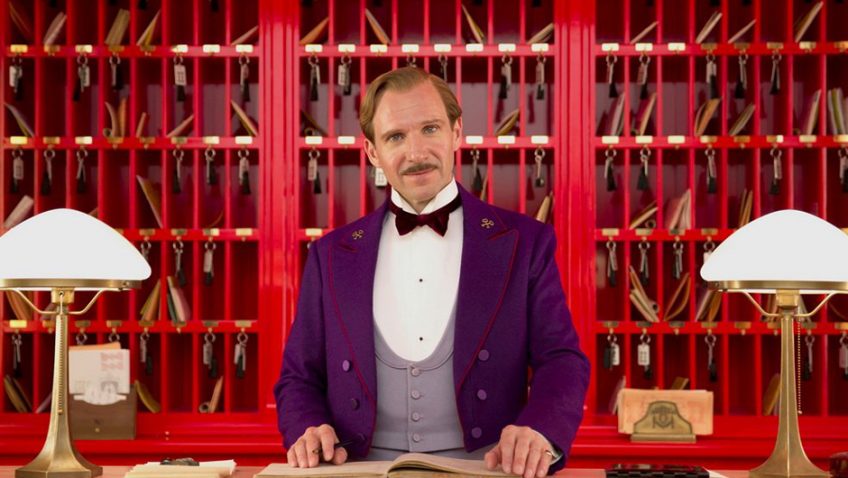
I wrote recently I could forgive the flaws I’ve found in Kurosawa’s work, for the majesty of Seven Samurai. I can totally say the same again for Wes Anderson. He is a director I’ve sometimes found quirky, mannered and artificial – but God almighty he deserves a place in the pantheon for directing a film as near to perfection as The Grand Budapest Hotel, a delight from start to finish, as beautiful to look at as it is whipper-snap funny, as heart-warming to bathe in as it is coldly, sadly bittersweet. After three viewings I can say it is, without a doubt, a masterpiece.

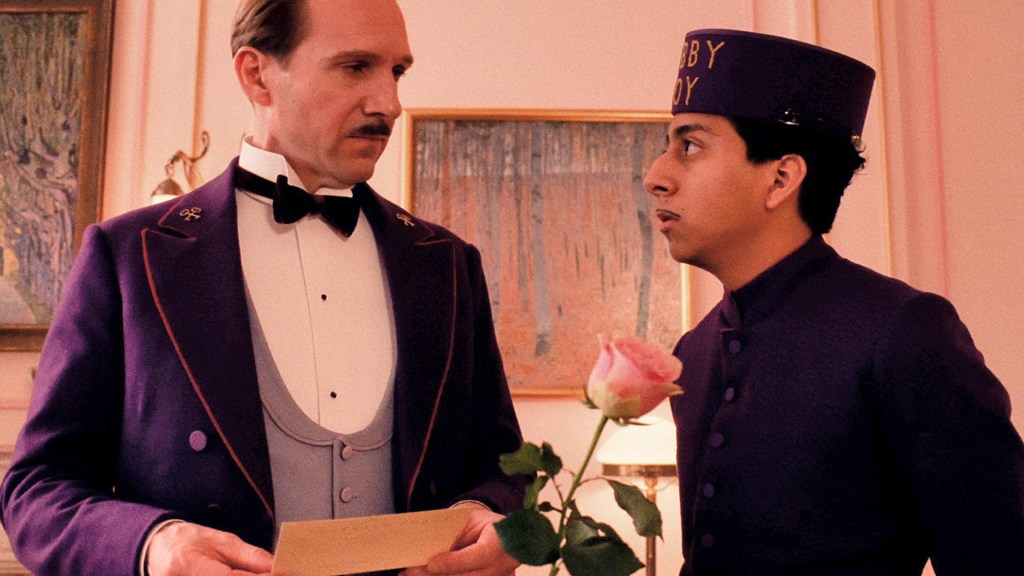
Like many Wes Anderson films, its storyline is eccentric, halfway between fantasy and absurdity. In 1932, in an opulent hotel, The Grand Budapest, concierge Monsieur Gustav (Ralph Fiennes) is the pinnacle of his trade: precise, fastidious, perfectionist, he can fix anything anywhere – opera tickets, the perfect table placement and a night of passion at any time for the elderly widows who visit his hotel. When one of them, Madame D (Tilda Swinton) dies leaving him a priceless painting, Boy with Apple he suddenly finds himself framed for her murder. Only his ingenuity, and the dedicated help of his protégé, best friend and surrogate brother/son, lobby boy Zero (Tony Revolori) will save him.

You can’t escape on the first viewing that The Grand Budapest Hotel is an extraordinarily funny film. Crammed with superb one-liners, it’s a showcase for a breathtakingly, blissfully funny performance from Ralph Fiennes whose comic timing is exquisite and whose mastery of the perfectly structured monologue of flowery language is as spot-on as his ability to deliver a crude punch-line. Anderson fills the film with clever sight-gags, bounce and a supreme sense of fun. You’ll laugh out loud (I frequently do, and I remember most of the gags) and wind back to watch them again.

But what lifts this is the wonderfully evocative, elegiac piece this beautiful film is. For all its comic zip, it unfolds in a romanticised past already a relic in 1932. We can’t escape the rise of Fascism that fills the film. Jack-booted soldiers accost and hunt Gustav and Zero. Adrien Brody’s furious heir to Madame D looks like a Gestapo officer, and his vicious heavy Jopling (Willem Dafoe so weathered, he looks like he’s been beaten by a carpet duster) has a stormtrooper menace. En route to Madame D’s funeral, Zero is nearly dragged off the train to be lynched by fascist thugs for being an immigrant and The Grand Budapest is taken over by this dreadful movement, filled with Mussolini-inspired ZZ insignia and blackshirts.

Under the jokes, the world Gustav represents has already died and been buried. We are never allowed to forget we are marching, inexorably, towards a very real-world war that will rip apart this fictional country and leave millions dead. Gustav’s gentile old-school charm ended with 1920s: and he sort of knows it. Fiennes, under the suaveness, conveys a man who falls back into potty language when he can no longer maintain his assured confidence that a straight-backed, polite assurance will solve any problem or a poetic reflection will allow them to put any unpleasantness behind them. Those days are gone and it makes for a deep, rich vein of sadness just under the surface.

It’s particularly acute because it’s made clear this is a memory piece. Anderson constructs the film like a memory box. It has no less than three framing devices. It opens and closes with a young woman in 2014 visiting a monument to a great writer, the author of the book The Grand Budapest Hotel. From there we flash back to the author (a droll Tom Wilkinson) in 1985 recounting how he met the man who inspired the novel, before heading again to a flashback to the 1960s where the young author (Jude Law) meets the man we discover is an older Zero (F Murray Abraham) who recounts the story we then watch. Each layer of the film descends deeper into Anderson’s artificial, carefully structured visual style, with its heightened sense of reality.

Old Zero – beautifully played by F. Murray Abraham – is introduced as a man of acute loneliness and sadness, who tells us early on the woman his young self loves, Agatha (a radiant Saoirse Ronan) will die and shuffles around the nearly abandoned The Grand Budapest (now a concrete nightmare of Communist architecture) with only his memories for comfort. No matter how jovial and bright the events of the 1930s are, we can’t forget that these are the reflections of a man full of regrets.

When old Zero’s narration turns to remembering Agatha, the lights around him dim: Agatha even enters the narrative almost by the side door: Gustav is arrested and imprisoned before she appears, along with a series of flashbacks-within-flashbacks to Zero and her meeting and her first meeting with Gustav, as if Zero had to steel himself to remember her (as reflected in Abraham’s tear-stained face). Later, when remembering the fates of Gustav (his best friend) and Agatha (the love of his life) he almost draws a veil over it (even their final scenes in flashback play out in monochrome). There is a deep, moving sense of humanity here, a powerful thread of grief that adds immense richness.

But don’t forget this is also a funny film! Anderson is an inventive visual and narrative director at the best of times, and here every single beat of his playful style pays off in spades. The entire 1930s section of the film (the overwhelming bulk of the narrative) plays out in 4:3 ratio, which to many other directors would be restrictive, but seems a perfect fit for a director who often composes his visuals with the skill of an expert cartoonist. The frame is frequently filled in every direction when within the grandeur of the hotel, but then feels marvellously restrictive for Gustav’s prison cell or the train compartments that seem to constantly carry Zero and him to disaster.

Anderson’s wonderfully precise camera movements also reach their zenith here. His camera is deceptively static, often placed in a series of perfectly staged compositions that places the characters at their heart, frequently looking at us. But then the camera will turn – frequently in a fluid single-plain ninety degrees to reveal a new image of character. There are Steadicam tracking shots that are a dream to watch. It’s combined with some truly astounding model shots (parts of the set are not-even-disguised animated models and miniatures, adding to the sense of fantasia) and the detail of every inch of the design (astounding work from Adam Stockhausen and Anna Pinnock) is perfection. The film is an opulent visual delight.

It’s a film of belly laughs and then moments of haunting sadness. But also, a wonderful celebration of friendship. The bond between Gustav and Zero is profound, natural and deeply moving – grounded, fittingly, in adversity from the agents of a hostile, oppressive state – and carries real emotional force. Newcomer Tony Revolori is hugely endearing as naïve but brave Zero, making his way in this new world (fitting the theme, he left his homeland after his family was destroyed by war) and sparks superbly with Fiennes and Ronan.

There is a wonderful beating heart in The Grand Budapest Hotel, amongst the farce, perfectly timed gags and cheekiness, that makes it a rich film you can luxuriate in. Anderson’s direction is faultless, Fiennes is a breathtaking revelation, both hilarious, affronted, decent and fighting the good fight. Gorgeous to look at, thought-provoking and laugh-out loud funny it’s a dream of a film.

Groundhog Day (1993)

Bill Murray lives the same day over-and-over again. It’s Groundhog Day!

Director: Harold Ramis

Cast: Bill Murray (Phil Connors), Andie MacDowell (Rita Hanson), Chris Elliott (Larry), Stephen Tobolowsky (Ned Ryerson), Brian Doyle-Murray (Buster Green), Marita Geraghty (Nancy Taylor), Angela Paton (Mrs Lancaster), Rick Ducommun (Gus), Rick Overton (Ralph), Robin Duke (Doris)

Few films are so well known they’ve become a shorthand. But mention “it’s like Groundhog Day” to anyone, and they know exactly what you mean. That’s a tribute to the film’s brilliant concept – but also its superb execution. Never mind just comedies, this is one of the smartest and best films to come out of America in the 1990s, so good it doesn’t seem to have aged a day. Groundhog Day is an enduring classic and quite wonderful.

Phil Connors (Bill Murray) is a misanthropic weatherman on a Pittsburgh news network. Every February, he is dispatched to the small town of Punxsutawney to cover “Groundhog Day”, an annual festivity where a local groundhog is used to predict whether winter will last six more weeks. Phil makes no secret of his contempt for the event, the town, its inhabitants and indeed everything else. After being trapped in the town by a snowstorm he failed to predict, Phil wakes up the next day – to find it’s Groundhog Day again! When the same thing happens the next day, Phil realises he is trapped living the same day in the small town over and over again – and no matter what he does during the day, he will always wake up in his hotel bed at 6am on Groundhog Day. What will he use the never-ending time for? Personal advantage? Or just maybe, becoming a better man?

Groundhog Day works because its concept is gloriously simple, and yet endlessly intriguing. Who can’t relate to the idea of a prolonged déjà vu? And anyway, don’t most of us feel at some points life is a never-ending treadmill (one of the town’s residents, asked what he would do, stuck in the same place every day where nothing you did mattered, replies “That about sums it up for me”)? Whole books have been written about the film’s philosophical roots – from Nietzsche to Buddhism – and the time loop’s duration. The film invites this because it keeps these concepts gloriously unexplained.

Imagine how much less powerful (and funny) the film would have been if Ramis had caved to studio pressure to either include a scene explaining why the time-loop was happening or providing a definitive answer for how long Phil spends in it. Hilariously, studio execs settled on a short period of time measured in months – others have gone for anywhere between decades to millennia. It’s certainly long enough for Phil to learn by heart the complete biographies of the entire town’s population, know the timeline of every event in the day to the second, and master everything from the piano (to Beethoven-like proficiency), to French and ice sculpting. There is a magic about not knowing the answer to these questions, that make the story brilliantly charming.

It also helps that the film remains, at heart, not science-fiction (which explanations would tip it towards) but a Capra-esque morality tale. The time-loop is, essentially, a second-chance over-and-over again for Phil to become a better person: to change from being a selfish misanthrope into a kinder, generous soul. That’s a story everyone can relate to, and becomes more and more heartfelt as the film continues (culminating in its uplifting conclusion). It also has the Capra touch of a heartless professional from the big city discovering (eventually) a warmth and truth in small-town America where the people are straight-forward and unaffected.

Which makes the film sound tediously feel-good. It escapes this completely because of three reasons. Firstly, initially Phil uses his new super-power of 24-hour immortality for what most of us would do – gain and greed. No consequences ever. Theft is child’s play when you know the exact second bank staff will be looking the other way. Easy to seduce a woman when you can ask her a series of questions on one circuit, then use her answers to pick her up on the next one. You can do whatever you want, confident the next day you’ll wake up in your hotel bed to I Got You Babe.

Even on his journey to eventual self-improvement, Phil only begins to change after exhausting all other options, including repeated attempts at suicide, to try and break the loop. And Phil, for all his charm, is not a good guy for a long time. His attempted seduction of producer Rita (a charmingly winning Andie MacDowell) over a never-ending series of first dates constantly fails, because no matter what happens, she eventually sees through his lack of decency (Phil’s attempts to recapture moments of spontaneous genuineness in later circuits fail completely).

Secondly, the film is brilliantly, gloriously funny – even with repeat viewings. Ramis’ brilliant shooting and structuring of the film focus on its repetition. We see the same shots and sets, hear the same music cues, the film is edited to stress repetition. Few things in comedy are as funny as anticipation and watching characters fly in the face of all the social conventions we deal with everyday. Seeing Phil’s different reactions to the same stimulus each time never fails to raise a laugh. Knowing the events almost as well as Phil, we eagerly await unexpected reactions. The script – by Ramis and Danny Rubin – is packed with brilliant lines, wonderful set-ups and is superbly structured. The first loop establishes all the settings and situations Phil will spend the rest of the film continually interacting with, and the film allows us to often be in on the joke with Phil (making us like him more).

Thirdly, and perhaps almost most importantly, the film could never have worked without Bill Murray in the lead role. For all the pull for Lost in Translation, this is surely Bill Murray’s finest performance, and stands comparison with the best work of Jimmy Stewart and Spencer Tracy, laced with that classic Murray touch. There is no other actor who can present a character so grouchy, deadpan, cynical and selfish but still make us love him. And – for all the terrible things Phil does in this film – you never stop liking him. His comic timing is exquisite (his varying reactions from frustration, confusion, glee and despair at his predicament spot on) but he also taps brilliantly into moments of genuine heart, loss and despair. Murray has spoken of how the theme of redemption spoke very strongly to him – and he plays perfectly a man so selfish that only after he has exhausted all other eventualities – including death – does he start to become a better man. It’s one of the greatest film performances of the 1990s, and the film is impossible without him.

Groundhog Day is pretty much perfect. The town of Punxsutawney is presented to us at first much like Phil sees it – old-fashioned and twee, populated by well-meaning but dull residents – but over the course of the loop, like Phil, we learn to embrace it. It perfectly mixes a glee at breaking the rules and embracing your inner misanthrope, with learning to develop and improve. It’s both hilarious and heart-warming, with every scene a classic and every performance spot-on. It has a timeless (!) quality about it, and its focus on telling a rollicking good story, full of heartfelt emotion and fabulous jokes, means you can add as much or as little spiritual depth to it as you like. It’s a modern It’s a Wonderful Life that might even be better.

On the Rocks (2020)

Rashida Jones and Bill Murray deal with family problems in On the Rocks

Director: Sofia Coppola

Cast: Rashida Jones (Laura), Bill Murray (Felix), Marlon Wayans (Dean), Jessica Henwick (Fiona), Jenny Slate (Vanessa), Barbara Bain (Gran)

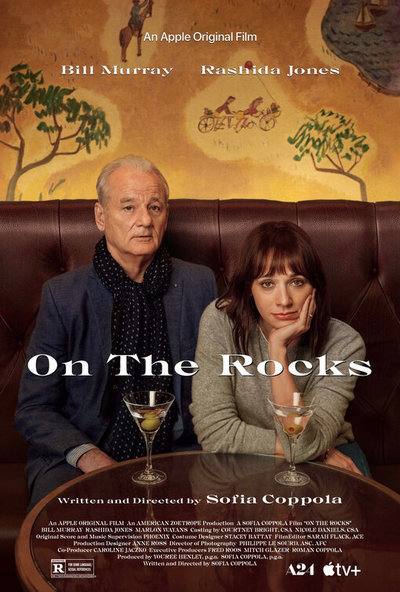
There is often a special bond between fathers and daughters. And it’s one that can be challenged if the father is “replaced” by a husband. After all, nobody wants to go from being the main man to second best. But how complex can this become when the father himself has a track record of selfishness and philandering? And is that the best person for the daughter to turn to when she starts to have doubts about her own husband? In Sofia Coppola’s gentle, light-weight film, Laura (Rashida Jones) reconnects with her roguish millionaire father Felix (Bill Murray), a successful retired art dealer, as she becomes increasingly worried that her husband Dean (Marlon Wayans) is having an affair with his attractive younger colleague Fiona (Jessica Henwick).

Coppola’s new film is an entertaining, low-key family and relationship drama that’s as light as a puff of air. Recycling many familiar ideas from her previous films – in particular the idea of women who seemingly “have it all” but are feeling discontented and trapped in their lives – it spins off into a fairly gentle parable of how doubts and insecurities can take over our lives, which mainly serves as a lovely little showpiece for two very engaging actors to entertainingly do their thing.

Rashida Jones balances the trickier part as a woman who’s half endearingly fond of her fun-loving dad, half infuriated and damaged by the way he wrecked his marriage to her mother and ruined her childhood (it seems her sister and mother are no longer on speaking terms with him). At the same time, she’s keen to hold onto her successful writing career and family life – while also facing an existential crisis as she feels herself becoming more and more stuck in a rut. There are distant echoes of the lack of focus Scarlett Johansson’s character felt in Lost in Translation, the many lonely women running the house in The Beguiled, or the rich girls cut adrift in The Bling Ring or Marie Antoinette.

Into all this drops the bombshell of her husband’s possible infidelity. Coppola gently uses this as a subtle investigation of human nature. Is infidelity and betrayal something all people have as common possibilities? Or does a history of infidelity in our families make us more ready to see it everywhere? Gentle is the word, as the film doesn’t really labour any of these points – perhaps worried that to do so would take it into deeper waters than it has the nerves to handle – and prefers to keep the mood light and frothy. This does mean that when – eventually – emotional moments come, they come rather from nothing, and a braver film would have balanced better the lightness of father and daughter chasing after a (possibly) cheating husband, with tension between that same father and daughter over his appalling past behaviour.

But then, the film perhaps falls rather in love with Bill Murray – and genuinely it’s pretty hard not to. Sofia Coppola again provides Murray with a part designed to match all his strengths. A charming performer, it’s very hard (near impossible) not to like Murray and as he coasts through the film with relaxed cool, arching an eyebrow there, a touch of glib lightness here, investing certain lines with a saggy sadness, others with a playful childishness, you’ll enjoy every moment. Murray makes perfect sense as the ageing rouéand cad, who has lived his life entirely for his own pleasure, and now is conducted by chauffeur from hotel to hotel, flirting with any woman who crosses his path.

It’s a delightful performance, with several scene stealing moments – not least when Felix is pulled over by the cops and charms his way out of a ticket with confidence, a bottomless contact book and charm. The cops even push-start his showy old sports car. Of course it’s the ultimate display of white privilege: I’m interested if Dean would have had similar success if it was him. The film shies away from any commentary on race at all, which feels like a missed opportunity. Does Dean put so many hours into work because he needs to prove himself in the ways people like Felix never had to? A different film might have wondered if sub-consciously Felix was even more jealous and concerned about losing his daughter to a black man. But these are areas the film chooses not to go into.

Instead it largely settles for being a charming meander, centred around Murray’s character, that doesn’t want you to look to closely and realise what a selfish cad he really is. Of course the film is really about Felix’s regrets about not having the relationship he would like to have with his children (and Murray more than gets this across with his skilful suggestion of sadness behind the eyes), but even this is a beat the film very lightly taps. What you end up with is a very light, almost whimsical film that moves through a series of events that wind up feeling rather inconsequential. A puff of air you feel would blow the film apart.

Tootsie (1982)

Dustin Hoffman plays somewhat against type in the marvellous Tootsie

Director: Sydney Pollack

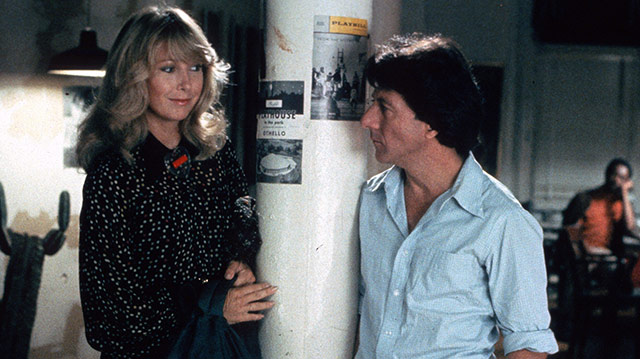
Cast: Dustin Hoffman (Michael Dorsey/Dorothy Michaels), Jessica Lange (Julie Nichols), Teri Garr (Sandy Lester), Dabney Coleman (Ron Carlisle), Doris Belack (Rita Marshall), Charles Durning (Les Nichols), Bill Murray (Jeff Slater), Sydney Pollack (George Fields), George Gaynes (John van Horn), Geena Davis (April Page)

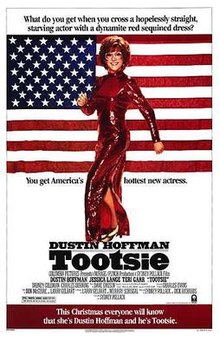
It sounds like a movie idea from hell: “We’ll get Dustin Hoffman to play a struggling actor who can only get a job when he dresses as a middle-aged woman and auditions for a daytime soap. Hilarious misunderstandings will follow…” But you’d be wrong: Tootsie is an absolute delight: not only a wonderful comedy, but a touching love story and an acute commentary on sexism and the compromises women are forced to make to get the same opportunities as men. It’s a wonderful, smart, thought-provoking film.

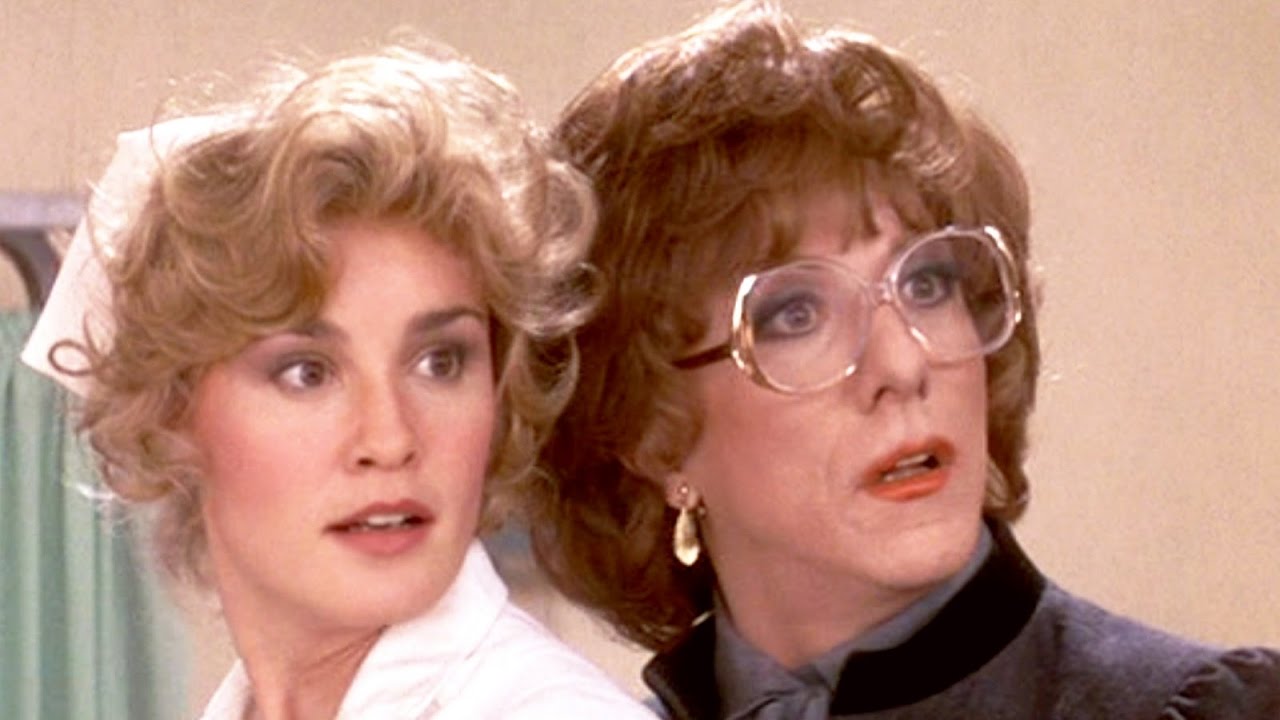
In a role that draws on more than a little self-parody, Dustin Hoffman plays Michael Dorsey, a dedicated, demanding, difficult actor who has alienated so many people across Broadway and Hollywood with his unwillingness to compromise that he can’t land a job. When his friend Sandy (Teri Garr) flunks an audition on a General Hospital-style daytime soap, Michael thinks “what the hell” and puts himself forward for the role under the disguise of the middle-aged “Dorothy Michaels”. Surprisingly he finds he lands the job: and realises that women’s lot on the masculine film-set is not a happy one, evading sexual approaches, treated like idiots and generally encouraged to not pipe up. Intelligent, clever fellow-cast member Julie Nichols (Jessica Lange) hides her light under a bushel. At first Michael enjoys the respect he wins, but as Dorothy increasingly becomes a feminist icon he’s plagued with guilt at the lies and deceptions he’s practising.

It’s the sort of idea that should be either patronising today (a man learns about feminism by walking in a woman’s shoes!) or inadvertently toe-curling. The fact that it isn’t (and I’ve watched this film with women who have enjoyed it a great deal, so I’m not completely guessing here!) is a tribute to the film’s lightness of touch, combined with a neat sense of the ridiculous, along with the emotional truth and genuineness that the film is handled with. It neither preaches nor mocks but simply focuses on telling the story and allowing us to draw our own conclusions. It also has a script packed through with some absolutely cracking jokes, all of which are delivered straight.

Central to its success is Dustin Hoffman, who plays the entire role completely straight. His Michael is a neat self-parody in his abrasive difficulty – but he’s also shown to be a concerned and genuine friend to Teri Garr’s delightfully ditzy Sandy, urging her to have more confidence (little realising how difficult it is for women to impress male casting directors if they behave with the confidence of men). Sure he’s not above clumsy passes to women at parties, but he’s no dinosaur or sexist. And becoming Dorothy Michaels is an opportunist moment of eagerness to show he has range and can get work if severed from his terrible reputation, rather than having any cruel or mocking motivations.

And what Hoffman does so well here is that Dorothy becomes her own personality. And that Michael immediately recognises that Dorothy, with her assurance, her kindness, her unwillingness to take nonsense, but her serene confidence, is a much better person than he is. She refuses to be trapped into either of the two roles the director intends for her (love interest or shrew) but insists her role in the hospital soap be treated like a dedicated professional, not defined by her sex – which makes her exactly the sort of role-model women around her (and eventually across America) have yearned for. Somehow as well, the film gets us to invest in what a great person Dorothy is, even as we know it’s really Michael in disguise – and Hoffman never, ever plays the part for laughs.

The casting allows the film to get a number of hilarious shots at the fast-paced, poorly-written, cheaply sexist nonsense that goes into daytime soaps. The director of the show is a roving lothario (played with all the smarm at his command by Dabney Coleman), who opposes Dorothy’s casting because she is not attractive enough, talks over the women in the cast and expects affairs as part of his salary. The show’s leading man is an aged actor (played with an oblivious sweetness by George Gaynes) who expects to kiss every woman in the show and is totally unable to learn lines. The plots of the soap are a joke, and the actresses are frequently placed into demeaning situations that real nurses and administrators (the only roles of course women can play in a hospital!) would never do.

Becoming horrified by this, Dorothy/Michael encourages the other women in the cast to break out from this – not least Julie Nichols, beautifully played by Jessica Lange as an intelligent, sensitive woman forced into pretending to be an airhead so as not to disturb the men around her. Lange is superb in this role, and so radiant that of course Dorothy/Michael finds himself falling in love with her – a complexity that constantly intrudes on the sisterly bond that Julie increasingly feels for Dorothy…

And that’s another source of guilt for Michael, who is (despite it all) a good guy, and slowly works out that there is no way of extracting himself from all this without hurting people’s feelings (not least when Julie’s sweetly charming widowed dad – played wonderfully by Charles Durning – starts to have feelings for Dorothy). Michael doesn’t want to hurt anyone – not even Sandy, with whom he finds himself stumbling into a one-night stand that he can’t work out how to reverse out of because he’s so desperate not to damage their friendship (something that he of course ends up damaging anyway). It’s a film that brilliantly balances these personal struggles with wider pictures.

Because, as Michael is aware, he’s himself guilty of using women by stealing the cause of feminism by pretending to be a woman. He’s perpetrating a con on the whole of America, and can’t work out a way to back out. The solution he does finally find is a comic tour-de-force – while finding time to still focus later on the real, emotional impact on those who have come closest to Dorothy – and gently indicates how lives can move on.

Sydney Pollack has probably never directed a film as smart, touching and wise as this one (he also puts in a hilarious cameo as Michael’s frustrated agent). It’s a film that could have been just a comedy about a man in drag, but in fact ends up raising profound issues about sexism, feminism and relationships that still feel relevant today. It’s almost certainly Hoffman’s greatest performance – honestly, he’s sublime here, it’s a once in a lifetime performance – and there is barely a wrong beat in it. The cast fall on the great script with relish – Garr was never better and Bill Murray has a superb unbilled supporting role as Michael’s acerbic, playwright housemate. You’ll laugh, you’ll cry, you’ll think and you’ll want to watch it again. Can’t say better than that.