
Tag: Brian Cox

Churchill (2017)


Brian Cox does his very best Greatest Britain as Churchill

Director: Jonathan Teplitzky

Cast: Brian Cox (Winston Churchill), Miranda Richardson (Clementine Churchill), John Slattery (General Dwight D. Eisenhower), James Purefoy (King George VI), Ella Purnell (Helen Garrett), Richard Durden (Jan Smuts), Julian Wadham (Field Marshall Bernard Montgomery), Danny Webb (Field Marshall Alan Brooke), Jonathan Aris (Air Field Marshall Trafford Leigh-Mallory)
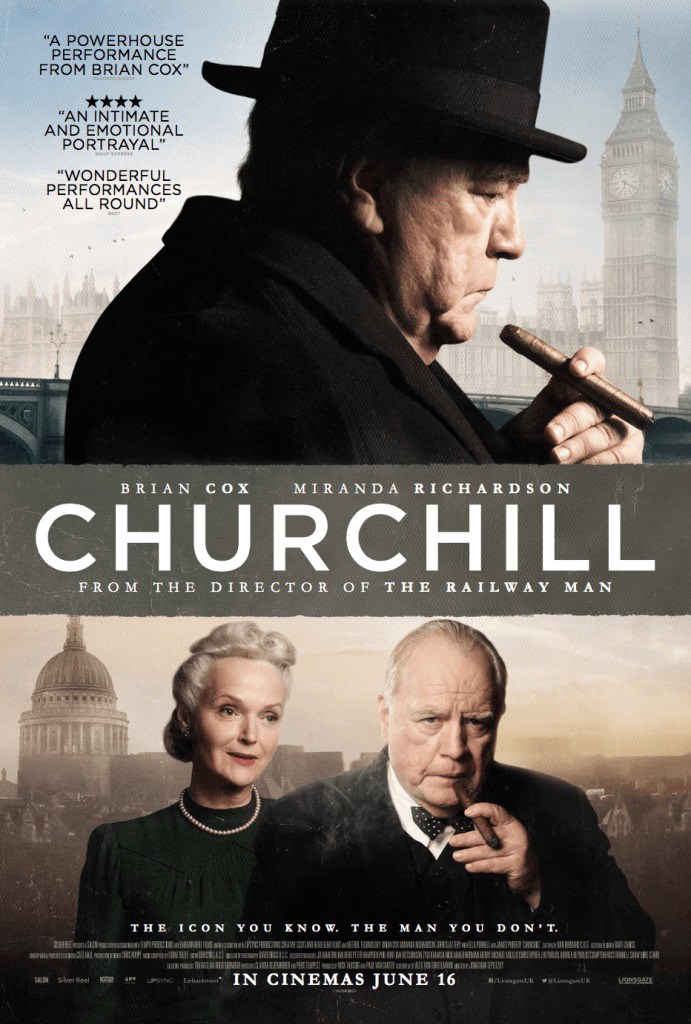
Someone should open a club: The Churchill Club. Every actor who’s played the Great Man gets instant membership. President the late Robert Hardy (seven times!). Other members? You name it: Finney, Gambon, Burton, Spall, Gleeson, Russell Beale, West, Hoskins… Think of a shorter, slightly rotund British character actor and inevitably they’ve had a go. Even the decidedly non-rotund, non-short, non-British John Lithgow aced the role in Netflix’s The Crown. With Gary Oldman also making his pitch this year in Darkest Hour, this film sees renowned character actor Brian Cox join the club. 

1944. Its three days before D-Day and Winston Churchill (Brian Cox) is getting cold feet. Haunted by memories of Gallipoli, he fears that the attack on Northern France will lead to disaster and oceans of blood. Against the advice of his Generals Montgomery (Julian Wadham) and Brooke (Danny Webb), he attempts to push General Eisenhower (John Slattery) to change the plans. As depression takes its grip on him, only his wife Clementine (Miranda Richardson) can get through to him. 

Churchill is a bit of a mess. It’s pretty well acted but highly televisual, shot with a self-conscious flourish that only emphasises its micro-budget. Teplitzky is in love with the cross-fade (or even worse the half fade) – constantly cutting from place to place for brief moments in the middle of scenes, often for lingering shots of actors staring out to sea or walking through fields. The action is often framed oddly, in long shot with full bodies in shot framed between ground and sky. Other scenes are filmed flatly – when Montgomery addresses his army, no amount of slow pans can hide that it consists of about 20 men.

On top of that, every single scene is scored within an inch of its bloody life. Now I love the power of film music, but this goes too far. The score is bland, predictable and unimaginative and just not that interesting to listen to. When it’s dropped heavy-handedly on top of every single scene it makes you want to scream. It’s also often completely misjudged or inappropriate – as gentle romantic piano swells during a key discussion between Churchill and the King, you almost expect them to kiss. 

That’s before we get started on the script, which is instantly forgettable. Alex von Tunkleman wrote a long running column in the Guardian on historical accuracy (or not) in films. Talk about a hostage to fortune, when you try to write your own film… I’ll go into historical issues in a bit, but there are lots of little things that feel wrong from Smuts (Deputy PM Of South Africa!) following Churchill around like some sort of valet too Montgomery addressing the Prime Minister to his face as “Churchill”. Stuff that just doesn’t feel quite right. The script also relies on a fictional “young secretary” who eventually speaks truth to the great man and wins his respect. Von Tunkleman is no writer of snappy dialogue, the film too often feeling like a wonky history lesson than a drama.

Historically the film does explore a different side of Churchill – enough to ruffle the feathers of the millions of Churchill fans out there. It focuses on his depression and self-doubt, within the framework of a period when he was starting to become sidelined by America. It also focuses on his little known opposition (certainly initially) to D-Day (he favoured a second front opened in Europe’s “soft underbelly” of Italy) – although it certainly expands this last-minute opposition for dramatic effect. I’m pretty sure he was on board by this point (however initially reluctant)!

What the film looks like it might do (but never quite does) is really explore some of Churchill’s laws and vulnerabilities – to look at the negatives and see how overcoming (or dealing with these) made him a great man. It touches heavily on Churchill’s depression – the “black dog” – with a desperately worried Churchill retiring to his bed to despair, praying for bad weather to prevent the landing and bawling out his secretary. Churchill is frequently wrong or mistaken, and the film captures much of the frustration his generals had with this talented amateur. It also isn’t afraid to show that, with American muscle driving the war, Churchill was becoming more of a mascot than a major orchestrator of allied strategy.

It’s a shaded portrait, but the film is eventually seduced by Churchill’s magnestism – a King’s Speech style final radio broadcast is all swelling regard, and a coda of Churchill waving his hat on a beach towards France hammers home his legendary status – miles away from its careful look at his growing irrelevance (and his concerns about this) early in the film. For all we have characters constantly stressing to Churchill his time is passing, the film can’t help finishing with a flourish that hammers home his centrality.

Churchill is flat and unimaginative but it does have an energetic, engaging performance from Brian Cox. While not in the first rank of Churchills, he captures the charisma, without slavishly imitating the famous voice. His Churchill, with his depression and doubt, also feels different: a slightly counter-establishment actor like Cox fits nicely with this. It’s an assured, charismatic performance hampered by the material. The rest of the cast feed off scraps though Miranda Richardson is assured as a twinkly level-headed Clementine. Richard Durden also deserves mention as gruffly supportive Smuts, as does James Purefoy as a gentle George VI.

Churchill means well – but fails. It’s aiming to question some of the reverence we have for the past, but ends up falling between stools, in the end too in love with the myth, but too critical to please the die hards. Flatly filmed and woodenly written, too many scenes fade from memory too quickly. Brian Cox (and Winston) deserved better.

Match Point (2005)


Love and lust collide in Woody Allen’s bizarrely classless Britain

Director: Woody Allen

Cast: Jonathan Rhys Meyers (Chris Wilton), Scarlett Johansson (Nola Rice), Emily Mortimer (Chloe Hewett Wilton), Matthew Goode (Tom Hewett), Brian Cox (Alec Hewett), Penelope Wilton (Eleanor Hewett), Ewen Bremner (Inspector Dowd), James Nesbitt (Detective Mike Banner), Rupert Penry-Jones (Henry), Margaret Tyzack (Mrs Eastby), Alexander Armstrong (Mr Townsend)

Match Point was originally intended to be filmed in New York, but Woody Allen could only raise the cash in Britain – so the location was shifted to London. The effect is a little bit like Julian Fellowes switching Downton Abbey to become a kitchen-sink drama in Liverpool: research has been done, the facts are all ticked off, but the understanding of the people and their situation just isn’t there. Maybe Allen should have hired Fellowes as a consultant. At least Fellowes could have told him an upper-class Covent Garden opera buff probably isn’t going to be in raptures about Andrew Lloyd-Webber’s The Woman in White.

Chris Winter (Jonathan Rhys-Meyers) is a tennis pro, now making a living as a coach in an upmarket London club. He coaches Tom Hewitt (Matthew Goode), and they discover a shared love of opera. Soon Chris is a regular visitor to the Hewitt family, a suitor and later husband to Tom’s sister Chloe (Emily Mortimer) and an employee at his father’s big city firm. He has everything he wants – except for Nola Rice (Scarlett Johnasson), Tom’s American actress fiancée…

The film was critically acclaimed in America but received a much more muted response here in Blighty. I can see why. Allen’s main problem is that he is tone deaf to the class hierarchy in this country. As such, he creates a Britain here that is close to something we would recognise, but subtly off. Chris is clearly from a lower social class than the family he marries into, he’s employed as a coach in a tennis club and he’s clearly less well travelled than the others. The family he marries into has a massive country house with servants, goes shooting at the weekend, runs a huge London business – it’s a modern day Downton Abbey.

If the same story was created by a British writer and director, Chris would clearly be presented as an ambitious, even ruthless, social climber looking to move up the ladder by doing everything he can to marry into a rich family and inveigling himself into their lives. Allen, however, doesn’t present the relationship like this – in fact, watching the film, I think it’s clear that he doesn’t really realise that Chris and his in-laws are in a totally different social class. He treats them all as if they are basically social equals, with money the only difference between them. For the British this just doesn’t fit in at all with our experience of the class system in this country – we know the Hewetts and Chris would always be aware of the social background difference between them, and that someone would comment upon it during the course of the film. No-one ever does. Class remains unmentioned. For a British person this just isn’t right.

So the “tragedy” if you like (or character flaw) of Chris should be that he is drawn sexually towards Nola Rice, despite it flying against his ambitions for moving upwards in his class. Instead, Allen’s script treats it solely as an affair of passion: the fact that the two “outsiders” in the social class (the working-class Irish boy and the American actress) are drawn to each other isn’t commented upon at all. The Hewetts are more suspicious of Rice because she’s an American and an actress, but the fact she (like Chris) doesn’t have a penny isn’t an issue. There is a lot of fertile ground here that any British director or writer would just know – but Allen fundamentally just doesn’t get it: he thinks the Hewetts are middle class not the loaded 1%+.

Of course, some of the problems are connected to Jonathan Rhys Meyers in the lead part. Watching him in this film, I can’t help but feel this is a solid 7/10 performance by an actor who normally bats a 5-6: he’s doing some of his best work on film, but his inadequacies as an actor can’t be overcome. It’s the eyes and voice for me: there just never seems much going on behind the eyes, and his unmodulated voice doesn’t bring any shading to his line deliveries. Chris should have the air of a slightly ruthless, ambitious but charming social climber – think Dennis Price in Kind Hearts and Coronets – but this is out of his range. Instead Chris is just a sort of blank that you can impose their own ideas on: it sort of works for the film, but it misses dozens of possibilities. He does well with the second half of the film and his guilt about the murder is well played, but it’s simply less subtle acting than is called for in the first half. He’s an average actor giving a performance above himself here.

Scarlett Johansson fares much better as a character who changes and develops dramatically over the course of the film, from mysterious, confident, sexy girlfriend to needy, frustrated, betrayed mistress. It’s a dramatic development throughout the film that is so skilfully done, it never feels jarring. Much of the cast is also strong: Matthew Goode is a real stand-out as Chris’ subtly spoilt brother-in-law, as is Emily Mortimer as a happy wife who never wants to think about the lie her life is. Rupert Penry-Jones and Margaret Tyzack have great cameos among the all star British cast.

The film takes place in a picture-postcard London (all the great sights are ticked off), and Allen directs with his traditional unfussy camera work. There is a certain pleasure to seeing big name British comic actors in tiny roles throughout (Paul Kaye, Mark Gatiss, Steve Pemberton and Alexander Armstrong among others pop up in small roles).

Allen doesn’t understand Britain like he does Manhattan, but that doesn’t mean it isn’t a decent film. The story’s theme of luck or chance vs fate doesn’t quite coalesce for me, but the feeling of events closing in on Chris late in the film does work very well, and I certainly felt the tension of whether Chris would get away with his eventual crime (even if I never really quite cared for Chris himself). Allen rates this as his favourite of his own films – which I guess goes to show you are never the best judge of your own work.