Tag: Brian d’Arcy James

West Side Story (2021)

West Side Story header
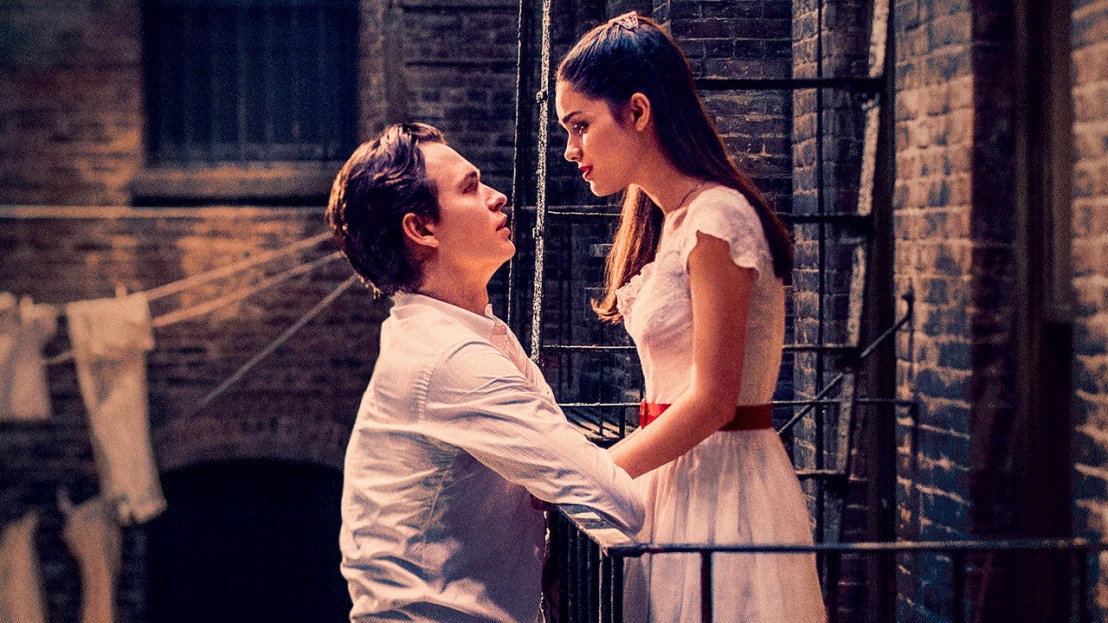
Ansel Elgort and Rachel Zegler are star cross’d lovers in Spielberg’s triumphant West Side Story

Director: Steven Spielberg

Cast: Ansel Elgort (Tony), Rachel Zegler (Maria), Ariana DeBose (Antia), David Alvarez (Bernardo), Mike Faist (Riff), Rita Moreno (Valentina), Brian d’Arcy James (Officer Krupke), Corey Stoll (Lt Schrank), Josh Andres Rivera (Chino), Iris Menas (Anybodys)
Was there actually a need to remake West Side Story? It’s the question everyone was asking before the film’s release. Judging by the disaster at the Box Office (also connected to our old friend Covid), it’s a question people are still asking. Well, you remake it by refocusing and partially reinventing it while remaining loyal to the roots of what makes this one of the greatest 20th century musicals. Spielberg’s triumphant film does exactly this, in many places even exceeding the Oscar winning original. This West Side Story is full of toe-tapping, heart-breaking numbers, gloriously choreographed numbers and scenes of high emotion and social insight.

In 1957 in Manhattan’s West Side, it’s the dying days of the San Juan Hill district, which is being slowly bulldozed to build the Lincoln Centre. Scrambling to retain control of what’s left are two gangs of youths: the Jets, a group of white rough kids led by Riff (Mike Faist) and the Sharks, a migrant Puerto Rican gang led by would-be boxer Bernardo (David Alvarez). The two groups plan a ‘rumble’ to settle matters forever. A fight that ends up carrying even more importance when both communities are outraged by the burgeoning romance between former Jet leader Tony (Ansel Elgort) and Bernardo’s sister Maria (Rachel Zegler). Will love triumph over hate? Well, it’s based on Romeo and Juliet, so I’ll leave it to you to work that out.

The original, Oscar-laden, West Side Story is a ground-breaking and brilliant musical. Based closely on the triumphant original Broadway production, it showcased earth-shatteringly brilliant choreography by Jerome Robbins. The sort of grace, power, passion and beauty in movement that very few productions of anything have got anywhere near matching. Spielberg’s remake can’t match that – and wisely doesn’t try, rejigging and reinventing the choreography with touches of inspiration from Robbins’ work. But, in many ways, it matches and even surpasses the other elements of the original.

The musical’s book is radically re-worked by playwright Tony Kurshner to stress the racial and social clashes between these two very different communities. Helped as well by the racially accurate casting (memories of Natalie Wood passing herself off as Puerto Rican are quickly dispatched), Spielberg’s film transforms West Side Story into a film exposing the kneejerk jingoism and xenophobia of the Jets (who are often deeply unlikeable) and the touchy, insecure defensiveness of the Puerto Rican Sharks.

Everything in the film works to establish the difficulty the Pueto Rican community had in settling in America. From language problems – most of the characters are still mastering English, with Spanish exchanges untranslated – to the obvious bias of police officers like Corey Stoll’s bullying Lt Schrank (officers and others frequently order the Puerto Ricans to “speak English”). Maria and Anita no longer work in a dress shop, but as cleaners in a department store. Racial slurs pepper the dialogue (Spic and Gringo litter the dialogue). The Jets are first seen defacing a mural of a Pueto Rican flag. Loyalty to your community – both of whom see themselves as under siege – is more important than anything. The film bubbles with an awareness of time, place and the dangers and troubles faced by migrant communities far more than the original.
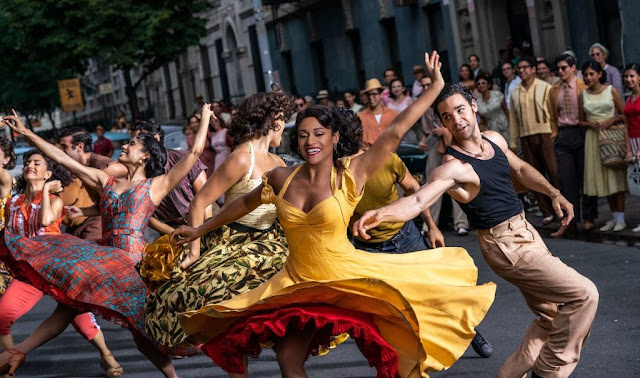
For that choreography, Justin Peck keeps the inspiration of Robbins, but mixes it with his own fast-paced, electric dynamism. The big numbers dominate the screen, from opening confrontation of the Jets and Sharks to the carnivalesque America, the playful Office Krupke, the frentic Gym Dance and the ballet inspired Cool. The choreography is earthier and punchier (in some cases literally so) more than Robbins, with a rough and tumble physicality and strenuous attack that contrasts with the balletic perfection of the original. It’s both a tribute to the original and also very much its own thing – and works perfectly.

Balancing tribute and forging its new identity is also at the heart of Spielberg’s brilliant direction. He’s confident enough to shoot many of the musical numbers with a Hollywood classic style – which allows us to see and admire all the choreography. But he also mixes this with sweeping, immersive camera work, thrilling tracking shots and beautiful images – there is a great one of Tony standing in a puddle surrounded with apartment window reflections, which looks like he’s surrounded with stars. Spielberg brings the demolished buildings very much into the visual design, part of making this West Side Story, earthier and rougher. The film is electrically paced and lensed with an expert eye.

The film’s two leads are both superior to the originals. Ansel Elgort is a fine singer (with a heartfelt rendition of Maria) and dancer (he excels at Cool), even if he at times struggles to bring his slightly bland character to life. He gives Tony a puppy dog quality – that does make hard to believe this version of the character killed a man in a brawl – as well as a wonderful sense of youthful impetuousness. Opposite him Rachel Zegler – plucked from YouTube by an open casting call – is sensationally wide-eyed, youthful radiance as Maria, naïve and in love, a superb singer.

Even better though are the supporting roles. Finest of all is Ariana DeBose, for whom this film feels like the unearthing of a major talent. Her singing and dancing is awe-inspiring, but it’s DeBose’s ability to switch from warm and motherly, to flirtatious and sexy, to grief, rage and confusion and all of it feeling a natural development from one to another is extraordinary. Her major songs are the films main highlights, stunningly performed. David Alvarez is a passionate, head-strong Bernardo, convinced that he is acting for the best (like DeBose his singing and dancing is extraordinary). Mike Faist is brilliantly surly and enraged (and struggling with repressed feelings for Tony) as Riff.

And, of course, there is Rita Moreno, now playing Valentina, a re-invention of the original production’s character of Don. Moreno worked closely as a consultant with Spielberg and Peck, and gives her scenes a world-weary sadness and desire for hope. She sparks beautifully with Elgort and to see her save Anita from gang rape (still a shocking scene, as it was when Moreno played it) and then angrily spit her contempt and rage at these boys is very powerful.

West Side Story needed to justify its existence. It does this in so many ways. Wonderfully performed by the cast, Spielberg pays homage to the original and classic Hollywood musicals but mixes this with electric film-making and a far greater degree of social and racial awareness (without ever hammering the points home) that allows you to see this tragedy from a new perspectives. It reimagines without dramatically reinventing and sits beautifully alongside the original. It’s more than justified its existence: in many ways it’s even better than the original.
Spotlight (2015)

SPotlight header
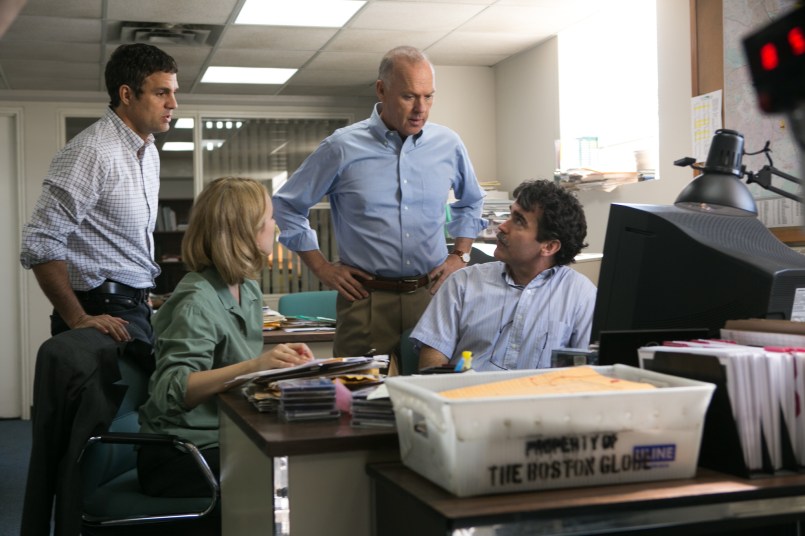
Ruffalo, McAdams, Keaton and James head up the investigation into the church in Spotlight

Director: Tom McCarthy

Cast: Michael Keaton (Walter “Robby” Robinson), Mark Ruffalo (Michael Rezendes), Rachel McAdams (Sacha Pfeiffer), Brian d’Arcy James (Matt Carroll), Liev Schreiber (Marty Baron), John Slattery (Ben Bradlee Jnr), Stanley Tucci (Mitchell Garabedian), Billy Crudup (Eric MacLeish), Jamey Sheridan (Jim Sullivan), Paul Guilfoyle (Peter Conley), Len Cariou (Cardinal Bernard Law), Neal Huff (Phil Saviano)

True villains are hard to spot: those clothed in good deeds are particularly well hidden. Few clothe themselves in good deeds more effectively than priests – and the small minority who use their positions of trust and power to abuse vulnerable children. It’s an unforgiveable, abominable betrayal that has ruined the lives of thousands of victims around the world. This century, the Catholic Church was rocked by a scandal: many in the church hierarchy were all too aware of these appalling acts, but protected priests from exposure rather than submitting them to well-deserved punishment. It took the work of crusading journalists to lift this veil and force the Church to begin to change its policy from protecting priests to protecting children.

The story was bought to wider attention by the dedicated work of the Boston Globe’s Spotlight team – the US’s finest investigative journalist team, a small team of reporters who work for months at one story. Boston is a firmly Catholic city, where the Church still holds a huge influence over the lives of its population. For years, faint suspicions of misconduct from any of the nearly 1,500 priests in the city was hushed up. It takes the arrival of an outsider at the Boston Globe – the paper’s unassuming new Jewish, Floridian editor Marty Baron (Liev Schreiber) – to push the Spotlight team to delve deeper into this story. He finds plenty of support from the team – respected editor “Robby” Robinson (Michael Keaton), the passionate Michael Rezendes (Mark Ruffalo), dedicated and empathetic Sacha Pfeiffer (Rachel McAdams) and increasingly disgusted Matt Caroll (Brian d’Arcy James). Using tried-and-trusted journalistic methods, passionate investigation, archival work and winning the confidence of survivors, the team piece together a systematic cover-up by the Catholic Church that extends all the way to the Vatican.

Spotlight scooped the Oscar for Best Picture (along with an Oscar for its brilliantly researched screenplay). It feels like a late Oscar partly awarded in memory of All the President’s Men, the film that Spotlight bears the most relation to. But, even more so than Pakula’s film, this is a low-key, reserved but strikingly effective and engrossing film that takes an almost documentary approach to the patient work required to uncover a story (no Deep Throat here) and the grinding shoe leather needed to get there. Fittingly, given the tragic story the team were reporting on, Spotlight is almost totally devoid of histrionics (there is at best one scene where a member of the team gets angry – only to be met with a quiet “are you done?”), instead being a tribute to the professionalism and integrity of journalists powered, but never overwhelmed by, their anger.

McCarthy’s film is refreshingly free of flourish or over-emphasis. It’s brave enough to let the story speak for itself, and trusts the viewer to understand both the emotional weight of abuse and the feelings of those involved without resorting to dramatic speeches or tearful dialogue. The details dominate – searching through archives for old newspaper clippings, waiting for access to court papers, days spent reading over a decade of parish records. Nothing is earned cheaply: every revelation the result of patient leg-work and following where the story leads without agenda or bias.

Agenda is something these journalists are deeply aware of. All of the team were raised in the faith to one degree or another, with strong roots in a community. The team’s leader, Robby, is an esteemed alumnus of a Catholic school one of the guilty priests worked at when he was a child – a revelation that quietly leads him to question both his implicit turning of a blind eye, but also how only a single man’s choices prevented him from becoming a victim. There is discomfort throughout the Boston Globe at the story – assistant Editor Ben Bradlee Jnr (a fine performance from John Slattery), while supportive of the team, is prickly at revelations that the Globe had previously not followed up reports of abuse and is deeply unhappy at the thought of accusing the Church itself.

The power of the Church in communities like this is subtly, but brilliantly, depicted. The film opens in the 70s with a paedophile priest having his actions being quietly hushed up by the police after the intervention of an ADA. Virtually every important person in the city is a Catholic and, like Robby, has been bought up and schooled in the Church. In exterior shots, McCarthy’s camera constantly frames churches on the edges of shot, their spires visible over residential blocks. The scale of the power of this institution – its reach and influence – is constantly demonstrated. It’s a big challenge for the team to take on – and one which they are not even sure their readers are ready to read about.

But McCarthy’s film isn’t crude. It’s made clear that these priests are a minority – 6% – and the anger is not with faith itself, but with the flawed and wrong decisions taken by men (the psychologist the team consults, an ex-priest, makes clear his faith is not shaken by his discoveries, only his trust in the institution). Equal care is given to the victims themselves. Their stories are reported by two characters in the film, each time with a careful lack of over-emphasis and a quiet, yet emotional, honesty. No attempt is made to sensationalise any of this.

And the film also makes clear that everyone is in some way complicit in this. The Globe has failed to report it. The police and government have covered it up. People might whisper about it – or say a particular priest is “dodgy” – but no one has made an effort to rock the boat and find out about it. Instead, victims are paid off, priests are moved to new parishes and everyone tries to carry on as normal. It’s a grimy and quiet conspiracy – miles away from the Grisham-esque danger the film’s trailer suggested – rather a collective failure of moral responsibility.

The film’s low-key approach, professionalism and absorption in how people do their jobs is deeply engrossing. Few things, after all, are as involving as watching highly professional people execute their jobs flawlessly. The performances are superb. Michael Keaton gives possibly the finest performance of his career – surely connected to it being his most restrained – as the team’s leader, whose sense of personal guilt and regret quietly build along with determination. Ruffalo (Oscar-nominated) is fantastic as his passionate, committed colleague (he gets the one shouting scene). McAdams delivers quiet empathy and powerful intelligence. Schreiber confounds expectations as the numbers man who emerges as a dedicated searcher for the truth.

The truth is exposed – but it’s just a tip of the iceberg. The story might be out there, but as the film shows in its coda, the struggle goes on. Crusading maverick lawyer Mitchell Garabedian (Stanley Tucci, very good) can’t celebrate the story’s publication – he’s got two child victims he needs to talk to. Cardinal Law (a fine performance of assured, misguided, certainty from Len Cariou) is promoted to the Vatican. Similar scandals emerge across the world. But the problem doesn’t go away. Just as the story needs time and work, the same qualities are needed to reform the Church.

Spotlight is quiet, engrossing and finely moving and triumphant film-making. It focuses brilliantly on professionalism and dedication producing results and shows that hyperbole and embellishment are not needed for outstanding drama. Told with documentary realism, acted with reserved grace and skill, McCarthy’s film is a call-back to 1970s film-making in the best possible way. A deserved winner and a small triumph.

First Man (2018)

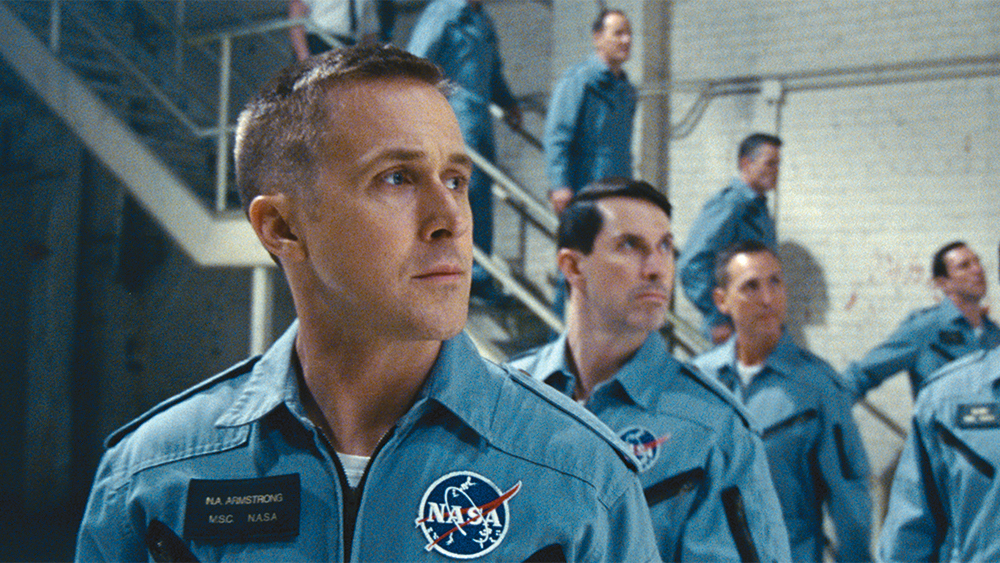
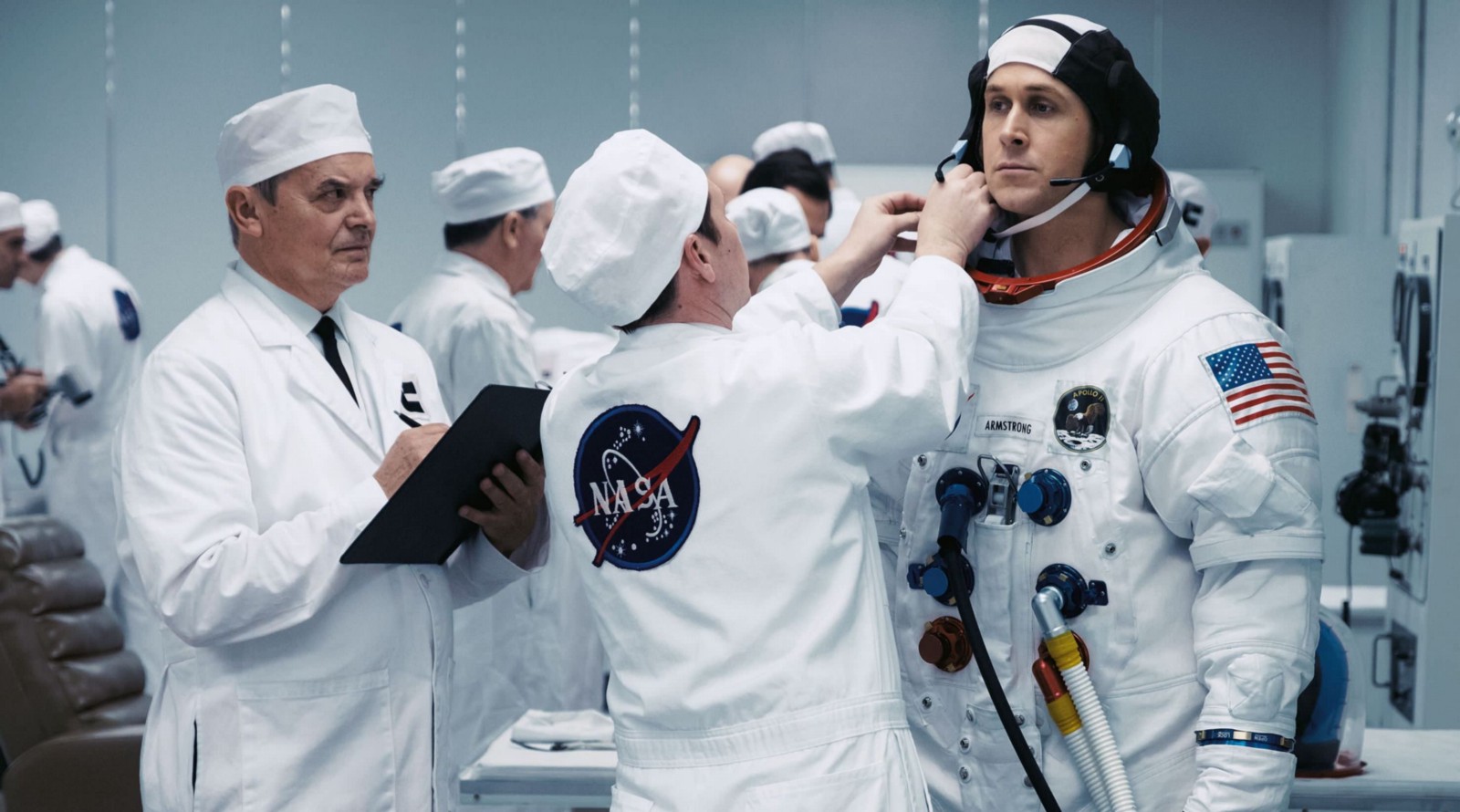
Ryan Gosling as an unreadable Neil Armstrong in the engrossing but cold First Man

Director: Damien Chazelle

Cast: Ryan Gosling (Neil Armstrong), Claire Foy (Janet Armstrong), Jason Clarke (Ed White), Kyle Chandler (Deke Slayton), Corey Stoll (Buzz Aldrin), Pablo Schreiber (Jim Lovell), Christopher Abbott (David Scott), Patrick Fugit (Elliot See), Lukas Haas (Michael Collins), Shea Whigham (Gus Grissom), Brian d’Arcy James (Joseph Walker), Cory Michael Smith (Roger Chaffee), Ciaran Hinds (Robert R Gilruth)

About halfway through this film, it struck me: Neil Armstrong is a not particularly interesting man who experienced the most interesting thing ever. It’s a problem that First Man, an otherwise exemplary film, struggles with: Armstrong himself, put bluntly, is unknowable, undefinable and, in the end, an enigma I’m not sure there is much to unwrap. Which is not to detract one iota from Armstrong’s amazing achievements, or his legendary calmness under pressure or his courage and perseverance. It just doesn’t always make for good storytelling.

First Man charts the years 1961-1969. During these years of professional triumph, Armstrong has success as test pilot, an astronaut on the Gemini programme (including command of Gemini 8, carrying out the first docking in space then saving his own life and the life of his pilot with his quick thinking when the mission nearly encounters disaster) and then the Apollo programme and his own first steps upon the moon. But Armstrong’s life is dogged by loss and tragedy, first his five-year old daughter to cancer, then a string of friends in accidents during the hazardous early days of the NASA space programme, including the deaths of Gus Grissom, Ed White and Roger Chaffee in the Apollo 1 fire. Armstrong becomes a man burdened with these losses.

There is very little to fault in the making of First Man – in fact it’s further evidence that Chazelle is a gifted filmmaker with a glittering future of great movies ahead. There are two things this film absolutely nails: the supreme majesty and awe of space and the terrifyingly rickety nature of the spacecraft we send men up into it in. 

Helped hugely by a superb score by Justin Hurwitz, which makes extensive and beautiful use of a theremin, the film captures the sense of mankind’s smallness, our vulnerability, in the face of the overwhelming vastness of space. Mixing goose-bump inducing wailing solos with orchestral sweep, and encapsulating the feeling of how small and lonely man in space is, the score goes a long way to match up with the visuals in creating a sense of space. The Oscar-winning visual effects – mixing computer graphics with some ingenious practical effects – never intrude but bring out the gritty reality of tin cans in space. 

Chazelle also really understands the impact of being so far beyond anything we can imagine, and his moon landing sequence is a thing of beauty. He expertly uses a number of close ups in the confined, claustrophobic campaign and largely eschews exterior shots (most of which only use the perspective of the crew’s view from the tiny windows, or of the cameras mounted on the side of the spacecraft). The moon landing follows suit, as we are thrown in alongside Armstrong and Aldrin as the lunar landing module takes its place on the moon – until the hatch opens with a whoosh of air (and sound) escaping the picture. And with that whoosh, the camera flies out of the hatch and switches – in an astonishing visual trick – from wide screen to IMAX shot to give us our first view of the vastness of space filling the frame. Suddenly, space fills the entire screen and the shocking beauty of the moon is a beautiful touch. We get as close as we can visually to experiencing the switch for Armstrong from confined spaces and beeping switches to vast panoramas and all-consuming silence.

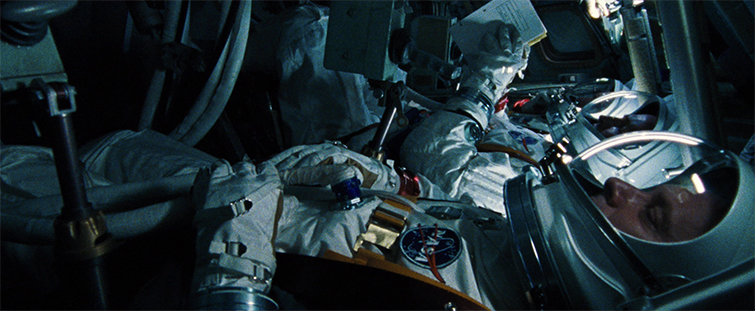
And we really feel the switch, because Chazelle has so completely immersed us into the dangers and insecurities of the space programme. The spacecraft are repeatedly shown as alarmingly shaky, screwed together (the camera frequently pans along lines of bolts inside the cabins), thin, tiny, vulnerable capsules that shake, groan, whine and seem barely able to survive the stresses and strains they are put under. Any doubts about the risks the astronauts are under are dispelled in the opening sequence when Armstrong’s X-15 rocket twice bounces off the atmosphere and the internal cockpit around him glows orange under the extreme heat. But it’s the same on every flight we see – these craft don’t look safe enough for a short hop to the Isle of Wight, let alone hundreds of thousands of miles to the moon and back.

And that’s clear as well from the danger that lurks around every corner of the space programme. Death is a constant companion for these pilots and can come at any time. Armstrong himself escapes only due to a combination of luck and skill. When luck disappears, death follows swiftly for many of his co-pilots. Off-screen crashes claim the lives of three of his friends. Chazelle sensitively handles the horrifying Apollo 1 fire (news reaches Armstrong of the death of several friends, including his closest Ed White, while wining and dining politicians at the White House), and the terrible cost of this tragedy hangs over every single second of the moon programme. Fate or chance at any moment could claim lives. This grim air of mortality hangs over the whole film, a melancholic reminder of the cost of going further and faster to expand mankind’s horizons.

This grief also runs through Armstrong’s life and shapes him into the man he becomes. The death of Armstrong’s daughter at the start of the film sets the tone – the shocking loss of a child at such a young age is tangible – and it seems (in the film) as if this was the moment that led to Armstrong hardening himself against the world. He weeps uncontrollably at the death of his daughter, but later deaths are met with stoic coolness. Armstrong in this film is a cool enigma, who by the end of the film treats concerned questions from his children about whether he will return alive from the moon mission with the same detachment he shows at the official NASA press conference. “We have every confidence in the mission” he tells these two pre-teens, “Any further questions?”

It’s the film’s main problem that in making Armstrong such an unreadable man, who buttons up and represses all emotion, that it also drains some of the drama and human interest from the story. While you can respect Armstrong’s professionalism and coolness under pressure, his icy unrelatability makes him hard to really root for over the course of two hours. The film also strangely only sketches in the vaguest of personalities for the other astronauts (Aldrin gets the most screentime, but is presented as an arrogant, insensitive blowhard) so we hardly feel the loss of the deaths. Its part of the attitude towards Armstrong as a man chiselled from marble, so lofty that the film doesn’t dare to really delve inside his own inner world or feelings but builds a careful front around him to avoid analysis.

It’s not helped by Ryan Gosling, whose skill for blankness makes him somewhat miscast here. Try as he might, he can’t suggest a deeper world of emotional torment below the calm surface, no matter how soulful his eyes. It’s a role you feel needed a British actor, who could really understand this culture of repressed stiff-upper-lipness. Indeed Claire Foy fares much better as his patient, loyal wife who holds her composure (more or less) for the whole film under the same pressures of grief as Armstrong. Gosling just can’t communicate this inner depth, and his blankness eventually begins to crush the film and our investment in its lead character.

First Man in almost every other respect is a great piece of film-making and another sign of Chazelle’s brilliance. But it’s never as dramatic as you feel it should be. Armstrong’s life doesn’t carry enough event outside his moon landing experience, and the film can’t make an emotional connection with the man, for all the loss and suffering it shows for him. For a film that is so close to so perfect on space and the Apollo programme it’s a shame – but makes this more a brilliant dramatized documentary than perhaps a drama.

Molly's Game (2017)


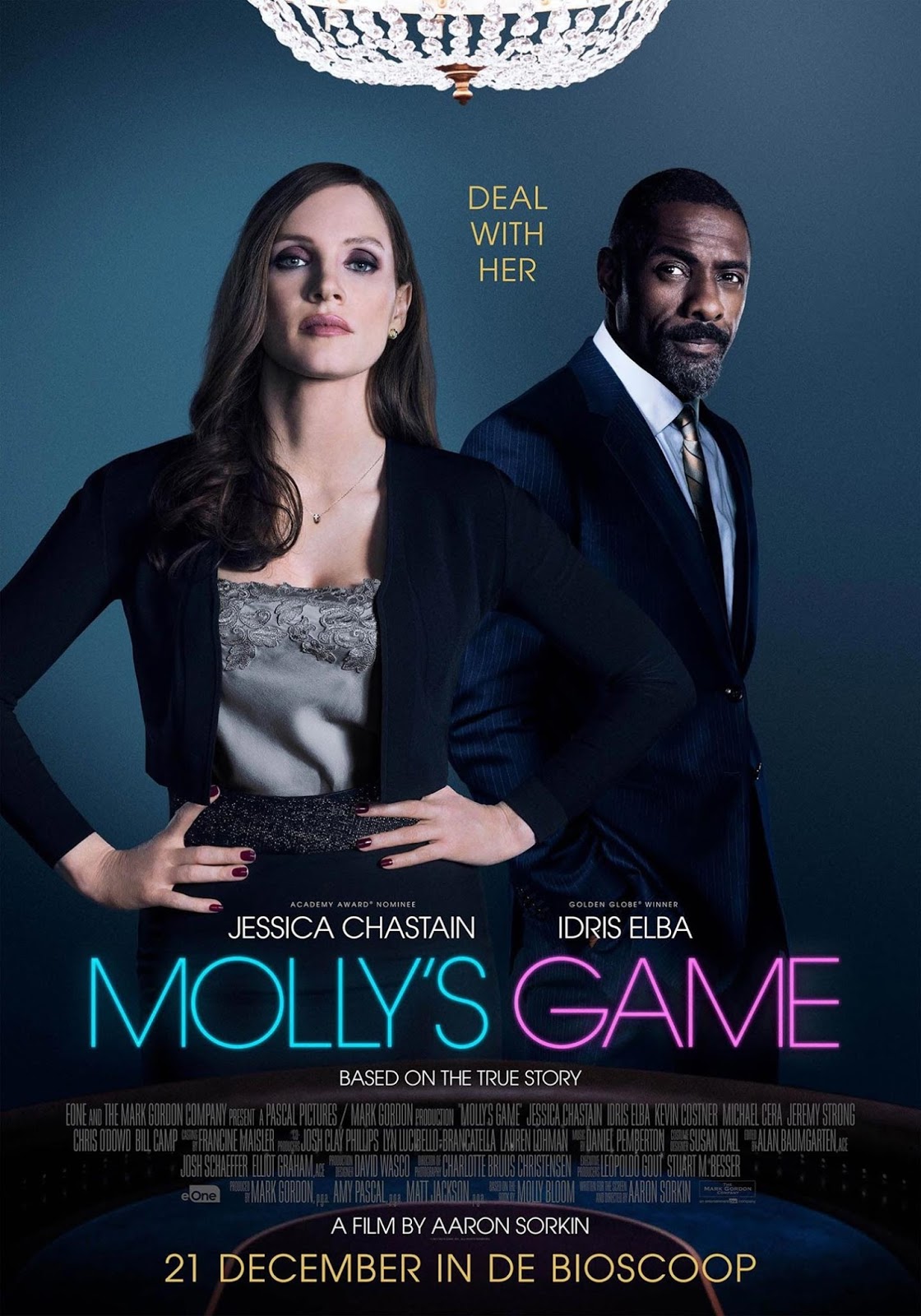
Jessica Chastain and Idris Elba excel in Aaron Sorkin’s dynamically scripted Molly’s Game

Director: Aaron Sorkin

Cast: Jessica Chastain (Molly Bloom), Idris Elba (Charlie Jaffey), Kevin Costner (Larry Bloom), Michael Cera (Player X), Brian d’Arcy James (Brad), Chris O’Dowd (Douglas Downey), JC MacKenzie (Harrison Wellstone), Bill Camp (Harlan Eustace), Graham Greene (Judge Foxman), Jeremy Strong (Dean Keith), Angela Gots (B)

Molly Bloom (Jessica Chastain) is all set to join America’s Winter Olympics team, under the guidance of her ultra-demanding psychiatrist father Larry (Kevin Costner), when a freak accident ends her career. So she heads to LA and becomes embroiled in the world of high-stakes poker, eventually setting up and running her own high stakes games in LA and New York, earning millions. But, over a decade later (in a parallel plotline) she has had a millions seized and is battling against imprisonment for her connections to the mob, with only lawyer Charlie Jaffrey (Idris Elba) on her side.

Sorkin’s zippy new drama has plenty of sparkling dialogue – as you could expect! Sure this film probably also proves he’s not really a director (it’s over-long, a little flabby, and structurally not very clean) but the guy can certainly put a speech together. My main issue with Molly’s Game is I’m just not quite sure what its point is. Maybe it only exists to entertain, but it feels like it wants to put together a touching story about family, faith and the value of your word. I’m not sure it really manages to achieve any of this. 

The parallel plotlines don’t always do the film a lot of favours. The present-day plotline of Molly and Jaffey working to clear her from the various charges she has been accused of, continually hints at some serious gangsterism set-ups later on: largely these never really transpire. Actually, the film heads into pretty standard “my-Daddy-didn’t-love-me” territory. It shy’s away from being something different and interesting about excess and punishment into psychiatry solving our problems.

Sorkin doesn’t always get the structure right, as if he hasn’t got the patience to actually make sure the fundamental plot information was clear enough, so eager was he to get on with the verbal pyrotechnics. Time is spent carefully exploring several poker hands – but the exact nature of the illegality of what Molly does running her poker games gets glossed over in seconds. 

But then this is a film that isn’t really that interested in plot dynamics, or even in over-arching themes. What it’s interested in is sizzling dialogue, and letting actors deliver it. The camera sits back and watches. So it’s not a surprise the most memorable scenes feature Jessica Chastain and Idris Elba (both superb) in a room, talking (or arguing) with each other. It’s the moments like these where the film really works – and Sorkin the director basically stays out of the way, using a two-camera set-up to record the scenes, like a filming of a Broadway play. 

Those two actors dominate the film. Chastain is excellent as Molly – ambitious, driven, playful but also vulnerable and ever-so-slightly bitter, who gets where she is through her own intelligence and hard work. Chastain also embraces playing a character with such a strong moral code – she’s terrifically warm and human in the part. Elba is equally fine, a wry professional with his own strong moral code (yup, The West Wing writer still loves those liberals of great conscience), an articulate (of course!), passionate advocate who is far warmer than he first appears.

The rest of the film never quite lives up to this, maybe because the poker games are never really that interesting, or because the life Molly leads among the rich and famous seems ill-defined (she has possibly the least impactful drugs addiction seen on screen). For someone who remains loyal to the end to her clients, we are never really clear why other than a suggestion of her basic sense of honour. Her projects are all set-up with ease, and the film builds towards a solution buried in psychiatry speak that similarly feels a little too easy.

Because while it is great that Molly is not defined by a romantic relationship – she is defined by men in virtually every other way. Her entire career is based on pleasing rich, middle-aged men (from whom she frequently has to bat away expressions of devotion or sexual interest). Three times she falls victim to senior male partners in business relationships. Above all, she is defined by her relationship with her overbearing father (well-played by a low-key Kevin Costner). The scene where this comes to a head, a father-daughter exchange late at night on a snowy New York bench, is so well-written and played you almost overlook its pattness.

Sorkin’s script is the most important thing here – and the film is built around it. Like Scorsese’s Casino(a film he must have seen a couple of times!) most of its opening act is structured heavily around Chastain’s expertly delivered voiceover. The actors get to enjoy delivering his engaging rat-a-tat dialogue, the expert playing and sharp dialogue ends up carrying a lot of uplifting moments in the film. It’s a film that embraces Sorkin’s scripting, and doesn’t worry about being too filmic about it: the zippiest moments of editing are so because the dialogue or voice-over demands it.

Some of the roles aren’t quite so well drawn: Michael Cera is just plain miscast in a role that needed a young Rob Lowe as an absurdly glamourous Hollywood poker addict (I can’t imagine people crossing a street let alone a continent to play cards with Cera). The rest of the women in the script get short shrift – even Molly’s mother is little more than a walk-on part. 

Molly’s Game is a lot of fun, even if it’s probably about 15 minutes too long. It’s got some great dialogue and, if Sorkin turns out not to be the best interpreter of his own work, he’s certainly no dud as a director. Overall, the themes and plot don’t quite come together as well as they should. But it’s very well acted – Elba and above all Chastain are absolutely terrific – and it has more than enough sparkle to it for an enjoyable Friday night.