Tag: Brian F O’Byrne

Conclave (2024)

Conclave (2024)

Papal boardroom politics combine with detective mystery in this engaging mix of high- and low-brow

Director: Edward Berger

Cast: Ralph Fiennes (Cardinal Thomas Lawrence), Stanley Tucci (Cardinal Aldo Bellini), John Lithgow (Cardinal Joseph Tremblay), Sergio Castellitto (Cardinal Goffredo Tedesco), Isabella Rossellini (Sister Agnes), Lucian Msamati (Cardinal Joshua Adeyemi), Carlos Diehz (Cardinal Vincent Benitez), Brian F. O’Byrne (Monsignor Raymond O’Malley), Jacek Koman (Archbishop Janusz Wozniak)
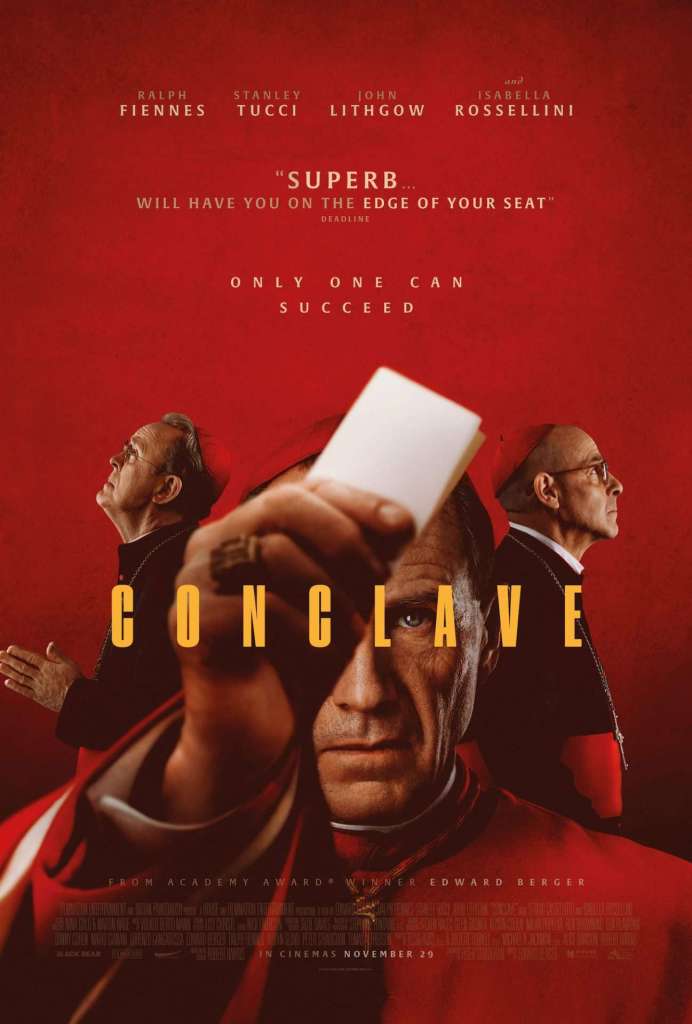
Few things have changed as little over 500 years than the election of a pope. Sure, they didn’t need to take away the phones of the Borgias and Medicis, but the idea of locking away the Princes of the Church in the Sistine Chapel until the Holy Spirit guides them towards choosing the next Heir to the Throne of St Peter hasn’t changed. But then neither (probably) has the ruthless politicking and barely concealed ambition of the cardinals (after all some were Borgias and Medicis!), many having dreamt their whole lives of moulding the Church into the shape they believe He wants it to be.

Politicking and spiritual and moral struggles with the temptations of ambition are at the heart of this excellent adaptation of Robert Harris’ novel. After the pope dies, Cardinal Thomas Lawrence (Ralph Fiennes), Dean of the College of Cardinals, is responsible for organising the new Papal Conclave. Lawrence, struggling with doubts whose request to resign was recently rejected by the Pope, is part of the moderate wing and a supporter of Cardinal Aldo Bellini (Stanley Tucci). The other major candidates are conservative Canadian Cardinal Tremblay (John Lithgow) and ultra-traditionalists Italian Cardinal Tedesco (Sergio Castellitto) and Nigerian Cardinal Adeyemi (Lucian Msamati). Lawrence slowly discovers severe reasons to doubt the suitability of all these candidates – while the number of cardinals suggesting he himself might be a suitable candidate grows.

Conclave is a very enjoyable dive into the mysterious world of papal politics. Part of its appeal is seeing that, under the mystery of centuries-old practices, elaborate robes and beautiful artworks, the struggle to elect a pope is a highly political business. Things ain’t changed that much since the Borgias, as various sexual, financial and other scandals crop up to scupper the chances of one candidate after another. As per 15th-century papal tradition, take away those flowing robes and lapses into Latin, and this is a cut-throat boardroom succession struggle that leaves more than a few reputations in ruins (and it ain’t going to be easy – even the late pope’s signet ring only comes off his finger after a rough-handed struggle).

In fact, Conclave works as well as it does because it’s a sort of Succession meets Father Brown, a brilliantly paced and staged merging of high-brow settings with pulpy page-turner thrills. At its heart is a superb performance by Ralph Fiennes as Cardinal Lawrence. Softly-spoken, Lawrence is dutiful, decent and diligent – and plagued with doubts about everything from his faith to his ambition, with permanently sad eyes, full of world-weary resignation. At one point Lawrence stares up at The Last Judgement, his eyes catching a man twisting in torment: he knows how he’s feeling. Unlike all the other cardinals, dripping with certainty, he’d rather be anywhere but there.

Lawrence becomes Father Brown, the quiet, level-headed priest going the extra mile to sniff out wrong-doing. As his concerns about many of his fellow cardinals emerge, he goes to rule-bending lengths to confirm these suspicions – and part of the delight of Conclave is how entertainingly it plays out murder mystery conventions alongside its papal shenanigans. Lawrence carries out his dogged investigation with an earnest sense of duty but what’s great about Fiennes’ performance is that he also manages to suggest the possibly of guilty ambition underneath. After all, Lawrence is a cardinal too, right? Why can’t he have a crack at being the Holy Father?

Lawrence has moments of temptation when the Holy See is dangled before him. Part of Conclave’s argument is that power is best suited to those most reluctant to carry it. Lawrence is one of the most reluctant among the papal players – but even he isn’t immune to guilty temptation. When he opens the concave with an off-the-cuff speech on moral conduct, is it subconsciously to establish his leadership? When he very publicly exposes one candidate’s misdeeds, is a side benefit demonstrating his own virtue? Conclave tracks Lawrence’s vote every time – and when he is tempted to vote for himself, an act of seemingly divine intervention takes place to almost tick him off.

It’s said at one point all cardinals have thought about their papal name. Lawrence shrugs this off, but later unhesitatingly gives an answer. Perhaps the only cardinal who hasn’t really thought about it is Cardinal Benitez (Carlos Diehz, wonderfully serene), secretly appointed Cardinal of Kabul by the late pope, a man almost alone in thinking this is a quest to find the holiest. The rest? They could probably tell their regnal names without thinking. And unlike Lawrence, they are certain about everything: from their own suitability to how pleased God will be when they land it.

Peter Straughan’s sharp and intelligent script gives an array of opportunities for excellent character actors (Conclave would make a good play). Sergio Castellitto’s scene-stealingly bombastic Tedesco, forever vaping when not growling about how chucking the Latin Mass was the end-of-days, can’t imagine he won’t win. It’s a trait he shares with Lucien Msamati’s Adeyemi, although Msamati finds a vulnerable humility that makes Adeyemi’s eventual downfall surprisingly affecting. Lithgow’s imperious Tremblay drips with arrogance (his eventual comeuppance sees Lithgow brilliantly deflate like a pricked balloon). Stanley Tucci is brilliant as the charming, morally upright Bellini who then surprises even himself with how fiercely ambitious he is.

Berger sets all this in a brilliantly oppressive setting, for all the beauty on the walls around them. Berger superbly conveys the isolation of the conclave, lit almost entirely artificially in heartless hotel rooms (that feel like monastic jails) and a fluorescent-lit canteen. The sound design is a massive part of this, the rooms devoid of ambient sound, just a crushingly deadened stillness. Frequently Lawrence’s breathing fills the soundtrack, giving the film a confessional feeling. It all means the late on surprise sound of a gust of wind carries the same impact for us as it does the cardinals.

Male voices dominate in the Vatican, so it’s telling Conclave deliberately undercuts this by giving one of its standout moments to Isabella Rossellini’s primly professional Sister Agnes. Like the other nuns staffing the conclave, she barely speaks – meaning when she does, it seizes the viewer’s attention as much as she does the crowd of cardinals. The flaws of this world return in the film’s final (slightly forced) twist, which helps question how much the alpha-male clashes between these papal academics may have shaped the atmosphere of the Church, and not for the better.

Conclave is tightly directed film, and a great adaptation of a page-turning novel with a faultless cast brilliantly led by Ralph Fiennes. It mixes pomp and ceremony with a fascinatingly tense struggle for power, made all the more gripping that in the parade of languages we hear (and all the cardinals can switch easily from English to Latin to Italian to Spanish) the language of power and ambition is constant but unspoken – and when it is explicitly stated, it has a devastating impact on those who use it. It’s a great touch in an entertaining and engaging film.

Million Dollar Baby (2004)

Million Dollar Baby (2004)

Oscar-winning sucker punch (literally) movie as a woman goes against the odds to make her boxing dreams come true

Director: Clint Eastwood

Cast: Clint Eastwood (Frankie Dunn), Hilary Swank (Maggie Fitzgerald), Morgan Freeman (Eddie “Scrap-Iron” Dupris), Jay Baruchel (Dangerous Dillard), Mike Colter (“Big” Willie Little), Lucia Rijker (Billie “The Blue Bear” Osterman), Brian F. O’Byrne (Father Horvak), Anthony Mackie (Shawrelle Berry), Margo Martindale (Earline Fitzgerald), Marcus Chait (JD Fitzgerald), Riki Lindhome (Mardell Fitzgerald), Michael Pena (Omar), Benito Martinez (Billie’s manager)

Spoilers: I thought the end of Million Dollar Baby was pretty well known, but when I watched it with my wife, I realised half-way through she had no idea where it was going. I’ll be discussing it, so consider yourself warned!

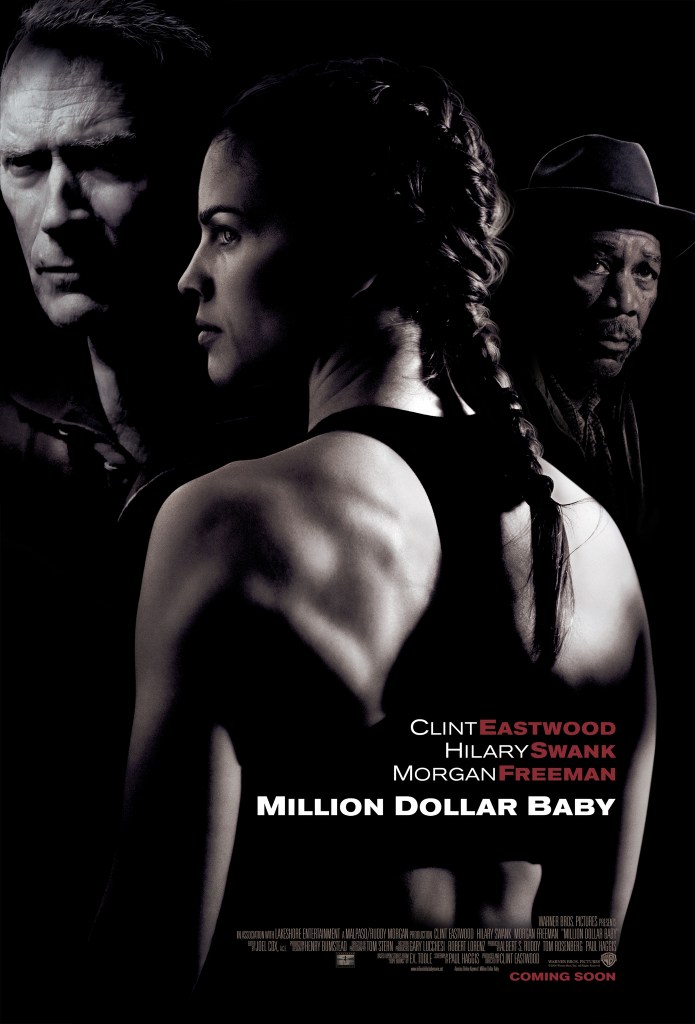
We know what to expect from most Sports stories don’t we? A plucky underdog fights the odds and emerges triumphant, winning the big match or going the distance when everyone doubted them. So it’s not a surprise Million Dollar Baby was marketed as a sort of female-Rocky. It had all the ingredients: Swank as a dreamer from the wrong-end-of-the-tracks, tough but humble and decent; Eastwood as the grizzled trainer; a working-class backdrop; a struggle to put their pasts behind them on the road to glory. Then, imagine what a sucker punch the final act of the film is when you suddenly realise you’ve not been watching a feel-good drama, but the entrée to a heart-wrenching euthanasia story.

Maggie Fitzgerald (Hilary Swank) has spent months persuading grouchy boxing trainer Frankie “I don’t train girls” Dunn (Clint Eastwood) to train her. Frankie suffers from a string of lifelong regrets, from the daughter that returns his letters unread to not ending a fight decades ago that saw best friend Eddie (Morgan Freeman) blinded in one eye. Frankie’s resistance is eventually worn down by Maggie’s persistence and the two form a close bond. Maggie is on fire in the ring – until a foul punch leads to a terrible fall leaving her paralysed from the neck down. With Maggie having lost everything that gave her life meaning, how will Frankie respond when she asks him to end her life?

Of course, the clues should be there earlier that we are not about to settle down for a triumphant Rocky II-style yarn. Eastwood’s (self-composed) maudlin score constantly works against the action, until we realise it is sub-consciously preparing us. Expectations are overturned: Frankie’s reluctance to let his fighter “Big” Willie (Mike Colter) go for a title shot – hesitation that lasts so long, eventually Willie hires a new manager – is shown to be misjudged when Willie wins. Dunn spends hours in church every day, plagued with guilt about misdeeds he can’t begin to put into words. Maggie’s family are not a supportive working-class bubble, but trailer-trash dole-scum who react to Maggie buying them with house with fury as it may affect their (unmerited) benefit cheques. We even get several shots of the stool that will eventually play a crucial role in crippling Maggie.

What the film is actually building to in its opening 90 minutes is not a story of triumph, but how a close relationship builds between a man who has lost his family and a woman whose family is a grasping horror story. Eastwood charts this with a carefully judged pace, delivering one of his finest performances as the guarded and grouchy Frankie, who uses his gruff exterior to protect himself from the possible hurt of emotional commitment. Because it’s clear Frankie actually cares very deeply, frequently going the extra mile to help people, even while complaining about it.

It’s that buried heart, that draws him towards the determined and good-natured Maggie. Rather like Frankie, Hilary Swank makes clear in her committed performance Maggie’s optimism and enthusiasm is as much of a shield as Frankie’s gruffness. She knows that she’s nothing to her family except a meal ticket and her entire life seems to have been one of loneliness, working dead-end jobs to funnel money to her mother at the cost of any life of her own. Switching away from her grinning enthusiasm leaves her in danger of staring at her own life and seeing what a mess it is.

With their two very different shields, these two characters are exactly what the other needs and one of the film’s principle delights is to see them slowly confiding in each other, sharing their vulnerabilities and filling the void their own families have left in their lives. This all takes place inside a conventional “sports movie” structure, which writer Paul Haggis almost deliberately doubles down on, as Maggie builds her skills, via training montages and Frankie starts to relax about sending people into the ring to have seven bells beaten out of them and dreams about one more shot.

This all means it hurts even more when that (literal) sucker punch comes. Eastwood’s film doesn’t shirk from the horrors of Maggie’s disability – re-enforced by the previous 90 minutes establishing how crucial movement and reflexes are to boxing, and how this element in particular helps give her life meaning. She’s covered with bed sores, can’t breathe without a respirator, it takes over an hour to lift her into a wheelchair (which she cannot operate) and eventually her infected leg is amputated. Her family visit only to get her to sign over her assets (she tells them where to get off). She is reduced to biting through her own tongue to try and bleed to death, meaning she is left sedated to prevent self-harm.

It’s all more for Frankie to feel guilty about. Although the film could have given even more time to exploring the complex issues – and moral clashes – around the right to die, it does make very clear the crushing burden of guilt and the impact his final decision will have on him. In fact, it would have benefited from spending more time on this and giving more time to O’Byrne’s priest (who quite clearly states that it’s wrong), to help give more definition to the arguments around assisted suicide (I wonder if Eastwood’s agnostic views came into play here).

Perhaps the film spends a little too long on its initial – even deliberately formulaic – rags-to-riches boxing story. In its boxing club vignettes, you can see the roots of the film in a series of short stories by former boxing trainer FX Toole. Mackie’s cocky boxy and Baruchel’s gentle intellectually disabled would-be boxer run through the film play like short story anecdotes. The narrative is linked together by narration from Morgan Freeman. It’s a natural fit for Freeman – essentially a semi-reprise of Red in Shawshank – and fits him like a glove (it was no surprise he won an Oscar). But trimming this content could have given more time to the films closing moral dilemma.

Which doesn’t change the impact it has. Eastwood’s low-key style – with its drained-out colours and piano chords – make a perfect fit, and its expertly played by himself and Swank (who also won an Oscar). Even on a second viewing, Million Dollar Baby still carries a real impact, particularly as you appreciate how subtly the sucker punch that floored so many viewers first time around is built up to.

The International (2009)


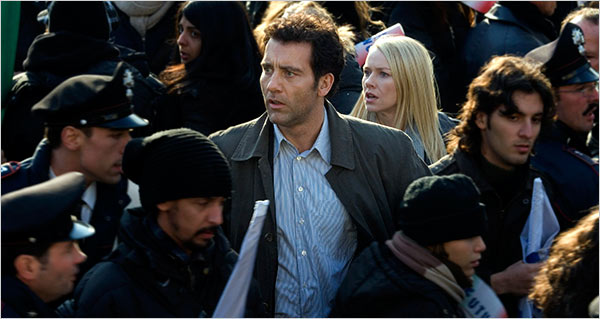
Clive Owen and Naomi Watts are lost in the high-pressure world of big finance in The International

Director: Tom Twyker

Cast: Clive Owen (Louis Salinger), Naomi Watts (Eleanor Whitman), Armin Mueller-Stahl (Wilhelm Wexler), Ulrich Thomsen (Jonas Skarssen), Brian F. O’Byrne (The Consultant), James Rebhorn (New York DA), Michel Voletti (Viktor Haas), Patrick Baladi (Martin White), Jay Villiers (Francis Ehames), Fabrice Scott (Nicolai Yeshinski), Haluk Bilginer (Ahmet Sunay), Luca Barbareschi (Umberto Calvini), Alessandro Fabrizi (Inspector Alberto Cerutti), Felix Solix (Detective Iggy Ornelas), Jack McGee (Detective Bernie Ward), Ben Whishaw (Rene Antall), Lucian Msamati (General Motomba)

Welcome to another of my unlikely pleasures. I remember seeing The International because we took a punt on it with an Orange Wednesday 2-for-1. I had no real expectations, but I was totally wrapped up in it. It has an old-school 1970s Hollywood-conspiracy-thriller feel. I keep waiting for it to be rediscovered (I’m waiting in vain it seems). But it’s a wonderful, tense little thriller which – by focusing on the shady, morally corrupt dealings of private banks – always seems relevant. Throw in alongside that a truly stand-out action set-piece at the centre of the film and you have a much overlooked pleasure.

Louis Salinger (Clive Owen) is a scruffy Interpol agent, with a reputation for getting too involved in his cases. Working with Assistant New York DA Eleanor Whitman (Naomi Watts), Salinger is investing possible illegal arms deals involving private investment bank IBBC. After their inside contact and Whitman’s fellow DA are both murdered in quick succession, Salinger takes the battle directly to IBBC. But the bank, chaired by ruthlessly blank businessman Jonas Skarsson (Ulrich Thomsen), is prepared to go to increasingly violent lengths to protect its interests, with assassinations arranged by its in-house security expert ex-Stasi agent Wilhelm Wexler (Armin Mueller-Stahl) and carried out by his mysterious Consultant (Brian F. O’Byrne).

Tom Twyker shoots the film in cool grays and drained out colours, giving it a very cold palette fitting for its exploration of the ruthless viciousness of big business. Twyker uses the cold, modern architecture of the various businesses the film is set in to great effect, making a wonderful, imposing backdrop. The camera constantly allows this domineering modern architecture to fill the frame, and mixes it up with some well-chosen aerial shots that reduces the action to cogs in a machine. It’s a very distinctive visual film – and it’s not until it finishes that you realise (apart from blood) you’ve really seen a red, a green or a purple in the whole film. There’s no jittery editing or hand-held camerawork – it’s got a smooth old-school cinematic quality to it.

The plot is a chilling conspiracy thriller, that (within the confines of a Hollywood action thriller) gets really in-deep into the workings of big finance. Critics accused it of being a light-weight Jason Bourne but really it’s more of a colder Parallax View. It largely eschews action in favour of paranoia, investigation and simmering tension. It’s a well-constructed journey down the rabbit hole, as Salinger gets both closer towards answers, and further away from bringing anyone to justice. 

Clive Owen’s rumpled performance is perfect. Far from being a “Bond audition”, Salinger is an outsider, a man who lives for his job, who wears his heart on his sleeve, and spends large chunks of the film either terrified or out-of-his-depth. Practically the first thing that happens to him is being knocked out by the wing-mirror of a truck. His grubby, unshaven scruffiness doesn’t recover from that. Owen gives the performance both a moral conviction and a slight air of desperation and bewilderment, as if he can’t quite understand why others aren’t as wrapped up in his case as he is.

He’s part of a great cast of actors – the film is full of unusual choices and rewarding cameos. Armin Mueller-Stahl mastered playing these world-weary ex-spies years ago, but delivers here. Broadway star Brian F O’Byrne is great, as a ruthlessly efficient hitman. Ulrich Thomsen is rather good as the blank businessman and family man, who seems to see no moral issues in the conduct of his bank’s business. Interesting actors like Patrick Baladi, James Rebhorn, Luca Barbaeschi, Haluk Bilginer and Lucian Msamati round out the cast with terrific cameos – there is always a unique actor and dynamic performance around every corner.

The plot of the film doesn’t unfold the way you expect it to – and mixes hope with a nihilistic powerlessness. Twyker’s directing is professional and he adds a lot of intelligence to a standard Hollywood set-up. He also throws in a few moments where the film pauses to reassess things we’ve seen before or to allow Salinger to puzzle out another crucial clue.

And it’s fitting for a film so in love with overwhelming power of modernist architecture that its most explosive sequence takes place in New York’s Guggenheim museum. This is a gut-wrenchingly exciting, destructive gun battle that serves as the pivot point. Brilliantly shot and edited, and perfectly built towards, it explodes into the film and grabs your attention. Owen again is perfect for this sequence – determined, but terrified and completely out of his depth – and Twyker’s use of the Guggenheim is masterful. Honestly it’s one of the best shoot-out scenes I’ve ever seen in a movie: five minutes of brilliance. You’d remember the film for that scene alone, if for nothing else.

Okay it’s not a perfect film by any stretch. Poor Naomi Watts has a thankless, ill-formed part. I’m pleased the film doesn’t include any romantic connection between the two characters at all, but (despite her work on the case) Whitman seems more a plot device than a character. The script largely fails to serve up too many memorable lines – and its main strengths are to present familiar actions and events in a fresh manner. Some have found the plot momentum to often flag – and there is something to that – and the overall schemes of the bank are not always completely clear.

But, nevertheless, I really like The International. It’s got a classic old-school feel to it. Its views on the immorality of big business feel very true, as does its presentation of the villain as basically a monolithic institution – the actual guys running the bank seem irrelevant, it’s just the ongoing nature of business. And in this world of corporations, where destroying a few men don’t admit to a hill of beans, how can truth and justice ever win out? Even if it had nothing else, tackling that idea makes The International feel like something new and worth revisiting. Well that, and that Guggenheim gun fight…