
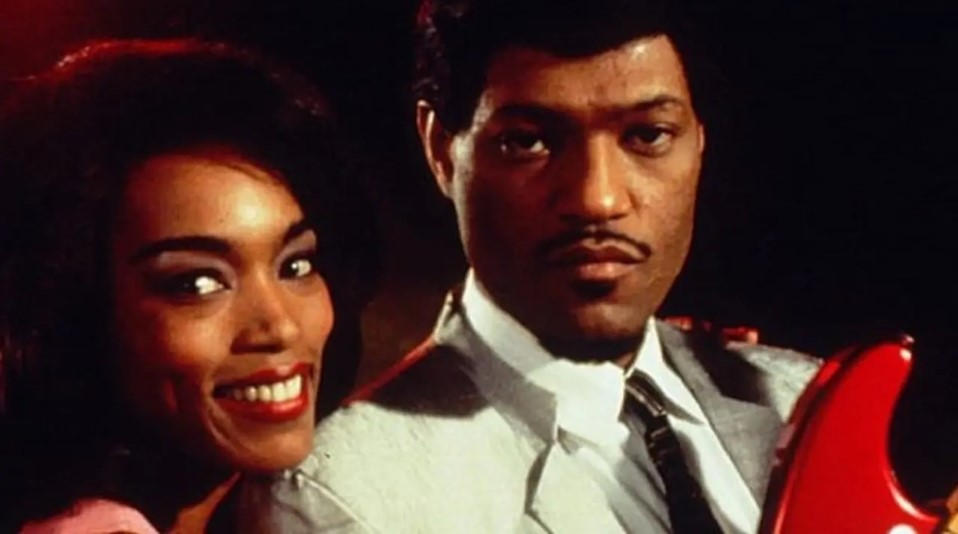
Tina Turner biopic sails into dark marital waters in a hard-hitting film
Director: Brian Gibson
Cast: Angela Bassett (Tina Turner), Laurence Fishburne (Ike Turner), Vanessa Bell Calloway (Jackie), Jenifer Lewis (Zelma Bullock), Penny Johnson Jerald (Lorraine Taylor), Phyllis Yvonne Stickney (Alline Bullock), Chi McBride (Fross), Jame Reyne (Roger Davies) Richard T Jones (Ike Turner Jnr)

How did Tina Turner become the Queen of Rock ‘n’ Roll? The hard way. Possibly the hardest. Tina Turner’s relationship (and marriage) to her initial discoverer, Ike Turner, lasted almost twenty years after their first meeting in 1956. During that time, Ike helped form her style – and viciously beat and assaulted her on a regular basis, increasingly in drug-fuelled bouts of jealousy as her talent and fame surpassed his own. What’s Love Got to Do with It? sees Angela Bassett and Laurence Fishburne bring this biopic and spousal abuse drama to the screen.
Well directed by Brian Gibson, with neat mixture of mock-documentary and home video footage carefully spliced into the film, What’s Love Got to Do with It? is practically the dictionary definition of a tough watch. It doesn’t flinch in showing the escalating violence in the Turner marriage. Bleeding noses, black eyes, furious fists and a rape scene in a recording studio that is almost unbearably visceral, What’s Love Got to Do with It? indeed: this is marriage as Dantean hell.
Tina Turner later felt the film went too far in depicting her as victim, but also not far enough in showing the violence in their marriag[AN1] e. (Ike Turner, needless to say, was equally unhappy – but who cares.) What she praised though was Angela Bassett’s performance. Cast at short notice, Bassett worked overtime to master Turner’s vocal and physical mannerisms. It’s a nailed-on performance, but Bassett also completely drills down into the heart of a woman who finds herself lost in a situation outside of her control, terrified but discovering the inner strength needed to lead her own life.
It’s a hugely emotional performance. Bassett makes Tina fiery, determined and talented – but even the strongest person can find themselves trapped in (and defending) destructive relationships. Despite the early example of Ike’s previous girlfriend Lorraine (a very good Penny Johnson), driven to a suicide attempt by Ike, despite his vanity and jealousy being clear early on, (as well as his control freak desire to dictate every inch of her life ,including changing her name to Tina Turner without her agreement), Tina is captivated by Ike.
As their relationship deteriorates, for all his vileness, Bassett’s Turner defends and excuses her husband. Whether he beats her up at home in front of the kids (and brings a dress home later as an apology) or smashes a cake into her face in a restaurant, it’s never quite his fault. He’s fragile, he’s an artist, sometimes she just makes him mad. Bassett brilliantly shows how this Orwellian double think can settle in, so that a woman like Turnerstays with her abuser for 16 years of marriage, until she realises she can break free.
Bassett’s electric performance is perfectly complemented by Laurence Fishburne’s burning, self-pitying performance of weakness and insecurity masked by anger and fury. Fishburne turned down the film five times (it was Bassett’s presence that eventually persuaded him). He felt the film didn’t do enough to show why Turner became the man he did. To be fair, he’s probably right. Turner has an early scene where he speaks of his childhood trauma (a fig leaf for his bullying) which Fishburne gives a real humanity, and he invests the early sequences with charm and charisma.
But Fishburne, like Bassett, doesn’t slack on the energy. As cocaine and envy eat Ike up, his body language becomes more bear-like, his speech ever more mumbled. His eyes cloud over with a look of hate. Only actors who trust each other completely could play these appalling scenes of domestic violence with such complete and utter commitment. Both Bassett and Fishburne give a horrible life to these shocking and sickening moments of hurt and pain.
Both actors essentially elevate material that, at heart, is standard biopic stuff, built around the usual obstacles – albeit the obstacle this time is hideous domestic violence. We see the roots of Turner’s career, the early hits, the terrible turmoil, so appalling that the final act triumph really moves. Gibson recreates Turner performances with expertise, each packing a real punch. Bassett’s capturing of Turner’s performance style is spot-on and her lip synching is flawlessly convincing.
What’s Love Got to Do with It demonstrates how hard it is to escape abusive relationships. But, the film though doesn’t quite manage to fully build the real life behind the characters. I can get why Tina Turner felt the film positioned her as too much of a victim, as it prioritises this aspect of her life before all others. While it’s made clear that Ike lived a life in which he victimised a series of women, the film’s focus on this issue diminishes the other aspects of Tina’s life and the building of her own career, making her for a large part of the film a punching bag for an abuser.
So, the survival makes for deeply affecting viewing. To see Tina return the punches and flee from a hotel in LA to find refuge in another hotel (she was granted a free room by a deeply sympathetic hotel manager who can read between the lines). Her refusal to be scared when, like all bullies, Ike comes crawling back begging forgiveness and then switches smoothly to threats when that doesn’t work. And above all the triumph of her career. The only thing she wanted from the divorce was the name “Tina Turner” – she had bled for it. And we saw it. What’s Love Got to Do with It might be, in many ways, a standard biopic but with two such forceful performances it has special moments.
 Movie Musings