
Tag: Brian Glover

Alien 3 (1992)

Sigourney Weaver goes through the motions again in Alien 3

Director: David Fincher

Cast: Sigourney Weaver (Ellen Ripley), Charles S. Dutton (Leonard Dillon), Charles Dance (Dr Jonathan Clemens), Brian Glover (Warden Harold Andrews), Ralph Brown (Aaron), Paul McGann (Golic), Danny Webb (Morse), Lance Henriksen (Bishop), Pete Postlethwaite (David), Peter Guinness (Gregor), Christopher Fairbank (Murphy), Phil Davis (Kevin), Niall Buggy (Eric)
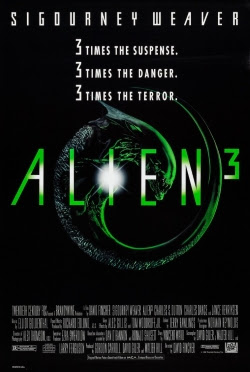
Few films feel more like a grim contractual obligation than Alien 3. If you want a real blood bath, you’d get more entertainment from reading about the tortured history of its production. Over nearly six years it saw off several scripts, at least two directors (including David Fincher resigning over continual studio interference) and Sigourney Weaver only agreeing to do the film if she was killed off at the end (well that and a big pay cheque).

All of this ended up as a depressing, grim and largely unenjoyable mess that goes over the same old ground as the first two films, but with diminishing returns. After the events of Aliens, our heroes ship crash-lands on a prison planet. Everyone on board is killed other than Ripley (we’ll come back to that…). The planet is populated by criminals who have embraced religion, led by Dillon (Charles S. Dutton) and a small staff of warders (Brian Glover and Ralph Brown) and Dr Clemens (Charles Dance). The company orders Ripley to sit tight and get picked up. But did an Alien on the ship lead to its crash? Is there now an alien on the planet? And is Ripley carrying an Alien inside of her?

It won’t surprise you to hear that the answers to all these questions are of course “yes”. And the film takes a painfully long time to get there. This is made all the more painful by the shockingly, uninvolving grimness of the story’s telling. Nowhere is this more clear than in the ruthless killing off of the surviving characters from Aliens. After the warmth and humanity of that story – and Cameron’s skilled creation of a family dynamic between Ripley, Hicks and most especially the mother-daughter bond between Ripley and Newt, it’s hard not to feel that their brutal off-screen deaths are a real slap-in-the-face. At a stroke all the character development of the previous film is negated. And so we get back on the treadmill of another monster hunt.

It’s not helped either by the fact there is hardly a character here you could give two hoots about. The prison is almost completely staffed by British character actors, peppered with the odd American. The script totally fails to give any of these people really distinctive personalities at all, before the Alien starts munching through them. On top of which the lazy script is littered with effing and jeffing, that serves to make the characters very angry all the time and even less engaging. The film’s most interesting new character, troubled Dr Clemens (a decent performance of world-weary sadness from Dance) is dead by Act Two, and the rest are basically an identikit pile of same-old-same-old. Dutton gets some good speeches as the prisoner’s morally complex leader, but he’s fighting an up-hill battle against turgid dialogue and tired old plotting.

Already by Alien 3 it feels like the franchise was out of ideas. Yet again “the company” is up to no good, only interested in making a buck off the creature. A post-industrial landscape again sees a number of people killed off in ever more familiar ways. The alien looks a bit like a dog this time (or an Ox if you watch the longer and even duller extended cut), but that’s about the most original thing here. And at the centre of the misery we have a grimly resigned and disinterested Weaver, who seemingly can’t wait for that Alien to burst out of her chest and end her association with the franchise for good.

It’s very hard to find anything enjoyable at all about this film. And it feels odd to say that about a film which is about people being brutally murdered one-by-one by an alien. But the others had touches of hope, humanity and demonic poetry to them. This is just a parade of slumming it British character actors, playing foul-mouthed rapists and murderers, getting torn apart. And then the film ends with a colossal downer even more downier than all the rest of the sludge you’ve had to sit through.

Basically Alien 3 reminds us that, with the monster as a motiveless killing machine, there weren’t many places to go with it. It’s not like it could suddenly reveal a motivation or something. So it seems the franchise was doomed – as it has been almost ever since this – to be a familiar parade of facehuggers, dark rooms, slow builds as people meander towards death down corridors, blood splatter and people who barely qualify as characters meeting grisily ends. Alien 3 is depressing and unrewarding in so many ways.

An American Werewolf in London (1981)

It’s a lesson in how not to spend your gap year in American Werewolf in London

Director: John Landis

Cast: David Naughton (David Kessler), Jenny Agutter (Alex Price), Griffin Dunne (Jack Goodman), John Woodvine (Dr Hirsch), Lila Kaye (Pub landlady), Frank Oz (Mr Collins), David Schofield (Dart Player), Brian Glover (Chess Player), Rik Mayall (2nd Chess Player), Don McKillip (Inspector Villiers), Paul Kember (Sergeant McManus)

Horror and comedy are both extreme genres, on the edges of normality and are designed to provoke extreme reactions, of either terror or hilarity. So it’s often a bit of a surprise that more films haven’t attempted to put the two of them together. But that’s what John Landis does in An American Werewolf in London. You’ll laugh, you’ll scream, you’ll even cry a bit. You’ll probably also look away a few times. And you probably won’t want to go hiking straight after it.

David Kessler (David Naughton) and Jack Goodman (Griffin Dunne) are two students backpacking through the English countryside. Taking shelter from the rain in a pub, The Slaughtered Lamb (pub sign a wolf’s head on a spike), they are swiftly intimidated by the locals and head back out – ignoring suggestions to keep on the road. Sure enough, they are attacked by a crazed wolf… Three weeks later David awakens in hospital, plagued with nightmares and visions of himself running through the forest. Could he be a werewolf? Falling in love with his nurse Alex (Jenny Agutter), he soon finds himself staying in her flat in London – just as the full moon rises…

AAWIL is a playful movie, with a grungy, college-humour to it. The jokes are often laugh-out loud funny, and the central characters are very engaging. As well as this the film is filled to the brim with blood, guts and slaughter. Guts fly, blood sprays. Landis gets the balance more or less spot-on between heightened humour and bloody slaughter – every bloody moment is followed by an excellent comic punchline, and just when the humour and romances start to get too much of a hold, you get a moment of shuddering violence. It’s also crammed with some great music – although in a terrible oversight there is no playing of Werewolves of London (if ever a song seemed written for a film…).

It’s best remembered for its influential werewolf transformation sequence. Rick Baker won the first Oscar for make-up for this tour-de-force at the film’s centre, which showpieces David’s painful looking transformation. This sequence has inspired every single werewolf transformation since, including David Thewlis’ in Harry Potter. Limbs stretch and distort. Hair springs up. His body arches and his spine practically snaps itself into new positions. His face distort, and the entire shape of the body changes. And of course it’s screamingly painful. The sequence hasn’t aged a day, and it’s still a marvel of make-up and practical effects.

Landis’ decision to largely shoot werewolves from POV or in flashes is a good one – when we get the animatronic wolf on the screen towards the end it is strikingly unconvincing and artificial looking, like a wobbily muppet. But for the bulk of it he makes these animals terrifying forces of nature. No wonder the creepy pub denizens are terrified of them.

The opening pub sequence is a masterpiece of small village aggression. Who hasn’t gone into a pub like this and felt like the room went silent as soon as you entered? The actors here revel in these hostile villagers, not least Brian Glover as a domineering loudmouth and David Schofield as a sinister darts player. It also brilliantly shows from the start that David and Jack are fish out of water – stuck adrift in a land they don’t quite understand, with a condition they don’t really seem to be completely aware of.

Not that it’s all bad for David, as he gets a steamy love-affair with Jenny Agutter’s alluring Alex, every geeky college boy’s dream of a gap-year love affair. Sure the bond between them is rushed – and Alex alternates between being caring-and-observant and is actually fairly dim when the film demands it (Yeah David has come home naked over than a woman’s coat, having spent the night sleeping in a zoo and has no memory of the night – but nothing odd strikes her about his behaviour…) – but she still gives a cracking performance.

David Naughton balances the film very well as David – a geeky student, horny and almost wilfully ignoring what’s happening to him. Griffin Dunne possibly steals the show as Jack, a strange mixture of best friend, geeky off-the-cuff wit and giver of bitter-but-straight-forward advice (the make-up for Jack by the way is almost more impressive than the transformation itself). 

American Werewolf in London is a bit of a (forgive me!) shaggy dog story. Structurally I’m not sure if it’s that great, as it tends to drift at times before a rush to the finishing line. The ending in particular is abrupt – not helped by a deliberately jarring final musical choice. It bowls along, but it’s so in love with its mix of horror and comedy that you never quite end up pulling for the romance at its centre as you should. I’m not sure John Woodvine was quite the right casting for the doctor investigating the werewolf phenomenon – he’s almost seems to feel as if he is above the picture. Landis gets some neat hits on British culture, but you can’t help but feel that there is more to be mined here – there isn’t quite enough American-British culture clash there to really sell David’s confusion.

It’s not a brilliant masterpiece – but it is very entertaining and crammed with striking scenes. Landis is playing around here – in fact he may be telling a massive joke, taking the piss out of monster movies while knocking slacker comedies by turning the slacker into a murderous monster. But it’s very good for all that – and for several key sequences alone you’ll find it hard to shake. It’s a film for late-night viewing and such a good mixture of comedy and extreme horror that it will always feel unique.