Tag: Brie Larson

Captain Marvel (2019)

Brie Larsen is Captain Marvel – yah boo sucks Trolls!

Director: Anna Boden, Ryan Fleck

Cast: Brie Larson (Carol Danvers/Veers), Samuel L Jackson (Nick Fury), Jude Law (Yon-Rogg), Ben Mendelsohn (Talos/Keller), Djimon Hounsou (Korath), Lee Pace (Ronan the Accuser), Lashana Lynch (Maria Rambeau), Gemma Chan (Minn-Evra), Annette Bening (Supreme Intelligence/Mar-Vell/Dr Wendy Lawson), Clark Gregg (Phil Coulsen)
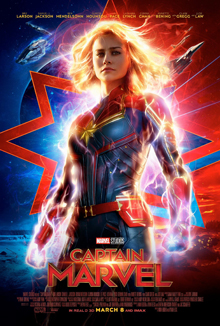
After almost 11 years, the big criticism of the Marvel Cinematic Universe has been that it had never made a film with a woman as the lead. Sure, we’d had various strong female characters, but never had one been trusted with headlining a movie. Well the studio has put that right with Captain Marvel, a hugely enjoyable, if not exactly groundbreaking, superhero origins story that can stand up with some of the best origin movies the studio has produced.

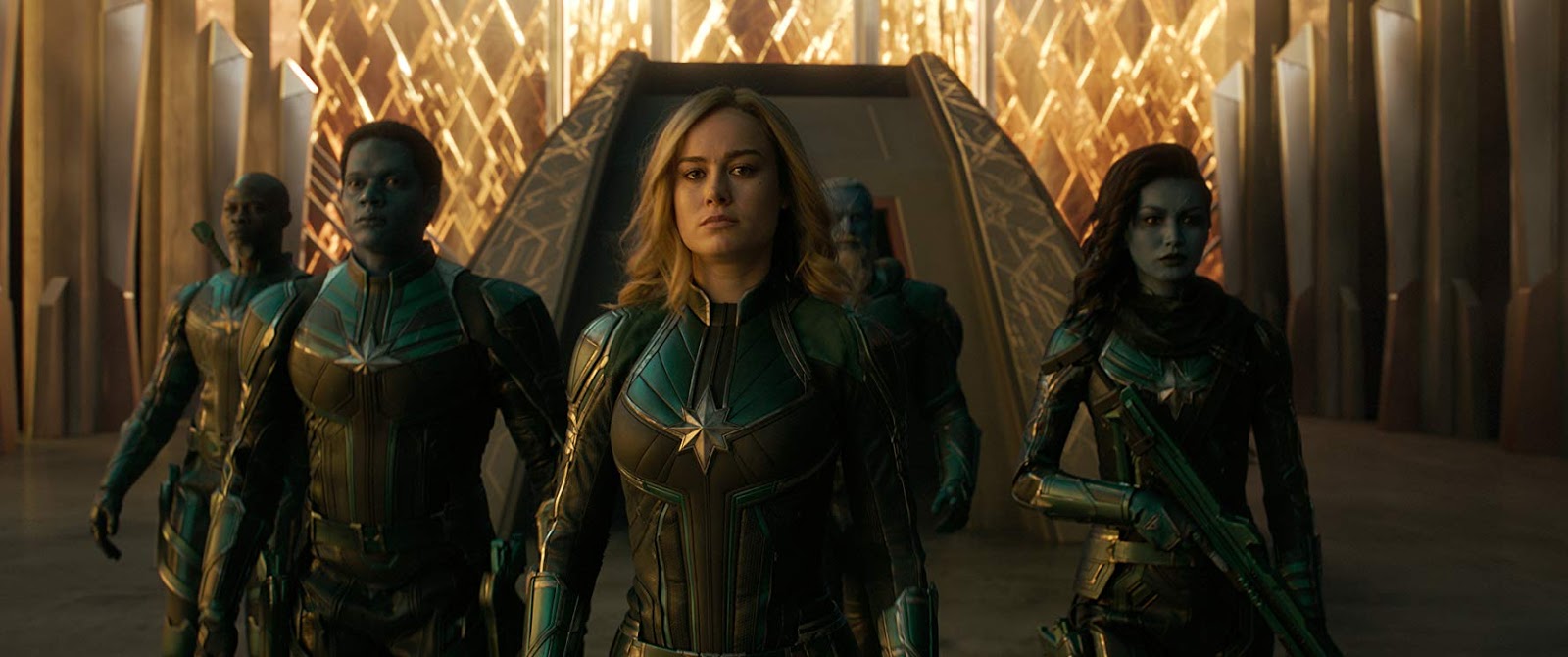
In the Kree civilisation, Veers (Brie Larson) is in training to take her proper place in the Star Force, under the tutelage of her mentor Yon-Rogg (Jude Law). But she’s struggling to control her immense powers, with her dreams plagued by strange visions and half memories of a planet that looks to us viewers a lot like Earth. After a Star Force mission goes wrong, Veers is captured by the shape-shifting Skrulls and their leader Talos (Ben Mendelsohn), her memory being searched for a time on Earth that she doesn’t remember. Escaping, she finds herself on Earth in 1995, and quickly allies with SHIELD operative Nick Fury (Samuel L Jackson, impressively digitally de-aged) to find out what the Skrulls want. But is everything as it appears? And what will happen as Veers starts to remember her true identity, as long-missing air-force test pilot Carol Danvers?

Captain Marvel I guess you could say is not an ambitious film. It largely sits pretty close to the well-established Marvel formula for introducing a new character, and it presents a series of visuals, fights and general tone mixing light-jokes with action beats extremely well. It’s a very professionally assembled product. However, what makes it work is the strain of emotional truth, and an interest in character as the driving force for events, that runs right through the centre of the film. It’s a testament to the imaginative and original direction from Boden and Fleck that at the centre of each clash we see, not the action and the pyrotechnics, but the emotion and character that give these things meaning.

They are also helped by an interesting plot, with some very decent twists, that throws the viewers into the deep end and carefully drip-feeds us information at the same pace as Carol picks it up. This also helps hugely for investing in Brie Larson’s Carol Danvers, a character who doesn’t know who she is and where she came from. Brie Larson does a terrific job, crafting a character “strong and determined”, but also witty, impulsive, brave, caring, decent and rather sweet with a strong moral compass that clearly, from the start, governs all her actions. It’s a fine performance and Larson is equally convincing in the film’s lighter, funnier moments as she is when banging heads together.

That helps keep the tone of the film pretty consistent as it heads through various twists and turns and rugpulls. Now I am sure some of these twists would be seen coming by anyone immersed in Marvel comicbook lore, but for us Muggles I appreciated the reveals about several characters defying expectations. The film also avoids false tension – a character is so obviously a shape-shifted replacement, it’s a relief that the film confirms this in minutes and the characters work it out shortly after. It’s a smart way for the film to fool you into thinking where it is going, while building towards more interesting reveals later on – particularly as it throws our expectations for several characters into the air.

And the action when it takes place is great fun, primary-coloured and accompanied by a great selection of 90s tracks. Because Boden and Fleck have spent so much time carefully developing the characters at its heart, these become action moments you can genuinely invest in, where people you care about are in peril, rather than the bangs and crashes without consequence that plague other films.

It’s also mixed extremely well with comedy. Samuel L Jackson in particular gets some great comic mileage out of a young Nick Fury, a man on his way to becoming the hard-as-nails guy we’ve seen in countless movies, but here still young, playful and (hilariously) besotted with a cat rather wittily called “Goose”. Ben Mendelsohn also gets some good moments from his mysterious shape shifter and Jude Law has a sort of put-upon charm as Carol’s mentor. There are also some lovely moments as Carol rediscovers her memories and rebuilds a relationship with her former best friend and fellow test pilot Maria Rambeau, well played by Lashana Lynch.

Captain Marvel is such good fun, such good old fashioned entertainment, that it seems to have defeated the efforts of the internet trolls to consign it to oblivion. It’s sad to say that, following in the footsteps of Black Panther, The Last Jedi, Star Trek: Discovery and Doctor Who, another “fan boy” franchise entry has seen its opening overshadowed by a bunch of sad wankers with key boards hammering into the internet (and whining into YouTube) about Disney and “the suits” forcing fans to watch stories about people who aren’t white males. Larsen and Captain Marvel got it in the neck for being sexist (it’s not about a man and Larsen dared to say she thought film critics were overwhelmingly white and male – guilty in this case), pushing a feminist agenda (because, like, it had a woman in it that wasn’t a damsel-in-distress or hooker-with-a-heart-of-gold) and not representing what the fans wanted to see in comic films (muscular men saving ladies and hitting things basically). Never mind that social commentary in the old days used to be what these fans bragged about their passions being so full of. Now any character who doesn’t fit a narrow set of racial and sexual criteria is an attempt by the PC brigade to push these pricks out of the fandom. Well to be honest we are better off without this turgid slime polluting fandom with their putrid stench. Put frankly, if films like Captain Marvel make some idiots decide they are going to boycott Marvel for ever more, well good – please fuck off and let the door slam you on your arse on the way out.

Anyway, rant over. Captain Marvel is great fun, Brie Larsen is great, the action is well done, the jokes are funny, the story is engaging and it’s all done and dusted in two hours. Go and see it.

Kong: Skull Island (2017)


The ape headlines and all other parts of the movie get crushed in Kong: Skull Island

Director: Jordan Vogt-Roberts

Cast: Tom Hiddleston (James Conrad), Samuel L. Jackson (Colonel Preston Packard), John Goodman (Bill Randa), Brie Larson (Mason Weaver), John C Reilly (Hank Marlow), Corey Hawkins (Houston Brooks), Toby Kebbell (Major Jack Chapman), John Ortiz (Victor Nieves), Jing Tian (San Lin), Jason Mitchell (Glenn Mills), Shea Whigham (Earl Cole), Thomas Mann (Reg Slivko), Richard Jenkins (Senator Al Willis)

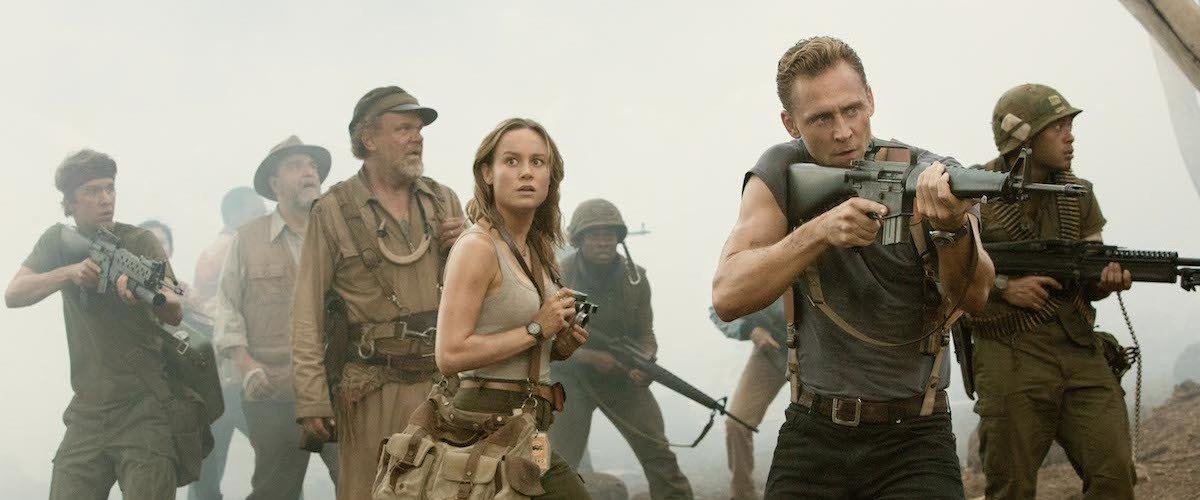
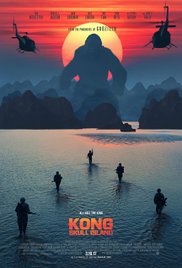
Kong: Skull Islandis another attempt to kickstart a monster franchise (rumours abound that eventually Kong and Godzilla duke it out. I’d start worrying about all those major landmarks.). So anyway, Kong: Skull Island sees a team of explorers head towards the mysterious Skull Island to… well to poke around I think. Actually the aims of the expedition rarely trouble the screenwriters so they shouldn’t trouble us. Anyway, Kong (larger than ever) is deeply pissed at this invasion of his territory so trashes every helicopter going. Our heroes are stranded on the island, while their incursion releases numerous monsters who endanger the whole world that only Kong can stop.

This pretty feeble film is a crumby repackage of numerous (much better) films – and yet another example of a generation of film-makers producing films whose only points of reference are older, better movies. This one plays like Apocalypse Now humped by King Kong. Perhaps one day we’ll actually get some truly original, distinctive films that make their own points rather than reworking others. And perhaps we’ll still get genre films that actually are interested in character and development, rather than bashing and blowing things up.

Anyway, the human characters are almost completely pointless in this B-movie retread. I was wondering how they persuaded such an illustrious cast of actors to come on board. This mystery was solved when I watched a remarkably bland DVD-feature – Tom Hiddleston’s video diary. This was basically shots of Hiddleston talking about having a great couple of weeks in Hawaii flying in helicopters, four weeks sunning himself in Australia and three weeks of travelling down a Vietnamese river. And he got paid millions of dollars to do it. No wonder he ends the video saying he’d recommend this life to anyone.

It certainly wasn’t the character that lured him in. Conrad is interesting for precisely one scene – as a troubled drunk in the bar – before he reverts into clean shaven, upright and heroic. His vaunted skills as a tracker are never used. His set-up as the natural survivor and leader never comes to fruition. His relationship with Brie Larson is based solely on them being the two most attractive members of the cast. As for Larson: has an Oscar-winning actress ever followed up her win with such a truly pointless, empty, non-part? 

The film is completely uninterested in human beings – it can’t even bother to make those that buy it early in the film distinctive individuals. Even the ones left at the end barely pass as people we know. Only John C Reilly crafts a truly engaging character as a sort of Ben Gunn figure. Samuel L Jackson gets the “soldier maddened by war” so that we have the typical “the real danger is man” sub-plot, but everything is by the numbers. The characters are so mix-and-match that you feel no peril at any point. It’s so cynical that it can even drop in a Chinese scientist from nowhere (who does nothing at all in the film) solely to try and sell the film to that market.

Our nominal heroes: most of them I’ve already forgotten

Kong is the real focus of the movie – and there is limited interest you can get out of a gigantic ape bashing and ripping things apart. Protracted battles go on and on and on. You really see the difference between the work of Andy Serkis and Peter Jackson in their Kong movie and this one. That Kong actually felt like a character you could bond with. This is just the wet-dream of a boy who grew up watching too many Harryhausen pictures, a behemoth who everyone stares at with wonder but whom the audience never feels any emotional investment in. And for all the faults of Jackson’s Kong, it was a film with brains, with heart, made with artistry and which understood character and emotion give meaning to spectacle, rather than being dull speed bumps a film needs to get over.

The film aims sometimes for an Apocalypse Now-style dread of humanity and the madness of war etc. etc. – but nearly always misses. The humans (and their aims) are such non-event blanks that we can’t care less about the danger of humanity. The film itself has none of the poetry of Apocalypse Now, and instead just wants a lot of (PG rated) violence and a bit of madness. Some of the madness even seems a bit uncomfortable – a tribe of natives are treated as humble exotics. It’s aiming to piggy-back on an attitude of America being humbled by Vietnam and lashing out – but never adds any material in the story to actually take this idea anywhere. Calling characters Conrad and Marlow doesn’t suddenly give it a Heart of Darkness depth – it just makes you think the screenwriters thumbed through CliffNotes before naming their characters. 

Instead the film winds on, never really getting entertaining, boring us with the characters and taking way too long lingering over monsters and bashings. The only thing the film loves is the bang, the buck and the “ain’t it SO COOL” shots of a monster ape hitting things. It’s totally empty, boring trash and it has all the grace and skill of a child’s home movie. Don’t get me wrong, it’s professionally made – but totally empty. Nothing in there is designed to stick with the audience or even remotely make them think. Harryhausen movies had a depth and magic to them that inspired a generation. Films, like this one, churned out by today’s imitators are empty light shows that won’t last a week in the imagination.

Free Fire (2016)


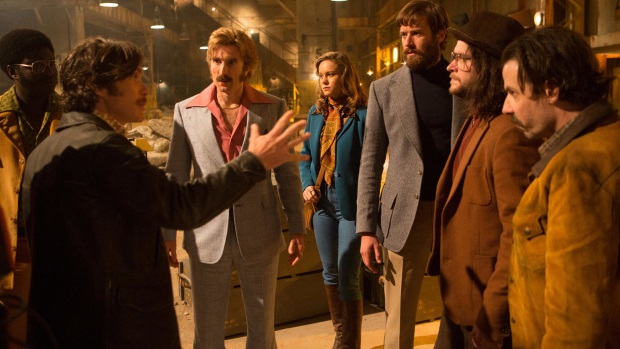
The calm before the storm in Ben Wheatley’s gun-fight Free Fire

Director: Ben Wheatley

Cast: Sharlto Copley (Vernon), Armie Hammer (Ord), Brie Larsen (Justine), Cillian Murphy (Chris), Jack Reynor (Harry), Babou Ceesay (Martin), Enzo Cilenti (Bernie), Sam Riley (Stevo), Michael Smiley (Frank), Noah Taylor (Gordon), Patrick Bergin (Howie)

At some unspecified point in the late 1970s, IRA men Chris (Cillian Murphy) and Frank (Michael Smiley) meet with Vernon (Sharlto Copley), via an intermediary Justine (Brie Larsen), to buy a lot of guns in an abandoned New York warehouse. Unfortunately, Frank’s druggy brother-in-law Stevo (Sam Riley) the night before was badly beaten by one of Vernon’s men Harry (Jack Reynor), after Stevo had maimed Harry’s cousin. Next thing anyone knows, guns are drawn and the shooting starts…

And that shooting lasts for the course of the rest of the film. Free Fire is like some sort of slightly odd concept album. As if Wheatley and co-screenwriter Amy Jump sat down and wondered “can we make a gunfight that basically lasts the entire course of a film”? The answer was, as it turns out, yes they could. Was it actually a good idea? Well that’s less clear.

The good stuff first. The film looks terrific, and is very well shot. The mix of beige and slightly over-saturated colours capture a hilariously flashy look at the 1970s. Soundtrack choices are very well made. The sound design – surely the main focus of any film focused on gunfights – is excellent, with bullets sounding like they are ricocheting past your ear. It’s cut with intelligence and clarity – it’s always immediately clear where you are and where everyone else is (Wheatley even patiently films our characters entering the warehouse through a series of doors – and old trick but it immediately gives us the geography).

The screenplay is also pretty funny in places, and does a good job of sketching out characters incredibly quickly. It’s lucky it also has a fine cast of actors to inhabit these swiftly drawn characters. Best in show is probably Armie Hammer as a suave, cock-sure hired gun who clearly believes the whole shebang is a little beneath him. Cillian Murphy as the nominal lead makes an engaging double act with Michael Smiley. Sharlto Copley adds maverick, overblown colour as a cocky weapons dealer. Brie Larson plays the long game as the intermediary whose loyalties seem a little unclear. Sam Riley is engrossingly pathetic as the whining loser whose actions lead to the whole disaster.

The gun fight itself is a neat combination of the realistic and the comic book. Our heroes are hilariously inaccurate with their weapons (as you expect most people would be in this situation) but this doesn’t stop every single character getting shot in the arms, legs and other body parts multiple times. Adrenalin means they largely shrug these off for the first half hour of the film, but by the final third each character is unable to walk and visibly struggling with growing shock and loss of blood. I’ll admit it’s rather fun to see a gunfight conducted largely by people crawling around on the floor groaning, in between whining and complaining at each other.

Structurally there isn’t a lot to the film. There is a twist of sorts as both sides are double crossed (the identity of the double crossers should be worked out by most astute watchers) and the film occasionally throws enemies together in odd partnerships and alliances. But the plot is basically a real-life survival film – who is going to get out of this warehouse alive?

Which is what brings us back to this concept album idea. Yes this an entertaining enough film – and it’s very short – but is a single gun fight between characters we’ve only vaguely got to know in the opening 10 minutes really enough to sustain long term interest? Is this something I can imagine re-watching? It’s got some funny lines and some decent moments, but honestly no not really. It’s an inventive idea, like a challenge Wheatley has set himself. But instead of seeing what is clearly a talented director playing with toys and seeing if he can make a film centred solely around an action set-piece, imagine if he turned that creative fuel on making an actual film. We know he can – he’s got some fine material on his resume. So why make this?

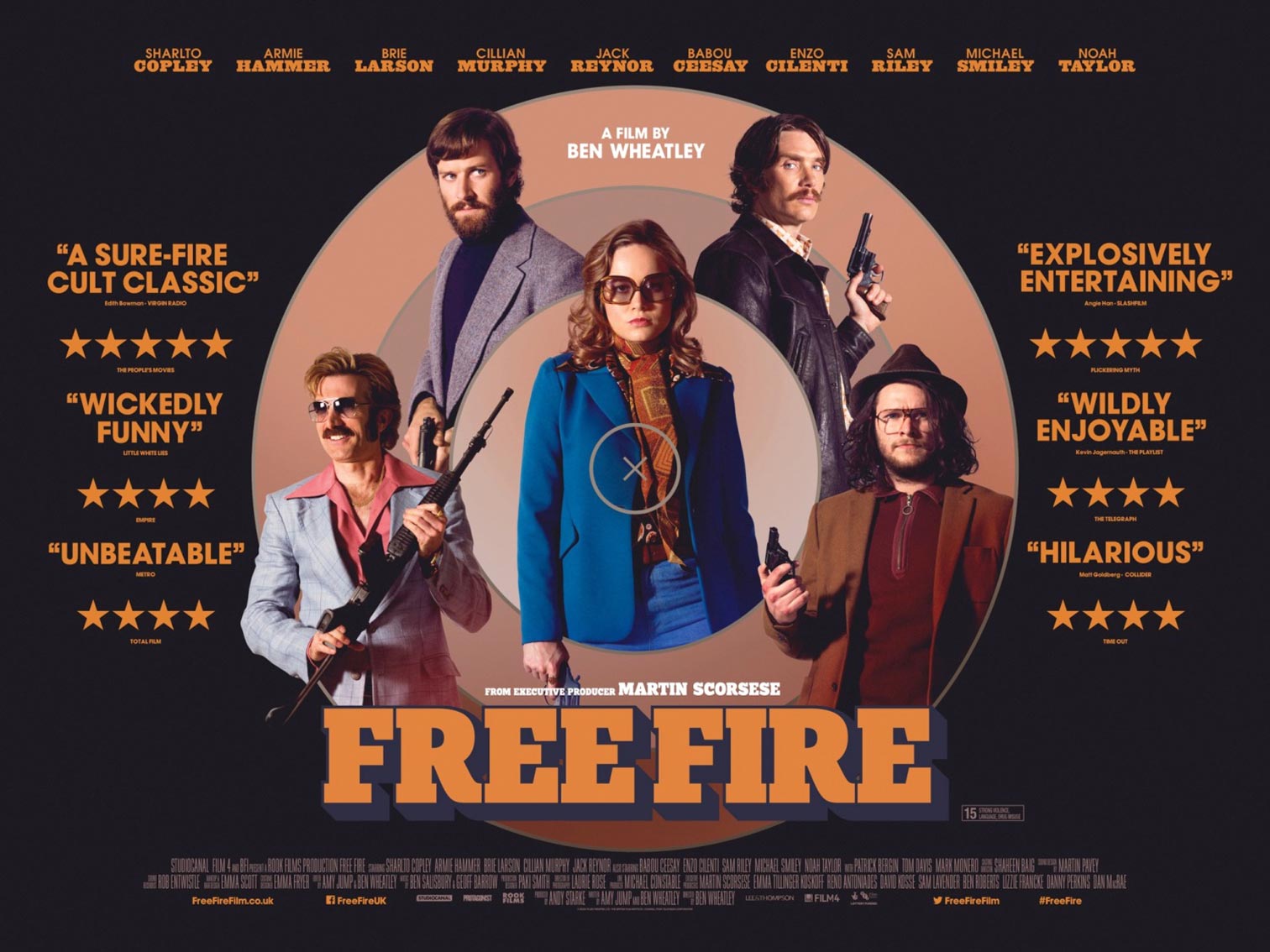
Free Fire feels like a conscious attempt at making a cult film, with its 1970s aesthetic, its eclectic cast of characters, its witty moments and punchy action sequences. I’ll agree it’s very different from anything else I’ve seen. Does that necessarily mean that it’s a good film? I’m not sure. It’s a challenge and almost a joke. It’s different from action scenes in Hollywood blockbusters – but at the end of the day, for all the fact that the gun shots have consequence, it’s just an extended action set-piece without context. Very entertaining but kind of empty.

Room (2015)


Brie Larson and Jacob Tremblay deal with a horrifying entrapment in Room

Director: Lenny Abrahamson

Cast: Brie Larson (‘Ma’/Joy Newsome), Jacob Tremblay (Jack Newsome), Joan Allen (Nancy Newsome), William H. Macy (Robert Newsome), Sean Bridgers (Old Nick), Tom McCamus (Leo)

Several years ago, I read a book on the train while coming back from Manchester. I wasn’t even sure why I had bought it: the cover made the story look fluffy and empty and (horror of horrors) it was narrated by a child. Surely a recipe for a tiresome read. I couldn’t be more wrong: I couldn’t put it down. Room was sensitive, it was heartbreaking, it was life-affirming, it was fantastic. If that’s not a tricky act to follow, I don’t know what is.

Room tells the story of Ma (Brie Larson) and her son Jack (Jacob Tremblay), who live together in a small room, with one skylight and no contact with the outside. Ma has built a whole world of childish adventure and excitement for Jack in this room, and their days are filled with games and laughter. But the audience knows better: at night Jack sleeps in the cupboard, ordered never to come out as Old Nick (Sean Bridgers) comes into the room and sleeps with Ma. Ma (or Joy) is a woman in her early twenties, kidnapped and trapped in this room for seven years.

Room is an extraordinary piece of film-making, which really captures the compelling richness of a fantastic novel. However, one thing I think is very interesting about this film is the varied reactions it receives from people. I watched this film with my wife, and we had quite different reactions to it: she found it bleak (despite having a positive ending), while I found it (like the book) a hopeful and positive film, a life-affirming story about the conquest of innocence over adversity.

Abrahamson has perfectly captured the tone and style of what was already a hypnotic and engaging book. In the book, the entire story is interpreted through the eyes of the child. The reader knows the situation is far more dangerous and sinister, but we see the confined world of the room from the viewpoint of a child who literally knows nothing else. The book requires the reader to tell themselves the “full story” between the lines of the child’s perceptions.

In the film this is much harder to create – we can see everything for ourselves. What Abrahamson and Donoghue (who adapted the script from her own novel) do so well is keeping the child at the centre, and filtering much the film through him – we don’t see or experience anything Jack doesn’t. This means that Abrahamson is able to bring some of the love Jack feels for the room around him into the story – an opening montage of their daily routine, including eating, play and exercise, shows that to a kid, this could be seen as a fun place to live.

It’s also, for Jack, an extraordinarily safe place: he knows every inch of his universe, and never encounters anything that he does not know or has not seen before. The struggle for Jack is not to escape the room, but to grow up – to accept the existence of a wider world around him and leave childhood security behind. It’s a theme in that helps make the film universal, despite its extraordinary circumstances, as a heartfelt coming-of-age story. Abrahamson’s skilful and brilliantly subtle direction threads this concept through the entire story, undercutting its potential bleakness and providing it with warmth and depth.

The fact that this was (for me anyway!) an uplifting film demonstrates with what grace it has been put together. The alternative story that runs underneath Jack’s full understanding is handled with sensitivity but unflinching honesty. Joy may go out of her way to protect Jack from what is really happening to her – imprisoned and routinely raped several times a week – but the viewer understands far more. When Jack says there are days when “Ma just needs to sleep all day” we know the causes of her feeling – and the quiet shot of Joy silent and still under a duvet speaks volumes of the mental strain she is under.

So why is this uplifting? Because for me, this story is about Joy’s struggle to keep her son innocent, to keep him safe and to protect him from the reality of what is going on around him. To make sure that his father never has a piece of him. In this she is completely successful: in fact, her focus is so overwhelmingly on protecting Jack that later in the film, when events remove the need for this, she herself undergoes a terrible mental collapse. But the message throughout is Joy’s overwhelming love for her son and her desire to protect him: and this makes her story, in a strange way, a triumph.

Joy’s story also seems (eventually) positive, due to the power of Brie Larson’s performance. Winner of a well-deserved Oscar, Larson is unflinching in her empathy for Joy’s situation, her dedication to the role apparent in every frame. She never allows Joy to become weak – she may be trapped, she may suffer from depression, but she has an inner strength that has developed from her fixation on the welfare of her son. She is uncompromising though in playing the reality of the emotional burden Joy is carrying both for herself and her son.

Larson also deserves much credit – as does Abrahamson’s direction – for the simply breathtaking work from Jacob Tremblay as Jack. It’s no exaggeration to say that without a child capable of delivering a performance like this, the film could not have existed. Tremblay’s performance is completely natural, totally unforced and deeply affecting. We totally invest in his fate. He has the pressure of carrying huge chunks of the film and does so with complete confidence. He and Larson have a totally natural chemistry between them, a bond that seems unshakeable.

This is a film I found profoundly moving – there are several moments (at least three) where I felt a lump in my throat and tears in my eyes: moments of sadness, but also moments of triumph and moments of simple human warmth. It’s a spoiler to even say that there are other people in this film, but the second half of the film widens the story and subtly changes its nature: it is a survival story from the start, but it’s also one of adjustment and recovery. This later act of the film is as wonderfully told as the first part, rich with empathy and human emotion.

Room is a truly wonderful film, a small scale story about huge and powerful themes that wears its greatness very lightly. Lenny Abrahamson’s direction – both technically and in its control of actors and story – is exceptional, creating a film that balances dozens of tones with aplomb. Like I said, it’s a film that invites you to take many readings from it: it’s a film about a victim, that feels like a triumph story; a film about a confined world that teaches us about the wider world; a film about imprisonment that feels like a celebration of freedom. It’s an extraordinary work, and there isn’t enough praise for Larson and Tremblay. I can’t imagine not being moved again the next time I see this – it’s a film for the ages.