
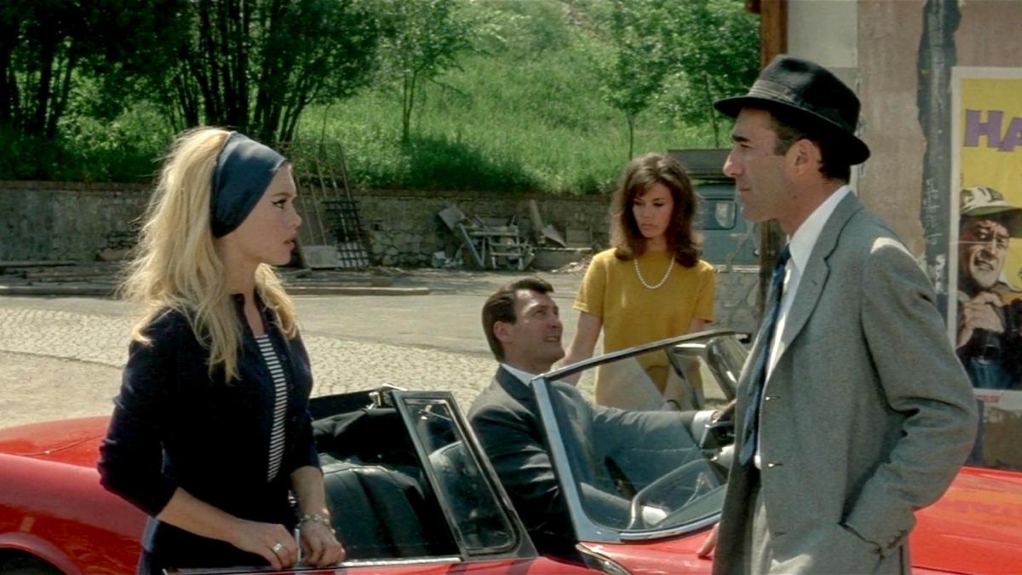
Godard’s film mixes virtuoso film-making with what feels a hard contempt for audience and characte
Director: Jean-Luc Godard
Cast: Brigitte Bardot (Camille Javal), Michel Piccoli (as Paul Javal), Jack Palance (Jeremiah Prokosch), Giorgia Moll (Francesca Vanini), Fritz Lang (Himself), Jean-Luc Godard (Lang’s assistant director), Linda Veras (Siren)

The title translates as Contempt and, to be honest, it’s hard not to feel a bit of the contempt when watching. Of all the Great Directors, the one I find the hardest to like is Godard. When you settle down to watch Godard, it’s hard not to escape the feeling you are steeling yourself to be looked down on. Godard wants you to know he’s watched more, read more and thought more than you about everything. Godard is playing out his fantasy of being a Hollywood director and a Great Artiste and wants you to know it. In fact, the further you move away from his debut À Bout de Souffle, the more his films become (for me) overly pleased-with-themselves statements rather than actual films.
Paul Javal (Michel Piccoli) is a writer, who wishes he could be producing great novels or plays, but is actually banging out crapola dialogue to fill American producer Jeremiah Prokosch’s (Jack Palance) Odyssey-opus, a film its director (Fritz Lang, one of Godard’s idols, playing himself) is trying to turn into art rather than the cheap sword-and-sandals epic Prokosch wants. But by taking the shilling, Paul earns the contempt of his glamourous wife Camille (Brigitte Bardot), who sleepwalks her way into an affair with Prokosch. Things come to head (as such) at Prokosch’s villa on Capri.
It was shot with a larger budget and a more controlling producer than any previous (or subsequent Godard film). God alone knows what they made of this – one suspects them reacting rather like Palance’s tantrum-filled producer when he inspects the arty dailies of statues and coastlines Lang has shot (“You lied to me Fritz!”). On some level Le Mépris is Godard playing a joke on his money men. They want a steamy relationship film, with plenty of Bardot on display? Have a slow series of elliptical conversations, a languid (but wonderfully filmed) argument scene in which Piccoli takes both a bath and a crap, and here are some deliberately functional shots of Bardot’s naked back on the bed while she and Piccoli intone empty dialogue. For a film that involves extra-marital sex, groping, a gun and a fatal car crash it’s deliberately unsensational – as if Godard was showing the money men he could ram anything they demanded into the film and still make it feel like a ticking-off.
To be honest, there’s also in Le Mépris a bit of Godard’s contempt for himself for selling out, as if he realised part way through he’d made a terrible mistake by taking the money and wanted everyone to know it. You can see it in the film’s visuals, that turn the demanded cinemascope wideness (which Godard loathed) into a series of pan-and-scan shots and tight close-ups that wipe-out the impact of the grand visuals. Godard may appear in the film himself, but his real substitute is his hero Lang, here a visionary polygot (the only person who can speak the full hodgepodge of languages the characters communicate in), who gives voice to Godard’s most closely held views about cinema and the only person completely assured and comfortable with what he is doing.
Not that there isn’t an awful lot to admire in Godard’s work here. As fits a director steeped in a love of film, Le Mépris drips with homages to cinema technique. Godard speaks the credits – Welles in Magnificent Amberson’s style – over an opening shot which is itself of an opening shot filming a crew filming the opening tracking shot of Le Mépris. There are touches of Ford, Hawks and Lang in the stylistic love of Godard’s heroes. Paul dresses like a mix of Sam Spade and Dean Martin and loves chatter about old movies (he’s very excited about the prospect of catching an old Hawks film). The tattered film studio is lined with film posters (including those depicting Godard’s former wife Anna Karina). We see the intricate procedures of film-making and post-production and Bardot even reads books about cinema in her downtime.
There is some astonishing film-making – Godard may be self-important, but he can shoot a film with grace. The tracking shots through the seemingly abandoned Cinecittà studios in Italy are beautifully done, as is the intriguing framework of the unique Capri villa and its striking staircase. The film’s highlight (and finest sequence by far, as well as its most human) is its middle act, a virtuoso choreographed sequence in the Javal’s under construction apartment (including French doors without glass, bathrooms without doors and intermittent furniture). The camera moves, brilliantly at a distance, to constantly frame these two characters interspersed between doorways, or kept apart by walls in the centre of the frame, barely ever managing to ever be in the frame together, the disjointed visual language perfect for communicating a conversation where they are never on the same page. It’s a superb way of filming partly an argument, partly a drifting out of love, partly a fumbling attempt to find common ground. There is a real emotional reality to this scene, something that isn’t present anywhere else in the film.
Even there though, it works because of its distance. Le Mépris is a strikingly distant film, Godard presenting a deliberately cold, hostile film that lacks any real warmth, empathy, wit or lightness, like he’s challenging us to swallow down this filmic medicine of cinematic inspiration and beautiful framing. Le Mépris also seems to despise its characters. Palance’s film producer (and this is a deeply uncomfortable performance from Palance, who constantly looks like he’s woken up suddenly and doesn’t know where he is) is a boorish philistine and an idiot. Piccoli’s writer is a shallow, preening lightweight who wants to be a Godard but is a hack with pretensions.
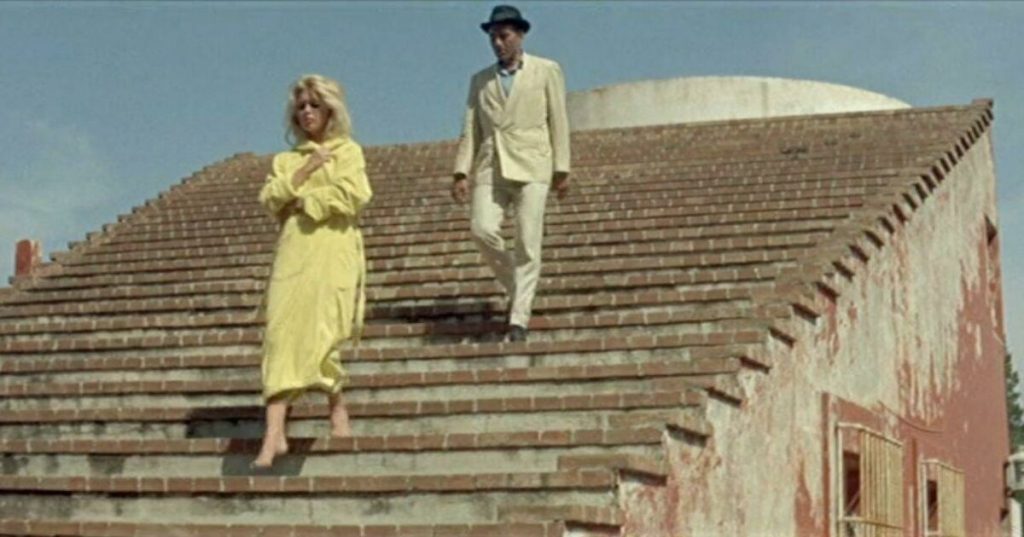
Interestingly the most intriguing character in it is Bardot – but she remains elliptical, perhaps because part of Godard can only see her as some sort of trophy or status symbol, something Paul fails to ‘deserve’ because he can’t maintain his principles. Her motivations remain a mystery and one wonders if there is much place for them in Godard’s masculine view of the world, where women are either secretaries or muses. Camille herself seems to see herself as sort of property, suspecting her husband of pimping her to a producer but then seemingly embracing that in any case (despite her contempt for Prokosch). There is an air in Le Mépris that Godard can’t really imagine either Bardot or Giorgia Moll’s Francesca (a striking presence, who has the best running joke with her rudimentary translations of Javal’s dialogue for Prokosch) as collaborators or equals to either the brutish producer or the tortured men, but people who can only be defined by their attitudes towards them.
Above all, Le Mépris wants you to know your place when watching it. To admire it, but also to know that your wishes for something more dramatic or humane are shallow, base desires. That really you should be seeking out the sort of arty stuff Fritz Lang is shooting on the island, not the page-turning nonsense the executives wanted. It’s an attitude that pours out of the film, and after a while its one that makes you want to spend your time elsewhere. Godard may be a clever guy, but he can be very poor company.
 Movie Musings