Tag: British Films

The Man Who Knew Infinity (2015)


Dev Patel is mathematical genius Srinivasas Ramanujan, struggling against prejudice in The Man Who Knew Infinity

Director: Matthew Brown

Cast: Dev Patel (Srinivasas Ramanujan), Jeremy Irons (GH Hardy), Devika Bhise (Janaki), Toby Jones (John Edensor Littlewood), Stephen Fry (Sir Francis Spring), Jeremy Northam (Bertrand Russell), Kevin McNally (Percy MacMahon), Richard Johnson (Vice Master Henry Jackson), Anthony Calf (Howard), Padraic Delaney (Beglan), Shazad Latif (Chandra Mahalanobis)

The British Empire. It’s a difficult slice of British history, and it undoubtedly contributed to contemporary attitudes of superiority that affected British people and their institutions. It’s these attitudes that form the central themes of The Man Who Knew Infinity, an effective story of a struggle against the odds. 

In the early 1900s, Srinivasas Ramanujan (Dev Patel) works in Madras as a junior accountant – but his superiors quickly realise his mathematical abilities far outstrip his mundane tasks, and encourage him to write to mathematics professors to bring his theoretical work to their attention. Ramanujan starts a correspondence with GH Hardy (Jeremy Irons) of Trinity College, Cambridge, who invites him to England to explore his potential. Once there, Ramanujan quickly proves his genius but, despite Hardy’s support, he struggles to be accepted by the fellows and students of the college, who only see an upstart from the colonies.

The Man Who Knew Infinity is a conventionally structured biography – struggles personal and professional, success followed by setback and a final triumph combined with a bittersweet ending. It’s structurally nothing different from things you’ve seen before, but it’s told with calm, quiet, engrossing dedication, with unflashy direction, a solidly written script and some truly excellent acting. No wheel is reinvented, but it revolves with a highly enjoyable and heartfelt tenderness.

It’s a film that manages to present mathematics without using spurious real-world clunky metaphors, and gets a lovely feel for the hard work and theoretical study that go into mathematical theory. It also brilliantly communicates what the maths is about. I’m no theoretical mathematician (football stats are my limit) but even I could follow (just) why Ramanujan’s insights were so important and what they meant to the field of theoretical mathematics. The film has a real feel, not only for rhythms of academic work, but also the politics of academia (which needless to say are labyrinthine).

But the film’s main point is the resentment and outright racism Ramanujan must overcome. Played by Dev Patel with a quiet decency and modesty that only rarely bubbles over into bitterness, Ramanujan is constantly hit with everything from misunderstanding to contempt. His every achievement is met by questioning and doubt. His proofs must be demonstrated time and time again. To win the support and respect of his peers, he must constantly revise and revise his work, while the slightest slip is held up as proof his fraudulence or luck. 

If you do want to criticise the presentation of this, you could say that much of the campaigning and struggle for acceptance is championed by the establishment figure of Hardy – it’s he who does most to convert others, and who presents Ramanujan’s key theories to the Royal Society at the end. Stressing Ramanujan’s politeness and humbleness does have the downside of making him a slight passenger at times in his own movie.

But then it’s not just his movie, because this is a story of a deep, near romantic, bond that forms between the gentle Ramanujan and the shy and sensitive Hardy. Hardy, the film implies, was a man uncomfortable with emotional closeness, but he feels a huge bond with Ramanujan, having overcome similar class-based prejudice. The two men have a natural understanding, and support each other, finding themselves in perfect sync in their opinions on mathematics and their outlooks on life. In the nature of the British, nothing is ever said – but it’s clear that both men feel an intense personal connection that, quite possibly in Hardy’s case, mixes with a suppressed romantic yearning.


This relationship largely works so well because Jeremy Irons is quite simply fantastic as Hardy. Cast so often as superior types, here he gets to flex other parts of his arsenal as someone shy, timid, and sensitive. Hardy is so uncomfortable with personal friendships, he can rarely bring himself to look directly at other people. Irons sits on the edges of frames, or hunches and shrinks, his eyes permanently cast down. Saying that, he brings out the inner steel and determination in Hardy, his devotion as an advocate for Ramanujan. Irons is so shyly withdrawn, that the moments he allows emotional openness with Ramanujan, and most movingly with fellow mathematician Littlewood (played with a kindly good nature by Toby Jones), are wonderfully affecting. This might be one of Irons’ finest performances in his career.

The Man Who Knew Infinity is in many ways a conventional film, but performances like Irons’ lift it into something a little bit special. It’s a well-meaning and heartfelt film that embraces some fascinating concepts and also presents a story of triumph against adversity that feels genuinely moving and engaging. Filmically and narratively it’s very much by-numbers at times – but it hits those numbers so well, you’ll certainly have no complaints.
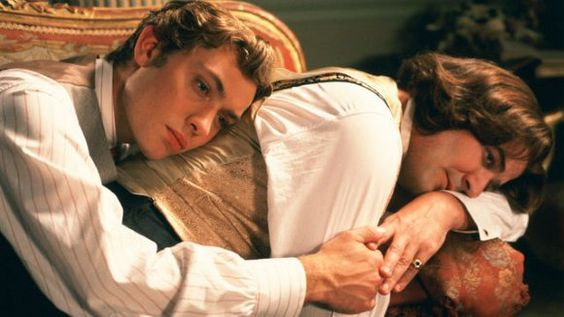
Wilde (1997)


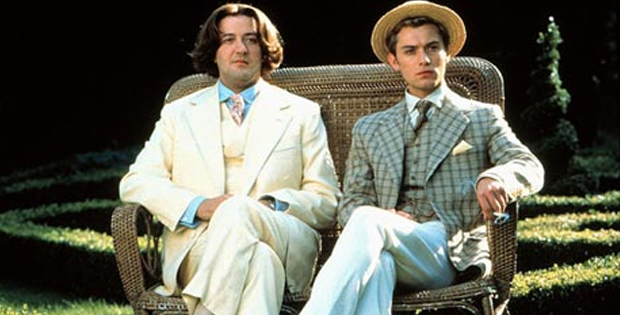
Jude Law and Stephen Fry in a disastrous love affair in sensitive biopic Wilde

Director: Brian Gilbert

Cast: Stephen Fry (Oscar Wilde), Jude Law (Lord Alfred “Bosie” Douglas), Jennifer Ehle (Constance Lloyd Wilde), Vanessa Redgrave (Jane Francesca Agnes “Speranza” Wilde), Gemma Jones (Sibyl Douglas), Judy Parfitt (Lady Mount-Temple), Michael Sheen (Robbie Ross), Zoë Wanamaker (Ada Leverson), Tom Wilkinson (Marquess of Queensbury), Ioan Gruffudd (John Gray)

Could there be a more perfect piece of casting than Stephen Fry as Oscar Wilde? Not only is Fry the spitting image of the famed Irishman, but Fry’s own mercurial talent, his enormous outpouring of novels, articles and screenplays, his skill as a raconteur and his general ubiquitous presence as a personality make him a pretty good modern equivalent of Oscar Wilde. A lifelong admirer of Wilde – and an increasingly vocal proponent of gay rights and mental health awareness – Wilde’s life plugs into many of Fry’s own outlooks on the world. So yeah, perfect casting!

Opening in 1882 with Wilde’s tour of America (he effortlessly charms a group of clichéd “yee-haw!” silver miners – who literally fire their guns into the air in delight at his bon-mots in the film’s crudest touch), the film covers Wilde’s growing career, but focuses on his personal relationships. Unaware of his homosexuality, he marries Constance (Jennifer Ehle), but discovers his true nature with her friend Robbie Ross (Michael Sheen). However, this leads to his destructive, obsessive love for alternately petulant and caring Lord Alfred Douglas (Jude Law), his beloved “Bosie”. When he is accused publically of sodomy by Bosie’s father, the Marquess of Queensbury (a raging Tom Wilkinson, chewing the scenery), Wilde takes the matter to court – a disastrous decision that destroys his life.

Brian Gilbert’s film is a sensitive and lovingly crafted slice of period drama, that movingly demonstrates the hypocrisy of Victorian values. Wilde is celebrated by the public, despite the open secret of his and Bosie’s relationship, while rent boys (including a one-line appearance from Orlando Bloom!) and discrete gay relationships are common place. Wilde is a gentle, naïve man for whom emotional closeness is more important than physical love. He charms a society only too aware of his nature. However, the instant he causes a stink, his reputation is ruined and his life collapses. What the film does so well is give us a sense of the inner vulnerability, doubt and desire for affection at the heart of a man who, perhaps more than any other, lived his life as a public exhibition.

Halliwell’s Film Guide claimed the film attempted to reposition Wilde as a family man, a grossly unfair view of the film’s stance. As if a man who discovers he is gay could not love his children, or that he could no longer care for his wife. Similarly, accusations that the film shows Wilde’s homosexuality as the roots of his downfall are similarly misguided – Robbie Ross is unaffected by legal troubles and he’s openly gay. No, the film is making a far more conventional (in a way) point – Wilde was brought low because he fell hopelessly in love with the wrong guy.

Jude Law’s big break was in this film – and watching it again is a reminder of what a firebrand, dynamic actor he can be. He makes Bosie half monster, half emotionally vulnerable child. He alternates (sometimes within the same scene) between affection, devotion, kindness and wildly petulant rage. He’s overwhelmingly selfish and self-obsessed – even as Wilde’s life collapses, he can only whine that he is furious his father is winning – but then remorseful and guilt-stricken when the consequences of his actions become clear (but not enough to not do it again). Law juggles all these contradictions with astonishing skill – it’s an assured, magnetic performance of brilliance. We can see why Wilde adores him, while at the same time wanting to wring his neck.

It’s also clear why all the other characters around Wilde find him so appalling. Ross (and Sheen is similarly superb as Wilde’s tragically “friend-zoned” devoted admirer) can’t bear the appalling influence Bosie has, but knows he’s powerless to do anything about it. In one great scene, Bosie haughtily says he knows Ross always hated him, before cruelly saying it’s because Wilde loved Bosie, but Ross was only “one of his boys” – the look of pain on Sheen’s face is brilliantly moving. Wilde himself seems almost sadly (if inevitably) drawn into Bosie’s tastes for casual sex and rough trade – often playing voyeur at these events, while sadly accepting Bosie doesn’t find him physically attractive. Wilde’s basically the victim of an abusive relationship – and the film does a brilliant job of demonstrating why a man otherwise so blessed with intelligence can’t see it.

Julian Mitchell’s excellent screenplay (based on Richard Ellman’s award-winning biography) uses Wilde’s The Selfish Giant as a framing device – subtly comparing Wilde and Bosie respectively to the giant and the child. It also brilliantly constructs a sense of Wilde’s quick wit and staggering intelligence, and provides a host of sparkling cameos for some fine character actors. The production design and photography are spot-on, and while Gilbert may be slightly workmanlike in his filming, he certainly lets the story tell itself.

The focus on Wilde’s family life is also reassuringly different – it’s brilliant to see Wilde’s obvious adoration for his children, and plenty of indication that he was actually (much of the time) a very good husband and father. Mitchell’s script softens Constance’s reaction to Wilde’s conviction (she wasn’t as forgiving and forward-thinking in her views as she seems to be here) but it does mean that we are allowed to see the full story of Wilde’s life, rather than having him defined by his sexuality. Jennifer Ehle also does a marvellous job with very little material, and her quiet dignity and support for her husband (despite her anger at his obsession with Bosie) is very affecting.

But at the centre of all this is that perfect casting of Stephen Fry. In all the rest of his career, Fry will never be better than he is here. His Wilde is intellectual, mildly arrogant, but also naïve, gentle and almost unworldly. His voice is perfect for the aphorisms, and he is really striking physically. Above all though, he brings a deep, emotional empathy to the part – you feel how personal this is for Fry the actor, and you feel how closely he identifies with a man who discovered his sexuality late. His besotted, blind love for Bosie is as affecting as it is frustrating. His vulnerability in Reading gaol is deeply moving. It’s a quite marvellous performance, anchoring a movie that is gentle, kindly, caring and sensitive in exploring the inner life of a very public man.

I Know Where I'm Going! (1945)


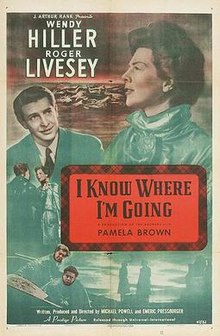
Roger Livesey and Wendy Hiller prove opposites can attract in Powell and Pressburger’s marvellous I Know Where I’m Going!

Director: Michael Powell, Emeric Pressburger

Cast: Wendy Hiller (Joan Webster), Roger Livesey (Torquil MacNeil), Pamela Brown (Catriona), Finlay Currie (Ruairidh Mhor), George Craney (Mr Webster), Nancy Price (Mrs Crozier), Catherine Lacey (Mrs Robinson), Jean Cadall (Postmistress), John Laurie (John Campbell), Valentine Dyall (Mr Robinson)

Joan Webster (Wendy Hiller) is a young middle-class woman with ambitious aims who has worked to secure a marriage to a wealthy, much older, industrialist. En route to the wedding in Scotland, she gets stranded on the Isle of Mull by a storm. There, she finds a world of very different values and principles than her own. She also finds herself thrown together with naval officer Torquil MacNeil (Roger Livesey) a man trying to return home for leave. Trapped on the island for days, Joan and Torquil find themselves romantically drawn together – however much Joan tries to avoid it.

Powell and Pressburger’s films all have a sense of filmic magic to them. They are the sort of films it’s very easy to fall in love with, and swear by. I Know Where I’m Going falls into that model extremely well – a dreamy romance in a stunning looking Scottish island, full of engaging characters and beautifully filmed. It’s a seemingly simple romance story, but it feels like a deep and engaging fable – it’s a film that shows how throwing a little uncertainty into a life can be a good thing.

Because Joan Webster categorically knows where she is going. The film’s entire build-up centres around her ambition and overwhelming focus. She literally dreams about marrying the engineering firm (yup that’s right, the firm itself not the man). She pushes her father into putting together a detailed itinerary for her entire journey. She seems to have no self-doubt whatsoever. So the magic of the film is that, deep down, it’s a about a woman realising that the place she has spent her whole life going, isn’t in fact where she wants to go. And the audience can see right away that she wants something else – much quicker than her!

This works because Powell and Pressburger get the romantic feeling of the island and its people so spot on. It’s very easy to get this Monarch of the Glen style Scottish idyll stuff feeling wearing and tedious. But somehow, it just sort of clicks. We don’t get the islanders’ charm and love of the simple life rammed down our throats, we just see how they behave and their simple contentment – and of course we have it compared all the time with Joan’s ruthless ambition. This combines really well with Powell and Pressburger’s lyrical style, their semi-magical romantic camera shots making the island seem hugely attractive (even when it is lashed with wind and rain).

By contrast our brief impression of the world outside Scotland seems cold and mechanical. It’s all offices, impersonal train booths, and besuited chaps giving stiff-collared responses. In a neat piece of cross cutting, one businessman even appears as if he has train steam puffing out of his top hat, like some human train. But we have hints that Joan has more romance under her skin than she would like to admit: as the train moves into Scotland (the film makes no real attempt at realism for its train shots) Joan dreams of the landscape they move through like some sort of tartan vision, with hills made of patchwork quilts. It’s one lovely image.

Then we have the arrival on the island – it’s got a charming, breezy openness about it. Out first introduction to Pamela Brown’s radiant Catriona is on a rainy hill with a pair of wolf hounds, before she bursts into a room (low angle cameras make her look even more romantic). Could the contrast with the mechanism of the rest of the world be more precisely made? There is a charming lack of interest in worldly affairs – the people are “not poor, they just haven’t got any money” – and what could be tiresome scenes set in ceilidhs and the like actually carry a lot of charm with them. Compare the vibrancy the islanders greet life with with the distant coldness of the wedding guests staying there – which group looks like the people you would like to spend time with?

The other thing that really works is the romantic relationship between Joan and Torquil doesn’t feel forced, or jump through too many clichéd hoops and feels organic and natural. The actors have fantastic chemistry, and the film playfully places them in a number of situations that drives this unspoken interest. It’s got more than a touch of screwball comedy about it – two people trapped together, one of them with mounting frustration – despite not really, as such, having a plot. 

Wendy Hiller is superb as Joan Webster – she brings a Katherine Hepburnish quality to the role: a determined, modern woman, a control freak in a situation where she has no power at all and hating every minute of it. What really works though is her own lack of self-knowledge. It’s clear to the viewer (and most of the characters) she is developing a deep attraction to Torquil, but Hiller makes it clear that Joan is completely unaware consciously of this. It’s a marvellous performance, totally relatable and hugely endearing, despite Joan’s ruthless certainty, because it’s always subtly puncturing that certainty with doubt.

Roger Livesey makes a perfect countpoint as Torquil. It’s a perfect role for him – a twinkly people-person, old-fashioned but not a stiff-upper lip cold-fish, who has dedicated his life to service, but can still enjoy himself. He also, in a way that many men in films of the time don’t, wears his feelings close to the surface. It’s clear he is in love with Joan from an early point, and every beat of his body language indicates this. At the ceilidh he can barely take his eyes from her – while his body language subtly (but not possessively) indicates his interest. He has an old-fashioned, casual, scruffy charm to him that never gets wearing. He’s also superb.

You’ve got a beautiful romance at the centre, with two characters it’s very difficult not to end up caring a great deal for. Beautifully acted – Pamela Brown is marvellous and Finlay Currie suitably gruff – it’s a film that feels distinctive, that makes charm and playfulness never feel wearing. Not much happens, but it’s beautiful, very sweet and extremely charming. You warm to these characters, and Powell and Pressburger create a world that feels incredibly attractive. There is some fine film-making here – from imaginative dream sequences, to intelligent visual choices that quietly influenced anyone making a film about the romance of the simple life. A little known treat.

Their Finest (2016)


Gemma Arterton and Bill Nighy do their bit for the war effort by making movies in Their Finest

Director: Lone Scherfig

Cast: Gemma Arterton (Catrin Cole), Sam Claflin (Tom Buckley), Bill Nighy (Ambrose Hilliard), Jack Huston (Ellis Cole), Helen McCrory (Sophie Smith), Eddie Marsan (Sammy Smith), Jack Lacy (Carl Lundbeck), Rachael Stirling (Phyl Moore), Richard E Grant (Roger Swain), Paul Ritter (Raymond Parfitt), Henry Goodman (Gabriel Baker), Jeremy Irons (Secretary of War)

During World War Two, Catrin Cole (Gemma Arterton) is hired by the Ministry of Information to write dialogue for propaganda films – to be specific “the slop” (the women’s dialogue). She pitches the semi-true story of two young women who take a boat to Dunkirk to rescue soldiers, and is hired to work with Tom Buckley (Sam Claflin) to write a screenplay. Among the cast of this film is Ambrose Hillaird (Bill Nighy), an ageing matinee idol having trouble accepting his days of playing young heroes are behind him. Together they overcome initial difficulties to create a film that moves the nation.

Their Finest is a gently amiable piece of film-making, totally predictable but still rather entertaining for all that. You won’t exactly be gripped or compelled by it, but you certainly won’t feel cheated out of your time watching it. It doesn’t have much in the way of originality about it – and you can see most of its jokes and events coming a mile off – but it’s still got a certain charm and warmth about it. And it’s crammed full of some very fun “film-within-a-film” scenes, both seeing the film the team create and the work (and backstage politics) that go into making it. There are also some neat gags (and wry comments) about the casual sexism of the day – and the film (without dwelling on the issue) makes a number of heartwarming moments out of its lead character succeeding against the odds on her own merits.

It also has a couple of fine performances, not least from an engaging and bright Gemma Arterton, who brings a great deal of quiet depth and dignity to Catrin. Catrin has a sweet lack of self-confidence about her – a gentle doubt, that she must learn to overcome over the film. She makes an affecting and empathetic lead. It also helps that she has a great screwball comedy chemistry with Sam Claflin. Claflin’s part is far more conventional – the gruff man with the heart of gold – but he nails the part’s humanity and its comic grumpiness.

The film’s main weapon of entertainment is Bill Nighy, in a part almost certainly written for him so well does it match his strengths. Hilliard is just the sort of vain, pompous, arrogant preener that Nighy can play in his sleep – a man who needs to be flattered and praised into doing anything, who assumes when he first reads the script he’s being offered the role of the young hero not the drunk uncle. What Nighy does so well with parts like this, though, is bring them depth and pathos. Hilliard may be an egotist, but he’s gently comforting in tragedy and has a profound sadness and insecurity behind him about where his career and life is going. So, while he brings a lot of the film’s comedy, he’s also a large part of its heart, elements that emerge increasingly as the film progresses.

The sequences that follow the making of the film are very funny. Jack Lacy is wonderfully sweet and genuine as an actual war-hero, an American serving in the RAF, parachuted in by the Ministry of War to send a propaganda message to the USA. Lacy’s Carl is well-meaning and loves films (not least his hero worship of Hilliard) but a hopeless actor, who can’t help smiling at the camera after every line. It’s a neat indication of the film’s well-judged tone that he is never a butt: the crew work hard to improve him, he’s eager to learn, he’s completely lovely – and when a character does complain about the extra work he is causing, Henry Goodman’s Alexander Korda-ish producer simply states “he has done things none of us would be brave enough to do”.

Because there is a harder realism about this film. It doesn’t shy away from the dangers and brutality of war – there are bombings and people die. Some deaths are characters we know, others are on the edges of the story. “I’m a bit emotional today. My landlady was killed last night” one character states. Each of our lead characters encounters a dead body, or knows someone who has been killed. There is a genuine danger of obliteration or invasion just on the edges of the comedy. It’s a neat balance that the film keeps, between pathos and light comedy.

The film-within-a-film, The Nancy Starling, is a brilliant pastiche of 1940s British war films, instantly recognisable and affectionately amusing. But it’s also, when we finally see parts of the film, rather moving. It has a real emotional force to it – the film-makers achieve the difficult balance of giving us a pastiche we can chuckle at it, but also a pastiche that feels like it would genuinely move the people watching it in the film. 

Their Finest’s main problem might be that partly because it’s so quietly unassuming and gentle, it is almost completely bogged down in predictability. Most of the character arcs can be seen coming a pile off – my wife and I were able to practically write the scenes ourselves as they happened. There is very little original here. Even the stories of actors’ pretensions and film-making disasters have a breezy air of familiarity about them – the sort of stuff we’ve seen in films about film-making hundreds of times before. In fact, what’s striking is that a film so predictable and familiar remains entertaining and endearing – which is surely some sort of testament to the acting and direction.

Their Finest is perfect for what it is: an entertaining, weekend-afternoon film that will pop a gentle smile on your face. There is nothing particularly deep or memorable about it beyond that. It has some fine performances, some good jokes and it will make you laugh. But will you remember much about it within a few hours? Probably not. Is it a film that you can imagine revisiting to discover new gems in it? Again probably not. Is it a film that will entertain you on a Sunday afternoon? Absolutely.

Sunshine on Leith (2013)


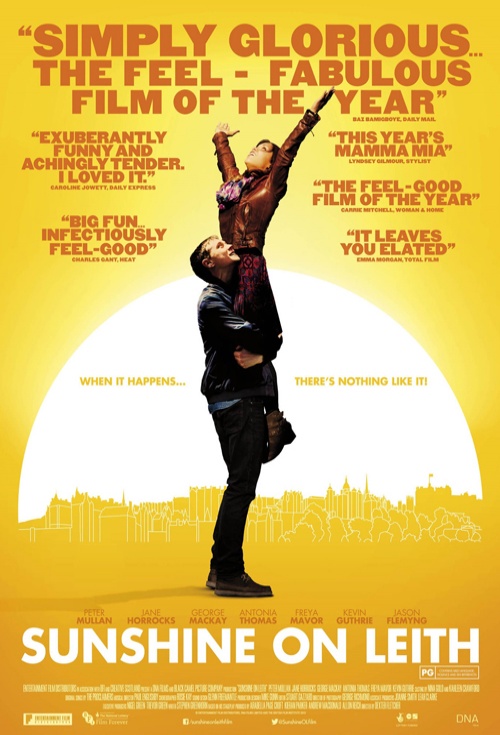
Peter Mullan hits the right notes in crowd-pleaser Sunshine on Leith

Director: Dexter Fletcher

Cast: George MacKay (Davy Henshaw), Kevin Guthrie (Ally), Freya Mavor (Liz Henshaw), Antonia Thomas (Yvonne), Jane Horrocks (Jean Henshaw), Peter Mullan (Rab Henshaw), Jason Flemyng (Harry Harper), Sara Vickers (Eilidh)

Sunshine on Leith is a jukebox musical that really works, because its story feels natural, its characters are engaging and the songs don’t feel too shoehorned in (even if, of course, we have a character called Jean to allow Oh Jean to be sung, and another moving to Florida which will of course require a Letter from America). It’s a really good reminder of how many really toe-tappingly, hummable, great songs The Proclaimers came up with. It’s not a masterpiece of course – but as a piece of solid, competent, crowd-pleasing cinema it’s hard to beat. 

The plot follows two soldiers returning from Afghanistan. Davy (George MacKay) is keen to start a new life, Ally (Kevin Guthrie) wants to marry Davy’s nurse sister Liz (Freya Mavor). Davy founds himself drawn to Liz’s colleague Yvonne (Antonia Thomas), while Liz struggles to reconcile her love for Ally with her desire to spread her wings and see more of the world. Meanwhile Davy and Liz’s father Rab (Peter Mullan) discovers, on the eve of his 25th wedding anniversary to Jean (Jane Horrocks), that a brief affair in his early marriage led to the birth of a daughter (Sara Vickers) he never knew he had. Love and family problems play out to a string of Proclaimers hits.

Sweeping camera-work from Dexter Fletcher helps to create a romantic, vibrant image of Edinburgh – you’ll want to book your tickets as soon as the film ends, this is such a good advert for the city – and he draws some wonderful performances from the cast, all of whom I suspect had the time of their lives making this film. How lovely is it to see Peter Mullan moving away from gruff hardmen, to play a man as sensitive and humane as Rab – and also to hear him croon with feeling some top songs? He makes a superb partnership with Jane Horrocks, who not surprisingly is the most accomplished singer, and who channels her natural bubbly mumsiness into a genuinely moving portrayal of a wife dealing with completely unexpected betrayal.

The film keeps the humanity of its characters very much at the centre, never over-complicating the plot or overloading us with extraneous detail or drama. The quietly tense opening sequence of Davy and Ally on tour in Afghanistan (with a rendition of Sky Takes the Soul) swiftly helps us invest in their safety – and sets us up to really feel their release once they return to the safety of civilian life. Nothing hugely unexpected happens in the film at all – it can be pretty accurately predicted from the start – but the whole thing is told with genuine warmth and feeling.

There are some stand-out musical sequences. Over and Done With, told as a pub story-telling session, works really well – it’s wonderful up-beat, vibrant sequence. Jason Flemyng has a great dance cameo during a fun-filled number set in the Scottish National Gallery (Should Have Been Loved). Davy and Ally dance thrillingly down the street to I’m On My Way as they celebrate their discharge. The final number – it’s not a surprise – sees what seems like most of Edinburgh corralled into a massive rendition of a song about walking a very long distance…

George MacKay demonstrates he’s a pretty decent song and dance man – and he also has the every-day ordinariness that makes him a perfect audience surrogate. His chemistry with Antonia Thomas is also fantastic. As the secondary couple, Freya Mavor is headturningly watchable as Liz, while Kevin Guthrie gives a nice air of bemused immaturity to Ally.

Sunshine on Leithis a brilliant crowd-pleaser, and has clearly been made with love and affection for the material and the songs, which seeps off the screen. It’s a perfect advert for everything in it. I would say that I am not sure Fletcher is the perfect film director – he’s afraid to let the camera stand still for too long in the larger dance set-pieces, which means we lose the impact of some of these numbers (or the chance to really appreciate the choreography). But he totally gets the tone of the film, and delivers that in spades.

It’s much pretty guaranteed that you’ll laugh, you’ll cry, you’ll fall in love. And you’ll want to watch it over again.

Victim (1961)


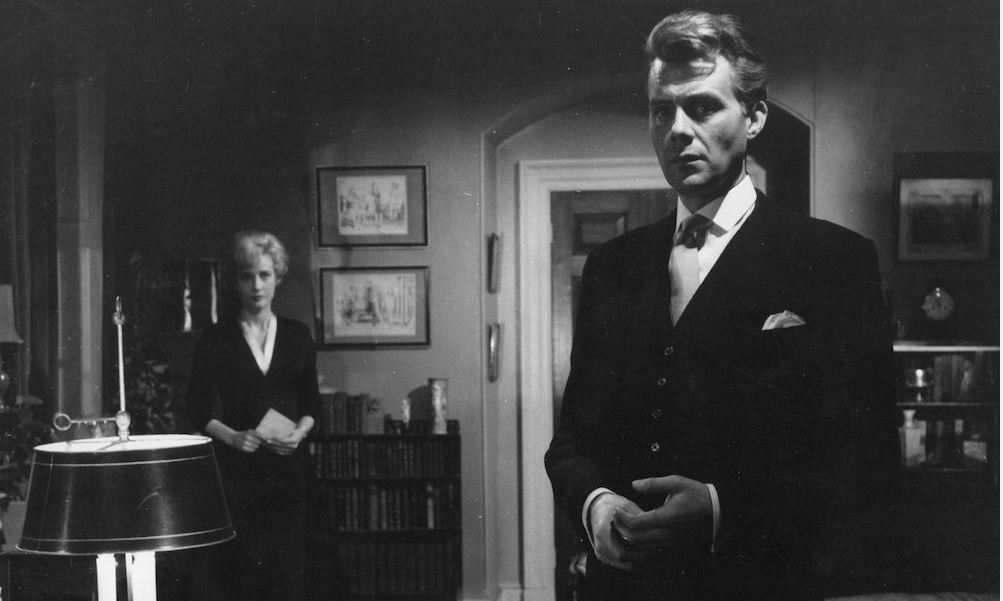
Dirk Bogarde takes on both blackmailers and the vilest of laws in Victim

Director: Basil Dearden

Cast: Dirk Bogarde (Melville Farr), Sylvia Sims (Laura Farr), Dennis Price (Calloway), Nigel Stock (Phip), Peter McEnery (Boy Barrett), Donald Churchill (Eddy Stone), Anthony Nicholls (Lord Fullbrook), Hilton Edwards (P.H.) Norman Bird (Harold Doe), Darren Nesbitt (Sandy Youth), Alan MacNaughton (Scott Hankin), Noel Howlett (Patterson), Charles Lloyd-Pack (Henry)

Victim is both a film of its time and hugely daring. It was released in 1961, six years before homosexuality was decriminalised. It feels slightly old-fashioned and coy in its language and style – but at the time would have been almost unbelievably daring. It not only presented gay people as normal people (and not limp-wristed comic figures) but sensitively and sympathetically argues that the law (or “blackmailer’s charter” as the Chief Inspector calls it) was morally wrong.

Melville Farr (Dirk Bogarde) is a married lawyer, about to be offered the position of Queen’s Counsel. One day he rebuffs the entreaties of a young man named Barrett (Peter McEnery). The man later hangs himself in police custody, the victim of blackmail. Farr held deep feelings for Barrett – but cut himself off from contact, having been haunted by his consciously suppressed homosexual feelings. Heartbroken and angered by Barrett’s death, Farr decides to take on the blackmailers – even if it means destroying his career and endangering his marriage to Laura (Sylvia Sims).

In 1961 Dirk Bogarde was one of the most popular actors in the country, a romantic leading man, best known for a series of light British comedies. He was also a gay man, who lived for decades with his manager and partner Anthony Forwood. It’s almost impossible to understand today how brave it was, how much of his career he put on the line, to play Farr. At a time when many people (including characters in this film) considered the very idea of homosexuality a revolting aberration, for Bogarde to play this role could have been career suicide. When even today Hollywood actors are afraid to come out for fear of damaging their careers, here in 1961 was an actor who was actually gay, playing a gay lawyer, at a time when that part of his life was a crime.

What’s particularly impressive about Bogarde’s performance is its calmness, its control. Farr rarely raises his voice, and never hectors us or the characters about the morality of the law. Only once does he show real rage – punching another man after a comment too far about a university “friend” who committed suicide. Bogarde’s Farr is a man, who (the movie implies) has constantly denied that part of himself (much to his pain and of those closest to him). His decision to take a stand is as much accepting a part of himself, as it is doing the right thing.

It’s the scenes with his wife where Bogarde excels. These are deeply, searingly painful scenes of a man struggling to express to his wife his own feelings. Farr makes it clear he ended contact with Barrett because he desired him, because he loved him – more (or rather in a different way) than he loves his wife. Bogarde allegedly wrote his own lines for this key scene, effectively Farr’s coming out. It’s a powerful scene of a man letting a burden fall from his shoulders, of finally saying something he could barely admit to himself. 

The relationship with his wife is one of the central points of interest in the film, the story developing in a way that feels natural and unforced. Sylvia Sims is equally good as a woman who is sympathetic, but can’t completely comprehend the depth of Farr’s feelings. There’s no condemnation or recrimination – but there is a low-key feeling of something being broken, of the two of them realising that they have companionship and a platonic love – but not the passion that marriage should have. It’s a testament to the un-showy realism of the film, that it avoids outbursts and fury in these scenes in favour of a quietly powerful, mutually supportive uncertainty.

The rest of the film treads a fine line between polemic and procedural. It’s a well-written, heartfelt piece that wears its research lightly. It’s crazy to think this is first film to actually use the word “homosexual”. The characters are a neat snapshot of the personalities of the time. Some of the straight characters are violently opposed to the “degenerates”. Others, such as the lead Inspector, enforce the law because they must. The homosexual characters are similarly wide-ranging: some are dignified, many are deeply scared, some have a patrician smugness and arrogance (it’s telling Farr gets more angry at these than anyone else in the movie). 

There are wonderful opportunities for a host of character actors. Charles Lloyd-Pack (as barber Henry) in particular suddenly unleashes a heartfelt, achingly sad speech of defiance in which he says he has been to prison twice for what he is, and will not go again. Norman Bird’s bookshop owner Harold is a mix of guilt, frustrated feeling and fear – a man deeply confused by his feelings. Nigel Stock is also marvellous as a car dealer terrified of losing out on an inheritance from his father-in-law should the truth be known. 

I also loved Noel Howlett’s quiet dignity as Farr’s assistant – and his matter-of-fact statement (after learning the truth) that he has never doubted Farr’s integrity and sees no reason to do so now has a brilliant stiff-upper lip emotion to it. The film contrasts this subtly with Alan MacNaughton’s thinly veiled disgust as Farr’s brother-in-law when he learns the truth.

The film wraps its careful research into the issues of the homosexuality laws – and the dangers of blackmail they expose people to – within an engaging whodunit mystery, set in a very real-feeling London of the sixties. The film has a wonderful eye and ear for the social life of the time, and it throws enough red-herrings and police detective tropes in there to keep the film entertaining. Despite its constant references back to the laws of the time, and the criticisms it makes, it never feels like a polemic – it’s first and foremost a human story.

Yes it is a little dated – very much of its time, and it’s shot with a careful conservatism by Basil Dearden, though he has an expert control of pace and there is no doubting his passionate commitment to this film and its subject matter. That’s what you need to remembe: how daringly, unbelievably controversial this film would have been to make. All the major players put their careers on the line here: and it pays off. It would be six years before the revolting laws were repealed, and this happened for many, many reasons – but this film was a genuine help for making people see the wrongheadedness of these laws.

Saturday Night and Sunday Morning (1960)


Albert Finney is an angry young man out for himself in Saturday Night and Sunday Morning

Director: Karel Reisz

Cast: Albert Finney (Arthur Seaton), Shirley Anne Field (Doreen), Rachel Roberts (Brenda), Hylda Baker (Aunt Ada), Norman Rossington (Bert), Bryan Pringle (Jack), Edna Morris (Mrs Bull), Elsie Wagstaff (Mrs Seaton), Fran Pettitt (Mr Seaton)

Whatever people say I am, that’s what I’m not because they don’t know a bloody thing about me! … What I’m out for is a good time – all the rest is propaganda. – Arthur Seaton

The 1960s saw a cultural shift in British cinema. Prior to this, most British films were either Ealing-style comedies or dramas focused on the middle or upper classes. When the working classes did appear, they were usually scamps or “ever so ‘umble”. This all changed in the 1960s with the emergence of “kitchen sink” dramas. The New Wave of British Cinema had arrived – films that looked at the real lives and issues of the working classes, that dared to present the working man (and it generally was men) as a living, breathing human being (warts and all) rather than some sort of latter-day Shakespearean comic turn.

Arthur Seaton (Albert Finney) is a skilled, well-paid worker in a bicycle factory in Nottingham. He’s also your quintessential “angry young man”, contemptuous of his fellow workers, adamantly opposed to being told what to do with his life and only interested in a hedonistic life where he does whatever he wants. As Arthur begins a relationship with aspirant young woman Doreen (Shirley Anne Field), his life is complicated by the wife of a fellow worker, Brenda (Rachel Roberts), whom he’s sleeping with, announcing she’s pregnant.

Saturday Night and Sunday Morning caused such a sensation when it was released. But it’s such a strong capturing of a particular time and moment that it’s hard to look at it today without seeing it as a little bit dated, or finding it hard to work out what all the fuss was about. But Arthur Seaton seemed to capture the mood of generation – and that’s a credit to Alan Sillitoe’s excellent (semi-autobiographical) script, based on his own novel.

Albert Finney gives the part a forceful, primal aggression that seems to capture the spirit of the age. He constantly bubbles with ill-directed resentment, mixed with cynicism and a beery oafishness. He isn’t a “faux” intellectual, like a Jimmy Porter, or a man striving to move up the greasy pole. He’s a chippy, arrogant, slightly lazy man with no interest in self-improvement. He’s also a horrendously selfish character, interested only in his own pleasure – I think it goes without saying his treatment of women doesn’t stand up well. Tied of being preached at about the sacrifices of the war generation (who surround him in the factory), he merely wants to do what he wants, when he wants. Despite his flaws, he seemed to capture the feelings of a post-war generation.

The film was also unique for the themes it addressed. It was pretty much unheard-of for a film to even mention the possibility of abortion. It tackled issues of adultery and pre-marital sex (it’s one of the first films to show a man and woman waking up in the morning in bed together). Its lead character drinks, swears (as much as allowed by the censors) and even takes pot shots at neighbours he doesn’t like with an air gun. All of this of course seems rather tame now – but at the time, it was radical to see someone like this, behaving like this, on screen.

The plot, such as it is, is as aimless in many ways as Arthur himself. Not a lot happens in the film, apart from Arthur constantly pushing to not “let the bastards grind you down”. Of course all the pain in the story actually comes from Arthur’s own actions, not least to Brenda, his occasional mistress. Rachael Roberts is sensational as Brenda – the finest performance in the film – a slightly faded former glamour girl, now older, lonely and whose appeal to Arthur (and his appeal to her) seems as much maternal as it does sexual. Brenda’s a tragic figure, clinging to a fantasy of a life free from her dull husband – but slowly (and sadly) learning that she is looking for something from Arthur he can never give her.

By contrast, Arthur’s other conquest, Doreen, is a far more assured, determined and ambitious woman, closer to his own age. Shirley Anne Field is playful and charming, but in her own way as much besotted with Arthur’s rootless masculinity as Brenda. Unlike Brenda though, she is a determined to get what she wants. Arthur and she eventually seem set to settle down for domesticity on a new-build council estate, a decision Arthur seems to resign himself to (he flings a stone impotently at the new houses, but barely seems to understand why). Even this relationship reinforces Arthur’s emptiness – his aimless rebellion lands him eventually in the very conventional lifestyle he spent the rest of the film pushing back against.

Karel Reisz shoots all this with a documentary realism. Freddie Francis’ brilliant photography gives a new wave, neo-realist romance to the Nottingham streets that reinforces the feeling that we are watching a real slice of life. Of course, today much of this revelatory impact of this is lost – we’ve seen these sort of dramas too many times. Arthur’s rebellion is so ill focused – and his attitudes bordering so heavily on the misogynistic – that it’s a lot harder to sympathise with him today than it would have been back then. However, it captures a moment of history, and a feeling many young people at the time had – that the world they were presented with just didn’t match up with what they wanted from life. A dated classic, but still an important piece of film making.

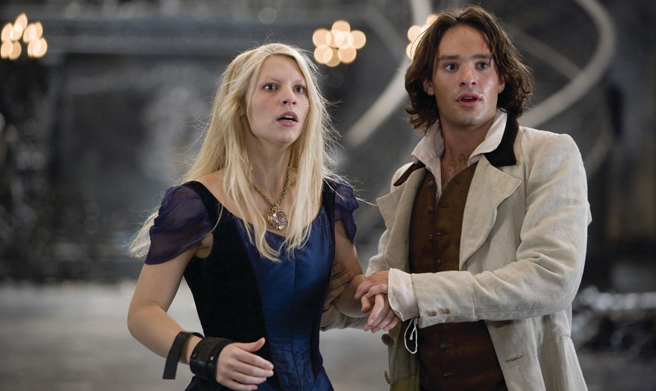
Stardust (2007)

Claire Danes plays a star and Charlie Cox a village boy in charming adventure fairy-tale Stardust

Director: Matthew Vaughn

Cast: Claire Danes (Yvaine), Charlie Cox (Tristan), Michelle Pfeiffer (Lamia), Mark Strong (Prince Septimus), Robert De Niro (Captain Shakespeare), Sienna Miller (Victoria Forester), Jason Flemyng (Prince Primus), Rupert Everett (Prince Secundus), Kate Magowan (Una), Ricky Gervais (Ferdy), Peter O’Toole (King of Stormhold), Joanna Scanlan (Mormo), Sarah Alexander (Empusa), Nathaniel Parker (Dunstan Thorn), Henry Cavill (Humphrey), Dexter Fletcher (Skinny Pirate), Ian McKellen (Narrator)

Stardust is loosely adapted from Neil Gaiman’s novel of the same name, an adult fairy tale refashioned into a crowd pleasing family film: a warm and genuine adventure story, stuffed with romance, excitement and drama.

Tristan (Charlie Cox) is a dreamy young man in the village of Wall, which neighbours the mystical and forbidden world of Stormhold. In love with the selfish Victoria (Sienna Miller), Tristan vows to travel to Stormhold and bring her back a fallen star. However, the star has landed in the form of a beautiful young woman, Yvaine (Claire Danes), and the two of them find themselves on a difficult journey to return to Wall. Along the way they must dodge the witch Lamia (Michelle Pfeiffer) who wishes to sacrifice Yvaine to regain her beauty, and the surviving sons of the late king of Stormhold, particularly the ruthless Septimus (Mark Strong), who need Yvaine’s necklace to claim the throne.

What works about Stardust is that it has an air of whimsy about it, without ever feeling whimsical or corny. It’s a grown-up fairy tale, in the sense that it has some black humour and acknowledgement of sex, but really it’s more of a charming adventure story in a fantasy setting, which manages to keep its tongue in its cheek and not take itself too seriously. Matthew Vaughn’s direction has a very light touch and never allows this soufflé of a film to either puff itself up too much, or to deflate. Instead it rolls along with a giddy charm, with a delightful odd-couple love story at the centre. It’s a film that totally gets its tone spot-on, helped by confident direction and a wonderful score.

Charlie Cox plays romantic lead Tristan with a great deal of charm and really captures the romance at his centre. He also manages that extremely difficult task of being likeable – you can’t help but warm to him despite the fact that his self-awareness is completely off for a large chunk of the film. Claire Danes is equally good as the prickly Yvaine, hiding a great capacity for emotion and longing under a defensive exterior. Their romance is of course highly traditional – they bicker because they love each other! – but both actors carry it off with a great deal of style. You can’t help but want them to get over their problems and get together.

The romantic plotline is also never overwhelmed by the faintly Pythonesque comedy that surrounds it, particularly from the ghostly chorus of deceased Princes of Stormhold. Vaughn produces a great cast of comic actors for this group, while entrusting Mark Strong with the lion’s share of the screentime as the dashing decoy antagonist. In fact, the construction of the film’s narrative is rather neatly done, as this plotline of the inheritance of Stormhold is largely kept separate narratively from the romantic Tristan/Yvaine storyline, with the intersections only occurring at key points.

The real antagonist of the film however is Michelle Pfeiffer’s witch Lamia, Pfeiffer offering a neat portrait of vanity intermixed with cruelty. It’s a very decent inversion of a “movie star” glamour performance, and Pfeiffer’s heartless ruthlessness is a very nice contrast with Tristan’s altruistic openness. In fact Pfeiffer is very good in this film: she gets the balance so right that Lamia constantly keeps you on your toes as to how villainous or not she may be. I’m not quite sure that the film quite manages to completely bring the two characters plot lines together to provide a really effective narrative drive to the film, but she certainly works as an effective antagonist.

The film’s structure is a combination shaggy dog story and classic quest structure, which allows each sequence to take on its tone and structure, from thriller to comedy, depending on the characters involved. What threads this together is the growing (and very sweetly structured) love story between Tristan and Yvain which keeps the momentum up as the film moves from location to location, with cameo roles sprinkled throughout, without the film losing momentum (though it is probably 15 minutes too long). The film’s comfort with letting it sequences expand is clear with Robert De Niro’s Captain Shakespeare, a feared cloud pirate whose secret desires are not so secret as he might think. The film delights in essentially extended jokes like this – but it gets away with it because these jokes manage to be quite funny (De Niro in particular turns in a very good comic performance).

It’s a film that manages to remain distinctive and original, while appealing to a wide audience, which is quite some trick to pull off. It also manages to do this without losing its distinctive rhythm, which is both endearing and enjoyable. The “rules” of its world are clearly established, and while many of the actors are slightly tongue in cheek, they never laugh at their characters but only gently tip the wink at the audience. This freedom largely comes from the conviction and honesty Danes and Cox endow the central characters with, to ground the film. It alsohas a great sense of emotional intelligence to it, and brings a lot of depth to the characters. It also helps that it’s brilliantly designed, looks ravishing and is full of several delightful performances.

There’s lots of terrific stuff in this film, with a very sweet story at its centre. In fact this sweetness is probably the secret of its success: it never takes itself very seriously, it dances lightly from scene to scene and never allows itself to become too overblown. It’s got a terrific cast and is well directed, with a snappy bounce. At moments it does feel a little long, and some sequences overstay their welcome a bit too much – but the central characters are so winningly played that you don’t really mind. Sure this is not a masterpiece, but it has a sort of magic about it, the charm, excitement, adventure and romance, all mixed together with such confidence that it’s a pleasure to watch.

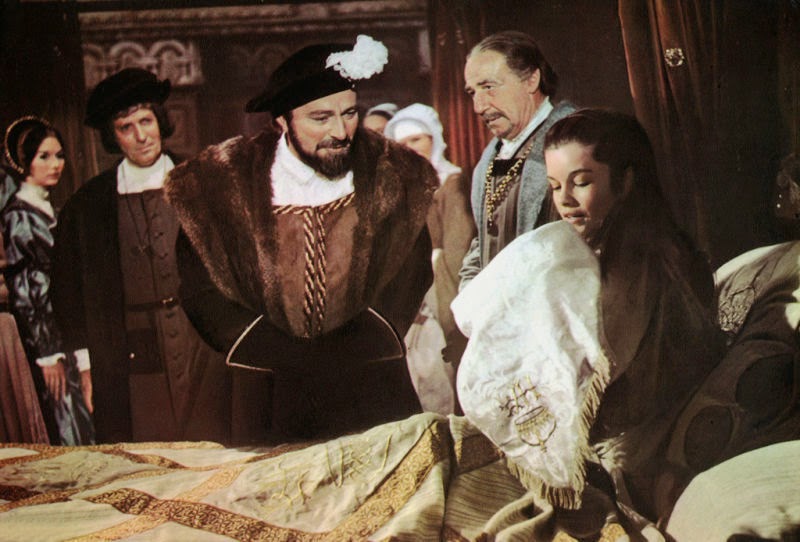
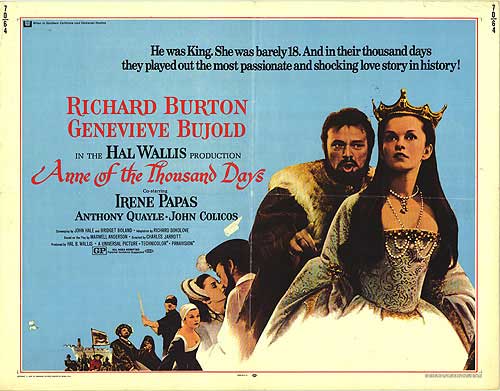
Anne of the Thousand Days (1969)


Henry won’t be happy with that girl: stagy adaptation of the Anne Boleyn story Anne of the Thousand Days

Director: Charles Jarrott

Cast: Richard Burton (King Henry VIII), Geneviève Bujold (Anne Boleyn), Irene Papas (Queen Catherine of Aragon), Anthony Quayle (Cardinal Wolsey), John Colicos (Thomas Cromwell), Michael Hordern (Thomas Boleyn), Katharine Blake (Elizabeth Boleyn), Valerie Gearon (Mary Boleyn), Peter Jeffrey (Duke of Norfolk), Joseph O’Conor (Bishop Fisher), William Squire (Sir Thomas More)

Anne of the Thousand Days fits neatly into Hollywood’s obsession of the 1960s: the grand British historical epic, crammed with costumes, old locations and leading Brit actors in beards mouthing “olde English” style dialogue. Some of these films are of course marvellous – A Man For All Seasons being clearly the best – some are merely competent. AotTD falls very much in the latter category. It’s a solid but dry and rather self-important piece of entertainment, more interested in wowing you with its pageantry than moving you with its emotion.

As the film opens, Henry VIII (Richard Burton) considers whether or not to sign Anne Boleyn’s (Genevieve Bujold) death warrant. The film then flashes back to tell us the story of Anne’s rise and fall. Along the way, the usual figures from Tudor history are wheeled out: Wolsey, Catherine, More, Cromwell and assorted Boleyns.  And of course, the whole thing ends with Anne proudly proclaiming her daughter will one day be the greatest queen of England, with quite exceptional clairvoyance given how unlikely that would’ve actually looked at the time.

The main problem is it isn’t sure what it wants to say about its central character. It wants to simultaneously position her as a strong, “modern” woman with her own ambitions but as a woman succumbing to passion. Essentially, it wants to have its cake and eat it: for Anne to understand Henry is far from love’s ideal vision, while not wanting to lose their “Great Romance”. So we have scenes where Anne questions why anyone would want to marry Henry or talks of her desire for peace, and later scenes where she demands the judicial murder of all who refuse to accept the marriage.

And it may want to show Anne as a modern woman, but – frustratingly – it’s only actually interested in her as a romance object. Her modernity is solely expressed in defying her family to try and marry someone other than Henry, and having spirited “I hate you/I love you” sparring matches so beloved of Hollywood. But the film has no interest in her intelligence, her involvement in the Reformation, or how this led into dangerous conflict with the increasingly powerful Thomas Cromwell (here her downfall is solely down to her inability to produce a son, and being jealous of love rival Jane Seymour, here playing the sort of minxy temptress Anne is often accused of being).

And even this simplified, Mills-and-Boon Anne is inconsistent– one minute she’s a sweet young girl bravely resisting her unwanted royal suitor. Then, she’s delighted with the power that comes with allowing the King to court her. Equally suddenly, she falls in love with him (though that scene is so confusingly written it’s initially unclear whether this is genuine or simply a ploy to win back the attention of Henry). Even away from the central “romantic” relationship, her character oscillates – she schemes revenge against Wolsey, but then is too nice to take Hampton Court from him.

Despite this, Genevieve Bujold delivers an excellent performance. The film successfully plays up her youth early on, and she brings the role a lot of passion, fire and intelligence. Her French-Canadian accent also makes perfect sense considering Anne was largely brought up at the French court. Bujold does her best to hold together an inconsistent character and delivers a real sense of Anne’s independence and intellectual strength. Not even she can completely sell the competing visions of Anne the film has, but she does a very good job with what she is given.

Richard Burton was allegedly fairly scornful of his performance, but he is terrific. One area where the film does succeed is repositioning Henry as a proto-tyrant, who literally cannot conceive he is wrong. In a memorable scene, Henry explains that, ruling as he does through God, any thoughts in his head must have been placed there by God, ergo he can never be wrong. If that isn’t a tyrant, I’m not sure what is. Burton’s charisma is perfect for a man who can flip on a sixpence from bonhomie to fury. While Anne’s intellectualism is overlooked, the film does a great job of demonstrating Henry’s intellectual fakery, via his bland and overbearing musical compositions (met with a rapturous response from the court). Lords literally breathe sighs of relief after they leave his presence. Burton may not be an ideal physical match, but embodies Henry’s ruthless selfishness and towering ego.

It’s a shame that, despite having strong performances, the film is not only so confused, but also so flat and dry. Charles Jarrott frames the film with a dull conventionality, carefully letting costumes and production design fill the screen like a dutiful workman. Has he got any really interesting ideas for shooting this stuff, or presenting a routine plot with any freshness? Not really. Instead we get spectacle, and inevitable rundown of events, but no real sense of novelty. It turns the whole thing into a rather slow, reverent slice of British history, dry and stodgy, ticking off events as it goes.

Those events come and go with a confused focus. The foundation of the Church of England is under explained. The fates of several characters are left unresolved – in particular Cardinal Wolsey (an otherwise excellent Anthony Quayle) simply disappears. The final condemnation of Anne is rushed and confused (you would be forgiven for not really understanding who she has been accused of sleeping with, and the alleged incest between her and brother is almost thrown away). Other characters are simplified (despite good performances from their actors):  so William Squire’s More is upstanding and honest, while John Colicos’ Cromwell is dastardly and scheming.

Anne of the Thousand Days is rather old fashioned and probably best watched now as a Sunday afternoon film. It tells a very, very familiar story (how many times have we seen Henry/Anne’s romance on screen before and since) without too much originality, and largely fudges putting together a clear sympathetic portrait of its central character. Having said that, it is well acted and looks wonderful. It’s just also rather dry and far too aware of having an “important” story to tell.

The Duchess (2013)

Keira Knightley in lusciously filmed, but shallow The Duchess

Director: Saul Dibb

Cast: Keira Knightley (Lady Georgiana Devonshire), Ralph Fiennes (Duke of Devonshire), Hayley Atwell (Lady Bess Foster), Charlotte Rampling (Countess Georgina Spencer), Dominic Cooper (Earl Grey), Aidan McArdle (Richard Brinsley Sheridan), Simon McBurney (Charles James Fox)

My main memory of The Duchess is seeing the trailer while watching Mamma Mia in the cinema. The first shot was Keira Knightley’s face, met with an overwhelming groan from the female-dominated audience. There is something about Knightley that seems to get people’s goat.  If you’re one of those who struggle to warm to Knightley as a performer, this probably isn’t going to be the film that changes your mind.

In the late 18th century, Lady Georgiana (Keira Knightley) marries the absurdly wealthy, but older and duller, Duke of Devonshire (Ralph Fiennes). She wants a meeting of minds. He just wants an heir. The marriage flounders – and gets worse when the Duke in turn starts an affair with Lady Bess Foster (Hayley Atwell), Georgiana’s closest friend. As her home-life becomes a menage-a-trois, with the Duke treating both women as wives (with their agreement) she begins to experience deeper feelings for the dashing Charles Grey (Dominic Cooper), an ambitious politician.

So, first things first, Keira Knightley. She does a decent job. She’s pretty good. But, rather like Jonathan Rhys Meyers, it feels like her best is a 7/10 performance. She’s dedicated, she’s really striving here – but always feels like someone trying rather than truly natural and unforced. She brings Georgina’s glamour and does a decent work of her bewildered hurt, but she (and the film) don’t communicate her intelligence and political activism, so she never really develops as a character. You can’t really put your finger on her doing anything wrong as such, it’s just a performance where you always see the acting, and never feel the naturalism.

It’s particularly noticeable here as her two supports – Fiennes and Atwell – are such accomplished performers. In many ways, the film would have been improved with Atwell in the lead. As it is, as the third corner of the triangle, she has just the right mix of guilt, warmth and mercenary self-interest. In a terrific low-key performance, Fiennes manages to turn a character the film always wants to push into being a bullying villain into a man who feels alive, real and often understandable if not (whisper it) even rather sympathetic.

The film is desperate to turn Georgiana into a suffering victim, and to push Devonshire into the role of a domestic despot. But in fact, most of Devonshire’s actions are quite forward thinking: he adopts and cares for his bastard daughter (conceived pre-marriage), he saves Bess’ children and cares for them as his own, he condones a quiet affair from his wife, he treats her with the utmost public respect and allows her to spend time with her son by another man (although this is relegated to a caption at the end). The only problem is he clearly doesn’t love her, while he clearly does love Bess. Hardly able to believe he wasn’t as besotted with Georgiana as the film is, the film works overtime to try and turn someone a little dull, with some surprisingly generous views, into a monster.

In order to make it categorical who is “right” and who is “wrong”, the film chucks in a gratuitous marital rape scene that feels so out of character and over-the-top, it actually makes you step out of the film. Did it really happen? There’s no evidence of it, and it flies in the face of virtually every other action the Duke does in the film. It’s probably also in there to further contrast Georgiana’s joyless couplings with the Duke against her passionate rumpy-pumpy with Dominic Cooper’s Charles Grey (here re-imagined as a penniless adventurer and radical, rather than the son of an Earl) Like Knightley, Cooper has the glamour and dash for the high-class Mills and Boon plot the film is peddling, but fails to convey Grey’s intellect and political ideals.

The film has deliberate echoes of Princess Diana throughout – the crowded marriage, the glamourous outsider marrying into a great family, the sense that her dashing public image made him look like a dullard. And like much of the public reaction to Charles and Diana in real life, the film can’t compute why Devonshire didn’t love this public idol, overlooking the fact that they shared no interests and had nothing in common. Many of Georgiana’s negative aspects are downplayed to help this – the gambling addiction that left her bankrupt is no more than high spirits here.

Basically this is a film interested in style over substance, aiming to turn a fascinating story about a menage-a-trois into something very straightforward and traditional about a husband who treats his wife badly. Now the style is great – Rachel Portman’s score is brilliant, the photography luscious, the make-up and costumes gorgeous – but the substance often isn’t there. The idea of Georgiana’s celebrity is only briefly touched upon, and her intellect barely at all.

Not content with airbrushing out her less appealing characteristics, even her positive ones are done few favours by this candyfloss depiction of her life – one of the first women to take a prominent role in the British political scene, a published writer of novels and poems, and a famously charismatic social figure, here she is little more than a mannequin on which to hang elaborate period hairstyles and costumes, who talks about being a free-spirited intellectual without doing anything that corresponds with these interests.

It shoves in dramatic events which feel out of step with both the characters and the events to push the film towards being as straightforward as possible. Knightley does a decent job – and Fiennes is extremely good as the Duke – but it settles for being something safe and traditional rather than a really interesting look at the cultural moods of the time, or the complexities of the real people it claims to portray. It shares it’s subjects beauty, but reduces her to blandness.