
Tag: Bruce Robinson

The Story of Adele H (1975)

The Story of Adele H (1975)

Distanced and measured film that becomes a heartbreaking study of lonely obsession and destruction addiction

Director: François Truffaut

Cast: Isabelle Adjani (Adèle Hugo), Bruce Robinson (Lieutenant Albert Pinson), Sylvia Marriott (Mrs. Saunders), Joseph Blatchley (Mr. Whistler), Ivry Gitlis (The hypnotist), Cecil de Sausmarez (Mr. Lenoir), Ruben Dorey (Mr. Saunders), Clive Gillingham (Keaton), Roger Martin (Dr. Murdock)
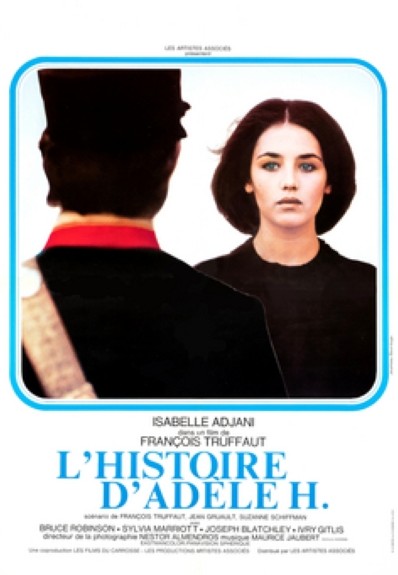
In 1863 there was, perhaps, no man more renowned in France than Victor Hugo. Which made it almost impossible to fly under the radar if you were his daughter. But that’s what Adèle Hugo (Isabelle Adjani) wants in Halifax, Nova Scotia, under the name Adèle Lewly. She’s there in pursuit of British army officer Albert Pinson (Bruce Robinson). Adèle loves Pinson truly, madly, deeply – and obsessively, believing he has promised marriage and ignoring his clear lack-of-interest. Adèle is willing to go to almost any lengths, spin any desperate story, burn through any amount of money, debase herself to a desperate degree to marry Pinson, as her own mental health collapses.

Based on Adèle’s own diaries (written in a code deciphered after her death), The Story of Adèle H unpeels the layers of a destructive obsession that has a terrible emotional impact on all involved. Truffaut’s film can seem cold and precise, as chilly at points as its Halifax settings (in fact shot in Guernsey, historically Hugo’s residence at this time after his banishment from France), his camera keeping an unobtrusive distance and slowly, carefully following the increasingly frantic actions of its lead.

But it’s part of Truffaut’s intriguing dance with our sympathies and loyalties. A more high-falutin’ personal drama may well have tipped us more strongly in our feelings about the desperate Adèle or the controlled Pinson. Instead, Truffaut’s film encourages us to see the story from both perspective and unearths a sort of as well as a tragedy in Adèle’s obsessive quest. But it also demonstrates Pinson’s unpleasant coolness and self-obsession, while allowing us to see his life is being destroyed by a stalker.

Of course, part of us is always going to be desperate for Adèle to shed her feelings for Pinson, who feels barely worth the obsessive, possessive desire she feels for him. A lot of that is due to Isabelle Adjani’s extraordinary performance. A young actor (over ten years younger than Adèle), she not only makes clear Adèle’s intelligence (this is a woman who composed music and wrote and red copiously) and her charm, but also her fragility and desperation. Adjani makes Adèle surprisingly assured and certain throughout, independent minded and determined – it’s just that her feelings are focused on a possessive, all-consuming obsession that is undented by reality.

It says a great deal for the magnetic skill Adjani plays this role with, is that we can both be frustrated and even disturbed by her actions but still see her relentless pursuit as (in a strange way) oddly pure. Truffaut twice quotes Adèle writing about the power of a love that will see someone crossing oceans to follow their beloved, and there is a daring bravery to it, a commitment to being herself and following her desires in a world that is still set up to favour of man over woman. It’s also easy to feel sympathy for her at Adjani’s tortured guilt about the drowning of her sister (vivid nightmares of this haunt her) just as the searing pain Adjani is able to bring to the role is deeply emotional.

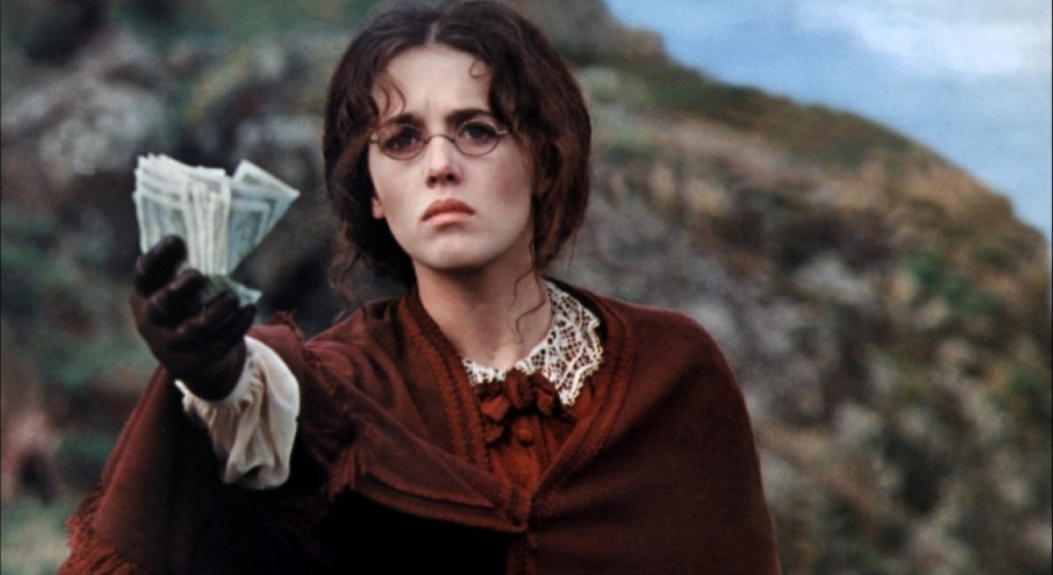
But that doesn’t change the unsettling awareness we have of the possessive horror of her actions. Adjani’s Adèle is an addict, the shrine in her room she builds to Pinson just part of the self-destructive behaviour of a woman who lies to everyone about her relationship with Pinson and pours every penny of her income into her next hit of trying to win him. Like a stalker she moves from following Pinson around to the streets to ever more extreme actions: spying on Pinson with his new lovers, hiring a prostitute to sleep with him (as both a perverse gift and a bizarre way to control his sexuality), tell his fiancée’s family she’s a jilted pregnant wife, haunt Pinson on a hunt clutching a waft of notes as a bribe while carrying a cushion stuffed up her dress… Her actions become increasingly more and more unhinged – so much so her attempt to recruit a fraudulent mesmerist to hypnotise Pinson into marriage starts to feel like the most sane and reasonable of her plans.

And slowly we realise that Adèle, for all our first feelings towards her are sympathy, is destroying herself just like an addict jabbing another needle into their arm to try and capture her next hit. Her obsession starts to destroy her health, reducing her to a dead-eyed figure walking the streets in an ever-more crumbling dress, refusing to move on, reducing herself to penury but still following Pinson like a ghost. She alienates herself from people, lies to her family, steals money… it’s a spiral of a junkie.

We can wonder what she sees in Pinson – but, like all addictions, that’s hardly the point. It’s almost the point that Robinson’s Pinson is a bland pretty boy. (It’s quite telling that he’s so forgettable, than on arrival in Halifax Adèle even mistakes a random officer – played by Truffaut – as Pinson). Our first impression of him is as a coldly ambitious, selfish fellow, a rake on the chance. And maybe, to a degree, he is. But it’s hard to take Adèle as a fair witness for whatever claims she makes about the promises Pinson makes. And the longer it goes on, the more its hard not to feel for the destructive effect Adèle’s constant presence has on Pinson. It costs him a marriage, his status and nearly his career. Does he really deserve this for being, really, just a rather selfish guy?

The Story of Adèle H takes our perceptions and makes clear how our feelings can shift and become more complex. Because really Adèle’s problem is not that she has been jilted: but that she is clearly not well, her mental health collapsing in front of her eyes as solitude and secrecy feed her lonely obsession. Her obsession is so great that she can acknowledge she both loves and despises Pinson, but not let that dent her unrelenting , irrational determination to marry him. This destroys her life.

In fact, it becomes hard not to feel sympathy for both characters whose lives are scarred by unrelenting self-destruction. And Truffaut’s approach in his filming actually adds a great deal to this, its forensic distance on this terrible affair placing it under a microscope that reveals clearly the nightmare they are both trapped in. Match that with Adjani’s incredible performance, a star-making turn that burns through the celluloid in its intensity, and you’ve got a quiet but subtly moving film that grabs you almost unawares in its emotional force.

Romeo and Juliet (1968)

Romeo and Juliet (1968)

Zeffirelli helps to reinvent Shakespeare on film as vibrant, urgent, young and sexy

Director: Franco Zeffirelli

Cast: Leonard Whiting (Romeo), Olivia Hussey (Juliet), John McEnery (Mercutio), Milo O’Shea (Friar Laurence), Pat Heywood (Nurse), Paul Hardwick (Lord Capulet), Natasha Perry (Lady Capulet), Robert Stephens (Prince), Michael York (Tybalt), Bruce Robinson (Benvolio)

When Romeo and Juliet was released in 1968, it was like a shot of adrenalin into the heart of Shakespeare. It was a play where audiences were used to middle-aged classical actors posing as teenage lovers (not just on stage: the last Hollywood version cast Leslie Howard and Norma Shearer with a combined age of 76). It was a play of wispy poetry, light breaking from yonder windows and stately tragedy. What it definitely wasn’t, was a young play. A play full of vibrant energy, youthful abandon and plenty of sex and violence. Zeffirelli’s film changed that: it was fast, sexy and above all young. It was unlike any Romeo and Juliet many cinema goers had seen before.

Everything new is eventually old of course. So influential was Zeffirelli’s film, it came to be remembered as a “tights and poetry” epic. Its traditional Renaissance Italian setting and well-spoken cast came 30 years later to represent the very same stuffy traditionalism it was kicking in the shins. When Baz Luhrmann released his William Shakespeare’s Romeo + Juliet, full of fast-paced editing, MTV tunes, gunplay and horny, Verona Beach teenagers, it was biting its thumb at the revolutionary style of Shakespeare Zeffirelli had introduced.

But, such is the richness of Shakespeare, there is more than enough room for both visions. Watching the film today is still to be struck by its pace and energy. This is a grimy, immediate film which Zeffirelli frequently shoots with a handheld intensity (particularly in the film’s sequences of violence). The costumes may have a primary-coloured sheen to them, but the emotions are raw and dangerous. There is a comedic zip and energy to its first half, which gives way to a grim sense of inevitable tragedy, that always seems just a few adjusted decisions away from being averted.

To pull the film together, Zeffirelli made some tough decisions. Almost 65% of the dialogue was jettisoned, most notably the whole of Juliet’s speech prior to taking the sleeping drug. Everything was cut and arranged to play to the strengths of his cast. His young lovers were great at the physical and emotional teenage energy, so that’s what Zeffirelli focused on. He cast two unknowns: 17-year-old Leonard Whiting and 15-year-old Olivia Hussey. Both had exactly the sort of unfussy naturalism he was looking for, playing the roles with a breathless, energetic genuineness.

They are, of course, not the greatest performers of the roles you will ever see. But Whiting’s Romeo is passionate, naïve and utterly believable as the sort of love-struck teenager who will choose oblivion when he’s lost his true love. Hussey (who, unlike Whiting, continued as an actor) has a wonderful innocent quality and a forceful determination underneath it. The two of them throw themselves into every scene (and each other) with gusto, rolling on the floor in despair or bounding into fights and arguments as if every word or blow will be their last.

It’s a youthful energy that the whole film bottles up and sells to the audience. Its opening scene takes the “I bite my thumb at you sir” classicism of the initial Montague-Capulet clash, and throws it into a dusty street brawl that sucks in most of the city. The camera weaves among this action, as people fly at each other, onlookers run in panic and extras’ bodies pile into the scuffle.

It’s an effective entrée for the film’s most effective sequence: the plot-turning fight that leads to the death of Mercutio and Tybalt. Zeffirelli brilliantly stages this as youthful bravado and hot-headedness that gets out of hand. Mercutio and Tybalt’s fight is initially more performative than deadly (so much so Mercutio’s friends don’t realise he’s been wounded until he dies) – only Romeo’s attempts to stop it cause it to escalate. Tybalt is horrified at the possibility he has harmed Mercutio and flees in terror. Mercutio maintains a front of all-good-fun that turns more and more into bitterness. Romeo’s revenge on Tybalt starts as an out-matched sword fight but turns into a brutal, dusty scrabble on the ground, with fists and daggers flying. All shot and staged with an improvisational wildness, people in the crowd ducking out of the way. It still carries real immediacy.

It’s particularly effecting as, until then, the film is arguably a romantic comedy. The first half not only surrenders itself to the youthful abandon and passion of the lovers, it’s also not adverse to a bit of knock-about farce with the Nurse (a fine performance of gruff affection from Pat Heywood). The Capulets’ ball is staged as another immersive scene, Nina Rota’s music helping to create one of the best renaissance courtly dances on film. With Romeo blanked by an austere Rosalind (who seems to barely know who he is), it zeroes in on the intense, can’t-take-my-eyes-off-you bond between the two lovers. All of it shot with a dreamy romantic intensity.

That carries across to the balcony scene, that again stresses the dynamism and sexual longing that revolutionises the poetry-and-posing the scene had become in people’s minds. This is after all a young couple who can’t keep their hands off each other to such an extent, they have to be physically separated by Friar Laurence (a cuddly Irish Milo O’Shea, over-confident and ineffective) before their marriage.

It makes it all the more striking then when the second half tips into melancholy and heartbreak. Zeffirelli brings the focus even more intensely onto the lovers. As well as Juliet’s speech, the Apothecary and Romeo’s killing of Paris (shot but cut as there were worries it would make the hero less sympathetic) are ditched, and the action is streamlined and runs inexorably to Romeo’s decease and the camera’s focus on Juliet’s hand as she begins to come back to life.

It’s a film full of interesting little side notes and character interpretations. John McEnery’s energetically manic and witty Mercutio (he, along with O’Shea handles much of the actual Shakespeare) is excellent, with more than a hint of a repressed homoerotic longing for Romeo. Natasha Perry’s austere Lady Capulet flirts openly with Michael York’s fiery Tybalt (their secret affair now a popular interpretation) while Paul Hardwick’s bluster as Capulet carries an air of desperation, with Zeffirelli capturing sad glances at his wife. To bolster its Shakespeare credentials, Olivier speaks the prologue (as well as dubbing multiple members of the Italian cast) for no pay or credit (though he must have known there was zero chance of his famous voice not being recognised!).

Zeffirelli’s film may just be, in its way, one of the most important Shakespeare films in history. If Olivier had shown Shakespeare could work as spectacle and Welles that it could be art, Zeffirelli showed it could be exciting and cinematic. That energy and filmic motion didn’t need to serve the poetry. It became so influential, that it eventually came to be seen decades later as “classical Shakespeare”. But it helped lay the groundwork for a series of films and productions that would leave posing, poetical renditions of the Bard behind.