
Tag: Caleb Landry Jones

Get Out (2017)


Daniel Kaluuya finds himself well out of his depth in Get Out

Director: Jordan Peele

Cast: Daniel Kaluuya (Chris Washington), Allison Williams (Rose Armitage), Catherine Keener (Missy Armitage), Bradley Whitford (Dean Armitage), Caleb Landry Jones (Jeremy Armitage), Stephen Root (Jim Hudson), Lakeith Stanfield (Logan King), Lil Rel Howery (Rod Williams), Marcus Henderson (Walter), Betty Gabriel (Georgina)
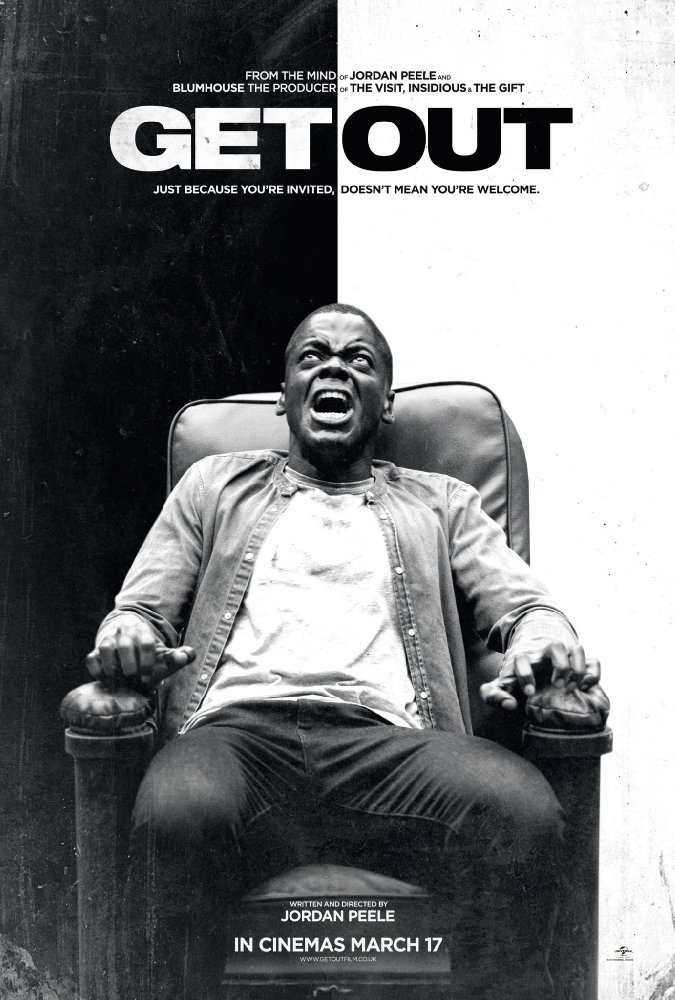
Really great genre film-making transcends its genre, while demonstrating all its strengths. Get Out is nominally a horror film, but strangely it didn’t feel quite like that while I was watching it. It’s more of a horror-inflected social drama with lashings of satire and commentary on race in America. It’s a smart, deeply unsettling film, which really makes you think about how racism has subtly developed in America over the past 100 years. It also manages to feel very much like a film caught at the turning point between Obama and Trump.

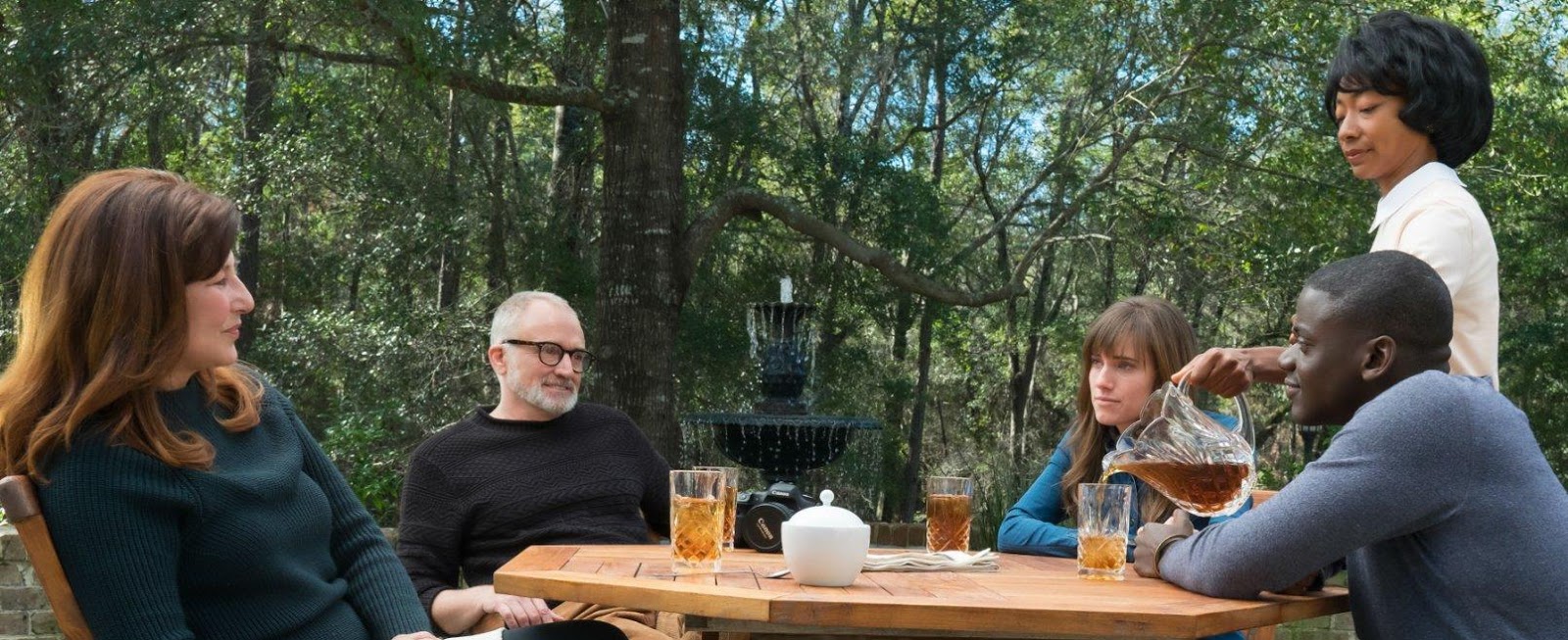
Chris Washington (Daniel Kaluuya) is a young, black photographer dating wealthy white Rose Armitage (Allison Williams). He reluctantly agrees to spend the weekend with her family on their countryside estate. Rose’s parents, neurosurgeon Dean (Bradley Whitford) and hypnotherapist Missy (Catherine Keener) are almost overly welcoming and in expressing their liberal credentials. Chris is doubly unsettled that the Armitages’ house has two black workers, both of whom seem alarmingly compliant. The weekend coincides with an annual get-together the Armitage family hosts, where the guests (all rich and white) make comments to Chris admiring his physique, build, sporting ability and genetic advantages. Chris can sense something is wrong – but can’t even begin to guess the mystery at the heart of the Armitage house.

Get Out is, more than anything else, a film about racial politics in America. It trades in the unsettled discomfiture some liberal white people feel when they actually have to interact with a black male from a different background, and then inverts this into a horror. But it rings true: the father so keen to be seen as liberal he uses the phrase “my man” repeatedly, praises Obama, shows off his “multi-cultural art”, delightedly repeats stories about Jesse Owens; the guests at the party who pinch Chris’ muscles, and praise his physique. It feels like a situation where Chris is invited but not welcome. 

In turn, it also inverts the discomfort some black people feel in white middle-class society. Chris finds his hosts patronising and condescending in their desire to be seen as open-minded. He’s uncomfortable at the black staff. Every second in the house reminds him that he doesn’t belong there. But the genius of Peele is that this could be nothing to do with anything except seeing a black man being constantly made aware of his difference in an unfamiliar milieu. 

Chris though, being basically a decent guy, does what any polite person in a minority tends to do: he works overtime to put his hosts at ease. He keeps quiet, he smiles, he laughs at jokes,  he tries to gently drift away. As almost the sole black person, he’s lost and out-of-his-depth and comfort zone (he’s reluctant about even going). All the other black people he meets are strange – Peel brilliantly shows the mixed messages from the servants in particular. In one brilliant sequence Georgina, the maid, says everything is fine while smiling and simultaneously crying. A black party guest dresses and behaves like the rest of the white people around him: has he just completely assimilated or is there something sinister going on here? Chris might guess more – but until it’s too late he decides to batten down the hatches and ride out an awkward weekend.

The house has plenty of mystery – there is a throw-away reference to a locked off-limits basement. Early in the film the couple hit a deer with their car: the police demand to see Chris’ ID even though he wasn’t driving, to the outrage of Allison. It’s a brilliantly eerie opening that hints at danger to come, both in the corpse of the deer and the suspicion of the police. It’s a brilliant touch to explore the barely acknowledged underlying racism of some middle-class Americans – this liberal elite would be horrified to hear the suggestion that they are anything but open-minded, but in fact have deeply paternalistic, two-tier beliefs that have subtly developed since the end of segregation.

The film is played superbly by the whole cast. Bradley Whitford brilliantly inverts his Josh Lyman persona. Catherine Keener is a sort of warm Earth Mother figure, with darkness and control under the surface. Both characters seem suspicious and yet are both so open and direct in what they say, you think it’s almost too obvious to assume they are villains. Caleb Landry Jones as their son is both full of alpha-male welcome and strange, violent and scornful looks and yearnings. Allison Williams as Chris’ girlfriend seems a strange presence in this household, but her honest sympathy for Chris, and her growing realisation with him that something is wrong, is the one thread Chris has to hang onto.

The star-turn of the movie is of course though Daniel Kaluuya as Chris. A young British actor, he’s superb here in a reactive role, trying to persuade himself everything is fine. His unease and insecurity are brilliantly done, as are the surface humour and reserved politeness he uses to disguise this. In a paranoid film, he is going out of his way to not appear paranoid. His relief in seeing any other black people – and then confused discomfort at their behaviour – is endlessly brilliant. As the plot progresses, Kaluuya takes Chris to some dark and emotional places, conveying both despair, fury and pain brilliantly. 
Peele’s film is not perfect. Introduce a character as a hypnotist and you are probably tipping the hat a little too soon – though to be fair, Peele even lampshades this by having Chris’ friend Rod (a hilariously endearing Lil Rel Howery) immediately point this out. The explosion of violence when it comes at the end is gratifying, but a little too much almost for a film about lack of power. The DVD contains an alternative ending that is, in fact, far better and more appropriate, which continues this theme (and is what I expected the ending to be as the film entered its final act) but was replaced because Peele felt (he says on the commentary) it needed a more upbeat ending.

Get Out though is both an excellent paranoia thriller with lashings of horror, and also a brilliant satire on race in America. Trading on the comedy of embarrassment, it has genuine things to say about how the racial divide hasn’t really gone away at all. Both funny and also deeply terrifying, its final reveal of what is going on is brilliant and also rings very true – as well as casting new light on several scenes we have already seen. Peele is a first-time director – but based on this he certainly won’t be one and done.

Three Billboards Outside Ebbing, Missouri (2017)


Frances McDormand is looking for justice in Martin McDonagh’s razor sharp Three Billboards Outside Ebbing, Missouri

Director: Martin McDonagh

Cast: Frances McDormand (Mildred Hayes), Woody Harrelson (Sheriff Bill Willoughby), Sam Rockwell (Officer Jason Dixon), John Hawkes (Charlie Hayes), Peter Dinklage (James), Abbie Cornish (Anne Willoughby), Lucas Hedges (Robbie Hayes), Željko Ivanek (Sergeant Cedric Connolly), Caleb Landy Jones (Red Welby), Clarke Peters (Abercrombie), Samara Weaving (Penelope), Kerry Condon (Pamela), Darrell Britt-Gibson (Jerome), Amanda Warren (Denise), Kathryn Newton (Angela Hayes)

How do we deal with grief? What might it drive us to do? How does it make us behave – and what sort of person can it make us become? Martin McDonagh’s superbly scripted and directed, brilliantly acted film explores these themes in intriguing and compelling depth, consistently surprising the audience, not only with unexpected plot developments, but also wonderfully complex characters, whose personalities and decisions feel as distanced from convention as you can get.

Mildred Hayes (Frances McDormand) is a grieving mother, who feels let-down by the police and justice system as they have failed to locate and arrest the rapist who murdered her daughter. She hires three large billboards on a quiet road out of her town in Ebbing, and places on each of them a stark message: “Raped while dying”, “And still no arrests?” and “How come, Chief Willoughby?”. The billboards lead to Sherriff Bill Willoughby (Woody Harrelson) doing what he can to re-open the case – a case with no real evidence or leads. But the local community – many of whom adore Willoughby – are increasingly angered by the billboards, not least Willoughby’s semi-protégé, controversial red-neckish officer Joe Dixon (Sam Rockwell). The billboards lead to increasingly violent disagreement in the small community – and surprising allegiances developing.

McDonagh’s black comedy-drama balances immense sadness and searing rage with jet-black humour. McDonagh’s distinctive (and often foul-mouthed) style runs through the entire film. It’s a film that not only defies real categorisation, it also defies expectations. You would expect this film to be a commentary on a heart-rending grieving mother struggling against an indifferent, incompetent, racist (or all three) legal system. Perhaps even a film that will build towards a sort of “whodunit” murder mystery. All these expectations are constantly turned upon their head. Any obvious, traditional narrative development – and lord the film plays with this throughout its runtime – is diverted. You never know where the film is going – and you would certainly never have guessed its conclusion from the opening. 

Our expectations are immediately inverted when Woody Harrelson’s Sheriff meets with Frances McDormand’s mother in the opening moments. We expect him to be indifferent, annoyed or bitter – instead he’s liberal, concerned, sympathetic and hurt, while understanding why Mildred has done what she has done. Mildred, who we expect to be moved by, whose pain we expect to empathise with – instead she’s burning with fury and resentment, is amazingly confrontational and unyielding, and her ideas for investigating the crime border on the ruthlessly right-wing. Far from the predictable drama you might expect, you are thrown into something unusual – and real.

The storyline continues throughout in this vein – McDonagh never takes the expected route, but constantly pushes towards something unexpected. His trademark spikey dialogue throws you off balance – this is surely one of the few films where you’ll see a son affectionately call his mother “an old c**t”, or a happily married, middle-class couple address each other with a stunning, loving crudity. Pay-offs to plot developments are confidently unorthodox, and devoid of the expected sentimentality. The murder mystery element of the story is played with in a unique way: even the crime itself remains unexplored and unexplained, with only a few grim photos and a few hints dropped in dialogue as to what happened.

Instead, the film focuses on how grief and upheaval affects a community. All of the characters deal with a profound personal loss over the course of the story, and the impact of this on them leads not just to anger and rage, but also in some a profound reassessment of their life and choices. It’s a film that looks at the struggle we have to control the narratives of our own lives, to not be a victim but instead to give the things that have happened to us meaning and importance. Each character wants to find a way to make the things that have happen to them have meaning, and to find a sense of closure. It asks what can and can’t we forgive, and how far do we need to take actions to find a sense of closure. The film’s open-ended conclusion both points towards suggested answers to these questions, while at the same time offering few.

Frances McDormand gives a compelling performance in the lead role, as a domineering, strong-willed woman who resolutely refuses to be a victim, but wants revenge. Burning with a simmering rage at the world, and quick to respond with aggression and even violence, McDormand never allows the character to become fully sympathetic, but constantly challenges us. It’s the sharpest-edged grieving mother you’ll see on film, as full of prejudice and judgemental behaviour as she is pain and guilt. She attacks each scene like a bull in a china shop, and Mildred Hayes is a smart, ruthless woman who takes no prisoners.

The part was written especially for McDormand, as was that of Joe Dixon for Sam Rockwell. Rockwell, one of those eminently reliable supporting actors, gives an extraordinary powder-keg performance as an on-the-surface dumb, racist bully with poor impulse control, who is barely able to hide a vulnerable mummy’s-boy complex and a strangely touching sense of loyalty. Rockwell is dynamite in each scene, but constantly gives us interesting and varied line-readings, changing our perceptions of his character with each scene. 

To briefly address a controversy that has arisen about the film.  McDonagh has explored extremes like this in the past – his work in the past has humanised murderers, child-killers, terrorists and executioners, while not excusing their actions. The film has courted controversy by refusing to condemn Dixon’s racism, or for not ‘punishing’ the character enough, but it instead asks us to understand why Dixon has done or said the things he says – and to empathise with the pain, despair and anger in his own life. Is Dixon a racist? He’s a product of his time and place, I’d say he’s really just very angry, without understanding why, and without having the emotional intelligence to deal with it. He might have done unpleasant things – in the film doesn’t dodge this – but it asks us to question why he might have done this, rather than paint him as a demon.

Equally brilliant (perhaps one of his greatest performances) is Woody Harrelson as the surprisingly liberal, good-natured, patient and humane Sherriff Willoughby. Surely no one could expect the authority figure in a film of this nature to be the most sympathetic and likeable character in the film, the one with perhaps the most moving personal story. Harrelson is simply superb in the part, and his gentle, lingering regret hangs over the film.

But the whole cast is marvellous. Hawkes is a deeply troubled and pained man hiding it under anger and mid-life crisis. Dinklage is a sad eyed, lonely man. Cornish sports a slightly unusual accent but is warmly loving and very normal as Willoughby’s wife. Hedges is impressive as Mildred’s son, whose life is made increasingly difficult by his mother’s unwillingness to compromise. Landy Jones is excellent as the empathetic billboard manager, too good for this town. Peters brings a reassuring air of authority and dignity to the film. With the dialogue a gift for actors, there isn’t a weak performance in the film.

McDonagh’s fine, simple direction adds a Western-style sweep to the action and allows the story to speak for itself, working with the actors to bring out some brilliant, unique characterisations. It’s an intelligent and thought-provoking film, that constantly pushes you in unexpected directions and asks intriguing and challenging questions about profound issues, especially grief. Despite this, it’s a laugh-out-loud black comedy, that will move you and which has the courage to leave many of its plot issues open-ended and true-to-life. It asks questions, but it also acknowledges that life doesn’t give us answers. It also reminds us that we can never judge people from our initial impressions or expectations.