
Scorsese tries to tell an Indigenous story – but from the persecutor’s perspective
Director: Martin Scorsese
Cast: Leonardo DiCaprio (Ernest Burkhart), Robert De Niro (William King Hale), Lily Gladstone (Mollie Kyle), Jesse Plemons (Thomas Bruce White), Tantoo Cardinal (Lizzie Q), John Lithgow (Peter Leaward), Brendan Fraser (WS Hamilton), Cara Jade Myers (Anna Brown), JaNae Collins (Reta), Jillian Dion (Minnie), Jason Isbell (Bill Smith), Louis Cancelmi (Kelsie Morrison), William Belleau (Henry Roan)
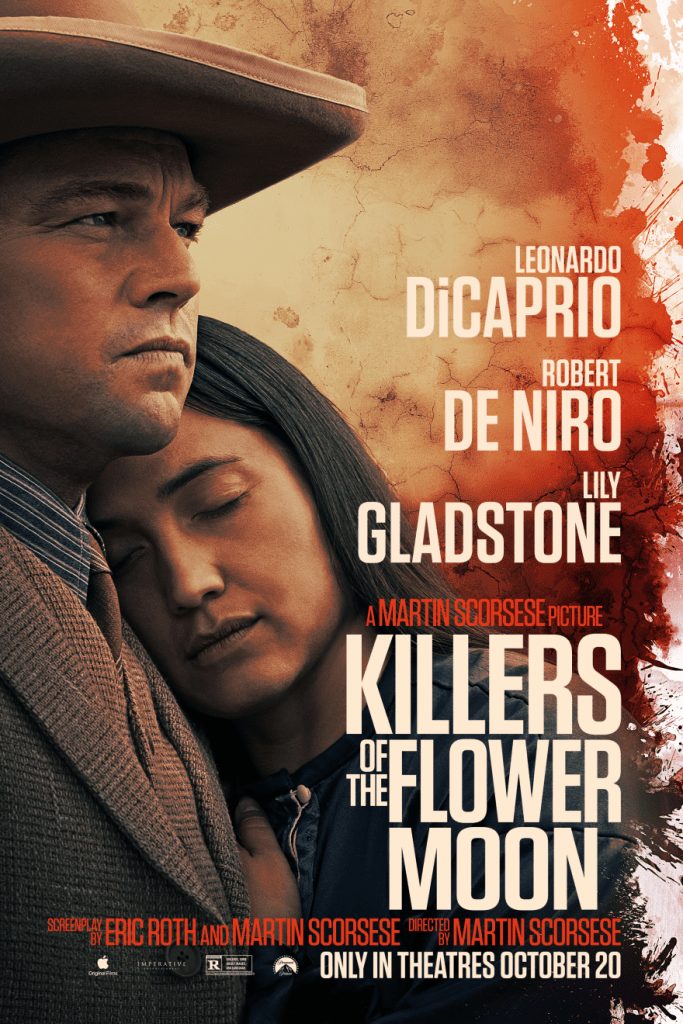
In the 19th century, the American government forcibly shifted Indigenous nations from their rich, fertile lands to unwanted backwater reservations. The Osage nation was moved from Missouri to Oklahoma, land no-one wanted… Until oil was discovered there in the early 20th century. Suddenly hugely rich, the Osage nation’s land once again became the focus of white Americans, as keen to dispossess these Indigenous people as they were in the last century. This ruthless grab of oil rights – and the brutal exploitation and murder of dozens of Osage people – is the theme of Scorsese’s epic Killers of the Flower Moon.
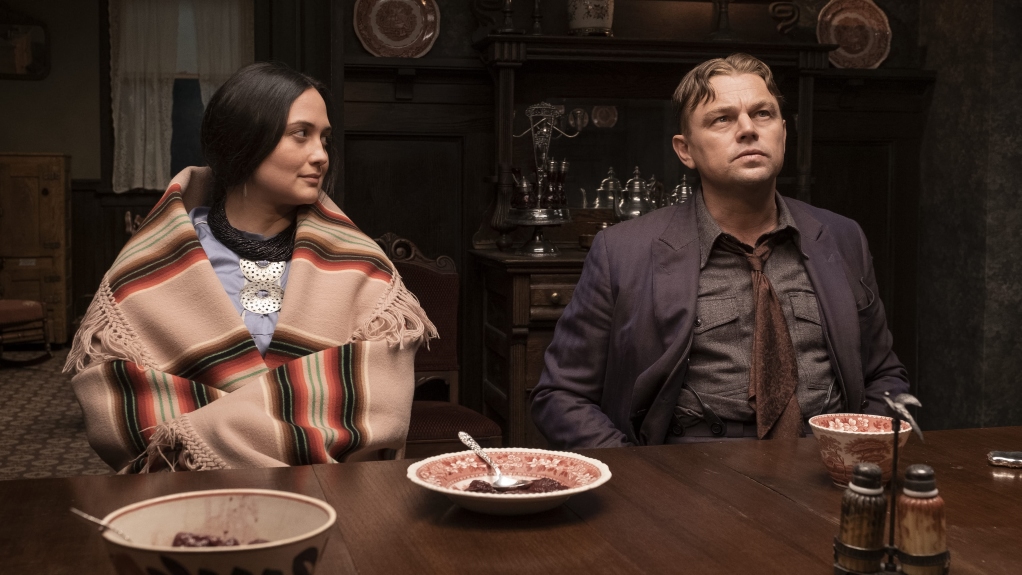
Ernest Buckhart (Leonardo DiCaprio) returns from war service (as a cook) to live with his uncle William King Hale (Robert De Niro) in Oklahoma. Hale lives on a ranch in the heart of reservation country and has built himself a powerful local presence by acting as benefactor of the Osage people. But Hale is, in fact, a ruthless sociopath who smiles cheerily at his neighbours, while plotting ceaselessly to steal their oil rights. Hale persuades Buckhart to marry Mollie Kyle (Lily Gladstone), whose family own headrights. While the gullible and easily-led Buckhart truly loves Mollie, he also willingly takes an active part for years in Hale’s schemes to murder the rest of Mollie’s family, so that their oil rights will collect with Mollie – and, in effect, with Hale.
Scorsese’s film is certainly a rich tapestry, but also a curiously mixed viewing experience. It feels at times like what it is – a film that dramatically changed its focus several times during its development, eventually reaching towards bringing the Indigenous experience to the screen, only to find that reach exceeding its grasp. The original book by David Grann focused on the FBI investigation into the crimes with DiCaprio originally set to play FBI investigator White (now played by Jesse Plemons). DiCaprio instead was drawn to the role of Buckhart, with the film repositioned to focus on the killers rather than the investigators or victims. During Scorsese’s extensive work with the Osage nation, the filmmaker became increasingly compelled by the exploitation of the Indigenous people.
Watching the film, it feels like a late swerve in focus Scorsese isn’t quite able to deliver on. However, some of the film’s most compelling content is its commentary on the Indigenous experience and the brutal exploitation and murders by a white community that sees the Osage people as second-class human beings. As a sort of twisted natural progression from encroaching on land a hundred years ago, people like Hale talk of marrying into Indigenous families, breeding out the blood and turning these communities into extensions of their own white families so they can control their wealth.
Over the course of the film, Scorsese carefully shows community gatherings becoming more and more dominated by white faces. Even tribal functions and ceremonies become awash with white faces, staring on with paternalistic, unfeeling smiles. From an early montage of Indigenous people enjoying their unexpected wealth (in a mix of historical and recreations photos and film stock), we progress ever more sharply into seeing whites take over. These fall into two firm categories: Masonic pinstripe types who stick together to cover-up crimes, and trailer trash and inept lesser-family members who are farmed out like cattle to soak up Osage wealth.
Scorsese’s film doesn’t shirk from depicting the casual racism of this community. A KKK march heads through the town. When Hale attends the cinema, he first sees newsreel footage of the Tulsa massacre then The Birth of the Nation. A montage of suspicious Osage deaths is marked by a Mollie voiceover stressing the lack of investigation. Osage oil owners are dispatched with increasing blatantness, as pretence of staged suicides and accidents degenerates into shootings, executions and finally bombs. Hale rants about the need to “take back control” and coldly states that they can escape any retribution because, fundamentally, no one cares or will remember.
But yet… this is still a film where we see a traumatic event happen to a group, but which focuses overwhelmingly on the perpetrators rather than the victims. I find myself agreeing with one reviewer that it feels at times like Get Out, told from the perspective of the white people. Scorsese’s film’s main beat feels like regret and guilt and perhaps what it needed was anger. For all its noble efforts, it’s hard to escape the fact that Mollie is the only Osage character in its epic runtime who is made to feel like a character, and she remains a person things happen to. The other Osage characters are, by and large, victims – Mollie’s sisters or William Belleau as Hale’s drunken, depressed neighbour – people who pop up in order to be dispatched.

I was reminded somewhat of The Searchers. In 1956, a film that criticised a John Wayne hero as an unpleasant racist was a big statement – but in a film where the Indigenous characters were still faceless nobodies, villains or comic relief. It’s similar here: Killers of the Flower Moon shows us the vileness of its white villains, but doesn’t really give us a full Indigenous perspective. And it feels, in 2023, we should do better. Even the impact and workings of reservations, land displacements and white-guardians isn’t explained in the film. Gladstone is marvellous – her eyes are full of suppressed pain, suspicion, fury and glimmers of the possibilities of forgiveness – but her character remains somewhat of a cipher, never quite receiving the exploration the killers of her family receive.
It feels like a realisation made during the filming, but without the time to deliver (after all the stars are playing the killers). Scorsese gives two beautiful Osage-themed bookends (and his carefulness around avoiding cultural appropriation is to be applauded), but the Osage themselves become passengers in their own story, allowed only a few brief moments to protest or express their anger. In a film that stretches over 200 leisurely minutes, more really should have been done.
Saying that, the film is blessed with two wonderful performances by Di Caprio and De Niro. DiCaprio, his mouth stuffed with rotten teeth, his body stumbling from scene-to-scene, expertly walks a tightrope between weakling and coward. Does he realise the moral morass he has climbed into? Or does he not care? How does he manage the mental gymnastics of plotting the deaths of his wife and her family and yet also convince himself that he is protecting her? It’s a fascinating performance. De Niro gives his greatest performance in 25 years as a polite, gentle man who warmly means every word of his friendliness but is also capable of acts of shocking murder and violence towards ‘his friends’ without even batting an eyelid. De Niro’s avuncular presence chills noticeably over the course of the film, brilliantly letting the egotistical dark heart leak out into the surface.
There is a lot to respect about Scorsese’s film, not least the way the late Robbie Robertson’s heartbeat-inspired score constantly creates an air of menace. It’s beautifully filmed – even if it is incredibly stately in its huge runtime – and it’s trying, very hard, to address an under-addressed issue in American culture. But it fumbles the ball because, for all its good intent, it still tells the story of an Indigenous group through the eyes of white people. Worse – their white persecutors. A braver, better (and shorter) film would have centred Gladstone’s Mollie rather than making her, at times, a passenger on a very long ride. Killers of the Flower Moon strains to make amends to Indigenous Americans – but instead it feels like a long guilt-trip for its white film-makers.
 Movie Musings