

Papal boardroom politics combine with detective mystery in this engaging mix of high- and low-brow
Director: Edward Berger
Cast: Ralph Fiennes (Cardinal Thomas Lawrence), Stanley Tucci (Cardinal Aldo Bellini), John Lithgow (Cardinal Joseph Tremblay), Sergio Castellitto (Cardinal Goffredo Tedesco), Isabella Rossellini (Sister Agnes), Lucian Msamati (Cardinal Joshua Adeyemi), Carlos Diehz (Cardinal Vincent Benitez), Brian F. O’Byrne (Monsignor Raymond O’Malley), Jacek Koman (Archbishop Janusz Wozniak)
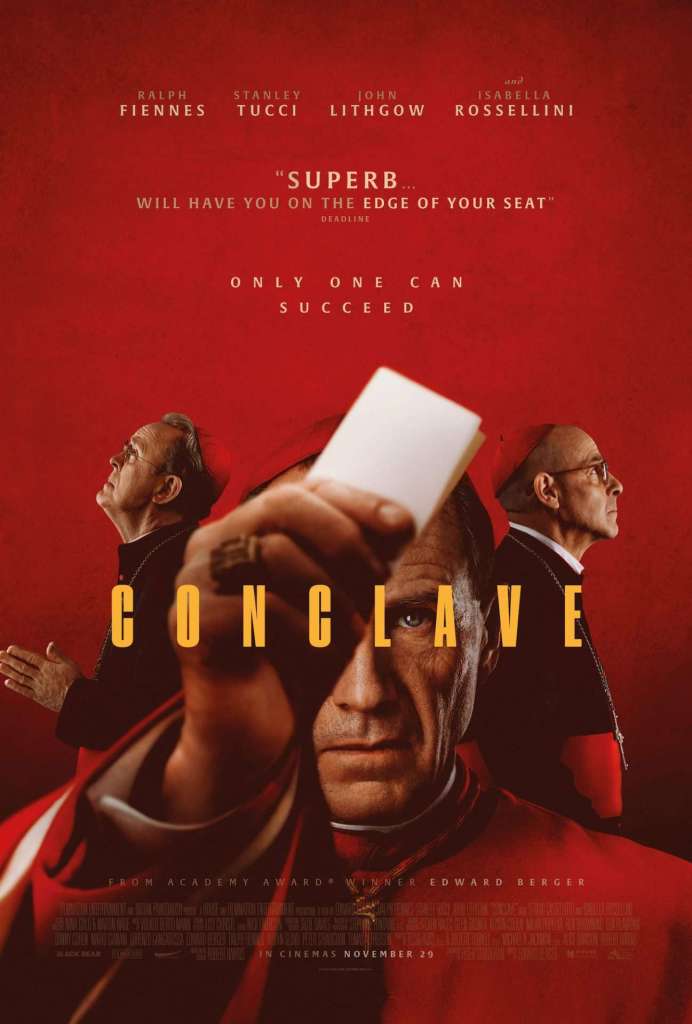
Few things have changed as little over 500 years than the election of a pope. Sure, they didn’t need to take away the phones of the Borgias and Medicis, but the idea of locking away the Princes of the Church in the Sistine Chapel until the Holy Spirit guides them towards choosing the next Heir to the Throne of St Peter hasn’t changed. But then neither (probably) has the ruthless politicking and barely concealed ambition of the cardinals (after all some were Borgias and Medicis!), many having dreamt their whole lives of moulding the Church into the shape they believe He wants it to be.
Politicking and spiritual and moral struggles with the temptations of ambition are at the heart of this excellent adaptation of Robert Harris’ novel. After the pope dies, Cardinal Thomas Lawrence (Ralph Fiennes), Dean of the College of Cardinals, is responsible for organising the new Papal Conclave. Lawrence, struggling with doubts whose request to resign was recently rejected by the Pope, is part of the moderate wing and a supporter of Cardinal Aldo Bellini (Stanley Tucci). The other major candidates are conservative Canadian Cardinal Tremblay (John Lithgow) and ultra-traditionalists Italian Cardinal Tedesco (Sergio Castellitto) and Nigerian Cardinal Adeyemi (Lucian Msamati). Lawrence slowly discovers severe reasons to doubt the suitability of all these candidates – while the number of cardinals suggesting he himself might be a suitable candidate grows.
Conclave is a very enjoyable dive into the mysterious world of papal politics. Part of its appeal is seeing that, under the mystery of centuries-old practices, elaborate robes and beautiful artworks, the struggle to elect a pope is a highly political business. Things ain’t changed that much since the Borgias, as various sexual, financial and other scandals crop up to scupper the chances of one candidate after another. As per 15th-century papal tradition, take away those flowing robes and lapses into Latin, and this is a cut-throat boardroom succession struggle that leaves more than a few reputations in ruins (and it ain’t going to be easy – even the late pope’s signet ring only comes off his finger after a rough-handed struggle).
In fact, Conclave works as well as it does because it’s a sort of Succession meets Father Brown, a brilliantly paced and staged merging of high-brow settings with pulpy page-turner thrills. At its heart is a superb performance by Ralph Fiennes as Cardinal Lawrence. Softly-spoken, Lawrence is dutiful, decent and diligent – and plagued with doubts about everything from his faith to his ambition, with permanently sad eyes, full of world-weary resignation. At one point Lawrence stares up at The Last Judgement, his eyes catching a man twisting in torment: he knows how he’s feeling. Unlike all the other cardinals, dripping with certainty, he’d rather be anywhere but there.
Lawrence becomes Father Brown, the quiet, level-headed priest going the extra mile to sniff out wrong-doing. As his concerns about many of his fellow cardinals emerge, he goes to rule-bending lengths to confirm these suspicions – and part of the delight of Conclave is how entertainingly it plays out murder mystery conventions alongside its papal shenanigans. Lawrence carries out his dogged investigation with an earnest sense of duty but what’s great about Fiennes’ performance is that he also manages to suggest the possibly of guilty ambition underneath. After all, Lawrence is a cardinal too, right? Why can’t he have a crack at being the Holy Father?
Lawrence has moments of temptation when the Holy See is dangled before him. Part of Conclave’s argument is that power is best suited to those most reluctant to carry it. Lawrence is one of the most reluctant among the papal players – but even he isn’t immune to guilty temptation. When he opens the concave with an off-the-cuff speech on moral conduct, is it subconsciously to establish his leadership? When he very publicly exposes one candidate’s misdeeds, is a side benefit demonstrating his own virtue? Conclave tracks Lawrence’s vote every time – and when he is tempted to vote for himself, an act of seemingly divine intervention takes place to almost tick him off.

It’s said at one point all cardinals have thought about their papal name. Lawrence shrugs this off, but later unhesitatingly gives an answer. Perhaps the only cardinal who hasn’t really thought about it is Cardinal Benitez (Carlos Diehz, wonderfully serene), secretly appointed Cardinal of Kabul by the late pope, a man almost alone in thinking this is a quest to find the holiest. The rest? They could probably tell their regnal names without thinking. And unlike Lawrence, they are certain about everything: from their own suitability to how pleased God will be when they land it.
Peter Straughan’s sharp and intelligent script gives an array of opportunities for excellent character actors (Conclave would make a good play). Sergio Castellitto’s scene-stealingly bombastic Tedesco, forever vaping when not growling about how chucking the Latin Mass was the end-of-days, can’t imagine he won’t win. It’s a trait he shares with Lucien Msamati’s Adeyemi, although Msamati finds a vulnerable humility that makes Adeyemi’s eventual downfall surprisingly affecting. Lithgow’s imperious Tremblay drips with arrogance (his eventual comeuppance sees Lithgow brilliantly deflate like a pricked balloon). Stanley Tucci is brilliant as the charming, morally upright Bellini who then surprises even himself with how fiercely ambitious he is.
Berger sets all this in a brilliantly oppressive setting, for all the beauty on the walls around them. Berger superbly conveys the isolation of the conclave, lit almost entirely artificially in heartless hotel rooms (that feel like monastic jails) and a fluorescent-lit canteen. The sound design is a massive part of this, the rooms devoid of ambient sound, just a crushingly deadened stillness. Frequently Lawrence’s breathing fills the soundtrack, giving the film a confessional feeling. It all means the late on surprise sound of a gust of wind carries the same impact for us as it does the cardinals.
Male voices dominate in the Vatican, so it’s telling Conclave deliberately undercuts this by giving one of its standout moments to Isabella Rossellini’s primly professional Sister Agnes. Like the other nuns staffing the conclave, she barely speaks – meaning when she does, it seizes the viewer’s attention as much as she does the crowd of cardinals. The flaws of this world return in the film’s final (slightly forced) twist, which helps question how much the alpha-male clashes between these papal academics may have shaped the atmosphere of the Church, and not for the better.
Conclave is tightly directed film, and a great adaptation of a page-turning novel with a faultless cast brilliantly led by Ralph Fiennes. It mixes pomp and ceremony with a fascinatingly tense struggle for power, made all the more gripping that in the parade of languages we hear (and all the cardinals can switch easily from English to Latin to Italian to Spanish) the language of power and ambition is constant but unspoken – and when it is explicitly stated, it has a devastating impact on those who use it. It’s a great touch in an entertaining and engaging film.
 Movie Musings