
Tag: Catherine Deneuve

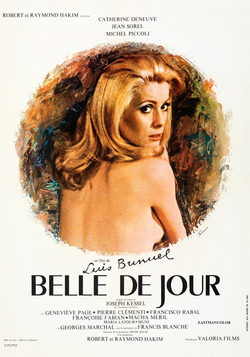
Belle du Jour (1967)

Belle du Jour (1967)

Buñuel’s sensual mix of fantasy and reality, asks intriguing and searching questions with ambiguous answers

Director: Luis Buñuel

Cast: Catherine Deneuve (Séverine “Belle de Jour” Serizy), Jean Sorel (Pierre Serizy), Michel Piccoli (Henri Husson), Geneviève Page (Madame Anaïs), Pierre Clémenti (Marcel), Francisco Rabal (Hyppolite), Françoise Fabian (Charlotte), Macha Méril (Renée), Maria Latour (Mathilde), Marguerite Muni (Pallas), Francis Blanche (Monsieur Adolphe), François Maistre (The professor), Georges Marchal (Duke)
Desire can be a scary thing; a deep dive into the things that excite and titillate us can be deeply unnerving. That’s the heart of Buñuel’s compellingly intriguing Belle de Jour, where dreams and fantasy merge with confused and repressed desires struggling to find an outlet. It makes for a fascinating, unsettling and erotic film, powered by a fearlessly superb performance by Deneuve. Buñuel’s film avoids judgement, frequently inverting lazy moral judgements in a film that flirts with playfulness and dark dangers.

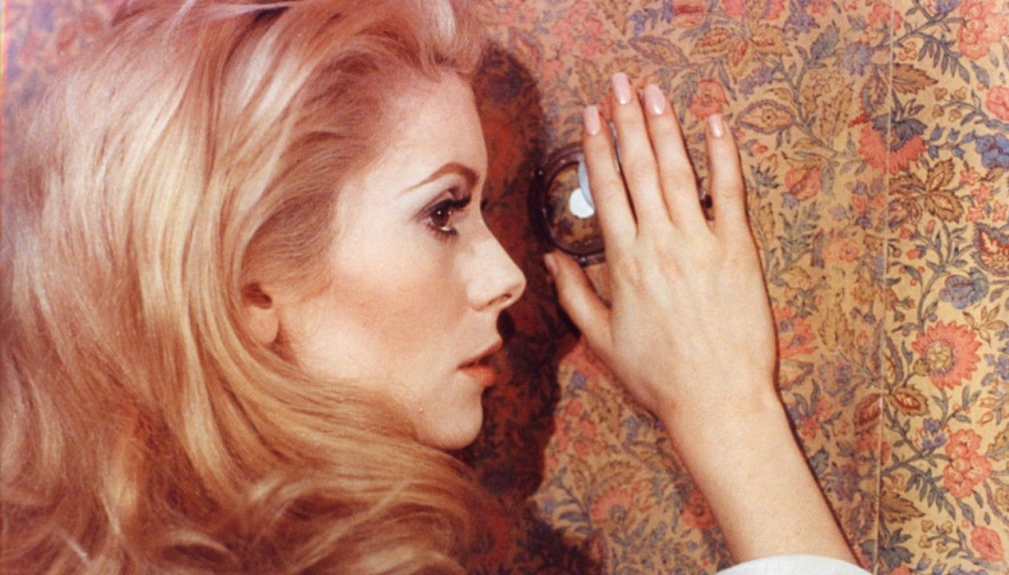
Séverine (Catherine Deneuve) is happily married to Pierre (Jean Sorel) but seems unable to find any sexual satisfaction with him. Sleeping in separate beds, the couple are supportive and loving but chaste. Séverine’s fantasy life though is awash with day-dreams of erotic, sadomasochistic desires in which she is degraded and humiliated, scenarios clearly alien in her marriage. Séverine finds an outlet for her desires by taking an afternoon job as a prostitute in Madame Anaïs (Geneviève Page) high-class brothel, where she can experience an erotic thrill in debasement that she barely understands herself. But can her secret survive the probing of sinister Husson (a brilliantly creepy Michel Piccoli) or her confused fascination with gangster Marcel (Pierre Clémenti).

Belle de Jour explores the dark desires many of us hold but never acknowledge – either to the world at large or to ourselves. It’s told with Buñuel’s masterful control, moves with smooth narrative economy and throws our expectations off kilter with carefully controlled switches from reality to fantasy. Buñuel’s unsettling opening shows Séverine and Pierre riding in a carriage through a tree lined country lane, their conversation tinged with hostility. We wonder what film it might be – we probably don’t expect Pierre to order the carriage to stop, demand the drivers drag Séverine from it, take her into the woods, flog her bare back and then allows one of his burly men to have his way with her. Just as we don’t expect the look of pleasure on Séverine’s face.

Fantasies like this re-occur time-and-time again throughout the film, as Séverine’s only way of truly explore sexual fantasies her husband is (presumably) unable to fulfil. In her fantasies she is abused, tied up, has mud flung at her and services men in the full knowledge of her husband. Buñuel presents this, as you might expect (for a man whose foot fetish has become something of a running joke) with a striking lack of judgement or moral ticking off. Instead, it feels more like Séverine is a woman trapped between two stools of seemingly knowing what she might want, but struggling to find the sexual and emotional confidence to acknowledge it. None of this, in any case, has any impact on her love for her husband or the importance she places on their marriage.

Buñuel captures this brilliantly with her hesitancy to follow through on her desire to knock on the door of hostess Madame Anaïs (an excellent Geneviève Page). We watch Séverine dawdle outside the apartment block, doubling back, staring blankly at shop windows and waiting until she cannot be seen and then shuffling up the stairs and back-and-forth outside the door. Buñuel repeats the trick later (with a shot focused on her feet) as she hesitates about whether to push her way through the door again next week.

In the bedroom, Séverine frequently feels awkward and uncertain (even a little embarrassed), which is striking until you realise this is less of the fear factor and more a kink one. She’s fails utterly with the Professor (François Maistre), a client who desires to be punished, a lust completely counter to her own desires. However, she ends a session with a burly Japanese customer, whose physicality terrifies the other girls (he also carries with him a mysterious buzzing box – Buñuel joked he was asked more about the content of this box than anything else in his films), exhausted but with a look of reclining, feline satisfaction on her that we don’t see before or since.

Buñuel’s film slips and slides ever more intriguingly into oblique uncertainty as Séverine explores the further reaches of her sensuality. A fascinating sequence tips uncertainly between dream and reality. Séverine encounters a mysterious nobleman (an austere Georges Marchal) during a casual café pick-up. But his coach drivers are the same as those from her earlier dream (tellingly, Buñuel also makes a Hitchcockian cameo as a café customer –tipping the wink this might not be reality). At the Duke’s home, Séverine lies in a coffin (in another dream call back, the butler is ordered to keep the cats out, the same bizarre cry Séverine made during her woodside thrashing) while the Duke masturbates under the coffin before flinging her out of the house like trash. Fantasy or reality? Is exposure to wider sexual desires expanding Séverine own dreams?

How much has she told Pierre about what happens in these dreams? It’s hard to believe Jean Sorel’s straight-shooting doctor would be as blasé as he appears about a recurring fantasy of his wife on a carriage ride followed of sexual humiliation. Did she just tell him about the first part? Séverine seems determined to shelter Pierre from her desires, part of compartmentalising her inner and outer lives. You could argue the general autonomy and respect he gives her not only powers her love for him, but also runs so counter to her inclinations that she finds it represses all desire for him.

Belle du Jour sees no contradiction between a desire for casual, need-filling sex with strangers and a loving marriage. You could argue Buñuel’s film suggests Séverine’s problems only start when she finds emotional bonds blurring in a fascination with Pierre Clémenti’s brutal, scarred gangster Marcel, who arrives like the violent embodiment of her dreams and who she longs to see again and again. Only when genuine feelings start to intrude, does what she is doing even begin to feel like any sort of betrayal. Buñuel presents Marcel as a destructive raging id, impulsively violent. But he also plays with our expectations of moral punishment for Séverine, throwing in a moment of Pierre studying an abandoned wheelchair with such jarring foreboding it’s easy to see it as a subtle joke on our expectations for Séverine’s expected narrative punishment.

The ending tips back into fantasy, presenting us with a choice of how much we choose to believe is real or not. While Séverine fears Pierre’s discovery of her secret, you can also imagine the shame and humiliation she would feel would also satisfy many of her deeper fantasies, with her fantasies of Pierre routinely berating her as a slut. Buñuel’s brilliant merging of fantasy and reality, with audio and visual hints and call backs that intrude into and loop back over both worlds is brilliantly suggestive.

Belle de Jour also owes a huge part of its success to the sensitive, non-judgemental performance of Catherine Deneuve which is brilliantly subtle and ambiguous, never presenting us with a constantly shifting range of possibilities about Séverine’s emotions. Deneuve is compellingly sympathetic and frustrating in equal measure, perfectly attuning herself to Buñuel’s complex canvas. That is a picture of puzzles and possibilities, that asks us to take deep and unsettling looks at ourselves and our own desires. Buñuel’s gift here is to take what could be red-light zone smut and turn it into something profoundly, challengingly opaque and intriguing.

The Last Metro (1980)

The Last Metro (1980)

Passion, privacy, tension and terror all come to head in Truffaut’s stately theatrical occupation epic

Director: François Truffaut

Cast: Catherine Deneuve (Marion Steiner), Gérard Depardieu (Bernard Granger), Jean Poiret (Jean-Loup Cottins), Heinz Bennent (Lucas Steiner), Andréa Ferréol (Arlette Guillaume), Paulette Dubost (Germaine Fabre), Sabine Haudepin (Nadine Marsac), Jean-Louis Richard (Daxiat), Maurice Risch (Raymond Boursier)

The curtain parts and we are introduced to a magic world of imagination and drama play out before us on stage. But how can the actors immerse themselves in this, while such huge drama plays out in the real world? It’s the dilemma of the Montmatre theatrical troupe in Paris during the Occupation. With war raging with all its complex moral choices and dangers, how can you focus on the art within – or for the matter process the complex emotional entanglements in an already claustrophobic profession only made worse by the perils of Nazi occupied Paris and their pet collaborators.

Truffaut’s film is called The Last Metro as it recalls a period during the occupation when hundreds of thousands of people crowded into Parisian theatres to stay warm at night before rushing to catch the final train home before the curfew. The Montmatre Theatre is run by Marion Steiner (Catherine Deneuve), a film star turned stage actor struggling to keep the theatre going in the absence of her Jewish theatre-director husband Lucas (Heinz Bennett) – who, unknown to anyone else, is hiding in the theatre basement. Bernard Granger (Gérard Depardieu) is her new lead actor for their latest Ibsenesque production: but his presence will stir powerful feelings in the embattled Marion.

Truffaut’s film steers away from his other more famous work – the sort of vibrancy and romance of earlier films like Jules et Jim or The Four Hundred Blows or the inventive playfulness of Day for Night. Instead, The Last Metro is a more formal, classically shot, interior piece that revels in small moments and touches of emotional investment so subtle and glancing some viewers might not even notice them. It’s also – surprisingly for cinema’s leading cineaste – a film deeply in love with the mechanics and backstage drama of theatre, subtly contrasting the claustrophobia and intensity of such spaces with the oppressive world-shrinking and glance-over-your-shoulder anxiety of occupation.

It’s also a superb character study, with a quite brilliantly complex and compelling performance from Catherine Deneuve. A starlet with a double burden – not only keeping the theatre alive, but also her husband – Marion is a woman pulled so hard and so overwhelmingly in so many competing directions, it’s taking every ounce of her control to hold herself together. Facing financial pressures, censorship pressures and the constant fear that a single wrong word could see her theatre ripped away from her and her husband discovered and killed, she maintains a cold and professional veneer that rarely, if ever, slips.

So little does it, that Bernard – played with an effortlessly underplayed grace and charm by Gérard Depardieu that belies his Rugby-player bellicosity – is, for the most part, blissfully unaware of Marion’s growing, unspoken, attraction to him. A love she seems hardly able to acknowledge herself, not least because it feels like an even deeper betrayal now of her husband, hiding out in the basement and utterly dependent on her, than it would in peacetime.

Lucas – a wonderful Heinz Bennent – is himself teetering on the edge of falling apart from the sustained effects of acute cabin pressure. Never leaving the damp theatre basement – apart from surreptitious trips to the stage late at night – Lucas’ attitude to his enforced imprisonment moves from a larkish boys-own adventure into an increasingly bitter resentment. Directing the show from afar – a drain has been hooked up so he can listen in on rehearsals – he provides late night feedback to Marion to accompany the detailed handwritten notes he ‘left behind’. Mapping out future productions on his cell walls, Lucas avoids the suspicion that the constant pressure of concealing him has tipped their relationship from romance to one of anxiety-ridden responsibility.

It contrasts with the play the company is performing: where, in typical Ibsen style, the lead is a tragedy tinged woman, suffering memory loss, who falls into a deep but mutually painful love with her son’s tutor. Even from the rehearsals, Marion begins to feel some bleed of this dramatic relationship into her real world: she asks Bernard to not touch her during rehearsals, as if worried that this moment of physicality could lead to consequences she cannot control.

Touch is a key sensation in The Last Metro – as if moments of physical contact and intimacy carry even more weight in a world where no one can be trusted and every word must be carefully watched. Bernard uses a repeated routine of palm reading to try and seduce (with mixed results) a series of women (most notably lesbian production designer Arlette – strikingly played by Andréa Ferréol – who, in a lovely flourish, he describes as longing for “like a warm croissant”). Physical contact – the light caress of a face and hands – is crucial to the film. Truffaut’s camera zooms in on moments where hands take each other, either in longing, understanding or – in a sequence where Marion journeys to Gestapo headquarters – with the threat of imminent violence.

Closing distance is particularly important in a period where all contact must be carefully judged and measured. Collaborators, like powerful press chief Daxiat, will use the smallest slight or word out of place to justify pulling your world down. Played with a hissable vileness by Jean-Louis Richard, Daxiat is a pompous, self-important, two-faced and vindictive man parroting Nazi slogans and revelling in his power to destroy careers. But, small man though he is, the Occupation gives him power – when Bernard angrily confronts him for his rudeness about Marion in his review, its Bernard who Marion is furious at for his recklessness.

It’s because hanging over every moment – and constantly playing in Deneuve’s expressive eyes – is the dread of what will be found if her theatre is searched or how doomed her husband will be if it is closed. Finding a play that passes muster with the censors and pleases the masses is literally a matter of life and death.

Truffaut echoes the claustrophobia of occupied France in his shooting of the cramped backstage world – and he and Suzanne Schiffman in their screenplay add to this with their look at backstage politics and affections between actors, stagehands and crew. Even the outside is shot like an interior – and Truffaut never bothers to make the locations feel like anything other than sets, as if the whole world is a claustrophobic theatre – with extensive use of mid and close-up shots and subtle tracking shots that maintain the theatrical effect.

It does make for a film that can feel stately and a little too heritage – and its undeniable you miss some of the energy of Truffaut’s other films (you can’t imagine his idol Hitchcock ever shooting a frame of The Last Metro­ – or what he would have made of its luxurious pace). Its subtle energy is sometimes so easy-to-miss that it can be easy for parts of the film to pass you by. Plotlines – such as Bernard’s support of the resistance – sit awkwardly at times within the framework, and the film’s boiling down of Vichy France to (essentially) one bad apple told a story about Occupation that was very pleasing to the French self-image (no wonder if was a massive hit).

The Last Metro is at times a little too in-love with its cultural heritage and the quiet professional skill of its making. But, it counter-balances this with some involving and subtle work from all its principles and director: and in Denevue (especially) and Depardieu it had two of the greatest actors in French cinema at the top of their game. Multi-layered and demanding, it’s a film that makes you work from its newsreel opening to its fourth-wall, metatextual ending, riffing on romantic entanglements, art, burdens and the oppression of occupation. Perhaps too knowingly prestige to be great, but still an essential watch.