Tag: Catherine Keener

Being John Malkovich (1999)

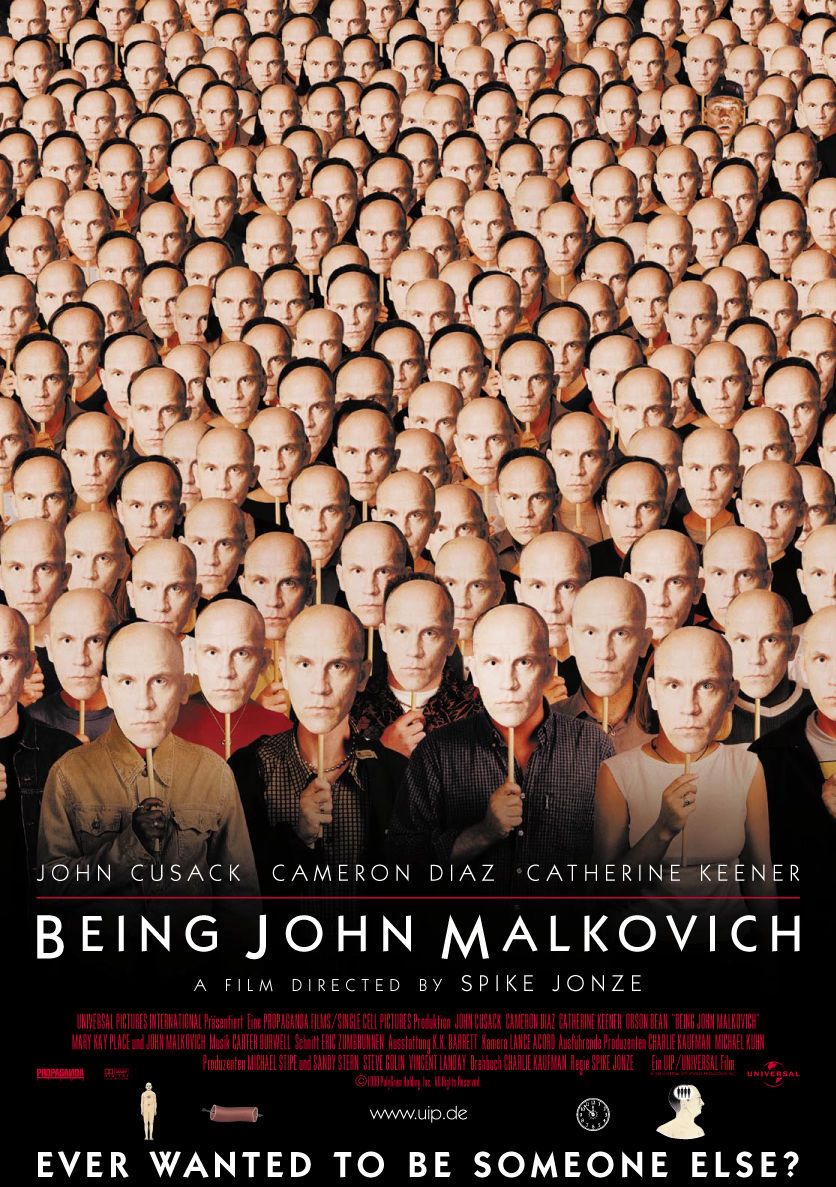
A portal into the head of a famous actor? What better way to find out what it’s like Being John Malkovich

Director: Spike Jonze

Cast: John Cusack (Craig Schwartz), Cameron Diaz (Lotte Schwartz), Catherine Keener (Maxine Lund), John Malkovich (John Horatio Malkovich), Orson Bean (Dr Lester), Mary Kay Place (Floris), Charlie Sheen (Himself), W Earl Brown (JM Inc Customer)
Is there a more consciously eccentric film ever made than Being John Malkovich? Can you imagine the pitch to the Hollywood suits? 

Our hero, Craig Schwartz (John Cusack) is a weedy, bitter puppeteer (as well as creep and potential stalker), whose wife Lotte (Cameron Diaz) fills their house with rescue animals, from talkative parrots to a chimp with PTSD. Needing to make ends meet, Schwartz takes a filing job at a company based on floor 7½ of an office block (it’s a low ceilinged floor built between the other two floors – it’s cheaper on the rent obviously) where he becomes obsessed with his sexy co-worker Maxine Lund (Catherine Keener), who is resolutely not interested. But all this changes one day when Schwartz finds a fleshy, dark tunnel behind a filming cabinet that takes someone into the mind of actor John Malkovich (John Malkovich) – for 15 minutes, before expelling you onto the New Jersey turnpike. Sounds like a business interest for Schwartz and Maxine (spend 15 minutes in someone else’s body!), but the experience of being in someone’s body slowly begins to change Schwartz, Lotte and Maxine – and having his brain invaded has a terrible impact on Malkovich himself.

If that’s not the oddest plot you’ve ever heard, then I don’t know what films you’ve been watching. The film was the brainchild of Charlie Kaufman, who developed from this into one of the most distinctively gifted screenwriters in Hollywood, a master of the quirky and weird, the off-the-wall and the science fiction tinged everyday fantasy, blessed with the ability to mix in genuine human emotion amongst the oddness. 

Being John Malkovich is an inspired idea and Kaufman’s script is ingenious in its structure and progression. Never once does the film settle for the expected narrative development or the conventional structure. It’s a livewire of a film that constantly leaves you guessing, switching tone and throwing logical but unexpected plot twists at every turn. There are plenty of moments where you could expect events to take a conventional turn, but the film never settles for the obvious.

Kaufman’s inspired script was lucky enough to find a quirky visual stylist who was willing to embrace it as much as Spike Jonze did. Jonze’s direction is a masterclass in small detail, slight twists and little touches of invention that never draw excessive attention to themselves but combine to make a thrillingly off-the-wall final picture. 

Jonze knows that the jokes and surrealism of Kaufman’s script are so effective that they don’t need a firm directorial hand to lean the humour on – they work absolutely fine presented almost as written, and make for terrific entertainment. He shoots the low ceiling of floor 7½ with such straightforward confidence that each scene becomes hilarious for its stooped actors and crammed rooms. Jonze can therefore concentrate the flourishes on core moments, from the puppetry that Schwartz and later a Schwartz-controlled Malkovich make their life’s work, to assorted training and educational videos that pepper the film at key moments.

Like Kaufman as well, Jonze’s storytelling works because he inherently understands human emotion and isn’t afraid to throw it into the film alongside the humour. Plenty of directors would have been happy to have all the principals settle into being comic stereotypes, or overplayed pantomime figures. Jonze encouraged the actors to find the depth – and sometimes the darkness – in their characters, to ground the film effectively with touches of real life tragedy and human flaws that give weight to the surreal sci-fi elements – so much so that they start to feel as real as the rest.

John Cusack’s Schwartz is a bitter, increasingly twisted fantasist and dreamer – the sort of guy who believes that his lack of willingness to compromise his art in any way is a strength (his puppetry shows are highly complex, sexualised, high-blown, poetry-inspired hilarious puffs of pretension). Schwartz could have become a joke or a guy with a big dream – but the film increasingly shows him to be a dark, obsessive, cruel even dangerous outsider, who has no problem with harming other people to get what he wants, his moral compass is driven by his self-assessment of himself as a man treated badly by others, so doing what he wants is somehow deserved. It’s an increasingly dark portrait of a man who has more than hint of danger to him.

Keener, as the focus of his obsession, also does extraordinary work as a woman the film is not afraid to present as unpleasant in her selfishness, casual cruelty and greed – but a woman who slowly allows herself to open up and reveal an emotional openness and romanticism someone watching the start of the film would never expect. Similarly Diaz’s downtrodden, sad wife at home flourishes and grows as a person, as she finds in herself a new comfort and ease with who she is, from inhabiting the mind of another person. Both are excellent.

The film explores fascinating ideas of identity – Lotte and Maxine find a freedom and an exciting otherness in being a passenger in another person’s body, and use it as voyages of self discovery for themselves. Schwartz on the other hand sees this body – just as he sees all human beings – as just another puppet for him to control, another way of adjusting the world to match his requirements, rather than change anything about himself. While some lose themselves in Malkovich’s body and find the experience rewarding, Schwartz can only find happiness when bending the body to his own will.

And what of Malkovich himself?  Well has there ever been a braver performance in film? Malkovich is superb as an arch portrait of himself as a rather self-important actor, with an unknowable coolness about him, an intellectualism that makes him a man easy to respect but strangely hard to relate to, a face that is distinctive but a strangely unrelatable style that makes him hard to remember (it’s really an extraordinarily funny and brave performance). As Malkovich realises what is happening to him, the film plays with real beats of tragedy and even horror – what would it be like to be forced into being a passenger in your own head? This is nothing compared to the horror Malkovich encounters when he enters the tunnel himself – to find himself in a world where everyone looks like Malkovich and can only speak using the word “Malkovich”.

Being John Malkovich uses its surreal ideas to explore profound – and even chilling – ideas of control, destiny, personality and identity. With several superb performances, a brilliant script and controlled and intelligent direction, it’s a film unlike any other – and continues to delight and surprise twenty years on from its release.

Capote (2005)

Philip Seymour Hoffman excels as the morally complex author in Capote

Director: Bennett Miller

Cast: Philip Seymour Hoffman (Truman Capote), Catherine Kenner (Nelle Harper Lee), Clifton Collins Jnr (Perry Smith), Chris Cooper (Alvin Dewey), Bob Balaban (William Shawn), Bruce Greenwood (Jack Dunphy), Katherine Shindle (Rose), Amy Ryan (Marie Dewey), Mark Pellegrino (Dick Hickock)

What profits a man if he gains the whole world but loses his own soul? It’s the sort of summation that I imagine Truman Capote himself would object to as trite and obvious. But it’s a question at the heart of Bennett Miller’s thoughtful, low-key biographical drama that seems to capture not only the agony of writing and creation, but also something of the soul of its lead.

In November 1959, two drifters Perry Smith (Clifton Collins Jnr) and Dick Hickock (Mark Pellegrino) kill an entire family in a remote farmhouse in Kansas. News of this is spotted by Truman Capote (Philip Seymour Hoffman), a brilliant novelist and New York intellectual, looking for his new project. Heading to Kansas, with assistant, novelist and lifelong friend Harper Lee (Catherine Keener), Capote’s initial plan for an article on the reaction of small-time America to unspeakable violence balloons into a full scale book, fuelled by his growing fascination for Perry Smith. While the book takes years – and the trial and appeals of the killer take longer and longer to resolve, the entire experience has an increasingly haunting effect on Capote himself.

Miller’s quietly and professionally assembled film, with a superbly haunting, autumnal feel to it that immediately echoes the blackness of the crime, and the traumatic effect being involved in it has on Capote. It’s also a superb film that understands how writers often work – the seizing of inspiration, the quiet observation, the shaping of moments and titbits of conversation into perfectly captured sentences that can be reproduced in the book. It helps that Capote has – despite his larger than life unusualness and eccentricity – a sort of unusual chameleon like ability, or rather the ability of the charismatically self-obsessed to make all others yearn for his attention and approval.

It’s all part of the many facets of the Capote’s personality that is brought out in Hoffman’s superb performance. Winning the Oscar – and almost every other award going – Hoffman perfectly captures not just every single physical and vocal attribute of Capote, but also seems to seize part of his soul as well. This is such a masterful examination of a person’s psyche, mixed desires and conflicting feelings that Hoffman’s psychological insight seems totally legitimate. Hoffman’s performance is strikingly perfect, transformative in the way few actors manage.

Hoffman’s Capote is a man who flits between arrogance and a caring tenderness, self-doubt and ruthless, consideration and selfishness, who slowly becomes more and more unnerved not only perhaps by his fascination with a brutal killer, but also the own moral depths he is willing to go to. He’s manipulative, emotionally intelligent and genuine enough to gain the confidence of a wide range of people – from Chris Cooper’s gimlet-eyed agent investigating the case (won other by his wife’s fondness for Capote’s novels and Capote’s starry Hollywood anecdotes) to Perry Smith’s would-be intellectual and sensitive soul who is also a hardened killer. 

It’s that relationship with Smith that is the heart of the film, Captoe’s growing closeness with him akin to a seduction, Smith the willing talker, flattered to share his insights into life with the famous writer, Capote eager to gain secret confessions of what was flashing through Smith’s mind while he committed the killings. But it goes deeper than that: Capote grows – or persuades himself he does, so great is his deception – a genuine affection and regard for Smith, wanting perhaps to see that there is more to him than appears. Nursing Smith through a hunger-strike he feeds him by hand. He spends hours in his cell. He reads every scrap Smith gives him of his writing. There is a slight breathless tension to their scenes together, and Capote agonises over the idea of Smith being executed, even as he begins to be repelled by the influence of letting someone else into his life is having over him, and his ability to finish the book.

Because finishing the book is his aim, and his every action is based around getting to that goal. Every moment of flattery and openness gains some other advantage, every second of his time in Kansas is based around soaking up the information he needs to complete the work. But the book will never be complete and finished, because Capote himself has become such a part of the story – by becoming a part of Smith’s life – it seems to almost start draining Capote himself. Writing the book, is like writing his own life, pulling out elements of his own psyche, his own darkness, you feel Capote would rather not explore.

Because as much as he enjoys the recognition and glory readings of the book bring him – he is increasingly unnerved by his own ruthless treatment of Smith. Lying to Smith about the progress of the book, lying about the title, ignoring his phone calls, finally brow beating Smith into telling all of his story about the killing by disparaging all of Smith’s “insight” by claiming there is no concept or idea that Smith can express that has not already occurred to Capote. Smith is a killer, but he is also somehow a sort of lost boy – Collins performance brings a lot out of the strange innocence and promise in Smith – and it still alarms Capote privately that he can so use Smith, lie so completely to him and still feel such overwhelming unnerved grief – or fear or something – when Smith is executed, and execution he has done nothing to help prevent despite his promises to the contrary.

Capote feels equal mixed feelings about fellow writers. His partner Jack Dunphy (Bruce Greenwood in a very good performance) seems to accept his role as the lesser light – and their relationship works all the better for it. Easier than the friendship between himself and Harper Lee, superbly played by Catherine Keener. Keener and Hoffman have a natural chemistry, reflecting Capote and Lee who know each other so well they can literally finish each other’s sentences and completely understand each other. Capote however cannot accept Lee’s success of her own, striking a wedge in the relationship – just as Lee begins to believe that Capote is manipulating real people like fictional tools for his journalistic novel.

Capote tackles complex and fascinating ideas in a coolly well-assembled, extremely well directed, framework that gets some sense of the difficulties and challenges involved in artistic creation – and the moral compromises that some people are driven to make to achieve them. Not to mention the way we are can make ourselves increasingly more and more uncomfortable as we discover more and more about our own personalities and flaws.

The Incredibles 2 (2018)

The family are back together, in belated but brilliant sequel The Incredibles 2

Director: Brad Bird

Cast: Craig T Nelson (Bob Parr/Mr Incredible), Holly Hunter (Helen Parr/Elastigirl), Sarah Vowell (Violet Parr), Huck Milner (Dash Parr), Samuel L Jackson (Lucius Best/Frozone), Bob Odenkirk (Winston Deavor), Catherine Keener (Evelyn Deavor), Brad Bird (Edna Moda), Sophia Bush (Voyd)

Fourteen years? In Hollywood that is nearly an eternity. Can you even imagine a film released today getting its first sequel over a dozen years later? But that is how long we’ve had to wait for a sequel to The Incredibles

Picking up immediately after the first film finished, the efforts of the Parrs, Bob/Mr Incredible (Craig T Nelson), Helen/Elastigirl (Holly Hunter), their children Violet (Sarah Vowell) and Huck (Dash Parr) and their friend Frozone (Samuel L Jackson) to stop the Underminer only lead to destruction. Superheroes are once again anathema to the authorities, but tech millionaire Winston Deavor (Bob Odenkirk) and his inventor sister Evelyn (Catherine Keener) are determined to change their reputation. Their plan? Use Elastigirl as the new “face” of responsible superhero-ing. Elastigirl takes on a new threat: the villainous Screenslaver who uses screens to hypnotise people and control them. Meanwhile, Bob has to cope with the pressures of being a stay-at-home dad, dealing with with teenage crushes, homework challenges and controlling super-powered baby Jack-Jack, who can barely control his never-ending series of powers.

And the world of Hollywood has changed so much since the first Incredibles film came out. Back then, comic book films were only just starting to come into fashion, and the Marvel Cinematic Universe didn’t even exist. So can The Incredibles forge its way in a cinematic landscape now overstuffed with superhero derring-do?  Well yes it does, because the film hasn’t lost the sense of what was so enjoyable about the first film. We still get all the action-packed excitement of some damn fine adventure sequences, choreographed with skill and wit. Playing alongside that we get all the homespun domestic turmoil of modern family life, right down to a dad struggling to help his son with his homework (“How can they change math?!”) and trying not to mess up his kids’ lives. 

The film resets the table to get us back to the situation of the first film – superheroes are illegal and unwanted and anything the Parrs do is going to have to be under the wire. And then it spins out a twist on the first film – this time it’s the super-competent and intelligent Elastigirl who will be the hero, while the more old-school Mr Incredible stays at home and looks after the kids. This combination works perfectly – Elastigirl is a brilliantly conceived character, cool, calm, collected, super smart, ultra-determined and ridiculously good at what she does. Holly Hunter’s southern tones are smoothly perfect for this part, investing it with just the right level of humanitarianism.

Really I should be annoyed about the end of the last movie being so completely reset in the opening minutes of this one, but truthfully the idea of superheroes struggling to balance everyday problems with illegal super-heroing is such a totally brilliant idea you are really happy to see it play out again, this time adding the dilemmas of Mr Incredible suddenly being thrown into a situation he can’t handle – having to be a regular dad – and collapsing in an unshaven, exhausted mess. 

Seeing someone struggle with such everyday problems is hilarious enough, but the film has a USP in the challenges of looking after cute little ball-of-trouble baby Jack-Jack: a sweet, blubbering little kid with a regular smorgasbord of powers, none of which he is able to control. Bob’s struggles to deal with this explosion of wildness (everything from laser rays to moving in the fourth dimension) throw up endless hilarious moments and sight gags that had me laughing out loud (probably too loud) in the cinema.

Sitting alongside this, Brad Bird hasn’t forgotten how to shoot and cut an action sequence – whether it’s animated or not. A chase where Elastigirl has to stop an out-of-control train is not only hugely exciting, but also tense and witty. Elastigirl is also such a relatable character that she adds huge amounts of human interest to every one of these action bits, and her determination to save lives – even of her enemies in exploding buildings – is really rather touching. The final action sequence doesn’t quite match the highlights of the first film, but it does excellent work.

Of course the villain is in fact using these strengths against her. If the film has one weak point, it’s that the identity of the villain is really rather obvious from the start. I pretty much guessed immediately who the villain was going to be. I can’t see anyone of any age being fooled, and the motivations of this villain seem a lot more rushed and less interesting than those of Syndrome in the first film. 

But that feels like a minor blemish on what is an excellent sequel, a real gem in the Pixar cannon. It’s still got the brilliantly retro-cool design that mixes the modern world with the 1950s and 60s. Michael Giacchino’s soundtrack is cracking. Brad Bird brings himself back as scene-stealing superhero costume designer Edna Mode. What’s not to like? I wouldn’t mind waiting another 14 years if they produce a third film as good as this one.

Get Out (2017)


Daniel Kaluuya finds himself well out of his depth in Get Out

Director: Jordan Peele

Cast: Daniel Kaluuya (Chris Washington), Allison Williams (Rose Armitage), Catherine Keener (Missy Armitage), Bradley Whitford (Dean Armitage), Caleb Landry Jones (Jeremy Armitage), Stephen Root (Jim Hudson), Lakeith Stanfield (Logan King), Lil Rel Howery (Rod Williams), Marcus Henderson (Walter), Betty Gabriel (Georgina)

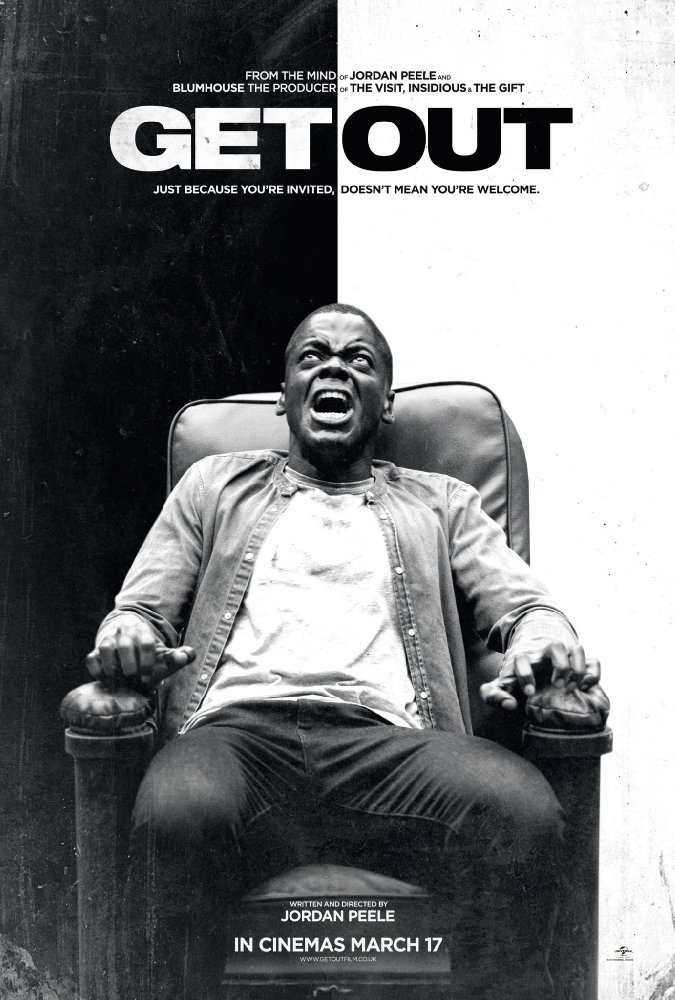
Really great genre film-making transcends its genre, while demonstrating all its strengths. Get Out is nominally a horror film, but strangely it didn’t feel quite like that while I was watching it. It’s more of a horror-inflected social drama with lashings of satire and commentary on race in America. It’s a smart, deeply unsettling film, which really makes you think about how racism has subtly developed in America over the past 100 years. It also manages to feel very much like a film caught at the turning point between Obama and Trump.

Chris Washington (Daniel Kaluuya) is a young, black photographer dating wealthy white Rose Armitage (Allison Williams). He reluctantly agrees to spend the weekend with her family on their countryside estate. Rose’s parents, neurosurgeon Dean (Bradley Whitford) and hypnotherapist Missy (Catherine Keener) are almost overly welcoming and in expressing their liberal credentials. Chris is doubly unsettled that the Armitages’ house has two black workers, both of whom seem alarmingly compliant. The weekend coincides with an annual get-together the Armitage family hosts, where the guests (all rich and white) make comments to Chris admiring his physique, build, sporting ability and genetic advantages. Chris can sense something is wrong – but can’t even begin to guess the mystery at the heart of the Armitage house.

Get Out is, more than anything else, a film about racial politics in America. It trades in the unsettled discomfiture some liberal white people feel when they actually have to interact with a black male from a different background, and then inverts this into a horror. But it rings true: the father so keen to be seen as liberal he uses the phrase “my man” repeatedly, praises Obama, shows off his “multi-cultural art”, delightedly repeats stories about Jesse Owens; the guests at the party who pinch Chris’ muscles, and praise his physique. It feels like a situation where Chris is invited but not welcome. 

In turn, it also inverts the discomfort some black people feel in white middle-class society. Chris finds his hosts patronising and condescending in their desire to be seen as open-minded. He’s uncomfortable at the black staff. Every second in the house reminds him that he doesn’t belong there. But the genius of Peele is that this could be nothing to do with anything except seeing a black man being constantly made aware of his difference in an unfamiliar milieu. 

Chris though, being basically a decent guy, does what any polite person in a minority tends to do: he works overtime to put his hosts at ease. He keeps quiet, he smiles, he laughs at jokes,  he tries to gently drift away. As almost the sole black person, he’s lost and out-of-his-depth and comfort zone (he’s reluctant about even going). All the other black people he meets are strange – Peel brilliantly shows the mixed messages from the servants in particular. In one brilliant sequence Georgina, the maid, says everything is fine while smiling and simultaneously crying. A black party guest dresses and behaves like the rest of the white people around him: has he just completely assimilated or is there something sinister going on here? Chris might guess more – but until it’s too late he decides to batten down the hatches and ride out an awkward weekend.

The house has plenty of mystery – there is a throw-away reference to a locked off-limits basement. Early in the film the couple hit a deer with their car: the police demand to see Chris’ ID even though he wasn’t driving, to the outrage of Allison. It’s a brilliantly eerie opening that hints at danger to come, both in the corpse of the deer and the suspicion of the police. It’s a brilliant touch to explore the barely acknowledged underlying racism of some middle-class Americans – this liberal elite would be horrified to hear the suggestion that they are anything but open-minded, but in fact have deeply paternalistic, two-tier beliefs that have subtly developed since the end of segregation.

The film is played superbly by the whole cast. Bradley Whitford brilliantly inverts his Josh Lyman persona. Catherine Keener is a sort of warm Earth Mother figure, with darkness and control under the surface. Both characters seem suspicious and yet are both so open and direct in what they say, you think it’s almost too obvious to assume they are villains. Caleb Landry Jones as their son is both full of alpha-male welcome and strange, violent and scornful looks and yearnings. Allison Williams as Chris’ girlfriend seems a strange presence in this household, but her honest sympathy for Chris, and her growing realisation with him that something is wrong, is the one thread Chris has to hang onto.

The star-turn of the movie is of course though Daniel Kaluuya as Chris. A young British actor, he’s superb here in a reactive role, trying to persuade himself everything is fine. His unease and insecurity are brilliantly done, as are the surface humour and reserved politeness he uses to disguise this. In a paranoid film, he is going out of his way to not appear paranoid. His relief in seeing any other black people – and then confused discomfort at their behaviour – is endlessly brilliant. As the plot progresses, Kaluuya takes Chris to some dark and emotional places, conveying both despair, fury and pain brilliantly. 

Peele’s film is not perfect. Introduce a character as a hypnotist and you are probably tipping the hat a little too soon – though to be fair, Peele even lampshades this by having Chris’ friend Rod (a hilariously endearing Lil Rel Howery) immediately point this out. The explosion of violence when it comes at the end is gratifying, but a little too much almost for a film about lack of power. The DVD contains an alternative ending that is, in fact, far better and more appropriate, which continues this theme (and is what I expected the ending to be as the film entered its final act) but was replaced because Peele felt (he says on the commentary) it needed a more upbeat ending.

Get Out though is both an excellent paranoia thriller with lashings of horror, and also a brilliant satire on race in America. Trading on the comedy of embarrassment, it has genuine things to say about how the racial divide hasn’t really gone away at all. Both funny and also deeply terrifying, its final reveal of what is going on is brilliant and also rings very true – as well as casting new light on several scenes we have already seen. Peele is a first-time director – but based on this he certainly won’t be one and done.