
Tag: CCH Pounder

Rustin (2023)

Rustin (2023)

Solid biopic tells an inspiring story in a straightforward way with a Domingo star turn

Director: George C Wolfe

Cast: Colman Domingo (Bayard Rustin), Aml Ameen (Martin Luther King Jnr), Glynn Turman (A Philip Randolph), Chris Rock (Roy Wilkins), Gus Halper (Tom Kahn), Johnny Ramey (Elias Taylor), CCH Pounder (Dr Anna Hedgeman), Michael Potts (Cleve Robinson), Audra McDonald (Ella Baker), Jeffrey Wright (Adam Clayton Powell Jnr), Lilli Kay (Rachell), Jordan-Amanda Hall (Charlene), Bill Irwin (AJ Muste)
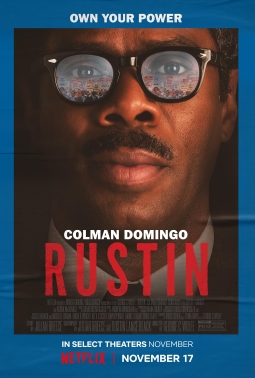
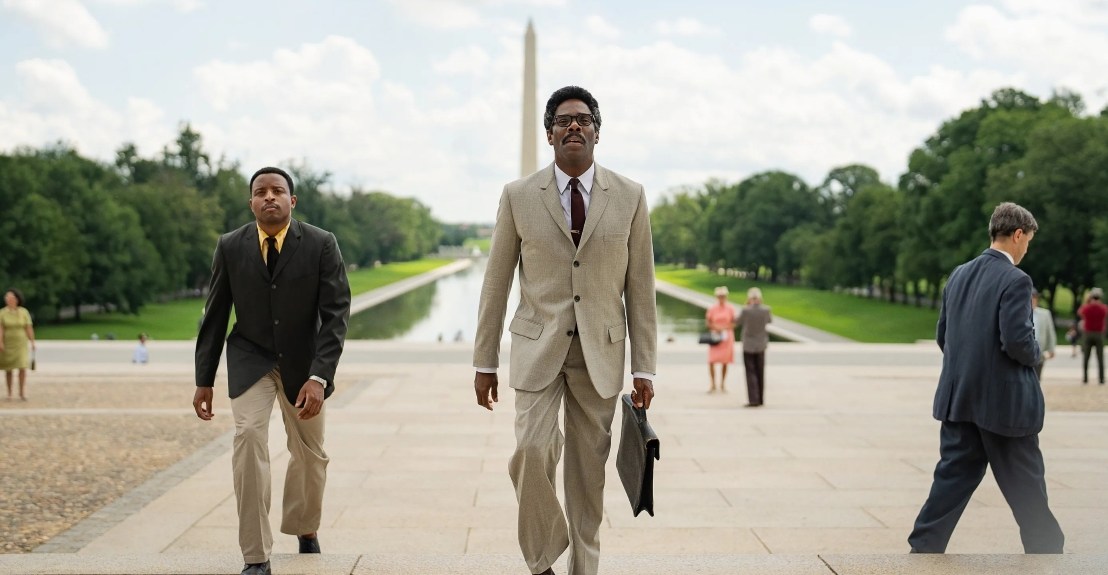
Bayard Rustin was on of crucial the civil rights activists in conceiving, planning and organising the 1963 March on Washington. A proponent of nonviolence and equal rights for all, regardless of race, gender or sexuality, he was a close friend and colleague of Martin Luther King and a key figure in innumerable campaigns. Rustin partly exists to bring his life more to public notice, focusing on the build-up to the March on Washington and exploring Rustin’s struggles as both a Black man and a gay man.

At its heart is Colman Domingo, who delivers a sensational performance as Rustin, bursting with energy and emotional compassion. Domingo brilliantly captures Rustin’s loud-and-proud nature, his overwhelming commitment to being who he is, and his passionate commitment to social justice. This is a force-of-nature turn dominating the movie, breathing passion and fire into Rustin’s compulsive desire to speak out.

Domingo matches this with a neat sense of comic timing (Rustin is frequently very funny) and a raw emotion. The emotional impact nearly all comes from Domingo. He’s genuinely moving when he misjudges the level of loyalty to him in the film’s opening act and has an offer of resignation accepted by the NAACP (after press reports suggesting he has seduced King). Even more so later in his emotional outpouring when the same NAACP members finally back him up. More focus on Rustin gaining full, unquestioning, acceptance from his colleagues could have offered a beating heart to the film.

Domingo’s performance elevates an otherwise, to be honest, fairly middle-of-the-road biopic that frequently wears its research heavily. It has an air of competent professionalism, with George C Wolfe’s direction lacking emotional or visual spark. Much of the dialogue – given a brush by Dustin Lance Black – frequently (and rather painfully) has the actors fill in historical context or clumsily shoehorns in real dialogue. There is very little spark to Rustin, as it dutifully ticks off events, building towards sign-posted emotional payoffs (and, admittedly, there are fewer payoffs more inspiring than a quarter of a million people gathering in Washington to cry for freedom).

This is not to say there aren’t fine moments and its recreation of the Washington March (some tight angles, well-chosen archive footage and subtle effects) works very well. There are some fine actors giving their all. Glynn Turman is a stand-out as the inspiring Randolph, savvy enough to play the game in a way Rustin isn’t. Aml Ameen’s capturing of King’s voice and mannerisms is perfect. Pounder, Rock, McDonald and others compellingly bring to life leading activists while Jeffrey Wright sportingly plays the closest thing to a heel as jealous congressman Clayton Powell.

However skilful reconstructions only take us so far. Often personal stakes are presented vaguely. The film avoids depicting Rustin encountering much personal homophobia – no member of the movement expresses negative views, with white pacifist campaigner AJ Muste (Bill Irwin) the only person to express openly homophobic opinions. The threat of someone discovering his past arrest (for a 1953 encounter with two men in Pasadena) is played as a core fear for Rustin, but the film is vague about the likely impact this revelation would have (since it seems to already be widely know). It’s astonishing that Rustin was so open when being so was a crime, but the film (aside from a brief moment when he considers a casual pick-up) risks underplaying the era’s prejudice and dangers.

To cover issues on homophobia and self-loathing guilt, the film invents a closeted reverend, well played with a tortured sense of shame and self-loathing by Johnny Ramey, who initiates a secretive relationship with Rustin. This fictional character absorbs all the fear and self-denial that many gay people felt at the time, allowing Rustin to show us what life was like for the many, many people who, for whatever reason, were not as outspoken as Rustin. But it does feel like somewhat of a compromise, and a character who feels a little too convenient, drifting to and from the story whenever it’s themes need a bit more of a personal touch.

It’s hard not to think the film could have gained more interest from exploring Rustin’s relationship with Tom Kahn (Gus Halper) – or even being clearer on the very nature of this relationship. An initial familiar intimacy indicates an established romantic relationship, but later scenes suggest instead a more casual flatmates-with-benefits set-up. Then we suddenly hit the inevitable moment when Kahn walks in on Rustin and Elias kissing and reacts like a betrayed partner. It finally decides Kahn is in love with Rustin, but Rustin hasn’t time for a relationship with so much work to be done. Despite this thought, the film wants to also say Rustin and Elias are profoundly in love, tragically only kept apart by social pressures. It’s trying to have its cake and eat it too. The cost to your personal life of being fully committed to a cause, or the awful pressures of loving someone in the face of prejudice, are both powerful stories. Settling on one and exploring it fully would have been more emotionally rewarding.

Rustin is a solid, well-handled, decent biopic. Bringing the life of a lesser-known civil rights activist to a bigger audience is a worthy aim, and Black and queer audiences (historically underserved) deserve to see films that centre their stories.  It’s also refreshing to see a film zero in on the importance of logistics for major events (what other film has a scene where the fillings of thousands of sandwiches to be kept in the warm sunshine becomes a heated debate?) and its focus on the work recruiting attendees, buses and resources for the March is great.

But the real success in this sometimes workmanlike film is Domingo, who lifts the entire thing with an emotionally committed performance that is perhaps better than it deserves.
Avatar (2009)

Avatar (2009)

Cameron’s monster-hit is an exciting slide of traditional story-telling, that had less cultural impact than you might expect

Director: James Cameron

Cast: Sam Worthington (Jake Sully), Zoë Saldana (Neytiri), Stephen Lang (Colonel Miles Quaritch), Sigourney Weaver (Dr Grace Augustine), Michelle Rodriguez (Trudy Chacón), Giovanni Ribisi (Parker Selfridge), Joel David Moore (Dr Norm Spellman), CCH Pounder (Mo’at), Wes Studi (Eytukan), Laz Alonzo (Tsu-tey), Dileep Rao (Dr Max Patel)

Why is Avatar so easy to mock? It’s the second biggest box office hit ever (Cameron holds slots two and three with this and Titanic:only Avengers: Endgame grossed more). But its cultural impact feels wide but not deep. As FOUR more Avatar films start to arrive from 2022, the question remains: why has no-one really talked about Avatar since 2009?

Perhaps it’s because there isn’t really much new or unique in Avatar, beyond the magic of its visuals and the magnificent showmanship of Cameron. For all the striking blue design of the aliens, their story was too reminiscent of too many other things. The script lacked punch, distinctive lines and unique characters. There was little to quote and few truly original pivotal moments that could be embraced by our cultural memory. Narratively and structurally, it’s all a little too safe, predictable and conventional.

 Avatar partly became a “must see” cinematic event, because it was the film that finally nailed 3D. Maybe it is the best 3D film ever made. I don’t know, I’ve only ever seen it in 2D. To be very fair, Cameron doesn’t fill the film with crappy shots of things pointing at the camera. Instead, concentrating on telling a cracking (if predictable) story and filling the screen with beautiful, imaginative imagery that works in any dimension.

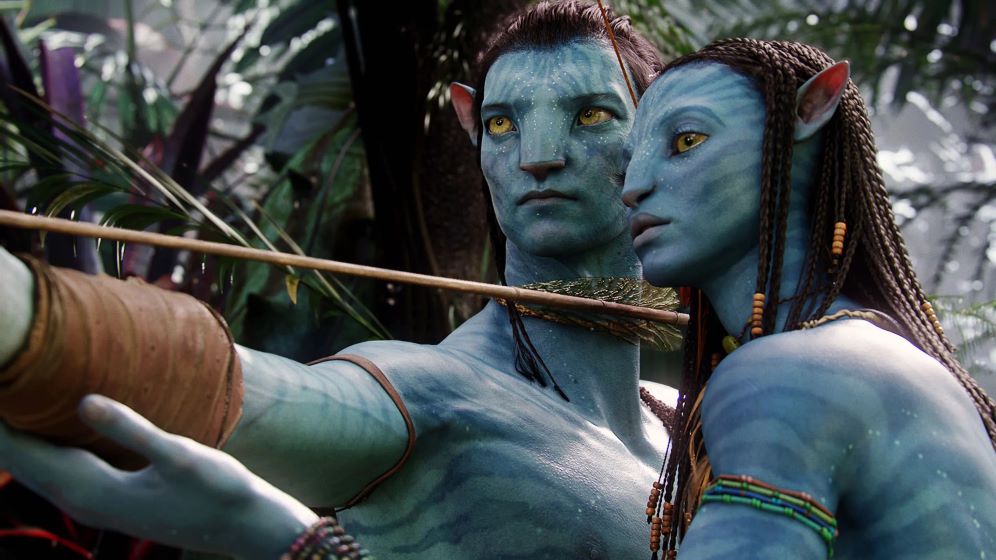
Avatar’s imagery is so striking because it’s set on the magical alien world of Pandora. In 2154, with Earth’s resources depleted, mankind has struck out into the stars – and Pandora is a rich seam of an insanely valuable mineral called unobtanium (chuckles presumably intended). Pandora is a carefully balanced biosphere, peopled by exotic animals and 10-foot, blue-skinned natives called the Na’vi. Pandora’s atmosphere is poisonous to humans, so scientists – led by Dr Grace Augustine (Sigourney Weaver) – use Na’vi “avatars”, operated by genetically matched humans, to explore. The mission is carefully balanced between science and financial exploitation by a sinister corporation, backed by mercenary army, led by the fanatical Colonel Quaritch (Stephen Lang).

Into this magical set-up drops paraplegic ex-marine Jake Sully (Sam Worthington), taking the place of his dead scientist brother because he is a genetic match for a freshly grown Na’vi avatar. With this warrior background, Jake is welcomed by the Na’vi, becoming an ambassador to the people. But Jake’s loyalties split as he finds a purpose in Na’vi life he has long since lost on Earth – and as he falls in love with Na’vi warrior Neytiri (Zoë Saldana). When the company decide to destroy the Na’vi’s home to gain access to the rich unobtanium deposits beneath, which side will Jake back?

It’s not hard to guess. At heart, Avatar fits very neatly into a series of Dances with Wolves-esque films, in which a wounded and lost (white) soldier finds a spiritual peace and solace with a native people, eventually rising up to fight for their rights against his own people. Avatar also finds roots in The Mission, with the scientists as the missionaries fighting alongside the natives (although with much better results), the conclusion of Return of the Jedi and Cruise’s The Last Samurai. Not to mention more than a few stylistic and plot echoes from Cameron’s own Aliens (you can even hear them at several points in Horner’s score), from technology (those stomping war suits) and cocky marines lost in a world they don’t understand (except this time, we love to see them killed off).

Avatar doesn’t challenge you, presenting its humble message of environmentalism and peaceful co-existence within a familiar framework where military forces and corporations are very bad and enlightened missionaries and Indigenous people are good. It entertains because it’s told with such skill. Cameron, while never the greatest screenwriter in the world, knows how to marshal his clichés and standard narrative tricks into something exciting and involving.

It also helps that the stock characters he creates a played with such forceful engagement by the actors. Stephen Lang is a growlingly hateable racist, delighting in the prospect of genocide, while Giovanni Ribisi’s corporate boss is a snivelling opportunist who couldn’t care less about the impacts of his actions. Opposite them, Sigourney Weaver gives huge weight to a fairly standard irritated-boss-turned-mentor role as the head scientist, Sully’s bridge to learning the Na’vi way. As Sully, Sam Worthington is not the most charismatic performer but he has an earnest intensity and emotional honesty that helps us invest in his pre-Pandora misery and his growing love of his adopted home.

Cameron’s greatest achievement though is the vision he creates for the Na’vi. All are played by actors using cutting-edge (and still impressive now) motion capture. Cameron builds a whole world for these people: a language, belief system, culture and bond with the environment. Sure, it’s heavily inspired by Indigenous American culture, but it feels real. Its bought to the screen with grace and tenderness and gains a huge amount from Zoë Saldana’s committed and emotionally open performance as Neytiri. Cameron so successfully builds a bond between audience and the Na’vi that you feel your heart wrench to see mankind tear their beautiful world apart.

It’s that emotional connection Cameron successfully builds that helps make the film work. After all we’ve all seen effects stuffed films before, but they don’t all become monster hits. And if the film was a dog, all the 3D magic in the world wouldn’t have helped. Few directors have as much skill with threading emotional bonds within the epic as Cameron. He shoots Avatar with a stunning majesty, carefully placed shots and graceful, almost traditional, editing help to build a sense of magic and wonder around the awe-inspiring alien vista. Avatar has a lot of action, but it never feels like just an action film: it’s a relationship drama, inspired by the beauty of its setting, with action in it.

More people have mocked Avatar with comparisons to the visually and thematically similar Fern Gully: The Last Rainforest than have actually seen Fern Gully. Narratively it does little new or unique and offers very little surprises. But its visuals are stunning and Cameron’s superb direction knows how to engage you. Clichés last because they carry a sort of truth: Avatar uses these truths to help you invest in a gripping, if conventional, story. But it’s also why its impact over time has been so slight – there aren’t any new ideas for viewers to tie themselves to and almost nothing that stands out as a unique cultural reference point – even if the conventional plot helped make it a short-term monster hit. But it’s also why it still makes for enjoyable rewatching.