
Tag: Cecil Parker

Guns at Batasi (1964)

Guns at Batasi (1964)

An excellent lead performance powers a solid film that slightly pulls it’s punches

Director: John Guillermin

Cast: Richard Attenborough (RSM Lauderdale), Jack Hawkins (Colonel Deal), Flora Robson (Miss Barker-Wise MP), John Leyton (Private Wilkes), Mia Farrow (Karen Eriksson), Cecil Parker (Fletcher), Errol John (Lt Boniface), Graham Stark (Sgt ‘Dodger’ Brown), Earl Cameron (Captain Abraham), Percy Herbert (Colour Sgt Ben Parkin), David Lodge (Sgt ‘Muscles’ Dunn), John Meillon (Sgt ‘Aussie’ Drake), Bernard Horsfall (Sgt ‘Schoolie’ Prideaux)
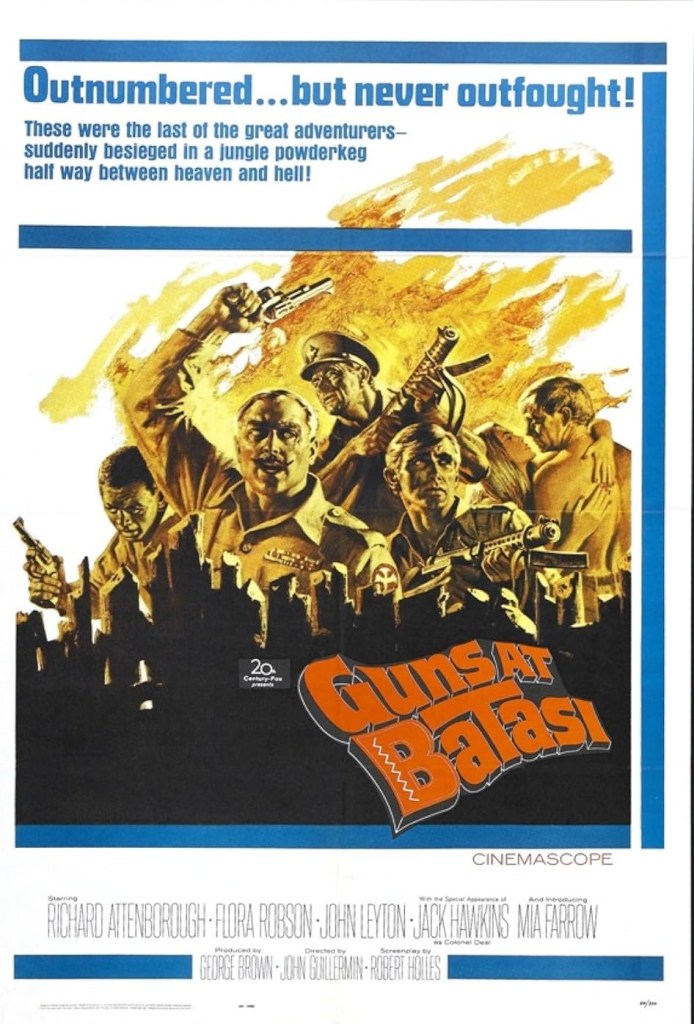
In the dying days of Empire, in an unnamed African nation, the British have agreed to a peaceful handover of power. Something that’s thrown out of kilter when an attempted coup takes place. That appals Regimental Sergeant Major Lauderdale (Richard Attenborough). His whole life has been keeping the peace in the colonies, making sure the mess is kept spick-and-span, drilling recruits, saluting portraits of the Queen and regretting he missed his chance to do his bit at Tobruk or El Alamein. A coup to him is nothing more than a mutiny, and harbouring the new overthrown government commander in the NCO’s mess from the troops looking to lynch him is both a matter of honour and (perhaps) a chance to fight his own little war preserving decency, honour and the British way.

Guns at Batasi is a fascinating slice of post-colonial film-making that succeeds as well as it does because it treats its lead character both as a sort of Blimpish moron and a tragic hangover whose Victorian principles are hideously out-of-step with the world around him. All of that is captured in Richard Attenborough’s rich, BAFTA winning, performance as he makes Lauderdale both faintly ridiculous (obsessed with neat collars, perfectly executed salutes and drill bullshit sitting) with an utter lack of interest in the world outside the parade ground and strangely likeable. He’s got a principled sense of right-and-wrong, a strangely affectionate regard for the soldiers he presses to the uttermost and an utter lack of cynicism or cruelty in his convictions.

It’s near career-best work by Attenborough, one well out of his wheel-house (at the time) of softly spoken eccentrics. In fact, he’s almost unrecognisable, transformed into a sort of walking bullet, rigid as his swagger stick and barking out his every utterance with a parade-ground bellow that emerges from a deep vocal bass. He’s a character soaking in absolute certainty, and Guns at Batasi gives him the dignity of letting him be both right and wrong without crowbarring in any moral judgement. Put bluntly, it trusts us to be intelligent enough to appreciate his determination to protect the lives of those under his care, just as we can feel uncomfortable at his parental attitude towards Africans.

Guillermin’s film places this bolted down man, absolutely certain of his understanding of the world, in two turmoils, one on-top of the other. Firstly, he’s the sort of bloke who wouldn’t have been out of place in the height of the Raj, barely able to believe that the British army (embodied by the decent, gentlemanly but subtly ineffective Colonel Deal expertly played by Jack Hawkins) doesn’t sweep everything before it anymore but has to negotiate with the locals. Secondly, he’s flung into the middle of a siege of the NCO’s mess, shepherding a mix of other sergeants, a young private (John Leyton) whose mocking 60’s swagger feels like he’s from a different planet and a painfully liberal visiting MP (Flora Robson) who feels Lauderdale is the problem not the solution.

Guns at Batasi builds its base-under-siege storyline very effectively, with Guillermin skilfully shooting a small set, interspersed with some well-staged action set pieces, not least Captain Abrahams (Earl Cameron) escape from his would-be lynch-mob. There is a neat sense throughout of a world pushing in on Lauderdale and his sergeants, from artillery pieces gathering on the lawn outside to an ever more searching series of questions for Lauderdale from the others about what exactly he thinks he’s preserving here. What’s well-handled about the film is you could see this as both Lauderdale making a stubborn stand that’s more about his pride than anything else, and a genuinely selfless noble attempt to save a persecuted man.

The film does slightly weight the deck in favour of Lauderdale. We warm to his witty sergeants-cunning to prevent the noble Abraham handing himself over to save lives (drafting a hugely wordy written order to do so, which he knows Abrahams will never stay conscious long-enough to sign). It’s hard not to sympathise with him, when the voice of liberalism is placed in the piously self-important lips of Flora Robson’s MP who insists, until she’s finally shown she’s terribly wrong, that coup lickspittle Lt Boniface (Errol John) isn’t the ruthless two-faced man-of-no-honour he so plainly is. It’s hard not to sympathise when Lauderdale tears Boniface off a titanic strip (a tour-de-force moment from Attenborough) or hard not to admire the professional pride in his duty to keep others safe.

If you could criticise the film, it gives less scope to putting into an explicitly critical viewpoint or giving much scope to Lauderdale’s probably less charming or attractive features. You could well imagine that, returning to Blighty, his attitudes could curdle into an unattractive ‘Britain First’ attitude. Sure, we are encouraged to see his obsession with perfectly ironed uniforms and the exact perfection of a salute as something quite silly. But he’s also a man who doesn’t question for a minute Britain’s inherent superiority or its right to dominate large chunks of the globe. But Guns at Batasi lacks a real character who challenges Lauderdale – even Leyton’s cheeky private ends up being adopted in an affectionate strict-fatherly way by the RSM, rather than someone who could really signpost Lauderdale’s relic nature or the potentially darker implications of his character. Just as the film treats the other sergeants lack of knowledge or interest in this country (right down to continually mis-pronouncing the local town as Battersea) as comedic rather than an insight into underlying complacent understanding as the world being a place run by and for the British.

But the film stands out as one of the best acting showcases Attenborough ever had, a swaggering role of bombast that he absolutely rips through while humanising it. There are great supporting turns from Horsfall, Herbert, Lodge and Mellion as wildly different types of sergeant and the film manages to be both quietly satirical, nostalgic and pack in some derring-do along the way. If it doesn’t quite manage to really seize on its potential, it’s still an interesting film.
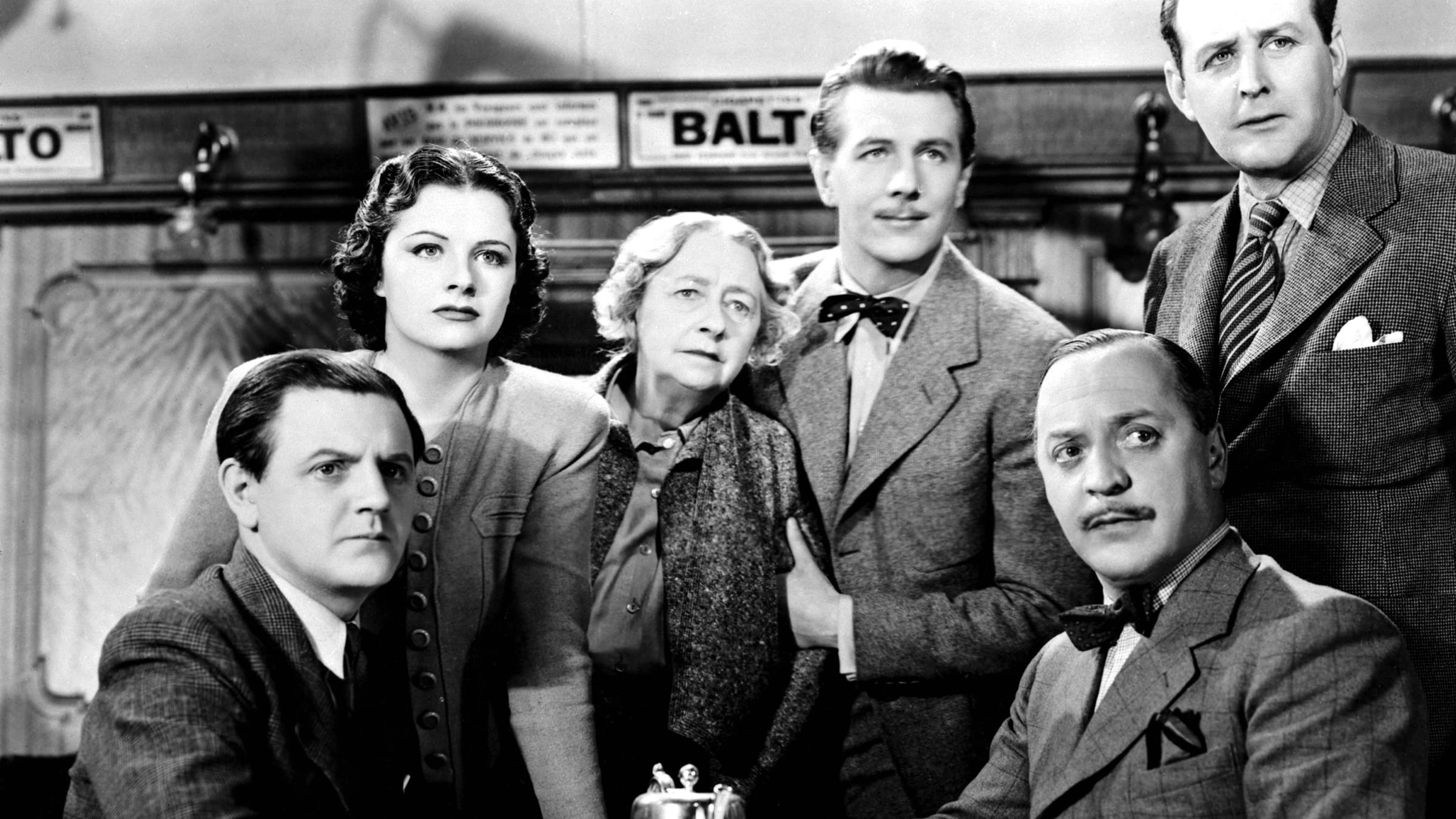
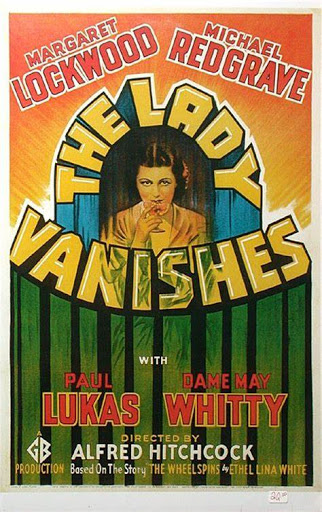
The Lady Vanishes (1938)

lady vanishes
May Whitty is searched for by Margaret Lockwood and Michael Redgrave in The Lady Vanishes

Director: Alfred Hitchcock

Cast: Margaret Lockwood (Iris Henderson), Michael Redgrave (Gilbert Redman), Paul Lukas (Dr Hartz), May Whitty (Miss Froy), Cecil Parker (Mr Todhunter), Linden Travers (“Mrs” Tothunter), Naunton Wayne (Caldicott), Basil Radford (Charters), Mary Clare (Baroness), Catherine Lacey (Nun), Googie Withers (Blanche), Sally Stewart (Julie)

In his conversations with Hitchcock, Francois Truffaut declared every time he tried to study The Lady Vanishes, all its tricks and mechanics, he always ended up too wrapped up in the plot to notice them. It’s about as fitting a tribute as a film can get, that it got one of the world’s ultimate film buffs just sit down and enjoy the ride. The Lady Vanishes is Hitchcock’s penultimate British film and it might well be one of the most enjoyable and entertaining films he ever made.

It’s late 1930s in Europe and a group of mostly British travellers have got stuck waiting for a train in the fictional country of Bandrika (but it’s clearly Germany). Iris Henderson (Margaret Lockwood) is on her way back home to (perhaps somewhat reluctantly) get married, exasperated by the loud noise made in the room above through the night by folk music expert Gilbert (Michael Redgrave). Charters (Basil Radford) and Caldicott (Naunton Wayne) are cricket obsessives, desperate to get home for the big test match. Mr Todhunter (Cecil Parker) is a lawyer, keen not to draw attention to the fact Mrs Todhunter (Linden Travers) isn’t actually his wife. When the train finally leaves the station the next day, Iris is hit on the head by a plant plot (was it pushed?) that very nearly hits governess Miss Froy (May Whitty). Miss Froy takes care of Iris on the train – but when Iris wakes after a rest, she finds Miss Froy has disappeared and – furthermore – everyone denies she ever existed in the first place. While a Bandrikan psychiatrist Dr Hartz (Paul Lukas) claims she may be suffering from concussion, only Gilbert believes her story. Will they be able to prove Miss Froy is real and rescue her from whatever peril she has found herself in?

Hitchcock’s The Lady Vanishes shouldn’t really work – not least since it takes nearly 20 minutes before we get any indication that we are watching anything other than a romantic comedy. But perhaps that’s also why it works, because those first 20 minutes are beautifully scripted, with some cracking dialogue and some skilfully drawn character work that invests us in these people long before any danger arises. It also serves as a brilliant counterpoint to the nearly non-stop tension and action that comes in the final hour of the film – who could have believed that all that light hearted banter in a guest house could end in a ruthless shoot out in the woods?

It all seems to change pace on a classic Hitchcock touch – a folk singer is suddenly, violently, strangled by an unseen assailant (why? I’ve no idea. The film doesn’t think you’ll care about the logic gap, and you don’t). But a large part of the film’s success stems from Hitchcock’s collaboration with Sidney Gilliat and Frank Launder on script-writing duties. Gilliat and Launder made a number of changes to the original novel, adding a greater espionage element. Even more importantly, they overhauled several of the characters, not least changing the Gilbert character from an engineer into a charming (if eccentric) folk music expert with a deadpan wit. Even more successfully, they introduced the hilarious ultra-British Charters and Caldicott, classic eccentric grown-up public schoolboys with a fascination with cricket (the combo was so popular Naunton and Wayne played versions of these characters another eleven times).

The script’s wit, playfulness and scintillating dialogue is what drives most of the film’s energy – and certainly what helps to make it as entertaining as it is. In particular, the dialogue exchanges between Lockwood and Redgrave hum with the sort of love-them-hate-them banter that wouldn’t seem out of place in a screwball comedy (“You’re the most contemptible person I’ve met in all my life!” “Confidentially I think you’re a bit of a stinker as well”), and the two actors shine in roles that start with classic feuding but subtly and beautifully come together as a romantic couple by the film’s end. Lockwood has pluck, guts and determination, a mix of socialite and head girl determination. Redgrave is superb as Gilbert, showing the sort of matinee idol wit and charm – not to mention an unconventional romantic sex appeal – that he very rarely got to exhibit again (sadly he didn’t get on with Hitchcock, and never worked with him again).

The film is full of wit and invention, but mixes it with a properly engrossing mystery. Every character has very clear reasons for denying the existence of Miss Froy (May Whitty is superb as a seemingly dotty old woman, hiding cunning and an unexpected capacity for action). We know that of course Iris is right – but even so, it’s hard not to begin to suspect that maybe the oily Dr Hartz (Paul Lukas whose professional smoothness neatly tips into cruelty) is right and she is suffering from concussion. The unravelling of this mystery is half Agatha Christie (vital clues pop up here and there), half famous five adventure – but the nearly “real time” playing out of the mystery injects huge amounts of tension and excitement, particularly as the villains start to be revealed.

The film also serves, interestingly, as a plea for British invention in European affairs in the era of appeasement. The train is stuffed nearly exclusively by Brits, most of whom are quite content at first to let things drift and not rock the boat. However, when the chips are finally down and its time to make a stand, the majority of the characters knuckle down and get their hands dirty to fight for justice. Even Charters and Caldicott take up arms (with a typical British reserve) to protect their fellow passengers, while Gilbert has already shown himself capable of being a man of action (as well as a pretty neat impressionist and physical comedian) when called upon. It’s telling that Cecil Parker’s Mr Todhunter is the nearest thing we see to an appeaser on the train (with a fear-and-hope-tinged expectation that everyone is playing by his own antiquated rules), and he’s the only one who angrily questions taking a stand.

It’s not surprising from Hitchcock, who made an even more passionate plea for intervention a few years later with Foreign Correspondent. Neither is it a surprise how superbly the film is made. Hitchcock is at the top of his game here, shooting the train brilliantly (the set was tiny, not that you could tell from the number of angles Hitch finds here). His mastery of the pace and tone of the film is spot on: the second half never lets up, and you never for one minute lose the film’s wit, even while the stakes become more bigger and bigger. The film has possibly the most winning romantic pairing in all of Hitch’s movies, helped hugely by the natural and winning playing of Redgrave and Lockwood. It so successfully builds up the possibility of Iris being mistaken, that it makes the audience start to question what they’ve seen.

It’s a superbly directed film, but above all it’s supremely entertaining in a way few other films can hope to be. Its re-watch value – from hearing the jokes again, to spotting the early clues – means it will be rewarding audiences for decades to come.

23 Paces to Baker Street (1956)


Van Johnson hears something’s up

Director: Henry Hathaway

Cast: Van Johnson (Philip Hannon), Vera Miles (Jean Lennox), Cecil Parker (Bob Matthews), Maurice Denham (Inspector Grovening), Isobel Elsom (Lady Syrett), Estelle Winwood (Barmaid), Liam Redmond (Mr. Murch), Martin Benson (Pillings), Patricia Laffan (Alice MacDonald) 

It’s an age-old truth that the movies always believe we can admire a hero more, if we see them struggling to overcome some form of disadvantage or disability that would normally rule them out of carrying out the actions they are trying to do. So what fits into that mould better than a blind man going up against a gang of criminals?

Philip Hannon (Van Johnson) is a successful American playwright living in London, who has lost his sight. One day in a pub, he overhears a conversation between a man and a woman that he suspects is related to the planning of a crime. But, unable to persuade the police of his suspicions, he has only his former secretary Jean (Vera Miles) and butler Bob (Cecil Parker) to help him investigate.

This is the sort of reliable B movie material, with some decent parts and interesting twists, that usually gets remade as a big-star, big-budget modern Hollywood drama. You know the sort of thing: Russell Crowe is a blind writer investigating a crime. In fact, it’s almost a surprise that this has never been remade, as it is an entertaining, diverting small-scale movie – the sort of thing that you can imagine settling down in front on a wet Sunday afternoon.

It’s a sort of sub-Hitchcock drama –fairly similar in tone to Rear Window – and there are several beats in there that totally fit with the master’s dramatic style. In fact, that’s what makes it such a quintessential B movie: everything about it feels like a slightly cheaper alternative to a major picture. Which isn’t a criticism as such: it’s just a very workmanlike, efficient little thriller, which fits neatly into Hathaway’s CV of safe, unspectacular film making. It’s still well made and does exactly what you would expect, but it’s not going to knock anyone’s socks off.

Van Johnson may similarly be a low rent Jimmy Stewart, but he’s pretty effective in this role, suitably vulnerable in places, while still suggesting enough of the prickly demeanour of the man who doesn’t want to be a victim. He also resists the temptation to overplay the blindness – something the whole film actually does quite well. As the man holding the entire film together he does a good job, and he even manages to be more or less believable as a successful playwright. Watching it, you think it’s a bit of shame he’s not better known today – he’s a good (if unspectacular) actor. Vera Miles offers some good support as a supportive love interest while Cecil Parker is quite droll as the butler.

The mystery itself has a few nice twists in it – the final twist is nicely set-up, enough for you to see it coming as we reach the dénouement (a well-staged confrontation in a darkened flat, which gets a lot of tension from watching our blind lead trying to identify all the lights in the house so he can remove their bulbs). The story sometimes doesn’t give us too much of a chance to work out the twists and turns before key clues are revealed by Hannon, but that’s no major problem. It’s also quite well filmed, with some nice shots of 50s London skylines.

It’s a decent and interestingly done film that gets some fresh content out of the blindness of its hero, never portraying him as a victim but as a proactive and determined man. Claims that this is some sort of lost classic are overdone – it’s never more than a sub-Hitchcock B picture – but it’s still highly watchable, has some engaging characters and some decent thriller sequences, and you care about the lead characters, even if you don’t particularly care about the crime itself and its victims (the victims in particular are pretty vague characters). It also relies rather heavily on the legendary heightened senses that blind always seem to have in Hollywood films. But for something that basically sounds like the plot of an ITV two part drama, this is solid craftsmanship.

One final note: the title means nothing. At one point Hannon guides a man through the fog. Turns out he’s 23 paces from his destination: Baker Street. The Hollywood suits were keen to drop in the “Baker Street” reference, to suggest a link to Sherlock Holmes. So goes to show – Conan Doyle, always good box office!