Tag: Chadwick Boseman

Ma Rainey's Black Bottom (2020)

Chadwick Boseman excels in his final performance in the stagy Ma Rainey’s Black Bottom

Director: George C Wolfe

Cast: Viola Davis (Ma Rainey), Chadwick Boseman (Levee Green), Glynn Turman (Toledo), Colman Domingo (Cutler), Michael Potts (Slow Drag), Jonny Coyne (Mel Sturdyvant), Taylor Paige (Dussie Mae), Jeremy Shamod (Irvin), Dusan Brown (Sylvester)

In a Chicago recording studio in July 1927, while the sun beats down outside, blues singer Ma Rainey (Viola Davis) is due to record some of her greatest hits. But she’s almost an hour late. The people who made it on time are her backing jazz band. Cutler (Colman Domingo), Toledo (Glynn Turman) and Slow Drag (Michael Potts) are seasoned pros. But trumpet player Levee Green (Chadwick Boseman) is something else, an ambitious and electric young man who feels he knows what the new sound is in a way that Ma doesn’t. Over an afternoon, as Ma flexes her power upstairs, the white agent and recording studio owner fret, and tensions between the band members slowly simmer towards and explosion.

It’s impossible to watch Ma Rainey’s Black Bottom right now without being very aware of the tragic early death of Chadwick Boseman. Boseman passed away while the film was in post-production, and it’s hard not to guiltily wonder if Boseman was aware this was to be his final performance. Either way, this was a stunning way for this electric, James Dean-like talent to sign off – a scintillating, passionate performance as a man carrying huge burdens and deeply repressed griefs and guilt. August Wilson’s play provides several key set-piece speeches for Levee – and Boseman burns through them with an intensity that will leave its mark on you.

Bright-eyed, with a wiry body of elastic tension that shifts from loose, jazzy movements to rigid bursts of fury, Boseman is extraordinary. Starting the film as seemingly an irresponsible, easy-going young man frustrated at the concessions of his elders, Boseman establishes a deep psychological pain at his core. He’s a young man who has seen his parents vilely mistreated by oppressive white men, who smiles to get what he wants but never forgets that the white bosses he works with see him as little better than a slave, ripe for exploiting. It’s a brilliant performance, one for the ages.

It dominates a film that is told with dynamism but never escapes its theatrical roots. Its set-piece speeches are virtuoso moments for the actors, but the silent observance with which they are watched by other actors feels more suited to theatre rather than the realism of film. The build towards the film’s tragic end, hinging on a moment of violence, is the sort of character breakdown that we accept in the theatre, but seems forced on film – especially when met with the sort of visual tableaux that seems to invite the curtain to come down. Wolfe directs what is very much a conversation piece in two locations with a great deal of energy and imagination – but it remains very much a theatrical venture at heart, where long speeches and elements of Greek tragedy (hubris, nemesis and character flaws) shape the plot.

But it doesn’t altogether matter when the ideas the film tackles are so vibrant and presented with such passion. It’s a film that sharply outlines the racial divide in America. Wilson’s play is all about how master/servant exploitation continues in America. Its early shots establish the only work black people in Chicago can find (all of it manual or secretarial), while the musicians are paid cash-in-hand, even Ma, because no bank will believe a black man hasn’t stolen a cheque.
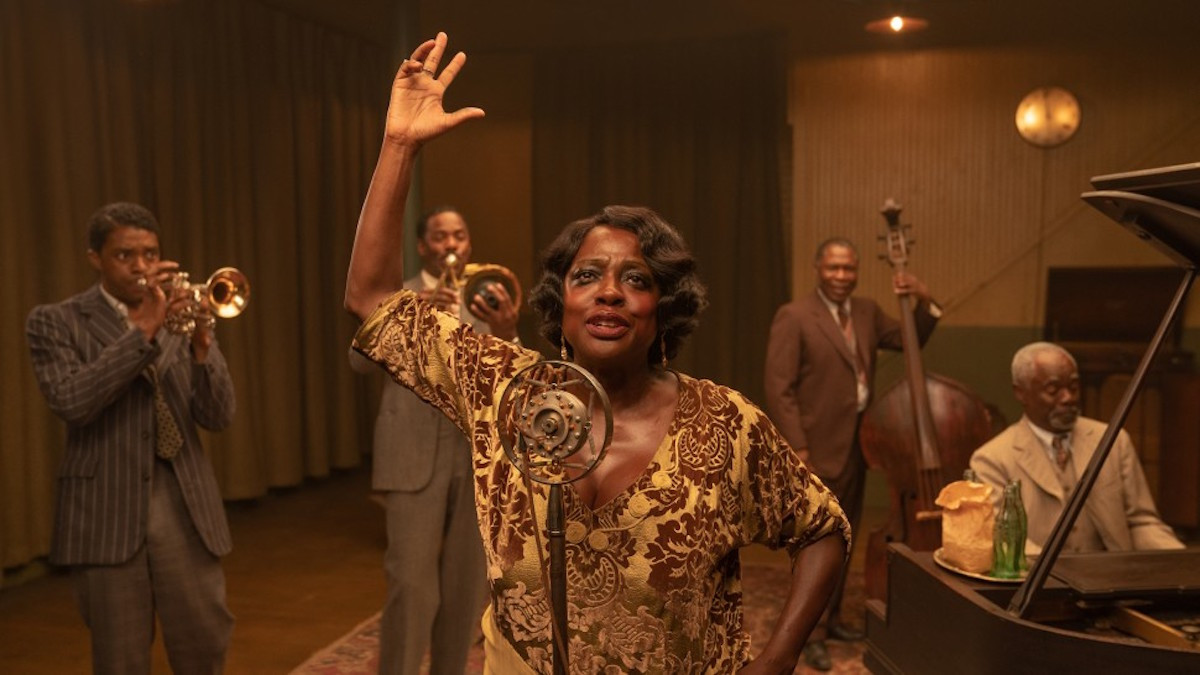
“All they want is my voice” says Ma, and she’s right. A difficult prima-donna, unafraid of expressing her desires both musical and sexual, Davis is larger-than-life but impressive as the domineering Ma. But Ma behaves badly because it’s the only way she has of exerting some control in this environment. She won’t see the profits from this recording work (it will be the white men running the studio). So, just for a few hours, she wants to remind them that they rely on her. So, she’ll be late. She’ll demand a cold coke. And she’ll insist her stammering nephew speaks the opening monologue of the song, even if that does mean burning through several recording albums to get it right. Because Ma may be an artist, but she’s also a tool to these people – something they will use while she can earn them money, and will then cast aside the second she is done.

It’s the same with the band. And the older hands have accepted it. Sure, they have their resentments and their sadnesses – old pro Toledo even remembers when he had the fire like Levee has – but they understand the game. They are props in the white man’s game, and they are content to earn a decent living from something they like doing, knowing that they are still living a better life than many. Cutler even has his faith to bolster him, a faith Leveee rejects in Boseman’s most electric scene, with a speech that angrily denounces God for his unfairness towards black people.

Levee is another thing again to the rest of them. He has plans and ambitions and wants to form his own band. He’s written his own songs, which have far more of the zip that we know jazz is heading towards. He’ll play nice to get what he wants, but he’s not willing for a second to forget how racist the world is. And he won’t let go of his anger for a moment. Compromise for him only serves a purpose. His youthful defiance and lack of deference spark resentment in the others – who either can’t or won’t understand him – and even Ma, perhaps seeing him as a threat, can’t stand him.

It of course leads to tragedy – and a coda that grimly reminds us all that in this world there may be winners but the thing that unites them all is that they are white. Jazz music may be on the cusp of change – and Ma will pay that price in a few years – but America isn’t. You only need to look at how the musicians are treated to know that equality is a million miles away.

The cast are faultless. Turman carries a quiet sadness and resignation as the ageing Toledo. Colman Domingo is relaxed then taut as Cutler. Taylor Paige has a dangerously selfish energy as Ma’s younger lover Dussie. But it’s still more of a play than a film, even if it is told with pace and energy, acted with such flourish and passion. It leaves you with effective and engaging arguments, but it still feels like it work best in the theatre.

Black Panther (2018)

Chadwick Boseman is the legendary Black Panther in Marvel’s solid comic book outing

Director: Ryan Coogler

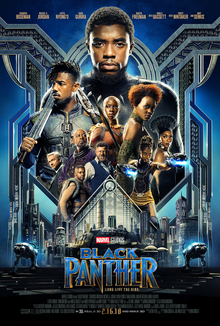
Cast: Chadwick Boseman (T’Challa/Black Panther), Michael B. Jordan (N’Jadaka/Erik Kilmonger Stevens), Lupita Nyong’o (Nakia), Danai Gurira (Okoye), Martin Freeman (Everett K Ross), Daniel Kaluuya (W’Kabi), Letitia Wright (Shuri), Winston Duke (M’Baku), Angela Bassett (Ramonda), Forest Whitaker (Zuri), Andy Serkis (Ulysses Klaue), John Kani (T’Chaka)

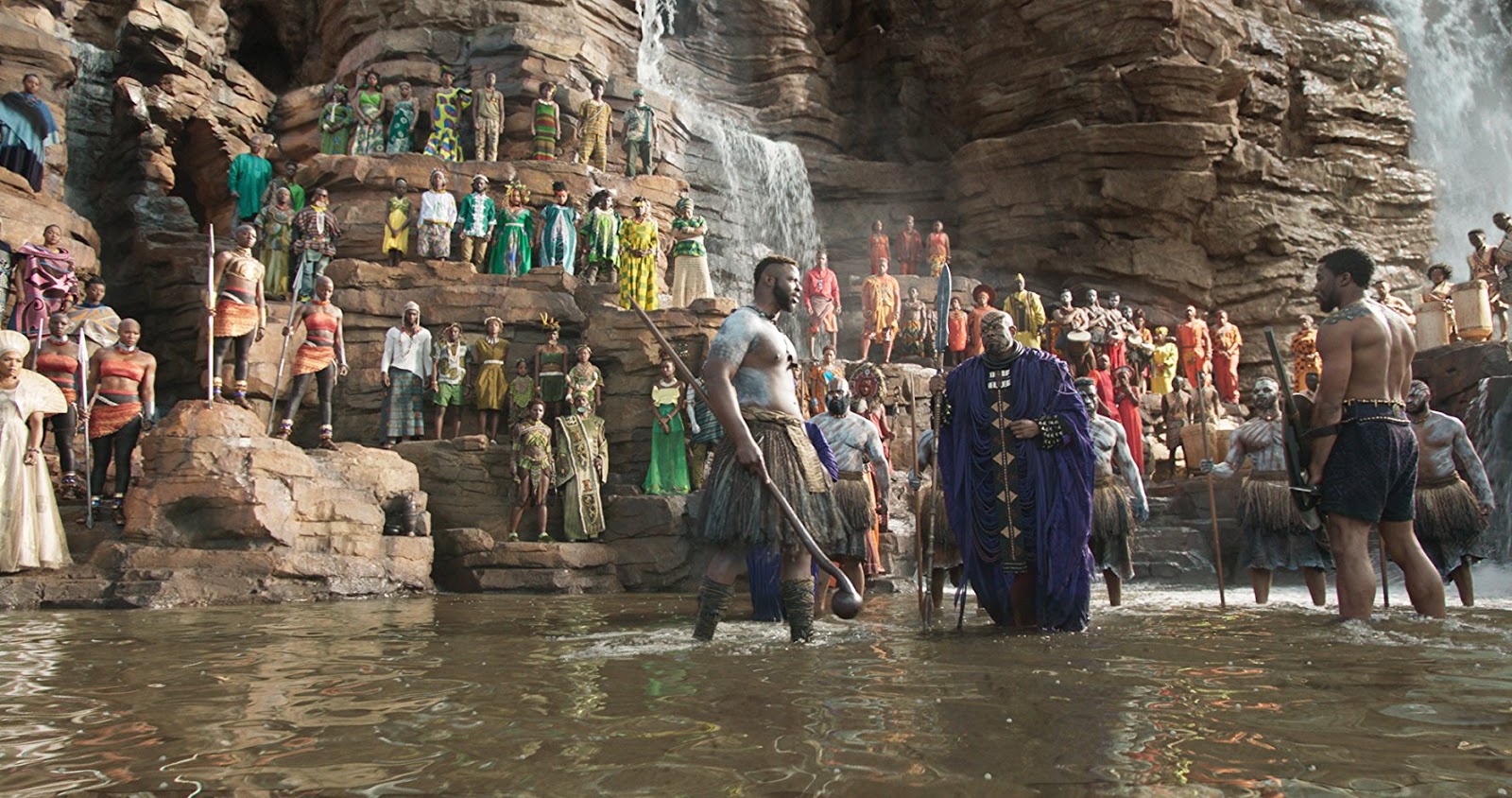
Marvel’s comic book world is now so stuffed with characters, worlds and dimensions that it is remarkable how many of its heroes are white and male. Black Panther does something completely different, giving us a set of African heroes and placing the common framework of a Marvel film within a very proud, and distinct, African heritage. So you can pretty much guarantee you ain’t seen a comic book film quite like this one.

After the death of his father (in Captain America: Civil War), T’Challa (Chadwick Boseman) becomes king of the secretive nation of Wakanda. Camouflaging itself as a poor and unadvanced nation in order to avoid interaction with the rest of the world, Wakanda has in fact for centuries been mining a remarkable metal, vibranium, that has helped the nation become hugely technologically advanced. Its king also bears the responsibility of being the “Black Panther”, ingesting a vibranium-infused herb to gain superhuman speed and strength. However, others have their eye on the throne, not least Erik “Kilmonger” Stevens (Michael B Jordan), who wants to turn Wakanda into a force that could protect the black people of the world from their historical oppressors and avenge centuries of slavery.

Black Panther never fails to be entertaining. The film is shot with a genuinely vibrant excitement, and I love the way it proudly embraces a comic book twist on African tribal heritage. In fact the film’s depiction of an African nation which is secretly the most powerful and advanced nation in the world is really quite an impressive political statement.

Ryan Coogler directs the film with flashy brilliance and comes up with a few ways of presenting what are (essentially) action sequences we’ve seen many times before in unique new ways. The stand-out is an early action scene in a Korean bar, filmed to appear as an immersive single take around a large set, the camera dipping and zooming from character to character. Coogler also brings a fair amount of visual wit to the fights while not losing the emotional and character depth the story is aiming for.

The film also has some fine performances, with Boseman dripping dignity, nobility and decency as T’Challa. Regular Coogler collaborator Michael B. Jordan gives a great contrast as bitter LA slums kid turned misguided would-be dictator Kilmonger. Danai Gurira stands out as proud general Okoye, torn between duty and personal loyalties. Hell even Forest Whitaker – clearly loving every moment of this OTT Marvel world – gets some weight and dignity out of his typical grandstanding style.

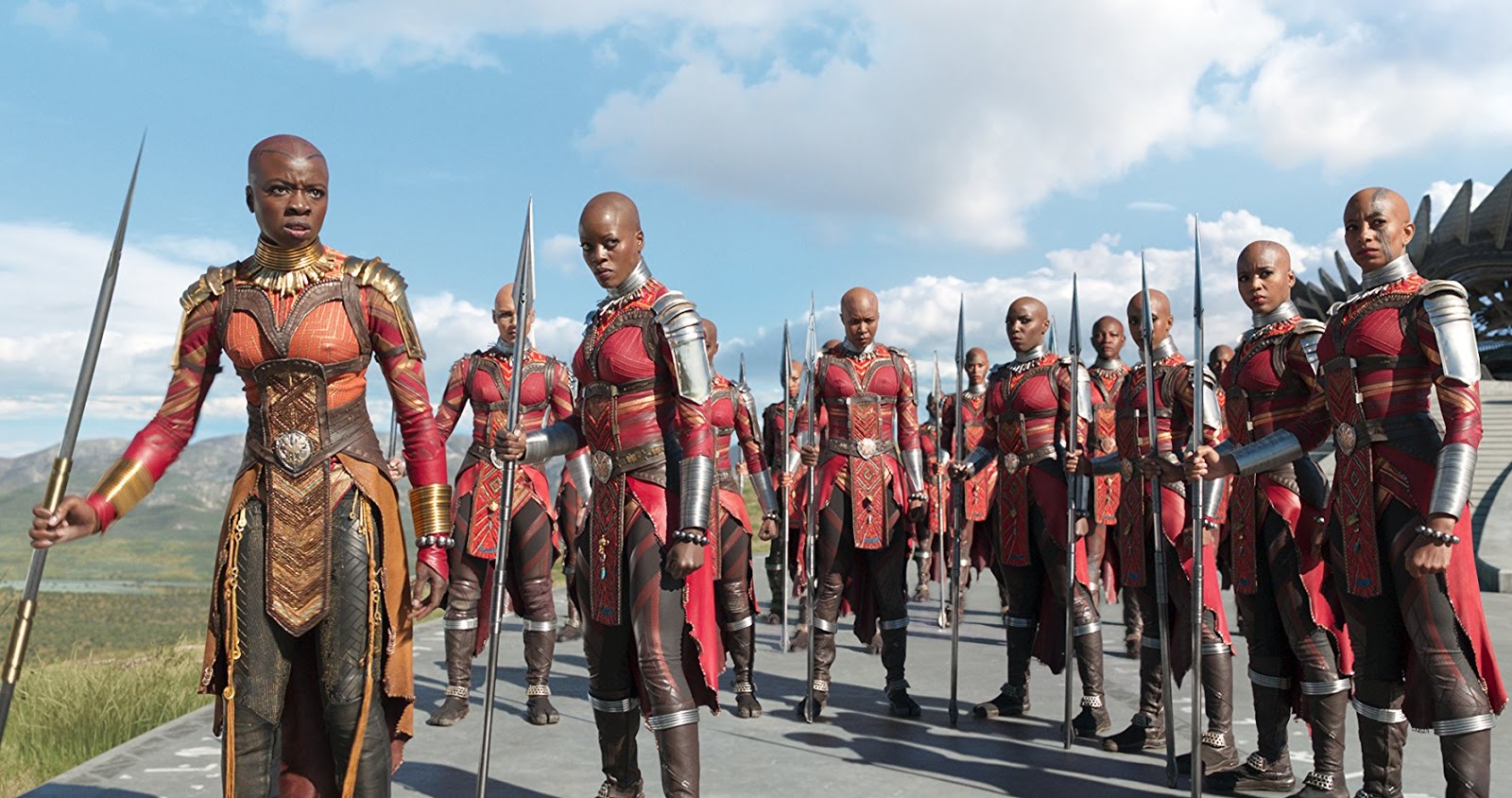
It’s another mark for the film that the world of Wakanda is so effectively gender neutral. Kings of Wakanda have a Praetorian Guard of female warriors, most of the leading voices on its council are women, and its technical genius is T’Challa’s sister Shuri (played by Letitia Wright in a charming, star-making performance). Sure it doesn’t feel like the role of Black Panther himself is up for grabs for anyone lacking a penis, but this is a world where women are equal, if not leading, partners in the action.

The film also addresses issues of post-colonial struggle, not least attitudes towards slavery and oppression handed out to Africa over centuries. Kilmonger’s fiendish plot is, in many ways, actually quite sympathetic – he wants to use Wakanda’s resources to protect those of African descent across the world. Jordan gets some good moments from his speeches laced with anger at the historical treatment of Afro-Caribbeans and, to be honest, it’s hard not to see his point. So hard in fact that the film has to drop hints that Kilmonger is a potential tyrant to stop him from seeing too reasonable. 

This is where the film’s plot starts to get slightly hazy. The character arc of T’Challa himself is pretty unclear. Traditionally in these films, the character must embrace his destiny. Problem is, a lot of this arc was covered in Captain America: Civil War. The writers are unable to give him a truly compelling replacement arc here. T’Challa drops a few references early on to not feeling ready – but basically swiftly embraces it. He never outlines a real alternative agenda to Kilmonger – there are characters in the film who argue “Wakanda doesn’t get involved in the world”, but he isn’t one of them, so there is no journey towards engagement with the outside world (on far more humanitarian terms than Kilmonger advocates). 

Frankly, Okoye is given a better character arc than T’Challa, beginning by advocating “we must serve the throne and respect our traditions even if we doubt them”, and learning later to follow her own conscience. T’Challa, in contrast, is no discernibly different at the end of the film to how he was at the beginning. 

T’Challa’s journey is basically getting something, losing it and then getting it back. Strip away Boseman’s performance and the character is basically pretty dull. He partly suffers, as does the rest of the film, from an overstuffed cast spreading the focus of the film far too thinly and leading to character arcs and interconnections feeling rushed. Kilmonger’s connection with T’Challa is forced – they only know each other for at best two days! – and there is a superfluity of villains. There’s not only decoy antagonist Klaue (and his gang) hanging about for a good chunk of the film, but also Daniel Kaluuya’s ill-defined best friend turned opponent, W’Kabi. Combining Kilmonger and W’Kabi would have helped no end, allowing two different, divergent agendas to develop and cause a relationship rift between two friends (Kaluuya is instead totally wasted in a nothing part, whose allegiances change depending on the demands of the plot). 

The good guys fare no better: Lupita Nyong’o is completely wasted as a love interest who feels stuffed into the movie because, y’know, these films gotta have one. She does nothing in the film that could not be easily done by another character, and nearly all of T’Challa’s emotional scenes – and personal motivation – are tied into his sister rather than this are-they-aren’t-they-a-couple. 

It’s all part of the traditionalism that underlies the film. Its structure is familiar and, like many Marvel origin films, the villain is a dark reflection of the hero with similar skills. The final battle is traditional and a little dull (and feels very similar to Avengers: Infinity War). The film avoids showing T’Challa torn between isolation and intervention – he in fact advocates both in the first 15 minutes – and doesn’t really make much of the prospect of a hero changing his mind or developing his views to embrace a wider world.

But it stands out because it is different. And it deserves no end of praise for making such a film so full of love and respect for its heritage. It walks a very difficult line between enjoying the bright exotic colours while not making the film patronising or overly “other-worldly”. How many other Hollywood films have, at best, two white characters (well played in both cases by Martin Freeman and Andy Serkis)? How many others would dare have the villain make a defiant, sizzling and emotionally inspirational speech about racial oppression and the hypocrisy of the West (though the film goes easy on America, with the speech taking place at the hilarious “Museum of Great Britain”. Where is this place – please get my tickets!).

That it slightly dodges and fudges the implication of these themes in its plotting and the conception of its hero – who is basically a dull character played by a charismatic actor – doesn’t reduce its pleasure at doing something different. I’m not sure it will stand up to repeated viewings – look past the setting and it does little new – but it’s a worthy entrance in a crowded universe.

Captain America: Civil War (2016)

Captain America and Iron Man stand-off in overblown Captain America: Civil War

Director: Anthony and Joe Russo

Cast: Chris Evans (Steve Rogers), Robert Downey Jnr (Tony Stark), Scarlett Johansson (Natasha Romanoff), Sebastian Stan (Bucky Barnes), Anthony Mackie (Sam Wilson), Don Cheadle (James Rhodes), Jeremy Renner (Clint Barton), Chadwick Boseman (T’Challa), Paul Bettany (Vision), Elizabeth Olsen (Wanda Maximoff), Paul Rudd (Scott Lang), Emily VanCamp (Sharon Carter), Tom Holland (Peter Parker), Frank Grillo (Crossbones), William Hurt (Thaddeus “Thunderbolt” Ross), Daniel Brühl (Helmet Zemo), Martin Freeman (Everett K Ross), Marisa Tomei (May Parker), John Kani (T’Chaka), John Slattery (Howard Stark), Hope Davis (Maria Stark), Alfre Woodward (Mariah Dillard)

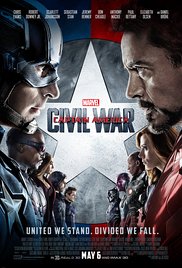
Captain America: Civil War is another explosive entry in the MCU, and is even more stuffed than usual, with nearly all our Avengers thrown into the mix – with the added twist that they fight each other! Yup it’s time for another playground argument: “If X fought Y, which one would win?!” That’s the main thrust of Captain America: Civil War, but it’s actually a distraction from the real plot. The much hyped fight at the airport (and the build-up to it) is a rather dull hour in the middle that distracts from a richer, more interesting film.

There is dissent in the ranks of the Avengers. The UN wants them to sign the “Zukovian Accords” – an agreement that they will work only under the direction of the UN. For Tony Stark (Robert Downey Jnr) this legal framework for their actions is essential – but Steve Rogers (Chris Evans) argues that the Avengers need to have the freedom to go where they are needed, not only where they are told. In this tense situation, a bombing in Vienna is swiftly blamed on Roger’s old friend Bucky Barnes (Sebastian Stan), who has become the brain-washed killer The Winter Soldier. In disagreement with Stark about the Accords and determined to protect Bucky, Steve quickly finds himself on a collision course with Tony.

The central idea here is actually fairly interesting: are superheroes people with a higher duty or just a group of vigilantes? Should they follow the direction of politicians – or be free to go where they are needed, when they are needed? How much accountability should they hold? If, in saving the world, dozens of civilians should die in the aftermath, is that acceptable or not? These are the ideas that lie under the arguments that the characters – principally Captain America and Iron Man – have. 

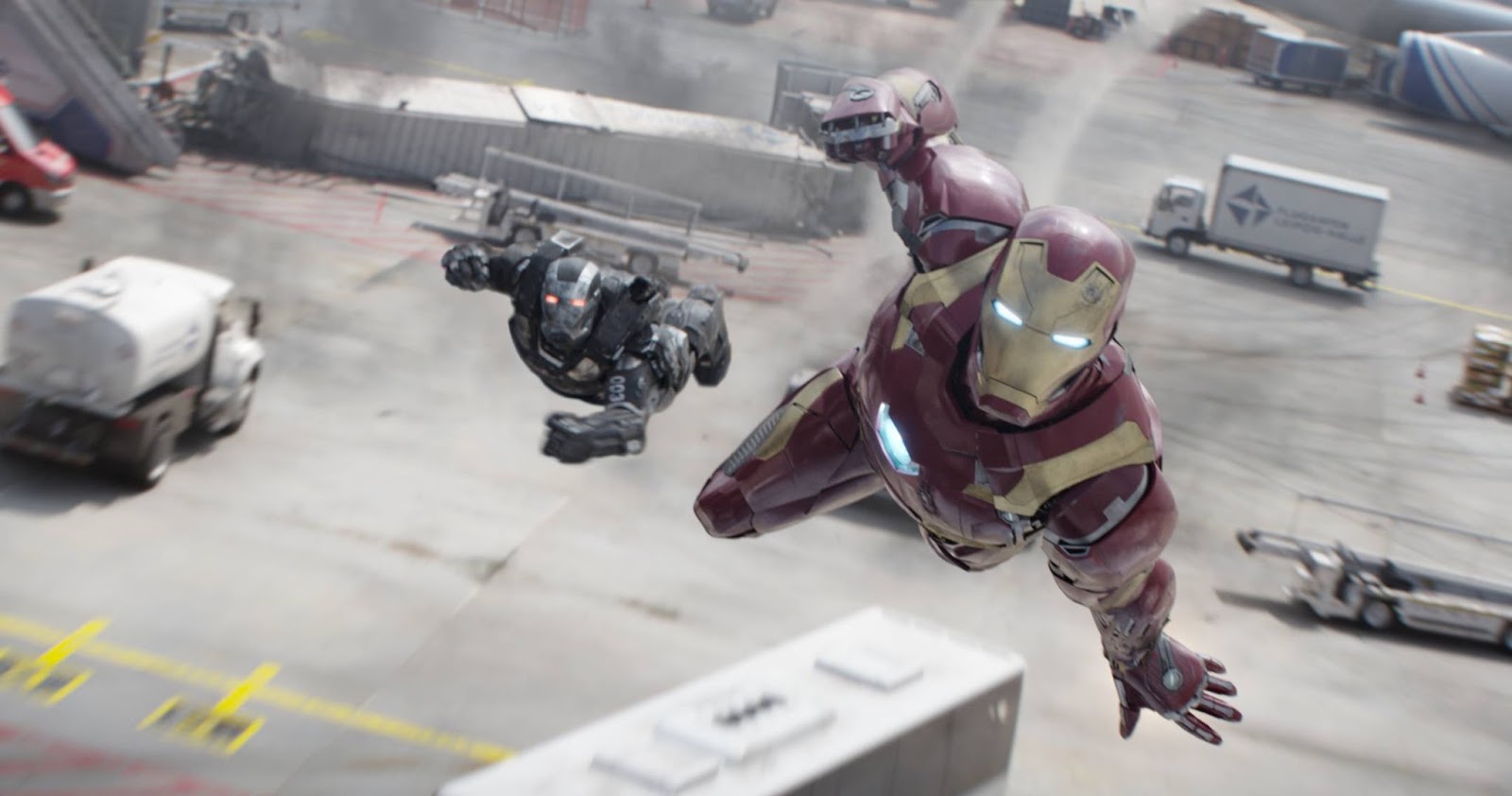
The first 40 minutes set this up nicely: an operation goes wrong, people are killed and the Avengers are confronted with footage of the collateral destruction they have caused while saving the world. But these ideas get left behind as the film gets caught up with pushing our characters into an artificial-feeling battle so destructive that an entire airport gets trashed by the “let’s cool our actions” team while trying to stop the “we should be independent” faction.

It would have been really nice to have these ideas explored in more depth, rather than a few moments here and there. Essentially, the film hires Alfre Woodard to deliver a top-notch performance as a mother whose son was Avengers collateral damage, to convince Tony things need to change, and leaves it at that. Steve’s counter-argument gets laid out swiftly – though he strangely makes no reference to the fact that the previous film saw a very similar “government organisation” revealed as the source of all evil in the Marvel world. It’s quick beats like this that set up this collision – but only Tony and Steve get any chance to express any form of developed views (in a few very well acted scenes). The motivations of the rest of the Avengers seem under-developed.

But that’s the problem with Captain America: Civil War: it’s seriously overstuffed. With some of these plots and characters removed, we could have actually had a very rich, thematic story.

The whole “Zukovia Accords” plot also has to constantly juggle for space with leftover “Winter Soldier” plotline from the previous two films. Truth be told, the latter is the more interesting, dealing with actual emotions, friendships and loyalties – chiefly the bond between Bucky and Steve (very well illustrated in a few brief, well played scenes). It’s this dilemma of whether Bucky can be held responsible for things he did under mind control that becomes the film’s key question. This plot line works far more effectively as it basically involves only three of the characters and feels like it has genuine things at stake, in a way I just can’t feel about the forced “civil war” angle. 

But it’s that civil war angle that the film is being sold on – and it’s what the middle section of the film is given over to. The big, airport-wrecking battle between the two sides is well shot, has good special effects and throws in plenty of neat one-liners. But what it completely lacks is any sort of dramatic tension or any stakes. As our heroes indestructibly bounce around while swapping light banter you never feel that this battle really amounts to anything. The sides don’t seem that far apart, or really that different – in fact the whole thing feels like playground horseplay.

The big battle is even undermined by the fact that we’ve already seen our heroes fight each other at least twice already in small combinations – and in all these cases, bodies are thrown about mercilessly but no one suffers more than a few scratches. Even after a character falls hundreds of feet to the ground, he’s later shown as basically being absolutely fine. The big battle is supposed to be the exciting showpiece, but it’s basically just big filler. A load of noise, where nothing really happens and no-one really feels at any risk, with no real consequences (all the emotional consequences emerge from the smaller scale final confrontation which would be unchanged if this airport fight was removed).

The film only really recovers again once that fight is benched, and we wind up with three of our heroes squaring off over very personal issues. This also brings to the fore the Daniel Brühl’s fascinating character, a very different type of villain: someone whom the film plays a neat game of misdirection with. The film reveals one of its themes as revenge, and how much it can dominate or twist our lives. This is given voice through a wonderfully written and played scene between Brühl and Boseman (very dynamic as the future Black Panther, dealing with grief over the murder of his father).

That scene gives an insight into the film’s real strengths: the small moments. The bits where the overblown fighting can be put to one side and we can see these characters (and the very good actors who inhabit them) talk. Moments like this carry more humanity, interest and tension than a thousand sequences of a giant Ant-man. In these moments, Downey Jnr and Evans are both terrific. Evans was born to play this part, making Rogers adamantine in his decency and nobility without being wearing, and also demonstrating an increasing streak of an old-soul who is tired of listening to other people and wants to make his own choices. Downey Jnr increasingly makes Stark a man hiding resentments, fears and doubts under a veneer of cool. Several other excellent performances also burst around the margins of the film (I’d single out Mackie who is excellent as the loyal Sam).

It’s just a shame Captain America: Civil War wastes some strong material in the prolonged set-up – and then enactment – of its superhero feud. Enjoyable as it can be to see this sort of stuff from time to time, after a while it’s tedious to watch invulnerable people taking pot shots at each other with no discernible impact. A single conversation with stakes – with a doubt about whether a friendship will hold or not – has more tension and excitement than a hundred sequences of heroes hitting each other. There is a more interesting story here – but between the action and the obligatory set-ups for future Black Panther and Spiderman movies (excellent as Boseman and Holland are in these roles) it doesn’t quite reach its potential.

Gods of Egypt (2016)

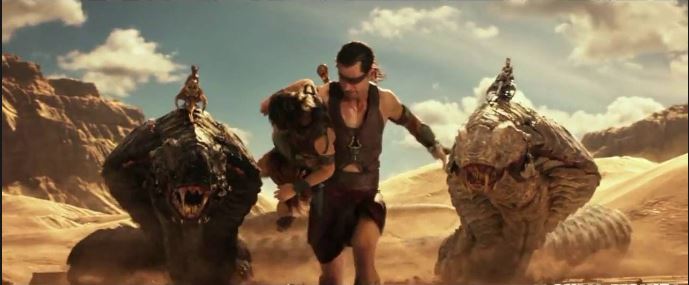
Just your standard Giant Meets Boy Gets Chased by Female Assassins Riding Giant Worms Story. Really didn’t anyone learn anything from Dune?

Director: Alex Proyas
Cast: Nikolaj Coster-Waldau (Horus), Gerard Butler (Set), Geoffrey Rush (Ra), Benton Thwaites (Bek), Chadwick Boseman (Thoth), Elodie Yung (Hathar), Courtenay Eaton (Zaya), Rufus Sewell (Urshu), Bryan Brown (Osiris)

Oh good lord where to begin. It’s not so much that this is a terrible film – although it is. It’s not offensive or unpleasant. It’s just a film that is almost impossible to take seriously whatever. It’s a fat, bloated, overblown mess where the plot makes almost no sense, the design is totally ridiculous, the acting bored or unengaging, and the directing totally lacking any charisma. It’s a film you can only laugh it, except for the fact that it’s so lamentably badly that it’s not even that funny. There is so little joy in the making of this bloated fart of a picture, that even as a joke it falls flat.

As far as I can tell, in a fictionalised ancient Egypt the Gods live among men. Horus’ coronation as the new king is interrupted by his uncle Set who seizes the throne, removes Horus’ eyes and sets about turning the realm into a dictatorship. He has some sort of overall plan but I’m really not sure what it was. Something to do with immortality or something. The film barely cares so neither should you. Set is a baddie. Horus is supposed to be a goodie, I guess, but he is such a humourless, arrogant, cold and (above all) boring God you probably won’t give a toss about him.

The film is a disaster almost from start to finish. In a decision that guarantees giggles every few minutes, the Gods are all 9 feet high, making the humans look like chippy midgets. Poor forced perspective hammers home this ridiculousness every few seconds. If this didn’t make the Gods silly enough, they also have some bizarre metal “battle modes” they transform into, which along with some piss poor special effects makes them look like refugees from Mighty Morphin Power Rangers. The colours are bright and primary and the sets all have the sheen of CGI, lacking any substance. The design decisions cross swiftly from daring into dumb. If you ever wanted to see a flying chariot pulled by winged scarabs or to see mix and match female hitmen ride giant worms chasing a giant and his normal sized friend, well hallelujah your day has come, this is the film for you.

The script, such as it is, is a loosely connected series of incoherent events. The acting is simply awful. Coster-Waldau completely lacks the big screen presence to carry the movie, his upper crust arrogance from Game of Thrones here comes across as insufferable and dull. Thwaites comic relief is about as funny as a hernia and his quest to save his true love has all the drama of running to catch a bus. Boseman aims for wisdom and grace but delivers camp and affectation in a truly terrible performance. Butler does at least have a bit of charisma, even though Set is such a poorly defined character he’s impossible to get interested in. Various other actors chip in autopilot performances for the cash. The female characters are little more than props. Geoffrey Rush needs a new agent: seriously how much money does he need?

The biggest problem though is it isn’t quite ridiculous, campy or shite enough to be a camp classic. Instead it’s just boring. It doesn’t have the sort of cosmic sweep or visual splendour to give you something to look at. Instead it’s loud, boring and stinks like animal droppings. That’s the worst thing of all: not even as a camp classic will this be remembered. Simply crap.