Tag: Charles Dickens

Oliver! (1968)

Oliver! header
Mark Lester asks for More. You may not share his sentiments in the Oscar winning Oliver!

Director: Carol Reed

Cast: Ron Moody (Fagin), Mark Lester (Oliver Twist), Jack Wild (The Artful Dodger), Oliver Reed (Bill Sikes), Shani Wallis (Nancy), Harry Secombe (Mr Bumble), Joseph O’Conor (Mr Brownlow), Hugh Griffith (Magistrate), Peggy Mount (Mrs Bumble), Leonard Rossiter (Mr Sowerberry), Hylda Baker (Mrs Sowerberry), Kenneth Cranham (Noah Claypool), Megs Jenkins (Mrs Bedwin)
1968. The Vietnam War gets worse. The My Lai Massacre is a low-point in America’s global reputation. MLK is assassinated. Student protests rip through campuses, culminating in Chicago riots at the Democratic convention. RFK is assassinated. In the UK, Enoch Powell talks about “Rivers of Blood”. A flu pandemic sweeps the world. The USSR ends the “Prague Spring” with tanks. It was a year of horrific global turmoil. Perhaps it’s not a surprise the Oscars chose as Best Picture something as blandly comfortable and utterly disconnected from all this mayhem as Oliver! A personality-free re-tread of a successful stage musical, with a few good tunes bolstering a lobotomised adaptation of Dickens’ novel, Oliver! is so coated with sugar it must have helped the medicine of 1968 go down.

Young Oliver (Mark Lester with his singing voice dubbed) is an angelic orphan, thrown out of the workhouse for asking for “more” (Never before has such an event occurred), eventually escaping to London (Where is Love eh?). There he finds the Big Smoke to be nothing less than a wretched hive of scum and villainy. Invited by pickpocket The Artful Dodger (Jack Wild) to consider himself part of the family, he’s soon learning how to pick a pocket or two from Fagin (Ron Moody). It’s not all fun and games though: violent criminal Bill Sikes (Oliver Reed) is a wildcard, although his devoted girlfriend Nancy (Shani Wallis), the sort of girl the boys will do anything for, remains loyal to Bill for as long as he needs her. But there’s a secret in Oliver’s past – who are his parents?

Carol Reed could once make a claim for being the greatest director in the world. You couldn’t make a case for that based on this cosily chocolate-box, unimaginative trudge through a musical that has little other than a couple of catchy tunes to really recommend it in the first place. The real MVP here is Onna White, whose choreography is very impressive. White takes everyday acts and, with a little bit of jazz and a dollop of musicality, turns them into dance movements. It gives the dance numbers a heightened reality that kind of works and provides nearly everything worth looking at it in the film. Reed certainly leaves her to it, carefully setting the camera up with simple wide and medium shots to capture as much of it as possible.

And you could argue that’s his job. But he brings nothing to the other parts of the production. Of course, Lionel Bart’s musical is a much lighter affair than Dickens’ original (although, in actual fact, this is much more of a musical remake of Lean’s Oliver Twist, making many identical cuts and sharing nearly all the same dialogue), but you’d think the director who gave us Odd Man Out and The Third Man could give some drama and character to London’s underbelly. Not a jot. They have the same muted technicolour cleanliness of everything else, and any hint of ruthlessness, criminality or moral conundrums are well and truly left at the door. What we get is a world where everyone – apart from Bill – is fundamentally nice and decent, and rapacious old men using children as criminals is basically not a lot different from running an after-school club.

It isn’t helped that Oliver!, like Bart’s stage original, has a weak book that offers little light or shade for its characters other than to typecast them into simplified “goodies and baddies”. Reed and the film either can’t or won’t stretch this much further – although the film does rearrange some events of the original production to give a bit more motivational heft to actions and introduce Bill earlier to at least add a bit more tension. The film is as quickly bored with the angelic Oliver as the original is – fair enough since he’s a tediously saintly chap – with Mark Lester alternating between looking winsome and shocked at the company he finds himself amongst.

Nothing can interrupt the overflowing “niceness” of what we are seeing. Ron Moody’s Fagin had been honed from performing it on stage so often (and he is very good). But his Fagin is a cuddly uncle, the sort of grown-up scamp you would invite over for a drink, only keeping an eye on the silverware when you did. This is, let’s not forget, a bloke who colludes in murder (though the film reduces his responsibility), kidnapping, grooms kids for a life of crime and willingly lets them die for him. Not a whiff of this is allowed onto the screen. The Artful Dodger (played with a cheeky but tellingly amoral charm by Jack Wild, who tragically never hit these heights again) is given more light and shade than Fagin.
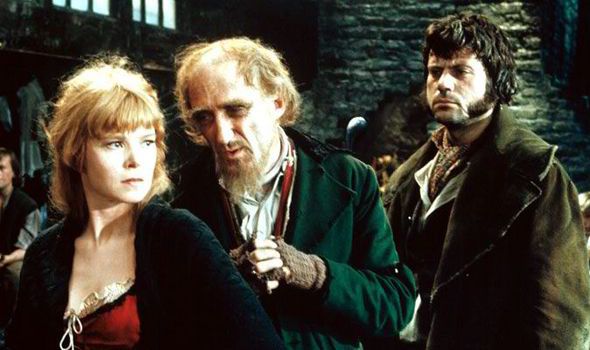
Like the musical, the film downplays the abusive relationship at its heart. Nancy is little more than a walking embodiment of the cliched “tart with a heart” trope, and the film adaptation chooses to praise her for not just sticking with her abuser, but slavishly devoting herself to him. In fact, beyond being casually kind to a child once in a while, this devotion is pretty much Nancy’s entire personality – and the film approves of it. This isn’t a dark picture of a violent man victimising a young woman, folks, it’s love! See, there’s a ballad about it and everything!

It’s a family drama so her murder takes place off screen (just her death spasm legs are seen), but you’d like to think the film could have taken a few moments to put a bit of light and shade on just why this character feels the way she does and does the things she does. In fact, the film is quite dependent on Oliver Reed, the only actor in it who dares to touch some sort of psychological depth – it’s quite telling that, even though he was a famed drunk, he’s the only member of the cast to have had any success after the film was released.

Instead, this is a great big, colourful, empty pantomime of a musical, devoid of character and (outside of its choreography) inspiration. It’s a great big explosion of tasteful sets, mugging actors, pretty colours, prancing and the odd catchy tune. It’s got no idea what the original novel was about at all, and no interest in even touching some of the themes of poverty and criminality Dickens was aiming at. Reed directs the entire thing with the indifference of a gun-for-hire.

Its syrupy sweetness and hammering tweeness leaves you punch-drunk rather than sugar-rushed. Oliver is such an insipid fella you’ll be delighted when he shuts up and sits in the background for most of the second half. It clumsily unveils a mystery and then drifts towards a conclusion that lacks any real drama. It studiously avoids anything that could remotely stretch the viewer. It’s trying so hard to charm you and hug you, it comes across like a lecherous stranger offering you sweets. Oliver! wasn’t even the best musical of 1968, let alone the best film. But in a year when the world was going to hell in a handcart, perhaps a kid-friendly fable bending over backwards to charm and reassure you was what the world needed. Doesn’t mean I need to stomach it now.
David Copperfield (1935)

David Copperfield header
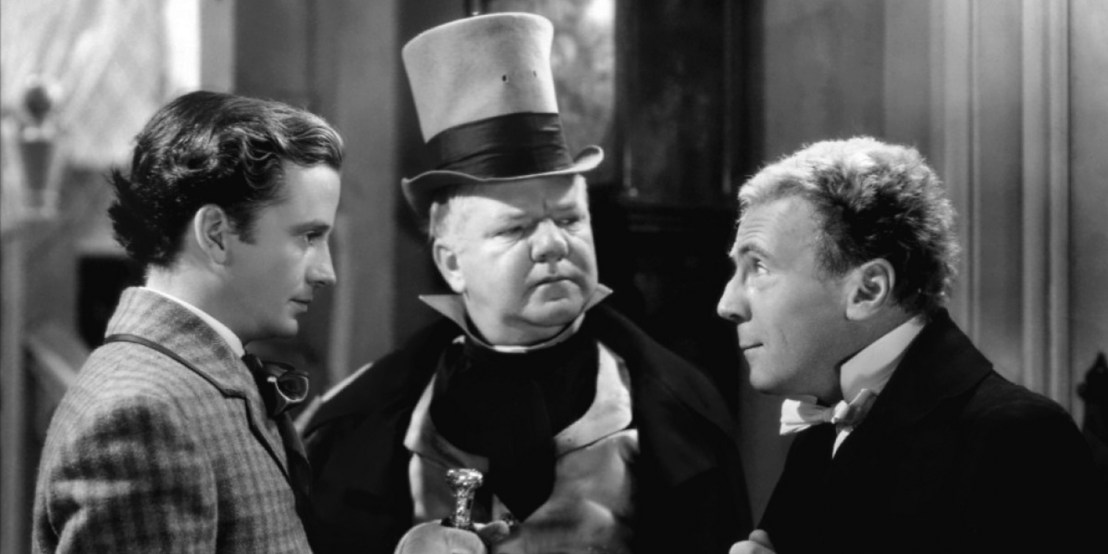
Frank Lawton, WC Fields and Roland Young bring Dickens to life in David Copperfield

Director: George Cukor

Cast: Freddie Bartholomew (Young David Copperfield), Frank Lawston (Old David Copperfield), Edna May Oliver (Betsey Trotwood), Elizabeth Allan (Clara Copperfield), Jessie Ralph (Peggotty), Basil Rathbone (Mr Murdstone), Herbert Mundin (Barkis), Jack Buckler (Ham Peggotty), Una O’Connor (Mrs Gummidge), Lionel Barrymore (Daniel Peggotty), Violet Kmeple Cooper (Jane Murdstone), Elsa Lanchester (Clickett), Jean Cadell (Emma Micawber), WC Fields (Wilkins Micawber), Lennox Pawle (Mr Dick), Lewis Stone (Mr Wickfield), Roland Young (Uriah Heap), Madge Evans (Agnes Wickfield), Hugh Williams (James Steerforth), Maureen O’Sullivan (Dora Spenlow)

You could argue David Copperfield is one of the most influential films ever made. David O Selznick was desperate to bring Dickens’ favourite novel to the screen. But the MGM suits were convinced it couldn’t be done (800 pages in two hours?! Get out of town!) and anyway who would want to come to the cinema when they could read the book at home? They were wrong, wrong, wrong and Selznick proved that classic literature (even if it was a cut-down version of a great book) could be bought to the screen and capture at much of the spirit of the book, even if you couldn’t dramatise all the events. David Copperfield remains very entertaining, not least because it also showed you can’t go to far wrong when you assemble an all-star cast who fit their characters perfectly.

The story of the film pretty much follows the novel (with exceptions, deletions and abridgements). Young David Copperfield (Freddie Bartholomew, growing up into Frank Lawton at the half-way point) grows up loved by his mother (Elizabeth Allan) and nurse Peggotty (Jessie Ralph), but loathed by his step-father Mr Murdstone (Basil Rathbone) who barely waits five minutes after his mother passes away before dispatching David to a factory in London. There David forms a bond with the charming exuberant Mr Micawber (WC Fields) before deciding to walk to Canterbury to seek the protection of his aunt Betsey (Edna May Oliver). Growing into a young man, he faces romantic problems, the schemes of the vile Uriah Heap (Roland Young) and the betrayals of his schoolfriend Steerforth (Hugh Williams). Will all turn out well?

Stylistically, David Copperfield aims to be as true to the novel as impossible. It’s designed to look as much as possible like a series of Phiz sketches bought to life and the actors have clearly studied both novel and illustrations to craft themselves as much as possible into living, breathing representations of their characters. Well scripted by Hugh Walpole (who also cameos early on as a Vicar), the film manages to be faithful without being reverential and tells an engaging story with momentum – even if the pace accelerates a little too much towards the end.

Walpole’s adaptation splits the book into two acts: the childhood of our hero and his life as young man. Giving an idea of how the momentum accelerates towards the end, this basically means the first hour of the film covers the novel’s opening 200 pages, leaving the last hour to hurry through the remaining 600. This means several characters and events are deleted, simplified or removed. However, Walpole still manages to retain all the truly vital information and iconic material, and recognises most of the striking material is found in that first 200 pages.

This childhood story is very well told, partially because Freddie Bartholomew (while he has touches of school play about him) is an affecting and endearing actor, who makes the young David a kid we care about rather than either an insufferable goodie-two-shoes or a syrupy brat. He’s a smart, kind, slightly fragile boy who we end up caring about – and it gives a real emotional impact when his mother dies (a very tender Elizabeth Allan) or to see him misused by Mr Murdstone (a perfectly judged performance of austere coldness by Basil Rathbone). Little touches of joy in his life – like the time he spends at the Peggotty’s converted ship home (a perfect representation of its description in the book) are really heartwarming, because David himself is such an endearing fellow.

It does create an obstacle for Frank Lawton when he takes over, since the audience is asked to try and bond with this new actor having already committed their hearts for just over half the run time to another. Lawton also has to deal with scenes rushing towards the conclusion rather than getting character beats like Bartholomew. Cuts impact his key relations: his school friendship with Steerforth is relayed second hand, meaning Steerforth turns up only to almost instantly let everyone down; Dora Spenlow and Agnes Wickfield get only brief screen time to establish their characters. The schemes of Uriah Heap are barely explained (he’s just a hypocritical wrong ‘un, okay?). It says a lot that the last fifteen minutes rush through the deaths of three major characters, a shipwreck, a dramatic confrontation, David travelling the world and a resolution of romantic tensions. It’s the only point when the film feels like its ticking boxes.

But it doesn’t completely matter (even if a two-part film would have helped no end – particularly allowing Lawton more room to develop a character) since the performances are so good. Expertly marshalled by Cukor – who rarely introduces visual flair, but coaches pin-perfect turns from the entire cast – every role is cast to perfection. None more so than WC Fields, for whom Wilkins Micawber became a signature part. Replacing Charles Laughton mid-filming (he claimed he looked more like he was about to molest the boy), Fields keeps his own accent and some of his own persona, but still fits perfectly into the Dickensian larger-than-life optimism and good will of Micawber. His comic timing is spot-on – watch him climbing over a roof or bantering with David and his family – and he seems like he has just walked off the page. If there had been a Supporting Actor Oscar in 1935, he would almost certainly have won it.

He’s the stand-out of a host of excellent performances. Edna May Oliver is very funny and has a more than a touch of genuine emotion as Betsey Trotwood. Jessie Ralph is excellent as Peggotty. Lennox Pawle makes a very sweet Mr Dick. Roland Young is the very picture of unctuous hypocrisy as Uriah Heap. Only the young women get a little short-changed: despite her best efforts, Madge Evans can’t make Agnes Wickfield interesting and Maureen O’Sullivan is rather cloying as Dora.

But the film itself is pretty much spot-on for the tone of Dickens, even if events are rushed. The impact of the Peggotty/Steerforth story is lost since we are never given the time to get to know any of the parties involved, and certain plot complexities are only thinly sketched out. But Cukor marshals the actors perfectly and throws in at least one striking shot, of Murdstone appearing in the distance as the camera follows a cart bearing David away from his mother. It always looks just right and the characters that do get the time are perfectly played, so much so that a few performances (Fields, Oliver, Young) may even be definitive.

David Copperfield proved you could turn a doorstop novel into a film and, even if you sacrificed some of the complexities (and might need to rush to fit it all in) you could still produce something that felt recognisable and true to the original. So, for that – with the mountain of adaptations that followed – we have a lot to thank it for.

The Invisible Woman (2013)

Ralph Fiennes and Felicity Jones excel in the thoughtful and well handled The Invisible Woman

Director: Ralph Fiennes

Cast: Ralph Fiennes (Charles Dickens), Felicity Jones (Nelly Ternan), Kristin Scott Thomas (Mrs Ternan), Tom Hollander (Wilkie Collins), Joanna Scanlan (Catherine Dickens), Michelle Fairley (Caroline Graves), Tom Burke (George Wharton Robinson), Perdita Weeks (Maria Ternan), John Kavanagh (Reverend Benham), Amanda Hale (Fanny Ternan)

In 1865 Charles Dickens was involved in a train accident. While he worked tirelessly, tending to those caught up in the accident, he was also extremely careful to hide the fact he was travelling with a young actress called Nelly Ternan. Ms Ternan was his lover, had been for several years, and the couple were returning from Paris. Dickens managed to avoid the inquest and preserve the secret of his affair. Because, while he was happy to publicly announce his separation from his wife, the idea of the public hearing that he had an affair with someone 27 years younger than him was unthinkable.

The affair is deduced from careful deduction and the small remaining correspondence (both parties destroyed large numbers of letters) by the biographer Claire Tomlin. Her book forms the basis of Fiennes’ thoughtful, careful and intelligent film, with the director playing Dickens and Felicity Jones as Nelly Ternan. The Invisible Woman is restrained and unjudgmental film-making, that largely avoids obvious moral calls and weaves a beautifully constructed tale of two people who make themselves both happy and miserable.

And that misery is partly due to the times they live in. It’s an era of Victorian morals, where all that matters is the surface appearance and any real emotions underneath can go hang. But it’s also a world where very different rules apply to men and women. Dickens can leave his wife (in a press announcement) – but of course a woman could never do the same. It’s a world of strictly defined rules, with clear roles for both genders that cannot be deviated from. And it forces Nelly Ternan to travel to Paris, because the public shame that would come with her pregnancy by Dickens would destroy her. It’s why, years after Dicken’s death, she is lying about how well she knew the man (even changing her name and age to further distance herself) so that she can conform with the expectations of being a school-master’s wife (and ensure she will not be thrown out to the streets).

The rules are so strong that both Dickens and Ternan are as much in thrall to them as anyone else. Dickens is willing to bend the rules – but only so far. He would clearly never dream of living openly with his unmarried partner and their child as his friend Wilkie Collins (a perfectly cast Tom Hollander) would do. And Nelly Ternan is as outraged at this liaison – and as desperately uncomfortable in their home – as any prim housewife would be. In fact, in many ways, Nelly is even more conservative than Dickens.

But then she has to be. After all, he would be a rogue, she would be a whore. Choices aren’t great for women – and in her chosen career of actress, Nelly is clearly far more enthusiastic than she is talented. It’s worries about the career that leads to her mother – an excellent performance of motherly love mixed with a quiet understanding of the world from Kristin Scott Thomas – all but encouraging Dickens to seduce her daughter. Because, for an independently minded woman passionate about the art, if you can’t be an actress your other option is to be a muse.

Even Dickens seems quietly ashamed at his seduction of this woman, while she half-persuades herself it isn’t happening until it is. So, what draws them together? Refreshingly this isn’t a question of an older man excited by a younger woman – or a naïve woman swept up by a powerful man. Instead, these are kindred spirits. Both of them are passionate, intelligent and questioning. They both express an emotional honesty and openness. They have shared passions for literature, theatre and stories. It’s a romance that slowly blossoms and is based on a shared feeling. It would have been easier to tell a story of seduction and abuse – but this is a more intelligent film than that. At that fatal train accident, its Dickens who yearns to stay with Nelly and its Nelly that urges him to leave to preserve his secrets.

As these two, we have two actors with beautiful chemistry. Felicity Jones is inspired as Nelly Ternan. She both idolises Dickens, but is also drawn towards him on a very human level. She is astute, but conservative and at times even remote. Her older self, over a decade later, is both prickly and defensive – and those are qualities you can trace in her younger self, and not just because of her fear of disgrace. It’s a beautifully judged performance, both older than her time and also with a vibrancy and energy that entrances.

Fiennes, a more reserved actor, seems like an odd choice for the bon vivant Dickens – but he brilliantly excels in the role, full of energy and room-filling dominance. He marvellously conveys the charm and passion of Dickens, but also his thoughtlessness. This is after all a man who drops his wife by newspaper announcement and builds a barrier between their bedrooms. Who loves Nelly, but not enough to make her anything but a secret. Who is passionate and excited about his work, but can be turn distant and cool in his personal life. It’s a fabulous performance.

And the two leads are centred in a low-key, poetic film. You get the sense that there is a danger in getting to close to genius. Dicken’s wife Catherine – a beautifully sad and lonely performance from Joanna Scanlan – even warns Nelly about it (while delivering a gift from her husband, sent to her by mistake). It’s a danger that shapes Nelly’s whole life – but also her life is enriched by having Dickens in it. It’s a film that avoids obvious moral judgments – and while there are things done which cause pain, everyone is living in an imperfect society. Fiennes direction and use of visual language is wonderful and this is an impressive film.

The Personal History of David Copperfield (2019)

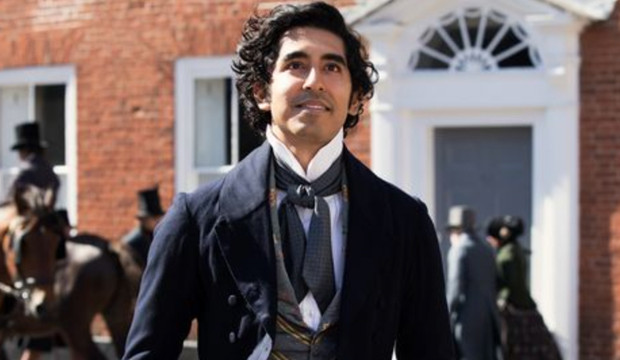
Dev Patel makes a charming lead in this Dickens adaptation that finds the comedy but misses the heart

Dir: Armando Iannucci

Cast: Dev Patel (David Copperfield), Tilda Swinton (Betsey Trotwood), Hugh Laurie (Mr Dick), Peter Capaldi (Mr Micawber), Ben Whishaw (Uriah Heep), Paul Whitehouse (Mr Peggotty), Aneurin Barnard (James Steerforth), Daisy May Cooper (Peggotty), Morfydd Clark (Dora Spenlow/Clara Copperfield), Benedict Wong (Mr Wickfield), Darren Boyd (Mr Murdstone), Gwendoline Christie (Jane Murdstone), Anthony Welsh (Ham Peggotty), Rosalind Eleazar (Agnes Wickfield), Nikki Amuka-Bird (Mrs Steerforth), Anna Maxwell Martin (Mrs Strong)

If Charles Dickens ever had a favourite child, it was probably David Copperfield. His novel – heavily inspired by events in his own life and upbringing – is an epic masterpiece, part coming-of-age story, part heart-warming family saga, part social satire. It’s quite a challenge to boil down its hundreds and hundreds of pages – and multiple plot points and characters – into less than two hours, but that’s the task Armando Iannucci takes on here. Does it work?

Well, to be honest, not quite. There is a lot to admire here, I’ll say that straightaway. And maybe I’m hard on it as I’ve read (or listened to) the novel at least three times. But for me this version drains out the heart of the novel. It zeroes in on the comedy – and there are several scenes and characters that are inarguably funny – but in doing so it removes or peels away anything bittersweet or with even a hint of sadness. It’s funny, but also a strangely empty and unengaging version of the story that it’s hard to get invested in and finally seems to drag.

Iannucci uses a terrific framing device, inspired by Dickens’ own public readings of his work. The film opens with Copperfield (a wonderfully jovial and engaging Dev Patel) publically introducing his novel to a theatre full of people which, with a flourish, disappears as he walks into the scenery and into his own past. Iannucci sprinkles his film with little flourishes like this to remind us of the semi-created nature of what we are watching, from Mr Murdstone’s hand looming into the Peggottys’ boat to pluck Copperfield into the next scene, through to the use of projected imagery at key points to fill in visually backstories the characters in the scene are relating.

The book has been well pruned and structured – and this is in some ways a triumph of compression, since it ticks off nearly all the main storylines of the plot (with some changes) and includes all the main characters. The real purist will decry such things as the loss of Barkis and Mr Micawber’s famous lines, or the translation of Mr Creakle into a factory owner or Rosa Dartworth into Steerforth’s mother. But these are necessities of adaptation and much of the storyline remains the same (if abbreviated). The script punches up the comedy a great deal – Iannucci has been vocal in his feeling that Dickens does not get the appreciation he deserves as a comic writer.

The script also digs up a few gems in the novel – Copperfield’s nervousness in reading, his inability to read to Murdstone’s gaze, is imaginatively reinterpreted as dyslexia. The semi-Freudian longing he feels for the warmth and innocence of his lost childhood is neatly captured by casting Morfydd Clark (very endearing and charmingly ditsy) as both his mother and his first love Dora. There are several laugh-out loud moments and a charmingly freewheeling love for absurdity.

But what doesn’t work is that the heart and soul of the novel has been stripped out. There is, to put it frankly, no pain or difficulty here. The tears in Dev Patel’s eyes at the end of the film as he closes his recital with the audience and reflects on the triumphs and losses of his life feel unearned. Put frankly nothing seems that hard, for all poverty rears its head at time. Even the Murdstones are less fearsome and cruel than they need to be. Worst of all, anything of any real emotional depth or tragedy from the book is removed. The two key tragic deaths of the book are actively reversed here, with both Dora and Ham surviving at the end. The complexities of Copperfield’s feelings for Dora and Agnes are resolved with immense ease for a traditional happy ending in a garden of the heroes surrounded by friends and families (exactly the sort of happy ending that Greta Gerwig gently poked fun at in Little Women). 

It’s all boiled down and told for jokes and the emotional engagement just isn’t there. Dev Patel enters the film too early – Copperfield is a young adult before he even heads to his aunt’s house – meaning the lost, vulnerable sense of sad childhood turning into a happy one is completely lost, and Copperfield’s fragility is too quickly brushed aside. Mr Micawber (a funny turn from Capaldi, but far too wheedling) is played so much for laughs that his essential decency and kindness is lost in favour of a man who spends his life borrowing cash. Too often humour is the first and only port of call, and finally it crushes the heart out of the story.

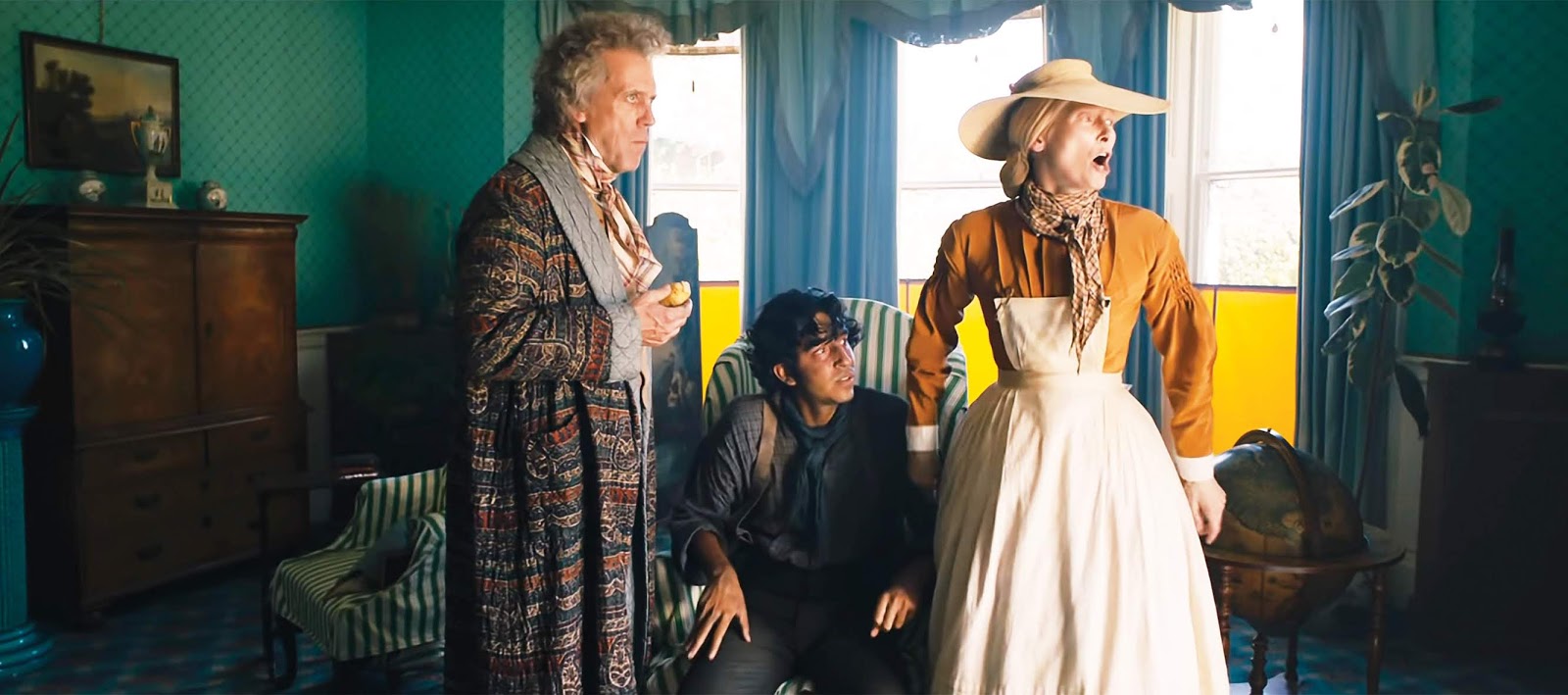
There are triumphs in the film’s cast. Hugh Laurie is simply outstanding as Mr Dick – warm, funny, wise, surreal, eccentric, half a philosopher, half an engaging and excited child – it’s Laurie’s finest performance ever on film. Benedict Wong is very funny as the alcoholic Mr Wicklfield. Tilda Swinton has great fun as a battleaxe but wise Miss Trotwood. Nikki Annuka-Bird could cut glass as Mrs Steerforth. Aneurin Barnard makes for a charmingly dissolute Steerforth. Ben Whishaw is terrific as the unctuous and ambitious Uriah Heep. The colour-blind casting works a treat to bring a range of wonderful actors in.

It’s just a shame the story doesn’t translate as well. There is a theme somewhere in here of Copperfield trying to work out his identity (much prominence is given to his multiple names and nicknames) but it never really takes flight, serving as a fig leaf of an arc rather than an actual arc. It’s a film full of jokes and fine moments – but with no heart, and no real engagement with the audience, it ends up feeling far longer than reading the book.

The Muppet Christmas Carol (1992)


Michael Caine with some of his best ever co-stars in The Muppet Christmas Carol

Director: Brian Henson

Cast: Michael Caine (Ebenezer Scrooge), Kermit (Bill Cratchitt), Miss Piggy (Emily Cratchitt), Gonzo (Charles Dickens), Rizzo the Rat (Himself), Statler and Waldorf (Jacob and Robert Marley), Fozzie Bear (Fozzie Wig), Dr Bunsen Honeydew & Beaker (Charity Collectors), Sam the Eagle (Schoolmaster), Steven Mackintosh (Fred), Meredith Braun (Belle), Robin Weaver (Clara)

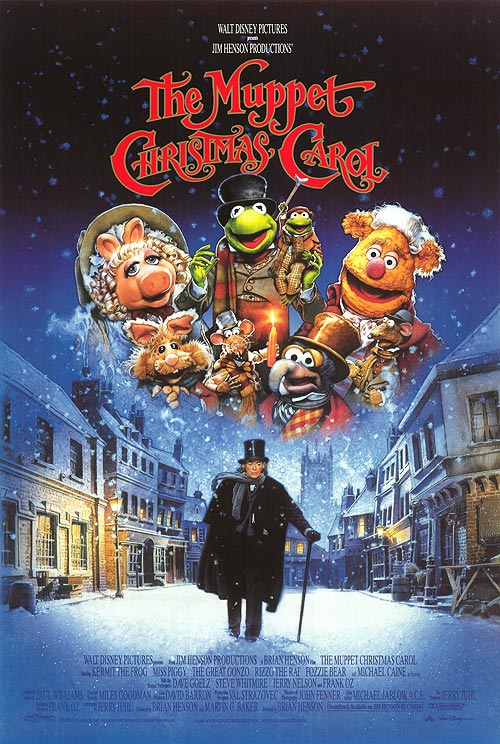
There have been many adaptations of Charles Dickens’ beloved novel. Surely few people would disagree – this is the best one. If you don’t love this film I’ll just say it – there is something wrong with you. That’s it. There is no hope for you. Just give up, pack up and go home. Because no Christmas is complete without this film. It’s brilliant. 

It’s also perhaps the version that feels the closest to Dickens’ plot – which is remarkable considering 90% of the parts are played by puppets. But what they do so well here is bring the film back to the roots of the novel – it follows the plot pretty much spot on, the setting and design feel brilliantly Dickensian, and it even introduces Dickens as a character. And who better to play the great Victorian showman than the Great Gonzo? Gonzo anchors the film brilliantly, and is both really funny and delivers an awful lot of text from the original book. This actually feels more like a slice of Dickens than nearly any other adaptation you can think of – I’m sure he would have loved it.

That’s why the film works – it has a mix of brilliant muppet humour in it (and there are some really laugh out loud moments) but it’s also a pretty straight adaptation. There are moments where the fourth wall is leaned on, but the content is never mocked. So you get all the fun moments around the edges, but you still get an extremely strong story that has worked for over 100 years. Thank goodness they pulled away from the original idea of parody and played it straight with a smile!

One of the main reasons it works so well is Michael Caine’s superb performance in the lead role. When Caine agreed to do the movie, he was straightforward about his intentions: “I’m going to play this movie like I’m working with the Royal Shakespeare Company. I will never wink, I will never do anything Muppety. I am going to play Scrooge as if it is an utterly dramatic role and there are no puppets around me.” That is totally what he does. Because Caine walks the balance so well, he plays the moments of comedy with great humour, but also the emotional force of Scrooge’s journey.

Caine so totally believes in and respects the world he is working in, that he brings the entire audience with him. If Caine can, with a totally straight-face, treat talking to a small bunny singing carols with as much integrity as he does sharing a scene with Laurence Olivier, all the rest of us can as well. Just think how the film’s mood would have been wrecked if Caine had winked at the camera, or said something like “I told you to only blow the bloody doors off” – the careful balance of the film would have been wrecked in a moment.

I think you can safely say this is one of Caine’s finest films: he’s got fantastic comic timing – his scowly ill-humour for the first third of the film is a delight – but he makes the later scenes genuinely moving. It almost seems like he inspires the muppets around him – Kermit and Miss Piggy’s later scenes dealing with the death of Tiny Tim are genuinely tear inducing (is this the only production of Christmas Carol where Tiny Tim isn’t insufferable?). The Muppets are all brilliant here (if Caine is going to treat them as real actors, I certainly am as well!).

That’s why the film works – it’s really emotionally moving. The muppets inspire a huge residual affection in everyone, and the film mines this brilliantly. So we get pleasure from seeing them – look there’s Fozzie Bear and Sam the Eagle! – and then feel their pain when they are sad. The film gets the balance just right on the muppets’ essential anarchy: at one point Sam the Eagle needs to be reminded that he is playing a Brit, Rizzo frequently forgets he’s playing a role, Animal seems unable to play the gentle music the script plays for at Fozziewig’s party… The film is crammed with small moments like this.

And it all works because it is held within a fine piece of straight storytelling – a faithful adaptation of Dickens, with a brilliant lead performance. It’s also very well made – inventively shot with a real sense of mood and atmosphere and brings memorable scene after memorable scene. There is barely a frame of the film where there isn’t something delightful, entertaining, thought-provoking or all three to spot. It carries emotional weight, it’s laugh-out-loud funny, you’ll fall in love with the characters. Caine sets the tone brilliantly, and raises the game of everyone involved – it’s an impossibly difficult acting task that no one in a muppet film has ever pulled off as well again. 

It’s one of the greatest Dickens adaptations, one of the sweetest comedies you’ll see, and one of the greatest Christmas movies ever made. On top of that it’s a brilliant musical, with some fantastic hummable songs (though the cutting of Love Is Gone from the DVD edition – too sad apparently –makes you sigh for Disney’s corporate soul). No Christmas would be complete without it. A must-watch classic.