Tag: Charles Gray

The Seven-Per-Cent Solution (1976)

The Seven-Per-Cent Solution (1976)

Affectionate and faithful Holmes pastiche that shines an interesting light on the Great Detective’s character

Director: Herbert Ross

Cast: Nicol Williamson (Sherlock Holmes), Robert Duvall (Dr John Watson), Alan Arkin (Dr Sigmund Freud), Laurence Olivier (Professor Moriarty), Vanessa Redgrave (Lola Devereaux), Joel Grey (Lowenstein), Jeremy Kemp (Baron Karl von Leinsdorf), Charles Gray (Mycroft Holmes), Samantha Egger (Mary Watson), Jill Townsend (Mrs Holmes), John Bird (Berger), Anna Quayle (Freda)
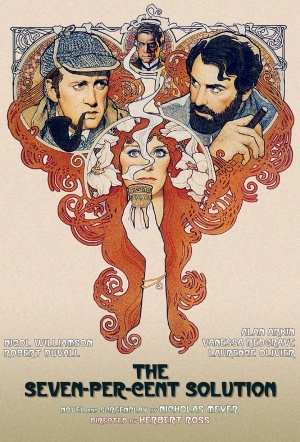
The magic of Sherlock Holmes is he is immortal. Doyle’s detective has been reshaped so many times since the publication of the canonical stories, that we’re now used to seeing him presented in myriad ways. It was more unsettling to critics – particularly British ones – in 1976, who didn’t know what to make of an original, inventive Holmes story that treats the characters seriously but is playful with the canon. Was this a parody or a new story? (Why can’t it be both!) Today though, The Seven-Per-Cent Solution stands out as a Holmesian treat, a faithful slice of gap-filling fan fiction.

Based on a best-selling novel by Nicholas Meyer (who also adapted it), The Seven-Per-Cent Solution expertly reworks Doyle’s The Final Problem. Professor Moriarty (Laurence Olivier) is not the Napoleon of Crime, but a mousey maths tutor, the subject of Holmes’ (Nicol Williamson) cocaine-addled idée fixe. Worried about his friends dissent into addiction, Dr Watson (Robert Duvall) tricks Holmes into journeying to Vienna to receive treatment from an up-and-coming specialist in nervous disease and addiction, Dr Sigmund Freud (Alan Arkin). The treatment is a slow success – and the three men are drawn into investigating the mysterious threat to drug addicted glamourous stage performer Lola Devereaux (Vanessa Redgrave) that may or may not be linked to her fierce lover, the arrogant Baron Karl von Leinsdorf (Jeremy Kemp).

As all we Holmes buffs know, seven per-cent refers to Holmes’ preferred mix of cocaine, taken to stimulate his brain between cases and see off boredom. But what if that persistent cocaine use wasn’t a harmless foible – as Holmes tells the disapproving Watson – but something much worse? Kicking off what would become a decades long obsession with Holmes the addict – Brett and Cumberbatch would have their moments playing the detective high as a kite and a host of pastiches would explore the same ground – Meyer created a version of Holmes who was definitely the same man but losing control of himself to the power of the drug.

This short-circuited some critics who didn’t remember such things from school-boy readings of Doyle and hazier memories of Rathbone (those films, by the way, were basically pastiches in the style of Seven-Per-Cent Solution as well). But it’s a stroke of genius from Meyer, shifting and representing a familiar character in an intriguing way that expands our understanding and sympathy for him. Holmes may obsessively play with his hands and have a greater wild-eyed energy to him. He may sit like a coiled spring of tension and lose his footing. But he can still dissect Freud’s entire life-story from a few visual cues in a smooth and fluid monologue and his passion for logic, justice – as well as his bond with the faithful Watson (here bought closer to Doyle’s concept of a decent, if uninspired, man) – remain undimmed.

It helps that the film features a fantastic performance from Nicol Williamson. Few actors were as prickly and difficult – so could there have been a better choice to play the challenging genius? Williamson’s Holmes is fierce in all things. Introduced as a wild-eyed junkie, raving in his rooms and haring after leads, his behaviour oscillates between drug-fuelled exuberance to petulant paranoia. But there are plenty of beats of sadness and shame: Holmes is always smart enough to know when he no longer masters himself. When the mystery plot begins (almost an hour into the film), Williamson’s does a masterful job of slowly reassembling many of the elements of the investigative Holmes we are familiar with – the focus, the energy, the self-rebuke at mistakes and the excitement and wit of a man who loves to show he’s smarter than anyone else.

The film is strongest as a character study, in particular of Holmes. Its most engaging sections take Holmes from a perfectly reconstructed Victorian London (including a loving, details-packed recreation of 221B from production designer Ken Adam) to waking from a cold turkey slumber full of apologies for his cruel words to Watson. Seeing Watson’s quiet distress at Holmes state, and the great efforts he takes to help him, are a moving tribute to the friendship at the book’s heart. The clever way Meyer scripts Holmes’ ‘investigation’ into Moriarty (an amusing cameo from Laurence Oliver, his mouth like a drooping basset hound) sees him apply all his methods (disguise, methodical reasoning, unrelenting work) in a way completely consistent with Doyle but clearly utterly unhinged.
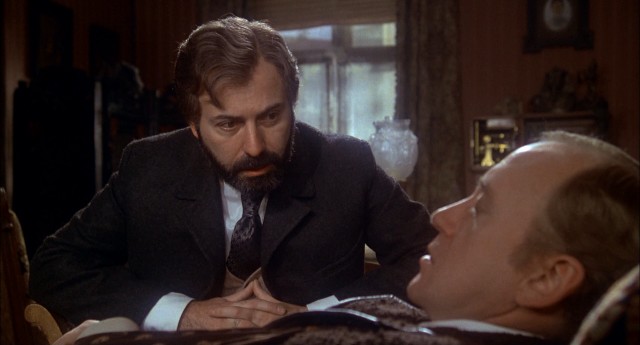
That first half serves as a superb deconstruction of the arrogance of literature’s most famous detective, who won’t admit the slightest flaw in himself. It’s still painful to see a frantic Holmes, desperate for a hit, causing a disturbance in Freud’s home and denounce Watson as “an insufferable cripple” (a remark met with a swift KO and later forgiven). Holmes’ cold turkey sequence is a fascinating sequence of nightmareish hallucinations, as he is plagued by visions of cases past (The Engineer’s Thumb, Speckled Band and Hound of the Baskervilles among them) and the eventual awakening of Holmes as a contrite, humbled figure very affecting.

Bouncing off Williamson we have the traditional “Watson” role split between that character and Freud. Robert Duvall is a very unconventional choice as Watson – and his almost unbelievably plummy accent takes some getting used to – but he gives the character authority without (generously) giving him inspiration. Limping from a war wound (another touch of the novels often missed until now), he’s dependable, loyal and goes to huge lengths to protect his friends.

But most of the traditional role is actually given to Freud, played with quiet charm and authority by Alan Arkin. Intriguingly the film places Freud as a combination of both men’s characters. He has the analytical mind of Holmes, investigating the subconscious. But he also chases after errands for Holmes, “sees but does not observe” during the case in the manner of Watson and eventually becomes an active partner in confronting the villains.

The actual mystery (taking up less than 40 minutes of the film’s runtime) can’t quite maintain the momentum, being a rather trivial affair (greatly simplified from the book) revolving around a cameo from Vanessa Redgrave as a fellow drug addict Holmes feels a touching sympathy for. Jeremy Kemp makes a fine swaggering bully, but his greatest moment is actually his pre-mystery anti-Semitic confrontation with Freud at a sports club, culminating in a Flemingesque game of real tennis between the two. If the film has any moment that tips into outright comedy, it’s a closing train chase that involves Holmes, Watson and Freud dismantling the train carriage to burn the wood as fuel.

But the real heart of the film is Holmes. Throughout the film we are treated to brief visions of the boyhood Holmes slowly climbing a staircase. What he saw at the top of that staircase is buried deep in his subconscious, with the final act of the film revealing all under hypnosis. It’s an intriguing motivator for all Holmes has become, just as it is surprisingly shocking. As Watson comments, the bravest act is sometimes confronting ourselves: The Seven-Per-Cent Solution treats the detective with huge respect, while pushing him into psychological waters Doyle would never have dreamed of. It’s why the film (and Meyer’s book) is a fascinating must-see for Holmes fans: it takes the material deeper, but never once forgets its loyalty to the source material.

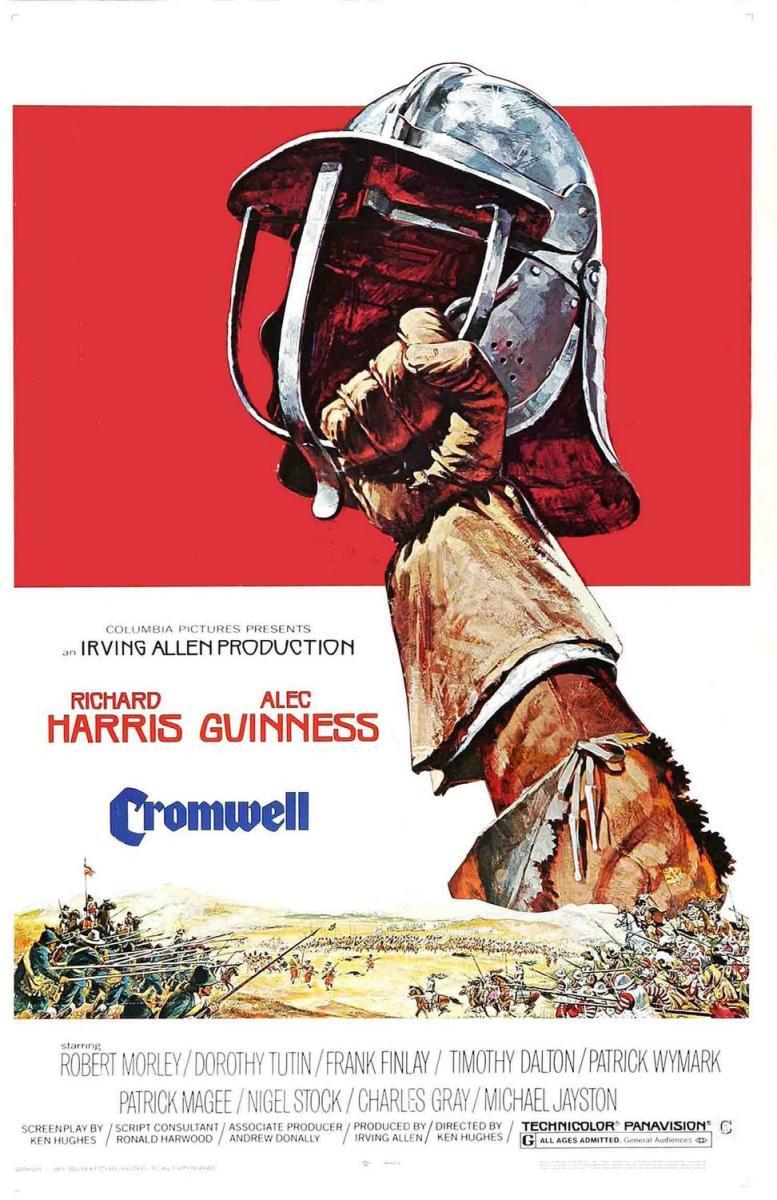
Cromwell (1970)

Cromwell image
Richard Harris let loose the revolution in Cromwell

Director: Ken Hughes

Cast: Richard Harris (Oliver Cromwell), Alec Guinness (King Charles I), Robert Morley (Earl of Manchester), Dorothy Tutin (Queen Henrietta Maria), Frank Finlay (John Carter), Timothy Dalton (Prince Rupert), Patrick Wymark (Earl of Strafford), Patrick Magee (Hugh Peters), Nigel Stock (Sir Edward Hyde), Charles Gray (Earl of Essex), Michael Jayston (Henry Ireton), Douglas Wilmer (Sir Thomas Fairfax), Geoffrey Keen (John Pym), Stratford Johns (President Bradshaw)

How much does history actually matter when you watch a historical film? We all know we aren’t watching a documentary don’t we? It’s worth bearing in mind when watching Cromwell a film which would probably be in the running for “least historically accurate film of all time”. But despite that, it’s entertaining and gets quite close to some of the spirit of the times – even if it changes most of the facts. It probably as well deserves notice for being one of the very few films to offer a sympathetic portrait of Oliver Cromwell – not a guy it’s easy to like.

It’s the 1640s, and England is a mess. Charles I (Alec Guinness) has been ruling the country directly, without involving Parliament, for over ten years. But now the money is gone and he needs Parliament to raise some more cash. Problem is, Parliament is more interested in pushing a defence of its own prerogatives rather than simply putting more money into the King’s pocket. Among the leaders of the Parliamentary campaign is Oliver Cromwell (Richard Harris), and he is not the man to take any false promises from the king. Before we know it, the country has tipped into civil war – and now it’s up to Cromwell to create a Parliamentarian army that is capable of defeating the King and bring democracy to the nation.

Ken Hughes film offers some plenty of scope and drama, even if is old-fashioned (even a little Victorian) in its Wrong-but-Wromantic Cavaliers and Right-but-Repulsive Roundheads (to mis-quote 1066 And All That). It’s a strange topic for a historical epic (it took years to get the funding) – but it looks fabulous and has a wonderful score that really embraces the religious music of the time.

What it gets right is the passion and the fire that people felt at the time for questions of politics and religion. The film frequently features heated debates (even if the dialogue is often more ticking boxes than inspired) that the actors invest with real force. Its view of events is of course truncated and at times simple (it is, after all, trying to cover around ten of the most tumultuous years in British history in about two hours), but it focuses on trying to get the spirit of things right.

A large part of this is Richard Harris’ firey performance in the lead role. There is, it has to be said, a cosmic irony in Cromwell, the least popular British leader in Irish history, winds up being played so sympathetically by one of the most famous Irish actors of all time. Sure, the real Cromwell would have hated being played by an Irishman and a Catholic (Cromwell was surprisingly inclusive at the time, but had no truck with either group). But then Cromwell would also have loved being portrayed as a mixture of George Washington and Cincinnatus (the Roman general who left his plough to assume supreme command when the nation needed him, only to retire again to obscurity). This Cromwell is bullheaded, but determined to do what’s best for the nation, with personal ambition not even a consideration. He’s the one true, selfless man in a revolution of violence.

In fact, Cromwell was sorely tempted by the eventual offer to be King (something he laughs off here). He also undoubtedly was touched heavily by ambition, while his attempt to turn the Protectorate into a hereditary office was a disaster that doomed the Republic (surely George Washington learned a few lessons from him). But, deep down, Cromwell was sincere – a guy who largely said, and did, what he meant. It’s that sense of morality that Harris gets very well here. And, while its easy to poke fun at those hoarse tirades Harris is frequently called on to deliver, this sort of intemperate ranting (laced with Biblical language and a strong sense of moral superiority) were pretty much central to Cromwell’s personality.

It makes for a very different hero, even if the film is determined to turn Cromwell into the only decent man in the Kingdom. Cromwell, in real life, never retreated from politics to return to his farm as he does in the latter part of the film (he actually spent this time on brutal campaign in Ireland, something the film mentions only vaguely in passing). But there is no doubt Cromwell would have believed he was the guy selected by providence to save the nation – and that idea the film channels very well. In fact, Cromwell gives you a pretty decent idea of what Cromwell might have been like – and a pretty accurate picture of who Cromwell wanted to be – even if the things it shows you only have a passing resemblance to what happened.

It’s a key directive throughout Ken Hughes’ film, which feels free to distort historical events willy-nilly (see more below). But there is a sort of truth in spirit, if not in fact – from the heated debate in Parliament, to the mixture of frantic panic and regimented order in the battles (one particularly good shot positions the camera under a charging horse, which makes a cavalry charge suddenly feel horrifyingly visceral). Sure it’s arranged into a much more simple black-and-white story, but it works.

A similar trick also works for its portrayal of Charles I. This is probably one of Guinness’ most over-looked performances. His Charles is a weak, indecisive man who confuses stubbornness and pride for moral strength. Softly spoken when calm, he collapses into heavily Scots accented rage when riled and his politeness is a only a shield for bitterness and vexation. He routinely shirks responsibility for his actions and spreads the blame around everyone but himself. Again, it might not all be accurate, but you can’t imagine this is far off from the actual King.

Historically though, so much of the film is wildly inaccurate. Many of these changes are done to increase the importance of Oliver Cromwell early in the Parliamentarian campaign. To scratch the surface: Cromwell – a minor figure until quite late into the war – was not one of the five members Charles marched to Parliament to arrest (neither was Henry Ireton). He certainly didn’t – and neither did anyone else – remain sitting when the troops arrived and set a motion in place protecting MPs. He never met the King before the war. Cromwell is later made C-in-C of the Parliamentarian army – an office actually given to Fairfax. The film’s depiction of the Battle of Naseby flips the numerical advantage exactly to favour Charles rather than Cromwell. Far from providing the key damning evidence at Charles’ trial, Hyde fled the country with Prince Charles.

But this is a fiction, rather than drama. Even if the facts it presents are largely nonsense, it gets a lovely sense of the divided loyalties and tensions that existed during this period. The performances are often quite broad – Robert Morley simpers and sneers as an opportunistic Manchester, Patrick Wymark growls and splutters as Strafford while Timothy Dalton goes way over the top as a foppish Prince Rupert – but some, such as Michael Jayston’s firebrand Ireton or Nigel Stock’s tortured Hyde (historical nonsense as his storyline is) are rather good.

And it’s hard not to like a film where the lead actor is going at it such great guns that you can actually hear his voice disappearing into a rasp. Cromwell doesn’t have much relation to the facts, but deep down it does seem to understand the man Cromwell wanted to be. And, on that level, it feels truthful and heartfelt – and that’s partly why it remains entertaining and why I remain rather fond of it.

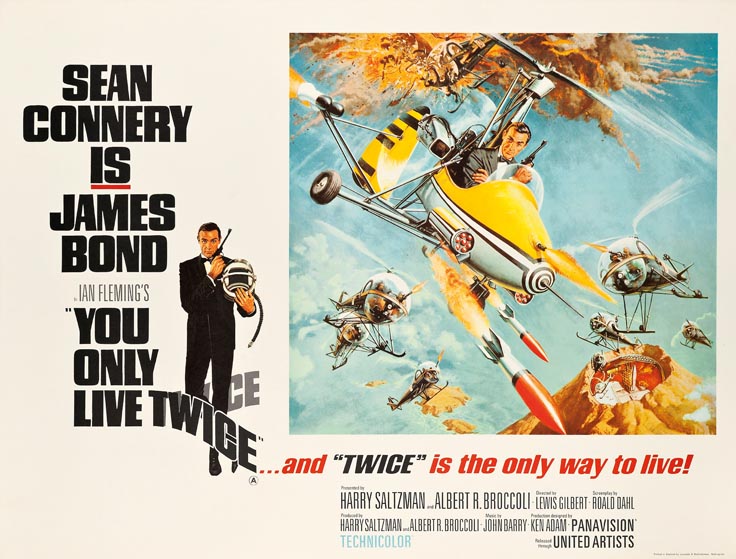
You Only Live Twice (1967)


I feel Connery’s attitude to the film comes across well in this image…

Director: Lewis Gilbert

Cast: Sean Connery (James Bond), Akiko Wakabayashi (Aki), Mie Hama (Kissy Suzuki), Tetsurō Tamba (Tiger Tanaka), Teru Shimada (Mr. Osato), Karin Dor (Helga Brandt/No. 11), Donald Pleasence (Ernst Stavro Blofeld), Bernard Lee (M), Lois Maxwell (Miss Moneypenny), Desmond Llewelyn (Q), Charles Gray (Dikko Henderson)

James Bond films: always fun, even when not that good. You Only Live Twice is probably the prime example. For many, many reasons, it isn’t actually very good but still remains strangely enjoyable just because, well hell, it’s Bond. 

Anyway YOLT revolves around naughty super villains SPECTRE nabbing US and USSR space missions, hoping to provoke a nuclear war between the two superpowers. Apparently they will profit handsomely from this – but how they see that happening in a nuclear wasteland isn’t clear. Anyway, James Bond (Sean Connery) fakes his own death and heads to Japan to investigate. Events peddle around Japan for ages, giving filmgoers the chance for some vicarious sight-seeing, before culminating in an all-out attack by Bond and a gang of ninjas on the hollowed-out volcano base of SPECTRE chief Blofield (Donald Pleasance).

YOLT is the moment Bond started to head full tilt towards the Moore-era of overblown, fantasy silliness. The plot is total bobbins (despite being repeated in The Spy Who Loved Me, Moonraker etc.) with both Russians and the US naturally continuing to suspect each other, even when each side loses a spacecraft (though I did like the fact that the actual astronauts together in captivity are shown to have far more in common than not). There is no logical reason for them to behave like this, even at the heart of the Cold War.

There is plenty of other nonsense here. Bond’s death is faked early doors for no reason (only the hopeless SPECTRE is in any way fooled). Bond meanders around Japan with even less subtlety than usual, with a series of clashes, fights and chases that make little real narrative sense at all. Later, again for no reason, (and almost unbelievable to watch today) he disguises himself as a Japanese man (PC alert ahoy, as Bond cuts his hair with a bowl and tans his skin. At least he doesn’t tape his eyelids back…). He also finds a kindred spirit in Tiger Tanaka, both of them treating a host of female servants as a shopping list for rumpy-pumpy.

As per many Bond films, the franchise clambers on top of a current fashion to feel hip and cool (but actually manages to feel fusty and stuffy). This time it’s the samurai craze, as Bond joins a sword-swinging, ninja training school. Yes, you read that right. But of course Bond also needs to get married before the attack: again why? His wife is of course offed seconds later, and Connery just about manages to look put out at this coitus interruptus (more on Connery later…)

SPECTRE themselves are hilariously incompetent. They are hoodwinked like children by Bond’s ludicrous faked death. They practically signpost their location by bumping off anyone who gets within about five miles of the place. Later, poor Blofield not only carefully talks Bond through the self-destruct button for his rocket, he also lets Bond take back his clearly gadget-concealing smoking case, blows away two sidekicks (one right in front of Bond) rather than eliminate Bond himself, then caps it all with sending the base itself to kingdom come. SPECTRE’s agents are equally useless, with Brandt too attracted to Bond to finish him off (and then deciding to tie him up in a plane, detonate a grenade in it and then parachute out to leave the plane to crash with Bond in it – needless to say Bond lands the plane with ease).

The terrific volcano set

The volcano base, however, is a triumph of production design – it’s staggering to think that everything you see on screen was built for real. It’s huge and iconic – and the battle scene between the aforementioned ninjas and SPECTRE goons that fills the final act of the film is hugely exciting, despite almost every single thing making virtually no sense. Incidentally the final battle’s structure is lifted almost completely for a similar sequence in The Spy Who Loved Me.

The problem is that everything else leading up to this feels like all involved are going through the motions – as if there wasn’t really anything fresh left to do or say in the Bond-verse. Need a glamourous location. Never been to Japan have we? Need some scuffles – not sure we‘ve done a roof top fight in long shot, let’s chuck that in. How about we kill Bond off for a few seconds – yeah never done that before. A super gadget needed? Bring on suitcase-assembled helicopter, Little Nellie. The final reveal of Blofeld is fun, but when you come back to watching the film you realise he’s as bland and identikit as Largo or Dr No – a pompous windbag who fucks everything up.

Stumbling through all this is a clearly bored Sean Connery. By this time, Connery was sick of the part (“I’ve always hated that damned James Bond, I’d like to kill him” he was to later say), and money was the only thing tempting him back. Connery coasts through the whole movie with the air of a man who would rather be anywhere else. There is no sparkle at all, just a weary going through the paces. He can barely raise a smirk, let alone a glimmer of interest in the events around him.

Bond turns Japanese. No they really did do this.

It’s the atmosphere of the whole film. Roald Dahl (yes that Roald Dahl) did the script – but he felt the book was pretty awful (one of Fleming’s duller efforts) so spiced it up with some new content. Problem was the suits basically demanded a certain quota of set pieces and a certain number of Bond girls. Trying to deviate from this template too much was far too difficult a challenge. Lewis Gilbert’s direction is professional but pretty uninspired: it sums up the whole movie.

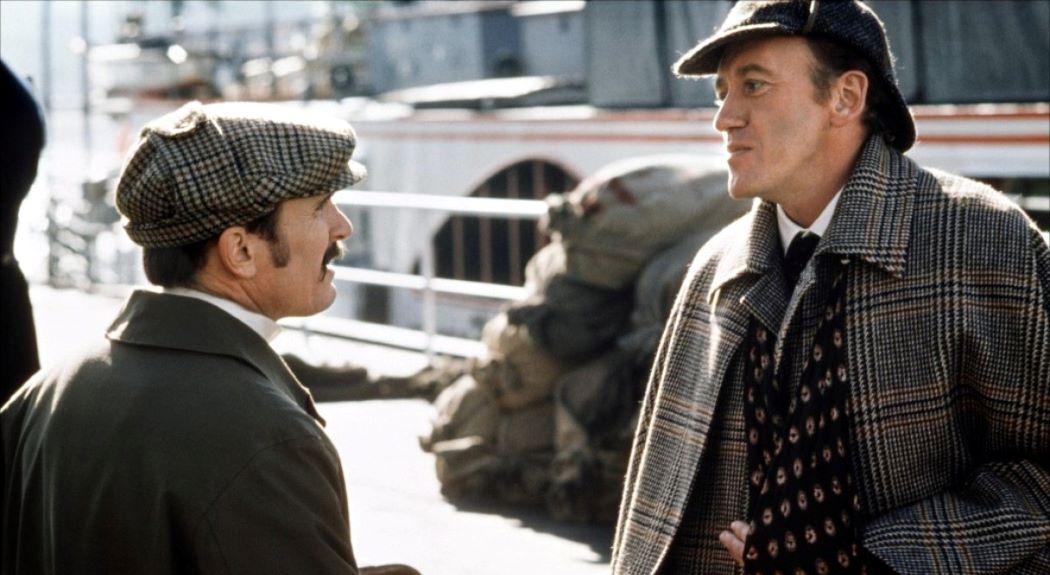
Most of the acting is pretty non-descript. Donald Pleasance at least deserves some credit for making Blofield’s appearance iconic and for doing a nice line of whispering menace. Charles Gray is pretty good fun as a camp British contact (“That’s stirred, not shaken. Is that right?”) – though SPECTRE (true to form) confirm all his suspicions by knocking him off after less than minute or two on screen. Everyone else blends into one.

So, anyway, YOLT is really nothing special – a tired entry into a tired franchise, with an all too obviously disillusioned star and action beats that largely feel like retreads of things we’ve seen before (done better) in the series. But yet, but yet… Somehow enough of the old Bond magic keeps you watching. Sure Connery is indifferent and the action more a travelogue than a thriller – but the final sequence is exciting, Blofeld (for all his ineptitude) makes a decent enough villain, and while no-one really gets het-up about it, the stakes do feel fairly high. Stretches of the film are dull – but others work very well. You may only watch twice, but it will be fun enough.