
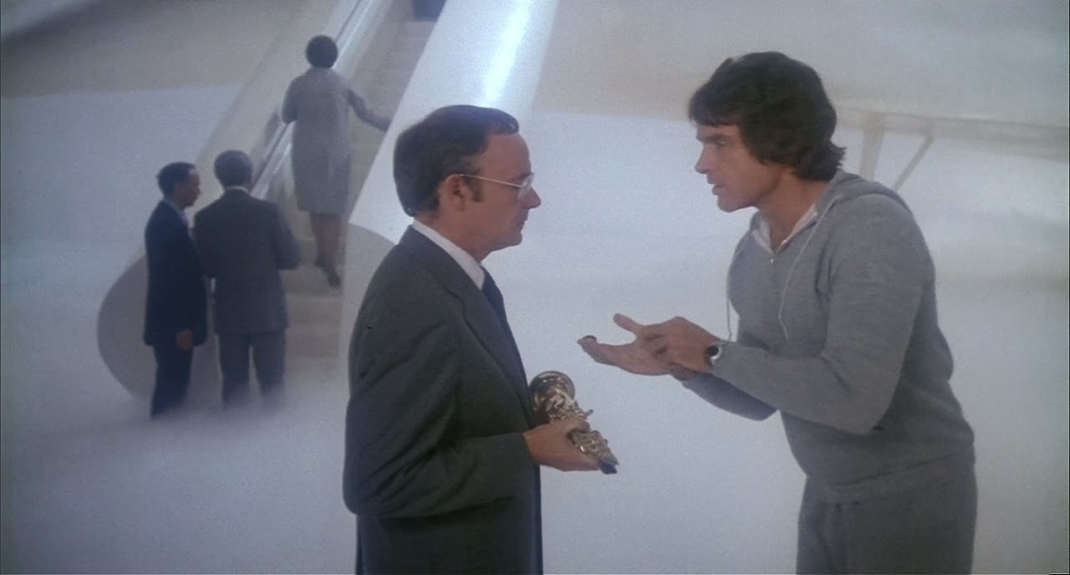
Deliberately old-fashioned and comforting drama, probably why it was a big hit when released
Director: Warren Beatty, Buck Henry
Cast: Warren Beatty (Joe Pendleton), Julie Christie (Betty Logan), James Mason (Mr Jordan), Jack Warden (Max Corkle), Charles Grodin (Tony Abbott), Dyan Cannon (Julia Farnsworth), Buck Henry (The Escort), Vincent Gardenia (Inspector Krim), Joseph Maher (Sisk), Hamilton Camp (Bentley), Arthur Malet (Everett)
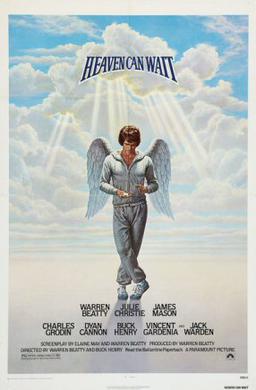
Beatty’s cosily old-fashioned directorial debut – in which, Welles like, he celebrated Oscar nominations for producing, directing, writing and acting – might well be the reason for its financial success. Perhaps a world in turmoil needed a remake of the smooth 1941 studio film Here Comes Mr Jordan, becoming the third adaptation of Harry Segall’s 1938 play. Heaven Can Wait reshuffles a few bits and pieces here and there, while aiming to capture as much of the tone of the original as possible.
Beatty is Joe Pendleton, promising quarterback for the Los Angeles Rams… until, facing certain death in a road accident he is plucked to Heaven by his guardian angel (Buck Henry). But the angel was overzealous, as supervisor Mr Jordan (James Mason) reveals Joe had 50 years to live. With his body cremated, Jordan arranges for Joe to take the body of billionaire Leo Farnsworth, recently murdered by his gold digger wife Julia (Dyan Cannon) and her lover, Farnsworth’s secretary, Tony Abbott (Charles Grodin). In his new body, Joe, inspired by environmentalist Betty Logan (Julie Christie), tries to make his company care while buying the Rams and persuading old coach Max (Jack Warden) that it’s really Joe and he needs his help to train his new body for the Super Bowl.
Heaven Can Wait shifts Here Comes Mr Jordan from the world of boxing to the world of football – possibly when original casting choice, Muhammad Ali, turned it down and Beatty’s high school football experience was a better fit. Ali wasn’t the only sought after legend – Beatty offered the sun and moon to Cary Grant to play Mr Jordan, but not even the presence of Grant’s wife Dyan Cannon could tempt him from retirement.
There are the odd tweaks here and there – the plane to Heaven is now a proto-Concorde for starters – but honestly Heaven Can Wait would have been made almost identically in the 1940s, with its dry wit, gentle romance and the Capraesque idea that the little guy can fix the world’s problems with a little bit of honesty, decency and common sense. There is almost nothing of the cynicism of the 1970s at all. It’s a gently reassuring throwback. Nothing wrong with that, but nothing inventive or original either.
Beatty does a decent job of directing things with a classical gentleness, and he’s also pretty good as the good-natured Joe, a sort of sweetly dim guy obsessed with health food and dodgy saxophone playing (roughly in that order). He’s got an endearing simplicity, the sort of guy who takes ages to work out he’s in a way-station for heaven, bounds into his new life with a chattiness that confuses his army of staff (used to an austere employer) and tries to corral his board of directors with a winningly earnest speech crammed with football metaphors, so intently well-meant it even manages to convince (some of) the crusty bean-counters sitting around the table.
Fish-out-of-water comedy emerges rather nicely out of how bemused both Beatty’s character is at the life he finds himself in, and how politely his staff and employees turn a blind eye to what must be a juddering change in personality of their boss. After all, Beatty and Elaine May’s script lands more than a few subtle digs suggesting Farnsworth must have been quite the dick. His wardrobe is a mix of ludicrous sailor and polo outfits and garish mock military uniforms. He had the staff raise a flag and fire a cannon every day. And his company is mercilessly gutting the environment.
Must be a shock for the staff then, that their new boss keeps popping into a cleaning cupboard on the stairs for surreptitious chats with invisible angels. Or that he corrals them en masse for a good-natured football training session in the grounds. The dry, carefully reserved reactions of these servants – led by Joseph Maher’s perfectly straight-faced butler – is consistently funny.
Also consistently funny are Dyan Cannon (Oscar-nominated) and Charles Grodin as a pair of conniving schemers, trying everything they can think of to pocket Farnsworth’s money. Cannon is hilarious, consistently oscillating between hysterical shock and resigned confusion at the unexpected appearances of ‘Farnsworth’. Grodin is perfect as the dry Abbott, a master of the micro-reaction, loathing his boss while also being pathetically deferential to him and wheedling a parade of schemes to try and dispatch his boss. These two are the film’s stand-out performers and funniest characters.
Not that there isn’t merit elsewhere. James Mason is perhaps the perfect substitute for Claude Rains, dry and suave as Head Angel Jordan and forming a good double act with co-director Buck Henry’s harassed junior angel. Jack Warden gained an Oscar nomination for a warmer, gentler version of his distracted coach from 12 Angry Men. Julie Christie’s chemistry with Beatty is not surprisingly on point, although the script gives her very little to play with for the film’s least developed role.
What is surprising though is the sudden bleak note Heaven Can Wait ends on: Joe will eventually lose all memories of his previous lives. It’s so sudden, I had to remind myself the same thing happens in the original (but with a bit more forewarning). Here, it emerges out of left-field and feels unbearably harsh, as if Heaven is cleaning up a clerical error by wiping Joe from existence. The film fails to prep us for this possibility – in the way the original did – as if it was felt the danger of being wiped from existence would spoil all that apeing of 40’s lightness (in which case why not just change it?).
Heaven Can Wait was garlanded by Oscar nominations (including those four for Beatty) but won only one for its admittedly clever set design which plays up the grandiose nonsense of Farnsworth’s mansion (I enjoyed Cannon’s bedroom with its matching fabric covering every wall and surface). Was that because it was so gently reassuringly, old fashioned, but fundamentally a very close remake? It’s a sentimental, charming little crowd-pleaser the sort of thing that perhaps made everyone feel better at the time, a decent, inoffensive film.
 Movie Musings