Tag: Charles McGraw

The Killers (1946)

THe Killers
Ava Gardner draws Burt Lancaster into a world of crime in The Killers

Director: Robert Siodmark

Cast: Burt Lancaster (Pete Lund/”Swede” Anderson), Ava Gardner (Kitty Collins), Edmond O’Brien (Jim Rearden), Albert Dekker (“Big Jim” Colfax), Sam Levene (Lt Sam Lubinsky), Vince Barnett (Charleston), Virginia Christine (Lily Harmon Lubinsky), Charles D Brown (Packy Robinson), Jack Lambert (“Dum-Dum” Clarke), Donald MacBride (RS Kenyon), Charles McGraw (Al), William Conrad (Max)
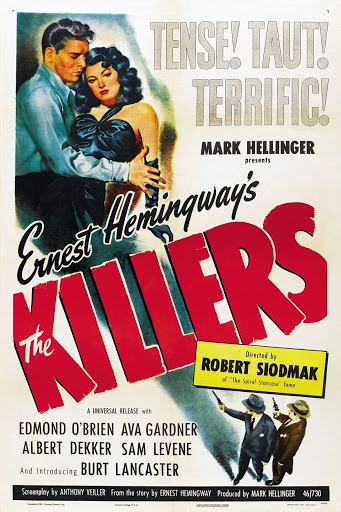
Ernest Hemingway’s short story “The Killers” is 3,000 words of tension and atmosphere, as a pair of hitmen turn up at a diner looking for a former Swedish boxer. They leave and a fellow diner runs to warn the Swede. He meets the news of his impending demise with a stoic acceptance that nothing can be done. That’s basically it. Siodmark’s film consumes the entire content of the source material in the first fifteen minutes. So the film basically expands and explores this set-up. The gripping opening is just our entrée into the film, that will explain to us why the killers are here, who the Swede was and why he needs to die. It makes for a tight, atmospheric and very well-done film noir.

Because there is no doubt that this is a classic film noir. The Swede’s backstory ticks all the boxes you would expect of the genre. Of course, all his troubles are rooted in a Femme Fatale (needless to say his former girlfriend is a saint). There’s a heist gone wrong, double crossing gangsters, a dedicated investigator and a range of locations from seedy nightclubs to rundown hotel rooms. The Swede (Burt Lancaster) is an easily-led handsome man, duped by a beautiful woman. Of course, it all finally leads to a series of shoot-outs, where the wicked are punished for their crimes. In many ways, the script (by Anthony Veillor, heavily polished by John Huston) simply turns the short-story into a familiar piece of genre work. What makes it work is the freshness with which it’s told.

Siodmark is not the biggest name director out there. But he’s a skilled professional and he elevates the material into something with deeper meaning. Perhaps it’s the Hemingway in its DNA, but this story plays like a Greek Tragedy. Fate intervenes at frequent moments, with chance and minor decisions circling back to reveal all. The Swede is a sympathetic heavy, out-of-his-depth, with the fateful flaw of being too trusting. Even the villains are vulnerable figures, while the femme fatale is only doing what she must to try and survive. It’s a neat structure.

And Siodmark shoots it with a beautiful, unobtrusive and pacey smoothness. Nothing in the film draws overt attention to itself, but every moment beautifully combines with those around it to create an absorbing whole. The pace works perfectly, and the film’s structure works very well. Throwing us essentially into the middle of the story increases the mystery – and also means that as we hear the story of each person who knew The Swede, we are constantly invited to rethink and reappraise events and characters we have already met.

It’s a film about the lasting impact of disappointment and disillusionment. Why doesn’t the Swede run a mile when he hears there are killers after him? Because its clear he died inside years ago – the bullet is just a formality. There is a rather touching romanticism to this. This strangely gentle boxer turned thug, who is so smitten by Kitty Collins that he can’t take his eyes off her during their first meeting. Who willing serves jail time for the stolen necklace she’s wearing. Who trashes his hotel and nearly flings himself out of a window when she leaves him. This is a shell of a man. And its not just him. Most of the crooks live out lives of disappointment and fear, while even our investigator seems to have very little in his life beyond chasing down insurance claims. If there is a message in this film, it’s that life is tough.

A lot of that impact comes from the sad-sack vulnerability in Burt Lancaster’s eyes. In his film debut here, Lancaster is at times a little raw. But what he conveys fantastically is the sense of a little boy lost. The Swede always looks out of his depth, dragged from pillar to post by other people, constantly unable to control the situations he finds himself in.

No wonder he’s so easily suckered by Ava Gardner’s gloriously savvy and fiercely determined Kitty – the character with the most drive and determination in the film. She’s smart enough to fool all the characters at least once – and ruthless enough to not give a damn about any of them. Gardner’s performance is spot-on here, with Kitty emerging as possible the most ruthless femme fatale this side of Double Indemnity – with Lancaster as much her gullible patsy as Fred MacMurray was. Gardner’s icy cool is so well done, that it adds even more weight to her performance of a last act switch to desperation, as events finally spiral out of her control.

Carrying most of the narrative is Edmond O’Brien in the slightly thankless role of the investigator piecing it all together. O’Brien however plays the role with a real savvy and drive, as well as with a growing sense of moral outrage – making his role much more than what it could have been (a feed for other characters). The rest of the cast is also very strong.

The Killers isn’t overtly flashy or eye-catching in the way of other films. But it carries with it a large degree of intrigue and more than a dash of hopeless tragedy. With sharp, efficient direction and some fine performances, it’s possibly one of the finest film noirs ever made.

Spartacus (1960)

Kirk Douglas leads the campaign for freedom in Spartacus

Director: Stanley Kubrick

Cast: Kirk Douglas (Spartacus), Laurence Olivier (Crassus), Jean Simmons (Varinia), Charles Laughton (Gracchus), Peter Ustinov (Batiatus), Tony Curtis (Antoninus), John Gavin (Julius Caesar), John Dall (Marcus Glabrus), Nina Foch (Helena Glabrus), John Ireland (Crixus), Herbert Lom (Tigranes Levantus), Charles McGraw (Marcellus), Joanna Barnes (Claudia Marius), Woody Strode (Draba), Paul Lambert (Gannicus)

You can’t talk about Spartacus without saying it can you? Did the team working on the film realise that, for all the big names, spectacles and sweeping that the film’s definitive contribution to popular culture would be the sound of a hundred men all claiming to be the slave leader? But it’s the moment you think of more than any other when the film comes up – and there’s not many films that can claim to have contributed such an instantly recognisable moment to our cultural heritage. It’s not the film’s only merit though: this is grand, entertaining, old-school Hollywood epic-film making.

In the last decades of the Roman Republic, Spartacus (Kirk Douglas) is a young man born a slave, purchased by gladiator trainer Batiatus (Peter Ustinov) to learn how to thrill the crowds and kill his opponents. There he falls in love with slave-girl Varinia (Jean Simmons) and clashes with the regime of the training school. Revolt however stirs when rich nobleman Crassus (Laurence Olivier) arrives at the school and demands a fight to the death of his entertainment – as well as purchasing Varinia. In the aftermath, Spartacus leads a revolt – which grows into a huge army that soons puts all of Rome at risk. But a risk is also an opportunity: certainly it is for Crassus, who sees this as his chance to bring the Republic under his control.

Spartacus is a grand piece of film-making, shot on a huge scale, a labour of love for Kirk Douglas as producer. Upset at being denied the lead role in Ben-Hur, Douglas decided to make his own Roman epic – and to make something even grander than that Oscar-winning epic. Everything was thrown at the screen: grand locations, huge sets, star actors and a sweeping epic score. Alex North’s classically tinged score – with it’s distinctive employment of Roman instruments and echoing of both the intimidating splendour of Rome and the bucolic happiness of the liberated slaves – is proper old-school Hollywood score-making, that helps set the scene for the film’s epic sweep.

And Spartacus is epic – and epic entertainment. While it’s possibly a little too long, it knows when to spice up events with a battle, love scene or bit of political skulduggery. There are multiple story lines going on in this film, and interestingly they don’t all intersect. It’s easy to see Spartacus – and his struggle for freedom – as the real story of the film. But for most of the Roman characters, this is an embarrassment or sub-plot. There is a whole other story happening around the struggle to preserve Roman Republicanism – with Crassus as the face of oppression and his opponent Gracchus the slightly soiled but still vaguely democratic face of the old system. Both plots only rarely come together, and while that of Spartacus captures the heart strings, a lot of the film’s narrative drive is in the Roman conspiracies.

Perhaps this is because in the entire rebellion only Spartacus and Varinia qualify as really having personalities. And those personalities are basically flawless. Spartacus is almost saint-like in his nobility, a guy who never does anything wrong and whose only mistake is trusting others in a shifting world. Douglas does a great job of performing a character who is practically a living legend – and he completely convinces as the sort of leader his people would follow to the end. His relationship with Jean Simmons is also touchingly sweet and innocent – the film is very good at capturing the sense of how stunted the emotional lives of slaves have been, and the powerful joy they can find in the freedom of simple intimacies so many of us take for granted.

But the slaves themselves are frequently (whisper it) rather dull. Many of them might as well be sitting around the camp fires singing Kumbaya. Bar a brief moment at the start, no suggestion of taking vengeance raises its head. The liberated slaves sing, clap hands and gaze with joy. Children play and people frolic in the fields. Tony Curtis – good value as Crassus’ ex-bodyman, a learned man and entertainer of children – stages a magic show, with patter that could have come straight out of a Brooklyn street. Other than him, none of the slaves register as personalities. A tint of darkness, or moments of fury or even dangerous rage against their oppressors would have made a world of difference. But this is a simple film, where the slaves are building a utopia.

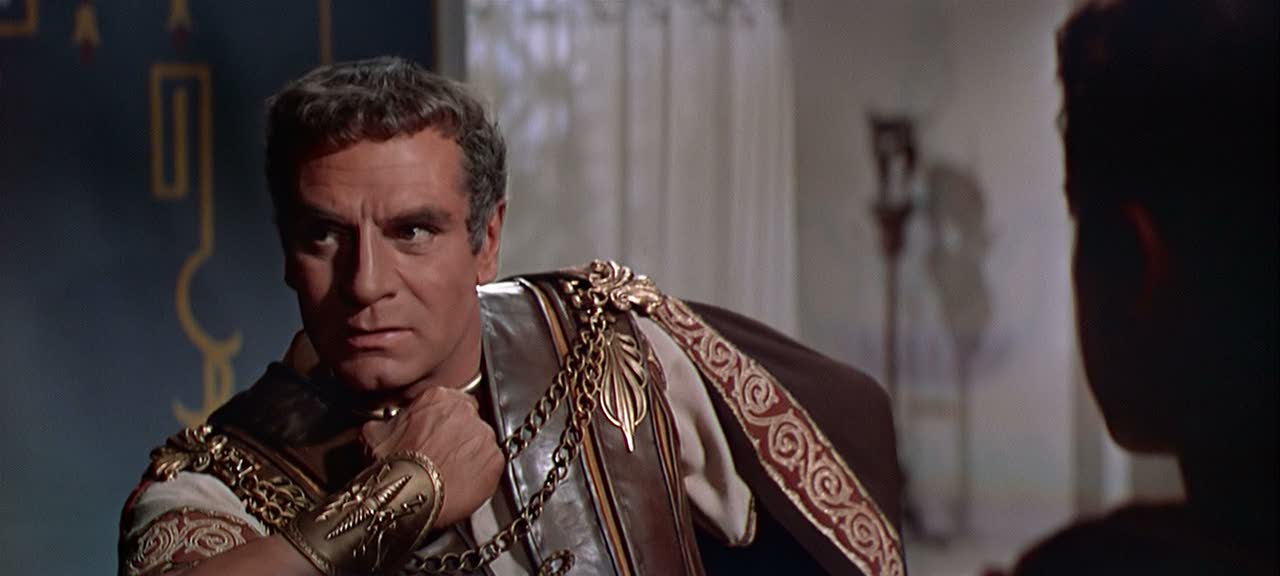
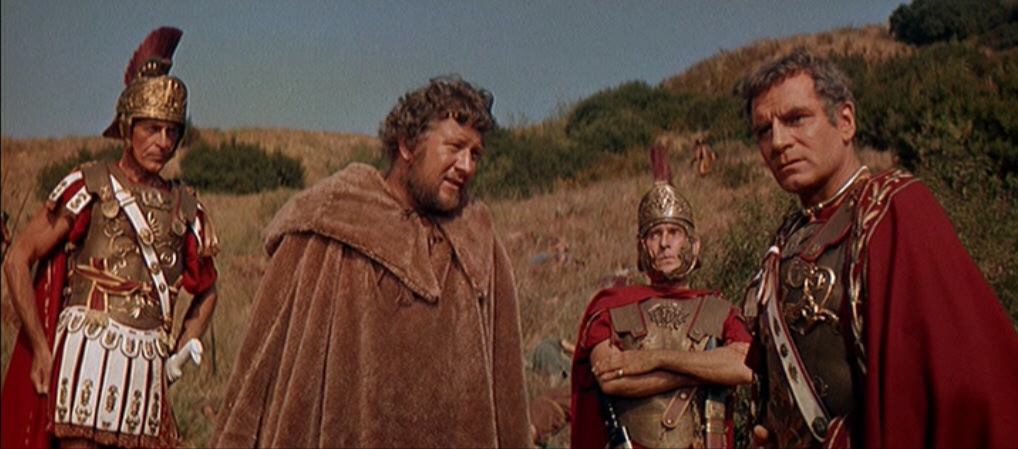
That’s probably why the film is more interested in the politics of the Romans. It’s certainly where the big name actors end up. Olivier is at his prowling, imperialist best – a heartless slice of ambition determined to bend events to his will. Against him, Charles Laughton with an impish cheek, a slightly corrupted air, as the man-of-the-people. These two conduct their own political battle of cut-and-thrust that Spartacus barely realises is happening. This manoeuvring is the real dramatic heart of the film, powered by these actors strengths (John Gavin and John Dall as their lieutenants look and sound very plodding against the playful archness of Olivier and Laughton).

That’s partly the point of Dalton Trumbo’s script (Douglas famously broke the Hollywood Blacklist by crediting Trumbo for his work on the film). While Rome plays politics, real people are fighting and dying for liberty – and will eventually find themselves crucified with nothing left but their pride and sense of freedom. It’s that feeling that probably lies behind the enduring love for this film.

It is perhaps Kubrick’s most universally beloved film. Interestingly though, it’s also the one Kubrick was least proud of. It’s true the film lacks much of his personal touch. While directed with flair and skill, parts of it could really have been made by any number of directors (not something you could say, for example, about The Shining or Barry Lyndon). Kubrick often quietly, albeit gently, disowned the film (he said he never knew what to say when people asked him about it). It’s the only Kubrick film where he was a “gun for hire”, subservient to the vision of the producer. His interest you feel is in the smaller moments – moments such as Woody Strode’s excellent cameo as a Gladiator (many of the strongest moments with the slaves in the tyranny of the Gladiator school, where life is meaningless and cheap). Really, it’s Douglas’ film – it’s similarities to The Vikings for example is striking – and while a poor advert for auteurism, it’s still a great advert for entertainment.

Kubrick’s greater interest in human failings and shades of grey perhaps explains why the Romans emerge as the more interesting characters. Spartacus’ lack of flaws were an intense frustration to him. Perhaps that’s why Peter Ustinov (who won an Oscar) is the films stand-out character. As gladiator owner Batiatus, Ustinov is devious, playful, amoral, ambitious, without principle, dryly witty but somehow still has touches of decency. The most colourful character in the piece is also the one most coated with shades of grey.

*It’s an advert for what makes Spartacus lastingly engaging and interesting whenever you watch it – even if the cry of “I’m Spartacus!” and the decency and honour of the slaves is always going to be what stirs the emotions and tugs the heartstrings. Douglas set out to make one of the greatest “sword and sandal” epics. He succeeded.