Tag: Charles Parnell

Mission: Impossible: The Final Reckoning (2025)

Mission: Impossible: The Final Reckoning (2025)

Cruise’s final mission is really a tribute to the star himself and his never-ending force of will

Director: Christopher McQuarrie

Cast: Tom Cruise (Ethan Hunt), Hayley Atwell (Grace), Ving Rhames (Luther Stickell), Simon Pegg (Benji Dunn), Esai Morales (Gabriel), Pom Klementieff (Paris), Henry Czerny (Eugene Kittridge), Angela Bassett (President Erika Sloane), Holt McCallany (Serling Bernstein), Janet McTeer (Secretary Walters), Nick Offerman (General Sidney), Hannah Waddingham (Rear Admiral Neely), Tramell Tillman (Captain Bledsoe), Shea Whigham (Briggs), Greg Tarzan Davies (Theo Degas), Charles Parnell (Richards), Mark Gatiss (Angstrom), Rolf Saxon (William Donloe), Lucy Tulugarjuk (Tapeesa)
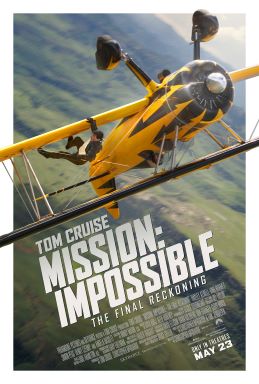
Almost thirty years after the first film trotted into the cinema, Tom Cruise signs off (he claims) his franchise of death-defying stunts with a final entry that dials the global threat up so far you can almost hear the desperate whirring as the doomsday clock tries to keep up. Mission: Impossible: The Final Reckoning is big in every single way, packed with set-pieces, dense procedural plot mechanics that require reams of exposition, global annihilation round every corner and at the centre the towering, chosen-one aura of Ethan Hunt himself, the only man who can save the world.

The Final Reckoning takes off a few weeks after the now-rechristened Dead Reckoning (after it under-performed they didn’t want to scare people off with a Part 2 subtitle). AI demigod The Entity is hellbent on gaining control of the world’s nuclear arsenals so that, having presumably binged Terminator, it can SkyNet-like wipe out humanity. Ethan (Tom Cruise) is on the run, but he has a plan. Dig out the sunken Russian sub where the Entity was ‘born’, fish out its source code, hook it up to an Entity-killing virus and trap the AI would-be-overlord in what’s essentially a glowing USB drive. This mission will involve lots of running, fighting, defusing of nukes, diving to the bottom of the ocean, jumping between bi-planes mid-flight… he might as well chuck the kitchen sink as well.

Mission: Impossible: Final Reckoning has plenty of fun, even if it is hellishly overlong. It’s the sort of crowd-pleaser that gets people clapping at the end (as several people in my packed-out screening did). When the stunts come, they’re hugely well-staged. As always the Tom Cruise USP is front-and-centre: if you see him do it, he did it. Yes, Tom really did jump out of a naval helicopter into the raging Atlantic. Yes, that really is Tom, climbing over a speeding bi-plane thousands of feet-up with only a pair of goggles to keep him safe. It’s no-coincidence the villain is an AI who creates an artificial digital reality. The Mission: Impossible films are all about it keeping it solidly real.

But, once the initial adrenaline rush subsides, I’m wondering if its pumped-up thrills are going to be a bit more wearing second-time around. What struck me about The Final Reckoning is, that for all the huge amount of stuff going on, there is precious little heart in it. More than any other M:I film since the little-loved M:I:2 (practically the only film in the franchise not to get a shout-out here), the act of saving-the-world here is a job for one never-wrong superhuman. Cruise does almost everything, his team’s main role being getting into the right place to send him a message or wire up a computer. On top of that, the best of the series set-pieces had flashes of Ethan’s stress, fear and sense of ‘I cant believe I have to do this’ humour – all of that is mostly missing here.

The Final Reckoning loses a lot of the heart of what made the earlier films so rewarding. It loses the moments of friendship or sparky interplay between the team. Cruise and Pegg, the series main comic relief, share almost no scenes together. Klementoff and Davies do virtually nothing as new team members, other than shoot guns and get captured. Cruise shares more time with Atwell, but the bizarre is-it-a-romance-or-not between them is as oddly undefined as Ethan’s relationship with Rebecca Ferguson’s Elsa was (in fact it makes you realise the most sexual thing Ethan has done since film three is hold someone’s hand). Cruise is so often on solo missions, that the film could probably have dispensed with the team altogether with only a small plot impact.

The film only affords to slow down to give Ving Rhames (the only other guy to appear in every film) a moment of genuine emotion – though special mention must go to Rolf Saxon and Lucy Tulugarjuk who from small moments craft characters I genuinely grew attached to and worried about. Otherwise, the bonds of friendship that powered the franchises most successful non-stunt moments are absent. In fact, also missing are the heist caper set-pieces – even the famous face-masks are only employed very briefly.

The Final Reckoning dials the stakes up so much, they are effectively meaningless. In previous films, high-stakes were mixed with personal ones: we were always more invested in whether Ethan save his friends rather than the word. The film also struggles without a real antagonist. Its nominal human opponent, Esai Morales’ Gabriel, little more than a smirk and an obstacle. Shorn of the most-interesting element of his character – his fanatical loyalty to his AI master – Gabriel is neither particularly interesting or a threat. In its vast runtime, Final Reckoning has no time to actually explore what the personal link between Ethan and Gabriel actually was, making you wonder why on earth they bothered to put it in both films in the first place.

It’s not helped by the fact that the film is so constantly in motion, that virtually every single scene of dialogue is about communicating what’s going to happen next. There are constantly (admittedly skilfully batted around) conversations explaining why Ethan has to go there, get this, bring it here, do this to it, put it in that all within a ridiculously small window of time. Sometimes, to shake it up, we cut across to the US bunker where a gang of over-qualified actors (Bassett, Offerman, McCallany, McTeer and Gatiss) similarly explain what the Entity is doing to each other. (Although, like Rhames, Bassett gets the most interesting stuff to actually act as a President facing a Fail Safe like terrible choice).

What you realise is that The Final Reckoning is pretty confident that what really pulls the audience in is Tom Cruise doing crazy stunts, so that’s what it gives us. In fact, rather than a tribute to the series (despite closing plot points from Missions 1 and 3) what the film really feels like is a tribute to Cruise, the last man-standing among the old-fashioned superstars. Most of the dialogue puffs up Cruise’s Ethan into Godlike status (it’s not quite “living manifestation of destiny” like Rogue Nation put it, but close). Cruise carries out two extended fight scenes in his pants (though if I looked like that at 61 so would I). No other actors intrude on his stunts or messianic sense of purpose.

Which is amazingly done of course. Literally no-one does it better than Cruise. The fact that the movie feels like Cruise effectively shot most of it alone with just the crew, means it almost doesn’t matter that its plot is merely to link together set-pieces. And if someone deserves a victory lap – which is what this is – then that guy is Cruise. I’d have wanted more of the fun, humour and warmth that made most of the other films such massively rewarding hits. But The Final Reckoning gives more of what the series does that no other series does. And I guess that’s a fitting finale.
The Killer (2023)

The Killer (2023)

Fincher’s lean, spare film is a perfectly constructed thriller and an intriguing character study

Director: David Fincher

Cast: Michael Fassbender (The Killer), Tilda Swinton (The Expert), Charles Parnell (The Lawyer), Arliss Howard (The Client), Kerry O’Malley (Dolores), Sophie Charlotte (Magdala), Emiliano Pernia (Marcus), Gabriel Polanco (Leo), Sala Baker (The Brute)

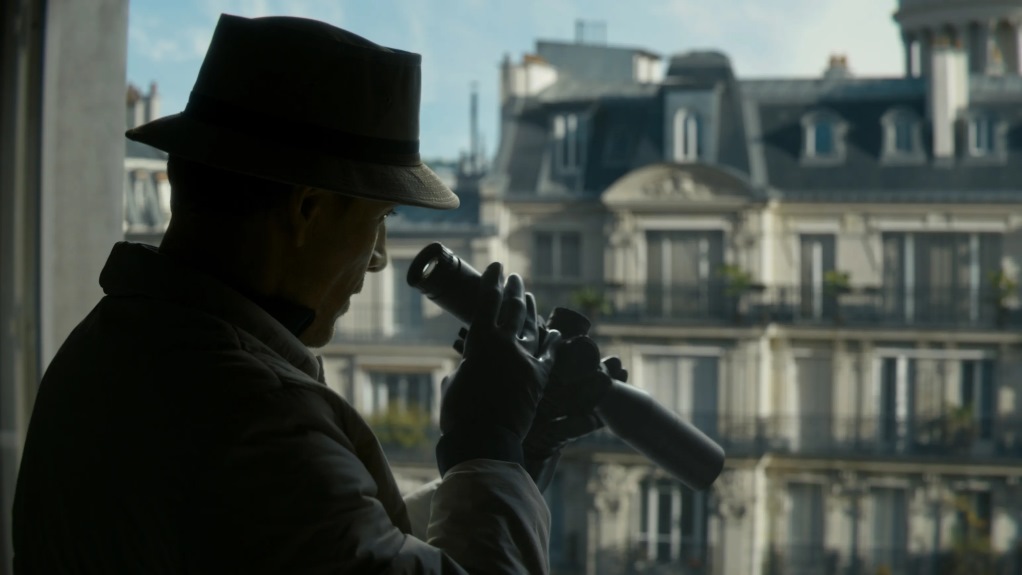
A man sits in monastic silence, starring out of a window at the best hotel in Paris that money can buy. He moves only to sleep, exercise with a monotonous rigour and consume a carefully calculated daily calorie amount from McDonalds. He wears gloves all the time, never moves from the sheeting he lays across surfaces and sometimes assembles and reassembles his rifle. He’s a nameless hitman for hire (Michael Fassbender) and a freak accident on this job will shatter his world of pristine order and leave him hunted by his employers and on a campaign of revenge to guarantee his safety.

The Killer is a lean, slimmed-down thriller full of Fincher’s love for procedure and detail, that delights in every beat of its detailed look at how a professional killer might go about his daily business. Be it lock-ups crammed with mountains of equipment, from guns to false number plates and endless zip-bound folders of fake IDs (all using character names from 70s and 80s TV shows) to the practised ease with which he penetrates even the the highest security building with an Amazon purchased card copier and light-fingered pick-pocketing. All of it assembled with Fincher’s pin-point precision and clockwork eye for detail.

On the surface, you might expect The Killer to be a sort of twist on Le Samouri, Melville’s look at a zen-like hitman. The Killer seems to fit much of the bill. Embodied with an athletic suppleness by Fassbender (his body seems to be almost elastic in the parade of physical stretches and exercises he performs, not to mention the fingertip press-ups he relentlessly pumps his whipper-thin body through). But Fincher gives us a seemingly never-ending insight into the Killer’s inner-mind, via a prolonged (near continuous) monologue of his inner thoughts, ideologies and mantras that dominate much of the film (the first twenty minutes plays out in near on-screen silence, just watching Fassbender and listening to his voiceover).

What’s fascinating is this interior monologue is only a shade away from a stream of corporate middle-management think. (It’s even implied the Killer was originally recruited while training as a lawyer). There are mantras with the air of an assassin’s version of positive thinking (“Stick to your plan. Anticipate, don’t improvise. Trust no one. Never yield an advantage. Fight only the battle you’re paid to fight.”) and passive-aggressive demands to hit a personal standard (“Forbid empathy. Empathy is weakness. Weakness is vulnerability.”). Far from the glamour of an unknowable force acting to a mystical code, this Killer sounds alarmingly similar to a self-doubting white-collar worker using Sun Tze to plan out his pitch meetings.

Beneath the sheen of Fincher’s beautifully dark film, is the suggestion we are watching a character study of a man perhaps only partially aware that his life, and his inner picture of who he is, is falling apart. For starters, despite his mantra of perfection and continued assurance of ‘every detail covered’ and ‘every angle anticipated’, our Killer makes a host of errors. Almost everything we see him do goes wrong in some-way: from that initial hit that takes out the wrong target, to stabbings that leave victims bleeding out faster than he intended, doses of knock-out drunks that are incorrectly calculated, house invasions that fail to surprise the victim… The mantra is clearly an ideal not quite a reality and the Killer’s greatest strength actually turns out to be his ability to improvise in unexpected circumstances.

In addition, for all he maintains he acts only professionally and things are never personal, the entire film chronicles a campaign of revenge in which he takes out a host of targets for personal reasons. The idea of the killer as a man separate from connections is already shattered from his obvious distress, returning to his home in the Dominican Republic after his botched hit, to find his girlfriend seriously assaulted and hospitalised. Michael Fassbender’s mastery of micro-features throughout the film, suggests waves of doubt and insecurity flooding behind the eyes of a man who has tried to master himself as an unfeeling violent limb of faceless masters.

As such, The Killer is a sort of pilgrim’s progress of a man discovering small, unexpected elements of himself while as impassively as possible knocking off anyone he considers a threat (effectively anyone who might know where he lives). No attempt is made in this to make the Killer entirely sympathetic – he ruthlessly kills at least one completely innocent person, and doesn’t hesitate to murder those he has identified, no matter how much he might sympathise with them.

But the monastic chill he aspires to is cracking. You can see it in his conversation with “The Expert” played with a mix of relish and resignation by Tilda Swinton. A professional killer like him, the Expert has not let this stand in the way of “a normal” life outside her trade. She’s married, is a popular regular at a posh restaurant and has achieved a level of compartmentalism the Killer can only dream of. Is the envy and self-doubt in his eyes as he listens to her emotionally articulate reflection on the life they have chosen?

Fincher’s film quietly explores this alongside some skilfully assembled sequences. In many ways the film mirrors its lead character: limber, dedicated, obsessive, executing its sequences with clockwork exactitude and following a fit-bit like a metronome. But it’s also a dark character study of a man (perhaps) realising how empty he has made himself, drowning out doubts with the music of The Smiths. Fassbender is the perfect actor for this, few matching his skill to be both blank and overflowing with suppressed emotion at the same time.

It makes The Killer a fascinating film, a Fincher film that feels at first like a minor work but offers more and more depths for reflection. On one level an auteur John Wick, which brilliantly outlines each trick of its expert lead character. On another level, a sort of dark character study of a man in the midst of an epic breakdown, falling back on mantras and mottos, processing his doubts and guilt through the only thing he really knows how to do: kill people.

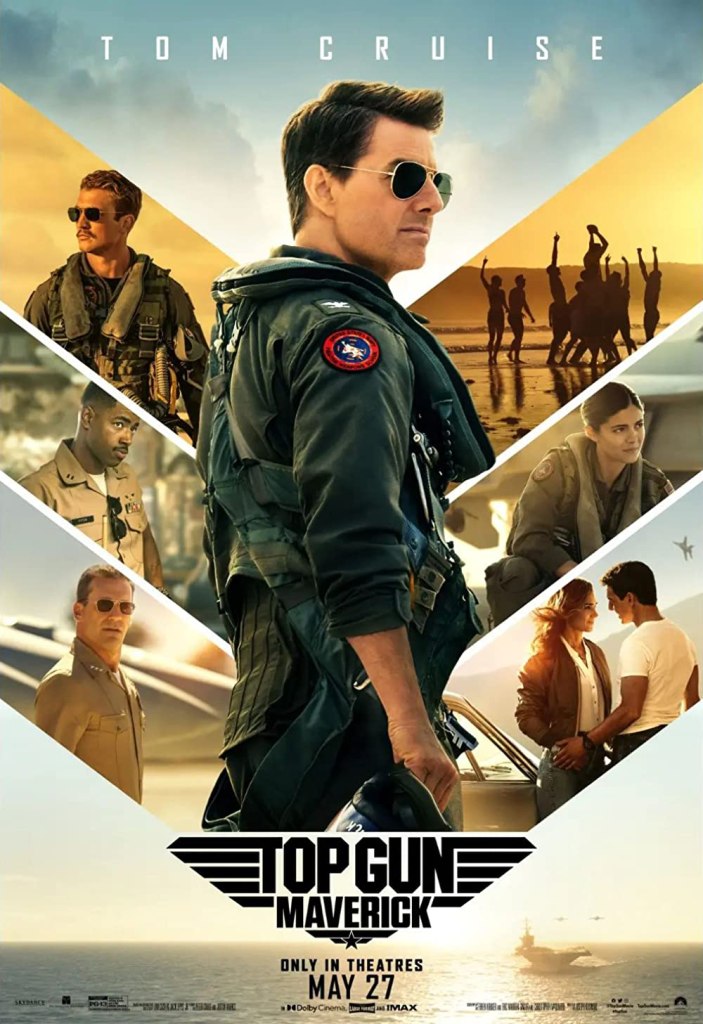
Top Gun: Maverick (2022)

Top Gun: Maverick (2022)

You’ll feel the need for speed in this triumphant better-than-the-original sequel

Director: Joseph Kosinski

Cast: Tom Cruise (Captain Pete “Maverick” Mitchell), Miles Teller (Lt Bradley “Rooster” Bradshaw), Jennifer Connelly (Penny Benjamin), Jon Hamm (Vice Admiral Beau “Cyclone” Simpson), Glen Powell (Lt Jack “Hangman” Seresin), Monica Barbaro (Lt Natasha “Phoenix” Trace), Lewis Pullman (Lt Robert “Bob” Floyd), Ed Harris (Rear Admiral Chester “Hammer” Cain), Val Kilmer (Admiral Tom “Iceman” Kazansky), Charles Parnell (Rear Admiral Solomon “Warlock” Bates)

It’s been 38 years since Tom Cruise last felt that need for speed. Top Gun is a sentimental favourite, partially because its the ultimate brash, loud, Reaganite 1980s Hollywood film. But (whisper it), it’s not actually – and never has been – a very good film. Perhaps though that’s all for the best: Top Gun has so little of merit in it, it offers an almost completely blank canvas for a sequel. It helps the team create Top Gun: Maverick, a film so insanely entertaining it should carry some sort of health warning.

Decades have passed and Pete “Maverick” Mitchell (Tom Cruise) is pretty much the greatest pilot in the world, deliriously skilled at everything in the cockpit and pretty much hopeless at anything outside it. He’s distrusted by all his superiors except his old wingman Iceman (Val Kilmer). Thanks to Iceman he is selected to train the next generation of pilots at TOP GUN for an impossible mission to take out a nuclear plant in a “hostile nation” (clearly Iran). One of that next generation is Bradley “Rooster” Bradshaw (Miles Teller), son of Maverick’s late best friend “Goose”, the guilt for whose death Maverick never recovered from. After Maverick tried to prevent Rooster from following in his father’s footsteps – not able to stand the thought of being responsible for the deaths of both his surrogate brother and son – can the two overcome their problems?

Top Gun: Maverick was delayed from hitting cinema screens for nearly two years thanks to Covid. Cruise resisted all opportunities to sell it to streaming: a decision vindicated by the supreme big-screen entertainment it offers. This one you really do need to see on the big screen. Its aerial footage is so stunning it makes the original look like tricycles on training wheels. Combined with that though, and unlike the original, Maverick has a thoughtful and engaging emotional storyline, with characters who change through well thought out emotional arcs.

But I’ll be honest, the staggering, visceral enjoyment of these plane sequences is probably the principal thing you’ll immediately take out of the film. Working from a training programme partly devised by Cruise, the film shows the impact of punishing G-forces by… actually putting the actors in planes travelling at these huge speeds. Unlike Top Gun, with its blue-screen cockpit shots, there is no doubt Cruise, Teller et al are actually in the planes as they bank at impossible speeds. Partially shot by the actors themselves – sitting the camera up in their cockpits – the film literally shows you the scenery flashing by. It’s Cruise’s mantra of doing it for real taken to a stunning degree. It’s the simple old-fashioned joy of knowing almost everything you see is real.

The mission this time is far more detailed: effectively it’s a steal from Star Wars, our heroes required to fly through a narrow ravine (below the radars of surface to air missiles) before climbing a steep bank and using their laser targeting to successfully blast a small access port. (It won’t surprise you to hear that on the final mission one character has to “use the force” when their targeting laser fails). Maverick’s training programme pushes the pilots to the limit, while his extraordinary flight skills quickly win their awe (in the first session he challenges all the pilots to take him down in a simulated dogfight, with everyone shot down doing 200 press-ups – Maverick does zero, everyone else 200+). Kosinski shoots with a cool clarity that makes you feel you are being punched by G-force.

But Top Gun: Maverick would just be a showcase for cool planes without its emotional heart. And it’s the intelligent and involving story that makes it work. Cruise is at his charismatic movie star best as Maverick – he knows exactly how to win the audience over – but his cocksure confidence is underpinned by a growing sense of fear at the risks he puts others through. Unlike the navy, his main concern is to get the pilots back alive and his guilt-ridden treasured memory of Goose is the hallmark of a man who never managed to put ends before means. He’ll take any risk himself, but balks at taking chances with anyone else’s life.

It’s what drives his troubled relationship with Rooster. The two have a surrogate father-son relationship, fractured by Maverick’s attempt to keep Rooster safe out of the cockpit. (Pleasingly, Rooster does not hold Maverick responsible for his father’s death, only for derailing his career.) The relationship between these two – Cruise’s Maverick quietly desperate to rebuild some sort of familial connection and Rooster shouldering resentment for a father-figure he clearly still loves – is handled with a great deal of tact and honesty. It really works to carry a wallop.

It’s also part of how Maverick’s place in the world, and decisions in life, are being questioned. As made clear in a prologue where he thumbs his nose at a sceptical Admiral (no one scowls like Ed Harris) by taking a prototype jet out for test run, he’s both a relic and a guy who doesn’t know when to stop (he wrecks the jet by pushing past the target of 10 Mach by trying to go another .2 faster). Unlike Iceman – a touching cameo from a very ill Val Kilmer that leaves a lump in the throat – Maverick never fit in within a military organisation (“They’re called orders Maverick”). He’s lonely, his past failed relationship with Jennifer Connelly’s Penny just one of many roads-not-taken. (There is no mention of Kelly McGillis’ character.) In a world of digital drones, he’s an analogue pilot flying by instinct: his days are numbered.

This is proper, meaty, thematic stuff explored in a series of involving personal arcs which by the end not only leaves you gripped because of the aerial drama, but also genuinely concerned about the characters. I can’t say that about the original. Top Gun: Maverick is not only a thematically and emotionally richer story – carried with super-star charisma by Cruise – than the original, it’s also more exciting and more punch-the-air feelgood. This sort of thing really is what the big screen is for.