
Tag: Cherry Jones

The Eyes of Tammy Faye (2021)

The Eyes of Tammy Faye (2021)

Transformative make-up can’t quite cover up this slightly empty film

Director: Michael Showalter

Cast: Jessica Chastain (Tammy Faye Bakker), Andrew Garfield (Jim Bakker), Cherry Jones (Rachel Grover), Vincent D’Onofrio (Jerry Falwell), Mark Wystrach (Gary S Paxton), Sam Jaeger (Roe Messner), Louis Cancelmi (Richard Fletcher), Gabriel Olds (Pat Robertson)
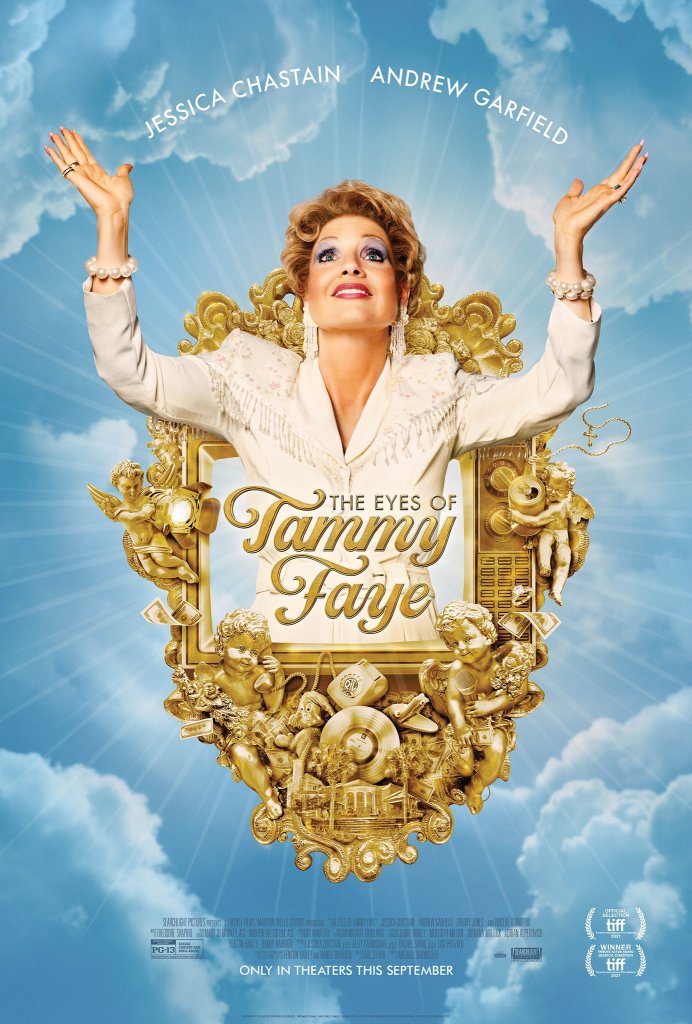
In the twentieth century, what better way to spread the Word of the Lord than television? The Eyes of Tammy Faye follows the lives of Tammy Faye Bakker (Jessica Chastain) and her husband Jim Bakker (Andrew Garfield), who co-founded the evangelical TV network, PTL (Praise-the-Lord). The network is a huge success but their marriage flounders, until both collapse when Bakker is convicted of embezzling millions from the network’s on-air fundraisers.

At least that’s what I found out what happened when I looked the Bakkers up. Narratively, The Eyes of Tammy Faye is a mess that often fails to make either events, or their impact, clear. Part of this might be legal worries – the film skirts around accusations of rape made against Bakker, fudging it as unspecified, unsavoury allegations from an ex-employee – but for the embezzlement, something Bakker was convicted for, there’s really no excuse. It’s genuinely hard to tell exactly how this crime happened or worked – the Bakkers’ life falls apart in the same way it rose, via a swift, stylishly assembled montage of headlines and soundbites.

Perhaps the film is unclear because it’s worried if there was too much information about precisely what happened, it might look like Tammy Faye was in on it. The film wants so much to make clear Tammy had no idea where all the money comes from, it has to keep us in the dark as well. Instead, it settles for being a sympathetic portrait of Tammy Faye, a genuinely nice person who stood out in the 1980s evangelical scene for focusing on the love of God, rather than all the social and political trends right-wing Christians wanted to let people know God definitely hated.

Despite aiming to be as sympathetic as possible, the film ends up rather short-changing her. Tammy argued to keep politics out of religion, uncomfortable with growing links with the Republican party and Reaganism. Even more admirably, she believed God loved gay people as much as he did anyone else, and that meant it was God’s will to love and support the gay community during the AIDS crisis. This was an almost unique – and brave – viewpoint. Tammy hosted AIDS sufferers on her show and, Princess Diana-like, urged an end to the prejudice and fear of those diagnosed with the disease. No one at the time with a similar public image was saying the same thing.

But the film boils this down to a single scene with Tammy hosting a Christian pastor AIDS sufferer on her TV show, and a couple of throw-away remarks from hissable bad guy, Reverend Jerry Falwell (a menacing Vincent D’Onofrio). The principle behind making such a stance gets lost, as does her life-long dedication to supporting the gay community (she ended up as a regular guest at Pride marches). The film is so focused on showing us she’s a nice, decent and kind person it doesn’t bother to show the principles behind her views.

It offers no explanation for how a woman whose whole life was steeped in conservative religious views interpreted Christianity so differently to nearly everyone else around her. It has no interest in the grit it must have taken to take this stance. Instead, it largely turns her into a candyfloss doll who loves everyone all the time because goshdarnit she’s so sweet.   

You could make a really interesting film here about a turning point in the politicisation of religion. Christian movements were flexing their muscles and pushing a conservative domestic agenda, heading down a road that would lead to violent debates on sexuality and abortion. The film could have used this life-story to explore these developments within the evangelical community. It flunks this opportunity, setting up goodies and baddies, skipping out details and draining a film that arguably should have been about politics into one that barely explains them.

It settles for being a conventional, safe and predictable cradle-to-grave biography about a nice person who gets in (unknowingly, of course) over her head, in a marriage to a man corrupted by fame. Jessica Chastain – winning a generous Oscar in a weak year – is lovable and perfectly captures the persona of Tammy Faye, but essentially just ticks off the expected biopic tropes. Andrew Garfield gives excellent support as her naïve husband, seduced by fame and money and confusion about his sexuality. (Another flunk of the film is never linking Tammy Faye’s support for the gay community with her obvious awareness of her husband’s suppressed feelings.)

The film won a second Oscar for its impressive make-up and hair, which transforms Chastain’s facial features (she did about 3-4 hours in the chair everyday) and plumps out Garfield’s face. It’s a trap the film gets seduced into: fascinating recreations of TV moments and appearances, that never really gets under the skin to help us understand either of the Bakkers’ at all.

Erin Brockovich (2000)

Albert Finney and Julia Roberts battle for justice in the caperish Erin Brockovich

Director: Steven Soderbergh

Cast: Julia Roberts (Erin Brockovich), Albert Finney (Edward L Masry), Aaron Eckhart (George), Marg Helgenberger (Donna Jensen), Tracey Walter (Charles Embry), Peter Coyote (Kurt Potter), Cherry Jones (Pamela Duncan), Scarlett Pomers (Shanna Jensen), Conchata Ferrell (Brenda), Michael Harney (Pete Jensen)

When Steven Soderbergh was being celebrated as the Great White Hope of arty American movie making back in the late 80s, it would probably have amazed his fans if you’d told them that 10 years later he would be directing a Julia Roberts star vehicle. But that’s what he pulled off to great effect in Erin Brockovich

Telling the true story of Erin Brockovich (Julia Roberts), the film follows her life from 1993 when she is struggling to make ends meet while bringing up three small children. After losing a court case – largely due to her brassy foul-mouthedness – she pressures her lawyer Ed Masry (Albert Finney) to give her a clerical job at his law firm. There she finds herself engaged with a simple real estate case involving PG&E, a major gas and electric company. Discovering the company has been polluting the water of the town of Hinkley in California – and left many residents with crippling health problems – Brockovich works to uncover the truth and to gets Masry to agree to build a legal case. She also finds her mouthy down-to-earthness allows her to connect with the people of Hinkley, and she soon becomes determined to get them justice.

The big thing that Erin Brockovich was about when it was released was Julia Roberts. In 2000, it was hard for heads not to be turned by seeing America’s Sweetheart wearing clothing so revealing and provocative it made her Pretty Woman character look reserved. And she swears! Frequently! The film was a triumph for Roberts, turning her from a romantic comedy queen into a serious actress. Roberts won every single Best Actress award going, up to and including the Oscar. And Roberts is very good indeed in the role. Few films have used her effervescence and warmth as a performer so well. You can’t help but side with Julia Roberts when she is firing on all cylinders, no matter what the situation – whether she is a brassy, chippy working mother, a Hollywood actress or a New York City prostitute, you find yourself on her side. 

But, looking back at the film now, this role essentially plays to all of Robert’s strengths. While it looks on the surface like a radical departure for Roberts, the film is basically very much in her wheelhouse. In fact, the whole film is almost a writ-large version of that shop scene in Pretty Woman (still one of the best scenes of modern cinema) stretched over the course of a whole movie. Julia Roberts is treated badly by snobby people, she doesn’t let it get her down, and then she returns with a triumphant flourish that puts the snobs in their place. 

That’s the whole game from Roberts: this is very much the type of performance she gave in Pretty Woman, Notting Hill and My Best Friend’s Wedding repackaged and given a novel appearance by being placed in a drama rather than a comedy. But all the little acting touches that would be familiar to you from those movies are there. There is nothing wrong with any of this, but the film in fact reinforces rather than refutes the idea that Julia Roberts (like Cary Grant) is largely a personality actor. She has a very skilful and impressive collection of acting touches, but they are pretty consistently the same across films. She performs with brilliant, luminous presence here – and commits fully to the part – but it’s more like the ultimate expression of the roles she played in the 1990s. It’s not a surprise looking back that she’s not had a hit like it since.

The rest of the film is an enjoyable mix of comedy and touches of tragic sadness. Soderbergh packages the film as a very safe entertainment, and its’ entertaining. The real Erin Brockovich claims the film is 98% accurate to what happened to her – which perhaps just makes you think that the clichés of film hew closer to real life than you might expect. Soderbergh doesn’t really have much to say here beyond big corporations and snobbery being bad and to never judge books by their cover. But it doesn’t really matter as the whole thing is presented with a confident, brassy buzz as if it is channelling Brockovich straight into celluloid.

It works all the time because you care about Erin, and you enjoy her company. It touches on some issues around sexism in the work place – although Erin is looked down as much for her working class roots as her sex – but there are elements there showing she is clearly judged by her appearance, and even the big firm lawyer brought in help fund the case can’t resist saying when he sees her “I see what you mean about a secret weapon”. Not that Erin herself isn’t ashamed to use her assets – when Ed asks how she can get people to allow her access to such confidential papers, she deadpans “they’re called boobs, Ed”.

That gives you an idea of the general comedic tone of the movie. It’s matched with a fairly predictable domestic plot-line. I suspect Soderbergh was probably making a bit of a point by turning Aaron Eckhart’s (very good in a nothing role) gentle biker, next-door neighbour, childcare provider and boyfriend into the sort of pleading “Honey please come home for dinner” non-entity that the woman often plays in films like this while her husband crusades. The film does manage to mine a bit of quiet sexual agenda from its otherwise fairly bubbly surface. It also draws attention to the way the film basically sets up Erin’s primary romantic relationship being not with a boyfriend, but with herself as she discovers the sort of person she has the potential to be.

There’s that Pretty Woman parallel again. The film is basically a dreamy re-invention saga, presented with a cool flourish. Roberts is excellent in a role that has become a calling card. She’s also got quite the double act with Albert Finney, who is brilliant as the put-upon, slightly haggard, slightly twinkly Masry who finds his own passion for justice reignited. Finney tends to get overlooked in this film, but he is superb and gives the best pure performance in the film. Soderbergh directs with a professional glossiness, and supplies plenty of heart-tugging victims (Helgenberger is very good as the main victim we see) mixed with punch-in-the-air, she’s proving herself better than them moments from Julia Roberts. It’s a very fun film, and genuinely entertaining. But like Roberts’ performance, it’s presenting old tricks in a new way, not reinventing the show.