Tag: Chloé Zhao

Hamnet (2025)

Hamnet (2025)

A powerful film about grief that works best in its smaller moments rather than its grand ending

Director: Chloé Zhao

Cast: Jessie Buckley (Agnes Shakespeare), Paul Mescal (Will Shakespeare), Emily Watson (Mary Shakespeare), Joe Alwyn (Bartholomew Hathaway), Jacopi Jupe (Hamnet Shakespeare), Olivia Lynes (Judith Shakespeare), Justine Mitchell (Joan Shakespeare), David Wilmot (John Shakespeare), Bodhi Rae Breathnach (Susanna Shakespeare), Noah Jupe (Hamlet)
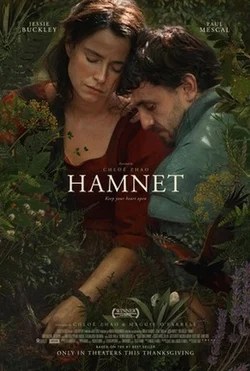
“Grief fills the room up with my absent child”. It’s possibly one of the most profound things said about grief and loss. Naturally, it came from Shakespeare who, more than any other writer, could peer inside our souls and understand their inner workings. Grief can strike anyone, and overwhelm them, leaving them hollowed out husks, uncertain how to carry on. It’s a terrifying force that grows to dominate Chloé Zhao’s adaptation of Maggie O’Farrell’s literary best seller: how it creeps, unexpectantly, into lives that are contented and happy and works to tear down their foundations.

Hamnet imagines the emotional impact of the death of a young boy on his parents: those parents in this case being Will (Paul Mescal) and Agnes (Jessie Buckley) Shakespeare. The film takes us from courtship to marriage, Agnes pushing Will to follow his dreams in London, the birth of their children and death’s seizure of their son Hamnet (Jacopi Jupe). It will have a deep impact on their lives: for Agnes a world of grief and isolation, for Will a cathartic injection of his grief into his new play, Hamlet.

There are many things in Hamnet that work extremely well, not least it’s strong emotional force. Much of the film’s second half is extremely moving, a lot of that from the gentle build of its first half. Grief isn’t an expectant force – it bursts, unannounced into lives. The first half of Hamnet is romantic and optimistic. Will and Agnes’ courtship, two awkward outsiders in a small, rural town, is touchingly portrayed, full of awkward gestures and flashes of joy. Their marriage – over the objections of many, but with the endearing support of Agnes devoted brother, played with real heart by Joe Alwyn – is very happy and they have delightful children who they love very much.

There are tensions: it’s tough to live under the roof of Will’s parents. His father John (David Wilmot) is an abusive bully, his mother Mary (Emily Watson, on excellent empathetic form under a harsh exterior) judgemental. Will is desperate for something more than being a second-rate glove-maker. It’s actually sweet that Hamnet interprets their living apart not due to marital troubles, but a recognition that their love doesn’t need constant contact. Will’s need of London’s bustle is balanced by Agnes’ desire for nature and (ironically) to protect her children from the disease-ridden big city.

It’s the first hour’s playful, graceful unfolding that makes much of the second half hit home. Zhao’s film has an ethereal romanticism, with the camera gliding with patient, unobtrusive warmth around Agnes and Will. While dealing with raw emotions, Zhao brings a sense of magical realism to the film without overplaying her hand. A large part of Agnes outsider status is based on perceptions of her as a witch, who spends her time in the forest building her herbal knowledge (Zhao introduces her with a phenomenal birds-eye shot, nestled womb-like in the roots of a large tree), trusts her dreams and has formed a deep link with a pet hawk. This other-worldly presence in Agnes, carries across in the film’s vibrant, dreamy nature – and shows why Agnes is so drawn to the shy, awkward poet, who similarly feels most alive in his own visions and dreams.

It makes the second half particularly impactful, as the truly shocking death of a child (surely one of the most traumatic child deaths put on screen, devoid of peaceful, Little Nell-like beauty and with Hamnet suffering in prolonged, agonising pain) rips into the happy haven of this life. Zhao’s compassionate distance works brilliantly here, as the film brings us into the pained lives of these bereaved parents, without every once making us feel like intruding voyeurs. Instead, we feel every blow of the film’s perfectly observed exploration of the mundane reality of grief.
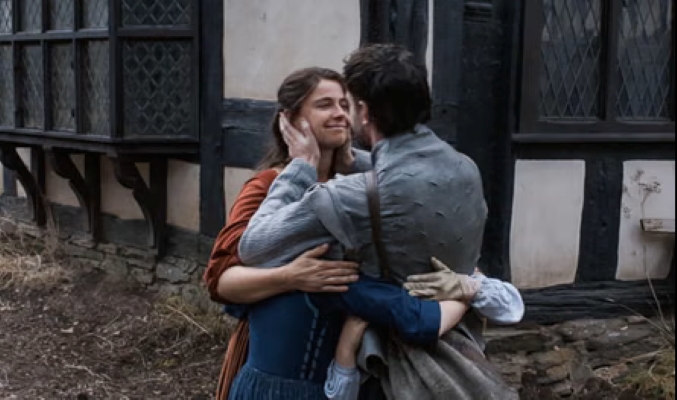
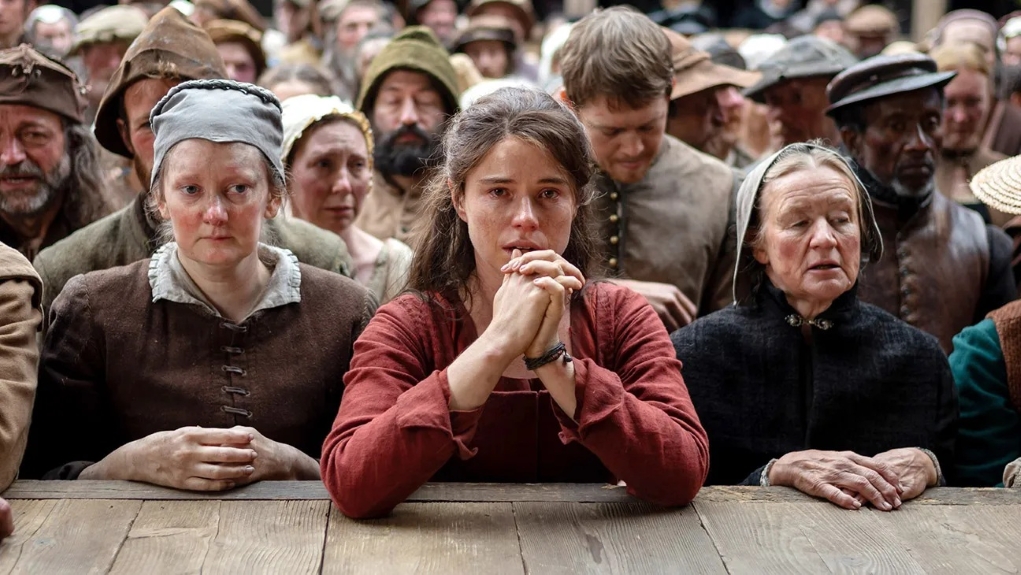
A lot of that is also due to Jessie Buckley’s searing performance as Agnes. Buckley is perfect as this slightly jagged, eccentric but determined women who knows her own mind and refuses to bend to others, full of an earthy romanticism. Her vulnerability is there – there is a very moving moment during her twin’s birth, when Buckley rests her head on Watson’s shoulder and weeps pitifully for her (deceased) mummy. But it doesn’t prepare us for Buckley’s perfectly judged raw emotionality. From an agonised, near silent scream at Hamnet’s death, Buckley shifts brilliantly into a shocked quiet whisper that she must tidy up the mess. Over the next few scenes, she collapses into herself, berating her husband with cold fury, wanting him to feel as paralysed with grief as she is. This is a fabulous performance by Buckley, well-matched by Mescal, whose pained soulfulness is perfect for a man processing grief through drama.

But I found the transition of this grief into the creation of Hamlet strangely less moving and more contrived. I’ve always found the attempts to use Shakespeare’s work to fill historical gaps in his biography tiresome. Hamnet studiously ignores that the role was played first by the middle-aged Richard Burbage, rather than a young actor – Noah Jupe, brother to Jacobi playing Hamnet – resembling the late Hamnet. Hamnet carefully re-cuts and selectively stages scenes of Hamlet to present it solely as the tragedy of a lost, sensitive soul. Lord knows what the emotionally enthralled Agnes made of the parts of Hamlet the film doesn’t stage: Polonius’ murder, the abuse of Ophelia, Hamlet making “country matter” gags and so on. Fundamentally it’s a lazy conceit that art can only come by replicating someone’s real experience and is presented in an obvious way designed to score straight-forward emotional points.

Hamnet gets so much right, it hurts that it doesn’t always work. There is an emotional anachronism to the central concept that didn’t land with me: was Hamlet just an inspired, cathartic therapy session for Shakespeare (unlikely since he ripped the plot from an older Danish legend called Amleth)? It lifts me out of things, just as the production and costumes frequently feels a little too clean, a little heritage (even more so considering the raw emotions). Moments of dialogue don’t quite ring true and little things like Shakespeare’s swimming ability (a skill possessed by virtually no one in Tudor England) or its coy dance around confirming Agnes’ historical illiteracy that jar. I’ll also confess I’m irritated by the film’s carrying across of the books conceit in avoiding naming Shakespeare for as long as possible (for almost 100 minutes), while making it clear from quotes throughout exactly who Mescal is playing.

But of course, I know, it’s an emotional fantasia, so perhaps it doesn’t matter that it feels like something shot on a National Trust property. When Zhao’s poetic, observational realism works, it carries real impact. There is a moment at the film’s end when a mirrored overhead shot with the film’s opening, and a look of such radiant hope crosses Buckley’s face, you forgive the manipulative and obvious musical choice accompanying it. Hamnet works best, not in its final showboating act, but in the raw, quiet, everyday moments that show both happiness and grief it gets close to an emotional force that leaves a lasting impact.

Nomadland (2020)

Nomadland (2020)

Poetic and surprisingly moving, this Best Picture winner is light on plot but deep on meaning

Director: Chloé Zhao

Cast: Frances McDormand (Fern), David Strathairn (Dave), Linda May, Charlene Swankie, Bob Wells, Peter Spears, Derek Endres

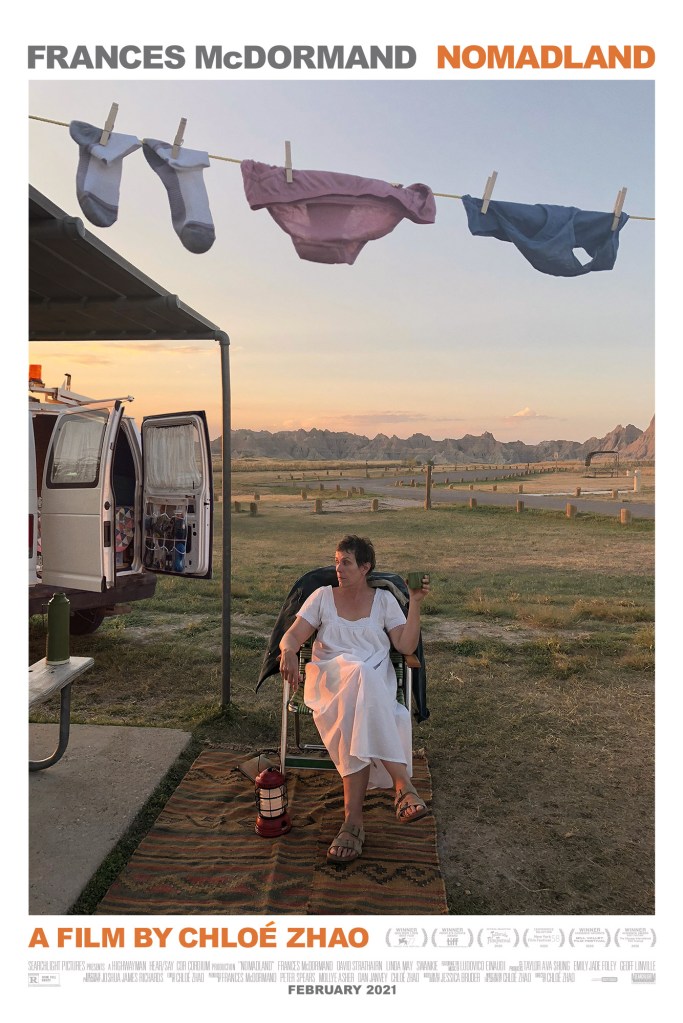
We all have ideas about what life should look like in the 21st century. Settled job, dream home, the rooted life. It’s what we are expected to be working towards – but it’s not for everyone. Nomadland, Chloé Zhao’s Malick-influenced road movie explores the lives of those who decide to live off that beaten track. The modern nomad, who chooses flexibility to move their home from place to place and don’t want to be tied down by bricks-and-mortar. It makes for a meditative, soulfully poetic film with a quietly mesmeric power.

Fern (Frances McDormand) is recently widowed, childless and has lost her job after the gypsum plant in Empire, Nevada closes. But, far from down-hearted, Fern is determined to lead a new life without the fixed commitments of her old one. She sells most of her possessions, kits out a van as a travel home and begins to drive across the country, taking seasonal jobs as and where she stops. She finds herself part of a warm and supportive community of nomads, who help to learn how to flourish in this unconventional home life.          

Nomadland winning Best Picture is as close as the Oscars have come to giving an award to Terence Malick. It’s hard not to feel his influence over the camera’s languid worship of the beauty of the Badlands, or its characters quiet searching for higher in life, via a communing with nature. Zhao’s film is a very effective and surprisingly moving character study, with only the smallest smidgen of a plot, but full of feeling. Radiantly shot by Joshua James Richards, it finds an orange-tinged beauty in a dawn and dusk and tiny moments of joy in rain falling in your face. All contrasted with the dull oppressiveness of buildings, those four walls shutting out nature.

Zhao’s film goes a long way in challenging neat assumptions we might have about this lifestyle. “I’m not homeless I’m houseless” Fern states and she politely – but firmly – turns down well-meaning offers of charity. The decision to move from place-to-place is not one enforced by poverty or failure. Instead, this is a rich, vibrant, supportive community that looks out for each other and share a legitimate (and refreshing) view of the world. Who says you need to spend your life chasing the dollar and building up a debt to have a fixed slice of real-estate you can sort of call your own?

This is particularly true in our post-recession world. Nomadland starts with the final collapse of an industrial community, now a ghost town. Many of the nomads find seasonal work that is often manual and low-skilled. Fern’s first job (of many) is working at an Amazon dispatch location, where jolly team leaders burst with enthusiasm met with smiling indifference by the (often older) staff. Fern’s travel is shaped around moving to key locations for seasonal work – Amazon, a campsite, a short-order chef job, beet processing… The economic situation is poor, but this is a way of playing the system to get a higher level of freedom, without debt or financial pressures.

It’s a key subject of a talk given to fellow nomads by Bob Wells, an influential advocate of the nomad life-style (one of any people playing versions of themselves). It’s part of a series of events at a nomad event – a sort of convention – where people gather to share experiences, advise and life-hacks. Ever needed to know how to change a tyre or what size bucket you should use for your built-in toilet? Wonder no more! On the road people come together in a way they never would in more regular life. With everything transient and nothing fixed, friendships and connections are more intense, constantly in that first glow of excitement.

That’s the pay-off of choosing this lifestyle. Everything is transient. Close friendships form, but you might not see the other person for months at a time. While phones help you to keep in touch, day-to-day you see completely different people from place-to-place. It will never be completely clear where you might be to your family. However, the short-lived intensity of connections can lead to a closeness and intimacy that might otherwise take months – a friend of Fern’s confides she has terminal cancer but regrets nothing, with a warmth and trust that would normally takes years to form not weeks.

It’s implied as well that the more short-lived intensity of friendships fits more with what the slightly taciturn and guarded Fern wants from life. Frances McDormand makes her friendly, ready with a smile, good company – but she is always slightly reserved and guarded. She will give sympathetic ears and invite confidences. But she is also a woman determined to live by her own rule. Having lived most of her life in one place in a happy marriage, a conversation with her sister (who bails her out with a loan to repair her van) reveals she was always prone to not look back when a decision was made. It’s the same with deciding to live on the road as moving to Empire – Fern knows her own heart and mind, and will fully commit to that.

This is despite temptations, the main one she faces being David Strathairn’s (the only other professional actor in the film) Dave, a fellow nomad who makes no secret of his romantic interest in her. Sweetly played by Strathairn, Dave pursues Fern and dangles the possibility of a more fixed and traditional life. They are close, but Fern has lived that life of marriage and rejected already the idea of a family. And, as McDormand makes clear in her soulful eyes, if that life was ever on the cards, it would have been with her husband not this new man, nice as he is.

Nomadland, like Fern, can see the dangers and problems. A van breaking down in the middle of nowhere is a major danger, a broken plate a potential disaster – Fern painstakingly reassembles it, not wishing to spend the money to replace it. Low temperatures and bad weather can make it uncomfortable – although she (smilingly) rejects an offer from a garage owner to sleep inside. But it also understands living this lifestyle is a legitimate choice, filled with rich possibilities. You only need to see Fern joyfully travel to the coast or get wrapped up in the embrace of the vibrant community she finds on the road to see that you could do immeasurably worse with your life.

Zhao’s film has a documentary realism to it, that comes from its deep immersion in real nomad communities. It makes copious use of real nomads playing versions of themselves, giving a rich feeling of authenticity to every moment. It also means we gain a real understanding of the idea that goodbyes are never final in this world, that there is always the prospect of seeing someone again “down the road”. The film’s poetic empathy, its warmth and the vibrant humanity of its characters makes it film that creeps up on you and has a surprising, but profound, power.

Eternals (2021)

Eternals (2021)

A cast of diverse actors are totally crushed in this pompous, dull Marvel film

Director: Chloé Zhao

Cast: Gemma Chan (Sersi), Richard Madden (Ikaris), Kumail Nanjiani (Kingo), Lia McHugh (Sprite), Brian Tyree Henry (Phastos), Lauren Ridloff (Makkari), Barry Keoghan (Druig), Don Lee (Gilgamesh), Harish Patel (Karun), Kit Harington (Dane Whitman), Salma Hayek (Ajak), Angelina Jolie (Thena)

It must have seemed like a good idea at the time… Marvel had already turned one little known gang of superheroes into a huge hit with The Guardians of the Galaxy. World defining stakes had been the core of most of The Avengers films. An ensemble cast of diverse actors were pulled together with an acclaimed (and now Oscar winning!) director at the helm. They only forgot one thing: to make the final film interesting, engaging or feel in any way original.

Our heroes are a group of very serious God-like Aliens called Eternals, who have been sent to Earth thousands of years ago by even more God-like Celestrial Aliens to protect humanity from savage monsters called Deviants. By 1521, the Deviants are defeated and our heroes are left unsure of what to do. Ordered to never interfere in the events of humanity, they go their separate ways and settle down into life on Earth. But in the present day the Deviants return – and the Eternals start to uncover dark facts about their mission.

All of this takes place over a runtime which feels pretty bloody eternal itself. Essentially the film opens with an info-dump, then spends a couple of hours getting the gang back together (interspersed with occasional additional info-dumps) before the inevitable final-act smackdown to save the world. The stakes have arguably never been higher: but with the film’s indolent pace and thinly sketched characters it sure-as-hell doesn’t feel like it. There is a lot of uninvolving world-building and its ends up feeling every bloody minute of its epic runtime.

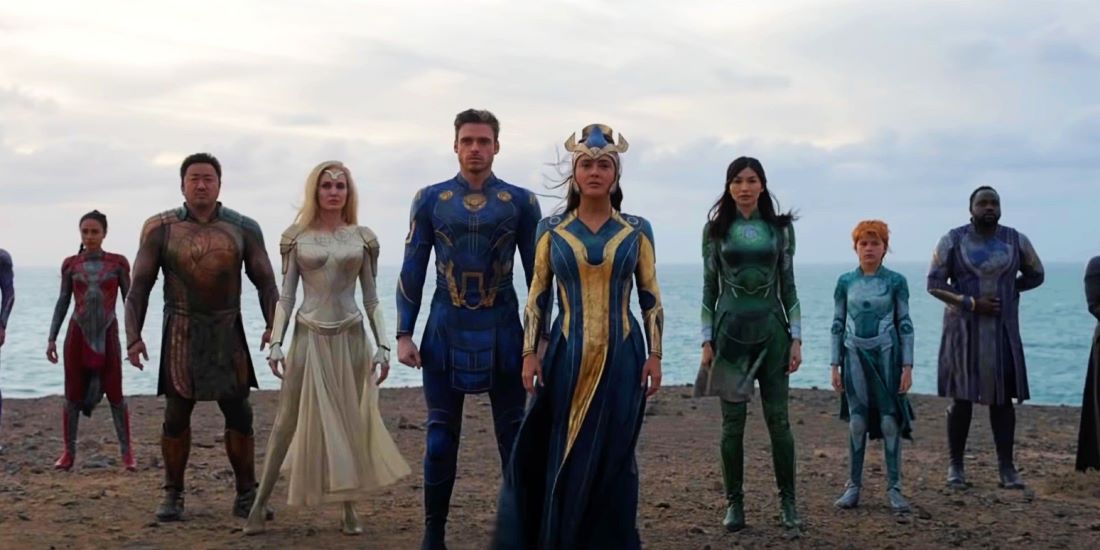
With its group of characters, essentially a loving family that has fallen out, this should really be an intimate, character-driven film. But it never balances the huge cast, the epic action and building relatable characters swiftly. Instead the Eternals rarely seem like anything more than heavy-handed sketches defined by basic character traits: a caring empath, a warrior princess, a slightly austere would-be-leader, a mentor destined to die, an eternal child frustrated about never growing up, a natural showman, a cold mind-controller, a deaf athlete and a gay guilt-ridden inventor. The cast (as very proudly trumpeted in its marketing material) is on paper the most diverse ever in Marvel. But it’s like simply making it representative was enough and they didn’t need to bother creating rich, engaging and multi-faceted characters.

All of them are squashed into a film that really feels like it could have been made by anyone. For all Zhao’s occasional indie visual beauty, this is totally free of authorial voice, with completely routine action set-pieces. There is the odd joke, but Zhao’s attempt to put her own mediative personality on the film only really ends up making the bits between the fights dry and boring. Put quite simply, Marvel seems to have rather crushed any life out of her. We get endless solemn moments, as characters watch with horror the results of the development in mankind they have encouraged (from the genocide of the Incas to the bomb at Hiroshima). These nearly always feel on-the-nose and obvious. It all stems from Zhao failing to make us care about these characters.

So, when they find out they have been betrayed by their masters – that their purpose is to fatten the Earth for feasting, not raise it in good health – its rather hard to feel the impact of the betrayal. The film isn’t even smart, or daring, enough to acknowledge that the same manipulative Gods who have used the Eternals have done the same thing to the Deviants. The film continues to treat these as wicked killers, when in fact they are as much victims as everyone else. Would it have killed Eternals to acknowledge this for a moment, to explore the implications of this more?

Especially since it’s so bloody long. It takes almost two hours for the film to bring the gang back together. Each reunion with a new Eternal is basically played the same – a brief bit of banter and then a horrified reaction as they discover the truth. Which means we basically see versions of the same scene play out six times, with diminishing levels of interest. Can’t these guys conference call?

There is no momentum to this ever. Where is the pace? Where is the urgency? The Eternals have been told they’ve only a few days to save the Earth, but they seem to spend most of it ambling around chatting and catching-up. Even when the end-of-the-world starts, most of them still sit around starring at the middle distance sadly and bemoaning their lot. This – and soft spoken intensity and lackadaisical wandering – are constantly used by the film as a short hand for seriousness, a self-importance the film wears very, very heavily.

All of the actors get crushed under the weight of the film. Nanjiani stands out pretty much as the only one having anything approaching fun while only Lee gets to show some sort of warm, uncomplicated human connection. Keoghan, Ridloff and Henry do decent work, but the rest of the cast seem hampered by how very, very, very serious they need to be all the time. One of them, of course, is a wrong ‘un (you can make a pretty decent guess early on which in it will be), but they turn out to be the dullest most stick-up-the-butt character of the lot. Despite the huge amount of time we spend with them, lead characters like Chan’s Sersei and Madden’s Ikaris remain enigmas we can’t be bothered to find out more about.

Eternals is pretty much a failure. It’s long. It builds an expansive universe with a series of clumsy lectures and fails to make any of these interesting. It’s got long battle scenes which feel like several other films. It’s got no personality or vibe to it. It sets up the odd interesting idea then takes it nowhere. It makes the end of the world a massive yawn, while telling you it’s a hugely important and daring film (it’s neither of those things). You end up feeling this might be the most forgotten Marvel film since The Incredible Hulk.