Tag: Chris O’Dowd

The Program (2015)

Ben Foster is the disgraced Lance Armstrong in this functional but insight free biopic The Program

Director: Stephen Frears

Cast: Ben Foster (Lance Armstrong), Chris O’Dowd (David Walsh), Jesse Plemons (Floyd Landis), Lee Pace (Bill Stapleton), Guillaume Canet (Michele Ferrari), Denis Menochet (Johan Bruyneel), Dustin Hoffman (Bob Hamman), Edward Hogg (Frankie Andreu), Elaine Cassidy (Betsy Andreu), Laura Donnelly (Emma O’Reilly), Sam Hoare (Stephen Stewart)
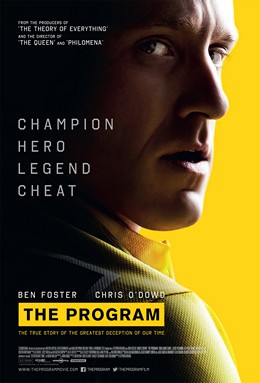
In sports there has probably never been an icon who fell so far as Lance Armstrong. Stephen Frears’ film reconstructs the story of Armstrong’s – played by Ben Foster – career, from finding his natural build and ability isn’t enough to win the Tour de France, through cancer diagnosis and recovery and then into his record-breaking run of Tour victories, all achieved off the back of running a comprehensive and professional doping system, and his final fall from grace.

Frears’ film is well-made and stylish and good at capturing the freedom and excitement of professional cycle racing. It’s also a skilled reconstruction of its time period, and a fairly well structured chronicle of events, which it reconstructs from journalist David Walsh’s (played here with a fine sense of moral outrage by Chris O’Dowd) book Seven Deadly Sins. Walsh had written stories for several years questioning Armstrong’s achievements, and Frears’ film puts together the events and testimonies that convince Walsh of Armstrong’s cheating with a documentarian skill.

Where the film fails though is its lack of drama and, crucially, its willingness to use dramatic and creative licence to attempt an exploration of Armstrong’s personality. What drove this cancer survivor to abuse his body with a parade of substances? How did Armstrong balance his passionate campaigning for a cure for a cancer with the lie he was presenting the world of how he didn’t just recover from cancer, he used it as a springboard to become the greatest endurance athlete in the world? Basically, what the film doesn’t really try to do, is get inside the head of its lead character.

Instead, the film follows its title: The Program. There is greater interest in the how of this cheating regime, not the why. Now perhaps in real life Armstrong is the shallow, narcissistic bully he often seems here, obsessed with winning at all costs with no moral quandaries at all. But it hardly makes for entertaining or satisfying drama. Foster is a brilliant physical match – and he captures the ruthless forward-drive of Armstrong very well – but this is a film that doesn’t really scratch the surface of what made Armstrong. We never get a sense of his motivations – or really his reactions as the world tumbles around him.

There is a fascinating story to tell here, but it’s almost as if the film is worried about giving this sinner some feet of clay we can sympathise with (to mix a few metaphors). Instead Armstrong is all chilled front and nothing underneath, and his villainy is so central from day one that we get neither a satisfying sense of a hypocrite unmasked nor of a Promethean fall from grace. 

Actually, Frears may well have been more interested in making a film where Jesse Plemons’ Floyd Landis was a central character – the devout Christian persuaded to take part in the doping scheme, who becomes Armstrong’s successor only to be immediately discredited in a way Armstrong would not be for years. It’s the tragedy of Landis that really has dramatic potential – a decent man who is well aware what he is doing is wrong, but is too weak to not accept the easy path to glory. It’s this story that has real dramatic potential – and might well have made a better focus for the movie.

The Program isn’t a bad film. It captures the drama of its sport well, and it brings together the events that led to Armstrong’s fall with professional skill. But it’s more of documentary than a drama and to be honest there isn’t much in it that couldn’t be picked up better from actually reading Walsh’s book. There was a lot of potential here – but it needed a film more willing to explore and understand its central character rather than just condemn him as a monster and move on.

Loving Vincent (2017)

Douglas Booth becomes a painting in the unique Loving Vincent

Director: Doreta Kobiela, Hugh Welchman

Cast: Douglas Booth (Armand Roulin), Jerome Flynn (Paul Gachet), Saoirse Ronan (Marguerite Gachet), Helen McCrory (Louise Chevalier), Chris O’Dowd (Joseph Roulin), John Sessions (Père Tanguy), Eleanor Tomlinson (Adeline Ravoux), Aidan Turner (Boatman), Robert Gulaczyk (Vincent van Gogh)

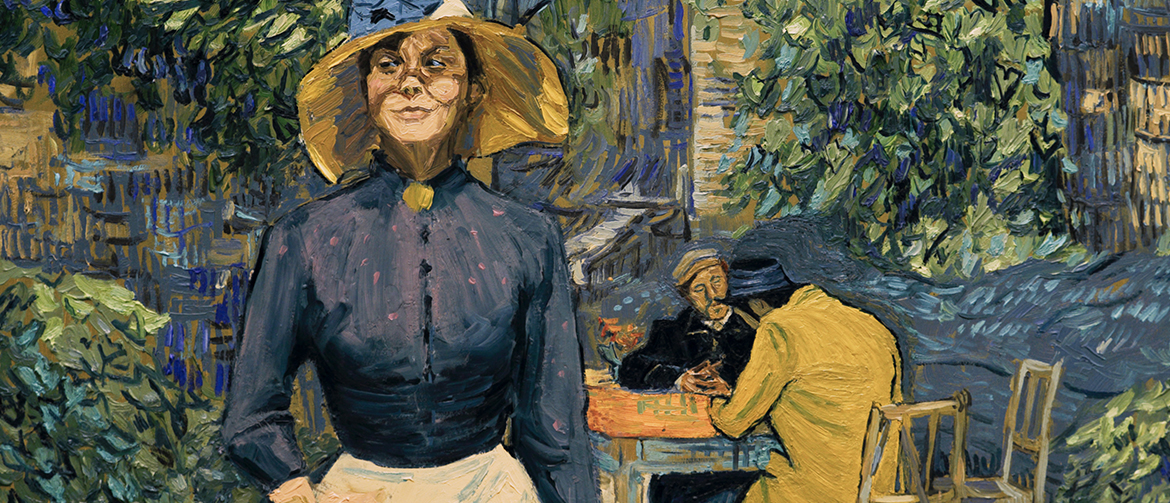
Now this is something very different. It’s a common turn of phrase to praise a well-photographed film by saying every frame looks like a painting. Well Loving Vincent is a film where every single frame is literally a painting. A beautifully painted pastiche collection of van Goghs, painted over a combination of motion capture and photographs of real locations. And, as you would expect, it is beautiful. 

The film covers events year after the suicide of Vincent van Gogh (Robert Gulaczyk). Armand Roulin (Douglas Booth) tries to deliver van Gogh’s last letter to his brother Theo. Roulin’s father Joseph (Chris O’Dowd) is also concerned that there is more to the death than meets the eye, as van Gogh had written to him that all was well in his life. Roulin travels first to Paris and then to Auvers-sur-Oise, where van Gogh spent his final days, talking to those who knew him, including his landlady Adeline Ravoux (Eleanor Tomlinson), his art supplier Père Tanguy (John Sessions), the daughter of his doctor Marguerite (Saoirse Ronan) and finally Dr Gachet (Jerome Flynn) himself. 

Loving Vincent looks simply beautiful. Its quality is astonishing. The film was shot on green screen with actors. Van Gogh’s paintings were then overlaid as backgrounds for the action. The film was carefully edited, then every frame in the final film was turned into a single hand painting – with real paint. 65,000 hand-painted frames. It’s astonishing – you’ve never seen anything like this before. The style, the homages to van Gogh, the respect and craft behind reproducing his distinctive look – it’s marvellous. Every single image in the film demands you linger upon it and soak it in.

I simply haven’t ever seen a film like this before. I can’t imagine any film like this being made again (for starters it took years to make). It demands to be seen if you have any interest in art or any interest in cinema as a visual artform. It’s so impressively done, you start falling in love with its artistry. It’s also got a poetic visual beauty to it. The flashbacks showing van Gogh’s last few days are put together with a black-and-white pencil-drawn style, which contrasts beautifully with the primary colours of the present day. The film walks a brilliant tightrope line between “real” and dreamlike wonder – final shots of van Gogh or sequences of Roulin dreaming feel like real visual expressions of inner thoughts in their greater expressionist vibrancy.

If there is a weakness to the film, it is that (whisper it) there isn’t much actually to it once you look past the visuals. It’s truly unique in look and feel but the story it delivers is fairly traditional and even (at times) a little flat. Despite being soaked in van Gogh I’m not sure you learn too much about him or his art from the film, and the film shies away from its more interesting topics. The dialogue or plotting rarely ventures above the average.

Perhaps one of the most interesting themes of the film is the struggle of the characters to understand and appreciate the difficulties of depression: that suffers can be optimistic one minute, and consumed with world-ending self-loathing the next. It would have been more interesting if the film had engaged more with this theme, rather than trying to build a rather flat murder mystery around van Gogh’s death. It also would have felt more true to the actual struggles of the artist – crikey, this material was spun out into an excellent Doctor Who episode, which feels like it managed to get more understanding of van Gogh than this film manages.

The acting however is pretty good – Douglas Booth anchors the film every well as the nominal detective figure, struggling with his own guilt over abandoning van Gogh. Saoirse Ronan is very good as a sad love opportunity lost for van Gogh, Eleanor Tomlinson radiant as his friendly hostess, Jerome Flynn tragically guilt-ridden and envious as Dr Gachet. It may not be a film that really gives actors the opportunity to let rip, but it’s still good.

The main question over Loving Vincent is whether there is enough to it to make it more than an art experiment, or a curiosity. Plot and storyline wise it’s a very traditional, rather straightforward film, but it carries a germ of depth in there. And then the film looks so uniquely marvellous that you can’t deny it a certain place in film history. Because you won’t see anything like this again, and if you have any love for the artist or art in general, you have to check it out. Every frame is literally a painting.

Molly's Game (2017)


Jessica Chastain and Idris Elba excel in Aaron Sorkin’s dynamically scripted Molly’s Game

Director: Aaron Sorkin

Cast: Jessica Chastain (Molly Bloom), Idris Elba (Charlie Jaffey), Kevin Costner (Larry Bloom), Michael Cera (Player X), Brian d’Arcy James (Brad), Chris O’Dowd (Douglas Downey), JC MacKenzie (Harrison Wellstone), Bill Camp (Harlan Eustace), Graham Greene (Judge Foxman), Jeremy Strong (Dean Keith), Angela Gots (B)

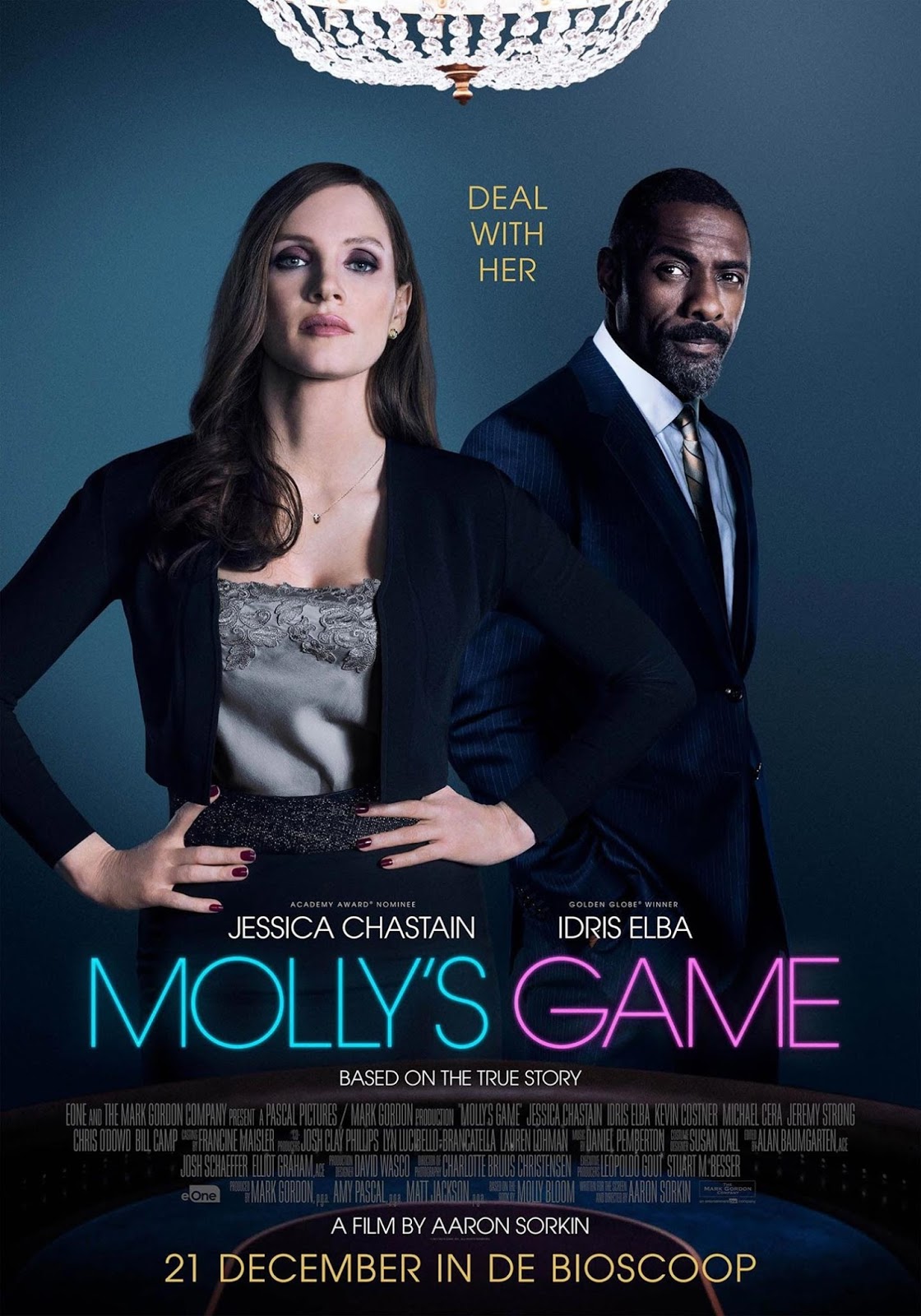
Molly Bloom (Jessica Chastain) is all set to join America’s Winter Olympics team, under the guidance of her ultra-demanding psychiatrist father Larry (Kevin Costner), when a freak accident ends her career. So she heads to LA and becomes embroiled in the world of high-stakes poker, eventually setting up and running her own high stakes games in LA and New York, earning millions. But, over a decade later (in a parallel plotline) she has had a millions seized and is battling against imprisonment for her connections to the mob, with only lawyer Charlie Jaffrey (Idris Elba) on her side.

Sorkin’s zippy new drama has plenty of sparkling dialogue – as you could expect! Sure this film probably also proves he’s not really a director (it’s over-long, a little flabby, and structurally not very clean) but the guy can certainly put a speech together. My main issue with Molly’s Game is I’m just not quite sure what its point is. Maybe it only exists to entertain, but it feels like it wants to put together a touching story about family, faith and the value of your word. I’m not sure it really manages to achieve any of this. 

The parallel plotlines don’t always do the film a lot of favours. The present-day plotline of Molly and Jaffey working to clear her from the various charges she has been accused of, continually hints at some serious gangsterism set-ups later on: largely these never really transpire. Actually, the film heads into pretty standard “my-Daddy-didn’t-love-me” territory. It shy’s away from being something different and interesting about excess and punishment into psychiatry solving our problems.

Sorkin doesn’t always get the structure right, as if he hasn’t got the patience to actually make sure the fundamental plot information was clear enough, so eager was he to get on with the verbal pyrotechnics. Time is spent carefully exploring several poker hands – but the exact nature of the illegality of what Molly does running her poker games gets glossed over in seconds. 

But then this is a film that isn’t really that interested in plot dynamics, or even in over-arching themes. What it’s interested in is sizzling dialogue, and letting actors deliver it. The camera sits back and watches. So it’s not a surprise the most memorable scenes feature Jessica Chastain and Idris Elba (both superb) in a room, talking (or arguing) with each other. It’s the moments like these where the film really works – and Sorkin the director basically stays out of the way, using a two-camera set-up to record the scenes, like a filming of a Broadway play. 

Those two actors dominate the film. Chastain is excellent as Molly – ambitious, driven, playful but also vulnerable and ever-so-slightly bitter, who gets where she is through her own intelligence and hard work. Chastain also embraces playing a character with such a strong moral code – she’s terrifically warm and human in the part. Elba is equally fine, a wry professional with his own strong moral code (yup, The West Wing writer still loves those liberals of great conscience), an articulate (of course!), passionate advocate who is far warmer than he first appears.

The rest of the film never quite lives up to this, maybe because the poker games are never really that interesting, or because the life Molly leads among the rich and famous seems ill-defined (she has possibly the least impactful drugs addiction seen on screen). For someone who remains loyal to the end to her clients, we are never really clear why other than a suggestion of her basic sense of honour. Her projects are all set-up with ease, and the film builds towards a solution buried in psychiatry speak that similarly feels a little too easy.

Because while it is great that Molly is not defined by a romantic relationship – she is defined by men in virtually every other way. Her entire career is based on pleasing rich, middle-aged men (from whom she frequently has to bat away expressions of devotion or sexual interest). Three times she falls victim to senior male partners in business relationships. Above all, she is defined by her relationship with her overbearing father (well-played by a low-key Kevin Costner). The scene where this comes to a head, a father-daughter exchange late at night on a snowy New York bench, is so well-written and played you almost overlook its pattness.

Sorkin’s script is the most important thing here – and the film is built around it. Like Scorsese’s Casino(a film he must have seen a couple of times!) most of its opening act is structured heavily around Chastain’s expertly delivered voiceover. The actors get to enjoy delivering his engaging rat-a-tat dialogue, the expert playing and sharp dialogue ends up carrying a lot of uplifting moments in the film. It’s a film that embraces Sorkin’s scripting, and doesn’t worry about being too filmic about it: the zippiest moments of editing are so because the dialogue or voice-over demands it.

Some of the roles aren’t quite so well drawn: Michael Cera is just plain miscast in a role that needed a young Rob Lowe as an absurdly glamourous Hollywood poker addict (I can’t imagine people crossing a street let alone a continent to play cards with Cera). The rest of the women in the script get short shrift – even Molly’s mother is little more than a walk-on part. 

Molly’s Game is a lot of fun, even if it’s probably about 15 minutes too long. It’s got some great dialogue and, if Sorkin turns out not to be the best interpreter of his own work, he’s certainly no dud as a director. Overall, the themes and plot don’t quite come together as well as they should. But it’s very well acted – Elba and above all Chastain are absolutely terrific – and it has more than enough sparkle to it for an enjoyable Friday night.