Tag: Christmas movies

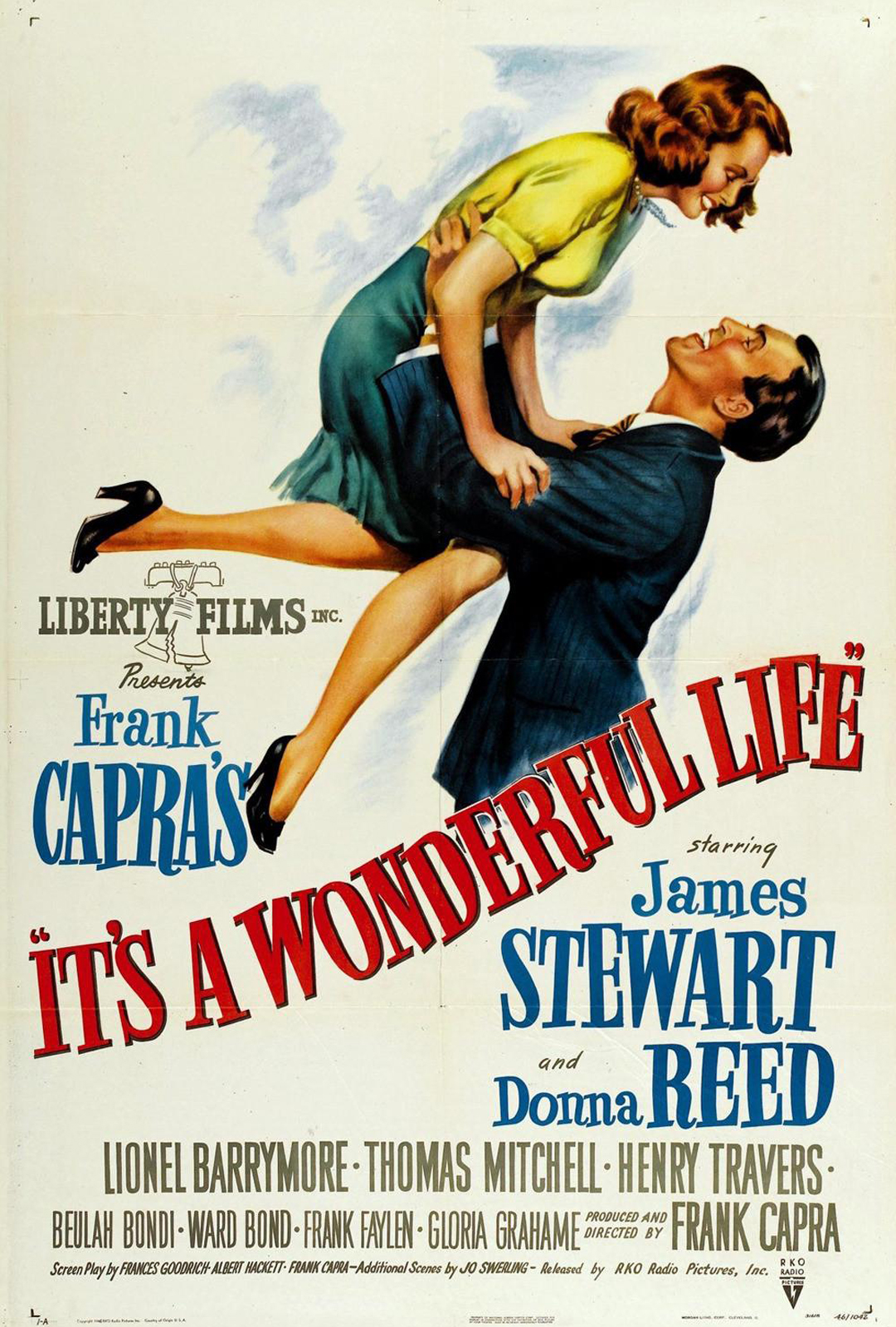
It's a Wonderful Life (1946)

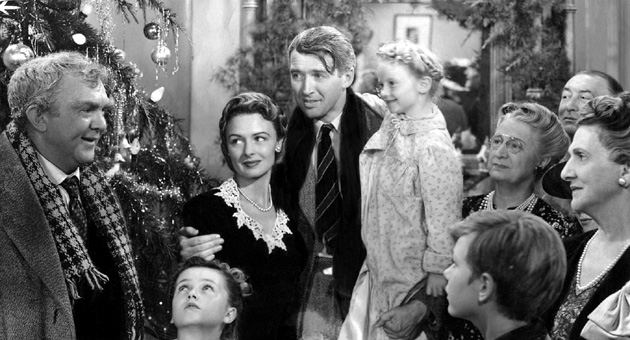
James Stewart discovers he has lived a good life in It’s a Wonderful Life

Director: Frank Capra

Cast: James Stewart (George Bailey), Donna Reed (Mary Hatch), Lionel Barrymore (Henry F Potter), Thomas Mitchell (Uncle Billy Bailey), Henry Travers (Clarence Odbody), Beulah Bondi (Ma Bailey), Frank Faylen (Ernie Bishop), Ward Bond (Bert), Gloria Grahame (Violet Bick), HB Warner (Mr Gower), Frank Albertson (Sam Wainwright), Todd Karns (Harry Bailey), Samuel S Hinds (Pa Bailey)
For many people it’s as much a part of Christmas as mince pies and Santa. Any list of the greatest Christmas films of all time – in fact any list of the most beloved films of all time – isn’t complete without It’s a Wonderful Life. Capra’s emotional, heart-warming, seasonal tale encourages us to take a breath and look at the riches in our life, to look past the surface frustrations and disappointments. It seems to have something to say to everyone. There’s a reason why it has been a staple of Christmas for decades.

The small town of Bedford Falls is a place George Bailey (James Stewart) has always dreamed of leaving for a life of adventure. However, circumstances always meant he has stayed in the town, running the family savings and loans business. He’s made a success of the business, raised a family with his wife Mary (Donna Reed – extremely good in an unshowy role), helped half the town into decent affordable homes, and changed his whole community for the better. So why is George standing on a bridge on Christmas Eve, contemplating throwing himself into the river? And will his guardian angel Clarence (Henry Travers) persuade him there are things worth living for?

Capra’s film is very easy to see as a wallow in sentimentality. Certainly, the film is in love with its image of small-town America, here a nirvana of folksy lightness where everyone knows everybody’s name. In reality, America as a whole, even at the time, probably had more in common with Potter’s grasping capitalism or the nightmare vision Clarence conjures of a neon-lit Potterville of loose morals and vice. But the film would never have worked if it was just sickly sentimental – or if it had been a cynical satire for that matter. Instead it works because it is overwhelmingly human, empathy dripping from every pore. It invests us deeply in this whole community and succeeds in making the viewer relate to them at every step.

This is partly because Capra has such a masterful skill for how the little touches can make a story come to life. The loose banister cap that Bailey keeps dislodging in his home. The drawing Donna has made of George’s offer to lasso the moon. The film is full of small moments of character, that create the over-whelming richness of a whole life. It’s also a story full of charm and genuine feeling for its characters, that understands the pain little griefs and small tragedies have.

Perhaps that’s also one of the reasons for the love people have for it. Because, let’s not forget, this is a film set on the darkest day of its lead character’s life, when he considers ending it all. One of the things I find the most touching about the film is that it never stigmatises depression, guilt or feelings of inadequacy. If someone as universally loved as George can look at his own life as a disappointment, and that this feeling is treated as both reasonable but also mistaken in the best way, it reassures as all not only that we shouldn’t feel guilty for feeling this but hopefully that we are as mistaken as George is. Failure is all in the perception – and It’s a Wonderful Life reminds us that perception is often unreliable when we turn it on ourselves.

Capra’s film relies strongly on our bond with George – so the casting of James Stewart in the role plays off perfectly. Stewart is quite simply superb, completely human and deeply moving. Capra provides Stewart with several striking set-piece speeches (all of which he delivers with aplomb). The entire film is essentially a riff on Stewart’s charm and likeability – but also his everyday quality, the sense that when we watch him we are looking at someone like us. Stewart makes Bailey honest, decent and kind. You can immediately see why people like him. His principles and sense of justice drive him every day to do the right thing – and what makes him such a deeply relatable character is that this so often flies in the face of his own desires and interests.
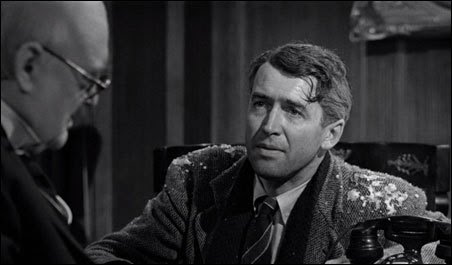
What Capra also understands – and taps into so well here – is the darkness in Stewart. Because someone so like us is surely as likely to suffer from  depression and disappointment as the rest of us. You can never forget this is a man who has dreamed his whole life of leaving this town, of making it as an architect, of forging a broader life for himself. He never wanted to be the pillar of the community and family man he becomes. There is disappointment in Bailey at every turn, however much he treats the world around him with warmth. This isn’t what he wanted. No matter if it has won him love and respect from all around him.

And who hasn’t ever felt that? But we know that deep down – even if he doesn’t always realise it – Bailey is happy with his lot. That if he didn’t care deeply about town, friends and family he would have left years ago. We know he’s a good man: that later he will deeply regret berating his poor befuddled Uncle Billy (a gloriously cuddly Thomas Mitchell) for losing $8k and losing his temper at his wife and children on Christmas Eve. There is a pain for us to see such a good man, a loving man, who we feel we understand, angrily ask his wife why they had so many children. Everyone has lashed out like George – and everyone has, at some time, looked at where their life is and felt “I could have been more than this”. Far fewer people have taken the time to look at all the good alone in their lives and what a good mark they have made on the world.

But that’s the genius of the film. Taking its cue from Dicken’s Christmas Carol (I’d also say Lionel Barrymore’s brilliantly hissable Potter is clearly a version of Bleak House’s vile moneylender Smallweed), effectively Clarence is the Ghost of Christmas Present, showing George what the world would have been like without him. Sure some of this is overblown – Potterville for goodness sake! – but the impact is those personal stories. The brother drowned as a child. The pharmacist imprisoned for manslaughter. The affordable homes never built. The family that never even existed. The mix of science fiction and classic morality tale helps us all to reflect – so many of us have people all around who care for us, whose lives would have not been as rich as they are without us, however much we may disappoint ourselves at times.

That’s perhaps behind the love for the film. It’s about hope, while never closing its eyes to despair. It recognises that sometimes we are not happy – and it tells us that that’s okay, so long as we don’t lose hope. It encourages us to take a look at ourselves in the round and to appreciate the whole picture, not just a part of it. You can call that sentimentality if you want – but at Christmas time this message of hope and love is sometimes exactly what you need.

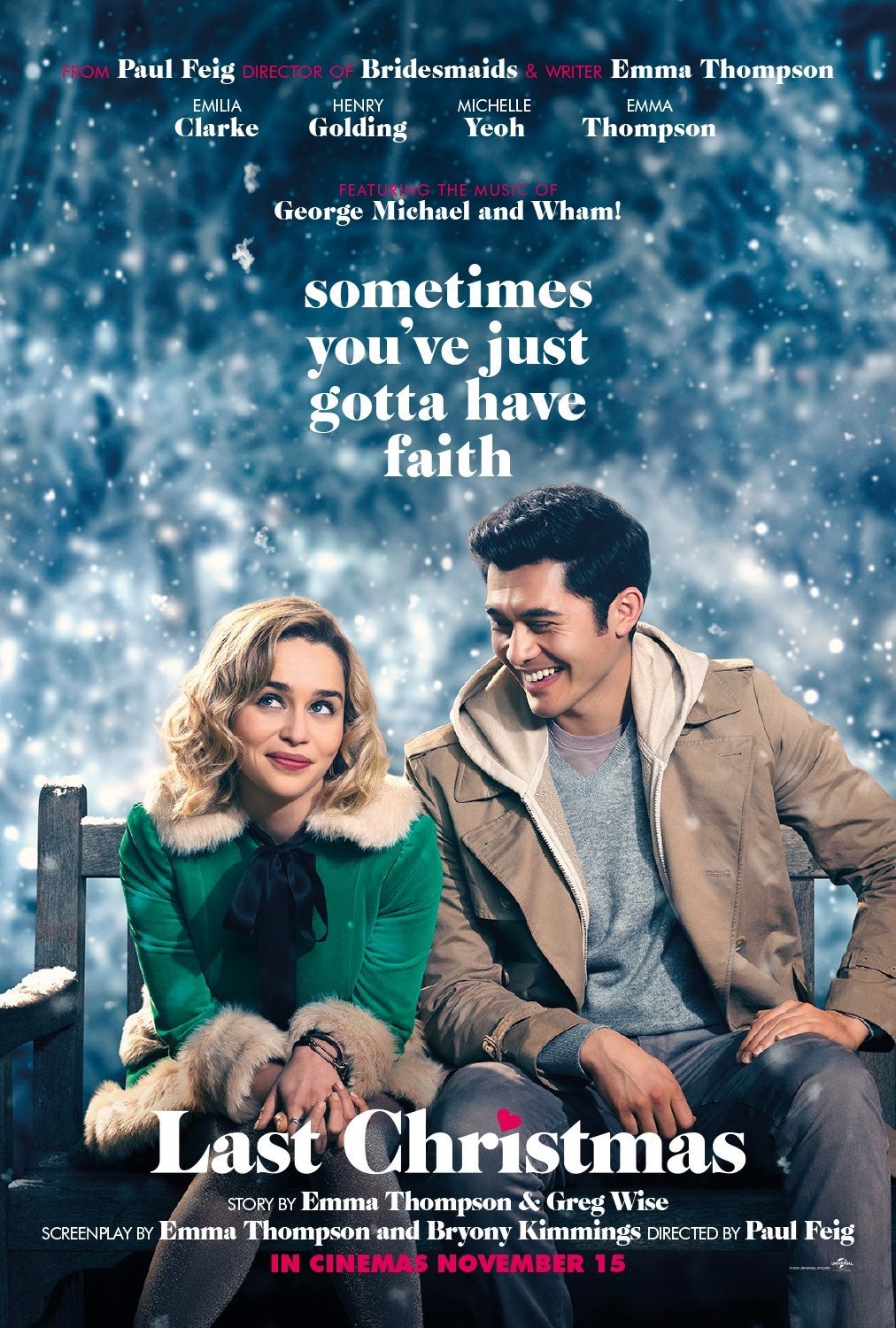
Last Christmas (2019)

Emilia Clarke and Henry Golding in a Christmassy romance with a twist

Director: Paul Feig

Cast: Emilia Clarke (Kate), Henry Golding (Tom Webster), Michelle Yeoh (“Santa”), Emma Thompson (Petra), Lydia Leonard (Marta), Peter Mygind (“Boy”), Rebecca Root (Dr Addis), Patti LuPone (Joyce), Ingrid Oliver (PO Crowley), Laura Evelyn (PO Churchill), Rob Delaney (Director), Peter Serafinowicz (Producer)

Last Christmas has been savaged by critics and held up by many like it was some sort of embodiment of everything that’s wrong with cinema. Jeez louise guys, take a chill pill why don’t you? Feig’s London based comedy, working with an Emma Thompson script, does exactly what it says on the tin – an It’s a Wonderful Life-inspired Christmassy story, that ticks all the Christmas boxes. It has no pretentions for doing anything else. And there is nothing wrong with that!

Kate (Emilia Clarke) is recovering from a heart transplant last year, and she’s heading off the rails. She takes no responsibility for anything, she’s selfish, lazy, demanding and making a car-crash of her life and health. Working as a full-time Elf in a Covent Garden Christmas store (run by Michelle Yeoh as “Santa”), Kate’s life is heading down the toilet until one day she meets Tom Webster (Henry Golding), an almost supernaturally decent guy, kind, considerate, friendly and caring. With his guidance can Kate start to turn her life around?

Well there is a twist in Last Christmas and, to be honest, it’s pretty easy to see coming. Anyone with half an eye on costumes or numbers of interactions will see it coming and anticipate what they are going to get. But you know, that’s fine. This is a film that knows what it is, a fairly unchallenging rom-com that’s spiced with a little touch of Capra-esque whimsy and a conventional morality tale of a selfish person turning round their life.

There are some good jokes, there are some reasonably charming performances, there is a good sense of fun driving through the whole film and it manages to capture at least a little touch of that Christmas-movie alchemy (a la Love Actually) where you can imagine people happily sitting down to watch it, in a light, fun, unchallenging way, for years to come. Its Feig’s offering for the Christmas movie cannon and it’s a perfectly acceptable entry. In fact its cosy predictability and familiar structure is pretty much a key part of its appeal. Because at Christmastime we don’t really want anything that’s going to stretch us or demand things from us. We kind of want to sit around and watch something a little predictable, a little fluffy but basically well-meaning and fun.

Emilia Clarke does a terrific job as light comedienne in the lead role, a role perhaps far more suited to her quirky, klutzy, off-the-wall charm than years of playing Daenerys Targaryen on Game of Thrones ever was. She throws herself into it here, happy to be silly, and shows both a good skill for pratfalls and also for drawing out a vulnerability from her character as well as being extremely charming. Henry Goulding makes a very good match as a character who could very easily tip over into smugly perfect, but again remains just the right side of charming.

Thompson writes herself a decent role as Kate’s Yugoslavian mother, a typical sort of nightmare domineering mother from films of this time, but laced with a sadness and isolation in the modern world and her adopted country. Moments that show the reaction of the characters to Brexit and the growing hostility to immigrants sometimes lean a little too heavily on the liberal conscience of the audience, but it fits in with the generally gentle, liberal attitudes of the film.

It’s a film that knows it’s a guilty pleasure, but it seems to have been designed to give you a sort of pre-Christmas glow. Catch it in the wrong mood and you will consider it one of the worst things you have seen. Take it in the right mood and you might even be charmed by it.

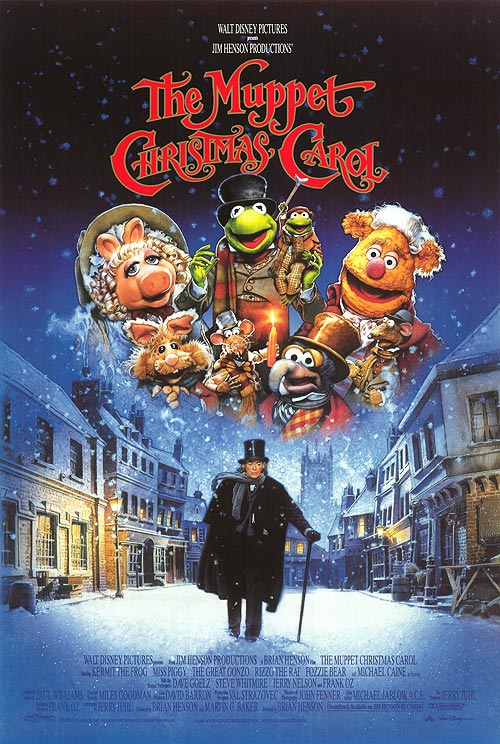
The Muppet Christmas Carol (1992)


Michael Caine with some of his best ever co-stars in The Muppet Christmas Carol

Director: Brian Henson

Cast: Michael Caine (Ebenezer Scrooge), Kermit (Bill Cratchitt), Miss Piggy (Emily Cratchitt), Gonzo (Charles Dickens), Rizzo the Rat (Himself), Statler and Waldorf (Jacob and Robert Marley), Fozzie Bear (Fozzie Wig), Dr Bunsen Honeydew & Beaker (Charity Collectors), Sam the Eagle (Schoolmaster), Steven Mackintosh (Fred), Meredith Braun (Belle), Robin Weaver (Clara)

There have been many adaptations of Charles Dickens’ beloved novel. Surely few people would disagree – this is the best one. If you don’t love this film I’ll just say it – there is something wrong with you. That’s it. There is no hope for you. Just give up, pack up and go home. Because no Christmas is complete without this film. It’s brilliant. 

It’s also perhaps the version that feels the closest to Dickens’ plot – which is remarkable considering 90% of the parts are played by puppets. But what they do so well here is bring the film back to the roots of the novel – it follows the plot pretty much spot on, the setting and design feel brilliantly Dickensian, and it even introduces Dickens as a character. And who better to play the great Victorian showman than the Great Gonzo? Gonzo anchors the film brilliantly, and is both really funny and delivers an awful lot of text from the original book. This actually feels more like a slice of Dickens than nearly any other adaptation you can think of – I’m sure he would have loved it.

That’s why the film works – it has a mix of brilliant muppet humour in it (and there are some really laugh out loud moments) but it’s also a pretty straight adaptation. There are moments where the fourth wall is leaned on, but the content is never mocked. So you get all the fun moments around the edges, but you still get an extremely strong story that has worked for over 100 years. Thank goodness they pulled away from the original idea of parody and played it straight with a smile!

One of the main reasons it works so well is Michael Caine’s superb performance in the lead role. When Caine agreed to do the movie, he was straightforward about his intentions: “I’m going to play this movie like I’m working with the Royal Shakespeare Company. I will never wink, I will never do anything Muppety. I am going to play Scrooge as if it is an utterly dramatic role and there are no puppets around me.” That is totally what he does. Because Caine walks the balance so well, he plays the moments of comedy with great humour, but also the emotional force of Scrooge’s journey.

Caine so totally believes in and respects the world he is working in, that he brings the entire audience with him. If Caine can, with a totally straight-face, treat talking to a small bunny singing carols with as much integrity as he does sharing a scene with Laurence Olivier, all the rest of us can as well. Just think how the film’s mood would have been wrecked if Caine had winked at the camera, or said something like “I told you to only blow the bloody doors off” – the careful balance of the film would have been wrecked in a moment.

I think you can safely say this is one of Caine’s finest films: he’s got fantastic comic timing – his scowly ill-humour for the first third of the film is a delight – but he makes the later scenes genuinely moving. It almost seems like he inspires the muppets around him – Kermit and Miss Piggy’s later scenes dealing with the death of Tiny Tim are genuinely tear inducing (is this the only production of Christmas Carol where Tiny Tim isn’t insufferable?). The Muppets are all brilliant here (if Caine is going to treat them as real actors, I certainly am as well!).

That’s why the film works – it’s really emotionally moving. The muppets inspire a huge residual affection in everyone, and the film mines this brilliantly. So we get pleasure from seeing them – look there’s Fozzie Bear and Sam the Eagle! – and then feel their pain when they are sad. The film gets the balance just right on the muppets’ essential anarchy: at one point Sam the Eagle needs to be reminded that he is playing a Brit, Rizzo frequently forgets he’s playing a role, Animal seems unable to play the gentle music the script plays for at Fozziewig’s party… The film is crammed with small moments like this.

And it all works because it is held within a fine piece of straight storytelling – a faithful adaptation of Dickens, with a brilliant lead performance. It’s also very well made – inventively shot with a real sense of mood and atmosphere and brings memorable scene after memorable scene. There is barely a frame of the film where there isn’t something delightful, entertaining, thought-provoking or all three to spot. It carries emotional weight, it’s laugh-out-loud funny, you’ll fall in love with the characters. Caine sets the tone brilliantly, and raises the game of everyone involved – it’s an impossibly difficult acting task that no one in a muppet film has ever pulled off as well again. 

It’s one of the greatest Dickens adaptations, one of the sweetest comedies you’ll see, and one of the greatest Christmas movies ever made. On top of that it’s a brilliant musical, with some fantastic hummable songs (though the cutting of Love Is Gone from the DVD edition – too sad apparently –makes you sigh for Disney’s corporate soul). No Christmas would be complete without it. A must-watch classic.