
Tag: Christopher Lee

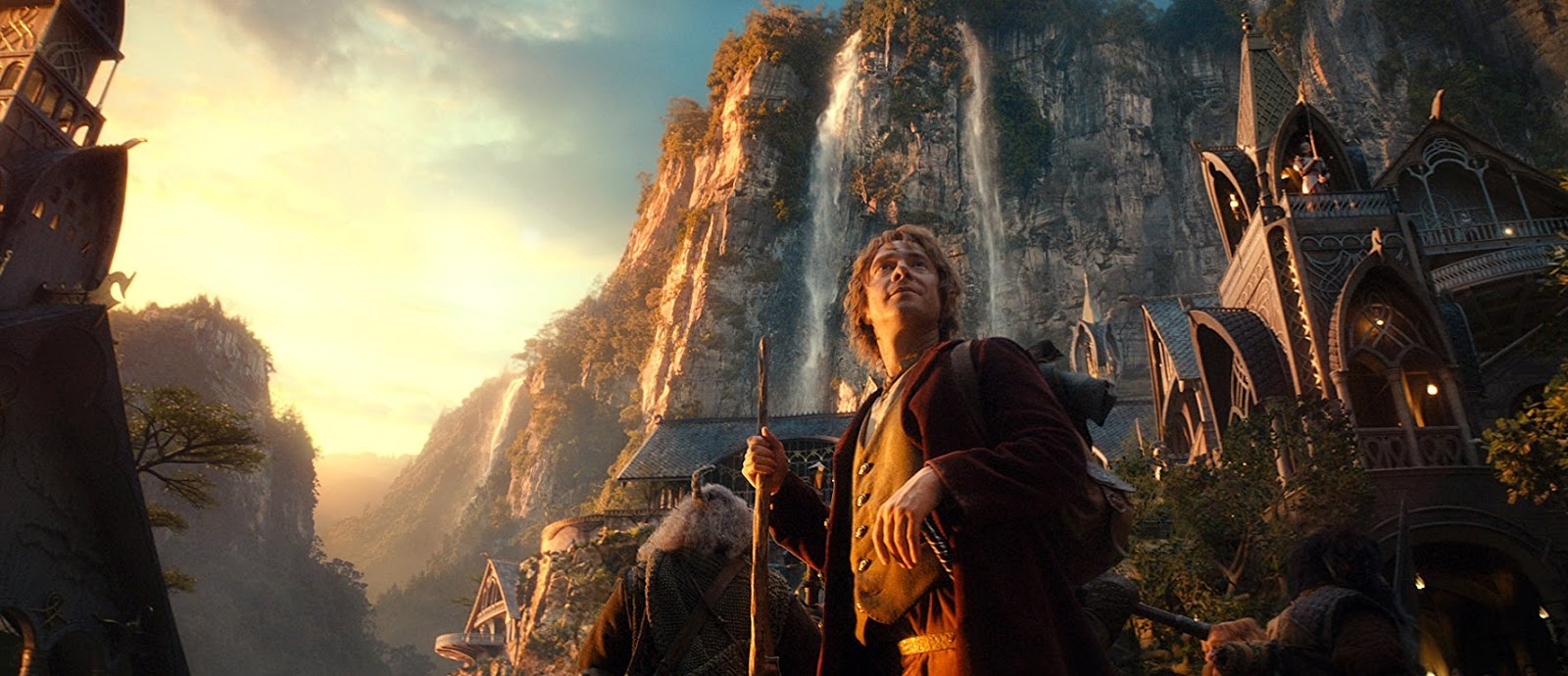
The Hobbit: An Unexpected Journey (2012)


Martin Freeman goes on An Unexpected Journey in the first of Peter Jackson’s deeply flawed trilogy

Director: Peter Jackson

Cast: Martin Freeman (Bilbo Baggins), Ian McKellen (Gandalf), Richard Armitage (Thorin Oakensheild), Ken Stott (Balin), Graham McTavish (Dwalin), Aidan Turner (Kili), Dean O’Gorman (Fili), James Nesbitt (Bofur), Cate Blanchett (Galadriel), Hugo Weaving (Elrond), Christopher Lee (Saruman), Ian Holm (Old Bilbo), Elijah Wood (Frodo Baggins), Sylvester McCoy (Radagast), Andy Serkis (Gollum), Manu Bennett (Azog the Defiler), Lee Pace (Thranduil), Benedict Cumberbatch (Necromancer)

The little-loved Hobbit films are finished now. This may be a controversial statement, but looking back at the three films now, An Unexpected Journey is clearly the best of an average bunch, the only one that feels like it has some sort of story arc, where the padding isn’t too overbearing and we get some character moments. Despite all that, it’s (bless) a bit of a mess. A tragic missed opportunity, which are like bloated windy farts that follow through.

So. It’s three films. We all know it shouldn’t be. We all know it’s a slight kids’ book. So let’s take it as read that even this, the best of the bunch, is an over-extended three hour expansion of six chapters (six bloody chapters!) of the original kids’ fable. Never, at any point, does this feel like it needs to be a long film. Where is the depth and passion in this film? It’s a slow, slow, quick, quick, slow paced splat, which takes ages and ages and ages to get going and then runs through as many set-piece action scenes as possible. 

Why did Peter Jackson make these films? Honestly, watching it you feel he had a gun to his head. He can’t bring any love or depth of feeling to huge chunks of the film. The action scenes feel put together by a choreographer and designed to be as loud and broad as possible, rather than because they are being put together by a storyteller. 

Thirteen dwarves? This is one of the main reasons Jackson was worried about making this film. How could he make these characters distinctive? How could he build plot arcs and storylines for each one? The answer was he couldn’t. So he didn’t even bother. Now I know the Tolkien fans would have hit the roof, but for goodness’ sake would it not have been better for the good of the film to cut the number of dwarves down? So we could get to know them a bit? Because large numbers of these dwarves are indistinguishable from the other. Throughout the course of this film, as a stand-alone viewing experience, only Thorin and Balin stand out in any way as immediately recognisable. They are the only two who you can always identify. The rest? They just all mash into one. They don’t even really have distinctive moments. They are just a mass.

So you watch the overblown, overextended and yawn-worthy action and chase scenes and you just can’t get wrapped up in them. Because all we are doing is watching huge, time-consuming sequences with a mass of characters we can’t tell about, and even when we do, we don’t have any emotional connection to them. The dwarves are all sort of refugees I guess, which gives us some sort of link to them, but it’s the same back story for each one. It’s indistinctive and unclear. If Jackson had gone with his gut and cut some of these out, then the extended running time could have been used to build establishing character moments, to give pay-offs and plot arcs for them. Instead, he kept them all – and never develops any of them.

Those action scenes do go on forever. I know they all come from the book, I get it, but there is no tension in any of them. Dwarves bounce, twirl and fly all over the place. Never at any point do they really feel like they are in danger. A run over the field from some wolves – yawn. The chase sequence through the Goblin kingdom in a mine – double yawn. The second is particularly bad as it brings back strong memories of the LOTR sequence in the Mines of Moria, which had a hundred times the excitement and thrills of this. 

In fact that reminiscence is a big problem for a large chunk of the film. The Hobbit is a kids’ book, but The Lord of the Rings is an adult fantasy novel. The attempt to tie these two different tones and genres of novel is a constant hiccup. So we get the dwarves pratting around and bouncing about, in moments that seem childish and cheap. And then we get doom-laden conversations, and dark over-blown musings about the stakes of the world – stakes that don’t tie in, in any way, with the content of the action, adventure story we are seeing in the film. Then there are blatant, clumsy references back to the original – did anyone else groan when Elijah Wood wandered onto the screen? Appearances from Blanchett, Weaving and Lee are all shoe-horned in. At least Ian Holm gets to do some lovely narration. But all these moments simply remind you that you could be watching a better film trilogy than this.

But despite all this, An Unexpected Journey isn’t all bad. Yes it hares about so quickly, with no depth at all, at great over blown length, but it has its moments and it is just about entertaining enough. Jackson can still do some of these moments well – the flashback that opens the film to Smaug’s attack on the mountain is very well done; in fact it has more inspired film-making and tension than nearly anything else that follows. Yes the arrival of the dwarves takes a lot longer to get going than the film needs – but at least it’s pretty charming, and Jackson’s whimsical love of Hobbiton is pretty clear. Shame I don’t think he brought any more invention or sense of charm to much of the rest.

It’s also helped by the fact there are some damn fine performances in there. Martin Freeman is just about perfect casting as Bilbo; he’s charming, vulnerable, slightly-out-of-his depth, brave, very English – he’s great. Ian McKellen practically is Gandalf by now, and he hasn’t lost his understanding of the character’s slightly grubby, grandfatherly charm. Richard Armitage as Thorin is brilliant, mixing a gruff, maverick quality alongside his pride and resolution – and his intense sense of loyalty. Of the rest of the cast, not many get a look-in, being either cameos or underdeveloped, but Ken Stott stands out as the kindly, wise Balin.

The film is also possibly the only one of the three that truly stands alone in some way. It has some form of plot arc behind it in the relationship between Thorin and Bilbo, and the lack of trust Thorin has for Bilbo, his unwillingness to accept him into the group. Similarly, Bilbo has to learn to embrace his role with the dwarves and his place in the company. This is actually a pretty touching and carefully done dynamic, that culminates not only in the film’s most involving (and tellingly low-key) action sequence, but also a tender moment of acceptance from the previously stand-offish Thorin (brilliantly sold by Armitage). 

This is a great plot arc. It also has a negative impact on the next two films – because this is the emotional climax in many ways of the trilogy – and it came in the first film of three! With this major emotional plot line between two of our core characters resolved by the end of the first third of the sequence, what is there to do with the rest of it? It’s a major loss for the rest of the trilogy. 

But for this stand-alone film it works well. Because it reminds you there is some heart in this film – heart missing from the next two films – because it is founded on an understandable emotional bond. The rest of the company may be indistinguishable, but at least Thorin and Bilbo move us. The best moments in these films are founded on feeling and character investment. Andy Serkis makes a great return as Gollum in an entertaining exchange with Freeman. The clash between Thorin and Azog is the most engrossing in the film because it has a genuine history to it established in the film, that a zillion clashes with the Goblin King, or a pack of wolves or faceless goblins never do. 

The Hobbit: An Unexpected Journey is a decent movie. It has flashes of excellence in it. It’s got some good performances. Peter Jackson is still able to shoot a decent scene, even if you don’t really feel his heart is completely in it. The performances are uniformly good, and some are excellent. But the whole thing feels like an overblown missed opportunity. There was a chance to do something magic here with this Hobbit series. But this wasn’t it. You can’t cast the same trick twice.
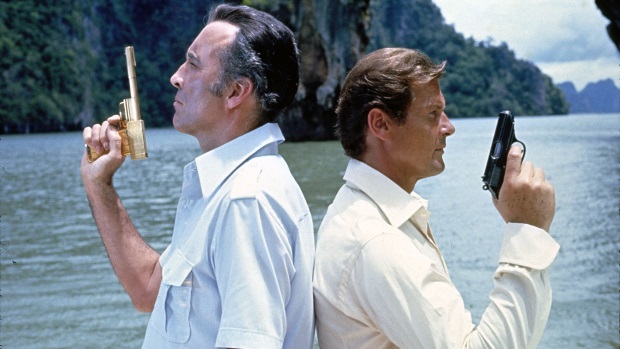
The Man with the Golden Gun (1974)


Christopher Lee and Roger Moore duel to the death in the confusing and strangely pointless The Man with the Golden Gun

Director: Guy Hamilton

Cast: Roger Moore (James Bond), Christopher Lee (Francisco Scaramanga), Britt Ekland (Mary Goodnight), Maud Adams (Andrea Anders), Bernard Lee (M), Hervé Villechaize (Nick Nack), Richard Loo (Hai Fat), Soon-Tek Oh (Lt Hip), Clifton James (JW Pepper), Desmond Llewelyn (Q)

I sat down to watch The Man with the Golden Gun having just heard the news of Roger Moore’s death. It seems an odd one to choose, as this was easily Moore’s least financially successful, and least fondly received, Bond film. But it had just been on TV, and I wanted to raise a glass (or eyebrow) to Britain’s finest.

MwtGG was very much the formula trying to find its way in a post-Connery world, with Moore’s performance an odd half way house between his later light persona and the harder edge of Connery. Anyway, the plot, such as it is: Bond is sent a bullet with his name literally on it from Francisco Scaramanga (Christopher Lee), the world’s greatest hitman who only uses golden bullets and charges a (now rather sweetly modest-sounding) $1million per hit.  Bond goes to Hong Kong to find out more and gets embroiled in some complex (and not particularly interesting) back-and-forth about hijacking the world’s solar energy supply, hindered by incompetent agent Mary Goodnight (Britt Ekland). It all culminates into a duel of guns on Scaramanga’s private island.

The problem with this film isn’t so much that it’s a bit dull – it’s that it’s not really about anything at all. Does anyone really understand Scaramanga’s scheme? Even he seems confused about it. As far as I can tell it’s something to do with controlling solar energy, but how the heck he’s going to control access to the sun I don’t know. Scaramanga seems far more interested in a silly heat gun he’s got as a side installation. Anyway, whatever the heck this is about, lots of other people seem interested in it. It’s powered by “the Solex”, which looks like some sort of robotic cigarette pack. This Solex changes hands even more regularly than Bond changes love interests, but its purpose and why it’s important are such a poorly explained macguffin it’s really hard to care.

What the film is nominally about (but turns out not to be) is the duel between Scaramanga and Bond. Turns out, of course, Scaramanga doesn’t have a clue about the bullet. His motivations towards Bond are as unclear as the plot, alternating between indifference, admiration and envy. On top of that, to make a duel like this work we need the feeling Scaramanga and Bond are two sides of the same coin – that with a push at the right time in his past, Bond could have turned into the ruthless hitman Scaramanga is. This could have worked with Connery’s early Bond – or Dalton and Craig – but never do you believe Moore’s Bond has a streak of black through his soul.

This is despite some ill-fitting moments in the film, created solely in an effort to show Moore’s Bond acting tough, moments that feel horrendously out of place and against character. In particular, early in the film Bond quite viciously roughs up Andrea Anders (he slaps her, nearly breaks her arm, spies on her with the shower and threatens her with a gun in a weirdly sexual manner). It feels totally wrong for Moore’s gentle suaveness. At other points in the film, Moore plays with a hardness and general prickishness that isn’t present in his other films, and doesn’t match his light style. Throughout the film he feels annoyed at Goodnight, he pushes a kid off a boat, he treats his colleagues dismissively – it feels all the time Moore is struggling to play a Bond way against his style.

To be fair, I can see why Bond is annoyed with Goodnight: Britt Ekland is probably the nadir of Bond girl stupidity. Literally nothing she does in this film is any use, and most of the rest of the time it actively helps the villains. She’s stupid, clumsy and not funny. She’s so incompetent you need to keep double checking she is actually meant to be an MI6 agent. Ekland has indignities heaped upon her on this film, from being locked in the boot of a car, to being hidden in a cupboard by Bond mid-coitus so that he can do the nasty with Scaramanga’s girlfriend. Late on, she nearly kills Bond by backing into a button with her bottom. Ekland’s main reason for being cast was of course her physical assets in a bikini – so it’s lucky that Scaramanga keeps her on his island dressed only in a bikini for the last third of the movie. Only way to make sure she doesn’t have a weapon, doncha know!

As the plot drifts around, going either in circles or nowhere at all, the producers land Bond in a kung-fu training school in Hong Kong. Bond films as a genre have always gently ripped off as much as possible whatever was popular at that time in Hollywood (Blaxploitation in Live and Let Die, Star Wars in Moonraker, Bourne in Quantum of Solace etc. ), and so it merrily climbs on the Bruce Lee bandwagon here. Unfortunately, it’s all highly stupid and adds nothing (Scaramanga even comments in the movieabout the ludicrousness of sending Bond to a school rather than just putting a bullet in him) and hits heights of ridiculousness when the entire school of elite trainers is bested by Bond’s sidekick and two teenage schoolgirls in school uniform.

That’s another thing wrong with this movie – the wildly varying tone. So at times we get Bond chasing down leads like Philip Marlowe. Next we have him roughing up a weeping woman. We’ve got Goodnight’s buffoonery, Scaramanga’s suave cruelty… It’s all over the shop. The comic moments of the film particularly grate. Was anyone waiting for Sherrif JW Pepper’s return from Live and Let Die? Didn’t think so, he’s as funny as a bout of gonhorrea. Even some of the good moments get undermined by bizarre tonal shifts: the classic car flip stunt (which is amazing, particularly because you know they did it for real after hours of careful calculations) is overlaid with a stupid “whoop” sound effect, like a Carry On film (even Guy Hamilton subsequently said this was a terrible idea).

However, it’s not all bad – no Bond film ever really is, such is the triumph of the formula. Christopher Lee is very good – you wish he was in a much better film than this one. The late duel in the film between Scaramanga and Bond is pretty good, even if it all ends a little too easily. Scaramanga’s funhouse seems totally bizarre (why the hell does he even have this on the island next to a power plant?) but its good fun. The MI6 base on a half sunk ship off the coast of Hong Kong, with all the corridors on the wonk is an absolute triumph of design. Bernard Lee gets lots more to do than he usually does – and delivers his exasperated boss lines with a sense of dry timing.

It doesn’t change the fact, though, that this is possibly one of the weakest Bonds around. It’s not a terrible film – I enjoyed watching it, though at least part of that comes from growing up with these films, making them as familiar as family members. But it’s way down there in the Bond list. It’s a slightly tired movie, in a franchise trying to find its feet under a new lead. Tonally it’s a complete mess for large chunks of it, and manages to make its plot seem inconsequential and dull. Nothing really seems that much at stake, and Scaramanga (despite Lee’s good performance) never feels like a villain we really understand. I’ve no idea what he wants, and no idea why he should be stopped.

The Man with the Golden Gun is only worth it for a doze in front of the television on a Sunday afternoon. Thank goodness that’s the only time it’s likely to appear on your TV. And putting all else aside, Moore was a terrific Bond and an even more terrific human being. Rest in Peace.

Sleepy Hollow (1999)


Rumours that Johnny Depp is tapping into his eccentric style are of course unfounded

Director: Tim Burton

Cast: Johnny Depp (Ichabod Crane), Christina Ricci (Katrina Van Tassel), Michael Gambon (Baltus Van Tassel), Miranda Richardson (Lady Van Tassel), Casper Van Dien (Brom Van Brunt), Jeffrey Jones (Reverend Steenwyck), Richard Griffiths (Magistrate Philipse), Ian McDiarmid (Dr. Thomas Lancaster), Michael Gough (Notary Hardenbrook), Christopher Lee (Burgomaster), Christopher Walken (The Headless Horseman), Claire Skinner (Beth Killian) 

Tim Burton’s films often take on a larger-than-life quality, an overblown fanciful journey into a world that is a few degrees off from our own. So a bizarre ghost story about a headless horseman lopping off bonces left, right and centre, in an isolated town that feels more like a construct from a series of other films than any sort of real place, probably suits him perfectly.

After a series of murders via decapitation in the small town of Sleepy Hollow, Iachobad Crane (Johnny Depp) is called from New York to investigate. An eccentric (what else, it’s Depp) moderniser, Crane believes in logic and forensic investigation and is having none of the fears of the townspeople that the murders are being committed by a headless ghost. However he soon changes his views…

This adaptation bears little or no resemblance whatsoever to the original source material, bar a few homages, one or two brief scenes and a few character names. Burton, indeed, seems to have no interest in it at all: what he is interested in doing is paying homage to high-blown Hammer horror films from the 60s and 70s. Whether you enjoy this largely depends on whether you were a fan of either Burton or this style of film-making going into it.

I found the film rather too arch throughout – from the stylised performances of the actors, through to the slight tongue-in-cheek tone. It’s not particularly scary at any point, despite the blood and gore – largely because nothing ever feels real, there’s no sense of dread or peril. Heads are lopped off with an almost comic athleticism, bouncing around floors or rotating on necks. Only one sequence – the murder of a family – carries any real sense of unease about it. The rest of the film is one not-particularly-witty black comedy, in which a lot of time and talent seems to be invested in something not particularly interesting.

Depp is of course perfectly suited to this, his “look at me” acting style springing to the fore as Crane. As usual he overloads the character with quirks and mannerisms, the sort of tricksy emptiness it’s easy to mistake for great acting. The rest of the cast go about their business with a trained professionalism. However, despite the array of British acting talent on display, in truth none of them make much of an impression, with the exception of a nice cameo from Alun Armstrong as a senior New York policeman, and Miranda Richardson who has fun with her role as a sinister housewife with hidden depths.

The awards attention for the film focused on its finest aspects – its look and design. The production design of the film is impressively constructed and the artificial look of the exterior sets actually fits in very nicely within the world of the film. Emmanuel Lubezki’s photography also looks fantastic, shooting the film with a slightly off colour, 70s style that adds a vibrant red to the large amount of blood on screen. Costumes and other technical aspects are also impressive. The film looks fantastically striking, like a brilliantly designed coffee table book – and has about as much plot as one. It’s my problem with Tim Burton – this whole “unique vision” of his, often seems to be an excuse for littering his films with in jokes, arch design and stylisation and leaving out the things we actually care about, like characters, emotion and drama.

In the end, it’s really not a lot more than a joke, a pastiche of a certain genre of film that seems much more like one for the fans than a joke that we can all take part in. I’m aware not liking it throws me open to accusations of not “getting it” or expecting more from it, but I basically didn’t really find the joke funny enough. Its arch style make it hard to relate to, and despite the clear enjoyment of all involved, not a lot of the wit behind the scenes is clear in the final product. With nothing to really invest in, a rather sudden ending and a mood throughout that is trying to be creepy rather than genuinely so. Don’t expect a retelling of its plot around a camp fire to awaken too many goosebumps.