Tag: Clark Gregg

Thor (2011)

Thor (2011)

Branagh lives his dream by making the most comic-book, bombastic Shakespeare-homage ever

Director: Kenneth Branagh

Cast: Chris Hemsworth (Thor), Natalie Portman (Dr Jane Foster), Tom Hiddleston (Loki), Anthony Hopkins (Odin), Stellan Skarsgård (Dr Erik Selvig), Kat Dennings (Darcy Lewis), Clark Gregg (Phil Coulson), Rene Russo (Frigga), Colm Feore (Laufrey), Ray Stevenson (Volstagg), Idris Elba (Heimdall), Jaimie Alexander (Sif), Josh Dallas (Fandral), Tadanobu Asano (Hogun), Jeremy Renner (Hawkeye)

If you’d told people after Henry V that one day Kenneth Branagh would direct a high-octane comic book movie about a Norse God who bashes things with a hammer, you’d have been laughed outta town. But Branagh was who Marvel called to launch the Thor franchise – and doncha know it turned out to be a pretty shrewd choice.

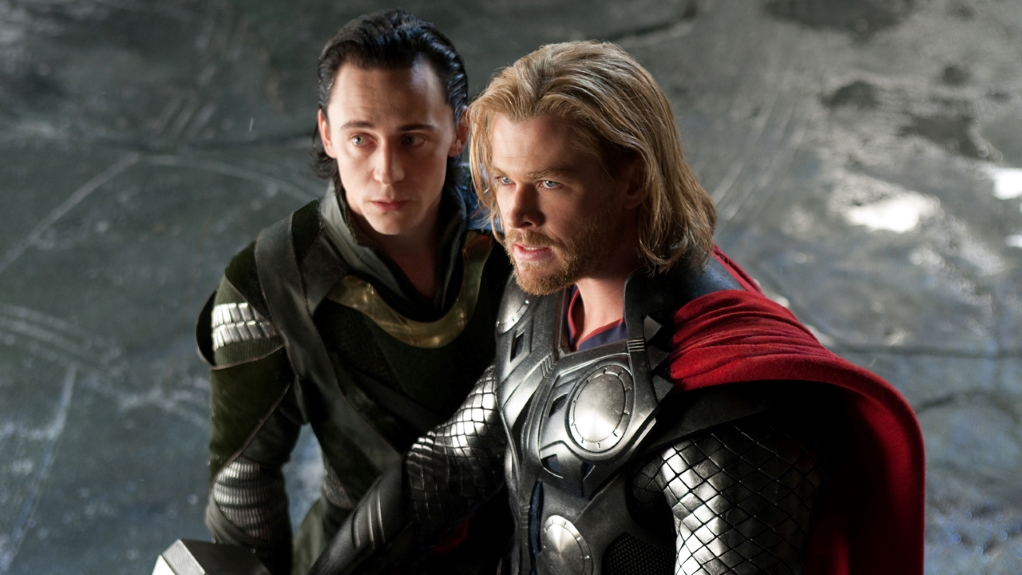
Thor (Chris Hemsworth) is the arrogant son of Odin (Anthony Hopkins) and heir to the throne of Asgard, the planet that keeps peace in the Universe. After an attempt by Asgard’s old enemies, the Frost Giants, to re-capture a stolen super-weapon, Thor leads a reckless attack on their homeworld that threatens to shatter a hard-won peace. Disappointed and furious, Odin strips Thor of his powers and banishes him to Earth, where the fallen God of Thunder must learn humility to be worthy of regaining his powers. On Earth, he falls in love with gifted scientist Jane Foster (Natalie Portman), while on Asgard the realm falls under the control of his brother Loki (Tom Hiddleston), who manipulates events to make his own claim for both the throne and their father’s love.

You can sort of see the Shakespearean bits bubbling away there. Fathers and sons, ambition and power, tragic flaws. Destiny verses desire. Loki as a mix of Edmond, Iago and Cassius. Thor as a Prince Hal earning the maturity to lead. Odin as a kindly Lear. Hell, you could see Thor washing up on the shores of New Mexico, like Twelfth Night’s Viola, forced to pretend to be something he isn’t. He even has his own mini-Falstaff, in gluttonous warrior Volstagg. It’s a heightened story of Kings and Queens, Tempest-style magic and Hamlet­-style family intrigue. Marvel, of course, partly hired Branagh to bring attention to this (effectively, paying Branagh for his Shakespeare-street-cred to make an otherwise snigger-worthy concept of Norse Gods in space get taken seriously), Thor does a great job of bringing this out without drowning the fun.

And of course, for those paying attention, Branagh had been dying to do bombastic nonsense for years. Shakespeare had disguised that Branagh adored loud crashes, big bangs, showy camera work (half of Thor is done in Dutch angles, apeing comic books) and pounding soundtracks. His Hamlet is crammed with half a dozen genres, from romance to action and Mary Shelley’s Frankenstein showed he could fly over the top with the best of them. But he’s also an actor’s director, and he draws performances here from Hemsworth and Hiddleston in particular that would lay the groundwork for making these two of the most popular actors in the whole damn franchise.

Thor above all does a brilliant job of making us care for a lead character initially presented as a likeable but arrogant, immature and cocky hit-first-think-later warrior, cavalier about people’s lives. There is a very funny humiliation conga inflicted upon Thor on arriving on Earth (a classic rule-of-three gag) leaving him successively tasered, tranquilised by a syringe in the ass and knocked over by reversing car. It’s a brilliant way of breaking the haughty – the Mighty Thor, who trashed an army of Frost Giants, laid low by a middle-aged doctor yanking down his hospital pants. But it all sets us on a path for caring about him, helped by how chivalrous and polite he is with Portman’s winning Dr Foster. Sure, he’s still dripping with hubris – assuming once he gets his hands on his hammer Mjolnir again, everything will be as it was – but at wider traces of humanity emerge we start to care for him.

It’s cemented by a very effective scene where Branagh proves his worth as a director of actors. After failing to lift said hammer – being, at this point, unworthy due to having not really learned anything – Thor sits alone in an interrogation room, visited by a disguised Loki. Hemsworth is very good in his scene: he suddenly makes Thor humbled, fragile, accepting his failures, not lashing out but tearfully apologising for his past behaviour, meekly asking to just be allowed to come home then bravely accepts his permanent banishment. It’s actually an effectiveportrait of overcoming hubris: Thor’s true heroism isn’t trashing Loki’s rent-a-robot that is the film’s penultimate foe. It’s accepting, in his depowered state, his role in the battle is to stay out of the way and help get people out of the way before offering his own life as a sacrifice if he will end the robot’s rampage.

If Thor, in Hemsworth’s gently sweet and funny performance, overcomes hubris, Loki succumbs to it. Tom Hiddleston’s charisma here (cemented by his excellent turn in The Avengers) helped him become Marvel’s most popular anti-hero. Like Thor, he’s a complex character: a second brother who secretly resents his brother’s prominence, wants his father’s love, learns things about his past which make him lean into his worst instincts, all to try and be what he mistakenly thinks his family wants. Hiddleston carries all this angst and tragedy with real skill, while also filling the role with wit and playfulness: it’s a great, star-making turn.

It’s a sign of the film’s surprising complexity that it’s hero and villain switch perspectives over its course. Thor starts by dreaming of destroying the Frost Giants to impress Odin while Loki counsels restraint. He ends it by making enormous personal sacrifices to protect them from a genocidal plan unleashed by Loki who wants to prove he’s as tough as Thor. The film ends not with a hero triumphant, but alone and grieving losses. It’s stuff like this that makes Thor a truly interesting, engaging film in a way other MCU outings are not.

And a lot of it comes from Branagh’s skill with actors. Thor might not offer the greatest acting challenges to the rest, but Hopkins in particular was better here than he had been for years (he credited Branagh with helping him rediscover his passion for acting) and Portman and Skarsgård bring a lot of humanity to thinly written roles. Sure, in other ways Thor is less special: it’s action set-pieces are, by and large, fairly uninspired and run-of-the-mill, the small town trashed by a robot looks and feels like a backlot stunt show, some of the comedy lands flatly. But when it focuses on the character drama of two contrasting brothers and their love for their father it’s feels more real and engaging than a host of more technically adept comic book movies.

Thor gets over-looked in the MCU rankings. But it’s a surprisingly thoughtful, well drawn character study about worthiness not being about muscle and force, but on your wisdom, compassion and humility and putting other people before your own needs and desires. All captured in a magic hammer that is otherwise impossible to pick up. Branagh’s film gets that, with added bombastic comic book thrills. Thor has entertained me each time I’ve seen it and will go on doing so.

Being the Ricardos (2021)

Being the Ricardos (2021)

I Love Lucy is bought to life in this behind-the-scenes drama that bites off more than it can chew

Director: Aaron Sorkin

Cast: Nicole Kidman (Lucille Ball), Javier Bardem (Desi Arnaz), JK Simmons (William Frawley), Nina Arianda (Vivian Vance), Tony Hale (Jess Oppenheimer), Alia Shawkat (Madelyn Pugh), Jake Lacy (Bob Carroll), Clark Gregg (Howard Wenke), John Rubenstein (Older Jess Oppenheimer), Linda Lavin (Older Madelyn Pugh), Ronny Cox (Older Bob Carroll)

A film about I Love Lucy is always going to lack cultural cache outside of the US: it would be the same if a British film about Dad’s Army or Hancock’s Half Hour played there. Without a legacy of growing up on endless re-runs, I think a lot of British audiences (like me) will be left playing catch-up working out who the stars are and what the show is about.

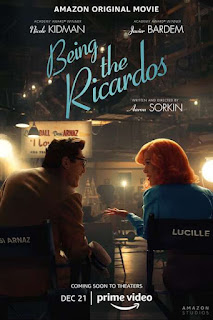
Sorkin’s Being the Ricardos follows one week in the making of I Love Lucy in 1952. It’s a big week. There are rumours of infidelity (from him) in the lives of the married co-stars Lucille Ball (Nicole Kidman) and Desi Arnaz (Javier Bardem). On top of that, the media is running stories that Ball is a card-carrying communist (not completely true). And finally, she’s pregnant, something the network can’t imagine would be acceptable to include in a family show. All these problems come to a head as that week’s show is finalised, rehearsed and shot.

Sorkin’s film is by far and away at its best when dealing with the backstage mechanics behind bringing a TV show to the screen. Which perhaps isn’t a surprise, as that is obviously material he’s very familiar with. The film is fascinating at showing the technical side of things like rehearsals, and it’s very illuminating on the dedicated perfectionism Ball bought to making the comedy work. We see every single gag being worked on over and over to mine the maximum number of laughs from it. There are long back and forth conversations on timing, positioning and nuances of line delivery.

There are similarly fascinating ideas during scenes in the writers’ room. A huge board maps out the details of future episodes. The writers – a neatly squabbling but fundamentally loyal Alia Shawkat and Jake Lacy, headed up by executive producer Tony Hale – are constantly pushed to fine-tune their ideas, while passionately defending many of their own jokes to the sceptical stars.

A sequence essentially showing Ball and the writers spit-balling ideas that will develop into future set-pieces is particularly well done. Sorkin also comes up with a neat visual concept showing how Ball considers the impact of the gags: events from the show play out in black-and-white then switch to colour as the action pauses and Ball considers what to do next to get the most laughs. It’s all part of the film’s primary strength: a fascinating look at the energy and passion required to produce a half-hour sitcom, be it arguing over camera placement to a sleepless and worried Ball calling her co-stars to the studio in the wee small hours to fine-tune a pratfall.

Where the film is less certain is all the other stuff it tries to cover. Being the Ricardos is almost the dictionary definition of a film biting off more than it can chew. It tries to cover: the making of a TV show, McCarthyism, a biography of the marriage of the two stars, the sexism of network TV, racial unease at the Cuban Arnaz playing Ball’s husband, the sexual prudishness of the 1950s, and expectations around gender roles. On top of which, Sorkin’s film trumpets continuously that this was the “most difficult week ever”. It’s an onslaught of stakes the film finds hard to deliver on.

For starters, most of the action focuses on the mechanics of making the show – mechanics that surely would be the same every week. The communist plotline is introduced then largely dropped for most of the film until the final rousing hurrah. McCarthyism is barely tackled, other than a new perspective from Arnaz, who remembers being forcibly driven from Cuba by Communists. Awkward flashbacks fill in some of the backstory around Lucille and Desi’s meeting but end up feeling like superfluous additional information that adds nothing to anything other than the runtime.

Tensions in their marriage bubble away before finally coming to a head, as if Sorkin didn’t want to spoil the rat-a-tat dialogue with some deeper content. The film is very good at showing what a great team they made: Ball’s creativity and comic genius matched with Arnaz’s business-sense and ability to plan every aspect of the show’s technical and financial set-up. But again, more could have been made of this – too often it’s an idea crowded in amongst others, with a tone that can’t decide how it feels about Arnaz’s possible betrayal or Ball’s fixation on it.

More could have been made about the prudish and sexist struggles Ball and Arnaz went through to get her pregnancy integrated in the show. It’s a fascinating realisation that the implication that a happily married couple must have had sex to produce a baby was anathema to TV networks in the 50s. A film that focused on the battle to get this integrated into the show – and the impact that doing so had on America and television – would not only have been more focused, it would also have played into the film’s real strengths: the mechanics of actually making television. As it is, this sense of the struggle Ball had to get due recognition in a male-dominated industry is lost.

As the two stars Nicole Kidman (under layers of latex to transform her facial features into Ball’s) and Bardem are very good, Kidman in particular brilliantly conveying Ball’s comedic genius as well as her self-doubt and insecurity, expressing itself in worries about her marriage to making sure her female co-star looks less attractive than her on the screen. Kidman pounces on Sorkin’s fast-paced dialogue and provides much of the film’s drive and focus. There are also neat supporting turns by JK Simmons and especially Nina Arianda as their co-stars.

In the end though, yet again, it feels like Sorkin the writer is ill-served by Sorkin the director. While the film is more sharply directed than his others, it lacks focus, discipline and drive, like Sorkin can’t bear the idea of cutting some of his own words and ideas so tries to include them all. It ends up meaning nearly all of them lack the impact they should have.

Captain Marvel (2019)

Brie Larsen is Captain Marvel – yah boo sucks Trolls!

Director: Anna Boden, Ryan Fleck

Cast: Brie Larson (Carol Danvers/Veers), Samuel L Jackson (Nick Fury), Jude Law (Yon-Rogg), Ben Mendelsohn (Talos/Keller), Djimon Hounsou (Korath), Lee Pace (Ronan the Accuser), Lashana Lynch (Maria Rambeau), Gemma Chan (Minn-Evra), Annette Bening (Supreme Intelligence/Mar-Vell/Dr Wendy Lawson), Clark Gregg (Phil Coulsen)

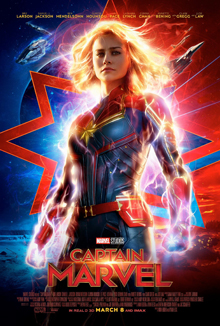
After almost 11 years, the big criticism of the Marvel Cinematic Universe has been that it had never made a film with a woman as the lead. Sure, we’d had various strong female characters, but never had one been trusted with headlining a movie. Well the studio has put that right with Captain Marvel, a hugely enjoyable, if not exactly groundbreaking, superhero origins story that can stand up with some of the best origin movies the studio has produced.

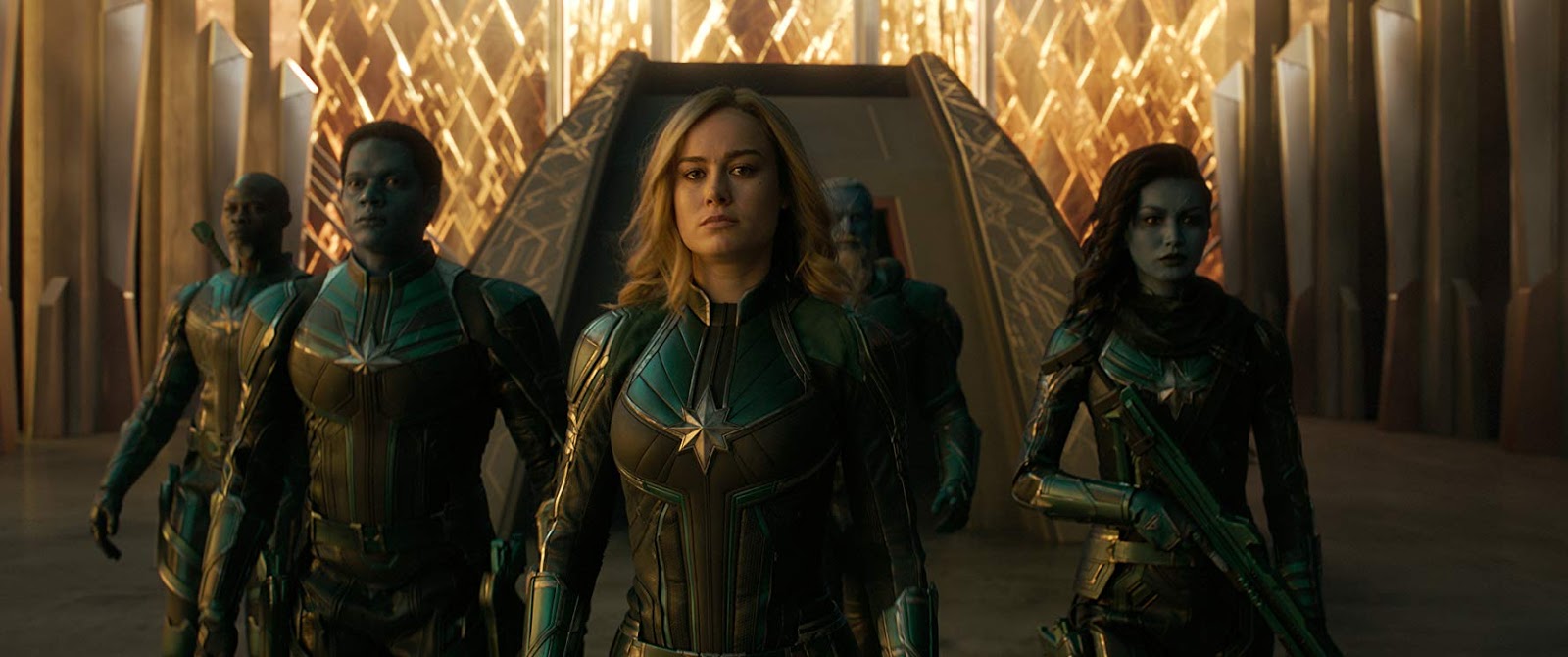
In the Kree civilisation, Veers (Brie Larson) is in training to take her proper place in the Star Force, under the tutelage of her mentor Yon-Rogg (Jude Law). But she’s struggling to control her immense powers, with her dreams plagued by strange visions and half memories of a planet that looks to us viewers a lot like Earth. After a Star Force mission goes wrong, Veers is captured by the shape-shifting Skrulls and their leader Talos (Ben Mendelsohn), her memory being searched for a time on Earth that she doesn’t remember. Escaping, she finds herself on Earth in 1995, and quickly allies with SHIELD operative Nick Fury (Samuel L Jackson, impressively digitally de-aged) to find out what the Skrulls want. But is everything as it appears? And what will happen as Veers starts to remember her true identity, as long-missing air-force test pilot Carol Danvers?

Captain Marvel I guess you could say is not an ambitious film. It largely sits pretty close to the well-established Marvel formula for introducing a new character, and it presents a series of visuals, fights and general tone mixing light-jokes with action beats extremely well. It’s a very professionally assembled product. However, what makes it work is the strain of emotional truth, and an interest in character as the driving force for events, that runs right through the centre of the film. It’s a testament to the imaginative and original direction from Boden and Fleck that at the centre of each clash we see, not the action and the pyrotechnics, but the emotion and character that give these things meaning.

They are also helped by an interesting plot, with some very decent twists, that throws the viewers into the deep end and carefully drip-feeds us information at the same pace as Carol picks it up. This also helps hugely for investing in Brie Larson’s Carol Danvers, a character who doesn’t know who she is and where she came from. Brie Larson does a terrific job, crafting a character “strong and determined”, but also witty, impulsive, brave, caring, decent and rather sweet with a strong moral compass that clearly, from the start, governs all her actions. It’s a fine performance and Larson is equally convincing in the film’s lighter, funnier moments as she is when banging heads together.

That helps keep the tone of the film pretty consistent as it heads through various twists and turns and rugpulls. Now I am sure some of these twists would be seen coming by anyone immersed in Marvel comicbook lore, but for us Muggles I appreciated the reveals about several characters defying expectations. The film also avoids false tension – a character is so obviously a shape-shifted replacement, it’s a relief that the film confirms this in minutes and the characters work it out shortly after. It’s a smart way for the film to fool you into thinking where it is going, while building towards more interesting reveals later on – particularly as it throws our expectations for several characters into the air.

And the action when it takes place is great fun, primary-coloured and accompanied by a great selection of 90s tracks. Because Boden and Fleck have spent so much time carefully developing the characters at its heart, these become action moments you can genuinely invest in, where people you care about are in peril, rather than the bangs and crashes without consequence that plague other films.

It’s also mixed extremely well with comedy. Samuel L Jackson in particular gets some great comic mileage out of a young Nick Fury, a man on his way to becoming the hard-as-nails guy we’ve seen in countless movies, but here still young, playful and (hilariously) besotted with a cat rather wittily called “Goose”. Ben Mendelsohn also gets some good moments from his mysterious shape shifter and Jude Law has a sort of put-upon charm as Carol’s mentor. There are also some lovely moments as Carol rediscovers her memories and rebuilds a relationship with her former best friend and fellow test pilot Maria Rambeau, well played by Lashana Lynch.

Captain Marvel is such good fun, such good old fashioned entertainment, that it seems to have defeated the efforts of the internet trolls to consign it to oblivion. It’s sad to say that, following in the footsteps of Black Panther, The Last Jedi, Star Trek: Discovery and Doctor Who, another “fan boy” franchise entry has seen its opening overshadowed by a bunch of sad wankers with key boards hammering into the internet (and whining into YouTube) about Disney and “the suits” forcing fans to watch stories about people who aren’t white males. Larsen and Captain Marvel got it in the neck for being sexist (it’s not about a man and Larsen dared to say she thought film critics were overwhelmingly white and male – guilty in this case), pushing a feminist agenda (because, like, it had a woman in it that wasn’t a damsel-in-distress or hooker-with-a-heart-of-gold) and not representing what the fans wanted to see in comic films (muscular men saving ladies and hitting things basically). Never mind that social commentary in the old days used to be what these fans bragged about their passions being so full of. Now any character who doesn’t fit a narrow set of racial and sexual criteria is an attempt by the PC brigade to push these pricks out of the fandom. Well to be honest we are better off without this turgid slime polluting fandom with their putrid stench. Put frankly, if films like Captain Marvel make some idiots decide they are going to boycott Marvel for ever more, well good – please fuck off and let the door slam you on your arse on the way out.

Anyway, rant over. Captain Marvel is great fun, Brie Larsen is great, the action is well done, the jokes are funny, the story is engaging and it’s all done and dusted in two hours. Go and see it.