Tag: Comedy

Addams Family Values (1993)


The Addams Family Values: Goth meets summer camp fun in this engaging comedy

Director: Barry Sonnenfeld

Cast: Anjelica Huston (Morticia Addams), Raúl Juliá (Gomez Addams), Christopher Lloyd (Uncle Fester), Joan Cusack (Debbie Jellinsky), Christina Ricci (Wednesday Addams), Carol Struycken (Lurch), Jimmy Workman (Pugsley Addams), Carol Kane (Grandma Addams), David Krumholtz (Joe Glicker), Peter MacNicol (Gary Granger), Christine Baranski (Becky Martin-Granger)

The Addams Family was a serviceable family comedy about a bizarre group of Halloween style characters, who delighted in leading lives of cartoony horror. It drifts along, and was a big hit, but its sequel Addams Family Values is several times smarter, more confident and funnier. As a comedy family saga mixed with cartoon creepiness, it’s hard to beat.

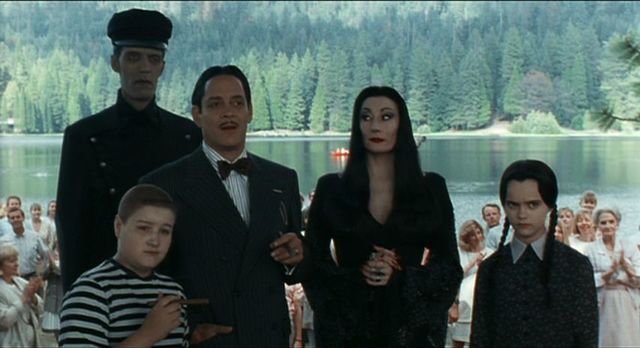
Celebrating the birth of their new child (“He has my father’s eyes” / “Take those out of his mouth”), Morticia (Anjelica Huston) and Gomez (Raúl Juliá) hire a new nanny, Debbie Jellinsky (Joan Cusack) to care for the baby. On her advice, they also decide to send the insanely jealous Wednesday (Christina Ricci) and Pugsley (Jimmy Workman) to a summer camp – needless to say they do not fit in with the All-American, Apple-Pie ideals championed there. Debbie meanwhile has wicked designs on becoming the widow of their rich Uncle Fester (Christopher Lloyd).

Addams Family Values gets a lot of comic juice out of some very witty set-ups. Everyone involved in the film feels more relaxed and happy to let the comedy breathe. Sonnenfeld lets the set-ups come naturally and allows the characters to come to the fore. Every joke in the film comes from watching the characters bounce off their circumstances. Of course, a lot of this comes from the fact the film doesn’t need to do any of the heavy lifting of introducing the world or the characters – it rightly assumes we know what we are getting from the start – but it still makes the film hugely entertaining.

A lot of the humour comes from the brilliant summer camp plotline, with its passive-aggressive, jolly-hockey-sticks owners (a very funny Peter MacNichol and Christine Baranski) and their naked favouritism for the popular kids. Placing the Addams children into a world of normal teenage politics and the forced jollity of adults who would rather still be one of the popular kids at school is a brilliant touch. This clash of values makes for no end of comic glory, culminating in a disastrous Thanksgiving play, which is a triumph of the sad and overlooked over the popular kids (because who watching any film favours the popular kids?).

Christina Ricci is brilliant in this – her deadpan sense of comic timing is spot-on. Every scene and every one-liner is stand-out. The film even finds time for a sweetly semi-romantic plotline between her and loser Joe Glicker (David Kumholtz, also very good as the kind of kid who likes to read A Brief History of Time). Ricci ends up carrying a lot of the film’s comic material, and she’s so perfect in the role that to a lot of us she will always be Wednesday Addams, never mind what she does.

The summer camp plotline is so drop-dead funny and memorable, it rather overshadows the film’s actual plot about Debbie’s attempts to seduce and murder Fester. Sonnenfeld struggles to make this main plot come to life – his real delight is in the sketch-based comedy of the summer camp and the Addams’ love for the grotesque and the extreme. Having said that, Joan Cusack is wickedly sexy and funny as a heartless social climber.

Anjelica Huston and Raúl Juliá remain divinely perfect as a couple so besotted they can barely look at each other without bursting into a steamy tango, or an avalanche of flirtatious foreign language banter. Juliá rips into the dialogue with a flamboyant gusto, and he’s a perfect foil for Huston’s supercool, arch one-liners. Sonnenfeld never lets the introduction of a baby affect their comic darkness in any way, which is a perfect set-up for comedy.

Addams Family Values is terrific good fun and always keeps you laughing. It’s a load better than the original, and has some terrific comic set-pieces in. Sure it’s got a pretty basic plot, but it’s directed with a wicked dryness by Barry Sonnenfeld and its cast are now completely comfortable in their eccentric characters. The tone always seems spot-on between the surrealist darkness and the childish, cartooney horror. It’s a very entertaining film.

An American Werewolf in London (1981)

It’s a lesson in how not to spend your gap year in American Werewolf in London

Director: John Landis

Cast: David Naughton (David Kessler), Jenny Agutter (Alex Price), Griffin Dunne (Jack Goodman), John Woodvine (Dr Hirsch), Lila Kaye (Pub landlady), Frank Oz (Mr Collins), David Schofield (Dart Player), Brian Glover (Chess Player), Rik Mayall (2nd Chess Player), Don McKillip (Inspector Villiers), Paul Kember (Sergeant McManus)

Horror and comedy are both extreme genres, on the edges of normality and are designed to provoke extreme reactions, of either terror or hilarity. So it’s often a bit of a surprise that more films haven’t attempted to put the two of them together. But that’s what John Landis does in An American Werewolf in London. You’ll laugh, you’ll scream, you’ll even cry a bit. You’ll probably also look away a few times. And you probably won’t want to go hiking straight after it.

David Kessler (David Naughton) and Jack Goodman (Griffin Dunne) are two students backpacking through the English countryside. Taking shelter from the rain in a pub, The Slaughtered Lamb (pub sign a wolf’s head on a spike), they are swiftly intimidated by the locals and head back out – ignoring suggestions to keep on the road. Sure enough, they are attacked by a crazed wolf… Three weeks later David awakens in hospital, plagued with nightmares and visions of himself running through the forest. Could he be a werewolf? Falling in love with his nurse Alex (Jenny Agutter), he soon finds himself staying in her flat in London – just as the full moon rises…

AAWIL is a playful movie, with a grungy, college-humour to it. The jokes are often laugh-out loud funny, and the central characters are very engaging. As well as this the film is filled to the brim with blood, guts and slaughter. Guts fly, blood sprays. Landis gets the balance more or less spot-on between heightened humour and bloody slaughter – every bloody moment is followed by an excellent comic punchline, and just when the humour and romances start to get too much of a hold, you get a moment of shuddering violence. It’s also crammed with some great music – although in a terrible oversight there is no playing of Werewolves of London (if ever a song seemed written for a film…).

It’s best remembered for its influential werewolf transformation sequence. Rick Baker won the first Oscar for make-up for this tour-de-force at the film’s centre, which showpieces David’s painful looking transformation. This sequence has inspired every single werewolf transformation since, including David Thewlis’ in Harry Potter. Limbs stretch and distort. Hair springs up. His body arches and his spine practically snaps itself into new positions. His face distort, and the entire shape of the body changes. And of course it’s screamingly painful. The sequence hasn’t aged a day, and it’s still a marvel of make-up and practical effects.

Landis’ decision to largely shoot werewolves from POV or in flashes is a good one – when we get the animatronic wolf on the screen towards the end it is strikingly unconvincing and artificial looking, like a wobbily muppet. But for the bulk of it he makes these animals terrifying forces of nature. No wonder the creepy pub denizens are terrified of them.

The opening pub sequence is a masterpiece of small village aggression. Who hasn’t gone into a pub like this and felt like the room went silent as soon as you entered? The actors here revel in these hostile villagers, not least Brian Glover as a domineering loudmouth and David Schofield as a sinister darts player. It also brilliantly shows from the start that David and Jack are fish out of water – stuck adrift in a land they don’t quite understand, with a condition they don’t really seem to be completely aware of.

Not that it’s all bad for David, as he gets a steamy love-affair with Jenny Agutter’s alluring Alex, every geeky college boy’s dream of a gap-year love affair. Sure the bond between them is rushed – and Alex alternates between being caring-and-observant and is actually fairly dim when the film demands it (Yeah David has come home naked over than a woman’s coat, having spent the night sleeping in a zoo and has no memory of the night – but nothing odd strikes her about his behaviour…) – but she still gives a cracking performance.

David Naughton balances the film very well as David – a geeky student, horny and almost wilfully ignoring what’s happening to him. Griffin Dunne possibly steals the show as Jack, a strange mixture of best friend, geeky off-the-cuff wit and giver of bitter-but-straight-forward advice (the make-up for Jack by the way is almost more impressive than the transformation itself). 

American Werewolf in London is a bit of a (forgive me!) shaggy dog story. Structurally I’m not sure if it’s that great, as it tends to drift at times before a rush to the finishing line. The ending in particular is abrupt – not helped by a deliberately jarring final musical choice. It bowls along, but it’s so in love with its mix of horror and comedy that you never quite end up pulling for the romance at its centre as you should. I’m not sure John Woodvine was quite the right casting for the doctor investigating the werewolf phenomenon – he’s almost seems to feel as if he is above the picture. Landis gets some neat hits on British culture, but you can’t help but feel that there is more to be mined here – there isn’t quite enough American-British culture clash there to really sell David’s confusion.

It’s not a brilliant masterpiece – but it is very entertaining and crammed with striking scenes. Landis is playing around here – in fact he may be telling a massive joke, taking the piss out of monster movies while knocking slacker comedies by turning the slacker into a murderous monster. But it’s very good for all that – and for several key sequences alone you’ll find it hard to shake. It’s a film for late-night viewing and such a good mixture of comedy and extreme horror that it will always feel unique.

What We Do In the Shadows (2014)


The odd housemates of vampire-comedy What We Do in the Shadow

Director: Jermaine Clement, Taika Waititi

Cast: Taika Waititi (Viago), Jermaine Clement (Vladislav), Jonathan Brugh (Deacon), Ben Fransham (Petyr), Jackie Van Beek (Jackie), Cori Gonzalez-Macuer (Nick), Stu Rutherford (Stu), Rhys Darby (Anton)

The life of a vampire – in between all the blood, what do you actually do? How do you fill the (never ending) time of immortality? Or, more mundanely, how do you find friends to live with? Jermaine Clement and Taika Watiti’s excellent flat-share comedy is a free-wheeling but very sweet vampire and buddy-movie comedy, set in a vampire flat share. It’s Being Human with more jokes, and more heart.

Opening their doors to a fly-on-the-wall mockumentary crew (whom they have taken a solemn vow not to eat), we enter the lives of four vampire friends who live in Wellington. Viagro (Taika Waititi) is a 379-year old dandy: prissy, with a hatred of clutter. Vladislav is a 862-year old former Vlad-the-Impaler style tyrant, still not completely over torturing people in the basement (though definitely ashamed of this vice). Deacon (Jonathan Brugh) is a youthful 183, the baby of the group, a self-absorbed rock-n-roll Byronite type. Petyr is 8,000 years old, and is a Nosferatu-style monster who never comes out of the basement. Their lives are turned upside down when Deacon accidentally turns boorish Nick (Cori Gonzalez-Macuer) – though this also introduces them to Stu (Stu Rutherford), a genial and immensely likeable chap whom they all take a shine to.

What We Do in the Shadows is a very funny spoof of nearly every vampire cliché you can imagine. Each vampire takes on the style and characteristics of a different sub-school of vampire dramas. It rolls along with a genial looseness, creating heart-warmingly endearing characters – despite the fact that the film doesn’t stint on watching our heroes brutally spill blood and guts as they eat various guests. Of course things like this are juxtaposed with brilliant belly laughs – something about vampires bickering about the washing up and the cleaning rota is just inherently hilarious. Watching them dress up for a night out (unable to see their own reflections) is a gem sequence.

The film shows each of its characters are frozen in time, sort of man-children, stuck in their own time periods and totally adrift in the modern world. It’s part of what makes them endearing. Throw in a couple of sweet plotlines, most notably Viagro’s romantic longing for the woman he moved to New Zealand for almost 60 years ago (and who now resides in a care home), and you’ve got a winner. The group’s interaction with Stu is wonderfully sweet – despite their initial irritance with (and hunger for) the ruddy-faced human in their midst, they quickly all bond with his straightforward calmness and his understanding of everything from the internet to working the TV.

It’s packed with plenty of hilariously inventive gags around vampire-lore. Our heroes spend every night prowling nightclubs – hampered by the fact that before they can enter anywhere, they need to be invited in (we see several snapshots of them attempting to get invitations from impassive bouncers). In confrontations they hiss and fly at each other in a way that’s just this side of silly. Viagro constantly bemoans the mess his housemates make when they eat their victims, without clearing up (he futilely attempts to get them to put towels down to protect the sofa). But there are also endearing spins – the vampires crowd around the computer to watch a youtube video of a rising sun, something they’ve obviously not seen for centuries.

The later introduction of a rival werewolf pack adds further comedy opportunities, with the werewolves headed up by an uptight control freak who enforces rules on everything from physical conduct to the use of foul language. It’s just one of many expert beats in a superb comedy.

What We Do in the Shadows is acted with such lightness and openness, it’s very easy to not notice that it’s brilliantly handled. In the hands of other groups of comedians, this could have been smug, self-satisfied and more about the actors amusing themselves than the audience. Instead this is a gleeful series of scenes, the movie like a big hilarious party we’ve been invited to join. As well as being sharply written and directed, the acting is fantastic. 

It’s an unusual, dark comedy – but it’s got a lot of heart and a lot of brains. It’s a comedic joy, that would certainly reward constant viewing – each scene contains comic highlights. Highly recommended!

Day for Night (1973)


Jean-Pierre Léau and Jacqueline Bisset are the leading actors in FrançoisTruffaut’s film making masterpiece Day for Night

Director: François Truffaut

Cast: Jacqueline Bisset (Julie Baker), Jean-Pierre Aumont (Alexandre), Valentine Cortese (Séverine), Jean-Pierre Léaud (Alphonse), Dani (Lilane), François Truffaut (Ferrand), Alexandra Stewart (Stacey), Jean Champion (Bertrand), Nathalie Baye (Joëlle), David Markham (Dr Nelson), Nike Arrighi (Odile), Bernard Ménaz (Bernard)

François Truffaut is perhaps the greatest example of a critic turned film maker. A noted French film expert, he made a splash when he turned to film directing and became one of the leading figures of the French New Wave. This movement was seen as a rejection of old-school, literary melodramas of French cinema, instead embracing social issues and using the techniques of cinema in new and imaginative ways. Truffaut later stated though he was not a revolutionary, but a man who wanted to make stories that were important to him, using all the tools of cinema available. And as a man who loved cinema – and worshipped the great directors of yesteryear – what story could be more important to him than the making of films themselves?

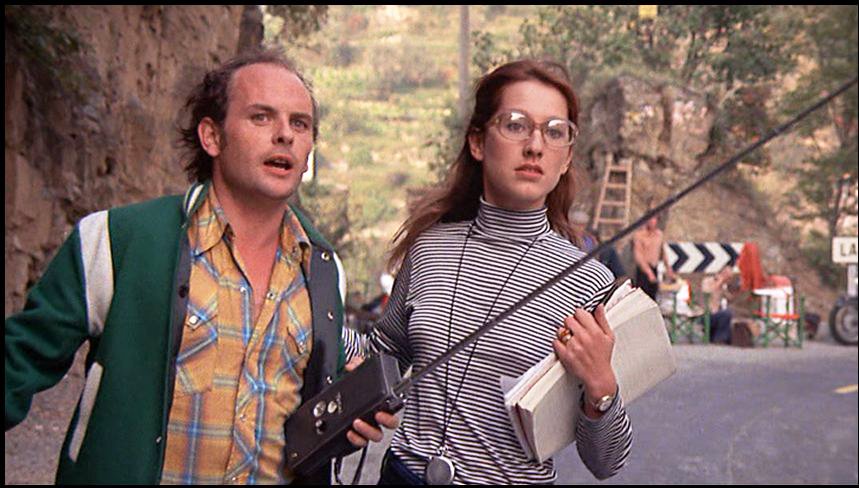
Day for Night (the term means to place a filter on the camera in order to shoot scenes set at night, during the day) is set during the production of Meet Pamela, a melodrama starring gentlemanly screen icon Alexandre (Jean-Pierre Aumont), increasingly fragile screen diva Séverine (Valentine Cortese), neurotic young star Alphone (Jean-Pierre Léaud) and British film star Julie Baker (Jacqueline Bisset) recovering from a nervous breakdown. The film is directed by Ferrand (Truffaut himself), working in close collaboration with the crew (many of them played by the real life crew of Day for Night) not least passionate cinephile script-editor Joëlle (Nathalie Baye). The film is plagued by compromise, reshoots and actor-induced difficulties, with Ferrand and his crew constantly forced to rewrite and adjust the story to compensate.

Day for Night is partly a gentle, satirical farce on movie-making (it even has a documentary camera crew, following events around), but really it’s a deeply romantic, wonderfully engaging, desperately sweet homage to cinema and movie making itself. In fact, I can’t imagine anyone who loves movies not loving this film. It’s a charming warts-and-all, behind-the-scenes look at how a movie is made, and what motivates the people who make it. The fact that it’s really funny, and has some wonderfully engaging characters in it, is the icing on the cake.


Truffaut places himself at the centre of the film in more ways than one. Obviously he’s playing the director – the still-centre of the film, who constantly must address and overcome a string of practical problems, from actors disappearing to malfunctioning props and (in one stand-out moment) a cat who refuses to lick milk from a saucer. But the film also places Truffaut the man at its heart: Ferrand’s love of cinema is Truffaut’s own. Three times we see Ferrand dreaming at night (it’s possible it’s even the same night – each set-up is the same). We see snippets of the dream before its full content is revealed: it’s a memory of the boy Ferrand (based on Truffaut’s own childhood) going to cinemas at night to steal still photos of Hollywood masterpieces (in this case Citizen Kane). Cinema is such a powerful, all-embracing part of Truffaut’s life that even as a child he had to worship at its alter, and commit theft to take a small part of it home with him.

This love of cinema runs through the whole film. Joëlle (a truly wonderful performance from Nathalie Baye: smart, sweet, engaging and sexy) can imagine leaving a man for a film but never vice-versa. The props man, Bernard, loves the tricksy solution search to overcome filming problems – and clearly carries a yearning to be on screen himself. The film is packed with longing stories of the golden age of Hollywood: at one point Ferrand drives around his set, bemoaning the loss of the era of studio-made films. It’s a film that celebrates the artisans of film, perhaps even more than artists. It’s an insight into what all those little jobs on the credits actually are, and the heroes are frequently carpenters, script editors, assistants, soundmen, extras directors… In fact all the problems of the film are caused by the actors themselves, the self-absorbed public face of an industry that is built on the love and dedication of the working people behind them.

The actors in the film do, however, contribute most of its comedic and romantic elements. Neurotic, needy matinee idol Alphonse (Jean-Pierre Léaud in a neat performance of childish self-obsession), fawns possessively over his girlfriend Liliane, who he treats as part lover, part sister, part surrogate mother. Frequently he disappears or melodramatically announces that he is finished with acting. He contrasts nicely with Alexandre (a gentlemanly and endearing Jean-Pierre Aumont), who goes through the film with a professional calmness, laced with charm, who is never late and never causes any trouble, but enjoys gossip – and quietly lives with a far younger male tennis player.

Jacqueline Bisset (again hugely engaging – it’s hard not to fall in love with the people in this film) perfectly captures both the attractive likeability and vulnerability of the person who lives their whole life in the spotlight, in a thinly veiled portrait of Julie Christie. She has a natural ease with the assistants and crew – but it’s her fragile mental state that has the insurance companies worried. It’s easy to see why she might feel like that, as the film set is a hot bed of flirtation and casual one-night stands – at one point even called out as such by an outraged assistant-director’s wife. What’s “nice” about the affairs though is their relative lack of long-term drama – short term tears and tantrums are swiftly forgotten, as everyone pulls together to make the film.

The drama of film creation is the magic here. The film is bookended by elaborate set-ups for a street scene (the film even playfully doesn’t reveal at first that what we are seeing is a film-within-a-film) – one carefully rehearsed, the other reshot with the set covered in snow to help cover up the reasons for an urgent reshoot. A scene between the father and the daughter-in-law is conceived, written, rehearsed and shot in one sequence – all in response to Ferrand and Joëlle’s perceptions of the dynamics between the actors. Ferrand, behind his quietness, is ruthless in using things for the film – one character finds their heartfelt confessions about the emptiness of life pushed under their door the next day as lines integrated into the script. It’s not cruel – and that’s the best thing about this film, it’s never cruel or bitter – it’s just the way of the game, the way we struggle to create art.

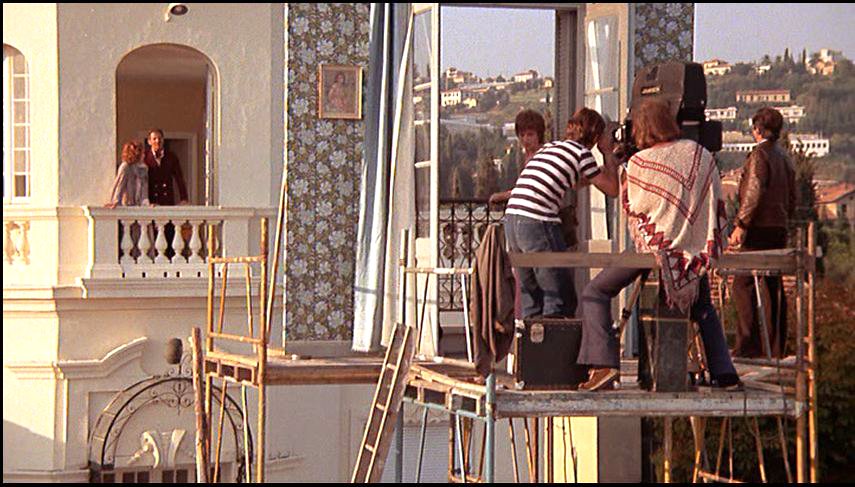
And the struggle is what is clear here. Ferrand bemoans in voiceover that every film starts with him wanting to make the best film he can, but always seems to end as a salvage job. Much time is spent setting up a complex ballroom sequence, which circumstances later require to be cut. Séverine (a winningly bright performance of diva self-parody from Valentina Cortese) frequently struggles with lines and blocking, regularly bringing the film to a halt – at one point her lines are stuck on a wall out of camera shot. It’s another example of the exposure of film magic – at one point a window and part of a wall is built on a scaffolding to give the impression of a building – only what will appear on camera is built, everything else is scaffolding. 

Interestingly, the film all this effort and work is being put into looks like a pretty forgettable melodrama. It’s in many ways another piece of comedic self-parody – Truffaut’s Ferrand is filming a thinly veiled version of Truffaut’s own The Soft Skin (I’m indebted to the Criterion Collection blu-ray special features for that titbit) – but it’s also a sign of how art and compromise go hand-in-hand. The final film is hewn from the circumstances of its making: it might not be what was intended at the start, but it’s the best we can do with the marble the artist has been given. Sure Meet Pamelalooks pretty average – but the important thing is the love invested in making it. If this goes into an average film, the same level (perhaps more) goes into a great one.

Day for Night is the perfect film for film aficionados. It’s warm, funny and moving. It’s crammed with wonderful performances. It’s shot with a playful expertise. It has a marvellous score by Georges Delerue – part actual score, part score recordings for Meet Pamela – and Truffaut keeps the whole light confection perfectly intact, never letting it burst or sink. It’s a masterclass in film crafting, which is about the craft behind making a film. It’s like peeking behind the magic curtain. It’s brilliant.

The Death of Stalin (2017)


Hilarious hi-jinks in Soviet Russia as the politburo struggle to deal with The Death of Stalin

Director: Armando Iannucci

Cast: Steve Buscemi (Nikita Khrushchev), Simon Russell Beale (Lavrenti Beria), Paddy Considine (Comrade Andreyev), Dermot Crowley (Lazar Kaganovich), Rupert Friend (Vasily Stalin), Jason Isaacs (Georgy Zhukov), Olga Kurylenko (Maria Yudina), Michael Palin (Vyacheslav Molotov), Andrea Riseborough (Svetlana Stalin), Jeffrey Tambor (Georgy Malenkov), Paul Whitehouse (Anastas Mikoyan), Paul Chahidi (Nikolai Bulganin), Adrian Mcloughlin (Joseph Stalin)

Armando Iannucci is a brilliant television satirist, who spring to wider fame with the success of foul mouthed political satire The Thick of It (re-imagined as Veep in the USA). His sweaty, sweary, fly-on-the-wall style, and characters who embody the panicked agitation of the nakedly ambitious but not-too-bright, was a perfect match for our modern world. Does the style work for the past? You betcha.

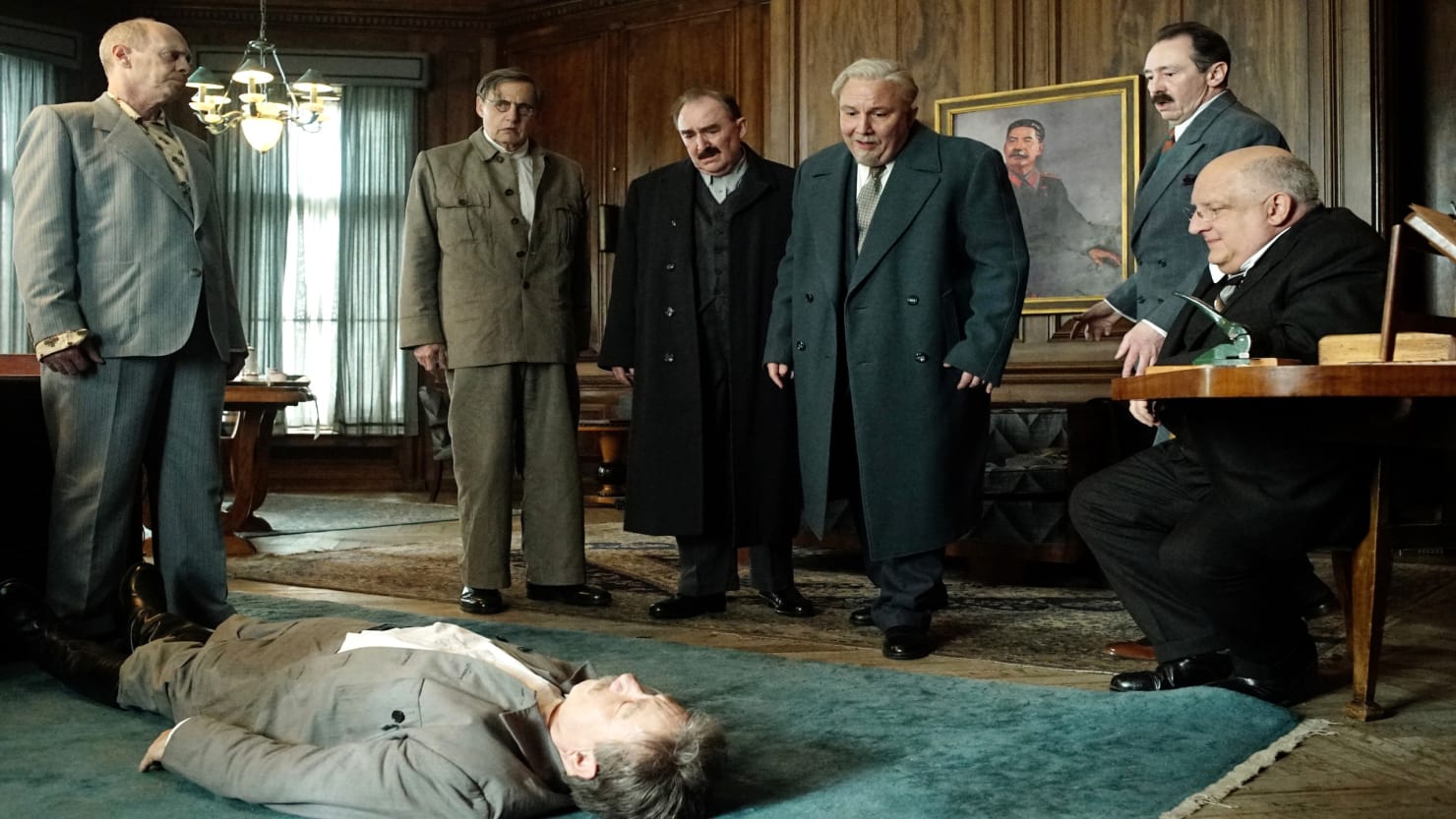
In Soviet Russia, a country near paralysed with terror, the ruthless dictator Stalin dies. This starts an immediate scramble to succeed him, with the leading candidates being weak-willed, vain and foolish deputy Malenkov (Jeffrey Tambor), vaguely principled but fiercely ambitious opportunist Khrushchev (Steve Buscemi) and sinisterly sadistic police chief Beria (Simon Russell Beale). Soviet Russia though is a pretty ruthless place for political manoeuvring, with retirement usually coming in the form of a single bullet to the back of the head.

First off the bat, The Death of Stalin is a blisteringly funny film, a real laugh-out loud riot. Why does it work so well? Because it understands that, hand-in-hand with the horror, Stalinist Russia was so completely barking mad that it lends itself completely to black comedy. Imagine The Thick of It, but with Malcolm Tucker executing rather than dismissing terrified ministers. Welcome to the madness. Events that seem crazy are pretty much true: although time has been telescoped, the struggle for the succession did more or less play out like this (with less swearing).

Every scene of this dark farce has a memorable, stand-out line or moment. The sweaty panic of these over-promoted yes-men is brilliantly reminiscent of the sort of panic you can imagine seeing in your office, with the exception that it probably isn’t literally life-and-death. Iannucci completely understands the wild improvisation of the fiercely ambitious in high-stress situations. If you think the ministers of The Thick of It were adrift when confronted with parliamentary enquiries, imagine how their counterparts struggle when faced with the threats of a bullet in the head.

Because that’s the great thing about this film – while still being hilariously foul-mouthed, it actually gives a pretty good idea of what it might have been like to live in Soviet Russia. The characters are constantly having to adjust to who is in favour and who isn’t, what it is permissible to think and say and what isn’t, who is “dead and who isn’t”. Iannucci totally understands human nature doesn’t change – those left alive around Stalin are just the sort of shallow, selfish, weaklings he’s been lampooning in The Thick of It. Most of the ordinary people we see are just desperate to keep their heads down – getting noticed for regular joes in this film is basically a death sentence. 

The opening sequence really gets this idea across. Paddy Considine is hilariously nervy and terrified as a radio producer ordered to send a recording of the live concert they’ve just broadcast (unrecorded) to Stalin. The frantic rush to reassemble the orchestra, fill the audience up again with people from the street, replace the conductor (the original having passed out in terror at the possibility that he may have been bugged questioning Stalin’s musical knowledge) is brilliantly funny – but works because the genuine expectation that doing the slightest thing wrong could lead to immediate execution is completely clear. Especially as the scene is intercut with Beria’s heavies rounding up innocent civilians to disappear into a gulag. 

Iannucci doesn’t dodge the ruthlessness. The film is punctured throughout by executions, often carried out with a black farcical desperation. It doesn’t shy away from the brutality of Beria, whose violence, sadism and pathological rape addiction we are constantly reminded of (and which are even more effectively sinister as he’s played by the cuddly Simon Russell Beale). In turn, a frantic Beria berates the rest of the politburo for their participation in the orgy of killings and show trials Stalin organised. We see people about to be taken to their deaths hurriedly offering terrified goodbyes to their loved ones. The final sequence of the film, as the battle for the succession reaches its end-game, tones down the jokes to give us an alarmingly realistic picture of a coup. Black farce ending in death: it’s as legitimate a picture as any of living in Stalinist Russia.

All of this is presented in a razor-sharp and witty script, and the cast who deliver it are brilliant. In a fantastic touch, the actors (with the exception of Isaacs) use their own accents, which only adds to the crazy fun. The acting is, across the board, fabulous. Russell Beale gives his greatest ever film performance as a grubby, ambitious, not-quite-as-smart-as-he-thinks Beria, with bonhomie only lightly hiding his chilling sadism and cruelty. Buscemi is equally brilliant as Khrushchev, who has the ego and self-delusion to convince himself that he is the only hope for a reformed USSR, while actually being a weaselly political player with naked ambition.

Around these two central players there is a gallery of supporting roles. Tambor gives a brilliant moral and intellectual shallowness to the hapless Malenkov. Friend is hysterical as Stalin’s drunken son, a deluded man-child barely tolerated by those around him. Palin’s cuddliness works perfectly as fanatical Stalinist Molotov. Whitehouse, Crowley and Chadihi are also excellent, while Riseborough does well with a thankless role as Stalin’s daughter. The film may be hijacked though by Isaacs as a swaggeringly blunt General Zhukov, re-imagined as a bombastic, plain spoken Yorkshireman, literally entering the film with a bang half-way through and bagging most of the best lines.

The Death of Stalin is not just a brilliantly hilarious comedy, it also feels like a film that completely understands both the terror and the confused ineptitude of dictatorship. In a world where it is death to question the supreme leader, is it any surprise that his underlings are all such clueless, ambitious idiots? Has anyone else understood the black comedy of dictatorship before? I’m not sure they have. You’ll laugh dozens and dozens of times in this film. And then you’ll remember at the end that when this shit happens, people die. This might be the best thing Iannucci has ever made.

Spy (2015)


Melissa McCarthy takes on the bad guys in actually rather funny comedy Spy

Director: Paul Feig

Cast: Melissa McCarthy (Susan Cooper), Jason Statham (Rick Ford), Rose Byrne (Rayna Boyanov), Jude Law (Bradley Fine), Miranda Hart (Nancy B. Artingstall), Bobby Cannavale (Sergio De Luca), Allison Janney (Elaine Crocker), Peter Serafinowicz (Aldo), Morena Baccarin (Karen Walker)

Comedy is an unusual thing to write about, I often find. Unlike any other film genre, you know immediately whether it works or not, ‘cos if you ain’t laughing it probably ain’t working. Well the good thing is that Spy does work, as I certainly laughed. It’s actually a fairly well structured comedy, a smart parody of Bondish action films matched with the foul-mouthed crudity you get in the films from the Feig/Apatow stable.

Susan Cooper (Melissa McCarthy) is the cheery deskbound analyst who provides real-time data and intel to would-be 007 Bradley Fine (Jude Law). But after disaster strikes, Susan volunteers to go into the field to find out as much as she can about Rayna Boyanov (Rose Byrne), the daughter of a rogue arms dealer who is taking over the family business. Despite the concerns of her boss – and super-macho fellow agent Rick Ford (Jason Statham) – Susan proves surprisingly adept at espionage, disguise and above all action.

What Spy does well is that it feels like it’s been written and shot with a bit of discipline, rather than the over-indulged and forced “improvisation” that so often blights these sort of comedies. It feels more controlled, and therefore easier to engage with – we are watching a group of good actors tell a story, rather than a gang of comedians showing off. I think this is helped by the fact that most of the cast are not natural comedians, but instead actors delivering gags with skill. Feig also shoots the film with zip and punch – most scenes don’t drag on indulging forced banter.

Melissa McCarthy is very  good as the rather sweet lead, torn between the role she has given herself in life, and her own desire to use her capabilities. Her character delivers many of the comic moments of the film, but she’s not the joke – instead she is shown to be brilliantly proficient both as the “eyes and ears” of Jude Law’s suave Bond-spoof role, and also as the woman in the field. McCarthy’s comic timing is matched with an affection for her character that makes her likeable and easy to empathise with. What she creates here is a genuine character who grows and develops as the film progresses.

The film’s real weapon is the strong cast of proper actors giving expert comic turns. Rose Byrne is hilarious as an imperiously bitchy, foul-mouthed villain who makes every line into a thinly veiled (and often not veiled at all) insult. Jason Statham gives probably a career-best performance as a ludicrously macho secret agent bragging incessantly about a string of unlikely sounding exploits, while being barely competent in the field. Who knew The Transporter could do such a neat line in self-parody? Allison Janney’s foul-mouthed, impatient CIA boss and Miranda Hart’s ditzy surveillance expert offer similarly rich comic roles. These actors know that the trick of real comedy is to deliver well prepared punchlines with controlled efficiency rather than crummy flights of fancy.

Spy also works because it has an actual story, and mixes this effectively with action and hi-jinks that feel like solid spoofs of Bondish films but are also genuinely entertaining in themselves. It’s a plot that stands (more or less) on its own, rather than feeling like a shoddy framework to hang rude jokes on. As such, the rude jokes complement by the plot (rather than crushing it) and most land with a genuine chuckle. It’s also lovely to have a film that places female characters so front-and-centre, not as props or as “sexy fighting women” (I’m looking at you Pride and Prejudice and Zombies) but as confident individuals who know who they are and are not defined by their relationship to a man. McCarthy is terrific, as are the rest of the cast. This is a film you will definitely enjoy.