Tag: Crime drama

Heat (1995)

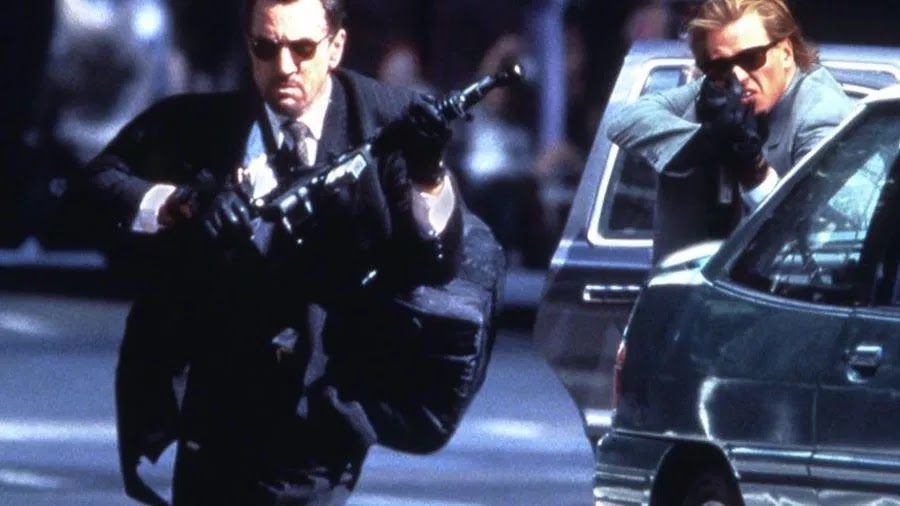
De Niro is packing Heat

Director: Michael Mann

Cast: Al Pacino (Lt Vincent Hanna), Robert De Niro (Neil McCauley), Val Kilmer (Chris Shiherlis), Jon Voight (Nate), Tom Sizemore (Michael Cheritto), Diane Venora (Justine Hanna), Amy Brenneman (Eady), Ashley Judd (Charlene Shiherlis), Mykelti Williamson (Sgt Drucker), Wes Studi (Detective Sammy Casals), Ted Levine (Detective Mike Bosko), Dennis Haysbert (Donald Breedan), William Fichtner (Roger van Zandt), Natalie Portman (Lauren Gustafson), Tom Noonan (Kelso), Kevin Gage (Waingro), Hank Azaria (Alan Marciano), Danny Trejo (Trejo), Xander Berkeley (Ralph)

In the mid-90s, Heat was the cinematic event of the year. De Niro! Pacino! Together! In one scene! The two acting heavyweights – wildly proclaimed and popular since the 1970s – had of course made The Godfather Part II together but had shared no scenes. Here, however, we’d see them both at the same time riffing off each other. The great thing is that there is so much more to Heat than just that one scene. Heat is a sort of poetic cops and robbers flick, part stunning action adventure, part profound exploration of the internal souls of men chasing down leads, both good and bad.

Neil McCauley (Robert De Niro) is a skilled career criminal who lives his life with a monastic self-denial, saying you can have nothing in your life “that you cannot walk out on in 30 seconds flat if you spot the heat around the corner”. Vincent Hanna (Al Pacino) is a bombastic, egotistical, workaholic detective with a self-destructive family life. Naturally, these two men find themselves on opposite sides, as McCauley plans his next job and Hanna works to stop him. But the men, with their similar codes dedicated to their chosen career, find that they have an increasing mutual respect – not that that will stop either of them “putting the other one down” if push comes to shove.

Heat is the pinnacle of Michael Mann’s career, and his most triumphant exploration of the conflicted, complex, masculine personalities at the heart of the high-adrenalin worlds of crime and police work. Mann has a gift for giving the simple rush and tumble of cops and robbers a sort of epic poetry, like a metropolitan Beowulf, and he achieves this again here. Heat is a film that throbs with meaning, it’s cool blue lensing and chilly, modern architecture serving as a perfect counterpoint to the cool, professional and focused personalities of its characters.

Heat also goes the extra mile by building this playground confrontation into a mythic battle of wills, a battle of principles and ways of living that seem separated only by a few degrees. Mann invests this with such sweep, such grandiosity (without pomposity), such scale that it becomes a sort of modern epic, a film where intense meaning can be mined by the viewer from every scene. Whether there is in fact any meaning there – avoid listening to Mann’s commentary which drills down so many of his elliptical character beats and open-ended scenes into the dullest, most predictable tropes that he had in mind while filming – is another issue, but Mann’s trick as always with his best work is to make something really quite small and everyday seem like a grand, timeless epic.

It all boils down to that famous coffee shop scene, where De Niro and Pacino for a few magic moments come together. It’s a scene that explicitly asks us to see cop and criminal and understand that there is in many ways very little to choose between them. It hinges on the gentle competitiveness of the actors, and the way they subtly play off each other. It also plays on our own histories of these two actors, of decades of seeing them as two sides of the same coin, both carrying so much cultural baggage for a string of iconic roles that saw them rule Hollywood for over a decade. It’s the sort of scene given extra investment, where you sense the mutual respect of the actors fuelling the strange bond that powers the scene. 

It’s also the one scene of the film that Pacino underplays in. The rest of the film he goes way bigger, powering through each scene with an explosion of shouting and drama. It’s a performance ripe for parody, with more than an edge of ham, but it just about works. Pacino turns Hanna (hilariously the character shares a name with a BBC political journalist of the 1980s) into the purest form of adrenalin junkie, a larger-than-life personality who tears through people and cases with a focused determination that allows no room for a personal life. De Niro downplays far more by contrast, apeing a sort of 1940s noir cool, a monkish insularity that prevents anyone from getting close to him, mixed with a laser-guided determination to do whatever it takes to make his score.

Mann’s film throws these two characters into a series of stunning set pieces with the bank robbery at the centre (“the one last score” that McCauley can’t pass up no matter the danger). The robbery – and the shoot out that follows it – is a triumph of action cinema, brilliantly shot and edited. The gun play is stunning, with Andy McNab having served as a consultant for the actors on the use of automatic weapons. The scene rips through the screen, spewing bullets all over the place in a ruthless, no-onlooker-spared rampage that also really pushes the limits of effective sound design. That’s just the highlight of several scenes that – with guns or otherwise – hum with tension, danger and excitement.

Mann also has enough room in this film though to skilfully establish a number of supporting characters with compelling story lines of their own. Val Kilmer is a tad wooden as McCauley’s number two, but his storyline of troubled marriage is mined for unexpecting pathos (thanks also to Ashley Judd’s fine work as his wife). Kevin Gage is very good as a psychopathic criminal unwisely brought on board to fill a slot in an early robbery. Dennis Haysbert has his own tragic plotline as a criminal trying to turn straight. Diane Venora is excellent as Hanna’s neglected wife, as is Portman as his vulnerable daughter-in-law. This isn’t to mention excellent performances from a rogues gallery of character actors, from Jon Voight to William Fichtner. 

Mann keeps all these plotlines perfectly balanced in a film that is very long but never drags for a minute. Crammed with exciting set pieces and brilliant sequences, it’s a film that manages to feel like it is about a very masculine crisis – the failures of men to balance the personal and their career, selfishly harming those around them because of their addiction to action. Mann’s film looks brilliantly at the essential emptiness and sadness this leads to – as well as the blinkered drive that never prevents men from stopping for a second and changing their lives, no matter how many reflective cups of coffee they have. Mann partners this existential, poetic feeling drama with the ultimate crash-bang cops and robbers and thriller, which will leave you on the edge of your seat no matter how many times you see it. Quite some film.

The Anderson Tapes (1971)

Sean Connery plans the perfect crime under the noses of the government in The Anderson Tapes

Director: Sidney Lumet

Cast: Sean Connery (John “Duke” Anderson), Dyan Cannon (Ingrid Everleigh), Martin Balsam (Tommy Haskins), Ralph Meeker (Captain Delaney), Alan King (Pat Angelo), Christopher Walken (The Kid), Val Avery (“Socks” Parelli), Dick Anthony Williams (Edward Spencer), Garrett Morris (Everson), Stan Gottleib (“Pop”)

Everywhere we go now we kind of know that we are being watched. There are cameras everywhere. Satellite links build into our cars. Heck we all carry everywhere we go a portable tracking and recording device that can be listened into. So the idea of surveillance being ever present wouldn’t be a surprise to us. But in 1971, the idea that the government could be listening all the time, at any time was something that couldn’t cross anyone’s mind. 

It certainly doesn’t occur to John “Duke” Anderson (Sean Connery) just out of chokey after a ten year stretch. He’s back into a world he hardly understands, but it doesn’t take longer than five minutes in the swanky apartment block of his girlfriend Ingrid (Dyan Cannon) for him to case the joint and plan to do it over – all the apartments at once. Putting a crew together, Duke plans to clean out all the whole block of all its valuable property in one go, with financial backing from the Mafia (who owe him for unspecified reasons). Problem is, Duke’s entire plan is being recorded and monitored by different government agencies from top to bottom who – even if they aren’t speaking to each other – are in position to wreck his plans the instant anyone puts the clues together…

The Anderson Tapes is part crime thriller, part black comedy caper. It generally plays it pretty light – with flashes of violence or danger – and throws in some satire on the surveillance age. The tapes in question are different levels of surveillance at every location Duke seems to stop at. His time in the apartment is recorded by a PI following his girlfriend. The feds bugging his mafia contacts. Most of his criminal gang are being watched by the cops. All this recording creates a load of trees which block the view of the forest. Not one of these agencies thinks about joining up their thinking, meaning the actual robbery comes as a complete surprise to all of them. It’s a neat satirical mark on the incompetence of administrative led organisations – when the robbery is finally being reported by a ham radio operator, the news almost doesn’t get through because of a refusal by the 911 operator to transfer a call without an agreement on who will pay the charges for the call.

In all this surveillance Duke is like a romantic hangover from a by-gone time. As played by Sean Connery he’s a romantic figure, like some sort of working-class Raffles, living by the principles of a gentleman thief. He abhors violence, gets on well with all races and creeds, respects his victims and protects them (so long as they don’t get in his way) and runs operations designed to be clean, quick and painless. He justifies his thievery with talk of how most of the property he nicks is just sitting pointlessly in safes, that the insurance will pay out and that in a way he’s giving a bit of excitement to bored middle-class people. Connery is rather good in this role, channelling this rogueishness and expertly maintaining Lumet’s light tone.

Lumet’s direction is competent, professional and assured. Lumet did not hold the film in high regard – it was one he did “for the money” – but he expertly constructs the film, keeps it tight and brings more than enough intriguing directorial flourishes to it. The action frequently pauses in the criminals conversation for a jump cut to the feds listening to the recordings, having paused the recordings themselves (the paused action even uses voiceover from the feds asking for confirmation of who they are listening to). Later, Lumet uses a similar device in the robbery interjecting flash forwards to the people in the apartment bloc being interviewed on site by the police, commenting on events we have often just seen while the aftermath plays out behind them, that throws in plenty of narrative curve balls and misdirects as the action pans out.

The film is dated in places. Quincy Jones’ score often uses a jarring series of electronic beeps that are meant to echo the surveillance of the piece, but actually sounds impossibly dated and jarring. An opening monologue of Connery on the thrill of safe cracking uncomfortably sounds like he is comparing it to non-consensual sex, Martin Balsam’s gang member is an impossibly limp-wristed antiques expert (although he is immediately believable as someone who wouldn’t be questioned surveying apartments for architectural improvements while he is actually casing the joint). There are other moments – but the film gets by because it never leans too hard on any of these attitudes. Indeed the apartment concierge, is depicted as inflatteringly racist and homophobic, in stark contrast to the multi-ethnic, un-prejudiced gang carrying out the robbery.

The Anderson Tapes is an enjoyable, is very 1970s, piece of work that has more than enough to entertain you. It has a clever structure and makes some sound points on surveillance which probably make it more relevant today than it even was then. Connery is very good in the lead role and there is some excellent support (Christopher Walken is strikingly charismatic in one of his first roles). It’s not in the first rank of its director’s films, but it’s still a very fine caper thriller.

The Next Three Days (2010)

Elizabeth Banks and Russell Crowe go on the run in workmanlike thriller The Next Three Days

Director:  Paul Haggis

Cast: Russell Crowe (John Brennan), Elizabeth Banks (Laura Brennan), Brian Dennehy (George Brennan), Lennie James (Lt Nabulsi), Olivia Wilde (Nicole), Ty Simpkins (Luke Brennan), Helen Carey (Grace Brennan), Liam Neeson (Damon Pennington), Daniel Stern (Meyer Fisk)

What would you do to protect the person you love? How far would you go to keep her safe? What would you sacrifice? What rules would you break? Paul Haggis’ serviceable thriller tries to answer these questions, but doesn’t really get much closer to the answers than I have here.

Russell Crowe is John Brennan, a teacher of English Literature at a mid-ranking college. One day, his wife Laura (Elizabeth Banks) is arrested for the murder of her boss. Despite her pleas of innocence, before they know it she is sentenced to spend most of the rest of her life behind bars. When desperation at the thought of her fate – and missing the upbringing of their young son – leads her to attempt suicide, John decides to take the extreme step of breaking her out of prison. But where to begin with the planning? And what will he be prepared to do?

It’s the sort of film that early-on has the lead character meet a ruthless expert (in this case an ex-con with a history of prison breaks, played with a growling enjoyment by Liam Neeson in a one-scene cameo) who outlines a list of rules and terrible things that the hero will be forced to do. The hero looks askance – but sure enough each situation arises and doncha know it the hero is forced to bend his own morality to meet the needs of his mission. What a surprise.

Only of course the film doesn’t have the courage to force Crowe’s John to actually do things that bend his morality. There is always a get-out clause. When his actions lead to him taking a petty criminal’s life (while stealing money from a drug den), it’s self-defence. When he looks like he may be forced to put innocent people in harm’s way, he backs away. When he’s asked to sacrifice something major, he refuses. The film wants to be the sort of film where we see the lead character change inexorably as he becomes harder and more ruthless to achieve his mission. But it worries about losing our sympathy, so constantly gives the audience and the character get-out clauses to excuse his behaviour.

Not that Crowe gives a bad performance – he’s actually rather convincing as a humble, slightly timid man way out of his depth at the start – but the film fails completely to show these events really changing the man. It believes that it’s turning him into a darker, more ruthless person, but it isn’t. At heart, this film isn’t really a character-study at all but a dark caper movie. Obstacles are constantly thrown in the path of our hero, many of which bamboozle him: but then when we hit the prison break itself at last, suddenly he’s pulling carefully planned rabbits and double bluffs out of his hat like Danny Ocean. It’s a film that wants to have its cake and eat it: to show a hero bewildered by his task, in danger from this ruthless world he finds himself in – but also to have him become a sort of long-game con artist thinking three moves ahead of the police.

It just doesn’t quite tie up. It’s the film adapting to whatever it feels the requirements and desires of the audience might be at a particular moment rather than something that develops naturally. Enjoyable as it is to see these sort of games play out, you can’t help but feel a little bit cheated – there has been no indication before this that the character has this level of ingenuity in him.

He doesn’t even really need to pay a price beyond that which he had accepted from the start: at points major sacrifices are dangled before him but he never needs to make any of them. He never has to really bend his personal morality significantly. It’s the cleanest conversion to criminality that you are likely to see.

The film cracks along at a decent pace – even if it is a little too long – and shows its various twists and reveals fairly well. Elizabeth Banks is pretty good as Laura, even though she hardly seems the most sympathetic character from the start (the audience has to do a bit of work for why Crowe’s character seems so devoted to her). Most of the rest of the cast are basically slightly larger cameos but no one disgraces themselves.

The main problem with the film is its lack of depth and ambition. Mentioning Don Quixote several times in the narrative doesn’t magically grant a film depth and automatically create intelligent contrasts with the novel. Instead it just sounds like straining for depth rather than actually having it.

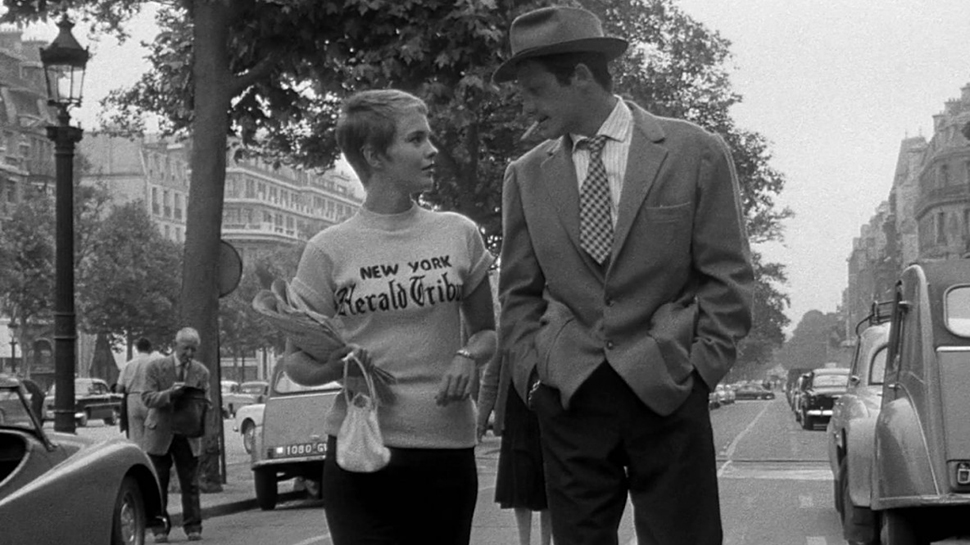
À Bout de Souffle (1960)

Jean Seberg and Jean-Paul Belmondo get obsessed with their own images in À Bout de Souffle

Director: Jean-Luc Godard

Cast: Jean-Paul Belmondo (Michael Poiccard), Jean Seberg (Patricia Franchini), Daniel Boulanger (Police Inspector Vital), Henri-Jacques Huet (Antonio Berruti), Roger Hanin (Carl Zumbach), Jean-Pierre Melville (Parvulesco), Liliane David (Lilane)

The French New Wave emerged from a group of film critics from influential magazine Cahiers du cinema in the 1960s, led by Francois Truffaut (who contributed a four page story outline to this film, although Godard later minimised his contribution as much as possible). The movement believed the director was the “author” of the film, stamping their personality on it. Packed with references to classic Hollywood movies, the films were shot with an improvisational lack of formality (that often hid brilliant cinematic technique) inspired by Italian neo-realism.

Breathless, Jean-luc Godard’s revolutionary masterpiece, was one of the central films in this school of filmmaking. It followed the last few days of Michael Poiccard (Jean-Paul Belmondo). A young man drifting through a life of petty crime, who idealises Humphrey Bogart’s style, he one day steals a car; it happens to have a gun in it, and in a moment of casual indifference he shoots a policeman trying to arrest him and flees. In Paris, while being hunted by the police, he reunites with his girlfriend, American student Patricia Franchini (Jean Seberg), and their self-absorbed relationship plays out under the shadow of the police net getting tighter and tighter.

Jean-Luc Godard’s film was hugely influential, as it seemed to re-write the rules of how films were to be made. Godard’s film is down and dirty, it’s almost guerrilla, but filmed with a wonderful, improvisational beauty. Shots are hand-held and dynamic, the action is all filmed on location, the framing is rough and ready, the camera gets up close and personal with the actors, throwing us in with them with an overwhelming sense of realism. The whole film feels irreverent, casual and cool, and gets a wonderful sense of urban Paris. It magnifies and reflects the very qualities the lead characters believe they have themselves.

Godard’s most influential touch was the use of jump cuts within scenes, with action jumping from moment to moment within a scene seemingly spontaneously, giving an impression of constant movement and ripping out the sense of time between actions. It also gives a sense of the film always driving forward, bouncing from beat to beat. According to rumour, this influential use of editing was a happy accident. The original cut of the film was well over two hours, and the distributors wanted something less than 90 minutes. Rather than cut whole scenes, Godard cut the small moments of movement or peace in scenes, giving the film a jagged freshness.

The whole film is full of these moments, the jumps over silences and conversational gaps, jumps in time lags between walking from point A to point B. It really works as well. The exterior scenes buzz with an exciting freshness. The long second act, basically nothing more than a conversation in a bedroom between the two leads, is edited almost like an action scene in a modern film – perfect for the self-dramatising energy the two characters are leading their lives with.

It’s those two leads who really help to make the film. Seberg picked up a quarter of the film’s budget to be the “name” lead, and she brings the film a soulful but distant sense of coolness. Belmondo was the real find, turning himself overnight into a mega star. In the sixties these were the people that your cool student wanted to be. Belmondo nailed his sense of iconoclastic cool in the opening moments – particularly when turning casually to the camera while driving his stolen car, to involve us personally in the story of his own life that he is constructing.

You can see how the performances (and characters) of the two leads had such impact on filmmaking. Energetic but also listless, contemptuous of authority and certain that whatever the world has in store for them it is definitely something more, self-absorbed and selfish, immature and convinced that their lives are more important that the average people around them – they are the predecessors of Bonnie and Clyde, of the young killers in Badlands. And nothing seemed to capture the counter-culture cool than Belmondo with a cigarette dangling from this mouth, apeing Bogart. 

But both lovers are equally selfish and obsessed with their own stories. Or rather, self-consciously living their lives like they are in a narrative – in fact you could say that the film predicts the self-obsession of the social media age. Michael lives a life that is all an entirely constructed front. He’s a would-be gangster, with a carefully studied front of gritty cool. He spends endless time making sure that his look, his clothes, his postures, his manners are always spot-on. He constantly keeps up a stream of consciousness narrative about his own life and situation, positioning himself as the sort of representative of modern American hip.

And Patricia is the same. Although at first she seems the more natural and grounded of the two, it’s clear her self-obsession is just as profound (if not more so) than Michael’s. Patricia constantly reviews and rebuilds the narrative of her own life, discussing her romantic life like it was a carefully constructed fiction, or some sort of hyper-cool Mills and Boon. “Do I love you? Should I love you? Can I make myself not love you?” Patricia’s construction of her own narrative – and her desire to shape and control it completely – makes her as completely artificial as Michael is. 

She’s so determined to construct her own narrative, that she shrugs off a string of revelations about Michael as if they didn’t exist. He’s a killer? Okay. He’s got at least two names? Hardly matters. He’s married? Nobody’s perfect. When deciding to betray Michael to the authorities, the action seems almost motiveless, but it quickly becomes clear that it is led by her latest review of the life situation and deciding it’s not what she wanted. Surrendering Michael to the law is her chance to say “No, I shape the story here – and I get to control who I feel love for, no one else”. By betraying Michael she is cutting a part of a life narrative out like she was removing a tattoo, something that she is not sure she wants any more but finds hard to remove.

One area where I do struggle with the film now is the attitude it has to its heroes. I think it wants us to kind of admire Michael – for all his faults – as some sort of unconventional hero looking to lead his life. I struggle to feel the engagement with a guy who is literally a murderer as much as the film wants me to – but I think this is the result of a major change from the more rebellious 1960s, to our changed times today. But then I’m also not sure that the film has as much heart as it wants to have – its characters are so consciously artificial that you never really get a sense of them as human beings. They are always characters, never people – and the film is always focused on their constructed images rather than anything real for you to invest in. There is much to admire, and not much to love.

And that doesn’t change the influential nature of the film. While it’s easier to admire the film than to love it – for all the strength of the performances, the characters are selfish fantasists – and its technical achievements sometimes distance as much as they throw us into the action, it’s still brilliantly put together. It’s masterfully made, and while I’m not sure it really has any heart, it’s got enough energy, force and urgency to make dozens of films.

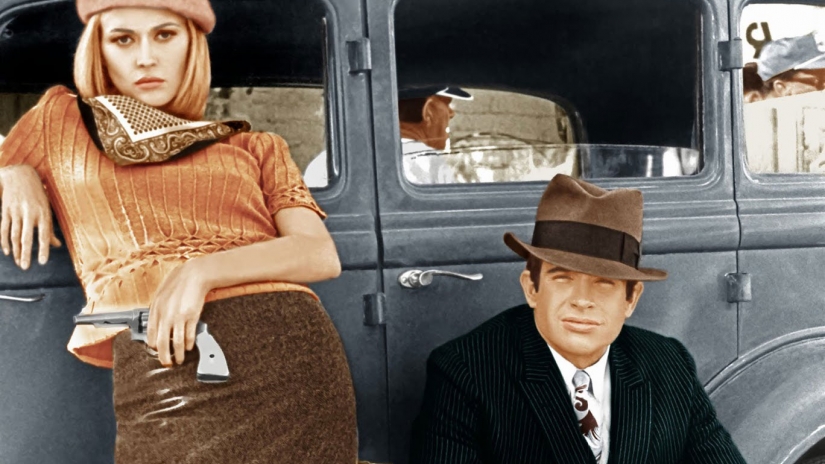
Bonnie and Clyde (1967)

Faye Dunaway and Warren Beatty are the shallow, violent romantics Bonnie and Clyde

Director: Arthur Penn

Cast: Warren Beatty (Clyde Barrow), Faye Dunaway (Bonnie Parker), Michael J Pollard (CW Moss), Gene Hackman (Buck Barrow), Estelle Parsons (Blanche Barrow), Denver Pyle (Marshal Frank Hamer), Dub Taylor (Ivan Moss), Gene Wilder (Eugene Grizzard), Evans Evans (Velma Davis)

Bonnie and Clyde can lay claim to being one of the most influential American films ever made. It came out of a seismic cultural change in America, as old style Hollywood royalty faded out and a new generation stormed the barricades to make films that felt rougher, rawer and told complex stories in shades of grey. 

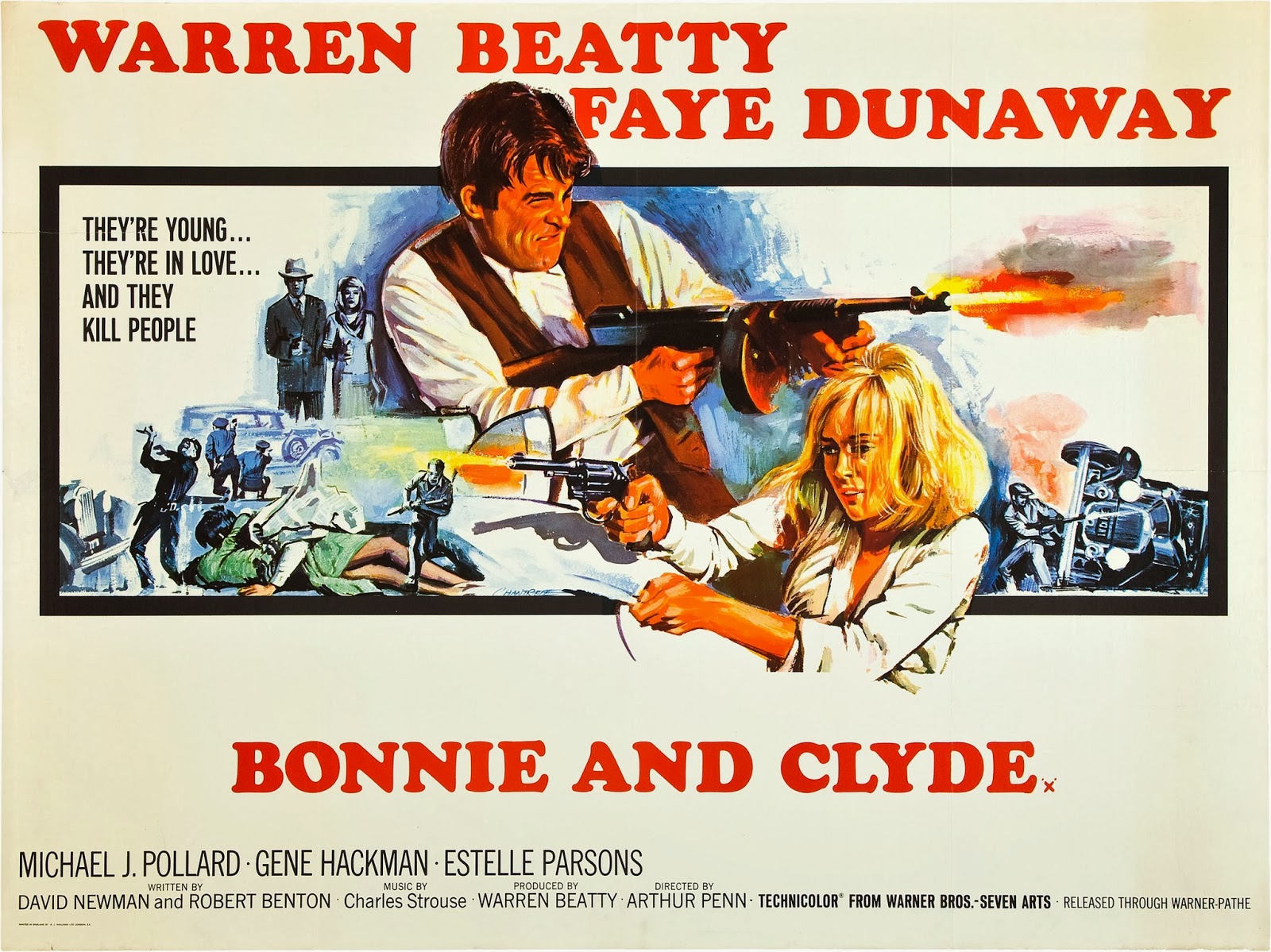
Clyde Barrow (Warren Beatty) and Bonnie Parker (Faye Dunaway): drifting youngsters, not interested in accepting a conventional life. They want to go where they please and take what they please. And if some people get hurt – well they can justify that to themselves. As the poster famously said: “They’re young. They’re in love. And they kill people”. In a deliberately disjointed narrative, where time is unclear, the two meet, head out together, commit crimes, stay on the run and are eventually killed by law enforcement. The story is simple – it’s the telling of it that matters.

Bonnie and Clyde latches on to a counter-culture vibe that was growing in strength at the time. But what the film does so brilliantly is subvert this. It invites us to identify to with the romantic, Byronic yearnings of its heroes, who see themselves as free spirits, living a life of idealistic, unconstrained excitement. But the film also has a clear eye on the trail of violence they leave behind them, their lack of regard for this and the impact on the victims. Because make no mistake, these dreamy killers get more and more violent as they go on.

The film turns these two killers into would-be celebrities – guys who want to project a certain image of themselves to the world (down to mailing the papers photos and poems about themselves). They enjoy the notoriety and their self-proclaimed mythology. Clyde walks into banks and gleefully announces he’s with the “Barrow gang”, as if half expecting someone to ask for his autograph. Later in the film, as Clyde reads their press coverage out loud, with CW Moss like a star-struck groupie, the film never forgets the two of them were basically nobodies, who wanted to feel like somebodies.

And it lets you enjoy the romance of this. There is something fairy-tale like in the film about Clyde picking up Bonnie from outside of her home, taking her into town for flirting and robbery. The whole film continues this dreamy logic, with time jumps and scenes that don’t necessarily link up directly with each other. 

But then the violence takes over. Wow is Bonnie and Clyde a film that lets you know about the impact of bullets. Gun shots don’t just maim or wing, they rip bodies apart. The japey feeling of their bank robberies gets dispelled about half an hour into the film when Clyde shoots a bank teller in the head from point blank range (“him or me”, he later tells his brother). The gang are so incompetent, that the film is frequently punctured by shoot-outs in which no mercy is shown to anyone. 

This is of course hard for the gang to reconcile with their self-image as Robin Hoods, so they mostly forget about it. Clyde won’t steal money from ordinary people (though he’ll happily steal cars, or beat a grocery store clerk into a coma). They playfully tease and taunt a captive US Marshal – until he spits in Bonnie’s face at which point violence ensues. Only at points do the gang seem to have the slightest idea of the dangers: after kidnapping Gene Wilder’s nervy car-owner and his fiancé, a happy-go-lucky Evan Evans (both excellent), merry conversations in the car with the gang are suddenly halted when Wilder admits he’s an undertaker – Bonnie immediately demands they are thrown out and the next shot is her weeping in a field. She doesn’t seem to understand the connection, but we can.

The film is superbly put together. Warren Beatty produced the movie practically from its inception. Robert Benton and David Newman’s script was intended as a French New Wave film – evident in its looseness, its lack of old-school values, its violence, its focus on naïve dreamers who choose the easy way out – but Beatty took the script, re-crafted it with Robert Towne (billed as special advisor) and decided the film needed an American director, not a Truffaut or Godard. He brought on board Arthur Penn, and the two worked together (fought together) closely to bring this radical, edgy, jittery, electric film to the screen. 

Penn and Beatty pushed themselves to some of their best work. Beatty is terrific as the vainglorious Clyde – whose determination in crime is matched by his impotence in the sack (the film wisely doesn’t overplay Clyde’s impotence as an ironic theme, but lets the audience draw its own conclusions). He also produced the film expertly. Penn’s direction is sublime, marrying the finest elements of French New Wave cinema with old-style Westerns.

The film is restless and energetic, and intermixes moments of fun and frivolity among the gang with ominous danger and violence. The camera jitters and shakes, while throwing us into the action – the film is masterfully edited – while at other points sailing on like a neutral observer. The film has a neat satiric edge, and Penn uses banjo music masterfully to ironically contrast with much of the action we see on the screen. The characters – all of them – seem to spend so much time talking about their press coverage because they have so little to say to each other. Even the lovers only really seem to find a moment of quiet devotion shortly before their death. It give you violence as entertainment, but also tells you effectively and quietly how appalling and dangerous violence is.

The acting is similarly extraordinary. Beatty is wonderful, as is Dunaway as an impossibly young, romantic Bonnie who adapts with alarming swiftness to killing and robbing. Michael J Pollard is excellent as the slightly simple, eager young car mechanic who hero-worships the couple. Hackman and Parsons are both excellent as Barrow’s older-but-not-wiser brother, and his wife who seesaws between resentment, fear and an imperious delight in her new-found infamy.

Penn’s brilliant film deconstructs the mythology of criminals to show the emptiness underneath, their shallow self-regard and lack of insight. It does this while still managing somehow to remain affectionate towards these two murderous dreamers. Bonnie and Clyde is a sublime modern Western, a commentary on fame, a dissection of violence and a great black comedy. Shot with youthful energy and an influential lack of traditionalism, it’s a film that always feels modern and necessary.

Charley Varrick (1973)

Walter Matthau schemes a caper in crime thriller Charley Varrick

Director: Don Siegel

Cast: Walter Matthau (Charley Varrick), Joe Don Baker (Molly), Andy Robinson (Harman Sullivan), John Vernon (Maynard Boyle), Sheree North (Jewell Everettt), Felicia Farr (Sybil Fort), Norman Fell (Garfinkle), Woodrow Parfrey (Harold Young), William Schallert (Sheriff Horton), Jacqueline Scott (Nadine), Tom Tully (Tom), Benson Fong (Honest John)

Don Siegel was perhaps the ultimate professional director, who took on any scripts that came his way, producing polished, professional films. In the later part of his career, he finally received some of the freedom to start shooting his quality B-movies on A-movie style budgets. Charley Varrick was the first film he made after his box-office smash Dirty Harry, and Siegel received more time and space to deliver a film that mixed action and drama with an elaborate, almost meditative, mystery.

Charley Varrick (Walter Matthau) is a former stunt pilot, whose small crop-dusting business is a front for carrying out small-scale robberies. A bank robbery in Tres Cruces, New Mexico goes horribly wrong – Varrick’s wife Nadine (Jacqueline Scott) is killed and he and his partner Harman Sullivan (Andy Robinson) find the small job they had anticipated is actually holding a huge amount of mafia money. Varrick knows the mafia won’t rest until they get the money back – and he is right, as bank president Maynard Boyle (John Vernon) has no choice but to call in ruthless hitman Molly (Joe Don Baker) to get the money back and kill those who stole it.

Charley Varrickwas also known by Don Siegel as The Last of the Independents – and that kinda fits its tone. Varrick is a small-scale operator who has chosen crime because he’s been squeezed out of the crop-dusting business by the corporations. He’s operating a crime gang that follows a series of carefully planned robberies, aimed at stealing humble amounts: enough to be a nuisance rather than cause a genuine scandal. He’s a small-time operator, proud of who is, who doesn’t want to hit the big time but to excel as the big fish in the small pond.

The whole film reflects this personality: the film is deliberately set in a quiet American town in the mid-West – the opening credits are played over everyday scenes of small-town life. Every location is slightly run-down and unimpressive. Those wrapped up in the crime are regular Joes – on both sides of the law – and the values and principles are those of mid-west America. Even Molly the hitman – while clearly ruthless and capable of extreme violence and full of disdain of those he meets – has a drawling, cowboy quality to him. 

Part of Siegel’s point is that into all this explodes a story of crime, murder and violence that all spins out of money (doesn’t it always?). The mystery element is the audience wondering how Varrick is going to get out of this with both cash and life intact. What Siegel does really well is effectively make Varrick an unreliable narrator. Despite the fact we follow him around in the film, we are never really told what he is thinking or why he does things. Only at the end of the film are all the threads of the actions he has carried out pulled together – a real lightbulb “ah ha!” moment – and the real purpose of what he has been doing is revealed.

To make a character who plays their cards so close to their chest work, you need an actor who is effortlessly charming. The film gets this in Walter Matthau. Matthau, with his hang-dog Droopy-face is hardly anyone’s first idea of a ruthless bank robber (surely part of the film’s point!) but his winning charm and kindly-Uncle quality, as well as the eye of assured cool that Matthau gives him, really make you root for him. In fact it works so well that you actually forget how ruthless Varrick in this film: from moving on swiftly from his wife’s death, to ruthlessly sacrificing several people in his quest for self-preservation. In other hands, Varrick wouldn’t half come across as a copper-bottomed shit. 

Instead, his plan of misdirection, clues pointing towards the wrong thing, and carefully juggled parallel attempts to escape (his unrevealed real plan, and the clumsy surface plan that the audience knows must be a bluff) really works to keep you engaged and entertained. Siegel is purposefully pulling the wool over your eyes in virtually every scene – and he has Varrick basically tell us he’s doing this – but there are few things that audiences like more than a magic trick. We want Varrick to pull a rabbit out of the hat at the end – to surprise us all with how clever he’s been (and to reward those who have worked out part of what he is doing).

Siegel mixes this with a surprising number of quiet, even soulful moments that mix the thoughtful with some black comedy. From Varrick’s tender kissing of his dead wife – right before he professionally carries on with their plan to burn the get-away car they escaped in (this time with his wife’s body inside it) – to a secret meeting/interrogation/intimidation of timid bank manager Harold Young (a twitchy Woodrow Parfey) by smooth big-city bank manager Boyle (a superbly cold John Vernon, nowhere near as assured and secure as he thinks he is) in a cow-filled field, these scenes are about character as much as they are about plot.

Siegel mixes this with moments of pure action and drama. The opening bank robbery is surprisingly violent, considering the gentle introduction to the film – and our “heroes” are amazingly ruthless towards those that stand in their way. Joe Don Baker’s chillingly amoral Molly hands out beatings as easily as he does slightly goofy Western smirks (a beat down of Harman is particularly brutal). Varrick is quietly ruthless and the film ends with a dynamic chase scene in a scrapyard, quite unlike anything you have ever seen.

Charley Varrick epitomises the sort of 1970s film that studios and Hollywood looked down on at the time, but inspired the filmmakers today far more than some of the Oscar winning gumph that got praised. Parts of it are dated – women in the film are either love interests or whores, and both Molly and Charley (Walter Matthau is no one’s idea of a lothario) bed compliant, impressed women in the film with an off-hand carelessness. But the core and heart of the film is in its cool, calculated confidence mixed with a sense of Western soul. With a terrific performance by Matthau, this is a fine example of independent film-making.

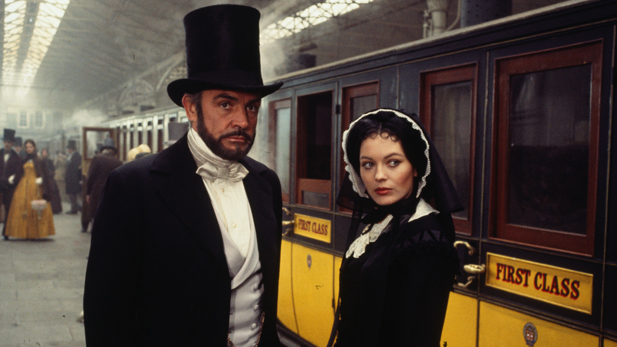
The First Great Train Robbery (1978)


Sean Connery and Lesley-Anne Down grab a train ride in The First Great Train Robbery

Director: Michael Crichton

Cast: Sean Connery (Edward Pierce), Donald Sutherland (Robert Agar), Lesley-Anne Down (Miriam) Alan Webb (Trent), Malcolm Terris (Henry Fowler), Robert Lang (Inspector Sharp), Michael Elphick (Burgess), Wayne Sleep (Clean Willy), Pamela Salem (Emily Trent), Gabrielle Lloyd (Elizabeth Trent), James Cossins (Harranby), André Morell (Judge)

When you think about Michael Crichton, it’s easy to forget he had many more strings to his bow than just writing airport plot boilers. He created ER, he wrote and directed a number of films (most famously WestWorld) – and one of his best books is actually a piece of semi-history, The Great Train Robbery. This book – a brilliantly researched and entertaining part history, part fictionalisation – covers the story of the Great Gold Robbery of 1855, a train-based gold heist. 

Crichton’s film of this book takes a slightly different tone – its realism is toned down slightly, its nose-thumbing anti-establishmentism shaved off, in favour of a lighter comic farce, a caper movie. It makes for an enjoyable movie – but it’s less interesting than the book’s documentary realism and its careful construction of the vast number of obstacles the criminals needed to ingeniously overcome.

Edward Pierce (Sean Connery) is a professional criminal who can pose as an upper-class gent. Having befriended a number of senior people from a leading city bank, he plans a daring heist on a train carrying gold from London to Dover – gold bound for the Crimean war. Pierce puts together a detailed plan – that involves gaining possession of copies of four keys essential for getting access to the safe on the train containing the gold – and recruits a team including expert locksmith and pickpocket Robert Agar (Donald Sutherland) and cunning courtesan Miriam (Lesley-Anne Down). 

The First Great Train Robbery is a caper – and it has all the structure and energy you would expect. From Jerry Goldsmith’s lyrical score to the framing device that constantly returns to Pierce’s key box getting fuller and fuller (like fingers flying up when recruiting The Magnificent Seven), the whole shebang is told with real lightness. Nothing is too serious – the criminals’ actions aren’t designed to hurt anyone (apart from one of their number who turns informant) – and the overall mood is a lark, with the criminals engaging in a boys’ own adventure.

This is helped by the excellent light-comedic playing from Sean Connery and Donald Sutherland as the two main architects of the crime. Connery uses his smoothness (hiding a chippy edge) extremely well – he’s the charming man you’d want to spend time with, and he wraps you up in his own sense of fun. Any obstacles are usually met with a wry smile – like some sort of period Danny Ocean, Pierce is always one-step ahead of the game. Sutherland – with an odd, half Irish accent – makes a very good put-upon wingman, grumbling but still enjoying the ride.

Most of the rest of the cast don’t make much of an impact. Lesley Anne-Down gets some comedic business – particularly a seduction that is designed to go wrong to gain possession of a key – but not a lot else to do. Malcolm Terris and Alan Webb bluster as arrogant dupes. Robert Lang growls as an angry cop. Wayne Sleep of all people pops up as an expert burglar.

The film sweeps from set-up to set-up, very competently filmed, with some decent design and photography (it was the last film of legendary photographer Geoffrey Unsworth). Crichton is a decent director, and if some moments look a bit dated or are a little too much (some make-up for Sutherland at one point looks rubbish) it’s still pretty good.

The real problem is that you lose the sense that, by-and-large, a lot of this actually happened – I mean, sure, it was probably with less banter and jokes, but people really did a lot of this stuff. The film doesn’t always dwell enough on the problems the thieves face, and doesn’t always explain why these obstacles are so vital to overcome. It misses a trick here with its eagerness to keep barrelling forward.

What this means is that film sometimes misses the sense of triumph and satisfaction of overcoming real hurdles – or the frisson of having it clear that a lot of these were real solutions that a real person came up with. The film also rushes its final conclusions. Historically we don’t know what happened to the gold and there was a trial of some of those involved – but the film never really makes that clear. Its conclusion zeroes in again on some hi-jinks, but it doesn’t really make clear the impact, the consequences or what happened to the Macguffin at its centre. You also don’t get the sense of hypocrisy the book mines so well, with the corruption of the upper classes being glossed over by society, but the thievery of the working classes being outright condemned. I missed that a lot from the film – fun as it is.

It’s an entertaining film but, to be honest, it’s not as good as the book – which is actually really worth a read. Crichton is a man with more talent than people give him credit for.

Ten Rillington Place (1971)


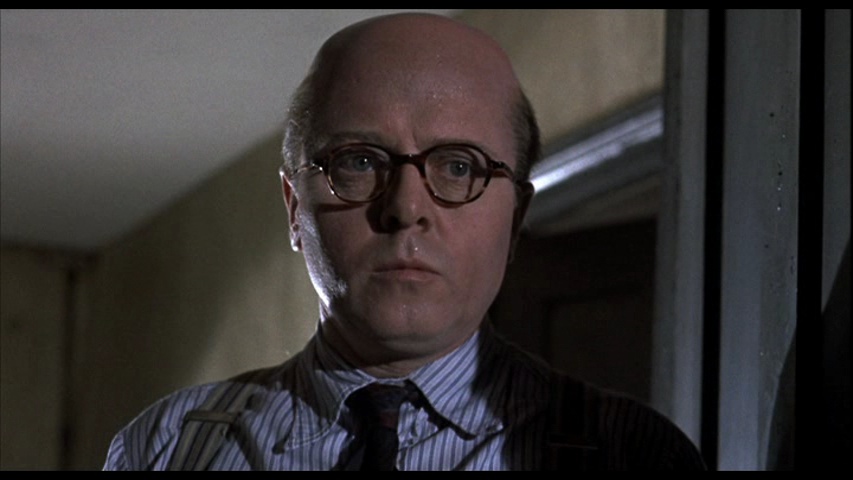
Richard Attenborough brings the killer John Reginald Christie to life in Ten Rillington Place

Director: Richard Fleischer

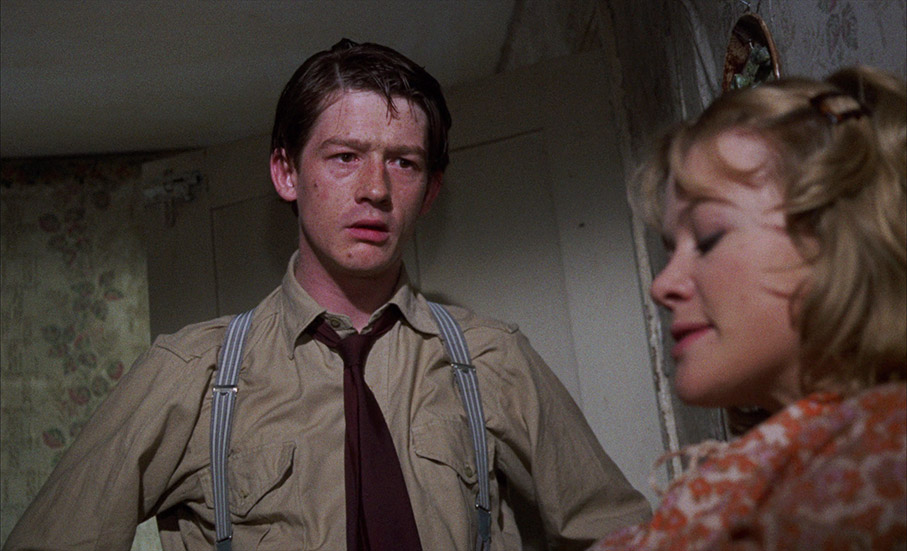
Cast: Richard Attenborough (John Reginald Christie), Judy Geeson (Beryl Evans), John Hurt (Timothy Evans), Pat Heywood (Ethel Christie), Isabel Black (Alice), Robert Hardy (Malcolm Morris), Geoffrey Chater (Christmas Humphreys), André Morell (Judge Lewis), Tenniel Evans (Detective Sergeant)

Films about real-life serial killers have that eternal problem: how far can they go in giving us answers? How much can we ever really understand why a killer does what they do? Is there any way of really putting ourselves in their shoes – and do we really want to? Ten Rillington Place avoids a lot of these issues by making no attempt to give understanding to Christie at all, simply presenting his actions, and by putting the focus on the tragic death of Timothy Evans.

In a miscarriage of justice Timothy Evans (John Hurt) was tried and executed for the murder of his wife Beryl (Judy Geeson) and their baby daughter in 1950. The real murderer? The man who lived downstairs, John Christie (Richard Attenborough), a socially maladjusted, softly spoken man who confessed to killing at least eight people three years later at his trial for murdering his wife. Christie had an uncanny gift for gaining the confidence of desperate women, would offer to perform illegal (and free) medical procedures (such as abortions), during the course of which he would gas them with carbon monoxide, strangle them, possibly carry out acts of necrophilia and then bury them in his garden or in the walls of his house. Evans never suspects until far too late that Christie is the killer and, scared that he will be accused, follows Christie’s advice to the letter – advice that will only make him look all the more guilty.

Richard Fleischer’s chillingly documentary-style film-making goes into forensic detail on the events of the murder of Beryl Evans and her daughter, and the wrongful conviction of Timothy Evans for the crime – largely on the basis of Christie’s testimony at Evans’ trial. Fleischer shoots the film with a deeply disciplined restraint, a calm documentary style that avoids any sensation lingering on the crimes, but still carries great emotional impact.

The film covers the period from Evans moving into the flat above Christie, Christie’s murder of Beryl, Evans panicked flight to Wales on Christie’s advice, his series of confessions to the police, his trial and execution. Book ending the film we get a scene with Christie murdering his neighbour Muriel Eady – a terrifying demonstration of Christie’s murder rituals, as well as an indicator of how easily he could gain the trust of his victims. What it strikingly doesn’t try to give us is any psychological explanation for why Christie did what he did. There are no revealing flashbanks, no cod-psychology. Instead we just see a killer, kill people. We might get an idea of what he gets out of it, but no explanation of what turned him to it. The film is all the more powerful for it. 

Instead the focus is on the victims, and the Evans story is heart-rending, partly because of Fleischer’s calm, sensitive direction, but mainly due to John Hurt’s astonishingly powerful performance. The film, and Hurt, don’t shy away from the qualities that made Evans seem like such a natural fit for a murderer at his trial. He’s a compulsive liar. He brags. He fights and argues with a fury. He’s not really that sympathetic a guy at first. But he’s certainly innocent. Hurt brilliantly demonstrates his vulnerability and simplicity – Evans was illiterate and almost unbelievably trusting, a liar who fell victim to a superb, manipulative liar.

His shock and slowly growing realisation of the nightmare he is in are incredibly moving, as is his powerful grief when he finds his wife killed – and his trusting innocence when he turns (unknowingly) straight to his wife’s killer for advice on what to do. Every action Evans takes in the film makes you want to jump in and urge him to do something – anything – different.  Unsympathetic as he is at the start, by the conclusion you almost can’t bear to watch him incriminate himself with each action. Hurt is sublime, with his weak manner, his confusion, his touching faith that it will all be okay and his feeble mantra of “Christie Done It” – it’s one of the greatest performances in his career.

Judy Geeson gives a marvellously emotional performance as Beryl Evans. Geeson has the perfect look for the part, and she completely embodies a woman who has found herself in a difficult situation, in love with a weak man. You understand completely how she is drawn towards Christie as a confidant, and why she would feel the desperation to abort a child she and Evans could never afford. Her eventual murder is horrifying in its struggle and desperation, the growing horrible realisation in her eyes that she is in mortal danger – this is a particularly strong sequence, difficult to watch for the viewer, as we know what a terrible series of decisions she is making. 

Fleischer’s film was motivated by a very firm anti-death sentence stance. The scene of Evans’ execution is shocking in its brutal suddenness. Shot with a handheld camera and in a single take (in near silence other than Hurt’s deep breathing), the execution is over and done with in less than a minute – from Evans sitting in a room, to the reveal of the executioner’s noose next door and the terrible drop (with a jump cut straight to Christie stretching his back). It’s a brilliantly low-key, but resoundingly powerful scene that sticks with you for all time.

All this way and we’ve not mentioned Richard Attenborough’s transformative performance as Christie. Attenborough presents the softly spoken monster as a bland, empty non-entity, a man who has almost nothing to make him stand out from the crowd. He never makes the part into a great monster or any sort of domineering force of nature. In partnership with Fleischer, he shows Christie was a total blank canvas of a man, “evil” only in the most mundane and uninteresting way. He’s so mild-mannered, you can see why so many women trusted him. Attenborough is chillingly blank throughout, in a deeply unsettling performance of crushing mundanity. He’s brilliant in this film – Attenborough was completely committed to its anti-death penalty stance – and he avoids the temptation of trying to explain or make sense of Christie. 

That’s the trick of the film – Christie is not a special man. He performs dreadful acts, but he is a nothing of a person, devoid of motive (the lack of motive is something those at Evans’ trial use most to argue against Christie’s possible guilt), a totally forgettable man who committed crimes memorable only for their cruelty. Fleischer, and Clive Exton’s careful, thoroughly researched script, is simply superb in presenting Christie with all his filthy blankness, Rillington Place in all its crushed lack of colour, and the murders in un-flashy documentary sadness. Ten Rillington Place is an engrossing true-life story that turns a miscarriage of justice into a Greek tragedy. It’s a much overlooked classic.

Carlito's Way (1993)


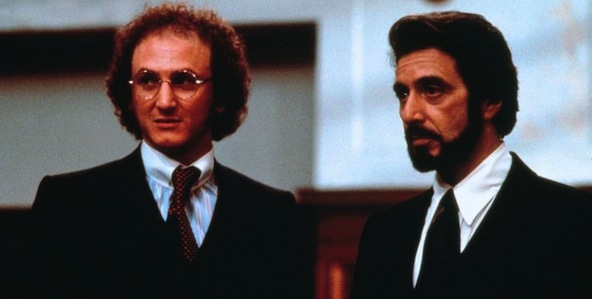
Sean Penn and Al Pacino struggle with the impact of a life of crime in Carlito’s Way

Director: Brian de Palma

Cast: Al Pacino (Carlito Brigante), Sean Penn (David Kleinfeld), Penelope Ann Miller (Gail), John Leguizamo (Benny Blanco), Luiz Guzmán (Pachanga), Jorge Porcel (Saso), James Rebhorn (Bill Norwalk), Joseph Siravo (Vincent Taglialucci), Frank Minucci (“Tony T” Taglialucci), Adrian Pasdar (Frank Taglialucci), Viggo Mortensen (Lalin)

Every so often from the 1990s onwards, Al Pacino actually bothered to act rather than rage in an orgy of self-parody. It’s the films where he does really embrace the challenge, like Carlito’s Way, that reminds you what a damn fine actor he is. Carlito’s Way may also be a reminder of what an overtly flashy director Brian de Palma is, but it’s a fine American gangster thriller.

In 1975, Carlito Brigante (Al Pacino) is released from prison after five years on a legal technicality, exposed by his friend and lawyer Dave Kleinfeld (Sean Penn). Carlito makes a speech at his hearing, claiming he is a reformed man who wants leave his criminal past behind him – and to the shock of Kleinfeld and his colleagues in the underworld, he’s telling the truth. Carlito attempts to go straight, and to rebuild a relationship with Gail (Penelope Ann Miller), the young woman he left behind. Unfortunately, Kleinfeld is not only becoming increasingly unpredictable due to his cocaine addiction, but he is starting to blur the lines between criminal lawyer and plain criminal. His actions continually threaten to drag Carlito back into the crime industry.

Carlito’s Way is a fine semi-morality tale, a modern tragedy of a man who, every time he thinks he’s out, “they pull me back in”. And of course we know that he’s on a hiding to nothing, as the film opens with Pacino gunned down by an unknown assailant and recounting most of the film’s plot (presumably) from beyond the grave. His attempts are doomed largely because, in order to go straight quick and easy, he has to raise money the only way he knows how – working in the very same flashy nightclubs and among the career criminals that he should absolutely be avoiding.

Carlito narrates the film with a weary reluctance, carefully recounting the mistakes he made and why. It’s a device that largely manages to avoid telling us the obvious, and actually gets us closer to, and like, Carlito. It also helps that Pacino’s voice itself has a gruff poetry to it, and he adds a Shakespearean grandeur to this familiar old-school tale of the crook who wants out.

Pacino’s intensity works fantastically for the part. He largely keeps the Pacino fireworks for the moments where they carry the most impact. He and de Palma carefully sketch out a portrait of Carlito as a world-weary man, who (try as he might) can’t leave behind the code and rules that have governed his life as a criminal. He can’t escape the confines of thinking like a criminal. Most terribly, his old-school sense of honour (few actors convey dishevelled personal morality better than Pacino) is what will doom him – he can’t break the code of the streets. It’s a terrific, empathetic performance from Pacino.

Pacino also develops a sweet, loving relationship between him and Penelope Ann Miller’s Gail. In the way of these films, Gail is a stripper – she alternates between sweetly loving and overtly sexually flirtatious as the plot demands – but Miller makes her feel like a real person. She and Pacino have great chemistry (which, rumour has it, also carried over into real life) and de Palma shoots their scenes with an old-school romanticism and a steady camera, which contrasts with the disjointed sweep and Dutch angles he uses elsewhere.

Sometimes these flashy angles get on my nerves. de Palma often feels like he’s trying too hard, rather than stretching his muscles. Saying that, he’s a master of the set-piece. The film has two action set-pieces and both simmer with tension and inventiveness. One involves a bungled drugs deal in a dingy bar. The other a thrilling chase sequence in Grand Central Station, a deliciously shot mixture of great editing and daring extended single shots. Sequences like this bring memories, inevitably, of Scarface and it’s tempting to see Carlito’s Way as a spiritual sequel – as if Tony Montana had been arrested and changed his ways.

Perhaps a testament to how good Carlito’s Way is (or rather how much I enjoy it) is that I even think Sean Penn is terrific in it. Penn is one of those actors I find tryingly self-important (both professionally and personally). But his weaselly lawyer, a hair-trigger addict, nowhere near as smart and adept as he thinks he is, is marvellous. Penn’s performance is a whipper-cracker mix of slimy self-confidence and arrogant blindness, with moments of curiously underplayed vulnerability that makes it make sense why Carlito remains so loyal to him. It’s one of Penn’s best, most controlled performances, a virtuoso performance of whining weakness.

Carlito’s Way is part pulp gangster thriller, part character study humanely outlining the impossible difficulty of changing our stars. Carlito may be ready to jack in the criminal world – but he continues to live the life of the criminal while persuading himself he isn’t. The whole film has a tragic inevitability about it – and would do even without the framing device. Carlito wants out – but he wants to rush to get the investment he needs, and walking the shadow line is the only thing he knows how to do. It’s a great modern tragedy.

Triple 9 (2016)


An all-star cast fail to make Triple 9 a classic, or even a decent watch

Director John Hillcoat

Cast: Casey Affleck (Chris Allen), Anthony Mackie (Marcus Belmont), Chiwetel Ejiofor (Michael Atwood), Clifton Collins Jnr (Franco Rodriguez), Woody Harrelson (Jeffrey Allen), Aaron Paul (Gabe Welch), Kate Winslet (Irina Vlaslov), Gal Gadot (Elena Vlaslov), Norman Reedus (Russell Welch), Michael K Williams (Sweet Pea), Teresa Palmer (Michelle Allen)

Triple 9 that never gets anywhere near fulfilling its potential. You look at the cast and you think “Wow! That has got to be one of the films of the year! Right?” Wrong. Triple 9 is another journey into the macho bullshit of the criminal underworld, where the “good” thieves have honour, the bad thieves are unscrupulous, the cops are all sorts of shades of grey, and the real baddies are foreign gangsters exploiting American criminals. All told with a backdrop of shouting, shooting and doping. You feel, and I suspect the filmmakers feel as well, that the film must be about something – but it really isn’t, it’s a super violent, dark Rififi with none of that classic’s touch.

Michael Atwood (Chiwetel Ejiofor) is a crack crook, leader of a gang that executes difficult jobs on demand for their Russian paymaster, mob boss’ wife Irina (a showboating Kate Winslet). Atwood’s crew includes dirty cops Marcus Belmont (Anthony Mackie) and Franco Rodriguez (Clifton Collins Jnr). Tasked to steal federal investigation data on Irina’s husband, Michael and his crew decide their only chance is to distract the police with a Triple 9 call out – the shooting of a cop. Their target? Belmont’s new partner, hotshot honest cop Chris Allen (Casey Affleck).

Triple 9 isn’t particularly inventive or unique. The problem is it also isn’t very interesting. This is largely because you don’t engage with any of the characters. Atwood is a blank, played by a disengaged Chiwetel Ejiofor. He has a standard sub-plot of a son he isn’t allowed to see. But it’s not enough to get us caring about him. Chris Allen isn’t particularly likeable (Casey Affleck is not the most relatable of actors) so it’s hard to get worked up over whether he’s going to be killed or not. The most interesting character is Anthony Mackie’s Belmont – but he has been saddled with an “I feel growing guilt” sub-plot that you’ve seen dozens of times before.

Perhaps aware that a lot of the writing was paper-thin, the film recruits a number of familiar actors to “do their thing” so that we can shortcut to what sort of person the character is meant to be, by seeing crude drawings of their more famous, nuanced roles. Aaron Paul’s performance will be familiar to anyone who has seen Breaking Bad; Norman Reedus essentially reprises his role from The Walking Dead. Woody Harrelson does his grizzled half-genius, half-dope fiend, difficult man schtick he’s done many times. Only Kate Winslet is cast against her type – and her scenery-chewing enjoyment of the role makes her feel like an actress doing a guest turn, rather than a real person.

Hillcoat’s direction doesn’t bring any of the film’s threads together. It never feels like a film that is about something. Where is the depth, where is the interest? It’s not even a particularly exciting film to watch, with the heist moments not particularly exciting or interesting, and its shot with a wicked darkness that never gets the pulse going. After some initial build-up, the plot never really goes anywhere unexpected, and the final pay-off is stretching for a narrative weight it just doesn’t have. 

Hillcoat and crew obviously feel they are making a higher genre film – but this is really just a pulp thriller, with actors acting tough but never convincing. None of the major events make a massive amount of sense: characters run into each other in a way that stretches credulity, the Russian mob runs its business with a counter-productive brutality, the dirty cops alternate between super cunning and horrendously dumb.  It’s a dumb, badly written movie that never comes to life. It doesn’t even have the real moments of excitement you need to at least grab you while the rest of the film drifts along. Not good. Not good at all. Triple 9? Not even triple stars.