Tag: Dan Hedaya

Mulholland Dr (2001)

Mulholland Dr (2001)

Surrealist, dream-like images fill a film that’s wilfully complex, perplexing and probably Lynch’s masterpiece

Director: David Lynch

Cast: Naomi Watts (Betty Elms/Diane Selwyn), Laura Harring (Rita/Camilla Rhodes), Justin Theroux (Adam Kesher), Ann Miller (Coco), Mark Pellegrino (Joe), Patrick Fischler (Dan), Michael Cooke (Herb), Dan Hedaya (Vincenzo Castigliane), Angelo Badalamenti (Luigi Castigliane), Michael J Anderson (Mr Roque), Monty Montgomery (The Cowboy), Lee Grant (Louise Bonner), James Karen (Wally Brown), Chad Everett (Jimmy Katz), Melissa George (Camilla Rhodes), Billy Ray Cyrus (Gene), Lori Heuring (Lorainne Kesher)

Spoilers: I’ll be discussing in detail the plot (if you can call it that) including its final act reveals which are crucial for understanding the film. So watch it first!

Where do you begin? Mulholland Drive feels like the culmination of Lynch’s work, a perfect boiling down of Twin Peaks, Lost Highway, Wild at Heart and Blue Velvet into a surrealistic meditation on Hollywood, wish-fulfilment, dreams and reality. It’s both wilfully inaccessible and surprisingly clear, both coldly cruel and achingly tender, full of hope and devoid of happiness. It’s tough, cryptic, engrossing viewing and unpeels like an onion (and likely to have the same effect on you as that vegetable). Every scene may mean everything or nothing, but there is not a moment of it that isn’t darkly, thrillingly engrossing.

It starts with a car crash on Mulholland Drive – but not before a stream of seemingly disconnected images that only later reveal their importance, including a women on a bed and a dizzying array of disconnected jittybug dancers drifting across the screen like paper cut-outs before a purple background. The car crash involves a mysterious woman ‘Rita’ (Laura Harring) who narrowly escapes being murdered but is left with amnesia. She stumbles to the house of Betty (Naomi Watts), a newly arrived girl in Hollywood, eager to become an actress. With only a bag of money and a mysterious blue key to go on, Rita and Betty search to find out who Rita is. Meanwhile, director Adam Kesher (Justin Theroux) finds his film (which Betty wants to audition for) being taken over by gangsters. Did I also mention an incompetent-but-brutal hitman, a supernaturally omniscient albino cowboy and a monstrous goblin-like hobo who lives behind a diner and can kill on sight?

Mulholland Drive grew out of Lynch’s plans for a new Twin Peaks style TV series. He shot a pilot, the footage from which takes up much of the first two thirds. Like Twin Peaks it was full of mysterious alleyways to be explored: it’s amnesiac lead, mysterious money and blue key, shadowy gangsters (even led by Twin Peaks veteran Michael J Anderson, here in a Red Room style hide-away, his head attached to a prosthetic body), creepy supernatural nightmare elements. Alas, the executives hated it (it wasn’t exactly Desperate Housewives), but French investors stepped in to fund Lynch turning it into a surrealist movie, with an additional half an hour of footage to an ending (of a sort).

A sort of ending is what we get. Mulholland Drive is a famously confusing, impenetrable film. But to me it seems clear. Lynch’s solution was to turn all the pilot footage into a bizarre and terrible dream – and latch on an ending set in the ‘real world’ which re-presents characters, events and throwaway moments in surprising new lights, leading us to radically reinterpret everything. Effectively, the first two-thirds are the guilt-ridden nightmare of Diane (Watts again), a failed actress in Hollywood who paid for a hit on a star actress Camilla (Harring again) who she believes seduced and spurned her. In her dream, Diane reimagines both herself and Camilla exactly as she wishes they were: herself unspoilt by Hollywood with preternatural talent, Camilla as an amnesiac utterly reliant on her.

What we have here is dreams as wish fulfilment: and what city is more about that, than Hollywood? Mulholland Drive plays as the dark underbelly of Sunset Boulevard (pretty dark and bitter already!). Lynch’s Hollywood is a vicious, heartless, bloody place, where cruelty and death are commonplace. In ‘the dream’ the gangsters – terrifying cameos from Hedaya and composer Badalamenti, the latter dribbling inadequate coffee from his mouth during a meeting in a grotesque power play – call the shots. Reality might be worse. This heartless factory of dreams chews up and spits out innocents like Diane, turning her from naïve and optimistic into  bitter, twisted shell, emotionally maladjusted, locked in her apartment tearily in thrall to her worst instincts.

It makes sense in a way that the film is dominated (probably) by a dream. Hollywood is the town of stories, and it’s perversely logical that the unreality should feel so detailed, engrossing and narratively compelling while what is (probably) reality is fragmented, mundane and laced with cruelty. To the people of films, stories are richer and more freeing than anything that happens in real life and infinitely more comforting.

Comfort is what our dreamer wants. Naomi Watt’s Betty seems like a cliché of a small-town girl, swept up in the big city. Full of aw-shucks charm, the eagle-eyed will spot little moments of strength that feel out of character. There are micro-flashes of anger and she’s determined to break into a mysterious, abandoned house to find a clue when Rita runs. She’s a gifted actress, turning a mundane script in an audition (a script she and Rita laugh at) into a simmering performance of sexual control that stuns the room. But this is a multi-layed performance, just one facet of a whole.

Because Betty’s talent is recognised in the way her ‘real-world’ counterpart Diane – stuck in small supporting roles, gifts from Camilla – never is. There are touches of this in that audition: the director is the least involved and speaks only in vague bullshit. Its not just that talent recognition: in the dream she can turn her lover Camilla, an independent and (perhaps) selfish figure, into someone so dependent on her that she literally doesn’t even know who she is. She even turns the man Camilla leaves her for, into a deluded, humiliated cuckold in thrall to gangsters.

Lynch’s crafting of this dream is flawless. He can mine tension from even the smallest moments. Innocuous events – two men sitting in a diner, a kind old couple in a cab, a business meeting, a singing audition – drip with menace and unknown horror. His camera frequently, almost imperceptibly weaves, as if held floating in space. Logic jumps and sudden transitions abound. Lights flicker and time never obeys rules. He is also a master of black humour: a hit-job gone wrong (with bodies and a vacuum cleaner joining the carnage) is hilarious, as is Kesher’s unexpected arrival home to find his wife in bed with a muscular pool cleaner.

Mulholland Drive is also a sensitive and highly emotional romance story between two lost souls. Betty, naïve and helpful and Rita, who clings with gratitude and adoration to the woman who helps her. Moments of sexual tenderness between these two are shot with erotic beauty: contrasted sharply with the more sordid, aggressive couplings between them in ‘reality’.

But these mix with moments of chilling, unspeakable horror. The hideous goblin living behind a diner, an embodiment of all that is cruel, evil and twisted, later clutching a box the releases the furies themselves seem to leap from. Is this a dark expression of the dreamer’s own guilt (which seems to be transferred to “Dan” a man we see literally dying of fright in a diner that becomes crucial later)? The Cowboy, who may or may not be of this world, glanced at two dreadful moments (just as he promises) seems to guides the dream. And the Silencio club, a theatre of the bizarre, disturbing auditory and visual twists and turns that serves as the gateway between dream and reality – something Betty subconsciously knows, vibrating in terror in her seat, knowing this fantasy she has crafted is under siege from dark elements of the truth demanding she acknowledge them.

Mulholland Drive deconstructs itself at every turn, aided by Lynch’s wonderful, hypnotic surrealistic touches. What’s beautiful about it, perhaps, is it leaves it very much up to you. For me, the desire for dreams to be fulfilled is crucial. It’s all captured in Watts and Harring’s multi-layered performances, their versions of the same women contrasting and complementing each other. Lynch allows their personalities to blur both in character and in visuals (Rita ends up in a matching wig in touches of Vertigo while the film’s blurring of two personalities echoes Bergman’s Persona, including a homage via a shot where both faces seem to merge into one).

An intense, fascinating dream-like exploration of several classic Lynchian themes, Mulholland Drive is his finest, most rewarding film. One which, whatever interpretation you place on its events, grips and challenges you at every moment, full of scenes which spark a mixture of imagination, horror and intrigue. Powered by two wonderful performances at its lead, both with just the right mix of reality and fantasy about them, it’s an extraordinary film.

Ransom (1996)

Ransom (1996)

Every parent’s nightmare gets tackled in this efficient, smart (but not quite smart enough) thriller from Ron Howard

Director: Ron Howard

Cast: Mel Gibson (Tom Mullen), Rene Russo (Kate Mullen), Gary Sinise (Detective Jimmy Shaker), Delroy Lindo (FBI Special Agent Lonnie Hawkins), Lili Taylor (Maris Conner), Liev Schreiber (Clark Barnes), Donnie Wahlberg (‘Cubby’ Barnes), Evan Handler (Miles Roberts), Brawley Nolte (Sean Mullen), Paul Guilfoyle (FBI Director Stan Wallace), Dan Hedaya (Jackie Brown)

There is no greater fear for any parent than losing a child. Doesn’t matter if you are prince or pauper, the same heart-pounding dread is there. But sometimes the risks are greater if you a prince. Because the more money you have, the more likely a kidnapper might think you’d be willing to swop that money to get your kid back.

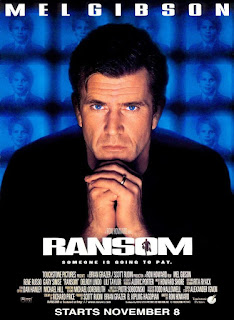
It’s what kidnappers decide when they take the son of Airline owner Tom Mullen (Mel Gibson). The kidnappers want $2million and no questions asked, in return for his son Sean (Brawley Nolte). Tom and his wife Kate Mullen (Rene Russo) are willing to pay – with the advice of FBI Agent Lonnie Hawkins (Delroy Lindo). But after the first bungled handover, Tom becomes convinced the kidnappers have no intention of returning his son alive. So, he takes a desperate gamble to try and turn the tables, much to the fury of secretive kidnapper (and police detective) Jimmy Shaker (Gary Sinise).

Ransom is a change of pace for Ron Howard, his first flat-out thriller. And it’s a very good one. Ransom has a compulsive energy to it, powered by sharp filming and cutting and some impressively emotional performances from the leads. It also takes a number of unexpected narrative twists and turns – before it reverts to a more conventional final act – and manages to keep the viewer on their toes.

Its main strength is an emotionally committed performance from Mel Gibson. Taking a leaf from Spencer Tracy’s book, this is Gibson at his best, very effectively letting us see him listen and consider everything that happens around him. Mullen is a determined man who plays the odds, and cuts corners only when he must – but is also convinced of his own certainty. He applies his own business learning – of negotiation and corporate deal-making – to this kidnapping, which is an intriguingly unique approach. Gibson’s performance is also raw, unnerved and vulnerable and he plays some scenes with a searing grief you won’t often see in a mainstream movie. Russo does some equally fine work – determined, scared, desperate – and their chemistry is superb.

Howard coaches, as he so often does, wonderful performances from his leads and from the rest of the cast. Gary Sinise turns what could have been a lip-smacking villain into someone chippy, over-confident and struggling with his own insecurities and genuine feelings for his girlfriend (a doe-eyed Lili Taylor, roped into kidnapping). Delroy Lindo is very good as the professional kidnap resolver and there are a host of interesting and engaging performances from Schreiber, Wahlberg, Handler and Hedaya. Ransom turns into a showpiece for some engagingly inventive performances.

Howard also triumphs with his control of the film’s set-pieces. The kidnapping sequence is highly unsettling in its slow build of the parent’s dread. The first attempted exchange is a masterclass in quick-quick-slow tension, with Gibson and Sinise very effective in a series of cryptic phone calls. The ransom phone calls are similarly feasts of good acting and careful cross-cutting, which throb like fight scenes. Howard understands that this is a head-to-head between two men struggling in a game of deadly one-up-manship, both of them constantly trying to figure out not only their next move, but the likely reaction of their opponent.

For much of the first two thirds of the film, Ransom is very effective in its unpredictability. There is a genuine sense of dread for how this might play out and the radical changes of plan both sides of the kidnap play out land events in a very different place than you might expect at the start. The more hero and villain try to out-think each other, the murkier the plot becomes.

It’s unfortunate that the final third devolves into a more traditional goody/baddy standoff with guns, punches and our hero reasserting his control (and the safety of his family) through the fist and the trigger. But then I guess in the 90s you couldn’t have a Gibson film without a bit of action. But when the film focuses on the thinking, talking, slow-burn tension and the sheer terror of parents who have lost a child, it’s a very effective and tense film that stands up to repeat viewings.

The Usual Suspects (1995)

The immortal gang in legendary twist thriller The Usual Suspects

Director: Bryan Singer

Cast: Stephen Baldwin (Michael McManus), Gabriel Byrne (Dean Keaton), Benicio del Toro (Fred Fenster), Kevin Pollak (Todd Hockney), Kevin Spacey (Roger “Verbal” Kint), Chazz Palminteri (Agent Dave Kujan), Pete Postlethwaite (Kobayashi), Suzy Amis (Edey Finneran), Giancarlo Esposito (Jack Baer), Dan Hedaya (Sergeant Jeff Rabin)

SPOILERS: If you have been living in a cave since 1995, don’t read on as I discuss the twist at great length…

“Convince me”. That’s what Customs Agent Dave Kujan (Chazz Palminteri) says as he begins his interrogation of limping, low-time crook “Verbal” Kint (Kevin Spacey). That’s certainly what Kint does – and it’s what the whole film is aiming to do in this, the most famous confidence trick in movies. The Usual Suspects is one of those once-in-a-blue-moon films where everything comes together perfectly. It’s also a sleight-of-hand movie that remains hugely engaging and entertaining even when (as surely most people now do!) you know exactly what the magician has up his sleeve. Its solid gold entertainment factor even survives today, despite the slightly queasy presence of both Kevin Spacey and Bryan Singer in its credits.

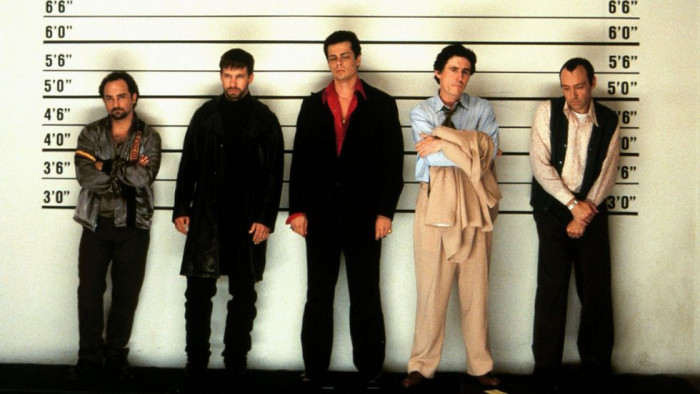
Told in flashback, the film follows the coming together of a bunch of regular criminals, pulled in for a line-up and deciding to team up. Along with Verbal, the others include McManus (Stephen Baldwin), Fenster (Benecio del Toro), Hockney (Kevin Pollak) and ex-cop turned criminal Dean Keaton (Gabriel Byrne). After a successful series of heists, the gang are conscripted by suspicious lawyer Kobayashi (Pete Postlethwaite) to take on a dangerous hijacking job for shadowy – possibly legendary – master criminal Keyser Soze, the bogeyman of the criminal classes. We know the job will go wrong – after all Verbal is banged up telling the whole story, the only survivor of the job – but how? And who is the shadowy Soze – or is he even real at all?

The Usual Suspects takes what you know about movies and then works double time to use it against you. With a structure inspired by classic noir crime films from the 1940s – the whole operation has a touch of The Asphalt Jungle while the interrogation has more than a hint of Double Indemnity – mixed in with a lot of Rashomon, it’s a movie that has you primed so much for a reveal and a twist that it skilfully misdirects you into expecting the wrong thing. Because how could you guess that perhaps the whole movie is a spun-out-of-the-moment invention by Verbal, and that possibly almost nothing we see during the course of its run time even happened. 

But how can we guess? From the very first scenes with Kujan and Verbal, Kujan is shot dominating the frame, always taller, always filling the screen. Verbal is sitting, meek, trapped by the frame, the camera frequently looking down at him. Every shot subliminally tells us that he is weak. The story has to be dragged out of him, with the investigation outside of the room forcing Verbal to expand on issues he doesn’t want to touch on. Like Kujan we invest in what we are finding out, because it looks like Verbal doesn’t want to tell it to us. That’s how they get you.

Because Verbal, in his story, is sprinkling in just the twist that Dave (and the audience) is probably expecting – that Gabriel Byrne’s Dean Keaton, the guy who claimed to have gone good, who just wanted out, was bad the whole time and was the criminal mastermind this whole time. Christopher McQuarrie’s ingenious script primes us for this: Dave Kujan is casting doubt on Keaton’s “death” right from the start, and as the audience surrogate figure we want to be as smart as he is. So what does it matter that we ”see” Keaton shot in the opening sequence of the film? Surely that was an illusion, and we’re as clever as Kujan in seeing through it.

The film even gives us a brilliantly assembled “reveal” series of edited flashbacks, in which every small moment and hint that has existed in the film is replayed for us (John Ottman’s editing is flawless here – and he should also have credit for composing the film’s hauntingly classical score) to convince us, beyond a shadow of a doubt that, yup, poor simple Verbal was taken in all the time by dastardly Keaton, the guy who looks like a film star. Only of course it’s bollocks. That charred corpse that Singer jump cuts to at the start of the film as police investigate the boat massacre is indeed Keaton. And the clever twist we thought we were working out, turns out to be a mass distraction laid out for us by Verbal and the film.

So we get a second brilliantly edited reveal sequence as it hits Kujan while he studies that most famous notice board in film, that everything he thought he had worked out had been spun out of hints and clues off the board – from asides and anecdotes to entire locations and characters. And Kevin Spacey limps and then walks away, shrugging off the skin of timid, weak Verbal to transform into the chillingly amoral Soze. It’s a trick that worked especially well when Spacey was an almost unknown actor at the time (today it’s less of a surprise to find out that Spacey could be a creep). There is possibly no better reveal in Hollywood.

But the film continues to entertain even when you know it because Singer’s film is stuffed with richly layered characters, scintillating scenes and some rich and spicy dialogue from McQuarrie. It’s a brilliant combination and provides every scene with a clear and electric dynamism that makes it impossible to tear your eyes away. There are some truly striking scenes – not least the iconic line-up scene – and the film carries an improvisational energy (that line-up scene is a magic use of outtakes, as the actors couldn’t keep a straight face during the sequence).

Part of the magic of it comes from the brilliant clash of a group of vastly different actors bouncing off each other: the self-consciously method Baldwin, the edgy energy of Pollack, the chilly technique of Spacey and the classically trained professionalism of Byrne, who pulls off with aplomb a difficult job of playing a decoy protagonist and antagonist in one. And that’s not mentioning the wild card of Del Toro who, working out his character was a one-note plot device, throws in an eccentric chic and impenetrable mumbling accent that is part affectation (the sort of thing that made the actor more trying later in his career) and part jaw-dropping show of confidence. And backing them up is a collection of actors as eccentric as Palminteri channelling Law and Order with a smile and Postlethwaite as a sinister limey lawyer with an accent that sounds like it hails from the Raj.

Singer’s direction is flawlessly confident, creating a rich tapestry that you could lazily call Tarantinoesque, but actually reminds you of John Huston in its carefully framed mise-en-scene. It’s a very classical movie in its way, that loves clever wipes, slow build ups, brilliantly edited and surprisingly low key in much of its framing and shooting. Everything is perfectly placed to help build up the illusion. Singer never touched these heights of confidence and control again. It’s also superbly edited throughout by John Ottman, each beat landing perfectly, each transition perfectly judged. It wouldn’t seem out of pace to see Cagney playing Kint (with Bogart surely as Keaton). 

The devilish trickiness of the plot is kept largely under wraps until late on – Soze isn’t even mentioned until nearly halfway through the film – and the film’s confident misdirection suggests this might just be the gang aiming too high and getting burned rather than a shadowy mastermind manipulating it all. It’s a brilliantly judged change of pace, and all part of the impish delight of the film. It’s a clever game, but has more than enough force and invention in its story telling to keep you gripped time and time again. McQuarrie and Spacey won Oscars – and the film hinges so much on Spacey’s ability to both tell an anecdote and also not push his acting lame – and the film lives on forever in the memory as one of the finest twists. But it does so because the twist grows so organically from the film, and the film’s delight in tricking you is completely infectious.

Clueless (1995)


Alicia Silverstone leads her in crowd troop in neat Jane Austen reimagining Clueless

Director: Amy Heckerling

Cast: Alicia Silverstone (Cher Horowitz), Stacey Dash (Dionne Davenport), Brittany Murphy (Tai Frasier), Paul Rudd (Josh Lucas), Dan Hedaya (Mel Horowitz), Elisa Donovan (Amber Mariens), Justin Walker (Christian Stovitz), Wallace Shawn (Mr Hall), Twink Caplan (Ms Geist), Breckin Mayer (Travis Birkenstock), Jeremy Sisto (Elton Tiscia)

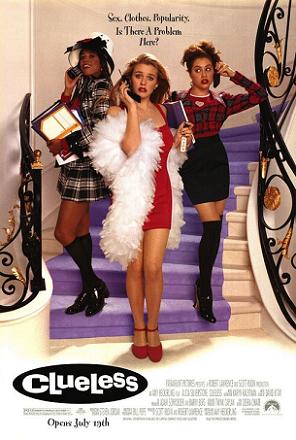
The 90s saw a rash of films that reworked classics into US high-school settings, aimed squarely at the teenage market. One of the most successful of these was Clueless: a decent, just-smart-enough reimagining of the plot of Jane Austen’s Emma.

Austen’s wealthy, match-making heroine here becomes Cher Horotwitz (Alicia Silverstone) – queen bee of the in-crowd in her high school. Like Emma Wodehouse, Cher is smart, beautiful and taken to meddling in the lives of those around her, sure she knows best about how they should behave – and whom they should date. She can be selfish and self-obsessed, but beneath it is fundamentally good-natured. When new girl Tai (Brittany Murphy) arrives at the school, Cher sees the scope for a makeover project – but it’s Cher herself who undergoes the greatest transformation.

The obsessions with status that populate Austen’s world actually translate very well into the high school setting, with its in and out crowds. It also a very neat restructuring of the novel, hitting all the basic plot points of Austen’s story, with some smart translations into the modern world (Christian – the Frank Churchill role – is particularly well updated). The film is sprinkled with sharp lines and snappy dialogue exchanges, and the cast are certainly in on the joke, walking a fine line between parody and playing it straight. This all contributes to the film’s fizzing energy and its charming momentum – you can see why teenagers loved it, as Heckerling has a wry wink at the camera at the concerns of teenagers, but also celebrates their potential for fun and friendship.

Watching the film over 20 years on, it’s remarkable how successfully it used the limitations of Alicia Silverstone to such great effect. It’s a bit bizarre to think Silverstone was considered the next big star of Hollywood, considering how few of her films have made any impact since this. However, here her lack of depth and shading, her unmodulated voice and rather bland style somehow work perfectly with a character who is superficial and who believes she is far cleverer than she actually is.

Clueless is that strange thing – a star-making turn that didn’t make a star, but Silverstone clicks perfectly into this role, making Cher engaging and rather charming despite her self-obsession. She delivers what the film requires in spades, even if Cher’s late character blossoming seems something required for the film’s plot rather than growing truly organically over the course of the film.

This abrupt burst of “learning and growing” partly clunks because Heckerling shies away from Emma’s more negative characteristics – tellingly, Emma’s public shaming of another character is here given to a different character. Can’t have anyone not liking the heroine for a second can we? In fact this determination to make Cher constantly as likeable as possible does rather miss the point of the original novel. It also reduces the “tension” (we all know how stories like this end!) of whether the heroine has driven her love interest away through her mistakes and missteps – and with less for the heroine to learn about herself, and less damage to repair in the relationship with the object of her affections, there’s proportionally less emotional impact to the final happy ending.

Speaking of that romantic plotline, you also can’t talk about the film without also commenting on the fact that it makes a bit of a fudge around the attraction between Cher and Josh, who (the film is at very great pains to point out) are not actuallysiblings, but do share the same father/step-father. It’s actually quite a weird twist, but I suppose just as retrospectively unsettling as Mr. Knightley loving Emma from afar from a ludicrously young age. It’s funny though to watch the film fall over itself to hammer home the non-family relationship between the two characters early on, so we don’t start shrieking “incest” by its conclusion.

All in all, the film – like its heroine – is a sweet, but superficial, candyfloss concoction, without the depth that could have lifted it from pleasing popcorn fare to satisfying story.