Tag: Dan O’Herlihy

Macbeth (1948)

Macbeth (1948)

Welles first Shakespeare film is a bizarre mix of inspiration and amateurishness

Director: Orson Welles

Cast: Orson Welles (Macbeth), Jeanette Nolan (Lady Macbeth), Dan O’Herlihy (Macduff), Roddy McDowell (Malcolm), Edgar Barrier (Banquo), Alan Napier (Holy Father), Erskine Sanford (Duncan), John Dierkes (Ross), Keene Curtis (Lennox), Peggy Weber (Lady Macduff), Lionel Braham (Siward)

Macbeth was Welles’ last hurrah in Hollywood before decades of self-imposed banishment and exile. He arrived at Republic Pictures – proud creator of B-movie Westerns, although also the home of a few John Ford classics most notably The Quiet Man – who were delighted to sign up a deal for a literary classic directed by America’s leading man of the theatre. What they ended up with was a film that’s such a bizarre mish-mash of brilliance, originality and amateurishness nonsense, that they were basically befuddled.

Welles shot the film, as contracted, within 23 days on old Westerns sets, with a budget od spit and boot polish. Welles was focused, more than any other film he’d worked on to that point, on visual imagery and total control of sound and audio. So much so he wasn’t fussed about recording any sound on set. All the actors pre-recorded their dialogue, under Welles’ strict instructions, and then silently lip synched while shooting the scenes. This gave Welles the freedom for a host of expressionistic, shadow-filled shots where the actors faces and mouths were frequently unseen – or longer shots where it was impossible to clearly see lips moving. It also made some truly rigid, uncomfortable performances (Jeannette Nolan was granted permission to record her sleepwalking scene ‘live’ so she could perform it with some semblance of conviction).

Macbeth was set in a Scotland somewhere between a fiercely traditional high-school production and a hodge-podge of influences from Celtic wizardry to Mongolian hordes. It’s shot on a dust-lined, cavern-filled panorama that frequently looks like a giant theatrical set or an empty multi-purpose wall-lined amphitheatre, with only a few scenes exchanging this for mist-filled heaths or low-ceilinged caves. The costuming and design is an eclectic mix: the murderers look like cavemen, some thanes wear kilts, Malcolm and his soldiers dress in medieval armour, Macbeth and Banquo look like fur-coated renegades from Genghis Khan. Welles himself would regret a bizarre crown which made him look like the Statue of Liberty.

There is a feeling that every idea was grabbed and thrown at the wall, in the expectation (hope?) that some of them would stick and lead to cinematic magic. There is a vague attempt to suggest Scotland is at war between Christianity and Paganism. A composite character, the ‘Holy Father’ parades around – chasing away witches, leading prayers for Duncan, taking dictation for Macbeth, warning Lady Macduff, rousing Malcolm – but with very little real sense that this ever adds up to anything logical or thematically clear. Welles merrily re-writes and transposes dialogue. Some works well – Banquo here seems far more of a potential partner than usual – others less so (Lady Macbeth turns up at the murder of the Macduffs for no clear reason).

But the stuff that works really works – and most of it is visual. The witches are shadowy figures, whose voices alter in cadence and pattern from scene to scenes (Welles had mixed male and female voices together to create an unsettling rhythm), their faces never seen. Inspired by his famous “Voodoo Macbeth” stage production, they craft muddy statues of Macbeth which they crown with a crude coronet. In one of the encounters with Macbeth, the camera pulls away to isolate Macbeth, lit in misty isolation. More Voodoo touches are seen in the hammering drum beats that greet Duncan to Macbeth’s castle.
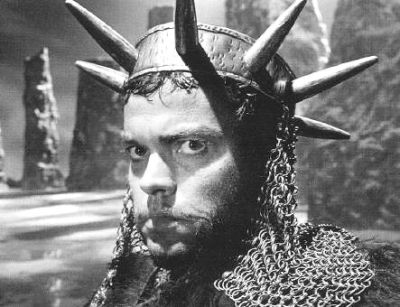
Mist and expressionistic images dominate. Malcolm’s army urges from among the fog, carrying their branches from Birnam wood. The final battle is a series of isolated shots of characters, often the camera craning up to them or seeing them march towards it. Macbeth is frequently shot from below, to heighten his sense of being almost an ogre. When first seen as king, he sits, isolated and drunk at the top of a flight of stairs, making him seem less imposing and more weak from the start of his reign. He is haunted not only by Banquo’s ghost, but Duncan’s as well, Welles camera cutting to reveal his cavern dining room empty of everyone but the Macbeth and the ghosts of murdered friends, the camera tracking the shadow of his fingers along the wall to reveal the bleeding Banquo.

The entire production becomes like a drug-induced fantasy, something a near-catatonic Macbeth might just be imagining as his dreams are crushed by the cruel fate he feels destined to follow. Welles establishes a now popular idea of the play being a huge cycle: at this death, the witches announce “Peace, the charm’s wound up” the camera catching a sight of Fleance who seems destined to repeat the chaos. (“The charm’s wound up” not indicating an end, as often mis-interpretated, but a readiness to be enacted.)

The camera, freed of the need to capture dialogue on set, flies around roams around or moves with swiftness. Characters walk into shadows. Sequences – such as the murder of the Macduffs – are met with a parade of fast cuts and actors charging towards the camera. Music cues are carefully repeated, and lines carry across transitions. There are plenty of striking images, from a mass crowd praying for Duncan to a low-angle camera tracking a worried Macbeth in the aftermath of the murder.

But yet… this is also a curious dog’s dinner of a film. For every great idea, others (like the Holy Father) either don’t land or make no sense. Macbeth’s seduction of the murderers, interestingly shot over his shoulder at an imposing distance from his servants, is followed by a laughably badly acted and staged murder of Banquo. The actors all perform in, pretty much across the board, dreadful cliched Scottish accents. This accentuates the problem of lip synching on set, which renders nearly everyone in the film flat and strangely lifeless, stuck to replicating a performance from days ago.

This includes Welles himself. Macbeth is, by some distance, his least interesting film Shakespeare performance. His Thane is all surface and no depth and Welles’ decision to play him as a slave to destiny, frequently renders him catatonic, reading the lines with a Scottish lilt that travels by way of Dublin, with plenty of pace but no depth. Jeannette Nolan struggles slightly with Lady Macbeth, a decent match with Welles but lacking presence. There is barely a performance of merit among the rest of the cast: McDowell is dreadful, O’Herlihy all at sea, Barrier out of his depth. The bulk of the cast look and sound – in their traditional costumes and awkward, unconvincing accents – like high school students staging “the Scottish play” in the most “Scottish” way possible.

Welles, naturally, having shot the film promptly disappeared to Europe leaving notes and memos from a distance about how it should be assembled, some of which were promptly ignored by a supportive studio turn exasperated. Those in Europe were more respecting of the results, praising Welles for re-imagining the text and its expressionistic, fluid shooting style. In America, these elements were condemned a mess. Macbeth is a bit of both: good ideas sitting alongside amateurishness and nonsense. It’s most interesting by far as a silent film: there are images here that linger, from the witches mud statue to Lady Macbeth’s plumet to death. But as an overall package Welles would dwarf it with Othello and Chimes at Midnight, which combined good Shakespeare and good film-making. Macbeth is a struggle to marry expressionist film-making and literary grace that doesn’t always succeed.

Further reading:

Fail Safe (1964)

Henry Fonda desperately tries to avert nuclear war in Fail Safe

Director: Sidney Lumet

Cast: Henry Fonda (The President), Dan O’Herlihy (Brigadier General Warren Black), Walter Matthau (Professor Groeteschele), Frank Overton (General Bogan), Fritz Weaver (Colonel Cascio), Edward Binns (Colonel Jack Grady), Larry Hagman (Buck), William Hansen (Defence Secretary Swenson)

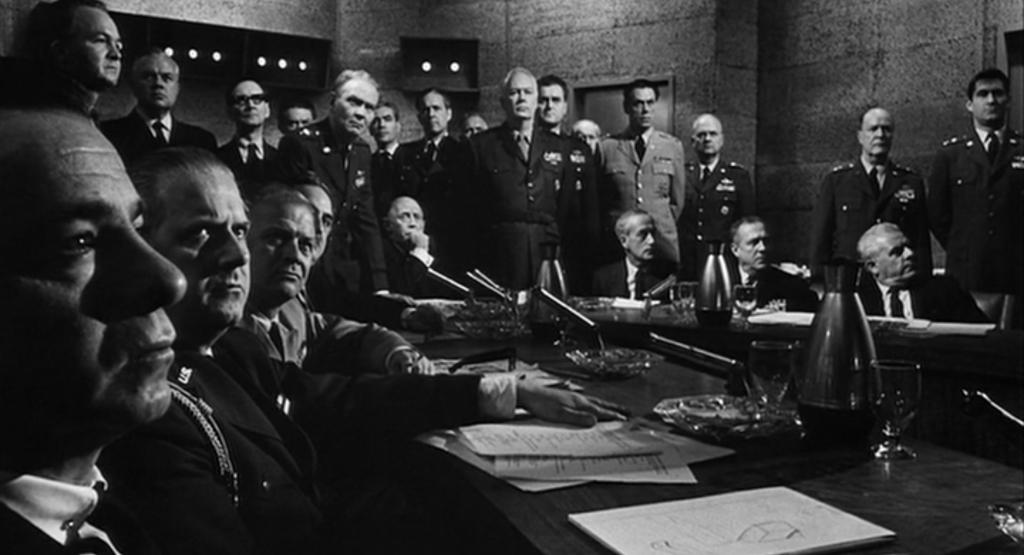
In 1964 the classic film on nuclear conflict was released and became a landmark in Hollywood history. Also released was Fail Safe. Dr Strangelove has dragged Fail Safe through history like a sort of phantom limb. It’s reputation – if you’ve heard about it at all – is “Dr Strangelove but with no jokes”. That’s hugely harsh on a well-made, tense and fascinating film that sees nuclear war as less the blackly comedic theatre of MAD (Mutually Assured Destruction, the buzzword of the day), and more as a dark human tragedy where mistakes, suspicions and paranoia lead to disaster.

During a routine manoeuvre, a mechanical power surge at USAAF leads to a mistaken but correctly authenticated order being sent to a wing of bombers to drop their nukes on Moscow. Due to Russian jamming, USAAF has no idea this has happened until after the five minute recall window. After the five-minute window has passed, the pilots follow their training and ignore all subsequent orders no matter who gives them – even if it’s directly from the President (Henry Fonda) himself. Desperately the President works with the Soviet Union to stop the bombers (and prevent the inevitable full scale nuclear war they would provoke). Problem is national pride, mutual suspicion, subordinates who can’t stomach co-operation between enemies and those that an accidental first strike is the perfect way to start a nuclear war one side could win, keep getting in the way.

While Dr Strangelove saw the insanity of MAD – the willingness of the leaders of both sides to promote a type of war that could only lead to the destruction of all life on earth – as so darkly absurd it could only be a subject for jet-dark-satire, Fail Safe takes a more humane if equally chilling route. Shot mostly with a low-key documentary realism by Sidney Lumet, the action is restricted to no more than four main locations. Once the crisis starts we never go outside. We never even see the Russians, represented only by photos and their words given life by Presidential translator Larry Hagman. Bar from the odd piece of stock footage, we are in the bunkers with the characters. And we feel as powerless as they do, as events spin out of control.

The film could be seen as an attack on the replacement of humans from the system by machines. Sure, the strike is triggered by a faulty piece of equipment. But everything after that is the result of good old-fashioned human error. The US debate about shooting down the bombers that goes on for so long, the bombers get out of range. The Russian refusal to accept US help to shoot the bombers down, leading them to taking pot shots at radar ghosts. The attempted coups on both sides in the command room, as junior officers refuse to co-operate with the enemy. The mistrust between both sides that leads the Russians chasing a decoy attack run rather the real bombing plane, despite the pleading of the American General that it’s a decoy.

And above all, the crushing arrogant insanity of introducing a system like this in the first place. A system so regimented and drilled into its soldiers – removing any chance of independent logical thought – that the pilot of the bombers will even ignore his own wife pleading down the line that the first strike he believes he is retaliating against hasn’t even happened. A system where leading American advisors suggest that, because it’s so difficult to call back an attack like this, why not just launch everything else after it as well and claim victory. This system can destroy the world but has no leeway for human error and forbids any independent thought from anyone. Now that’s MAD.

It takes a while for the film to get going, laying its groundwork slowly. Much of the first half hour introduces the characters – such as the family life of anti-Nuclear but loyal soldier General Black (a very good Dan O’Herlihy) and the chilling pragmatism of war theorist Professor Groeteschele (Walter Matthau) to whom nuclear war is just a matter of working out what the acceptable casualty rates are (he would agree with Stalin that one death is a tragedy, a million is a statistic). We tour the USAAF base where level-headed General Brogan (an excellent Frank Overton) and his twitchy number two Colonel Cascio (a slightly too fidgety Fritz Weaver) demonstrate just how fool-proof their systems are to a couple of congressmen – just as those systems fail.

From there the film plays out almost in real time, as the planes fly the two-hour journey to drop their bombs. Two hours when everyone tries to desperately tell themselves that this disaster can be prevented (or in some cases, can be turned into victory). Lumet’s film captures wonderfully the claustrophobic intensity of this. The Russians – despite never being seen – are skilfully humanised with snatches of conversation and photographs. The pilots are brave, resourceful, brilliantly trained – making their rigid determination to destroy the world for no reason (because their training doesn’t allow them to consider any other alternative) all the more tragic.

It all culminates in an impossibly bleak ending, the President’s only alternative to all-out nuclear war is one of terrifying magnitude. The inevitable build to this sacrifice is also executed with a low-key intensity. Fonda is perfect in the lead role – his tortured gravitas and decency pushing him towards ever more distasteful and finally appallingly bleak decisions.

Lumet’s film isn’t perfect – an overly impressionistic opening of General Black’s recurring dream of a matador smacks of someone who has watched way too many Bunuel films – and its slow start probably takes five minutes too long. But with its chillingly cold glaze on the flaws in the nuclear deterrent and the people who operate it, it deserves to be remembered as something more than Dr Strangelove Without the Jokes.

Waterloo (1970)

Rod Steiger chews the scenery as Napoleon in this epic restaging of Waterloo

Director: Sergei Bondarchuk

Cast: Rod Steiger (Napoleon Bonaparte), Christopher Plummer (Duke of Wellington), Orson Welles (Louis XVIII), Jack Hawkins (Lt-General Thomas Picton), Virginia McKenna (Duchess of Richmond), Dan O’Herlihy (Marshal Michel Ney), Rupert Davies (Colonel Gordon), Philippe Forquet (Brigadier-General Bédoyère), Ian Ogilvy (Colonel De Lancey)

In 1970 there was no CGI. Want to stage a battle scene? Well you’re going to have to use real people, rather than populating your screen with pixel soldiers. I’ve always had a fondness for epic films of this era, where you look at the screen and know everything is real. And one of the best examples of this battle-heavy genre is this 1970’s chronicle of the Battle of Waterloo in 1815. Because in 1970 the only way to recapture the battle on camera was effectively to re-fight it with a cast of tens of thousands of extras and horses, across a film set the size of the original battlefield. Can you imagine anyone attempting that today?

An international co-production, the film throws together an eccentric hodgepodge of actors. No more than you would expect of a film co-financed by Italy and the Soviet Union, shot in English, directed by a Ukrainian (with a team of four translators) with a lead actor from New York and the cast stuffed with dubbed actors from across Europe. In fact the slight air of Euro-tackiness about the film is one of the things I sort of love about it.

Rod Steiger as Napoleon delivers the sort of OTT performance he loved to give, capturing the self-aggrandising, larger-than-life nature of the Emperor while frequently chewing the scenery and oscillating between whispers and shouting. It’s perhaps no more than you would expect when playing a man whose entire life was a stage-managed performance of dangerous charisma. It does though make a nice contrast with Christopher Plummer who, perhaps aware of who he was working with, goes for an archly low-key, even wry touch, as the more austere Wellington.

The film covers the time period of Napoleon’s Hundred Days, from his arrival from Elba to the final defeat at Waterloo (with a neat prologue showing an exhausted Napoleon accepting he must abdicate and head into exile in 1814). Much of the first half hour is a showpiece for Steiger’s bombastic Napoleon. Few other characters get a look in (Welles cashes another of his cheques for one-scene cameos, as a bloated Louis XVIII fleeing into exile). To be honest, much of the first half of the film is a slightly stodgy (more-or-less) faithful trot through historical events leading to the battle.

But this is really to set the table for the film’s central appeal, which is that astonishing recreation of the battle itself. Shot in the Ukraine, the Soviet Union (as their part of the deal) effectively recreated the landscape of Waterloo, bulldozing hills, planting thousands of trees, sowing fields and laying over six miles of drainage to help create the muddy fields. On top of which, the USSR threw in 17,000 troops to serve as extras (insanely impressive, even considering it’s only a fraction of the nearly 191,000 troops involved at various stages in the battle).

Marshalling all this was Soviet director Sergei Bondarchuk. Used to commanding film sets like this – he had previously directed a four-part version of War and Peace, where similar number of Soviet troops had recreated Austerlitz and Borodino – Bondarchuk certainly knows how to show the money is all on screen. Aerial shots and long tracking shots take in regiments of soldiers taking up position. Cavalry charges of hundreds of horses are brilliantly shot. The French cavalry charge against the British infantry squares is stunning in its scale and size. Everywhere you look, wide-angled shots demonstrate the depth of extras, the vast scope of the battle and the huge numbers of soldiers marching across screen. If nothing else it’s a superb marshalling of resources.

Bondarchuk brings a number of stylistic flourishes from his War and Peace to the film here. Sadly many of these choices have dated badly – and even at the time, looked a little silly. Interior monologues are demonstrated with close-ups and the sound of actors whispering over the soundtrack (although Bondarchuk also mixes this up with a prowling Napoleon addressing the camera directly). The film loves crash-zooms and fast wipes – one crash zoom generates giggles as it zooms in on Napoleon as he turns fast to face the camera after particularly bad news. Bondarchuk at times drains out the noise of the battle to focus on small details, most notably in the British cavalry charge. It gives moments of the film an odd dreamy film, particularly striking because most of it is so baked in realism.

To be honest the film is workmanlike, rather than inspired, with all the focus on marshalling the thousands of extras. There are moments of character for both Napoleon and Wellington – flashes of doubt, insecurity, fear are mixed in with supreme confidence. The film also hits a neat line in the horrors of war. The camera tracks along the mangled bodies after the battle, while at the peak of the clash a British soldier has a mental collapse, breaking from his square to bemoan “Why are we killing each other?” Not exactly subtle, but it works.

But the film’s main appeal is that scope – and its breath taking. The film itself is more to look at than think about, but with the detail of its recreation of the battle makes it a must for any Napoleonic history buff. Peter Jackson has said his own cavalry charges in Lord of the Rings were inspired by this film – the difference being Jackson’s horses were CGI, while Bondarchuk literally charged hundreds of horses direct at the camera. And you won’t see scope like that anywhere else.

And that’s partly because the film was a bomb, putting an end to such huge scale films as this and also leading to Stanley Kubrick’s plans for a Napoleon biopic being cancelled. Perhaps the worst part of its legacy.

The Dead (1987)

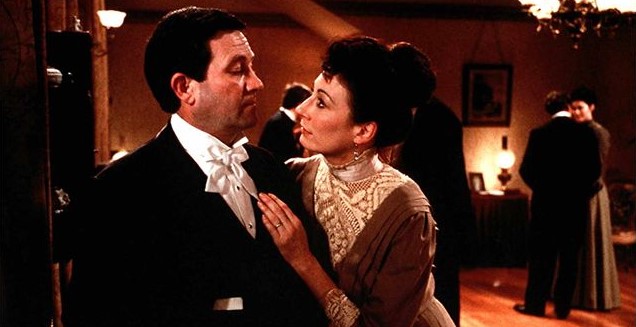
Donal McCann and Anjelica Huston in a marriage with a past in The Dead

Director: John Huston

Cast: Anjelica Huston (Gretta Conroy), Donal McCann (Gabriel Conroy), Cathleen Delany (Julia Morkan), Helena Carroll (Kate Morkan), Rachael Dowling (Lily), Ingrid Craigie (Mary Jane), Dan O’Herlihy (Dan Browne), Marie Kean (Mrs. Malins), Donal Donnelly (“Freddy” Malins), Sean McClory (Mr. Grace), Frank Patterson (Bartell D’Arcy), Colm Meaney (Raymond Bergin)

John Huston’s final film was a long-standing passion project, anfaithful adaptation of James Joyce’ short story from The Dubliners. Huston had only a few months to live when shooting the film – he was hooked up to an oxygen supply for the course of its film-making and confined to a wheelchair. His children Anjelica and Tony (who wrote the screenplay) helped to nurse him through this final project. The final film makes for a beautiful wistful, heartfelt and tragically toned story that’s small in scale but carries great emotional force.  It’s a beautiful adaptation.

The film is set at a Christmas house party for family and friends, a regular thrown by two spinster sisters, Julia (Catheen Delany) and Kate (Helena Carroll) Morkan. The soiree – with recitals, dancing and wonderful meal – is an annual treat, with a regular guest list of family and old friends. The Morkan’s nephew Gabriel (Donal McCann) frequently serves as unofficial master of ceremonies – this year nervously checking and rechecking his after-dinner speech. However, at this year’s dinner Gabriel’s wife Gretta (Anjelica Huston) is caught-off-guard by a moving song, that brings back to her a flood of memories from her younger days of a late first love – a revelation of a past life that in their bedroom after the party, stuns Gabriel and causes him to reassess everything he thought he knew about his wife’s past and how his own life has been bereft of the sort of passion she has displayed over a memory.

The summary above essentially captures the entire story of this James Joyce tale that is short on events but deeply long on emotional meaning. Critics have sometimes said it can only be a shadow of the original – but it’s an adaptation not a replacement. Huston’s film is a gentle, unhurried, carefully presented chronicle of everyday lives and the emotional depth that’s can lie buried beneath them. The Dead is short on flash, but it has such warmth, love and respect for its characters, and vibrancy in its playing that it hardly matters that for almost an hour nothing (as such) actually happens. Instead, Huston and his actors so completely understand and communicate the warm bonds between its characters – from decades of knowing each other – and the entire party has such an air of truth to it you can genuinely just enjoy watching the characters enjoy it.

It’s full of perfectly observed moments that ring true – and all straight from Joyce. The younger men who attend the party, and duck out of a gorgeous piano recital for a quick drink, to return and lead vigorous applause at its end. The awkwardness of small talk between two people that don’t really know each other, but are too polite to turn away. The affectionate indulgence of the drunken son of an old friend (“sure, he’s not as bad as he was last year”) who is quietly not passed the port and leads a praise for Julia’s slightly-off-note singing that is so lavish it manages to be as touchingly well-meant as it is grin-inducingly embarrassing. Huston had a long-held regard for the warmth and generosity of Irish hospitality and feeling and this seeps into every pore of the film.

But the film is stuffed full of moments of simple, real-world pleasure crafted by a director who understood that the impact of the stories late emotional revelations depended on the everyday low-key presentation of the film’s first hour. And there is no end of delight be had from the Morkan sister’s tearful pleasure and pride at Gabriel’s sincere speech of gratitude at the dinner’s end (even if it is overladen with classical parables). Or in the quietly supportive way Gabriel goes about organising events for them in the house, from shepherding the tipsy Freddy to a bathroom to sober up to ending events by gently wakening Protestant Dan Browne at the party’s end from his drunken doze in the cloakroom. Around all these events is the conversation of people who have known each other for years and are comfortable to sink back into the patter of familiar themes.

All of which is then perfectly counter-pointed by Gretta’s quiet revelation of a past of passion and deeply held first love that she has never spoken of before – and causes Gabriel to certainly look anew at everything in his life. It’s a sad and delicate Proustian revelation of how the slightest nudges to our memory (in this case the soulful rendition of an old Irish song) can unlock sudden wells of feeling, making events from years ago suddenly seem as painfully recent as yesterday. 

For suddenly Gabriel moves from initial jealousy into a deep and abiding sadness at how nothing in his own life could ever have motivated such depth of feeling from himself – that frankly he has nothing in his experience to match the grief and unforced emotion his wife has displayed. It’s a very Joycian revelation in which the present and the future is readdressed in light of the past. Suddenly Gabriel must reflect that his life has been one of competent and forgetful mediocrity and that he himself will die – and that fate awaits us all, with the snow falling on us all living or dead, and that Gabriel will forever lack the emotional depth and poetry to express it.

The film’s elegiac qualities match perfectly with the end of Huston’s career – and maybe the sad regret of Gabriel is Huston judging whether he made an impact either. The film however is beautiful, recreating Ireland perfectly in California with a superb cast of Irish theatre stalwarts specially imported. Donal McCann is wonderful as Gabriel, Anjelica Huston quietly moving as his wife while the rest of the cast are faultless: from Cathleen Delany and Helena Carroll’s carefully judged spinsterish generosity to Donal Donnelly’s garrulously friendly drunkenness (perhaps motivated by the impossibility of living up to his mother’s – an imperious Marie Kean – high standards). The Dead may not capture all the depth and beauty of Joyce’s writing (what can?) but it captures more than enough to be a beautifully judged film.