Tag: Danielle Darrieux

La Ronde (1950)

La Ronde (1950)

Ophüls masterful film is a cheeky end-of-pier comedy in smart clothes and subtle musing on filmmaking

Director: Max Ophüls

Cast: Anton Walbrook (Master of Ceremonies), Simone Signoret (Léocadie, the Prostitute), Serge Reggiani (Franz, the Soldier), Simone Simon (Marie, the Chambermaid), Daniel Gélin (Alfred, the Young Man), Danielle Darrieux (Emma Breitkopf, the Married Woman), Fernand Gravey (Charles Breitkopf, the Husband), Odette Joyeux (Anna, the Young Woman), Jean-Louis Barrault (Robert Kuhlenkampf, the Poet), Isa Miranda (Charlotte, the Actress), Gérard Philipe (the Count)

La Ronde is the sort of film many would describe as elegant and sophisticated, with its Edwardian Viennese setting, gorgeously expansive costumes and luxuriant sets. Which is perhaps part of Max Ophüls’ joke: because, in many ways, La Ronde is a sublimely naughty end-of-the-pier show where a suave Master of Ceremies (a gloriously arch Anton Walbrook, standing in for Ophüls himself), manipulates events and people to present a chain of sexual encounters that eventually loop back round through the partners to the prostitute (Simeone Signoret) who started it all. Only of course she didn’t start it, since Walbrook’s MC instructed her exactly which soldier she was to invite for a romantic knee-trembler. La Ronde is a sex comedy of manners – but it’s also an intriguing commentary on the act of film-making.

Walbrook’s MC is essentially the film’s director. He all but tells us this, as Ophüls camera (in one of the director’s signature long, roving camera moves) tracks him walking in evening garb in front of what looks suspiciously like a painted backdrop… and then is immediately revealed to indeed be one as Walbrook guides us past a film camera onto another set, changes his clothes and begins handing out instruction to actors. Over the course of the film, Walbrook will guide characters between sets (through a blatant back-stage area), take on a series of small roles to directly intercede in the action and even snip out the film of La Ronde’s most smutty part. He’ll even cue the sun to rise. Walbrook’s archly artificial performance is crammed with assurance, charm and a supremely entertaining streak of naughtiness: for what is a film director but a sort of enthusiastic child who enjoys playing out his stories for us.

It makes sense that La Ronde takes place in a curiously artificial world, that often seems to be only populated by whichever pair of lovers Walbrook happens to have introduced. Its design echoes the circular narrative of the piece. Ophüls camera frequently moves through circular tracking shots, while the frame is stuffed with circles. From the merry-go-round the MC rides on, circles are everywhere: courtyards and rooms are circular, stair-cases and walkways roll round on themselves, characters are framed through chandeliers or circular gaps in ormolu clocks. The set seems to loop around as much as the story does, characters being forced into rotation, as if they were constantly riding the merry-go-round (which indeed we see, at one point, kitted out with a whole dinner service) not in control of their own fate but driven forward by endless momentum.

It’s an endless momentum that crashes only once, the MC’s roundabout breaking down when a young lover suffers from a bout of impotence. It’s telling that, during this sequence, we get the closest we get to an adult conversation between two lovers, Daniel Gélin’s eager-to-please young man and the relaxed worldliness of Danielle Darrieux’s married woman. Just as it’s telling that the only encounter not punctuated by sex, but instead by an earnest conversation that there are more important things in a marriage than the buzz of passion, is between Darrieux and Fernand Gravey’s fusty but strangely vulnerable Husband. Aside from that, these encounters have a constant frission of desire beneath them, only rarely punctuated by more complex emotions.

In fact, there is something very stereotypically French about a film that essentially says a constant parade of sexual encounters between willing partners is perfectly harmless, so long as eyes are open and honesty prevails. It’s also striking how, from encounter-to-encounter, characters switch from seduced to seducer.  Simone Simon’s Chambermaid goes from the arms of Serge Reggiani’s enthusiastic soldier (whose interest in her declines almost immediately after the deed), to shamelessly provoking the lust of Gélin’s young man who then immediately, enthusiastically, courts Darrieux. Odette Joyeux coquettishly plays along with Gravey’s extra-marital tumble and then finds herself swept up with Barrault’s poet who is putty in the hands of Miranda’s actress.

It all eventually loops us back round to Simone Signoret’s prostitute: and if there is anything in La Ronde about the cost of love, it seems fitting it should be connected to the loneliness of the only person to whom this is a professional obligation rather than a choice. Signoret makes the woman surprisingly melancholy and regretful, more desperate perhaps than anyone else for a taste of genuine connection: be it from Reggiani’s soldier (to whom she offers a free romantic encounter, which he only accepts so long as it doesn’t involve a ten minute walk to her apartment) or later from Philipe’s count, where she seems not even surprised that he awakens claiming to not remember a thing about the night before. La Ronde bookends a frequently light, sexy, cheeky film with its most tragic character (another sign of Signoret’s skill at pained neglect).

Aside from this, it’s a surprisingly light, playful and cheeky confection – one which relies on its impact from the masterfully graceful filming it receives from Ophüls, at the top of his game here. No point is made too forcefully, every scene smoothly but relentlessly builds towards a comic highlight, each shot is framed to perfection, from the gliding tracking shots to the Dutch angles and circulatory framing. This is a director’s film like few others: so, its immensely fitting it should, with Walbrook’s character, effectively make the director the key character, delightedly telling us every part of his design, guiding our eyes where to look and manipulating and positioning the other characters so they add to our enjoyment. There are few films quite like La Ronde in that all this is done with an astonishing lightness of touch. Nothing here is to be taken too seriously, or to be hammered home too hard. Instead, it’s a whimsical naughty story intended to leave you with a grin on your face when you recount it to friends.
Alexander the Great (1956)

Alexander the Great (1956)

An odd epic, which both loathes its subject and also presents him as a golden-boy

Director: Robert Rossen

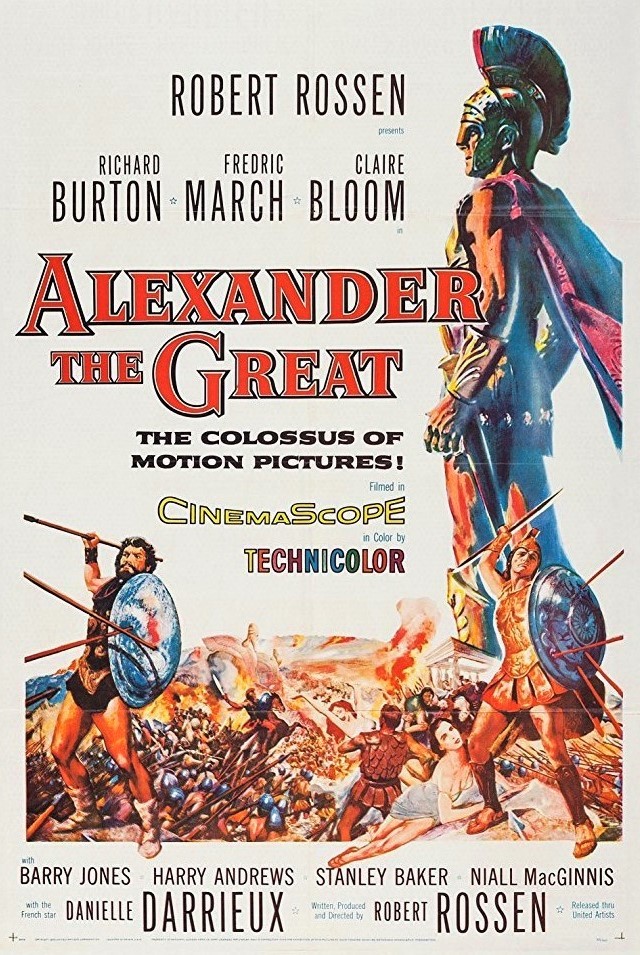
Cast: Richard Burton (Alexander the Great), Fredric March (Philip II), Claire Bloom (Barsine), Danielle Darrieux (Olympias), Barry Jones (Aristotle), Harry Andrews (Darius), Stanley Baker (Attalus), Niall MacGinnis (Parmenion), Peter Cushing (Memnon), Michael Hordern (Demosthenes), Marisa de Leza (Eurydice), Gustavo Rojo (Cleitus the Black), Peter Wyngarde (Pausanias), William Squire (Aeschenes)

No one in history achieved so much, so young as Alexander the Great. He conquered most of the known world before he was thirty and left a legend that generations of would-be emperors found almost impossible to live up to. He did all this, while remaining a fascinatingly enigmatic figure: either a visionary nation-builder or a drunken man of violence, depending on who you talk to. Alexander the Great, in its truncated two hours and twenty minutes (sliced down from Robert Rossen’s original three-hour plus) can only scratch the surface of his story and that’s all it does.

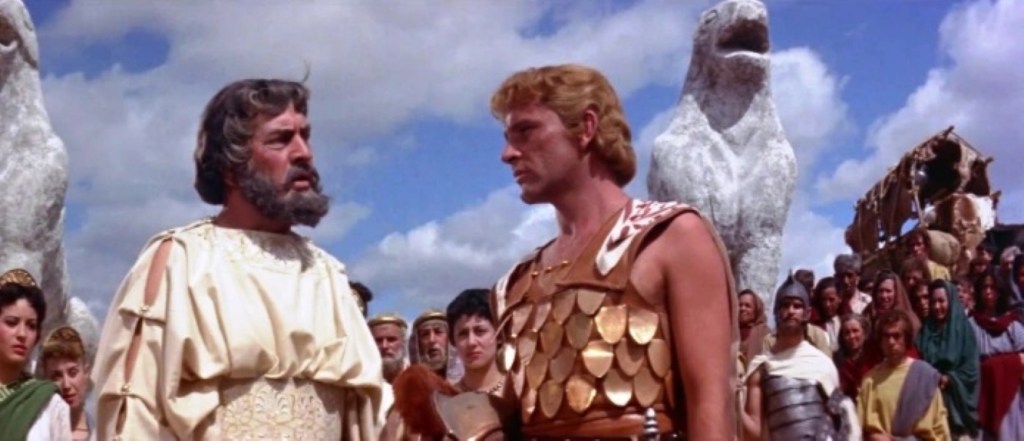
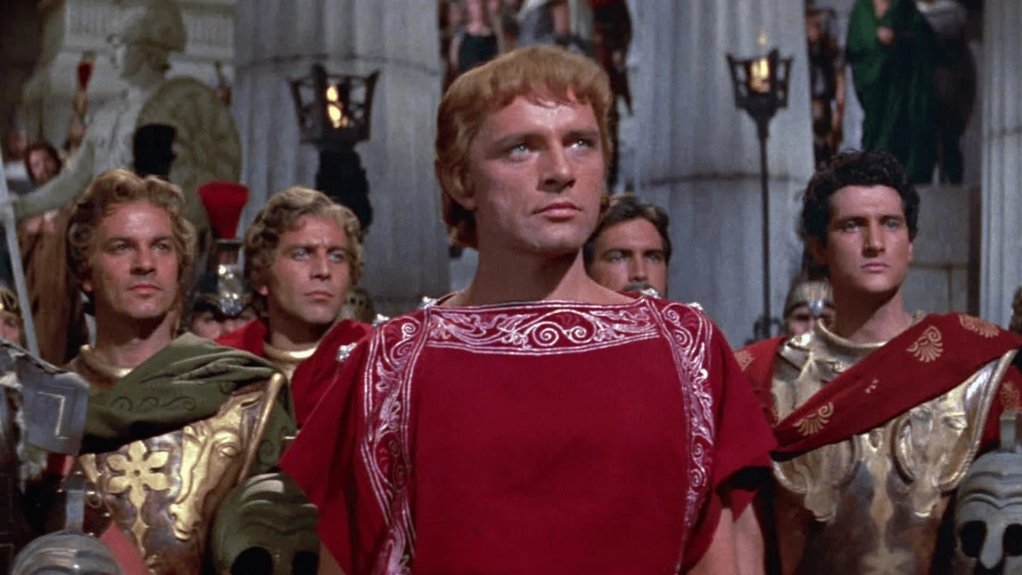
As the great man, Richard Burton flexes his mighty voice in a film that splits its focus roughly equally between the early days of Alexander and his troubled relationship with both his father Philip II (Fredric March) and his mother Olympias (Danielle Darrieux) and his own kingship and conquest of the known world until his early death. Surprisingly, perhaps because the world is so vast, it’s the first half of the film that’s the most interesting – perhaps because showing up the internecine dynastic squabbles between petulant royals are more up director and writer Rossen’s alley than global dominance.

Perhaps as well because it feels pretty clear Rossen doesn’t particularly seem to like Alexander. Over the course of the film, the pouting monarch will prove to have a monstrous ego (even as a teenager fighting Philip’s wars, he cockily re-names a sacked city after himself), ruthlessly slaughters opponents after battles, is prone to fits of rage, informs his followers with wild-eyes that he’s God himself, leads his army into the dried out hell of the deserts of the Middle East and turns (at best) a blind eye to his mother’s plans to assassinate his father and then murder his father’s second wife and baby son.

The film culminates in a shamed Alexander kicking the bucket more concerned with maintaining his legend for future generations than assuring any kind of future for his kingdom. But the sense of hubris destroying the great man is never quite captured. This is partly because the grand figure we are watching lacks any personal feelings or fear. He can’t seem to experience loss or grief and only understands negative events in terms of their impact on his reputation. And he never seems to truly learn from this – even when he harms friends, his regrets are based around the impact such action will have on how those around him see him. At the same time, Rossen can’t quite follow his heart and make a real iconoclastic epic meaning he instead leaves titbits here and there for the cinema-goer to hopefully pick up among the spectacle.

As such, Alexander is still pretty persistently framed as we expect a hero to be, with a rousing score backdropping Burton’s speeches and poses, even while the film seems deeply divided about whether this guy who conquered most of the known world and lay waste to Babylon was a good or bad thing. While acting half the time like a egomaniac tyrant, the film still carefully partially shifts blame for his character flaws onto his mother’s Lady Macbethesque influence (Darrieux does a good line in whispering insinuation) or Philip’s bombastic egotism (March, growling with impressive vigour).

Rossen has far more admiration for people like the fiercely principled Memnon (a fine Peter Cushing) who refuses to compromise only to be rewarded by a post-battle one-sided butchering from Alexander after his offer to surrender and spare the lives of his men is turned down. Even Michael Hordern’s Demosthenes comes across as a man of principle, certainly when compared to Alexander’s Athenian-of-choice Aristotle, interpretated here as a pompous windbag cheer-leader for dictators. Oddly even Harry Andrews (possibly, along with Niall MacGinnis’ wily Parmenion, the films finest performance) as Darius comes across as a man of surprising human doubt under his regal exterior. But, perhaps because of choppy-editing cutting down a complex story into just over two hours, Alexander the Great can’t resist framing its hero as a sun-kissed golden-boy, towering above everyone else in the film.

Watching Alexander the Great you get the feeling the film has effectively entombed him as a marble statue, so devoid is he of fundamental humanity. Perhaps this was Rossen’s solution to shooting a film about someone he seemed so devoid of human interest and sympathy for. There is a reason why Charlton Heston – the first choice for the role (can you imagine!) – called Alexander the Great “the easiest kind of picture to make badly”. Frequently Alexander the Great tips into a sort of sword-and-sandles camp made worse by how highly serious it takes itself. Not helped by Burton’s all-too-clear boredom with the part and contempt for the material, Alexander strikes poses and delivers speeches as if he’s been ripped straight out of Plutarch or a bust display in a museum.

Apart from rare moments – usually in the first half as he processes his complex feelings of love and loathing for his overbearing father – he is almost never allowed to be human. His friends – most notably his famed best-friend (and lover) Hephaestion – are reduced to a gang of largely wordless extras and only Claire Bloom’s Barsine is given any scope to talk to him as if he’s a man rather than just a myth. It gets a bit wearing after a while as you long for something human about the man you can cling onto.

It’s also a shame that Rossen seems uncomfortable with shooting the battle sequences. The battles of Granicus and a combined Issus-Gaugamela look rather like damp scuffles over shallow streams than some of the mightiest clashes of the Ancient world. Rossen communicates no visual sense of either strategy or scale (despite the bumper budget). Similarly, the grand sets look too theatrical and never quite as impressive as they should do, despite some fine painterly compositions. Rossen can never quite find a way to make his hundreds of extra seem like thousands and he falls back in the second half to communicating Alexander’s success through a tired combination of map montages, voiceover and repeated shots of men marching left to right and burning cities.

Alexander the Great is a deeply flawed epic. It’s neither swashbuckling fun that bowls you along, or a breath-taking piece of historical spectacle. Nor is it psychologically adept or insightful enough to show you something truly different about its hero. Instead, it tries to straddle both ways of thinking and ends up collapsing in the middle. If only Rossen had found his own Alexanderian solution to cutting this Gordian knot. Instead, the film just ends up a cut-about mess that fades from memory all too soon.