
Tag: David Cronenberg

Eastern Promises (2007)

Eastern Promises (2007)

Brutal violence in London’s underbelly in Cronenberg’s formal and chilling dark fairytale

Director: David Cronenberg

Cast: Viggo Mortensen (Nikolai Luzhin), Naomi Watts (Anna Ivanova Khitrova), Armin Mueller-Stahl (Semyon), Vincent Cassel (Kirill Semyonovich), Sinead Cusack (Helen), Mina E Mina (Azim), Jerzy Skolimowski (Stepan Khitrov), Donald Sumpter (Inspector Yuri), Raza Jaffrey (Dr Aziz), Josef Altin (Ekrem), Tatiana Maslany (Tatiana’s voice)
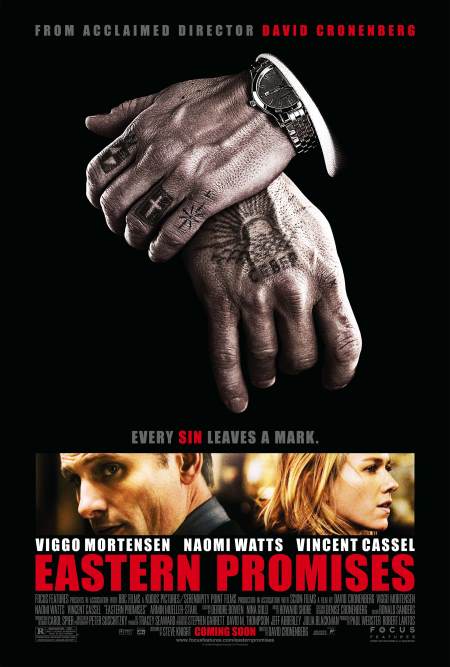
Big promises shipped back to Russian villages, telling women about dreams they can make reality in the bright lights of London. Those are Eastern Promises – but the reality, of sexual slavery and abuse in Russian Mafia controlled houses is horrifyingly different. Set in an underbelly of London just under grand restaurants and red buses, Eastern Promises is a typically tough and bloody gangster fable from David Cronenberg, which plays out like a nightmare fairytale.

It’s the nightmare of midwife Anna Khitrova (Naomi Watts). When a pregnant Russian teenager dies giving birth, the only clue she has to who her daughter’s family might be is a Russian diary and a business card for a Russian restaurant. Anna – whose family are Russian immigrants – is offered help by grandfatherly restaurant owner Semyon (Armin Mueller-Stahl). Seymon is all pleasant insistence that he can help, even as asks after every detail of her life. Because Seymon is a ruthless Mafia kingpin, with a hapless son Kirill (Vincent Cassel) leaning on the emotional and practical support of his imposing, heavily tattooed driver Nikolai (Viggo Mortensen). As Anna is pulled further and further into Semyon’s deadly world of death, could she have a surprising saviour?

Cronenberg’s film, sharply scripted by Steven Knight, is shot with a traditional stillness and a palette of strong colours – all of which reassuring visual language is utterly at odds with the skin-slashing violence at its heart. Eastern Promises opens with a Russian gangster practically having his head sawn off with a switchblade, in the hands of a mentally-handicapped nephew of a minor Turkish gangster. There isn’t a single gun in Eastern Promises – after all that would be breaking British law! – instead violence is meted out with the violent intimacy of a knife across the throat.

The film’s formal structure and framing – angles and cutting are kept simple, almost static – works brilliantly. As we watch throats slashed, grim sexual encounters or moments of imposing menace, the matter-of-fact presentation of these become more-and-more chilling. Eastern Promises feels like a bogey-man fable. Seymon’s restaurant – all class and bright red walls – an ogre’s cavern that leads us into an ever-grimmer world of violence and mayhem.

It’s a world Anna is unprepared for. Determined and resilient, Naomi Watts’ Anna is also undone by her politeness. How can she refuse an offer to help from someone as polite as Seymon? Watts does extremely well with a slightly under-written role, a woman on a quest who slowly realises how terrible the world she is peeking into is, but stop from trying to force through what she believes is right. Her disbelief – and out-of-place semi-innocence and sense of moral duty – make her stand out all the more in this terrible underbelly world, full of ogres and secret codes.

At the centre of is a monster. Armin Mueller-Stahl looks like your favourite uncle, but he quietly exudes cold, remorseless villainy. He’s the sort of man who delights in cooking the finest borsch, playfully teases his granddaughter’s violin playing and doesn’t bat an eyelid about ordering a rival to be dismembered. Mueller-Stahl is terrifying as this man the audience instinctively knows is dangerous and will stop at no moral boundaries to get what he wants (watch the steely eyed kindness he asks Anna where she works, lives and who she knows during their first meeting).

The obvious moral void in Seymon makes the unreadable Nikolai even more intriguing. Played with an extraordinary physical and linguistic commitment by Mortensen, Nikolai’s body is a tattooed walking advert of his past and capacity for violence and he’s the sort of relaxed heavy who is as unfussed with stubbing a cigarette out on his tongue as he is with snipping fingers off a corpse. Mortensen’s skill here is to make us constantly unsure where the moral lines are for Nikolai. He is a confirmed killer, but he takes an interest in Anna. Is this sexual or protective? What does he make of his bosses’ brutality towards women? What does he think of his direct superior Kirill?

Kirill is played with a larger-than-life weakness by Vincent Cassel in a thrilling performance that constantly shifts expectations. At first, he seems like a drunken blow-hard with a capacity for thoughtless violence. But Cassel makes clear he is a weak man with some principles, bullied by his father (to whom he is a constant disappointment), desperate to prove he is more capable than he is. He has an emotional reliance on Nikolai laced with sexual fascination (he can barely keep his hands off him).

Nikolai seems to accept this. But we don’t seem to know why. His actions are constantly open to interpretation. Ordered to have sex with a prostitute, he almost apologises to her after – left alone with her after Kirill has watched their sexual encounter, he’s strangely tender. He urges Anna to keep her distance but follows orders with calm disinterest. How far will he go? What moral qualms does he have, if any? Mortensen’s carefully judged performance is a master-class in inscrutability in a film that plays its cards very close to its chest as to why he (and others) do the things they do.

Cronenberg’s entire film is structured like this. Is the dragon a dragon or a potential knight? Can Anna emerge from this semi-Lynchian nightmare world and return to normal life – or will everything connected to her be destroyed by this world. Cronenberg’s study of this shady, heartless world is masterful. The “rules” and code of this brutal Russian Mafia world are excellently explored. And the film’s formal style culminates in a stunningly violent but beautiful (if that’s the right word) fight between a nude Mortensen and two knife-wielding Checians in a Turkish bath that is a brutal model for how these things can be done.

Eastern Promises resolves itself, after twists and turns, into something more comforting and traditional than you might expect. But is it a fairy tale ending to a nightmare? Either way, Cronenberg’s mix of formality and unflinching gore is masterful and in Mortensen it has a performance both relaxed and full of tightly-wound violence. Tough but essential.
A History of Violence (2005)

Viggo Mortensen: Hero or Villain? A History of Violence

Director: David Cronenberg

Cast: Viggo Mortensen (Tom Stall), Maria Bello (Edie Stall), Ed Harris (Carl Fogarty), William Hurt (Richie Cusack), Ashton Holmes (Jack Stall), Peter MacNeill (Sheriff Sam Carney), Stephen McHattie (Leland Jones), Greg Bryk (Billy Orser), Heidi Hayes (Sarah Stall)

Cronenberg’s films redefined ideas around body horror. And one of his most accessible – and perhaps one of his richest and finest – films takes these ideas to another level by looking at the lasting – and damaging – impact of violence. That’s not just the immediate, visceral impact either – and lord knows Cronenberg doesn’t shirk on that here – but also the intense, long-term psychological impact and how it shapes entire lives. A History of Violence is a brilliantly told and superb piece of film-making that mixes thought-provoking content with a gripping, Western-tinged plot. It’s got a claim to being one of the best American films of the Noughties.

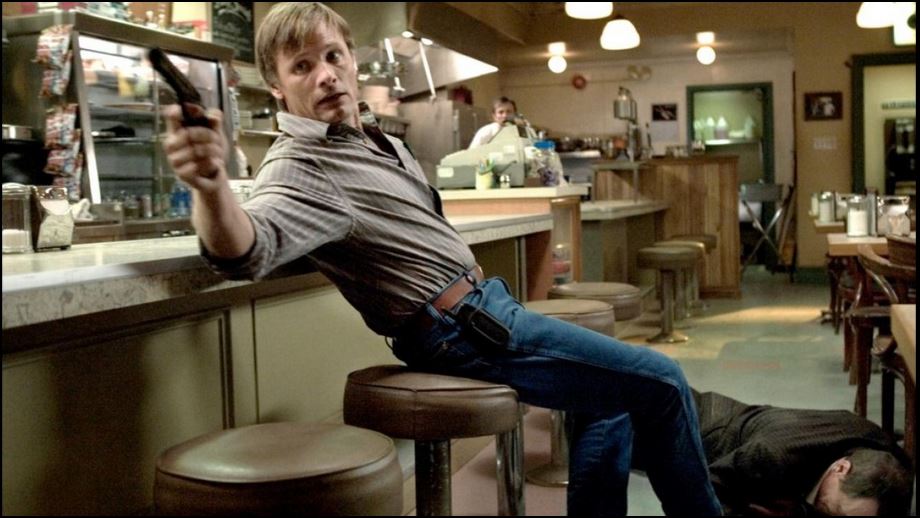
Tom Stall (Viggo Mortensen) is a regular Joe in a very small town in rural America. Running a small café, he lives a blissfully happy life of Americana with his wife Edie (Maria Bello), a lawyer, and their two children Jack (Ashton Holmes) and Sarah (Heidi Hayes). Their world changes forever though when Tom’s diner is held up late at night by two ruthless killers (Stephen McHattie and Billy Orser) and – with an instinctive ruthlessness – Tom ruthlessly dispatches the killers and saves the lives of his co-workers and patrons. His heroism makes him a local hero and brings plenty of excited press attention – but why does Tom seem so uncomfortable with this? Could it be linked to the swift arrival in the town of big-city criminal Carl Fogarty (Ed Harris) who claims Tom is none-other than Joey Cusack, psychopathic hoodlum from Philadelphia who gouged out Fogarty’s eye? Are Tom and Joey one and the same? And how will the doubts affect Tom’s family?

Cronenberg’s film brings brilliant tension to this question of identity, setting it in a very modern-feeling Frontier town, which has more than a sense of a classic John Ford western town, complete with disturbance from murderous figures from outside, shattering the peace. But the film adds that distinct Cronenberg touch by suggesting that, behind the quiet diners and picket fences, the real danger may already be at the heart of the town. Is Tom who he claims to be? Or is he a malignant dark force at the centre of the town (and his family) bringing destruction to everything? What other dark truths, you can’t help but think, might be hiding behind those shutters?

But then that’s what you get with violence. It taints and ruins everything it touches. Innocent lives are shattered. Families and loved ones are left mourning. But it also twists and shapes the personalities of its perpetrators. It marks them and changes them, washing out positive qualities and leaving those who use it the most drained, empty and uncaring. The film opens with a chilling long shot as McHattie and Orser check out of a motel. Cronenberg keeps the camera still and holds the camera still to study the casual body language and chilling lack of engagement of its killers (“Why the delay?” “I had a little trouble with the maid”). The scene continues for an agonising length, making us dread the reveal of what these clearly dangerous, amoral men have done in this motel – the reveal eventually shown with a clinical precision, which serves as an entrée to even greater horrors.

The final killing in the motel is the last time the film will shy away from the immediate horrors of violence. Even Tom’s heroic slaughter of the killers to save lives doesn’t shirk from showing us the impact on the bodies of the killers as Tom dispatches them – bodies torn apart by bullets, with McHattie’s killer left with most of his lower jaw destroyed beyond recognition. Later we’ll see the impact not only of bullets, but also the jerking death spasms of those who have had their noses smashed into their faces, necks snapped or bullets pass through their heads. Never is this glorified – and never are we allowed to simply categorise some killings as good or bad. No matter who it is, the human body will still suffer staggering trauma.

But violence’s impact isn’t only physical. As Tom’s increasing comfort with using his natural propensity for brutal killing (“Have you never asked, why is he so good at killing people?” Fogarty asks an Edie still in denial) grows, so violence takes over his family and starts to shape the actions and decisions of those around him. Arguments become more regular and more visceral. Tom’s gentle son brutally beats his bully at school. The loving father Tom suddenly slaps him across the face. Edie and Tom’s blissful life – we see them playfully making love on a date night – degenerates into conflict, distrust, flashes of violence and finally an angry, intense and passionate sex scene on the stairs that is an exact mirror image of their earlier love scene.

Edie is, for all her horror at Tom, partly excited by finding her husband has such a capacity for danger and brutality. That’s the dark attraction of violence in this film: it reveals secrets about ourselves. Tom seems to subtly shift within conversations from the gentle Tom into the chillingly distant Joey. Worst of all, the more that muscle is stretched the more Tom seems to take comfort and enjoyment in it. Taking what we want, with no regards for the consequences, is liberating and makes us feel strong. No wonder it’s so attractive. And no wonder violence has so shaped and defined humanity’s history. It tends to get people what they want and it can feel good. And it looks cool. Because despite the horrors of the impact of the violence, Cronenberg is also honest enough to admit that it’s exciting.

At the film’s centre is a superb performance of cryptic unknowability from Viggo Mortensen, in possibly his finest role. Mortensen uses micro expressions, small beats and body language that moves between casual and chillingly precise to show two personalities in one body. And Mortensen also demonstrates the struggle between these – between the man he wants to be and the man he might well be. He’s equally matched by Bello, wonderful as a woman who finds her whole life destroyed but can’t shake an unnerving attraction to this man of danger who has suddenly emerged.

The entire cast are pretty much faultless. Ed Harris gets a decent role of gruff menace, but the film is almost lifted in a final act cameo by William Hurt. Oscar nominated for (what amounts to) less than five minutes of screen time, Hurt is simply a force of nature as a Philadelphia crime boss kingpin, purring out his lines with all the fury of a caged lion, mixing a readiness for violence with a darkly comic menace. It relaunched Hurt’s career as a leading character actor – and arguably he should have nabbed the Oscar for it.

Cronenberg’s film engages with ideas of identity throughout. What defines us? The things we’ve done? The choices we’ve made? How many years need to pass before we can say that we’ve changed? What makes us better? And can we decide the sort of people we want to be? It’s impossible to say for sure. If your whole family life is founded on a lie, how do you know what about yourself is true or not? These are fascinating questions and the film offers no easy answers at all. Can Tom return to the life before a violent history shook everything up – perhaps he can, perhaps he can’t. But one thing’s for sure (and Cronenberg makes clear) it won’t be a simple overnight fix and a Hollywood ending. For all the hoodlums Tom dispatches, the real damage is on the workings of his family and the real casualty is the life his family thought they had. And those wounds don’t heal.