
Tag: David Hare

Plenty (1985)

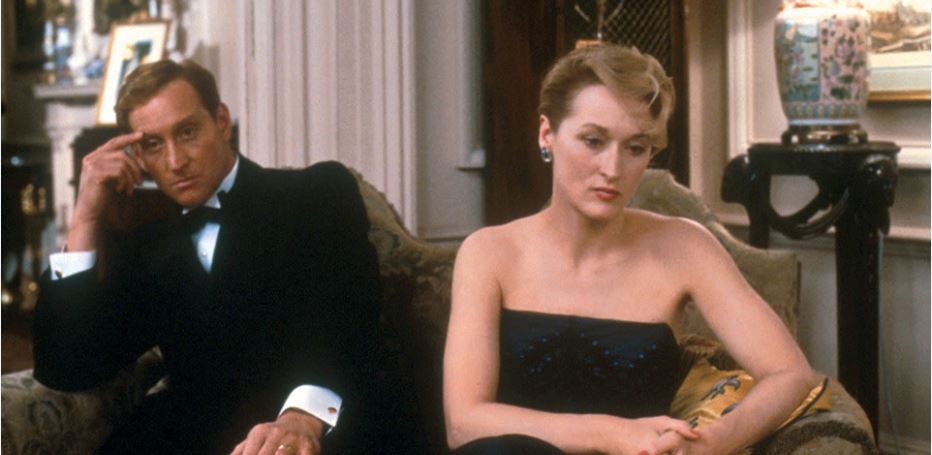
Charles Dance and Meryl Streep endure marital misery in the bleak, oblique and uninvolving David Hare drama Plenty

Director: Fred Schepisi

Cast: Meryl Streep (Susan Traherne), Charles Dance (Raymond Brock), Tracey Ullman (Alice Park), John Gielgud (Sir Leonard Darwin), Sting (Mick), Ian McKellen (Sir Andrew Charleson), Sam Neill (Lazar)

David Hare’s 1970s play Plenty looked at the impact of peace on the war generation. A “state of the nation” story on the growth of prosperity in the post-war era, and the return of many to the humdrum reality of life with Britain’s importance as a world power in rapid decline, led to isolation, anger and depression. It’s a shame that much of that really doesn’t come across in this buttoned-up, murky and unclear social drama, with a hard-to-follow plot and a hard-to-like central character.

Susan Traherne (Meryl Streep) is an SOE courier in France during the Second World War, who has a one-night stand with fellow SOE operative Lazar (Sam Neill) which has a profound effect on her. After the war, she marries Foreign Office civil servant Raymond Brock (Charles Dance), but is unable to find a purpose and contentment in regular civilian life. As the years tick by, and their surroundings grow ever more plentiful, Susan becomes more and more unhappy, difficult and demanding.

The central issue with Plenty (I can’t comment on the play, having never seen it) is that Meryl Streep creates possibly one of the least likeable leading performance you are going to see. Perhaps mistaking Britishness for cut-glass chill – or perhaps it’s the character – Streep’s Susan is brittle, bitter, angry, annoying and infuriating. She complains about everything around her, she lashes out at people, she sulks and whines with no self-insight, she constantly makes life difficult for those around her (most of whom are unbelievably patient) and she is almost impossible to work out. 

While the film perhaps intends her to be as sort-of PTSD sufferer, with undiagnosed personality disorders, who cannot reconcile the shallowness of her life with the excitement of war service, I’m not sure this comes across. All we really see is her deeply irritating self. We don’t get a sense of her war service – we see her breakdown early in the film in France – and her relationship with Lazar remains so ill-defined we are unclear what impact it had on her, other than part of a halcyon memory. The film’s final scene is a flashback to the end of the war: Susan watching a sunrise on a French hill dreaming of her life being full of days like this. That scene would have been helpful earlier – it’s the only time we see her optimistic or likeable in the film, and it gets lost by placing it at the end. With it in order we could have warmed to her more.

Instead she remains a shrill presence, in a hard to relate to film that never really makes clear whether we are meant to empathise with Susan, or find her as frustrating as some of the characters do. The film also fails to make this enigma part of its viewing design – I don’t feel like having the lines blurred made the film a richer experience, just one it was harder to engage in. Schepisi’s directing style is very cold and distant – from the slow camera moves, to the tight close ups on Susan at key moments, to the deliberate lack of clear time line (each scene moves on weeks, months or years from the previous one with only a few design and dialogue hints to suggest the change).

Combined with Hare’s indefinable script – crammed with elliptical conversations, unclear emotional and dramatic points, and political points delivered with a querying shrug – it makes for a film that is very hard work to engage with – and doesn’t offer much to reward the viewer if they do. 

What pleasures there are come from the performers. Charles Dance is good as Susan’s long-suffering husband – far from a domineering patriarch, his only real crime seems to be that he is a bit boring. Ian McKellen makes a great cameo as a senior civil servant, coolly and calmly telling Susan the errors of her thinking. Sting is an odd choice (I suspect his presence helped the film get backing) and Tracey Ullman does tend to go too far as Susan’s bohemian but more emotionally restrained friend.

John Gielgud steals the show. He is simply superb as Brock’s boss, an old-school diplomat who is, at first, a figure of fun with his Edwardian values but whom events (in particular Suez) reveal to have firm principles. Gielgud also gets most of the film’s best lines, while his quiet air of polite dignity is both endearing and admirable. His delivery of the following line to a tedious bore of a party guest basically is the high point of the movie: “But perhaps before I go, I may nevertheless set you right on a point of fact. Ingmar Bergman is not a bloody Norwegian, he is a bloody Swede.”

But there aren’t enough pleasures like this in this overbearing, rather trying film that never really decides what point it’s trying to make. I think it’s something about wealth and discontent and the more selfish and scrambling build of the post-war generation towards Thatcherism. But I’m really not sure. And to be honest I’m not sure I care.

Denial (2016)


Timothy Spall as Holocaust denier David Irving in this misfiring courtroom drama

Director: Mick Jackson

Cast: Rachel Weisz (Deborah Lipstadt), Tom Wilkinson (Richard Rampton), Timothy Spall (David Irving), Andrew Scott (Anthony Julius), Jack Lowden (James Libson), Caren Pistorius (Laura Tyler), Alex Jennings (Sir Charles Gray), Mark Gatiss (Professor Robert Jan van Pelt), Harriet Walter (Vera Reich), John Sessions (Professor Richard J. Evans)

In 2000, historian David Irving (here played by Timothy Spall) was exposed as a Holocaust denier who forged and distorted historical records to help his pro-Hitler agenda. This came after his unsuccessful attempt to sue American historian Deborah Lipstadt (Rachel Weisz) for accusing him of Holocaust denial in her book Denying the Holocaust. The decision led to the destruction of Irving’s reputation, career and financial wealth. This film tells the story of this case. Lipstadt’s legal team are played by Andrew Scott (solicitor Anthony Julius), and Tom Wilkinson (barrister Richard Rampton). The publicity-hungry Irving famously acted as his own lawyer.

Denial has a fascinating story at its core, but bungles it by getting the focus wrong. Now I’ll admit I might know more about this trial than the regular guy-on-the-street. But the drama here was in the detail of the debunking of Irving’s denier bullshit. The film benches most of this, reducing Irving’s career of historical re-adjustments into a few simple sound bites. The fascination of this trial was the dissection of denier myths – but the film aims for more conventionally “drama”, by introducing a series of “could Irving win?” moments that never ring true. Not only does this detract from the drama – it also, arguably, makes it easier for Holocaust deniers out there to claim the film doesn’t give the appallingIrving a fair crack of the whip.

It’s a shame, as when the focus is on the facts of the case, it’s very good. Tom Wilkinson is excellent as the maverick Rampton, whose abrasiveness hides his humanitarianism. The drama skirts over the trial’s cut and thrust, but when it does tackle these moments it’s very interesting. The sequence where Rampton pins Irving to the floor over theories that the gas chambers were de-lousing stations for dead bodies (“then why are there bolts on the outside of the doors?”) or air raid shelters (“are we to imagine the SS running 2.5 miles from their barracks to a shelter in an air raid?”) are compelling, and far more interesting than anything else in the film. Even the Cliff’s Notes version of Irving and his views in this film is enough to repulse any sane viewer, and watching him skewered on the witness stand is fascinating and satisfying. There just isn’t enough of it.

One of the film’s greatest problems is pushing Lipstadt front and centre. This seems logical on paper but, as her lawyer says, “this trial is happening to you, it’s not about you”. Lipstadt was deliberately not part of the trial strategy, to keep the focus on Irving. But the film can’t accepts her “story” was to do nothing. It keeps wanting to give her a ‘Hollywood moment’, but the facts can’t provide one – so we get lots of scenes of Lipstadt jogging, or feeding her dog, or watching news reports – time that could have been much better spent elsewhere.

Despite this, Weisz’s performance is very good –she bravely makes Lipstadt prickly and hard to like . Similarly, Andrew Scott is excellent as Julius, but his character is poorly explained (“He’s using you for the publicity” Lipstadt is told – we see no indication for this anywhere) and his decision to exclude Holocaust survivors from the witness list to prevent them being harangued by Irving is botchily explained, the film not wanting to admit that this was a wise decision.

I feel a lot of the film ended up on the cutting room floor. Short scenes pop up now and again around paralegal Laura making you feel she must have been a more important character at some point. I feel huge parts of courtroom reconstruction got trimmed. I suspect there was more around Harriet Walter’s Holocaust survivor. Even Irving feels heavily trimmed – Spall is very good (and subtly vile, but with a persuasive old school charm) as the faux-historian, but the film needs more of him, if only to explore his views more, rather than just treating him like a demon.

That sums the film up: it’s ham fisted. Too much dialogue thunkingly introduces historical events or legal procedures. The film talks about the importance of research, but relies on characters “cracking the case” with flashes of inspiration. It handles the research trip at Auschwitz sensitively (and daringly, shows Rampton taking an aggressive questioning stance of the guides to prepare for the case) – but then the film can’t help throwing in Lipstadt imagining victims clawing at the gas chamber door for escape. I hated the final shot, lingering on the disputed holes in the gas chamber roof used to drop in Xyklon-B, as if we needed this to be confident that, yes, the Holocaust did happen.

I really wanted to like Denial, but it’s no more than an adequate dramatisation of a fascinating court case. It’s brilliantly acted, in particular the four principles. There is an interesting film to be made here about the increasing struggle we have with the abuse of free speech to give equal importance to views that are offensive or just plain wrong. But Denial never really becomes that film – instead it turns its fascinating historical event into a run-of-the-mill Hollywood tale of a plucky heroine vanquishing the bad guy.