
Tag: David Hemmings

Juggernaut (1974)

Juggernaut (1974)

Disaster film masquerading as a sort of state-of-the-nation political satire of 70s Britain

Director: Richard Lester

Cast: Richard Harris (Lt Com Anthony Fallon), Omar Sharif (Captain Alex Brunel), David Hemmings (Charlie Braddock), Anthony Hopkins (Supt John McLeod), Shirley Knight (Barbara Bannister), Ian Holm (Nicholas Porter), Clifton James (Corrigan), Roy Kinnear (Social Director Curtain), Caroline Mortimer (Susan McLeod), Mark Burns (Hollingsworth), John Stride (Hughes), Freddie Jones (Sidney Buckland), Julian Glover (Commander Marder), Cyril Cusack (O’Neil), Michael Hordern (Baker)

Based on an event that almost happened – a bomb threat against the QE2 that led to a bomb disposal team parachuting onto the ship at sea, only to discover it was a haux – Juggernaut was a popular 70s thriller that today looks surprisingly dry. The ship here is the SS Britannic, caught in stormy seas. A calm man calls the firm’s director (Ian Holm) and to state he’s placed multiple high explosives onboard. Bomb disposal expert Anthony Fallon (Richard Harris) and his crew fly to the ship, captained by Alex Brunel (Omar Sharif), to try and disarm the bombs while Superintendent John McLeod (Anthony Hopkins) – whose family, naturally, is onboard – races against time to find the bomber.

Juggernaut can feel as sluggish as the cruise liner it’s set on, with large chunks feeling like they are being played for surprisingly low stakes. The passengers feel strangely impassive about their imminent deaths. When a member of the bomb disposal crew drowns on arrival no one seems to care. There is a strangely sombre mood everywhere, a general air of misery that seems in place long before the bombs are even announced. The police investigation is carried out by a team that thinks its hopeless and the captain retreats to his cabin to fiddle with executive desk toys.

Then you realise. This isn’t The Towering Inferno full of can-do action. This is a British disaster film, which is really about the depressing, dreary, dead-end feeling a lot of people in Britain had about their country (seemingly permanently in the grip of strikes, economic depression and political crisis) throughout the 70s. Juggernaut reflects this completely, the ship a weird state-of-the-nation place where even a bomb threat can’t shake the general feeling of grim acceptance that life doesn’t get any better than this, everyone and everything in charge is useless, so best get used to it.

Richard Lester appropriately then directs events in a very distanced way – perhaps he also wanted to put behind him his Hellzapoppin’ style that bought him fame and success with the Beatles. Most of the moments of action and tension are presented in a deliberately prosaic style (the culmination of the film happens in a distant long-shot with the final dialogue mumbled quietly) with a journalistic lens (there are obvious debts to Fred Zinnemann’s The Day of the Jackal in its forensic laying out of procedure, but with that film’s pace or urgency carefully compromised, despite the clock ticking down). As part of this, the characters become devoid of exactly that – character.

Juggernaut actually is more about taking rebellious swings at British politics than solving a crisis. The British government – embodied by a smugly self-satisfied John Stride’s three-piece-suit apparatchik – makes it quite clear the 1,200 souls on the Britannic are expendable if the cost compromises the government. Juggernaut has more discussion of government subsidies than every other disaster film alive. The navy is run by fusty rules-bound types (interestingly, the private enterprise company is presented much more favourably – Holm, as its representative, is principled, decent and the only guy who really cares about the passengers). The bomber is a disillusioned former government worker, shafted on retirement by the cheapskate MOD (he even asks for an embarrassingly small amount of money). Fallon, in his cynical style, constantly bemoans how nothing in the country works and how useless his bosses are.

Juggernaut flings together an American style disaster and action plot, with a kitchen-sink drama about British society. While its interesting, personally I feel mashing these two genres together creates a slow, dry action-adventure and a shallow, social commentary. The tone seems to have confused some of the actors: Omar Sharif seems literally all-at-sea. A potential romance with Shirley Knight’s character deliberately goes nowhere – the film so takes the unconventional route with plots likes this that you state to wonder why on earth Knight even agreed to do it). Anthony Hopkins permanently feels like his attention is elsewhere. The smaller roles tend to come out best: Stride’s uncaring official, Roshan Seth as waiter who pretends to speak less English than he does (a neat social commentary on cultural expectations in the 70s), Michael Hordern in a scuzzy cameo as a bomb expert – all of them make more impact.

Lester does treat himself to several amusing background events. A nameless passenger who doesn’t let the ship’s imminent explosion get in the way of his exercise regime (he runs into almost every single main character at some point). Throw-away gags (very much in the style of The Three Musketeers) are common, such as market stall owner turning to place something on his stall, not noticing it’s been sent flying by a speeding police car or a flustered Holm feeding Rice Krispies to his kid then his dog. You could make the surrealist argument the real hero is Roy Kinnear’s entertainment officer, relentlessly continuing the good cheer. From umpiring half-hearted badminton matches in a squall to jollying the passengers through a fancy dress party that could also be their last evening on earth, Officer Curtain is determined ‘civilisation must be preserved’. Is there a better vision of what it felt like living in 70s Britain, clinging to the fading memory of the Blitz spirit?

Richard Harris – in a neat and no-doubt-boozy pairing with David Hemmings – is the only one of the leads seemingly allowed to inject life in this, or able to marry up the counter-culture harrumphing and tense wire-cutting action in a performance of amusing cynicism and cocky pride. Juggernaut – for all it boils down to our maverick hero having to choose between the red and blue wire – is actually fairly detailed (and praised by experts) on the process and teamwork of bomb disposal, even if Harris’ less-than-steady hands are not what I would want standing between me and death.

Away from him though Juggernaut is a curiously unhurried, slow and sometimes-less-than-gripping thriller that really shines a light on the slightly run-down, depressed and bewildering place Britain was to many people in the 70s. A land it seems where everything felt a bit hopeless and pointless and nothing seemed to work – except the bombs used to blow the place up. Expect that and you’ll find stuff to enjoy: expect The Towering Inferno and you are in for a disappointment.
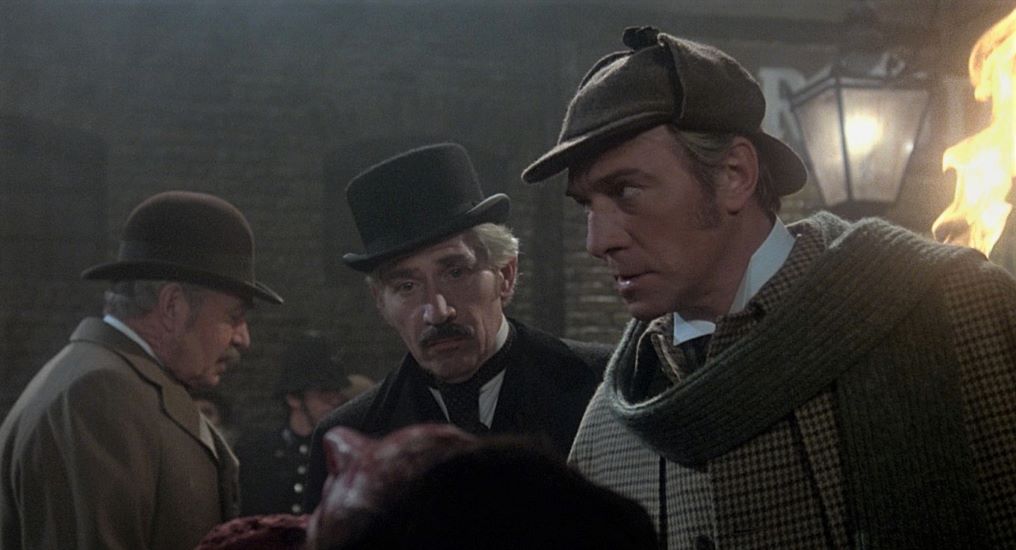
Murder by Decree (1979)

Murder by Decree (1979)

Sherlock Holmes investigates Jack the Ripper in this overlong but enjoyable Doyle pastiche

Director: Bob Clark

Cast: Christopher Plummer (Sherlock Holmes), James Mason (Dr John Watson), David Hemmings (Inspector Foxborough), Susan Clark (Mark Kelly), Frank Finlay (Inspector Lestrade), Anthony Quayle (Sir Charles Warren), Donald Sutherland (Robert Lees), Geneviève Bujold (Annie Crook), John Gielgud (Lord Salisbury)

In the world of Sherlock Holmes pastiches, it’s a popular sub-genre: Sherlock Holmes vs Jack the Ripper. How would Holmes have taken on the murderer who has baffled generations since those brutal Whitechapel killings in 1889? Murder by Decree explores the idea, mixing Conan Doyle with a deep dive into (at the time) the most popular theory in Ripperology, the Royal Killings (Murder by Decree indeed!).

It’s all pulled together into a decent, if over-long, film, shot with sepia-toned stolid earnestness by Bob Clark. With its fog-ridden Whitechapel sets (carefully built but always strangely empty), heavy-duty actors sporting large sideburns, wavy-screen flashbacks and carefully unimaginative framing, there is something very old-fashioned about Murder by Decree. That also extends to its Ripper theory, steeped in a very 70s class-conscious conspiracy. The film pads out its two-hour run time with many a POV shot of the Ripper prowling the streets, which bring to mind Jaws and slasher horror films of the time.

Where Murder by Decree does stand out is in its imaginative characterisation of Holmes and Watson. They are presented as affectionate friends – Mason’s older Watson has a sweet indulgent elder-brother feeling to him, giving Plummer’s sparkly Holmes plenty to tease and bounce off. They split the casework between them – Watson is an equal partner, even if Holmes does the brainwork – and use their strengths to complement each other (notably, Watson frequently distracts people so Holmes can interrogate a witness more closely). They genuinely feel like long-term friends (there is a delightful sequence where Holmes is so distracted by Watson’s attempt to fork a pea, that he squashes it onto the fork – to be met with a forlorn “you’ve squashed my pea” from Watson, who likes the peas intact so they “pop in my mouth”).

They are dropped into the middle of a very much of-its-time Ripper theory. Murder by Decree centres on the theory that the murders were ordered (the film reluctantly suggests tacitly) by the establishment to cover up the secret marriage of Prince Edward, Duke of Clarence to a Whitechapel woman, Annie Crook. This alleged marriage produced a baby, and a royal doctor, sheltered by a Masonic conspiracy, sets about eliminating everyone who knows the truth. Of course, it’s almost certainly bollocks – but with its mix of secret societies, Royals, a lost heir and the rest, it’s an attractive story.

It gains a lot from the performances of the two actors. James Mason flew in the face of then popular perception by presenting a quick-witted, assured Watson, more than capable of looking after himself (he bests a blackmailing pimp in a street fight and is very comfortable with guns – far more than the reticent Holmes). He’s still the classic gentlemen, who loves King and Country, but also shrewd, brave, loyal, able to win people’s trust and look at a situation with clear eyes.

With Christopher Plummer, Murder by Decree has one of the all-time great Sherlock Holmes. Plummer’s Holmes is refreshingly un-sombre, twinkly with a ready wit, who loves teasing Watson (cleaning his pipe with Watson’s hypodermic needles) and delights in his own cleverness. But Plummer takes Holmes to places no other film Holmes goes. The case as a devastating effect on him: he weeps at the fate of Annie Crook (consigned by conspirators to a slow death in an asylum) and furiously attacks her doctor. When the conspiracy is unmasked, he emotionally confronts the Prime Minister and berates himself for his failures. There is a depth and humanity to Plummer’s Holmes unseen in other versions, a living, breathing and surprisingly well-adjusted man, unafraid of emotion.

Sadly, the film takes a little too long to spool its conspiracy out. Rather too much time is given to an extended cameo by Donald Sutherland as a pale-faced psychic who may or may not have stumbled upon the killer. There are a lot of unfocused shots of that killer, all swollen black eyes and panting perversion. It relies a little too much on a Poirot-like speech from Holmes at the end explaining everything we’ve seen. But there are strong moments, best of all Geneviève Bujold’s emotional cameo as the near-catatonic Annie Crook, cradling in her arms a memory of her stolen child.

There are many decent touches. The film is open in its depiction of the filth and squalor of life in Whitechapel – a pub is an absolute dive, and the women pretty much all look haggard and strung out. It has a refreshingly sympathetic eye to the victims, with Holmes denouncing the attitudes of both Government and radicals (looking to make political hay from the killings) who see them as lives without intrinsic worth. Holmes places no blame or judgment on them, or the choices life has forced on them, which in a way puts him (and the film) quite in line with modern scholarship (even if there is the odd slasher-style shot of mangled corpses).

The main issue is the film never quite manages to come to life. It’s a little too uninspired, a bit too careful and solid where it could have been daring and challenging. There are good supporting roles: Finlay is a fine low-key Lestrade (at one point persistently raising his hand to ask his superior permission to speak) while Gielgud sells the imperious Lord Salisbury. There is enough here for you to wish the film just had a bit more of spark to lift it above its B-movie roots. But in Plummer and Mason it has a Holmes and Watson to treasure – and for that alone it’s worth your time.

Gladiator (2000)

Russell Crowe dominates in Ridley Scott’s Oscar-winning Gladiator

Director: Ridley Scott

Cast: Russell Crowe (Maximus Decimus Meridius), Joaquin Phoenix (Emperor Commodus), Connie Nielsen (Lucilla), Richard Harris (Emperor Marcus Aurelius), Oliver Reed (Proximo), Derek Jacobi (Senator Gracchus), Djimon Hounsou (Juba), Tomas Arana (General Quintus), Spencer Treat Clark (Lucius Verus), David Schofield (Senator Falco), John Shrapnel (Senator Gaius), Rolf Moller (Hagen), Tommy Flanagan (Cicero), David Hemmings (Cassius)

When Gladiator hit the big-screen the swords-and-sandals epic genre was dead. A relic of the early days of technicolour Hollywood, where the widest possible screens were designed to tempt audiences away from the television and into the movie theatre, Roman epics were often seen as stodgy things, usually carrying heavy-handed Christian themes while gleefully throwing as much of the decadence of the empire on the screen as possible. Gladiator changed all that, bringing an emotional and psychological complexity to the genre, as well as a rollicking good story and some brilliant film-making. An Oscar for Best Picture confirmed the genre was back.

In 180 AD General Maximus Decimus Meridius (Russell Crowe) commands the final battle of the Roman forces to conquer the German tribes and bring them under the control of the Emperor Marcus Aurelius (Richard Harris). The humble, dutiful and principled Maximus is a natural leader and the son Marcus Aurelius wishes he had, rather than the son he has the insecure and ambitious Commodus (Joaquin Phoenix). When the Emperor decides that Maximus not Commodus will succeed him – with the brief to restore the Roman republic – Commodus murders the Emperor. When Maximus refuses to give Commodus his loyalty, the new Emperor sentences him and his family to death. Maximus escapes, although he is badly injured, but arrives too late at his home to save his wife and son from death. Collapsing, the General is taken by slavers, healed by fellow slave Juba (Djimon Hounsou) and sold to the North African Gladiator school of Proximo (Oliver Reed). Maximus will play the Gladiator game – because he longs to have his revenge on Commodus.

Gladiator is superbly directed by Ridley Scott, who perfectly mixes the epic scale of the drama with the intimate, human story at its heart. The film looks absolutely fantastic from start to finish, with the superb visuals backed by a breathtakingly beautiful score by Hans Zimmer and Lisa Gerrard that skilfully uses refrains and themes to instantly identify the core emotions in the audiences mind. These themes are associated with emotional beats that immediately plug us into the interior thoughts and emotions of the characters. 

It works because of the emotional truth at its heart. Basically it’s a love story between a man and his dead wife, and isn’t afraid to explore the depths of love that we feel for those closest to us and our pain of their loss. Maximus’ wife and child are represented in silent flashbacks and by two small icons Maximus carries with him on campaign. When, late in the film, he is reunited with these items his raw, tearfully quiet joy carry as much force as any real reunion would do. What drives the film is less a drive for revenge – although there is no doubt this is a motivator for Maximus – but of a continued sense that he must fulfil all his duties (in this case restore the Republic as his surrogate father wished) before he can return to his wife and son (i.e. die).

It’s that which makes the film so easy to invest in emotionally, and which makes Maximus (a hardened killer) so easy to relate to. If he was just a raging man out for revenge, the film would carry a leaner harsher look. But he is instead a man motivated by love, who yearns to be with his family again. Mortality hangs over the entire film – the first shot of the film, famously of the hands in the wheat, have buried themselves in the consciousness because we can all relate to a man who longs to lay down his labours and be with the people he loves. Christianity doesn’t appear too much in Gladiator (unlike older Hollywood Roman epics) but faith is there in spades. And Maximus will do nothing that will jeopardise a reunion with his family in heaven.

This deeply involving story of a man who remains faithful to the memory of his wife – and Scott wisely removed any love plot with Lucilla, which would have felt like cheatingso strongly does the film build Maximus’ love for his wife – that audiences are happy to go with the film through all the violence that follows. Gladiator hit the sweetspot of having something for everyone, from emotion to action. And the action is brilliant. The opening battles is hugely impressive, from its scale to the imaginative interpretation of Roman tactics. It’s trumped by the more raw and ragged action that comes in the Gladiatorial ring, as Maximus transfers his brutal efficiency at war into the ring for the amusement of the crowd.

Like all Gladiator films and series the film successfully has its cake and eats it – so we get a sense of the horror of people fighting to the death for our entertainment, while also heartily enjoying watching our heroes kick ass. The sequence that uses this most effectively, as Proximo’s outmatched Gladiators follow Maximus’ strategic experience and military training to defeat a group of deadly chariot fighters, would-be a stand out in any movie.

The film further works due to the assured brilliance of the Oscar-winning Russell Crowe in the lead role. Crowe exudes natural authority as a general – he genuinely feels like the sort of man that first his soldiers and then his fellow Gladiators will follow to the bitter end. Crowe also dives deep into the soulful sadness at the heart of Maximus, the romantic longing and the searing pain of the betrayal and murder of his family. It’s a performance of immense, small-scale intimacy that also never once gets over-shadowed by the huge spectacle around him. I’m not sure many other actors could have pulled it off.

But the whole cast is extremely strong, Scott encouraging great work across the board. Joaquin Phoenix in particular takes the villain role to a bravely unusual place. His Commodus, far from a sneering Caligula, is in fact a weak, anxious, jealous even strangely pitiable man, so insecure and riven with envy for others that he becomes twisted by it. But we never lose a sense of the humanity at his heart, the sense of a little boy lost, scared by the world around him. It makes sense the Connie Nielsen’s Lucilla – walking a difficult line as a character who has to play both sides – could both fear and hate him but still love the fragile little brother she still senses in him.

Scott’s trusting of experienced pros – many you feel hungry for an opportunity like this – is clear throughout the whole cast. Richard Harris was pulled out of a career slump and reinvented here as an elder statesman, with a wry, playful and eventually moving performance as Marcus Aurelius. Scott’s biggest risk was pulling Oliver Reed from a life better known for drinking bouts to play Proximo. Playing his best role for almost thirty years, Reed reminded us all for one last time that as well as a chat-show joke he was also a powerful and dominant performer, his Proximo a snarling scene stealer. Reed’s death – his final scenes completed with special effects – made this a better tribute than he could have ever imagined.

There are few feet placed wrong in Gladiator. As an action spectacular it’s faultless, but this works because of the truth and love at its heart. It creates an epic that is emotionally involving as it is exciting to watch. The reconstruction of Rome is hugely impressive and Scott paces the film perfectly, letting its force grow along. You never once feel thrown by its scope, and so completely does it wrap you up that, as it becomes more operatic in the final act, the film is never at risk of losing you. It deserves to be remembered with the best of the Hollywood epics.