Tag: Debra Winger

An Officer and a Gentleman (1982)

An Officer and a Gentleman (1982)

Classic 80s romance? Or is it, in fact, a searing kitchen-sink drama about class and depression? One of the great mis-remembered films of all time

Director: Taylor Hackford

Cast: Richard Gere (Zach Mayo), Debra Winger (Paula Pokrifki), Louis Gossett Jnr (Gunnery Sergeant Emil Foley), David Keith (Sid Worley), Lisa Blount (Lynette Pomeroy), Robert Loggia (Byron Mayo), Lisa Elbacher (Casey Seeger), Tony Plana (Emiliano Santos Della Serra), Harold Sylvester (Lionel Perryman), David Caruso (Topper Daniels)
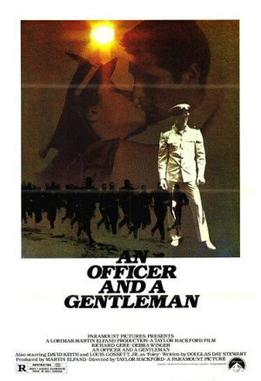
An Officer and Gentleman is remembered as a sweep-you-off-your-feet romance, with power-ballads underplaying attractive Hollywood stars passionately proclaiming their love. It ain’t anything like that. This proto-Top Gun – a film it has strong similarities to in structure and design – is actually a kitchen-sink drama masquerading as a feelgood movie, with a final romantic image and “Up Where We Belong” leaving a deceptive memory behind. Where Top Gun is loud, brash and fundamentally reassuring and straight-forward, An Officer and a Gentleman is jagged, surprisingly difficult and unsettling. Put it this way: Tom Cruise doesn’t call anyone the c-bomb in Top Gun.

Zach Mayo (one of Richard Gere’s legendary performances, the memory of which guided much of the rest of his career far more than its reality) is a Navy-brat determined to be nothing like his alcoholic, whoring dad (Robert Loggia). He’s going to graduate from Naval Flight Candidate school and become “an officer and a gentleman”. Zach is a damaged soul, defensive, closed-off and selfish, a smarmy, cruel loner interested only in what he can get out of any relationship. The film is about whether Zach will learn to become a sympathetic, caring person, rather than a resentful douche.

There are three influences that might just change him. Firstly, fellow trainee Sid (David Keith), from a Naval officer family, attending because his deceased brother can’t. The second is training officer and uncompromising disciplinarian Sgt Emil Foley (Louis Gossett Jnr). And, finally, factory worker Paula (Debra Winger), one of the local women officer candidates are warned are intent on bagging a husband by fair or foul. Each will play a different role in making Zach a fully rounded person.

Hackford’s film is a tough, hardened one that takes a long hard look at mental health, guilt, suicide, parental resentment and a host of other complex issues. Any romantic moment is matched with one of pain, fury or characters doubled over with guilt and shame. It dives deep into its flawed hero and shows how someone can, almost unwittingly, be reconstructed into something warmer. It does all this in grimy, scruffy settings with characters making desperate choices motivated by poverty and lack of choices.

It opens with a shaggy-haired, scruffy Gere starring into a mirror in a dark motel room while his father is passed out in bed with two prostitutes. We are constantly reminded of Zach’s working-class background, his life growing up trailing behind his (largely indifferent) father after the suicide of his mother, left to fend for himself in the rough and tumble of the Philippine streets. At naval school, the same chippy resentment of how people perceive his roots persists – along with the lessons he has spent his whole life learning: that he should count on no-one but himself.

Zach doesn’t believe he’s worth loving. Facing abandonment issues (of different kinds) from both his parents, he doesn’t give a toss about anyone and expects them to feel the same. He sets up a grift selling pre-polished buckles and boots to his fellow candidates, only helping them for a price. He completes exercises alone, cheats in aeronautical class, and gloats as he passes anyone on physical trials. When dating Paula, he frequently retreats into cold rudeness when conversation turns to anything emotional, and repeatedly claims he wants nothing more than a bit of fun. It all stems – as Paula realises – from a defensive hostility, pushing people away before they can leave him.

His lack of team-playing is identified early by Foley as his Achilles heel. Louis Gossett Jnr won an Oscar for his impressively nuanced work here. At first Foley seems an almost unbelievably horrible man, a bully dropping racist and homophobic slurs with casual ease, who makes it his mission to drive his candidates out of the programme (right down to bragging that he chisels a mark on his swivel stick whenever another one drops out).
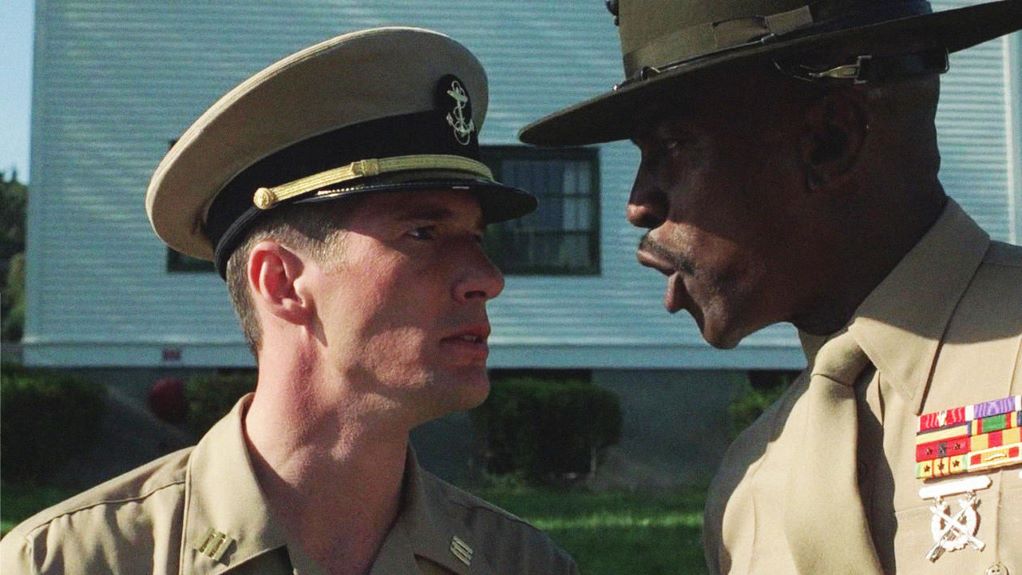
However, Hackford and Gossett Jnr skilfully show this is, to a degree, a show: Foley is tough because the military is tough, and deep down he does care. Candidates slowly earn his respect (female candidate Seeger may fail to climb a wall, but goddamn he respects her guts) and he quietly goes to great lengths to support them. Foley’s act is intended to get them to excel – and he’ll be proud of them when they do, just as they will be grateful to him. The strength of Gossett Jnr’s performance mean his scenes dominate the narrative (at the cost of the romance), but this is to the film’s benefit.

Interestingly, that romance is often the least effective part of the film. Gere and Winger have fine chemistry (despite, allegedly, not getting on) but the narrative often takes sudden time jumps. From one scene to another they’ll go from together to split up, and the film never quite manages to show us naturally how this is changing Zach. Instead, it frequently stops to tell us this, with on-the-nose conversations. Winger is good, but the relationship feels forced – as if it a film couldn’t exist without a romance, when actually Paula could be removed altogether and it wouldn’t really change the film.

It’s forced perhaps because what really feels like it changes Zach is the friendship with Sid. Played very well by a sensitive David Keith, Sid is everything Zach is not. Confident, happy to help others, a natural leader and team player. Under the surface he isn’t – doubtful and insecure – but the friendship between them is the spark that changes Zach. Sid is, much like Goose in Top Gun, the sacrificial pal, but this sacrifice promotes real growth in Zach. The parallel romance between Sid and gold-digger Lynette (a fine Lisa Blount) is also an effective commentary on Zach and Paula, both characters being mirror images of the leads.

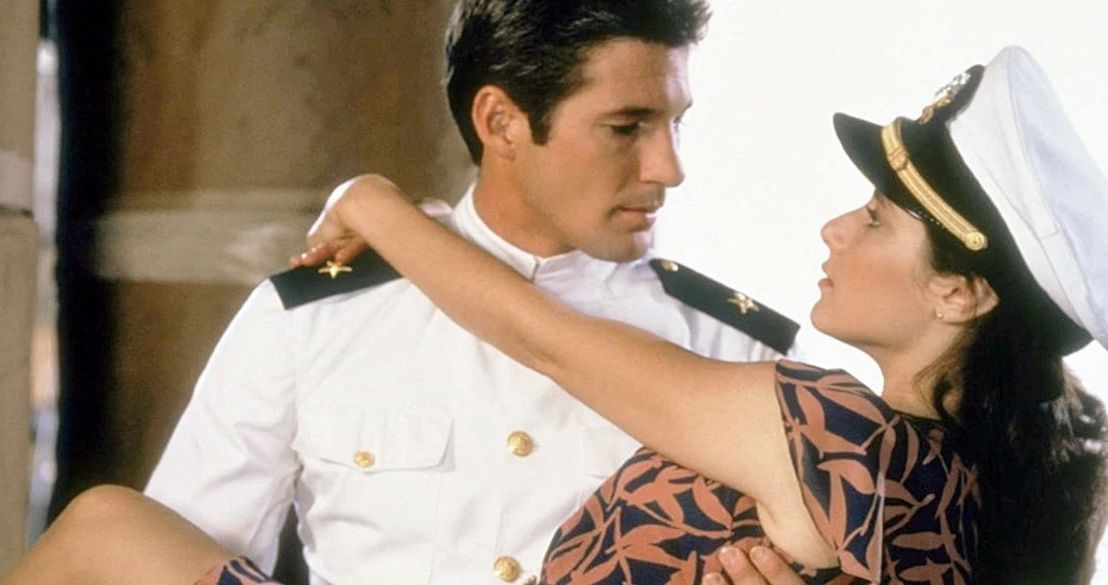
The film culminates in that romantic sweep-you-off-your-feet moment in the factory: but that feels like it belongs in a different film than the hard-boiled one we’ve been watching of a man confronting his fear of failure and lack of self-worth. Gere, by the way, is very good as Zach – his smirk a defensive screen for a host of psychological problems (few actors would have been willing to be as unlikeable as Gere is here). An Officer and a Gentleman is really a character study in working-class resentments, but somehow is mis-remembered as the quintessential 80s romance. It truly isn’t. Instead Hackford’s film – flawed as it is – is smarter and pricklier than that.
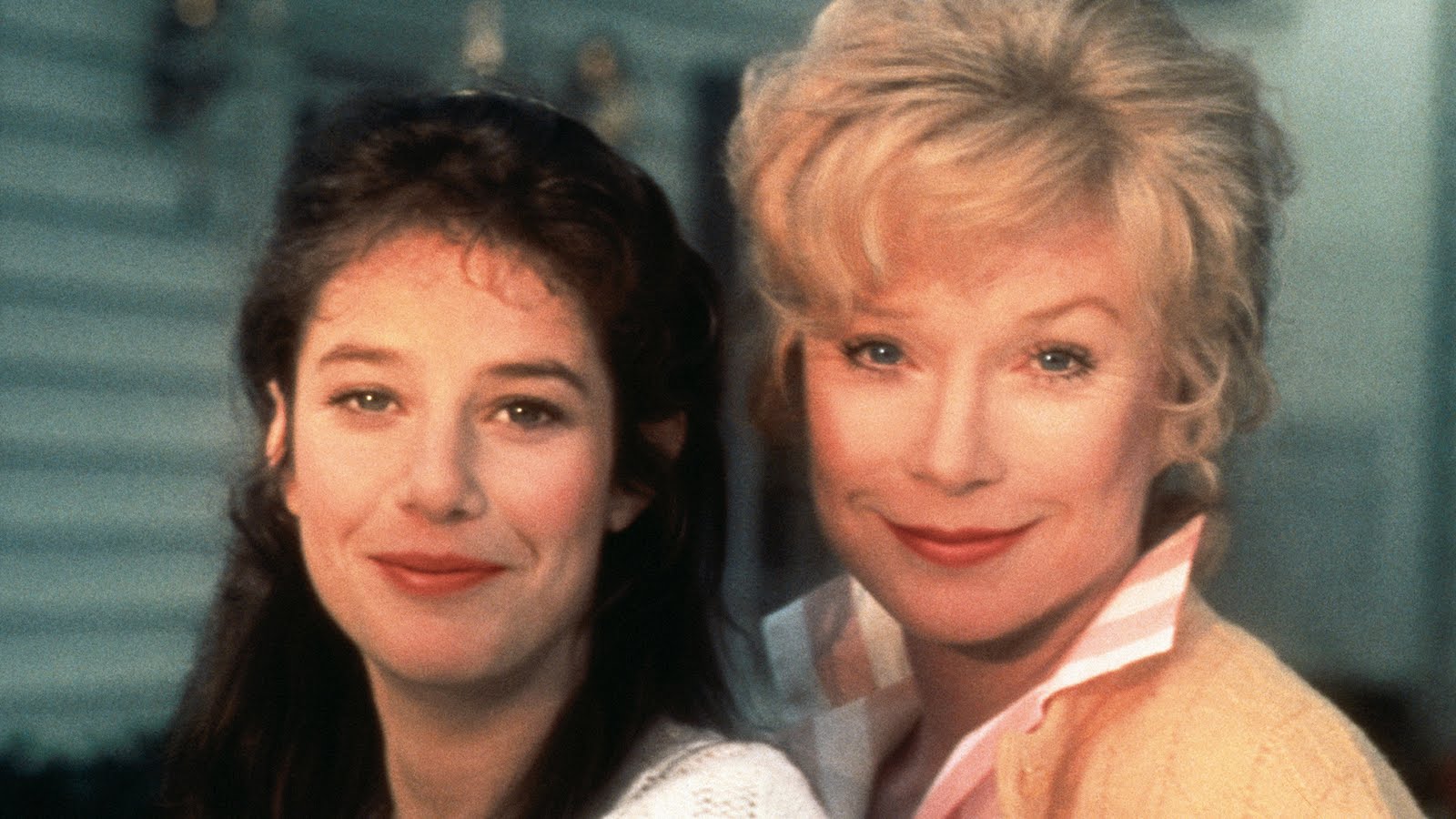
Terms of Endearment (1983)

Debra Winger and Shirley MacLaine are tempestuous but loving mother and daughter in Terms of Endearment

Director: James L Brooks

Cast: Shirley MacLaine (Aurora Greenway), Debra Winger (Emma Greenway-Horton), Jack Nicholson (Garrett Breedlove), Jeff Daniels (Flap Horton), John Lithgow (Sam Burns), Lisa Hart Carroll (Patsy Clark), Danny De Vito (Vernon Dalhart)

Spoilers: If you can spoil one of the most famous tear-jerkers of all time.

I think its fair to say 1983 was a weak year at the Oscars. The finest film of the year, Ingmar Bergman’s Fanny and Alexander, was a four-hour Swedish saga (and arguably a TV series anyway), wasn’t nominated. The most lasting films of the year, Flashdance, ScarfaceWar Games and Return of the Jedi, were never Oscar bait. Terms of Endearment motored through to hoover up five Oscars – beating out The Big Chill (cut from a similar soapy cloth), The Dresser (a British stage adaptation), The Right Stuff (a slightly cold Mercury programme saga box office flop) and Tender Mercies (a low-key character drama about a Country-and-Western singer that won Robert Duvall an Oscar). By any measure that’s not a list for the ages.

And Terms of Endearment had the added bonus of being the second biggest hit of the year, after Jedi (yes, I know!). It’s a surprise, as this sort of female led drama rarely scoops the big prize – so at least it makes a pleasant change. Terms spools out a collage of scenes (there are sometimes time jumps of years between scenes), chronicling the lives of over-protective, domineering mother-and-free-spirit Aurora (Shirley MacLaine) and her daughter, defiant, at times highly-strung, Emma (Debra Winger). The two have a difficult, though loving relationship, often depending on each other for emotional support – especially in their relationships: Emma’s with feckless philandering English Professor ‘Flap’ Horton (Jeff Daniels) and Aurora’s with playboy retired astronaut Garrett Breedlove (Jack Nicholson). But both come together when tragedy and illness strike.

Watching Terms of Endearment today, it’s often hard to see what the fuss was about. Although it wasn’t the first film to jerk tears via last-act illness (see Love Story), this started a wave of films where illness to a key member of the family (usually a mother) has a devastating, tear-jerking (but often eventually heart-warming) effect on the rest of the family (especially young children). Terms of Endearmentprobably does this better than those that followed, but watching it today its hard not to see it as something a little more familiar than it might have felt at the time.

Brooks’ background was in TV (he had several successful shows on his resume, from The Mary Taylor Moore Show to Taxi – so he certainly knew what the masses liked) and this, his first film, often feels like a cut-down mini-series. It matches exactly the sort of soapy, family saga of several TV epics of the time, and Brooks shoots the film with an unfussy, visually flat series of TV angles (aside from his skill with actors, his directing Oscar is a travesty). With each scene effectively standing alone – its collage effect means the film covers at least 14 years minimum with often only the age of the children any indication that time has passed – it also has a slightly bitty air of something assembled for cutting into episodes or advert breaks.

Not that there is anything particularly wrong with this. But, it does mean the film feels like it meanders along through a series of small crises, designed to be easily digestible. The film has a whimsical lack of directness – not helped by its overbearing (and dated) musical score. It relies strongly on sparky dialogue delivered by a cast who all look like they are having a good time (although, allegedly, they really weren’t with Winger and MacLaine in particular barely on speaking terms when the cameras weren’t rolling).

The main dramas are romantic. Aurora doesn’t quite know how to respond to her feelings for gnarled playboy Garrett. An early date between them hilariously contrasts her ludicrously over-formal clothes and his scruffy indifference. Its a difficult dance between two people who, for various reasons, are scared of commitment. But then Emma has made her own mistakes. She’s married Flip (is there a worse name in cinema?) for independence, but really they have nothing in common – and Flip’s eye quickly goes roving. Emma responds in a way her mother would understand: a potentially ‘first strike’ affair with John Lithgow’s meek bank manager (Lithgow and Winger have a wonderful scene at a diner, where he is almost too scared to touch her hand). You can see both mother and daughter teeing themselves up to make the same mistakes: the generations never learn from each other.

At the heart of the film is the mother-daughter relationship. But for me, this often lacks focus and never really coalesces into something that feels real or emotionally coherent. Now you could say that’s like life – and that’s a fair point – but several of the events feel heightened (particularly those featuring Aurora) and the characters are mutually dependent when the story demands it, and barely in touch when the opposite is needed. It’s easy to feel some connecting thread is being lost in those massive time-jumps. I found it hard to escape the feeling several times that people behave like this in the movies but never in real life.

But then, you get the final thirty minutes which revolves around the cancer diagnosis and eventual death of Debra Winger’s character. Here is where Brook’s flat, unobtrusive style comes into its own, his simple, restrained staging of these scenes making them surprisingly moving and affecting – especially considering the artificiality of some of what we’ve seen so far. For the first time, emotion, truth and earnestness – without too much blatant heart-string tugging – comes into play, and these simple scenes of two mothers saying goodbye to their children and each other end up having real emotional impact – as do the slightly stunned scenes of grief of those left behind.

It’s a shame then that most of the rest of the film before that doesn’t quite connect with me. The film was festooned with Oscars, but naturally the person most responsible for it working – Debra Winger – missed out. Winger is superb here, the only character who feels genuinely true, tender and also flawed in natural ways. She is slightly impulsive but also frightened of change, a character who can shout and rage but also is weak and dependent on emotional bonds. She’s totally believable and I would have loved to see more on her troubled relationships with her kids, and how her eccentric mother has impacted her ability to form bonds with her kids. The film doesn’t go there.

The Oscar went through to Shirley MacLaine who gives a big, showy performance as Aurora – and nabs the “Oscar Clip” moment as she bellows at nurses to give her daughter her medication. MacLaine’s Aurora never for one moment feels like a real person, but instead a novelistic invention of an eccentric mother, thrown on screen. MacLaine plays her to the hilt, but it’s a performance that feels mannered. But she gets the film’s fun moments – and gets to spark off Jack Nicholson who coasted to another Oscar as the sort of horny scoundrel he would play again and again for the much of the next thirty years on screen.

Terms of Endearment has enough in it that, if you like this sort of thing, you’ll love it. Perhaps it does mean more to mothers-and-daughters. I found it at times overly twee and laboured. But I can forgive it a fair bit for how effectively it displays grief – and how brilliant Debra Winger is in it. Over honoured? Sure. But, for its genre, a high point.

Shadowlands (1993)

Debra Winger and Anthony Hopkins sublime in the moving Shadowlands

Director: Richard Attenborough

Cast: Anthony Hopkins (CS “Jack” Lewis), Debra Winger (Joy Davidman), Edward Hardwicke (Warnie Lewis), Joseph Mazzello (Douglas Gresham), John Woods (Dr Christopher Riley), Michael Denison (Harry Harrington), James Frain (Peter Whistler), Julian Fellowes (Desmond Arding), Peter Firth (Dr Craig), Roger Ashton-Griffiths (Dr Eddie Monk)

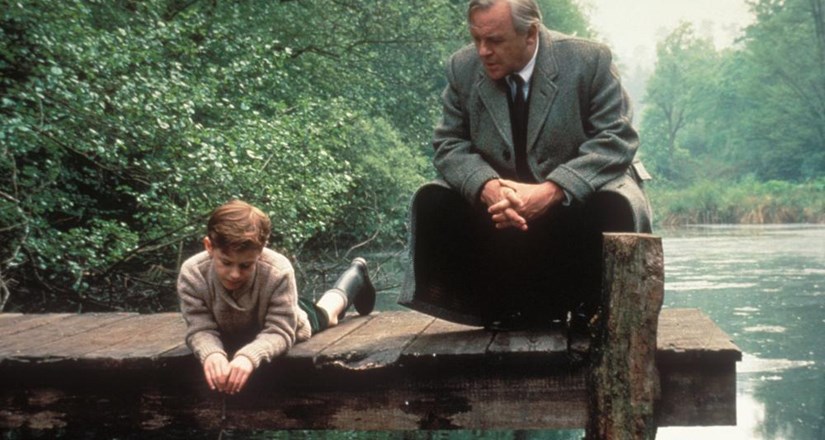
“We can’t have the happiness of yesterday without the pain of today. That’s the deal”. It’s a sentiment that runs through Shadowlands, a beautifully made, deeply heartfelt, incredibly moving tear-jerker based on the (largely) true story of how the man who invented Narnia, CS Lewis (Anthony Hopkins), fell in love very late in life with an American poet Joy Davidman (Debra Winger) only for her to succumb to cancer early in their marriage.

The story had a been a life-long investment from William Nicholson, who had developed the story first into a radio play, a TV drama (with Joss Ackland and a BAFTA winning Claire Bloom) and then a stage play (which won Nigel Hawthorne several awards in the lead role, including a Tony Award) and finally into this film. A wonderfully tender, profound and genuine exploration of the not only grief but the joy and delight that opening yourself up to love can bring you, Nicholson’s Oscar nominated script was brought to the screen by Richard Attenborough.

Looking back over Attenborough’s CV you immediately notice the vast majority of films he directed were massive, all-star, huge scope epics – A Bridge Too Far, Gandhi – which were as much triumphs of logistics and studio managements as they were displays of directing. Shadowlands is one of the smallest scale, most personal films he ever made – and it’s enough to make you wish that Attenborough had allowed himself to make more intimate chamber pieces like this. It’s a wonderful reminder, not only of how skilled he is at pacing and story-telling, but also what a sublime actor’s director he is. Dealing with material that in lesser hands could have become sentimental, Attenborough turns out a film that is realistic, tender, sad but also laced throughout with a warmth and (figurative and literal) Joy.

And of course the involvement of Attenborough also meant the involvement of his regular collaborator Anthony Hopkins. At the start of the 90s Hopkins was in such a run of form he could plausibly claim to be the best actor in the world. In all of this though, Shadowlands might be one of his finest accomplishments. Superbly detailed, perfectly restrained, gentle, tender, hugely vulnerable and intensily scared (under it all) of connecting with the wider world or allowing himself to feel genuine emotions, Hopkins’ CS Lewis is simply exceptional. With all the discipline of a great actor he never once goes for the easy option, but gently allows emotions to play behind his eyes (the eyes by the way that he can hardly bring himself to settle on other people until half way through the film). And those moments where he weeps – three times in the film, and each increasingly more emotional – are simply beautiful in every way from acting to filming.

Lewis is bashful and repressed, so it’s all the moving to see his face start to relax into excitement and joy when he spots Joy in the audience at a lecture he is giving, or him simply enjoying the intelligence and challenge that she brings to her conversation with him. Debra Winger as Joy Davidman matches Hopkins step-for-step, in a sublime performance of prickily New York attitudes at first out of touch in Oxford, but whose humanity shines through. It takes her time perhaps to feel the love Lewis does (but can’t admit too), but when she does start to feel more for Lewis, she has no patience for his repressed unwillingness to acknowledge them. On top of which, Winger is very funny in the role – she has little truck with the sheltered, clubbish snobbiness of some of Lewis’ friends and takes a wicked delight in shocking the stuffy, unchallenged intellectuals.

The chemistry between these two actors is sublime, and the slightly autumnal relationship between the two of them that builds feels wonderfully genuine. Nicholson’s script makes an astute examination of Lewis’ personality and Christianity. Throughout the film, we are brought back again and again to a lecture Lewis gives – with increasingly less and less disconnection – on why God allows suffering and pain in the world. Pleasingly Lewis’ faith in the film isn’t challenged – only his rather pleased-with-itself lack of doubt and his complacent lack of experience. Experiencing love and loss himself, makes him question the views he has held – and leads him to develop a richer, more genuine understanding of the world.

Which all makes the film sound very heavy, and it’s not. It’s a delightfully light done story that never once leans too hard on the tragedy. Instead it punctures several moments with touches of humour (much of it from Joy’s American clashes with high-table Britishness) and moments of sweet affection. The film gains a lot of balance from Edward Hardwicke’s delightful performance as Lewis’ Dr Watson-ish brother Warnie, a bluff ex-army officer turned academic who reveals himself over the course of a film to have a great deal of hidden love, affection and empathy. It also has a delightful performance from Joseph Mazzello as Douglas Gresham, a child performance that brilliantly avoids all cloying sweetness and feels very real as a shy, nervous boy dealing with his mother dying.

But then, Lewis is also a shy nervous boy (both he and Warnie never really got over the death of their mother as boys – a moment that both wordlessly acknowledge while observing Joy with her son at the hospital), and the film follows him becoming something more than that, a man wh has loved and lost and can deal with it. A neat subplot around James Frain’s difficult working-class student demonstrates his growing ability to relate and empathise with others. A large chunk of the film builds towards Lewis’ tearful outpouring of grief (a scene impossible to watch dry eyed), a reaction that seemed impossible in the opening moments.

But then that’s what the film is saying: We have to accept that the joy of loving people, the wonder and warmth that they bring to our life, will inevitably one day lead to us losing them. Allowing us to experience love and joy is counter balanced by the pain we will feel when they go. It’s a deal – and if it is a deal, it’s the price we pay for having our life enriched. Attenborough’s simply beautiful, romantic film covers all this gently and brilliantly: it’s a film to treasure and hold tight.