
Tag: Delphine Seyrig

Last Year at Marienbad (1961)

Last Year at Marienbad (1961)

Ultimate arthouse film, designed to reward constant analysis and interpretation with no answers

Director: Alain Resnais

Cast: Giorgio Albertazzi (X), Delphine Seyrig (A), Sacha Pitoëff (M)
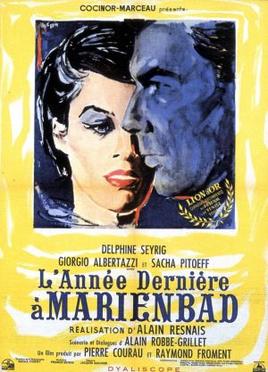
If there is one film that could practically stand as a dictionary definition of art-house cinema, it might be Last Year at Marienbad. A striking collaboration between director Alain Resnais and novelist Alain Robbe-Grillet, is puts the vague in Nouvelle Vague (French New Wave to you and me). Last Year at Marienbad is a film almost unlike any other, a work of art that lays itself out in front of you and asks you to bring your own viewpoint to bear to decide what (if anything) it’s actually about. You could call it a riddle wrapped in a mystery inside an enigma (to borrow a phrase from Churchill – and lord knows what he would have made of it).

Last Year at Marienbad is set in a sprawling, Versailles-like palace (which might be a hotel), where grand, art-laden corridors go on forever, every room drips with fine details the grounds are mini-countries and opulent, geometric designs fill ever corner of the building. Within this, a parade of people dressed in evening finery move like impassive robots, uttering flat banalities and either moving slowly between rooms or standing impassively like statues. Among these strange, ghost-like figures a man (Giorgio Albertazzi) waylays a woman (Delphine Seyrig) and tells her a year earlier they met somewhere else (possibly Marienbad, but could have been Frederiksbad, Karlstadt or Baden), fell in love and planned to elope a year later. She doesn’t remember him at all. He spends the film trying to persuade her. Another man (Sacha Pitoëff), who might be her husband, engages the first in a mathematical card game (nim) which he defeats him at constantly.

If that sounds sparse, it’s because a plot description barely functions for a film so wilfully oblique it’s about whatever you decide it’s about. Resnais and Robbe-Grillet’s purpose perhaps can be seen when our two could-be lovers discuss a classical statue. (In a neat touch, the statue itself was specially carved for the film). Their conversation revolves around different interpretations of what these Roman (or Greek) figures are doing: is the man protecting the woman from walking into danger? Is the woman protecting the man? Are they in love? Are they arguing? Why is there a dog sitting at her feet, looking away? This conversation is framed through a series of lingering shots from multiple angles, that invite us to bore our eyes into the statue and decide for ourselves.

And that’s basically the film in microcosm. It’s a series of beautifully haunting images and scenes, shot by a gliding camera and accompanied by Francis Seyrig’s hypnotic score, that invites the views to stare at this film like they would a painting in a gallery and spot as many (or as few) tiny details as they like and see if it changes their view of the artist’s overall intention. Last Year at Marienbad, in effect, nearly defies any sort of logical criticism. What you take out of depends entirely on what you put in. Which is to say, it’s as perfectly legitimate to say it’s a pile of pretentious, piss-taking piffle as it is to call it a gorgeous, transcendent piece of art that leaves you thinking for days.

Everything is designed to leave things open to question, with the normal rules of logic and cinematic structure routinely discarded. Characters will be in frame at the start of the shot and then, as the camera drifts away from them, suddenly appear in another (impossible) location – for example one shot starts with X at a card table, then drifts across the room to the doorway to see him enter.

The people move like functional props, or bored actors trotting through their marks. There is barely a facial expression or jot of intonation in anyone. They stand mutely to attention, or shift through a senseless parade of conversations, waltzes and card games. There is a ghostly, dream-like, never-world quality to the entire hotel (it’s influence on The Shining – from Resnais’ controlled, Steadicam style shots, to the haunting sense that mankind has no agency or influence in the building – is really clear). It’s as cold as a block of marble, and the people often feel like statues that have walked off their pedestals into the world.

Locations are inconsistent and change all the time: Resnais shot the film in multiple palaces and stitched the locations together, hiding cuts with carefully placed objects (in one instance A walks down a corridor seemingly in one shot, but Seyrig is actually walking through about three totally different locations). The pattern, design and contents of rooms change (A’s bedroom shifts through myriad designs and layout, most noticeable in its constant swopping between either a mirror or a painting above the mantelpiece). An exterior balcony next to that statue subtly changes location as well (and even appears as a detailed landscape painting).
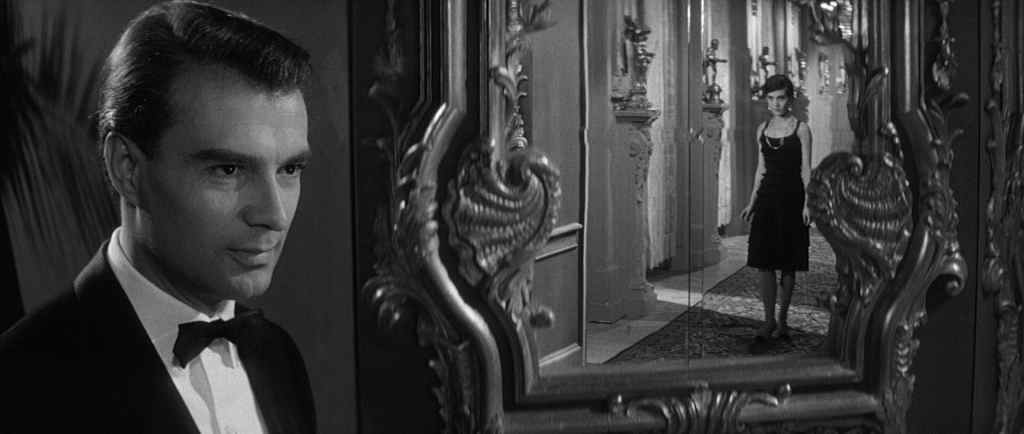
Everything shifts, twists and contorts all the time as if the film reforms depending on the angle you are looking at it from. The hotel could be a purgatory or a dream. It could be a half-formed memory. X could be an Orpheus striving to save his Eurydice. Or a self-aware film character. Or a trapped dead soul. A could be an amnesiac, a fantasy figure, a ghost, a part of X’s psyche. M could be her husband, X’s alter-ego, death or a complete stranger. Every single interpretation is legitimate and you could pull out different moments to support any one of them.

Myself, I saw it as like a dive into X’s memories. Everything about the shifting scenery, strange dis-jointed logic of the film moving seemingly at random between past and present, the repetitions and reframings of the same conversations, seemed like a man sifting his memories. X even stops and argues against certain scenes (‘It didn’t happen like that.’) There are hints of a dark trauma: repeated shots of A cowering in her room, brief moments of shock, tears and her pulling away from X. We see multiple hints of A’s death, including a possible shooting by M. I started to think this was X reframing his memories to absolve himself: that after rejection by A, he assaulted her in some way, she committed suicide (the opening play the characters are watching is Romers based on Ibsen’s play about a man haunted by the suicide of his wife). X is now forcing his memory to adjust this into a tragedy where he was the victim – and as part of that must persuade A she loved him.

But that’s just my view. You could just as well say X is so bored watching Romers, he makes up a whole fantasy based on it to keep himself entertained (inevitably, the set of the play changes completely whenever we see it). I do think it interesting most 60s criticism took X completely at his word as a victim, while more recent criticism has often cast X as an unreliable narrator (if that term has any meaning here). What matters more is whether you are intrigued enough to find dwelling on what this all means (the way we dwell over a Picasso) worth your time. For me it unquestionably is.
The Discreet Charm of the Bourgeoisie (1972)

The Discreet Charm of the Bourgeoisie (1972)

Dinner dates never happen in Buñuel’s playfully witty, absurdist satire

Director: Luis Buñuel

Cast: Fernando Rey (Rafael Acosta), Paul Frankeur (François Thévenot), Delphine Seyrig (Simone Thévenot), Bulle Ogier (Florence Thévenot), Stéphane Audran (Alice Sénéchal), Jean-Pierre Cassel (Henri Sénéchal), Julien Bertheau (Monsignor Dufour), Milena Vukotic (Inès), Claude Piéplu (The Colonel), Maria Gabriella Maione (Terrorist), Muni (Peasant), Michel Piccoli (Interior Minister), Pierre Maguelon (Brigadier Sanglant), François Maistre (Commissaire Delecluze)

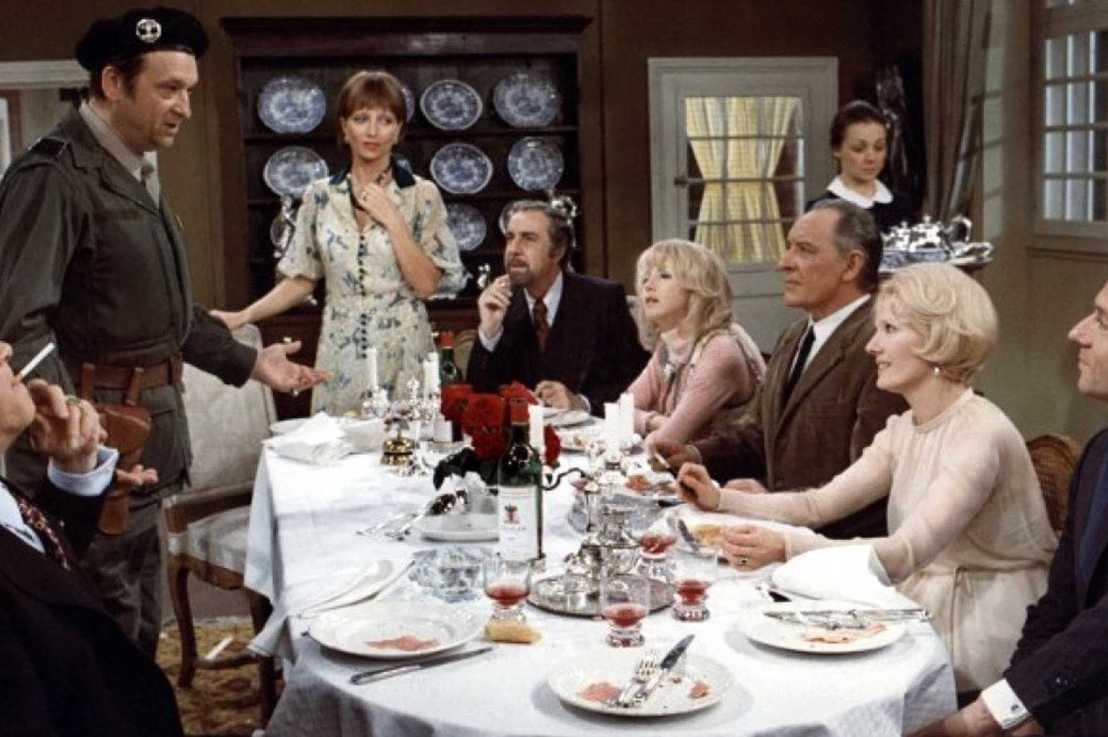
Six very bourgeoisie Parisian friends try to have dinner; but circumstances keep getting in the way. Circumstances that become increasingly bizarre, surreal and absurdist and half of which may or may not be dreams (or even dreams within dreams). This is the jumping off point for Buñuel’s engagingly light and witty, but also profound, intriguing and defying interpretation. The Discreet Charms of the Bourgeoisie. In the hands of a dogmatic artist, it would be heavy-handed trash: in Buñuel’s it maintains a playfulness making it entertainingly (if at times infuriatingly) mystifyingly unreadable.

Those six friends are a shallow, self-obsessed bunch who talk the snobby talk of class and culture, but their knowledge is skin-deep and their lifestyle funded by cocaine smuggling. That cocaine is trafficked into Paris in the diplomatic bag of Ambassador Rafel Acosta (Fernando Rey), representative of the (fictional) Latin American Republic of Miranda. It’s sold by his friends, François Thévenot (Paul Frankeur) and Henri Sénéchal (Jean-Pierre Cassel), and its these three – along with their wives Alice Sénéchal (Stéphane Audran) and Simeone Thévenot (Delphine Seyrig) and Simone’s sister Florence (Bulle Ogier) – who keep trying to have dinner.

Those dinners are constantly interrupted by a series of increasingly outlandish events, that the guests accept with the sort of blasé insouciance this sort of people pride themselves on. Things escalate on successive nights from Henri forgetting he has invited their guests to dinner, to a dead landlord of a country inn, the Sénéchals slipping out to the garden to have sex, a Bishop (Julien Bertheau) who longs to be a gardener, a café that runs out of tea and coffee, an army division on military manoeuvres, their arrest by the police… That’s not mentioning the onslaught of dreams as the characters imagine yet more meals interrupted by murder, terrorism and even their dining room turning into a stage in front of an audience where they don’t know their lines.

If that sounds pretentious… I suppose that’s fair. But the point is that Buñuel never hectors or overplays his hand. Instead, the film is an absurdist light comedy, a whimsical road-to-nowhere (like the country road we frequently see the six characters walking down in cutaways) that, in its structure, aims to expose the shallowness and hypocrisy of an entire class. Our ‘heroes’ are overwhelmingly concerned, time and again, with their own basest needs – mostly food and sex – and are more than happen to call in a chauffeur so they can mock him for not knowing how to drink a cocktail correctly (doesn’t stop him enjoying the cocktail way more than any of them do). They encapsulate a whole class, concerned only with tucking in and making sure everyone can see they are unshaken by events, no matter how outlandish they seem.

Into this mix, Buñuel throws an astonishing and inventive selection of dreams that increasingly dominate the second half of the film. (And in fact, makes you wonder after a while whether everything we’ve seen in the film is some sort of crazy, unlikely fever dream). Buñuel used to joke he slipped in dreams when he needed to expand a films runtime, but it’s wonderful here how often the dreams comment subtly on the characters and their perceptions of each other: and how little they seem to learn or be aware of the implications of this.

The most surreal dream of all is Henri’s fantasy of entering a house – a house with walls painted with false perspective images of other rooms – where the group encounter rubber food and then a curtain sweeps aside to find an expectant audience watching them. Despite the prompts for their lines, the characters flee in sweaty nervous panic. Do they realise the meaning of this exposure of their sense of unbelonging? You can be sure they don’t.

In fact, in a stroke of daring by Buñuel, they are so remote from understanding this that Henri is in fact having a dream inside François’ dream: as if François can only vicariously confront his fear of unbelonging by dreaming about another man dreaming about it. That worry of mockery and isolation in society is then continued in François’ dream, as he dreams of Henri waking from a dream and arriving at a party at a Colonel’s house where the mockery and ignorance of Rafael’s home country becomes so overbearing, Rafael shoots the Colonel dead. As if, again, François can only imagine being pushed to extremes vicariously.

Perhaps he’s simply jealous of Rafael, who is blatantly conducting an affair with his wife. Rafael’s a man of class, obsessed with greed and lust. He’s also a sneaky coward and a creepy opportunist, not above trying to seduce a female terrorist who tries to kill him (and then having her shipped off by his security when she turns him down). Doesn’t make him different from anyone else: the Thévenots are arrogant upper-classes scorning those below them, Florence a shallow, selfish drunk, the Sénéchals full of hedonistic entitlement.

Buñuel’s film gently deconstructs the code and hypocrisies of this society – with its unspoken rules, strange hierarchies and lusts – not with lectures but with the tools of farcical theatre. The film repeatedly feels like a left-field Cowardian drawing room comedy, mixed with Moliere farce. A cheating wife is interrupted by the sudden arrival of her husband, a Bishop borrows the clothes of a gardener so no one believes he is a priest, sudden entrances and exits constantly interrupt scenes. This is all told with a light, revealing wit: with subtle playing and controlled, skilful direction, we learn about these characters depth (or lack of them) while enjoying the frequently bizarre circumstances.

It doesn’t just touch them either. When the characters are arrested, they are released on the orders of the Interior Minister for reasons that we are don’t hear three times because of traffic noise. Outside noise jumps in at several key points to undermine key information and interrupt events – the characters indifference to this as constant as their general ambivalent uncaring coolness to everything else. It’s also funny.

There are also darker dreams, told by soldiers and police officers, haunted by mauled bodies and murderous consequences. A soldier tells a dream of a ghostly encounter of his dead mother, urging him to avenge the death of his parents (its left unclear if this is a false memory or a dream). A policeman sees a vision of his dead body releasing his prisoners – after an interrogation of a young man that sees a piano transformed into an electric chair.

Not to mention a world where suave class and violence sit side by side. Rafael’s readiness to use guns – shooting a wind-up toy of a terrorist from across the street, his apartment littered with hidden firearms – is matched by the Bishop who mixes forgiveness and revenge for the man who killed his father. Much of this taking place in the classiest and most well-observed of environments.

There are excellent peformances across the board, but this is a triumph from Buñuel. It’s a film that defies easy interpretation and understanding, that wraps its insight up in intriguing, unreadable and bizarre dreams and events which strike a magical balance between both possible and impossible. It explores a whole class and its hypocrisies, but does so in a series of light, even playful, scenes which feel more like light-comedy. It’s the work of an inventive master working with the medium in a unique and unrepeatable way, who can be both surrealist enigma and master of farce. You could watch it multiple times, drawing different shades and interpretations every time.

The Day of the Jackal (1973)


Edward Fox takes aim as suave assassin The Jackal

Director: Fred Zinnemann

Cast: Edward Fox (The Jackal), Michel Lonsdale (Deputy Commissioner Claude Lebel), Terence Alexander (Lloyd), Michael Auclair (Colonel Rolland), Alan Badel (The Minister), Tony Britton (Inspector Thomas), Denis Carey (Casson), Cyril Cusack (Gunsmith), Maurice Denham (General Colbert), Olga Georges-Picot (Denise), Barrie Ingham (St. Clair), Derek Jacobi (Caron), Jean Martin (Wolenski), Ronald Pickup (Forger), Anton Rodgers (Bernard), Delphine Seyrig (Colette de Montpellier), Donald Sinden (Mallinson), Timothy West (Commissioner Berthier)

The definition of lazy criticism is to say a story doesn’t work because we know the outcome. If that was the case, no production of Hamlet would ever work, and no adaptation of a best-selling book would ever find favour with an audience. We’d be bored by films based on history and we’d be even more indifferent to the hundreds of films made every year that follow accepted narrative structures. What makes a film compelling is often not the destination, but the journey. How do we get there? What do we learn? How does it make us feel? All of these things are keenly observed throughout Fred Zinnemann’s masterful adaptation of The Day of the Jackal.

The year is 1962 and the French President Charles de Gaulle is blamed by many for weakening France by granting independence to Algeria. The Organisation Armée Secrète (OAS) hire an English professional assassin known only as The Jackal (Edward Fox) to assassinate De Gaulle. When word of the target leaks to the panicked French Government, Commissioner Claude Lebel (Michael Lonsdale) is given an impossible task – identify a man of whom the government knows nothing and stop him from carrying out a plan only he knows the details of. Meanwhile, the Jackal relentlessly goes about his meticulous planning.

So anyone with passing familiarity with history will know that de Gaulle was not assassinated in the early 60s. Watching The Day of the Jackal, you know that the Jackal will fail. But that’s not the point of the film. Instead it’s a masterful, streamlined thriller that completely understands how much we can invest in watching someone go about a job with calm, cool professionalism. It’s the ingenuity and meticulousness that makes the film compelling, the way each angle of the Jackal’s plan is carefully considered and information slowly delivered to the audience. In some areas we are a couple of steps ahead of Lebel’s search. In others we are as far behind as he is: we may know the weapon and the Jackal’s secret identities, but we know as little about his final plan as Lebel does – it’s only when it’s revealed that all the pieces we’ve seen make perfect sense.

It’s a film that has been assembled with all the grace and skill of a master clockmaker. Zinnemann’s direction and Kenneth Ross’ taut screenplay make every second count. There isn’t a single piece of flab on the bones of this movie, every scene carries a piece of vital information that contributes to the overall picture. Zinnemann sprinkles the film with careful passing shots of calendars and clocks, making the sense of a countdown towards the Jackal’s strike hang intimidatingly over the whole film. The film is gripping, right from its opening reconstruction of the almost-successful OAS assassination attempt on De Gaulle in 1962. Everything feels perfectly interlinked and connected, each scene brilliantly builds on top of the ones before.

This is quite simply an unshakeably brilliant engine of a film, a relentless ride with tension and excitement dripping from every frame. It’s not afraid to be cruel or dangerous – and some of the victims are truly blameless – and it’s not afraid to show that violence and cruelty are weapons as much for the authorities as the Jackal (the cruellest act, after all, is committed by the French Army on poor loyal Wawlinski).

A large part of the success of the film rests on Edward Fox’s performance in the lead. Fox gives the Jackal an unshakeable, public-school, confidence, an attractive resolve that sees him meet every obstacle with a cool elán, resolutely unperplexed by anything that he encounters. Fox’s superb performance succeeds in making you engage with (and even root for) a man who is a cold-blooded professional killer, who commits murder (when provoked) without hesitation. How does this happen? Again it’s his efficiency, his expertise. The film totally understands how engrossing watching talented people go about their work can be.

The film makes the minutia of setting up an operation immensely compelling. In careful detail, we see exactly how the Jackal goes about getting a false passport from the authorities. How he scopes out a potential place to conduct the assassination. His careful preparation of disguises and fake identities. In one gloriously done scene, we see him practise using his specially constructed rifle on a melon at a huge range. Carefully he takes a series of shots at the melon, adjusting the sight each time to make the weapon as accurate as possible. The scene is a showcase for the Jackal’s meticulous professionalism (you can see why the producers were outraged when the scene was cut from a TV screening in the 1980s – it’s practically a highlight of the movie).

Similar investment, however, is made in the detailed footwork involved in tracing and detecting the Jackal by the French and English police. Michael Lonsdale is a perfect foil for Fox’s urbane cool, with his dour, grey, crumpled Label, a man selected somewhat unwillingly for a mission but who slowly reveals the cool head and nerves of steel that made him perfect for the job. The police-work used to try and close the net on the Jackal is as intricate as the hitman’s own work – careful plodding through files and methodical calculation and educated guesswork. It’s as far from the rush and tumble of Hollywood as you can imagine – but somehow, because it feels so real, every discovery against the odds by the authorities becomes hard-won and exciting. The sense of a net being skilfully built also serves to make the Jackal’s skilful evasion of each trap all the more compelling.

And the tense race against time lasts for the whole of the film. The film brilliantly keeps this cat-and-mouse game alive, with the police and the Jackal constantly leap-frogging each other to stay one step ahead. Each move and counter-move has all the intricacy of a chess game. There are enough twists and turns to keep every audience member gripped. The eventual assassination attempt itself is built up to beautifully – a wordless, tense but brilliantly assembled montage of liberation day celebrations keeps both the police and the audience on their toes as to where the Jackal will strike from. The finale of the film turns on a twist of fate that is simply a brilliant coup de theatre. There is even a droll little coda that deepens the mystery of the Jackal even further.

Zinnemann’s direction throughout is flawless – calm, measured and methodical, and never allowing flash or bombast to drown out events. It’s helped as well by the wonderful cast of actors – a real who’s-who of British and French character actor talent, with Alan Badel’s smooth Interior Minister, Eric Porter’s cool but fanatic OAS leader, Cyril Cusack’s quiet gunsmith and Derek Jacobi’s eager young detective particular standouts. I also have a lot of time for Olga Georges-Picot’s quietly moving performance of a woman pushed to extreme actions by grief.

The Day of the Jackal is another of those near perfect movies. Everything it sets out to do it does perfectly, and it rewards constant viewing. It’s got some terrific unflashy performances and is a perfect demonstration of why professionalism and expertise can be so engrossing. It wraps this up into a deliciously tense confection, where every scene bubbles with undercurrents of drama and danger. There is not an off-beat – instead it’s a brilliant piece of pulp cinema that transcends itself into being something truly adept and dramatic. You can’t take your eyes off it for a second. I don’t hesitate for a second in saying it’s one my favourite thrillers.