Tag: Delroy Lindo

Sinners (2025)

Sinners (2025)

Coogler’s mix of political statement and horror flick is overlong but very effective

Director: Ryan Coogler

Cast: Michael B Jordan (Elijah “Smoke” Moore/Elias “Stack” Moore), Hailee Steinfeld (Mary), Miles Caton (Sammie “Preacher Boy” Moore), Jack O’Connell (Remmick), Wunmi Mosaku (Annie), Jayme Lawson (Pearline), Omar Miller (Cornbread), Delroy Lindo (Delta Slim), Li Jun Li (Grace Chow), Yao (Bo Chow), Buddy Guy (Old Samme)
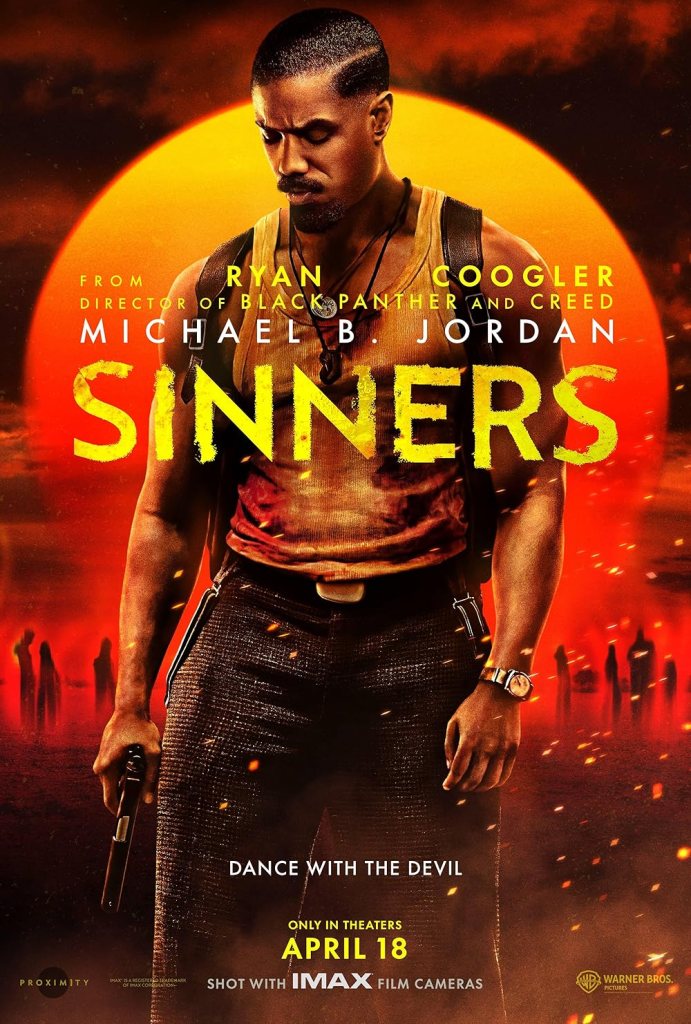
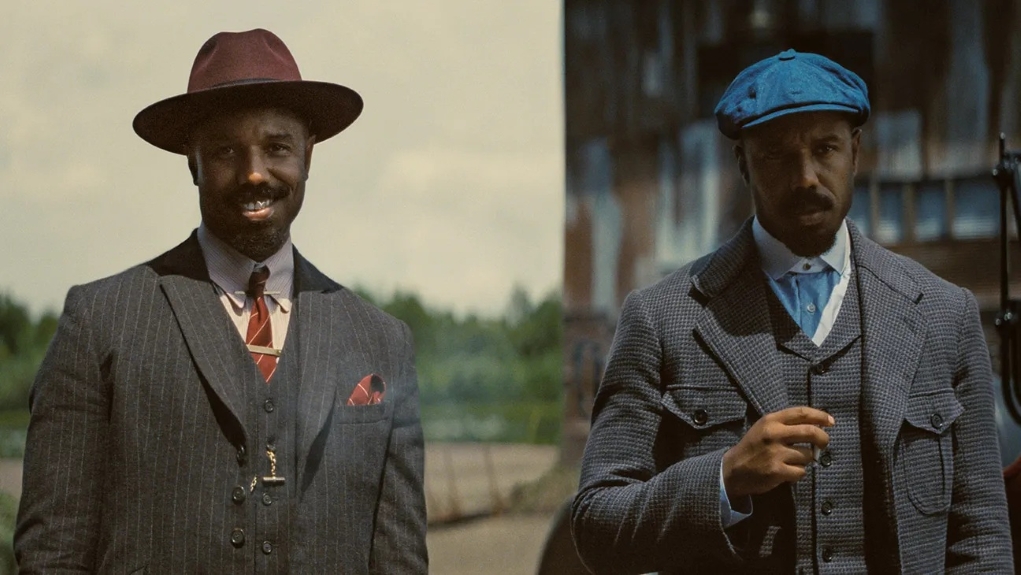
In 1932 twin brothers Smoke and Stack (Michael B Jordan, pulling double duty) return to the racist South of Mississippi after years of war service followed by time spent working for the gangs of Chicago. They dream of setting up a juke joint for the Black community, flying in the face the racism of local Mississippi. But the dangers of the KKK pale slightly, when their opening night coincides with the arrival of vampire Remmick (Jack O’Connell) who dreams of forming a new family of the dead – and wants to recruit Mississippi’s Black community, with promises of equality in his world they could never have in their own. Holed up in their juke joint, can the brothers and their families and friends survive a night long siege until dawn?

The basic set-up of Sinners is, to be honest, familiar. It delights in hueing close to Vampire mythology – garlic, wooden stakes, silver and sunlight are the key weapons here and the vampires are powerless to cross a threshold until they are invited – and the ‘base under siege’ that occupies the film’s final act is essentially taken direct from the sort of set-up John Carpenter excelled at in his heyday. What makes Sinners really stand-out is the richness of its character relationships and its social context.

That social context is, of course, the Jim Crow South. Sinners is a film steeped in the racial injustice of a particular time-and-place. In 1932, Black workers still pick cotton on plantations in exchange for wooden nickels. Families live in shanty towns and use different shops than the white folk (local goods dealers the Chow’s run two convenience stores, on opposite sides of the street, to serve their two clienteles). The danger of lynchings are everyday threats (Delroy Lindo has a haunting monologue, beautifully delivered, as Slim recounts the lynching of a former band partner, who unwisely produced his stuffed wallet at a train station). Virtually the only white people we see (other than Rennick) are KKK members.

In this world of radical injustice, it’s fascinating that Coogler suggests, in some ways, the afterlife of a Vampire is more just and fair than actual life. Rennick, himself the relic of a long-oppressed pagan Irish community, makes solid points about Smoke and Stack facing a losing battle trying to play by the white man’s game as entrepreneurs and would-be local businessmen. He even, genuinely, states he would be happy to kill the entire KKK just to wipe their hatred from the Earth. There is a certain truth in the fact that, in the legions of the undead, all are equal and race means nothing. That getting bit could be a doorway to a new world, free of racial oppression – even if it also seems to mean living in the sort of community Rennick alone crafts.

It becomes a fascinating idea, joined with the fact that Rennick also points out Christianity is a spirituality forced on the Black community. Unlike the blues music, that gifted young cousin to the brothers, Sammie (a lyrical performance in every sense from Miles Caton) plays so well it can cross the bounds of space and time joining Black souls together, the enslaved people didn’t bring Christianity with them across the water. It was forced on them, as much as the labour in the fields. Sinners isn’t quite brave enough to explicitly denounce the Church as just another wing of enslavement (even if Sammie’s preacher father uses trauma to hammer conversion on people, rather than offering comfort). But it does make clear that Sammie’s ‘coming-of-age’ is whether he will choose the culture of his ancestors or the culture of his oppressors.

This is thought-provoking stuff – and Coogler does a superb job of threading it through the blood-spurting, neck-biting, stake-hammering action that fills up a large portion of the film’s conclusion. Sinners is dripping in Blues music, which artfully and beautifully wraps itself around the film to perfectly capture its tone and pitch. The sequence where Sammi’s music fills the juke joint, is transcendent in more ways than one, powerful and transporting in its musicality and passion (Ludwig Göransson’s score, created in partnership with several Blues artists and the actors is exceptional). Coogler matches it with one his trademark, virtuoso, one-take shots, the camera seamlessly weaving in and around the juke joint as our 1930s characters dance alongside modern club dancers and musicians as well as tribal African musicians of the distant past.
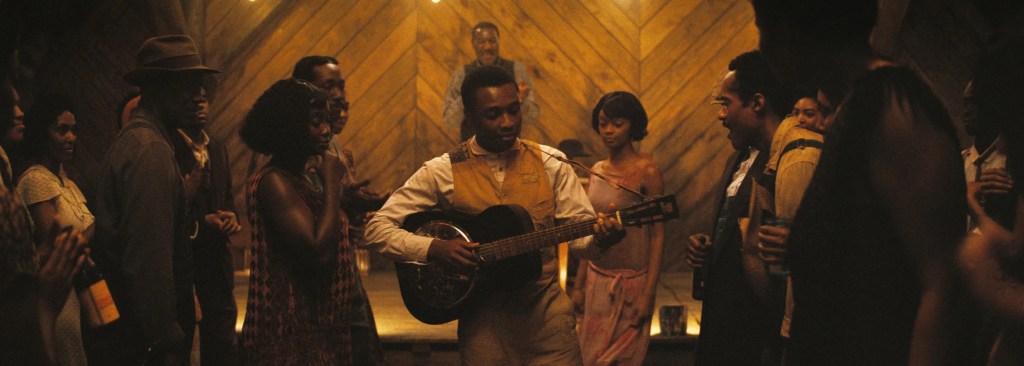
It also rewards more as Coogler takes his time throughout the film’s long opening act to really establish the characters and their relationships. You can argue that Sinners is over-indulgent in the sometimes overlong (well over an hour) long ‘recruitment’ sequence as Smoke and Stack assemble family and friends for their opening night. But this careful exploration of the closeness and warmth between these people – their loving sense of family, loyalty and sometimes painful shared history – pays off in spades when they begin one-by-one to turn to Rennick and then on each other. Coogler then makes these corruptions of the living into the hungry undead really sting, just as we feel the pain of those left among the living who must stake their nearest and dearest.

That carries further impact from the strength of the acting. Jordan, one of the most charismatic actors out there, gives a superb double-performance as the two twins, expertly sketching out their contrasting personalities and their deep love for each other. He makes Stack charismatic, gregarious and fun, and Smoke gruff, reserved but endlessly loyal and protective. They are too sharply humane turns, with Jordan so naturally playing off himself you forget both are played by the same actor.

Equally fine are the rest of the cast. Miles Caton is youthful idealism being shaken by traumatic events on the greatest night of his life. Wunmi Mosaku gives Smoke’s wife Annie a moral authority and deep sense of lingering grief. Hailee Steinfeld is vivacious but similarly burdened by disappointment and pain at chances lost as Stack’s one-time girlfriend that prejudice thwarted. Delroy Lindo’s soulful skill invests Slim with a real grace under the drunkenness. Even O’Connell, at times transformed into an Orlock-like nightmare, has a lonely humanity behind his ruthless, never-ending desire to build a new community (which he controls) around him.

There are powerful subtexts throughout here, even if parts of Sinners could at times benefit from a little tightening. Coogler effectively gives a rich hinterland to some familiar genre settings: and he surprises us with two codas, one rich in satisfying revenge violence the other with a rhapsodic melancholy which feel like natural ends for both their characters. Sinners mixes its Spike Lee influences with its John Carpenter ones with excellent effect, and is another firm reminder of the visual flair and piercing individualism of Coogler as director.

Ransom (1996)

Ransom (1996)

Every parent’s nightmare gets tackled in this efficient, smart (but not quite smart enough) thriller from Ron Howard

Director: Ron Howard

Cast: Mel Gibson (Tom Mullen), Rene Russo (Kate Mullen), Gary Sinise (Detective Jimmy Shaker), Delroy Lindo (FBI Special Agent Lonnie Hawkins), Lili Taylor (Maris Conner), Liev Schreiber (Clark Barnes), Donnie Wahlberg (‘Cubby’ Barnes), Evan Handler (Miles Roberts), Brawley Nolte (Sean Mullen), Paul Guilfoyle (FBI Director Stan Wallace), Dan Hedaya (Jackie Brown)

There is no greater fear for any parent than losing a child. Doesn’t matter if you are prince or pauper, the same heart-pounding dread is there. But sometimes the risks are greater if you a prince. Because the more money you have, the more likely a kidnapper might think you’d be willing to swop that money to get your kid back.

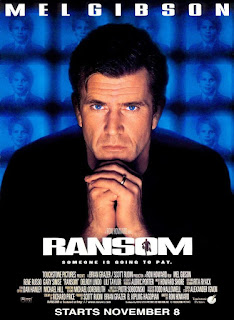
It’s what kidnappers decide when they take the son of Airline owner Tom Mullen (Mel Gibson). The kidnappers want $2million and no questions asked, in return for his son Sean (Brawley Nolte). Tom and his wife Kate Mullen (Rene Russo) are willing to pay – with the advice of FBI Agent Lonnie Hawkins (Delroy Lindo). But after the first bungled handover, Tom becomes convinced the kidnappers have no intention of returning his son alive. So, he takes a desperate gamble to try and turn the tables, much to the fury of secretive kidnapper (and police detective) Jimmy Shaker (Gary Sinise).

Ransom is a change of pace for Ron Howard, his first flat-out thriller. And it’s a very good one. Ransom has a compulsive energy to it, powered by sharp filming and cutting and some impressively emotional performances from the leads. It also takes a number of unexpected narrative twists and turns – before it reverts to a more conventional final act – and manages to keep the viewer on their toes.

Its main strength is an emotionally committed performance from Mel Gibson. Taking a leaf from Spencer Tracy’s book, this is Gibson at his best, very effectively letting us see him listen and consider everything that happens around him. Mullen is a determined man who plays the odds, and cuts corners only when he must – but is also convinced of his own certainty. He applies his own business learning – of negotiation and corporate deal-making – to this kidnapping, which is an intriguingly unique approach. Gibson’s performance is also raw, unnerved and vulnerable and he plays some scenes with a searing grief you won’t often see in a mainstream movie. Russo does some equally fine work – determined, scared, desperate – and their chemistry is superb.

Howard coaches, as he so often does, wonderful performances from his leads and from the rest of the cast. Gary Sinise turns what could have been a lip-smacking villain into someone chippy, over-confident and struggling with his own insecurities and genuine feelings for his girlfriend (a doe-eyed Lili Taylor, roped into kidnapping). Delroy Lindo is very good as the professional kidnap resolver and there are a host of interesting and engaging performances from Schreiber, Wahlberg, Handler and Hedaya. Ransom turns into a showpiece for some engagingly inventive performances.

Howard also triumphs with his control of the film’s set-pieces. The kidnapping sequence is highly unsettling in its slow build of the parent’s dread. The first attempted exchange is a masterclass in quick-quick-slow tension, with Gibson and Sinise very effective in a series of cryptic phone calls. The ransom phone calls are similarly feasts of good acting and careful cross-cutting, which throb like fight scenes. Howard understands that this is a head-to-head between two men struggling in a game of deadly one-up-manship, both of them constantly trying to figure out not only their next move, but the likely reaction of their opponent.

For much of the first two thirds of the film, Ransom is very effective in its unpredictability. There is a genuine sense of dread for how this might play out and the radical changes of plan both sides of the kidnap play out land events in a very different place than you might expect at the start. The more hero and villain try to out-think each other, the murkier the plot becomes.

It’s unfortunate that the final third devolves into a more traditional goody/baddy standoff with guns, punches and our hero reasserting his control (and the safety of his family) through the fist and the trigger. But then I guess in the 90s you couldn’t have a Gibson film without a bit of action. But when the film focuses on the thinking, talking, slow-burn tension and the sheer terror of parents who have lost a child, it’s a very effective and tense film that stands up to repeat viewings.

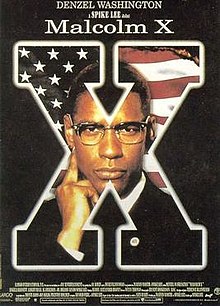
Malcolm X (1992)

Denzel Washington dominates in Spike Lee’s masterpiece Malcolm X

Director: Spike Lee

Cast: Denzel Washington (Malcolm X), Angela Bassett (Betty Shabazz), Albert Hall (Brother Baines), Al Freeman Jnr (Elijah Muhammad), Delroy Lindo (West Indian Archie), Spike Lee (Shorty), Roger Guenveur Smith (Rudy), Theresa Randal (Laura), Kate Vernon (Sophia), Lonette McKee (Louise Little), Tommy Hollis (Earl Little), James McDaniel (Brother Earl), Steve White (Brother Johnson), Ernest Lee Thomas (Sidney), Christopher Plummer (Prison Chaplin Gill), Peter Boyle (NYPD Captain Green)

In the early 1990s, Norman Jewison was attached to direct a biopic of Malcolm X, the powerful African-American activist, tragically assassinated in 1965. It was the project of Spike Lee’s dreams – and Jewison conceded he did not have the vision for the film that Lee clearly had. Lee stepped in – and thank goodness, as this is perhaps a film only he could have made. It splices together Lee’s customary political savvy and (accurate) sense of the injustice Black Americans have faced with a surprisingly adept use of the cinematic language of David Lean and other sweeping epics. In bringing these together, he created a superb biography, a great piece of epic cinema and a vital piece of American film-making.

The film covers the life of Malcolm X in three clear stages. Firstly his young days as a tearaway in Harlem, with drug addiction and crime, all with best friend Shorty (Spike Lee), a local gangster whom he admires (Delroy Lindo) and white girlfriend Sophia (Kate Vernon). The second act is his conversion to Islam under the guidance of (fictional) Brother Baines (Albert Hall) and his rise as an incendiary speaker with the Nation of Islam under the influence of its leader Elijah Muhammad (Al Freeman Jnr). The final act covers his disillusionment and departure from that organisation after a host of scandals and political disagreements, his pilgrimage to Mecca and his return looking to work with other civil rights movements before his assassination by former members of the Nation of Islam.

It’s hard to know whose film to call this, because Spike Lee and Denzel Washington both invest this film with so much passion, director and actor working in perfect synchronicity, that it’s impossible to imagine the film without one or other of them. Washington’s performance is quite simply extraordinary. He spent over a year of focused preparation on the film, and every pore of his body seems to have soaked in the mood, manners and attitudes of Malcolm X. It’s a transformative performance of purest emotional commitment: impassioned, empowering and enthralling, charismatic in the extreme. He never shies away from the anger and the faults of Malcolm X, but so engrossingly human is his work that he brings to life in a way few people had before Malcolm’s humanity, his generosity, his love, his decency. It’s a performance that seems to have transformed the actor into the man and the film works so well because Washington completely involves you in his story. 

Washington should have won the Oscar that year – it went instead to Al Pacino – and Malcolm X also should have been nominated for Best Picture and Best Director, far more so than Scent of a Woman nominated in both categories. It’s a film that builds its audience’s empathy so successfully with its lead character, and so clearly understands what Malcolm was trying to do, that you come away from it full of respect and admiration for the man. Even when the film was made, many people saw Malcolm X as a divisive, even dangerous figure – but watching the film you forget that and invest in him as a man.

It’s also inarguable – as n-words and racial bias from many whites in the film litter the screen – that it opened the eyes of many people as to exactly how harsh living in America was at the time if you were black. Put simply, it was a country labouring constantly under injustice, persecution and suffering where a black life was worth less than a white one. It’s a theme that Lee has returned to time and again in his work – and quite rightly – and it’s the sort of masterclass of simmering political anger that powers the best of his work. Would any other director under the sun have chosen to open this film with footage of the Rodney King beating? Would anyone else have thought of ending it with a coda in South Africa, as Nelson Mandela (yes the real Nelson Mandela) addresses a classroom full of children about the importance and power of Malcolm’s vision of black people taking pride in themselves and their heritage – a pride beaten out of them still today, as Lee’s Rodney King footage shows.

Lee’s direction is quite simply superb, a wonderful fusion of his own styles with a classical sweep of David Lean, spiced with the textual play of Oliver Stone. The photography from Ernest Dickerson is wonderful, the film is beautifully cut and assembled and the recreation of period detail from set to costume is remarkable. Lee’s style is sublime, from a riotously fun Harlem song and dance routine (really impressive) with Malcolm others dancing a superb Lindy Hop, to the harshness of prison, through to the intelligent and acute analysis of growing divisions in the Nation of Islam (Al Freeman Jnr is fabulous as Elijah Muhammed) and Malcolm’s developing political stance.

Lee’s film is even-handed on the whole – Malcolm’s real opponents are ideological disagreements, the film dramatizes a moment Malcolm considered a great regret where he rudely brushed aside a white college student keen to help his cause, and the film makes a lot of play over his controversial opinions on Kennedy’s assassination (essentially that he deserved it). But it also builds a superb sense of Malcolm’s personal life alongside, and the film is crammed with moments of quiet intimacy and a wonderfully developed performance of supportive love from Angela Bassett as Betty.

But the Lee touch is in that sense of anger. The politics and fury of Malcolm’s speeches and his message to black people today to save themselves and find pride in themselves carry through the whole film. Lee was sick and tired of the “white saviour” film and he triumphantly made here a film that was by black people, about black people but had something for all to hear. Malcolm X is a superb piece of biography cinema that leaves you with justifiable admiration for a man it’s easy to misjudge, engrosses you in a complex and disturbing era, angers you at racism and its impact, and also leaves you entertained. In many ways the most classical of Lee’s films – but a reminder that he is a unique and compelling voice. He thought he was the only one that could tell this story. He was right.

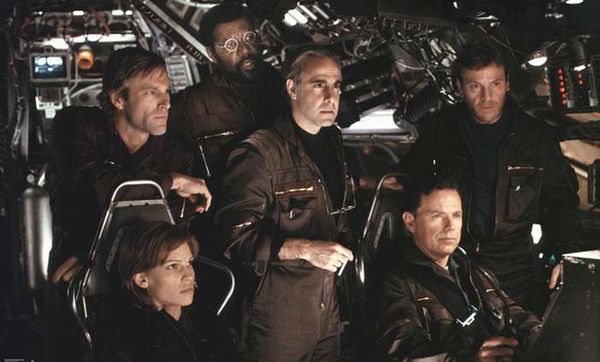
The Core (2003)

The Only Way is Down for our heroes in super silly Sci-fi disaster The Core

Director: Jon Amiel

Cast: Aaron Eckhart (Dr Josh Keyes), Hilary Swank (Major Rebecca Childs), Delroy Lindo (Dr Edward Brazzleton), Stanley Tucci (Dr Conrad Zimsky), Tchéky Karyo (Dr Serge Leveque), Bruce Greenwood (Commander Robert Iverson), DJ Qualls (“Rat”), Alfre Woodward (Dr Talma Stickley), Richard Jenkins (Lt General Thomas Purcell)

Dr Josh Keyes: “Even if we came up with a brilliant plan to fix the core of the Earth, we just can’t get there”

Dr Conrad Zimsky: “Yes, but – what if we could”

If you have any doubts about the type of film you are going to watch, then that tongue-in-cheek dialogue exchange (and the words can’t capture the playful, I-know-this-is-crap wink that Stanley Tucci tips practically to the camera) should tell you. The core of the Earth has stopped rotating. Which basically means all life on Earth is going to end in the next few months. Unless, of course, we can restart the rotation of the Earth’s core. So time to load up a team of crack scientists into a ship-cum-drill, made of metal that doesn’t buckle under pressure (this metal is, by the way, literally called unobtainium by the characters) so that they can sprinkle nuclear bombs through the centre of the Earth to kickstart the rotation of the planet and blah, blah, blah.

It’s perhaps no surprise that The Core was voted the least scientifically accurate film ever made by a poll of scientists about 10 years ago. Nothing in it makes any real sense whatsoever, and it’s all totally reliant on the sort of handwave mumbo-jumbo where you can tell getting an actual logical explanation was going to be far too much hard work, so better to roll with a bit of technobabble and prayer. Questions of mass, physics, pressure are all shoved aside. The film sort of gets away with it, with a leaning on the fourth-wall cheekiness – no fewer than three times in the film the impossible happens with a “what if we could” breeziness, as a character pulls out a theory or discovery with all the real-world authority of the fag-packet calculation.

But then scientific accuracy is hardly why we watch the movies is it? And this is just a big, dumb B-movie piece of disaster nonsense, which throws in enough death-defying thrills, predictable sacrifices and major landmarks being wiped out topside to keep the viewer entertained. In this film Rome and the Golden Gate Bridge both get taken out by spectacular disasters. Beneath the surface, the characters go through the expected personality clashes and learn the expected lessons.

The script (most of which is bumpkous rubbish) really signposts most of this personal development. Will Zimsky and Brazz rekindle their respect and overcome decades of rivalry? Will Serge, on the mission to save his wife and kids “because it’s too much to think about saving the whole world”, have to pay the ultimate sacrifice? Will Major Childs finally get the courage and determination to take command and make the hard calls? I won’t tease the fate of Mission Commander Bruce Greenwood, but he is called upon so often to reassure Childs that one day she will be ready to take command, alongside other mentoring advice, that the only surprise is that he lasts as long as he does.

So why is hard to not lay into The Core? Because, not that deep down at its core, it knows it’s a silly film. The script has enough awareness of its cliché and scientific silliness that it almost doubles down on it. And the actors play it just about right: for large chunks of it they perfectly hit the beats of sly archness that suggest just enough respect to not take the piss, but enough self-awareness of what they are making. But these are all very, very good actors and when the serious moments come, it’s remarkable how much they can shift gear – with the grisly death of one character (while the others powerlessly try and save him) played with an almost Shakespearean level of tragedy by a distraught Eckhart and Lindo. Later, as three characters juggle over who will go on a suicide mission to keep the mission on track, the bubbling emotions of shame, relief, pride, respect and buried affections are genuinely rather affecting. Its moments like this that makes me kind of love this big, dumb, stupid film.

But it remains stupid. Topside, Alfre Woodard and Richard Jenkins bumble through roles they could play standing on their heads. A hacker – Rat – is as clichéd and full of techno-nonsense as any of the science, which is even more painfully obvious to us now that we’re all so much more tech-savvy than we were in 2003. Events happen because, you know, they can. Discoveries and scientific conclusions are made because the script needs them. But the film knows this, it doubles down on it and it accepts that every problem is just a “But what if we could!” away from being solved. Stupid, but strangely loveable.

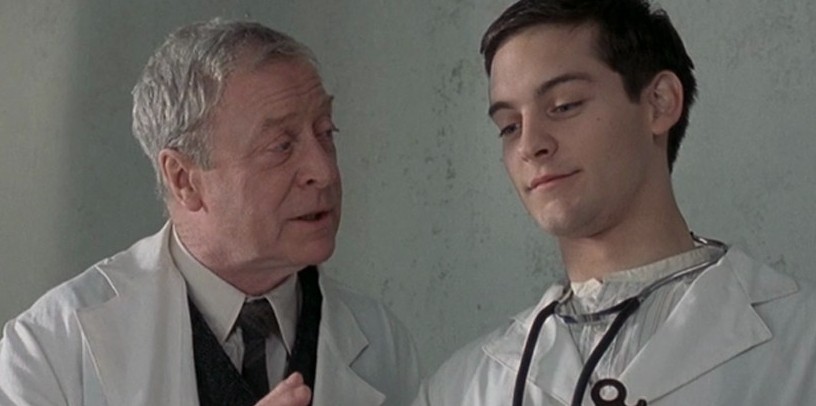
The Cider House Rules (1999)


Michael Caine and Tobey Maguire deal with moral dilemmas in this handsome adaptation of John Irving’s Dickensian novel

Director: Lasse Hallström

Cast: Tobey Maguire (Homer Wells), Michael Caine (Dr. Wilbur Larch), Charlize Theron (Candy Kendall), Paul Rudd (Lt. Wally Worthington), Delroy Lindo (Arthur Rose), Erykah Badu (Rose Rose), Heavy D (Peaches), K. Todd Freeman (Muddy), Kieran Culkin (Buster), Jane Alexander (Nurse Edna), Kathy Baker (Nurse Angela), Kate Nelligan (Olive Worthington), J.K. Simmons (Ray Kendall) 

The Cider House Rules is the sort of well-constructed literary adaptation that Hollywood excels at producing: a well-crafted script (Irving adapted his own novel extremely well), juggling serious affairs without hectoring the audience, handsomely mounted, with a Dickensian style and a cast of heavyweight actors delivering performances that speak of their investment in the film.

In a Maine orphanage in the 1940s, Homer Wells (Tobey Maguire) is raised by Dr Wilbur Larch (Michael Caine) as a surrogate son. Larch is a domineering autocrat with a passionate love for his charges, whose humanitarian instincts lead him to perform illegal abortions. Troubled by this – and feeling pressured into succeeding Larch’s as director – Homer leaves with a young woman (Charlize Theron) and her fiancée (Paul Rudd) after she visits for an abortion. Working as an apple picker in their orchard, under Mr Rose (Delroy Lindo), Homer learns important lessons above love and duty.

There are many similar films that feel like dull awards-bait, and the fact that this one avoids that is a major point in its favour. It’s very easy with material like this – cute orphans and tear-jerking speeches – to feel Cider House is a manipulative film (and I guess in a way it is) but it’s put together with such commitment and sincerity I found it genuinely moving. Hallström’s warm and beautifully paced direction creates a marvellous coming-of-age tale with characters whose flaws can be as deep as their warmth is vibrant.

The film also manages to move beyond its ‘coming-of-age’ roots with intelligent (but not too heavy-handed) mulling on the nature of “rules” – both those imposed on us and those we impose on others. Dr Larch (a magnetic performance by Oscar-winner Michael Caine) is a maverick, disregarding the abortion laws as he believes it is better he does abortions rather than someone untrained; he is also perfectly willing to impose his own rules on Homer as testaments to be followed without question. Similarly the “Cider House Rules” written on the wall of the apple workers’ lodgings are rejected outright by the working gang for their own unspoken code of conduct, no more effective than the system it replaces. All the characters are forced to draft their own rules (or principles) they can live with, matching their circumstances and actions.

The film also looks gently at the conflict between our desires and our duties, with Homer and Candy both yearning for freedom from their natural inclinations to have something to serve. This is presented as a struggle without a natural “right or wrong”, even if the apple orchard is a loose Garden of Eden, into which evil is admitted with tragic (and life-changing) consequences. A small criticism would be that the charismatic warmth of Caine’s performance and the family atmosphere of the orphanage are so endearing that it does unbalance the dilemma Homer eventually faces – instead of the audience feeling as torn as Homer about whether he should stay or return, most audience members I think would want him to return to the orphanage forthwith!

Tobey Maguire is so perfectly cast as the naïve in some ways, wordly wise in others, old-boy-young-man that he effectively reprised Homer Wells as Peter Parker a few years later. His sweet face –uncomplicated innocence and charm are in every twitch of his smile – carries the film, and his easy-going desire for a simple life makes perfect sense of the character’s rebellion against Larch’s benevolent dictation. Equally good for me though is Theron as Candy. She is a wonderfully expressive performer: midway through the film she is caught off-guard by an overlong hug from Homer, and a series of conflicted emotions from shock, to guilt, to attraction play across her face.

There is hardly a weak performance in the film, with Hallström drawing excellent work from the young orphans. Amongst the sprawling, Dickensian feeling cast, Caine is marvellous as the part dictator, part humanitarian Larch making a larger-than-life character feel real and grounded. Lindo captures the pride mixed with arrogance of Mr Rose. There are plenty of other excellent performances, not least from Baker and Alexander as two contrasting nurses in the orphanage.

I almost feel slightly guilty for the impact Cider House Rules had on me. In many ways it’s exactly the sort of safe, middle-of-the-road “serious” drama that seems designed to attract the notice of Oscar voters. But it’s told with a great deal of skill and dedication, and delivers so many emotional moments with warmth and feeling, I found myself genuinely moved by it. In fact I felt a bit teary at least twice. This is closely linked to some excellent performances – and a wonderful swelling musical score by Rachel Portman – but despite being the sort of middle brow Hollywood film it’s fashionable (and easy) to attack, I thought this was engaging, moving and thought provoking from start to finish.