
Tag: Demi Moore

Ghost (1990)

Ghost (1990)

Romance and the afterlife come together in a very earnest, but rather endearing, mega-hit

Director: Jerry Zucker

Cast: Patrick Swayze (Sam Wheat), Demi Moore (Molly Jensen), Whoopi Goldberg (Oda Mae Brown), Tony Goldwyn (Carl Bruner), Rick Aviles (Willie Lopez), Vincent Schiavelli (Subway ghost)

The biggest smash hit of 1990, Ghost turned Demi Moore into one of Hollywood’s biggest star, transformed ‘Unchained Melody’ into one of the most popular songs of all time and turned pottery into a hobby everyone thought they should try at least once. You wouldn’t have predicted any of this when you were pitched Ghost, helping to explain why nearly everyone in Hollywood turned it down. After all who wants a romantic film where the hero is six feet under and ectoplasmic by the end of the first act? Throw in that the film was directed by Jerry Zucker, best known for a parade of spoofs, comedies and farces and the smart money was on a bomb waiting to happen. Guess again.

Sam (Patrick Swayze) and Molly (Demi Moore) are a loving couple, living in New York: she’s a sculptor, he’s a banker (the sort of contrasting professions only Hollywood romantic couples have). They have big plans for the future; plans cut short when Sam is killed by a mugger. But Sam doesn’t move on with the bright heavenly light. Instead, he sticks around on Earth, wanting to be near Molly and desperate to find out who killed him. Something that’s hard to do when he can’t touch or move anything and no one can see or hear him except other ghosts. Two things change his (after)life – discovering his murder was only the tip of a pile of shady dealings at his bank that puts Molly in danger and fake-psychic Oda Mae Brown (Whoopi Goldberg) who isn’t quite as fake as she thought.

Ghost is extremely earnest and surprisingly endearing. Despite what the doubters said, from Romeo and Juliet to Titanic nothing gets people invested in a romance more than a tragic end. Ghost merely reshuffles the deck by placing this death at the start, then explores the on-going grief of two deeply bonded people, wrenched apart. It mixes that with familiar romance tropes: it doesn’t let Sam’s demise get in the way of the old “he just can’t say I love you too” chestnut (a Han Solo-ish ‘Ditto’ is his preferred response), inevitably finding a way to flip this in a later plot point.

Sure, it’s easy to giggle at the soft-focus obviousness of the lovey-dovey material between Swayze and Moore, but you can’t doubt their commitment or their natural chemistry. The film’s ace-in-the-hole of ‘Unchained Melody’-sound-tracked pottery turning into earth-rocking rumpy-pumpy is parody-bait, but kind-of-works in its soapy earnestness in showing how much they hunger for each other’s touch. (You could say it can’t be that good since they seem to fly through foreplay to climax in the time it takes a not-that-long song to play). Both actors are quite under-rated: Moore is perfectly tender and fragile (she was partly chosen for her ability to cry on a six-pence) but also tough and determined when the situation calls for it, while Swayze charmingly develops his character from cocky junior-master-of-the-universe to a deeper, more rounded man after he ceases to be alive.

Having stressed so much their tactile love in the film’s first act, it makes the afterlife hit harder. In this film haunting has the potential for a being a dull chore (the rules of haunting here were wonderfully parodied in BBC’s Ghosts sitcom): ghosts are stuck in whatever clothes they died in (without all the blood), can’t touch anything in the real world and end up sitting around waiting for they’re-not-sure-what. Dead Sam carries on one-sided conversations, tags behind Molly when she drives places and watches time go by so slowly. Ghost captures rather well the weakness of this situation: Sam sees all sorts of danger unfolding for Molly, but there is literally nothing he can do about it (a desperate Swayze thrashing his hand through things trying to stop them, plays rather well).

Ghost gets some brief meta-physical fun out of the lack of logic in ghosts being able to walk through walls and pass their hands through objects but can sit in chairs perfectly fine and never sink through floors (basically, don’t ask, as also parodied in Ghosts). It even chucks in some mildly-disturbing POV shots of what it looks like to Sam as he walks through someone else (icky basically). You can’t keep a high-flyer down though and Sam masters ‘ghost skills’ after what seems like a few hours training from an unbalanced poltergeist (a wonderfully twitchy Vincent Schiavelli), allowing him to interact with objects in the real world (he basically becomes an invincible superhero – and the ease he masters this makes me wonder why every single ghost can’t put aside an afternoon to learn how to do it. They’ve got the time after all!).

Of course, you couldn’t make a film about a man who can’t talk to anyone. Ghost has a trump-card in the Oscar-winning Whoopi Goldberg, having a whale of a time in a terrific comic performance as a hustling fraudster who unknowingly turns out to be a real psychic, eventually pushed into helping Sam. Goldberg provides nearly all of the film’s laughs – and her mad-cap energy makes an excellent contrast with the earnest leads – with her fast-talking frustration at the constant stream of interjections she hears from Sam (making conversations with other people rather challenging). It’s a role with several comic set-pieces, not least a crowded séance full of ghosts desperate to be heard, but also with heart as Oda Mae becomes a better person despite herself.

She does this of course by helping Sam root out exactly why he was murdered. The reveal of Sam’s secret nemesis will be a shock only to someone who has never seen a film before. Of course, his even cockier colleague and best friend (played with a sleazy desperation by a marvellously weasily Tony Goldwyn) is behind the shady financial dealings Sam was uncovering. Just to hammer home how much we loath Goldwyn’s Carl, he’s also a whiner, a guy who loves flashing his cash and makes some none-to-subtle topless moves on our grieving Molly. How dare he!

Ghost builds itself to a neat final confrontation that proves surprisingly affecting in its honesty (dead means dead) and its optimistic view of the afterlife as a place where love still lives on. Sure, it’s a bit corny and its weakness for teary, soft-focus romance is easy to poke fun at. But you can’t argue that it doesn’t work: it’s romantic, sweetly played, funny when it means to be (Goldberg is excellent) and surprisingly optimistic and feel-good.

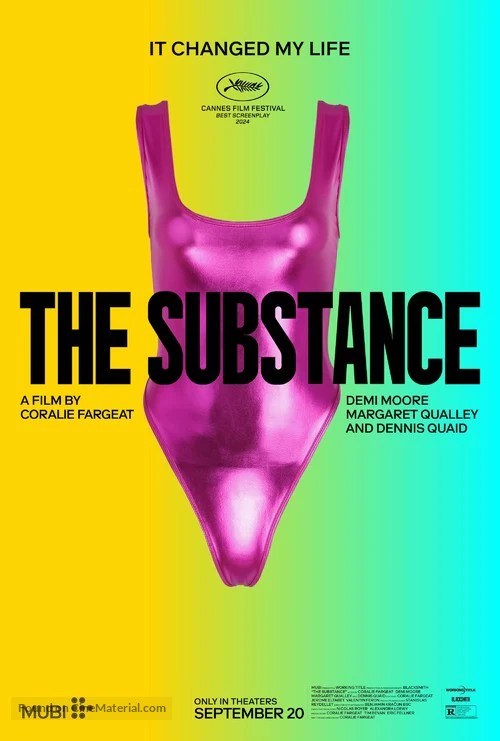
The Substance (2024)

The Substance (2024)

Twisted body horror isn’t quite the feminist statement it thinks it is, but still a unique film

Director: Coralie Fargeat

Cast: Demi Moore (Elizabeth Sparkle), Margaret Qualley (Sue), Dennis Quaid (Harvey), Edward Hamilton (Fred), Gore Abrams (Oliver), Oscar Lesage (Troy), Christian Erickson (Man at diner)

Getting old in Hollywood is not kind. Particularly for women. Elizabeth Sparkle (Demi Moore), a big star of the 90s, now eeks out a living as exercise queen for a daytime TV show. But TV exec Harvey (Dennis Quaid) decides people don’t want to watch a woman in her 50s and unceremoniously gives her the boot. Fearing a life of lonely irrelevance, miles from the limelight, Elizabeth accepts an invitation to try ‘The Substance’. This black-market drug creates a ‘younger, more beautiful, more perfect’ version of you – birthed from your spine. Taking the drug, Elizabeth spawns Sue (Margaret Qualley), a 20s version of herself who promptly lands her old job on the exercise show.

The two must swop places every week, one living their life (either in obscurity or vicariously enjoying much-lusted after career success) the other lying comatose on the bathroom floor. At first the balance works, but they soon grow to resent each other: Sue despises Elizabeth’s self-loathing bitterness while Elizabeth becomes consumed with envy at Sue’s hedonistic success. Quickly the balanced life between the two collapses, leading to inevitable disaster.

The Substance is one of those films you can pretty much guarantee people will remember about 2024. Pretty much everything in it is dialled up to eleven, a crazy mix of The Picture of Dorian Gray and Cronenberg-body horror (particularly The Fly) by way of David Lynch. Fargeat shoots it with a deliberate grindhouse intensity, revelling in the vast amounts of icky body horror, gallons of blood and guts, often filmed in a mix of dream-like drifting and trashy exploitation.

It’s a sharply directed, extremely intense film from Coralie Fargeat (who also scripts), punchy, vicious and darkly hilarious. It’s also been shot to be almost as uncomfortable to watch as possible. The camerawork is frequently disjointed, full of disconcerting jerky close-up. Nightmare Lynch-style dream horror images pop-up, along with haunting Mulholland Dr style floating heads and Kubrickian homages. Every moment of body horror is accompanied with revolting, squelching sound-effects. You’ve rarely seen anything as intensely, bizarrely OTT as this, the film carefully designed to get audiences either screaming “fucking hell!” or hiding their eyes behind their popcorn.

The film’s most successful moments are these moments of shocking body horror. Created from a host of ingenious practical effects (The Substance surely is destined for a make-up Oscar), the film superbly creates everything from green-fluid soaked birthing scenes to the grim disintegration of various body parts that slowly ages Demi Moore into a wizened babushka to the final hellish Elephant Man by way of the The Fly inspired ending. It’s superbly done, deeply unsettling, but blackly entertaining in its extremity. And The Substance is incredibly extreme, pulling absolutely no punches in this blood-soaked, Angela Carteresque fairy-tale horror.

Fargeat draws an extremely committed performances from Demi Moore, given the sort of acting challenge she never got when she was the biggest star in Hollywood, playing a woman so consumed with ingrained self-loathing and disgust (having so completely swallowed the ideology that your personal value is directly connected to your appearance) that she would rather live as a recluse in the shadow of another version of herself than build a new life. There is an extraordinary scene where a panic stricken Elizabeth prepares for a date with an old schoolfriend (possibly her last chance at a normal life) but is so consumed by self-loathing and doubt about her appearance (painfully ironic, since she of course looks great) that she goes through multiple attempts at make-up up in the movie, each time rubbing it off with such increasing fury that by the end she’s virtually sand-papering her face as if trying to erase herself from existence.

Just as fine is Margaret Qualley as the ‘perfect’ version of Elizabeth, but who has just the same self-loathing and insecurity as the original. It’s a similarly committed performance by Qualley, a carefully studied, surprisingly vulnerable performance while also being ruthlessly ambitious and self-indulgent, which embraces the hyper-sexualised expectations of young women in Hollywood. Dennis Quaid also throws in a fun cameo as a lasciviously camp, OTT executive full of ruthless, heartless bonhomie who sees women only as window-dressing for perverts. After all it’s an industry that forgets: from the opening montage of Elizabeth’s Hollywood star going from eagerly photographed to forgotten, through to the insultingly trivial gift stuffed in her hands as she is dismissed.

But The Substance’s satire is often rather forced and obvious (right down to Quaid’s exec being called Harvey). It feels like it misses a trick by having its only female character being a woman who has so swallowed the ageist views of Hollywood, she literally can’t imagine questioning it. So much so, her clone equally embraces life as a sex object. While The Substance invites us to understand the poison of this world independently, there is virtually no commentary on the unjust sexism within the film. In fact, The Substance so echoes the leering camera angles and pervy shots of the worst kinds of sexist cinema that sometimes it’s a bit hard to see it as satire and (as the camera stares at Qualley’s butt or down her top) more as just reality.

At no point do Elizabeth or Sue make any form of realisation about how they have been indoctrinated to only understand themselves as being worth something so long as they look like a pin-up. While The Picture of Dorian Gray understood the temptations of a selfish hedonism even when we know its wrong and The Fly was all about the damaging impact of ambition, for all its pointed smirking fun The Substance is at heart more of a pulpy gore-show revelling in extreme than a sort of social satire.

In fact the more you watch The Substance the more you think it’s real inspiration is Whatever Happened to Baby Jane and the ‘hag-horror’ of the 60s. A star name of yesteryear, takes on a role that riffs on their loss of youth and beauty, throwing them into an ever more twisted tale of obsession and revenge. You could argue The Substance trusts us to see for ourselves that all this rampant sexism is wrong: but you could also quite happily watch the film and assume it was Elizabeth’s vanity that caused all the problems, not the system that inoculated it in her.

There is another version of The Substance that could match its pulpy love of horror thrills with a bit more of an insightful commentary on gender politics. But the fact the film ends in an explosion of blood that makes The Shining look positively restrained (a sequence that goes on too long in an overlong film), you suspect its real heart is actually in creating shocking images rather than really exploring the issues it wants you to think it is addressing.

Mr. Brooks (2007)

Kevin Costner goes for a ride, accompanied only by his imaginary friend. We’ve all done it. Right?

Director: Bruce A. Evans
Cast: Kevin Costner (Earl Brooks), William Hurt (Marshall), Demi Moore (Detective Atwood), Dane Cook (“Mr. Smith”), Marg Helgenberger (Emma Brooks), Danielle Panabaker (Jane Brooks), Ruben Santiago-Hudson (Detective Hawkins)

Apparently when Kevin Costner read the script he thought it was the best script he had read in years. This probably says more about Kevin’s choices since the early 1990s than it does about the script itself but this is still a decent enough thriller with an interesting twist on the psychopath killer story.

Costner’s Mr Brooks is a successful business man and loving family man who also happens by night to be a serial killer. The twist being throughout that he is accompanied in his crimes by his imaginary friend, played with creepy relish by William Hurt. Brooks is consumed by guilt from his “addiction”, visiting AA and constantly claiming he is ready to quit. The film opens with an unexpected curtain being left open during a carefully prepared murder, leaving Brooks open to blackmail from an eye witness with a taste for trying this murdering lark.

The film is performed with such guilty and gleeful relish by Costner and Hurt that it’s incredibly easy to be swept up by its momentum and to forget that out hero is a serial murderer. The film is very careful to give centre stage to the invention and intelligence of its anti-hero which, combined with Costner’s fundamental likeability as a performer, are very attractive traits for any viewer. Only at a few points is the darkness of Brooks explored, most prominently from Costner’s near orgasmic sigh and shoulder roll after committing the first murder of the film. Otherwise the viewer is as seduced by this dark world as Brooks himself has been.

A sub plot about Brooks daughter possibly inheriting her murderous inclinations is much less interesting but does allow Costner to offer an amusing twist on the straight-as-an-arrow American heroes he made his career playing. But it never engages as much as the strange will-he-won’t-he dance Brooks has with his blackmailer  (a fantastic performance of scuzzy bravado hiding cowardice from Dane Cook). Demi Moore also gives a surprisingly effective performance as a hard as nails career copper chasing down the murders.

But it’s the performances of Hurt and Costner that really lift this film up into the higher reaches of the second tier of psychological thriller, along with the neat concept of the childhood imaginary friend gone completely over to the bad. Hurt in particular is terrific, in a performance that is part raging id monster part caring big brother. A dark guilty pleasure I’m not surprised it is slowly gaining cult status.