Tag: Demian Bichir

The Midnight Sky (2020)

The Midnight Sky (2020)

Dystopian end-of-the-world drama gets dull and dreary in this misfire

Director: George Clooney

Cast: George Clooney (Augustine Lofthouse), Felicity Jones (Dr “Sully” Sullivan), David Oyelowo (Commander Adewole), Kyle Chandler (Mitchell), Demián Bichir (Sanchez), Tiffany Boone (Maya), Caoilinn Springall (Iris), Ethan Peck (Augustine), Sophie Rundle (Jean)

The world has been evacuated after an unspecified radiological disaster, with the survivors bound for K-23, a newly discovered moon of Jupiter capable of supporting life. The only person left on Earth is Augustine Lofthouse (George Clooney), suffering from a terminal illness. He remains behind at an arctic base to warn returning space missions. The returning mission Aether – crewed by Jones, Oyelowo, Chandler, Bichir and Boone – are en route, but to make contact with them Lofthouse must travel across the arctic to a back-up transmitter, accompanied by a mysterious wordless child called Iris (Caoilinn Springall) who seems to have been left behind during the evacuation.

The Midnight Sky is the largest, most technically ambitious film Clooney has directed. Did the focus on the technical aspects mean he took his eye off other elements? Even the ones his previous films have been strong on: dialogue and character. The Midnight Sky looks great and has some impressive effects. But it is a dull film, lacking pace or energy, populated by paper-thin characters and often feeling like a Frankenstein-like stitching together of elements of other, much better, films.

It splits its focus between two story lines: one a survivalist two-hander between Clooney and child actress Caroilinn Springall; the other a “journey home against the odds” space mission. The first carries a little more interest, if only because Clooney manages to brilliantly convey loneliness, isolation, sadness and how terminal illness increases the effects of all of these. There is also emotional depth from his growing bond with Iris: the two of them playfully flicking peas at each other over dinner and his protecting her from the dangers outside. This is shot in some stunning Iceland vistas and shows a competent selection of various traditional survivalist set-ups during the struggle to complete the journey. It’s not exactly original, but at least it holds the interest.

That interest isn’t found in the space scenes – although the lack of originality is. How did Clooney fail to notice that he assembled a terrific cast of actors, but then failed to give them so much as a whisper of a character to play between them. This crew are terminally unengaging 2-D characters, whose dialogue echoes tropes of other films. Despite the dangers they encounter while navigating a course to Earth (that inevitably takes them through uncharted meteor storms), we are never really given a reason to really care about these characters (all the sad mooning over holograms of the families they left behind doesn’t actually make us feel like we know them).

The sense of nothing we are seeing here actually feeling new is key, and the main problem with the whole film. Countless other films have covered world-ending events. Clooney’s battle to cross the arctic and survive carries more than an echo of The Revenant by way of The Road. The struggles in space have lashings of Gravity with an Interstellarvibe. And those are just for starters. Even the final narrative twist (which you can probably see coming) echoes other film twists. For all the handsomeness of the film, it never feels fresh, always more of a tribute remix of other superior films that you should probably just consider rewatching instead.

That’s Clooney’s main failing here. As if he was so focused on getting the technical elements spot on, he never checked if the patient had a pulse. The Midnight Sky, knitted together from the offcuts of other films, has only the vaguest of heartbeats. Nothing is original and virtually no character in it ever feels either fully-formed or someone we care about. Others, all too obviously, serve as nothing but narrative devices. There are some wonderful shots and a lovely score from Alexandre Desplat. But narratively, the film often feels too cold, distant and emotionally dead. It ends up feeling far, far longer than its two-hour run time.
Alien: Covenant (2017)


The xenomorph rises again, in prequel Alien: Covenant

Director: Ridley Scott

Cast: Michael Fassbender (David/Walter), Katherine Waterston (Daniels), Billy Crudup (Oram), Danny McBride (Tennessee), Demián Bichir (Lope), Carmen Ejogo (Karine), Amy Seimetz (Faris), Callie Hernandez (Upworth), Guy Pearce (Peter Weyland), Noomi Rapace (Elizabeth Shaw), James Franco (Jacob)

The Alien franchise is a series I’ve always had a lot of time for. Perhaps I just enjoy the carnage and blood letting of these movies, but at their best there is a sinister poetry behind the pure destructiveness of this rampaging beast, with a perfect mix of haunting nihilism and stirring action. In 2012, Scott returned to the franchise to explore its roots. His prequel film, Prometheus, had a mixed reception (and it’s a film I’ve found weaker with repeated viewings) but it still had that mixture of nihilistic poetry and gore. So where does Alien: Covenant fall?

Set 10 years after Prometheus, a solar flare hits the colony ship Covenant. To repair the damage, the ship’s android Walter (Michael Fassbender) wakens the crew, although the captain (an unbilled James Franco) is killed by a malfunction. Command passes to Oram (Billy Crudup), although many of the crew look to the captain’s wife Daniels (Katherine Waterston) as their moral leader. After the damage is repaired, the crew investigate a signal from an abandoned world, where they find the marooned android David (Fassbender again) and a planet with a terrible virus, that infects its hosts to create brutal Xenomorph monsters. But is all as it seems?

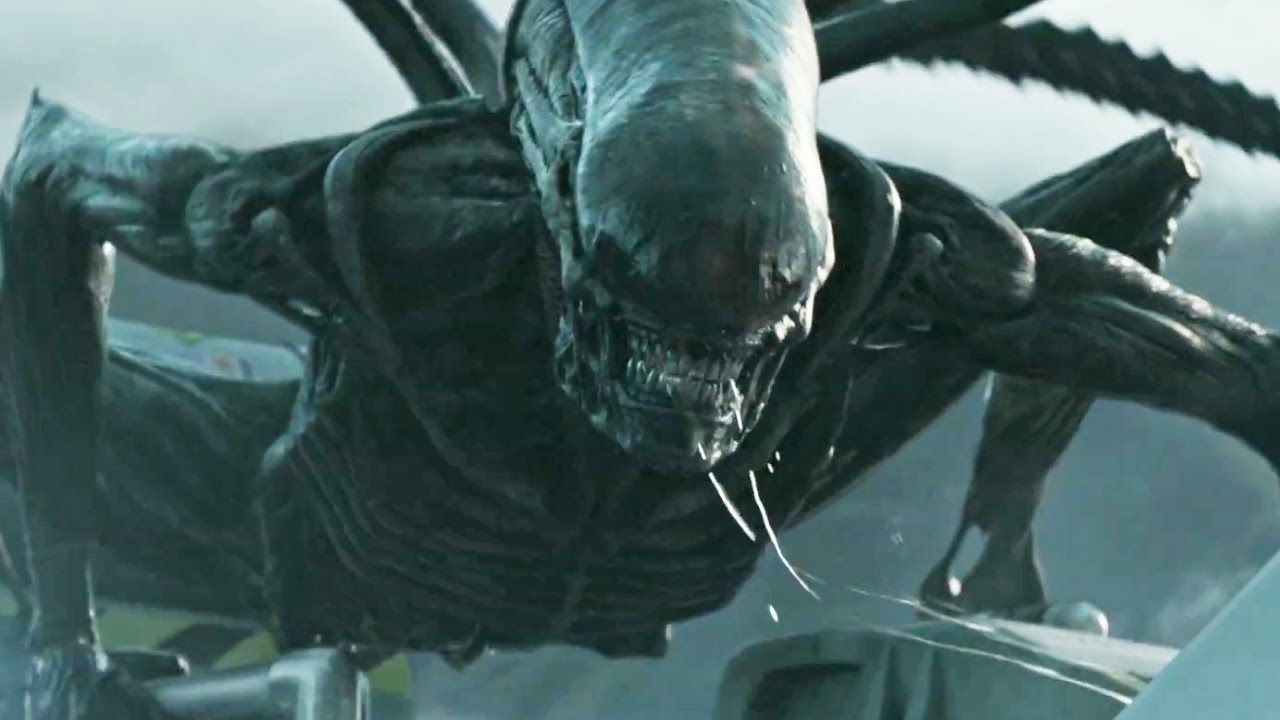
Alien: Covenant is a mixed bag. It has a haunting and unsettling tone and gives us plenty of aliens in all their various forms. Many of the sequences of alien attacks are exciting. It’s trying to build a mythology around the creation of the aliens, and tie that in with a thematic exploration of our needs to create and destroy. It wants to explore the potential dangers of artificial life, and how it could judge us and find us wanting. At the same time, it’s a flawed and rather predictable film, which never really surprises you. It might give you some things to think about – but it won’t provoke your interest enough to make you really think about them for long after the credits roll.

Its main weakness is in its large cast. Most of the characters are referred to throughout by non-descript surnames, hammering home their lack of individuality. The film is so resolutely invested in the establishment of its mythology, it has no time to build characters or a story around the crew. They are little more than ciphers, plot tools to deliver specific points rather than for us to relate to them, or feel concern for their fate. Even Waterston’s Daniels, nominally our surrogate character, feels distanced and undefined. Like the rest of the cast, she suppresses the loss of a loved one (there are at least three bereaved partners in this film) with a suddenness that speaks less of her professionalism and more of the film’s shark-like need to always moving forward.

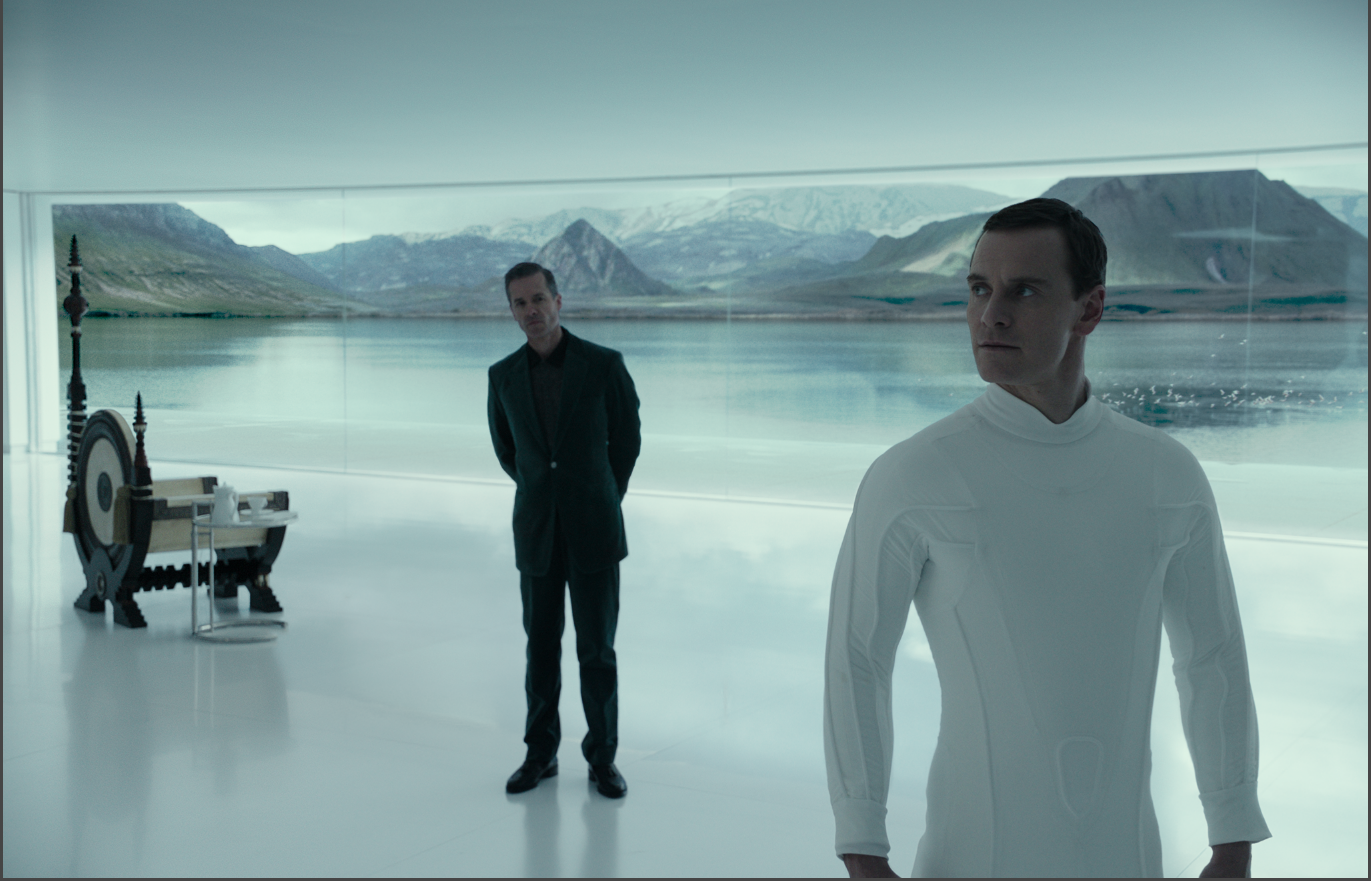
The one exception to the blandness is Fassbender’s dual role as androids David and Walter. It’s an actor’s bread and butter to play different roles, so we shouldn’t be surprised that a great actor like Fassbender executes it here with such skill. But he clearly distinguishes both the loyal, straightforward Walter and the darkly oblique David, and manages to craft the two most impressive performances in the film. This also gives Fassbender several chances to act oddly with himself, including a scene where David (rather suggestively) teaches Walter to play a pipe (it’s all about the fingering) and even a creepily possessive kiss scene between the two androids.

It helps that the film positions David as a protagonist-antagonist, and spends time exploring his fractured psyche (because it is central to the creation of the aliens, the film’s main interest). From its dark prologue, which shows David awkwardly questioning his nature with his creator (a swaggering cameo from Guy Pearce), David carries much of the film thematic interest. He is a creation of mankind, who believes he has surpassed his creators. Learning that Walter, a second generation, has been programmed to be less ‘human’ in his emotional capability as David, only confirms his belief that he is perfect. David is fuelled by a homicidal rage towards his creators, matched with an insane fixation on his own perfection.

The film wheels out a host of literary big guns to suggest a richness and depth to its exploration of these themes, from Milton to both Shelleys, but these points are really window dressing, as David is really closer in spirit to a Mengele crossed with a mad scientist from an old Hollywood B-movie. Despite this though, Fassbender’s David feels like a fully-rounded, absorbing character. His ‘Walter’ performance is equally good – gentler, compassionate, less grandstanding but quietly engaging.

Alien: Covenant is a film that aims high and wants to add some intellectual heft to its “slasher” roots. I think it’s probably a film that “hangs out” with ideas rather than enters into a proper conversation with them, but at least it’s aiming for thematic depth and richness, even if it often misses. I’m not sure it carries the sense of wonder and awe, and near-religious parallels, Prometheus (a deeply flawed, but more haunting film than this) managed. But it wants to make us question our place in the universe, and how our blind overconfidence could one day doom us. These ideas may just be window dressing to the blood and guts that the film delights in, but it at least shows that Scott is trying to make something a little deeper, and trying to make points about human nature.

It may be this focus on philosophical musing and the mythology of the alien’s development, distracted the film-makers from creating a plot to wrap around all this. The characters actions are too are often determined by the requirements of the plot, rather than logic or characterisation. So many dumb decisions are made, it stretches credibility: deflecting on a whim to a strange planet, charging around this alien world with careless abandon, following a clearly demented android you don’t trust into a room full of alien eggs – the plot requires each of the characters to perform various acts of stupidity in order for it to get anywhere.

The plot is also a hybrid that remixes beats from the previous films. No death (and there are loads of them) carries any surprise or shock value, and the alien itself (impressively filmed as the action is) behaves pretty much as you would expect. The familiarity of the events also makes the characters feel (to the audience) even more stupid and careless. There is excitement, but the film never really gets you to the edge of your seat – with its familiar action, and bland characters most of whom are little more than alien-fodder, you just never feel a tension or investment in their fates.

I wanted to like Alien: Covenant more than I actually did – but the truth is that it’s a film that lets itself down. There are moments of awe and wonder in there. It has a very good villain, whose motives and reasoning are interesting and thought-provoking. It has a terrific pair of performances by Michael Fassbender. But it’s also got too much flatness – plot and characters seem rushed and thinly sketched out. It’s clear where Scott’s and the writers’ focus was – and it means chunks of this movie just glide past the eyes and ears. Not the worst Alien film by a longshot – but still someway off the greatness of the first two films.