Tag: Denise Richards

Starship Troopers (1997)


Earth’s military might goes up against space bugs in Paul Verhoeven’s militaristic satire

Director: Paul Verhoeven

Cast: Casper Van Dien (Johnny Rico), Dina Mayer (Dizzy Flores), Denise Richards (Carmen Ibanez), Jake Busey (Ace Levy), Neil Patrick Harris (Carl Jenkins), Patrick Muldoon (Lt Zander Barcalow), Clancy Brown (Sgt Zim), Michael Ironside (Lt Jean Rasczak), Seth Gilliam (Cpl Sugar Watkins)
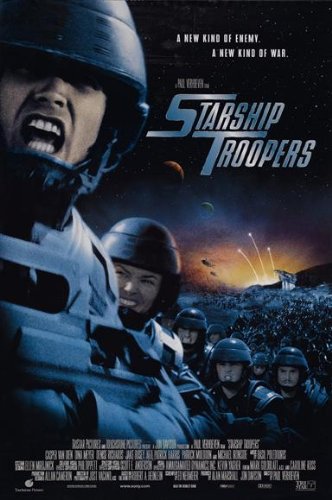
Every so often, a film uses the tropes of bad films so well, and makes such effective satirical digs, that people initially miss the point of what the film is trying to do. This is pretty much what happened with Paul Verhoeven’s Starship Troopers. On the surface a terribly acted, deeply stupid sci-fi actioner about soldiers killing space bugs, Verhoeven actually created a sharply intelligent, wry satire on the very bombastic militaristic fascism it seems to celebrate. This satirical bent was missed not only by the critics, but also the producers of the straight-to-video sequels the film spawned.

In the 23rd century, mankind has reached the stars. But it’s done so by creating a militaristic, aggressive society, where the young are encouraged to join up to the military in order to become “citizens”. Leaving high-school, hotshot would-be-pilot Carmen Ibanez (Denise Richards) joins up – followed by her boyfriend Johnny Rico (Casper van Dien), in turn followed by Dizzy Flores (Dina Mayer), the girl in love with him. Joining the ground soldiers, Ricco and Flores find themselves as the point of the spear in mankind’s war with the Arachnids (the Bugs), a race of (it becomes clear) intelligent and savage insects on a distant planet.

Starship Troopers isn’t really like anything else: it might well be Verhoeven’s American masterpiece, the perfect mix of his love for extreme gore, violence and sex (filmed with lashings of comic colour and playful glee) with keen social satire, the very ideas he had explored in everything from Robocop to Total Recall. At first glance, Starship Troopers serves up the all-action, gun-toting space battle excitement you would expect from its genre. But Verhoeven not only ramps everything up to 11, he also laces the dialogue and action with a keen satirical bent that hammers home the underlying theme of how war essentially (as Verhoeven puts it) “makes fascists of us all”.

The action is regularly interrupted by propaganda newsreel footage, which stresses the importance of sacrifice for the military effort. The military training camps are almost obsessively focused on brainwashing and reducing the young people in them to cogs in the machine, with safety and welfare as very much a secondary concern (the death of a recruit in an exercise is a concern only because it shows careless leadership rather than because of the death itself). Everyone in the film seems to be a perfect physical specimen. Military lives are thrown away through a combination of arrogance (they’re just bugs, this will be easy!) and incompetence, but never with any feeling of responsibility or expression of regret (though the media works hard to adjust all casualty figures wildly downwards).

The film fires shots at everything in the industro-military complex. The foreign policy of this world is ludicrously aggressive and jingoistic. Despite the spin of the propaganda, it’s pretty clear that humanity has started the war itself. The army is like Hitler’s wet dream – sleek perfect bodies, suicidal self-sacrifice, a complete lack of questioning of any orders or directives, a willing acceptance of corporal punishment. This attitude of violence and unthinking aggression is at every point of society – newsreel footage shows children holding guns with grinning soliders, who then proceed to hand out live ammunition. Later children are shown stomping cockroaches, to cries of the “the only good bug is a dead bug!”. Trials are routinely praised for the brevity (one day between arrest, conviction and execution!). It’s a terrifying world.

What Verhoeven does so well is that, while aware of the multi-leveled nastiness of the world of Starship Troopers, he also makes it a pretty effective straight-war movie. It’s exciting and the action quotient is high. Just like the soldiers in the picture, it’s very easy to see the bugs as faceless opponents which it is easy to feel little regret over killing. The battle scenes are high scale – and of course blackly comic in their extreme gore and bloodlust. But you can still enjoy the action – which is why the film works so well as satire. And also perhaps why so many at the time missed the point. Verhoeven makes this as an enjoyable B-movie, by really effectively using the tropes of B-movies. He turns the trashy B-movie into a sort of art exhibit.

That surely also explains some of the casting. I’m not sure how many of the actors are in on the joke. Certainly Casper van Dien and Denise Richards seem blissfully unaware of the satirical bent under the film. These two wooden actors trot through the sort of banal, by-the-numbers plot arcs and dialogue that fill films like these, with van Dien’s jaw as chiselled as granite and Richards grinning no matter the content of the scene. But their honest woodenness is perfect for the film: a smarter actor would have wanted to tip the wink to the audience, but these guys play it totally straight without even a hint that they are aware of the message underneath.

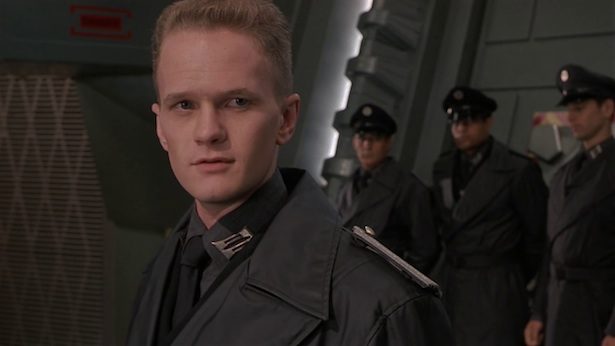
The more satirical element is left to other members of the cast: Michael Ironside has great fun as an almost absurdly fanatical solider, first introduced as a teacher lecturing his students on how the state must come before everything else and violence is the solution to all the world’s problems. Neil Patrick Harris tips a slight nod to the audience as a young man who rises so swiftly through the ranks that by the time we reach the end of the film, he’s a Gestapo-coated secretive colonel. He fits right into the grey militaristic, Nazi design of the military. You can watch all this stuff and simply enjoy the silliness – teenage boys will love this. And when they mature they’ll realise how awful the world it’s presenting is.
 

Starship Troopers is the ultimate military satire, a film that pushes every single fascist, militaristic society cliché to the limit. The news comes only from state propaganda. Military training involves brainwashing, maiming and slaughter. Education praises anger and violence as a solution to all problems. Verhoeven shoots this all with a grandeur, that pushes the celebration of militaristic violence to the max. 

It’s a film which is brave enough to make its militaristic sequences exciting, to shoot and cut this fascist wet dream with a stirring sense of excitement underpinning all the action. At the end you can celebrate the small victory our heroes celebrate in what is clearly going to be an ongoing war – until of course you realise it’s the victory of a Nazi organisation. The fascist world of the future may bring us sexual and racial equality – but that’s because it’s worked out everyone is needed to feed the grinder. It’s a super-smart satire film that disguises itself as a completely trashy action flick. It’s actually rather brilliant.

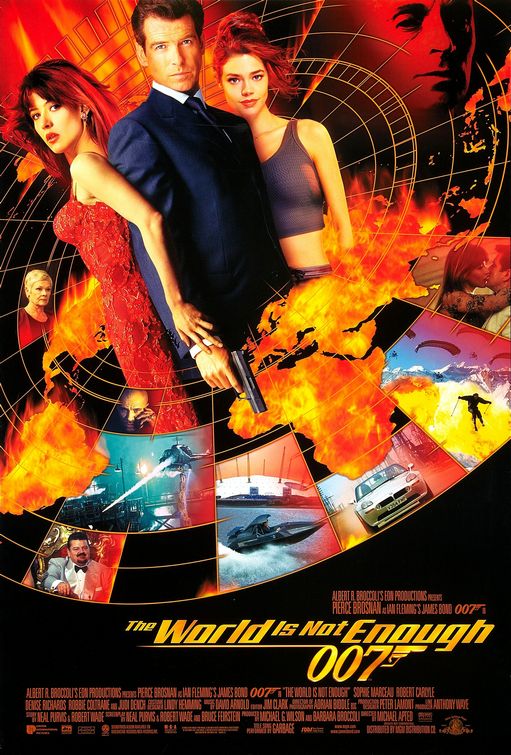
The World is Not Enough (1999)


Pierce Brosnan falls into Sophie Marceau’s clutches. Time for one last screw.

Director: Michael Apted

Cast: Pierce Brosnan (James Bond), Sophie Marceau (Elektra King), Robert Carlyle (Renard), Denise Richards (Dr Christmas Jones), Robbie Coltrane (Valentin Zukovsky), Judi Dench (M), Michael Kitchen (Bill Tanner), Colin Salmon (Charles Robinson), Desmond Llewelyn (Q), John Cleese (R), Samantha Bond (Miss Moneypenny), Ulrich Thomsen (Sasha Davidov)

I’ve long been of the belief that Pierce Brosnan’s Bonds were each a decline from the last, no matter how much money and action were thrown at the screen. TWINE in no way shakes that opinion. It’s a film I remember when I saw it in the cinema twenty years ago being a little, well, disappointed by.

After the assassination of an oil tycoon in MI6 headquarters, James Bond (Pierce Brosnan) is assigned to protect his daughter Elektra (Sophie Marceau) as she vows to complete the pipeline her father started. MI6 believes her life is endangered by her former kidnapper Renard (Robert Carlyle). Heading to Eastern Europe, Bond soon finds himself in the middle of a complex game, with a mysterious string puller, that seems to revolve around the stealing of a nuclear warhead and the kidnap of M (Judi Dench), with only nuclear scientist Dr. Christmas Jones (Denise Richards) to help.

TWINE is all about its electrifying opening sequence. It’s possibly the biggest, most exciting introduction to a Bond movie yet. Not only does it have a truly compelling action sequence in the boat chase down the Thames, but there’s plenty of plot, tension, mystery, revelation and humour – Bond straightens his tie under water – to match the entire content of some Bond capers. Brosnan is deadly in the Bilbao sequence – you believe he’s a killer – he’s working out of the money trap is Bond at his most ingenious and the beautifully filmed and edited boat chase is an absolute wonder. It’s edge of the seat stuff and when it finishes, you can just imagine a cinema full of people letting out a sigh of relief and kicking back to enjoy the rest of the film.

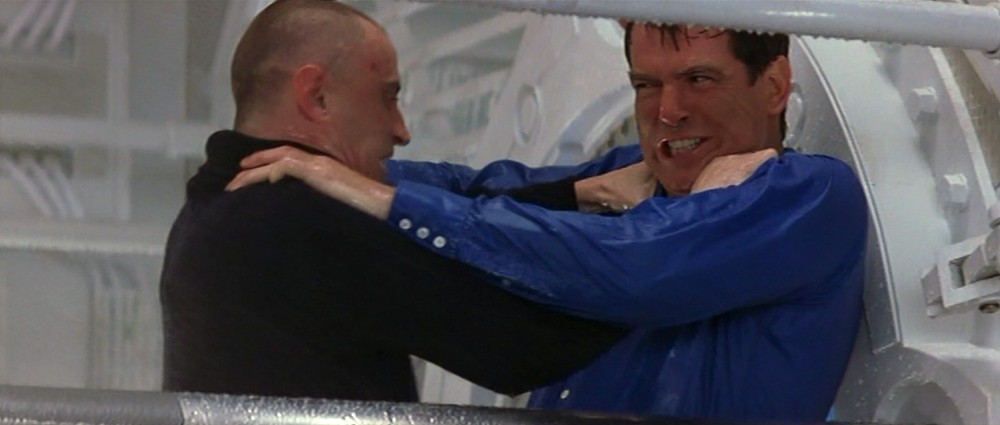
In fact that’s part of the problem. As Anthony Lane said in his review of the film “It’s the best 15 minutes in film this year. Let’s pack up and go home”. The problem is literally nothing in the film that follows can even hope to live up to this – and by the end, it’s practically given up trying. How does a film that started so vibrantly end with such a hackneyed fight on a submarine, with our heroes squabbling over something so fiddily it looks like an ink cartridge?

In between the phenomenal start and the damp squib ending, the film pings off to a lot locations – Azerbaijan! Turkey! Bilbao! – but everywhere still has the same bland, identikit feel to it, for all the shots of the odd famous landmark. That’s not to mention the rather laborious plot that ties the film together. It’s a film that feels like it’s trying to make a series of big statements about our hidden selves, revenge, manipulation – but falls short each time. It’s wrapped inside the most elliptical villain scheme I can remember. I only watched it a few days ago and even I’m not sure why Elektra wanted to blow up that damn submarine in Turkey.

Bond and Renard face off in the underwhelming sub sequence

Increasingly it becomes bogged down in machinations that feel recycled from previous films in the series. Shady Russians, corrupt security guards, chases down the snowy mountains, fiddily endings in old style nuclear subs. The film’s second biggest set piece – the attack on a cavier factory – has a rather formulaic inevitability about it. 

It has its moments of cool and charm, but in many ways it’s a blunt and crude film. What sort of eclectic film casting selects people as wildly diverse as Goldie and Ulrich Thomson as sidekicks? Robbie Coltrane returns as Zukovsky, but his character has been broadened from his first outing in GoldenEye into some sort of comic relief, a cane carrying buffoon a million miles from the ruthless ex-hitman in his first appearance. We even get a return of the “MI6 accidentally stumbles in on Bond doing the nasty” closing gag so beloved of the Roger Moore era. By the end of the film it really feels we’ve come a million miles from the ruthless efficiency and dynamic action it opened with.

The film’s most interesting beat, without a doubt, is Elektra King. It’s a stroke of inventiveness to turn the character established as the Bond girl, into the film’s villain.  Elektra uses many of the tropes of traditional Bond girls – vulnerability, sensuality, playfulness, a certain gutsiness – and repackages them as villainous tools, weapons of manipulation and deceit. Sophie Marceau is very good as possibly the most intriguing villain of the whole series, and the film neatly leaves open the question of how far her experiences twisted her, or whether her sociopathy was a deep lying trait. Her chemistry with Brosnan seems at times a little forced, but she gets most of the meaty content of the story and handles it with gusto. It’s especially neat to see how Marceau adjusts and adapts her performance for each person she encounters – with Reynard she’s playful and infatuated, with Bond she’s more aloofly sensual.

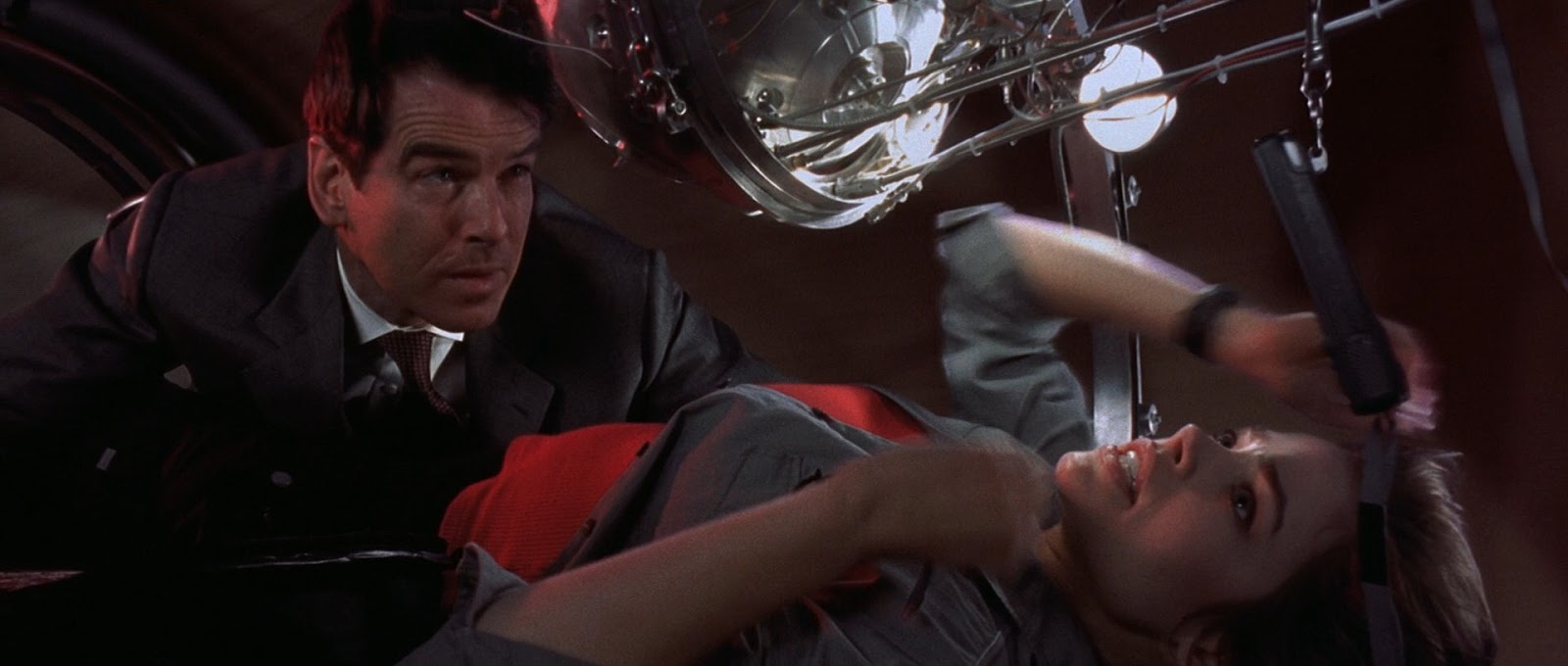
Denise Richards gets all nuclear physicist

She certainly fares better than poor Denise Richards, playing a character who feels like she was written backwards from the film’s closing punchline (“I thought Christmas only comes once a year” indeed). As if the producers wanted to counterbalance the innovativeness of Elektra, Richards feels like she’s wandered in from a classic Moore film: nominally an expert in something grand sounding (nuclear physics – and you can have a £1 from me if you ever meet anyone who believes Denise Richards has a PhD in rocket science) but really a damsel in distress dressed in hot pants. I’d further add that Brosnan already looks far too old for her.

The film’s best asset though is Brosnan’s Bond. The more I rewatch Brosnan’s efforts, the more I feel sorry the guy didn’t get more of the sort of material Dalton and Craig received either side of him. He clearly has the acting chops to do something a bit more interesting with the character, but his Bond is always a bit tonally confused – one moment he will stare viciously at a fallen opponent, the next he’ll be wearing a shit-eating grin and perving over ladies’ underwear in a nightclub. Brosnan does both these things, I hasten to add, extremely well: this film is probably his peak action performance, and at several points (not least his first encounter with Reynard) his sense of physical danger is jaw dropping. TWINE is a kind of perfect embodiment of his era: 1/3rd Connery to 2/3rd Moore.

For all that the big picture of the film gets away from Apted, he does have a good eye for smaller moments that stick with you – the tie moment, Brosnan’s look into the camera after his first kill. Moments like this appear throughout the film: a cut back to Zukovsky’s grin when Bond’s car is destroyed, the pinpoint bullet shot that hits a plate of glass right in front of an unblinking Reynard. Moments like this get increasingly lost as the film pushes on and becomes more and more formulaic and traditional, but they are still there.

That’s what it all comes back to: the film is not the sum of its parts. Moments stand out, but the whole thing really doesn’t. Everything feels a little too pre-packaged. Even an actor as brilliant as Robert Carlyle (the sort of actor everyone said should play a Bond villain) is lost in the mix, his performance as forgettable as a million other “ruthless anarchist” types we’ve seen before. There are some neat homages – I like the painting of Bernard Lee in MI6 HQ – but too much of it feels like more of the same, told with a professionalism that crushes the life out of individualism. So while it has moments that excite and entertain, as well as elements (such as Elektra King) that feel unique and original, too much of it also feels like, well, any other Bond film. For all its energy, it feels like watching a world-class athlete run on the spot.

FINAL COMMENT:This film does get some credit however for how tastefully it handles the final scenes of Desmond Llewelyn as Q. Tragically Llewelyn died in a car crash shortly before the film was released, but his work here is possibly some of the best he contributed to the series. Never let them see you bleed and always have an escape route.