
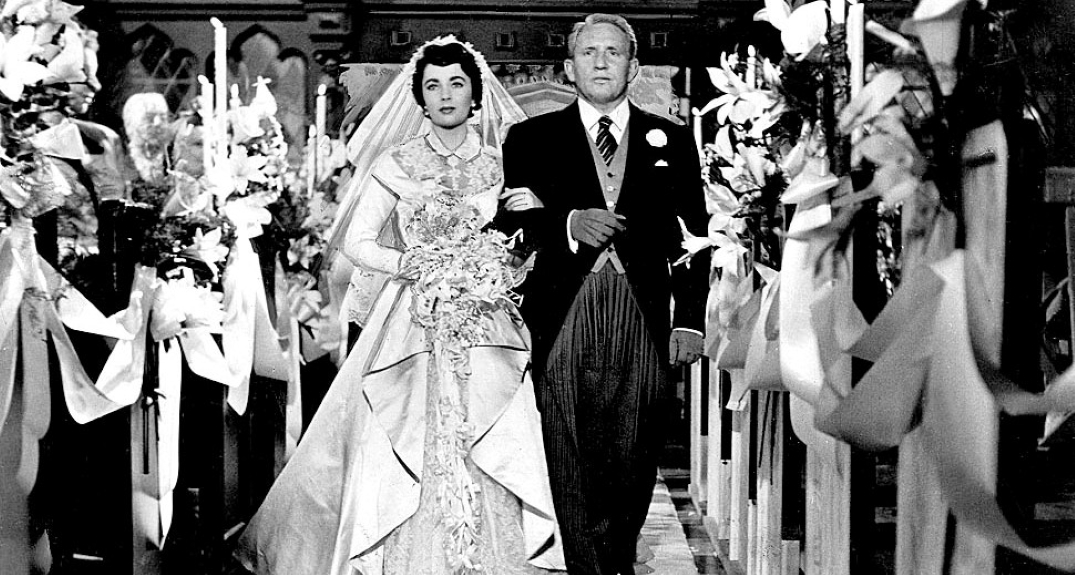
Gentle, well-made comedy is elevated by a star turn from Spencer Tracy
Director: Vincente Minnelli
Cast: Spencer Tracy (Stanley Banks), Joan Bennett (Ellie Banks), Elizabeth Taylor (Kay Banks), Don Taylor (Buckley Dunstan), Billie Burke (Doris Dunstan), Leo G. Carroll (Mr Massoula), Moroni Olsen (Herbert Dunstan), Melville Cooper (Mr Tringle)
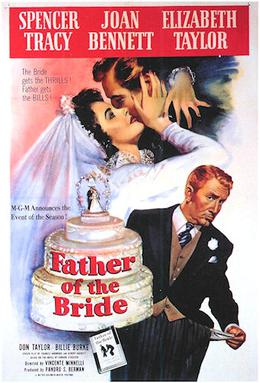
Apparently almost 70% of couples find wedding planning stressful. Perhaps they would be reassured to hear things haven’t changed much since the 1950s! Stanley Banks (Spencer Tracy) is a successful partner in a law firm whose domestic bliss is disrupted when daughter Kay (Elizabeth Taylor) announces she intends to marry boyfriend Buckley (Don Taylor). With the support of her mother Ellie (Joan Bennett), Kay dreams of a big church wedding – and Stanley is left counting the cost while struggling with his sadness at his daughter growing up and flying the nest for good.
Father of the Bride delightfully takes a simple idea and mines it for as much comic effect as possible. The structure is simple: the build-up to and staging of the wedding, with all absurdities of such things as fussy caterers and exacting church wardens pointed up. There are minor bumps and hiccups, but nothing that would make a viewer ever seriously worry that all will not turn out well. Instead, the film riffs on the constant exasperation of a father watching the plans (and cost) of the wedding spiral ever upwards, as more and more extras pile on top of others.
Much of its success is linked to Spencer Tracy, excellent as the eponymous father. The role was written for him and Minnelli demanded he should play it when producers suggested a more comic actor like Jack Benny might fit the bill better. (Katherine Hepburn did not take on the wife, though I can’t imagine she would found much to engage her in Joan Bennett’s underwritten role.) The entire success of the film revolves around our connection with Tracy, something never in doubt with his skill and assurance.
Minnelli cements this with an opening shot panning across wedding debris before craning up to introduce us to a fourth-wall breaking speech of resigned weariness from Tracy. His narrative voice is returned to again and again, as Tracy shares a wry and exasperated commentary. Father of the Bride is a testament to Tracy’s comic chops, his mastery of the micro-reaction providing constant laughs, from a look of disbelief across a dining table to one of shock as the latest bill flies in. It’s a hilariously effective performance, in which Tracy embraces the ridiculousness of farce. Like a practiced comedian he spays himself (three times) while attempting to open a coke or kids himself into believing he looks dandy in a morning suit several years too small for him.
But the performance – and the film – really works because Tracy also communicate its humanity. In his relationship with Elizabeth Taylor (suitably radiant as Kay, and full of a forceful personality she surely inherited from her father), Tracy makes clear his love for his daughter and his sadness at an end of an era: he won’t be ‘the man’ in her life anymore. Even with small inconsequential moments (such as Kay ignoring Stanley’s appeal to wear a coat before fetching it immediately when Buckley suggests the same), Tracy shows sadness dance across his face. The wedding is awash with bittersweet moments, with Tracy as harried host desperately attempting to speak with his daughter one last time before she leaves. Father of the Bride through Tracy’s performance mines a great deal of quiet, genuine emotion from a parent struggling with a child grown up.
It’s a bittersweet thread Minnelli’s film keeps pinging away under the comedy. Minnelli seems an unlikely choice (you’d expect a Cukor or Capra), but his skill with composition adds to the film without overwhelming the slender story with flash. The opening shot of wedding debris prepares us for the hustle and bustle of the big day, where a parade of carefully choreographed background events in the Banks’ house is as skilled as the bustling crowds of the event. Minnelli gives a Dali-inspired flair to Banks’ pre-wedding nightmare (his feet melting into the ground and clothes falling apart) and he plugs into Tracy’s reactive skill to frame these off-the-ball moments for maximum impact.
Editing also helps accentuate jokes. On hearing his daughter intends to marry, Banks reflects with horror on who this suitor might be, a montage of assorted suitors (from athletic, to bookish, to dancing) spooling past us. (The biggest joke now might be how utterly safe all these suitors are, the sort of lads you imagine fathers today would be desperate for daughters to bring home). Minnelli also fades in and out on blurry close-ups on glasses to communicate both the passing of time and Stanley’s rising inebriation (after a growing parade of martinis) when the Banks meet with Buckley’s parents.
This sort of comic energy helps carry the film very effectively. Of course it is all very simple – the 1991 remake added more moments of crisis and obstacles for the characters to overcome – and that can explain why events sometimes feel stretched out even over its slim 90-minute run time. For all the film’s tagline (“Bride gets the thrills; Father gets the bills!”) suggests frustration on Stanley’s part, moments where he weeds through a huge invite list (525!) or bemoans paying for an orchestra no one is listening to are generally underplayed (perhaps it was thought we could only sympathise so much before starting to think of Tracy as a penny pincher?)
But, overall, the film works very well indeed, mostly due to Spencer Tracy’s hugely effective performance – funny, endearing, likeable and hugely relatable with a perfect balance between comedy and emotional depth. It would have been nice to have had more of a contrast between Stanley and Buckley – when Buckley turns up to a heart-to-heart with father-in-law clutching a briefcase full of his work, I immediately thought ‘never has a woman more clearly married someone like her dad’. But what the film aims to do it, it succeeds at. And that’s to have some good-natured, heart-warming fun showing how even stars like Tracy can find weddings stressful.



 Movie Musings