Tag: Donald Moffat

The Right Stuff (1983)

The Right Stuff (1983)

Patriotic heroism subtly retold as shrewd satire – no wonder the film bombed

Director: Philip Kaufman

Cast: Sam Shepard (Chuck Yeager), Scott Glenn (Alan Shepard), Ed Harris (John Glenn), Dennis Quaid (Gordon Cooper), Fred Ward (Gus Grissom), Barbara Hershey (Glennis Yeager), Kim Stanley (Pancho Barnes), Veronica Cartwright (Betty Grissom), Scott Paulin (Deke Slayton), Charles Frank (Scott Carpenter), Lance Henriksen (Wally Schirra), Donald Moffat (Lyndon B Johnson), Levon Helm (Jack Ridley), Mary Jo Deschanel (Annie Glenn), Scott Wilson (Scott Crossfield), Kathy Baker (Louise Shepard), David Clennon (Liaison man), Jeff Goldblum (Recruiter), Harry Shearer (Recruiter)
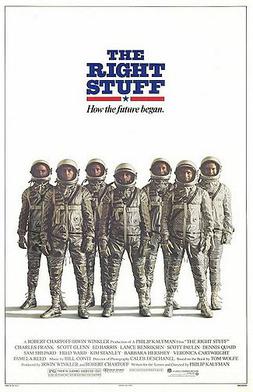
During the Cold War, the US and Russia had to fight with something – from proxy wars to chess, but most famously with Space: the competition to go further, faster and higher among the stars. The Right Stuff focuses on the Mercury Seven pilots at the centre of the US response to Soviet success including Alan Shepard (Scott Glenn), John Glenn (Ed Harris), Gus Grissom (Fred Ward) and Gordon Cooper (Dennis Quaid), a mix of the cocksure and the confident. But in a space programme where a monkey is an acceptable “pilot” for this human cannonball, do any of them have “the right stuff”? Could any of them match the skill of legendary test pilot Chuck Yeager (Sam Shepard) – one of the guys who scorned this astronaut programme for being “spam in a can”?

The Right Stuff, adapted from Tom Wolfe’s book, seemed destined to become a patriotic smash-hit. Despite its eight Oscar nominations (and four wins) it was, in fact, a catastrophic bomb. Perhaps that was because it subverted its patriotism so well. The Right Stuff is, in fact, a subtle, anti-heroic satire (told at huge length) masquerading as a patriotic yarn. It’s marketing avoided that meaning those most likely to enjoy didn’t go and see it, and those who went for that felt alienated. While largely respecting the astronauts, it suggests space race triumphalism was a sort of mass hysteria, with limited results, inflated into something mythic by political expediency, media spin and industrial might. Not the happy, flag-waving message Reaganite America expected or wanted.

Kaufman’s sympathy instead lies with an older, “truer” America. The Right Stuff is an intensely nostalgic film: but for a completely different time. It is in love with Frontier America, where men-were-men and the daring proved themselves in taming the frontier, in this case the sky itself. Our tamer is Chuck Yeager, played with a monosyllabic Gary-Cooper-charisma by Sam Shepard. Yeager is the last of the cowboys (even introduced riding a horse in the desert), taking to the skies like an old frontiersman hunting down that “demon” who lives at the sound barrier.

This is the sort of America The Right Stuff celebrates, and Yeager is the guy who has it. Unlike the Mercury programme, Yeager isn’t interested in showbiz and self-promotion (his reward for breaking the sound barrier? A free steak and a press embargo), just the quiet satisfaction of having done it. It’s the old, unflappable, quietly masculine confidence of a certain kind of American tradition and it’s totally out of step with the world the media is now celebrating with the astronauts. Instead, these effective passengers in the rocket will be hailed as the great pilots.

Kaufman’s film is a long, carefully disguised, quiet ridicule of many of the aspects of the Mercury programme. It’s conceived, in a darkened room, by a group of politicians so clumsy they can’t even work a projector. It’s head, Lyndon B Johnson (Donald Moffat on panto form) is a ludicrous figure, at one point reduced to an impotent tantrum in a car when he doesn’t get his way. The NASA recruiters are a comedy double act – Goldblum and Shearer sparking wonderfully off each other – who first suggest (in all seriousness) circus acrobats as pilots and then fail to identify Yuri Gargarin. The programme begins with a series of failed launches that travel tiny distances before exploding, culminating in one attempt ending with an impotent pop of the cap at the top of the rocket.

NASA is slightly ramshackle and clueless throughout. Far from the best and brightest, Kaufman is keen for us to remember that many of the scientists fought for the Germans in the war, that decisions were often made entirely based on what the Russians have just done, that the astronaut recruitment tests are a parade of bizarre physical tests because no one has a clue what to test for, and that the final seven selected aren’t even the best just the ones who persevered through the tests and (crucially) were small enough to fit in the capsule. That doesn’t stop the media – played by a San Francisco physical comedy troop – from turning them overnight from jobbing pilots to superstars.

The astronauts status is frequently punctured. Scott Glenn’s granite-faced Shepard is strapped into the cockpit for hours on his first flight, until finally he begs to pee (followed by a montage of coffee being slurped, hose pipes blasting and taps dripping) before being instructed to release his bladder into his suit, meaning he heads into space sitting in a puddle of his own piss. Dennis Quaid’s cocksure Cooper has an over-inflated idea of his skills and is prone to dumb, blow-hard statements (arriving at Yeager’s Air Force base he non-ironically states he’ll soon have his picture up on the deceased pilot’s memorial wall). Fred Ward’s Gus Grissom is a slightly sleazy chancer – controversially The Right Stuff presents him as panicking on re-entry from his first mission, blowing his hatch and sinking his ship, something he categorically denied (and was later proved not to have done).

Even John Glenn, played with a sincerity and decency by Ed Harris (if this had been a hit, Harris’ career of playing hard-heard would have been totally different), is subtly lampooned. So straight-laced he literally can’t swear (his attempt to say ‘fuck’ never gets past a strained Ffff), he’s introduced via a ludicrous TV quiz show and his square-jawed morals frequently tip into puritan self-importance. Undergoing physical tests, Kaufman even cuts from his grimacing face to a grinning chimp on the same test (and who will beat him into space). Compared to Yeager, who can correct a plane on a desperate nose dive and beat the skies into submission (and has the only outright heroic refrain in Bill Conti’s Oscar-winning score), none of them have that right stuff.

Do they get it? In a way: but their triumph is establishing their character, not their skills. Kaufman uses Yeager to point us towards this (his seal of approval is vital for the film): after Grissom’s debacle, he defends him in the bar and praises their courage in essentially sitting on top of a massive bomb.
Tellingly, the astronauts’ most courageous moment in the film isn’t in the cockpit at all: it’s Glenn supporting his stammering wife’s refusal to go on air with LBJ, despite the pressure from NASA bigwigs – and the other astronauts uniting in fury when Glenn is threatened with being dumped from the next flight. The others become more noble through maturing and casting aside fame’s temptations.
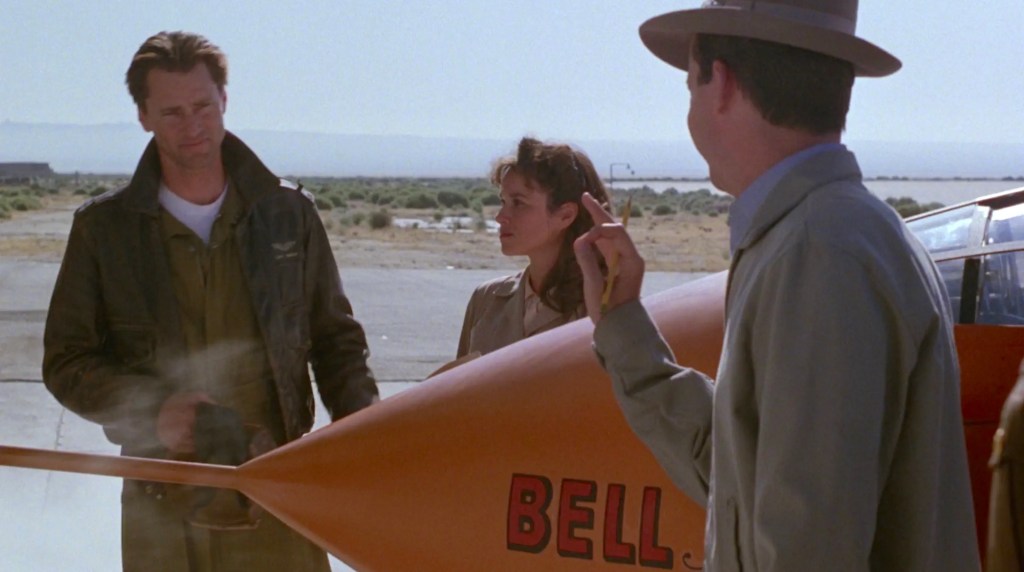
In a way they prove their spurs, even if Kaufman’s film makes clear none of them can match Yeager’s traditional values. The film ends with Yeager, maverick to the last, undertaking an unauthorised test flight in a desperate attempt to keep funding for his jet programme going. Even with this final flight – dressed in a bastardised version of a space suit – Yeager shows he’s not lost it, a man so undeniably superhuman in his American resilience that even a bit of fire won’t slow him down.

The Right Stuff celebrates Yeager, but he’s the B-story – and the film frames him as a forgotten figure, left behind by a world obsessed with the bright and shiny. The Right Stuff has to centre the astronauts but it doesn’t focus on the missions (which, apart from Glenn’s, barely receive any screen time – certainly not compared to the time given to Yeager’s flights) or the glory, only quietly implies there was a slight air of pointlessness about the whole thing – that the space race was perhaps just a dick-waggling competition between superpowers. It makes for interesting – if overlong – viewing, but as punch-the-air entertainment, no sir. No wonder it bombed.

Clear and Present Danger (1994)

Clear and Present Danger (1994)

Tom Clancy’s door-stop thriller is turned into an involving conspiracy thriller that makes masterful use of Harrison Ford

Director: Philip Noyce

Cast: Harrison Ford (Jack Ryan), Willem Dafoe (John Clark), Anne Archer (Dr Cathy Ryan), Joaquim de Almeida (Colonel Felix Cortez), Miguel Sandoval (Ernesto Escobedo), Henry Czerny (Bob Ritter), Harris Yulin (James Cutter), Donald Moffat (President Bennett), Benjamin Bratt (Captain Ramirez), Raymond Cruz (Domingo Chavez), James Earl Jones (Jim Greer), Tim Grimm (Dan Murray), Hope Lange (Senator Mayo)

Tom Clancy’s Jack Ryan has always been the All-American hero (his slimy, besuited CIA rival even frustratedly snarls “you are such a Boy Scout”). Ryan is almost too-good-to-be-true: pure as the driven snow, incorruptible, a success at everything he does and a devoted family man. What chance does someone like that have in Washington? In Clear and Present Danger, Ryan is dragged into the War on Drugs, unwittingly becoming the front man for an illegal military assault team against the Columbian cartels, ordered by a US President on a vendetta for the death of a friend. When the truth comes out, you’ve got one guess who takes it on himself to save the soldiers who are hung out to dry by the suits in Washington.

We know he’ll do the right thing as well, because he’s played by Harrison Ford. Ryan is basically a blank slate as a character, so Ford’s straight-as-an-arrow everyman decency does most of the heavy lifting to establish who he is. As an action hero, Ford has the chops but his real strength is his ability to look frazzled, scared and muddling through – rather like the rest of us would. Ryan gets in some real scrapes here, from dodging missiles in an attack on a diplomatic convoy to desperately fighting for his life in a timber factory. Ford’s strength as an actor is to be both authoritative and also vulnerable – his willingness to look scared but determined works wonders.

Clear and Present Danger also gives plenty of scope for Ford to employ his other major empathetic weapon: the clenched jaw and pointed figure of moral outrage. He does a lot of both here, a central scene seeing Ryan confronting besuited rival Ritter (played by a weaselly, bespectacled Henry Czerny, the polar opposite of Ford’s clean-cut everyman-ness) earnestly telling him he broke the law and is heading to jail (laughed off). There can’t be an actor more skilled at getting you to invest in someone, to both simultaneously worry about him while being confident he will do the right thing. It’s a rare gift, and Clear and Present Danger exploits it to the max.

Ford is the centrepiece – and main strength – of a competent, well-made conspiracy thriller, directed with a professional assurance by Philip Noyce. It makes a good fist of translating Clancy’s doorstop novel – with its huge complexities – to the screen (although you might need a couple of viewings to work out the twisty-turny, backstabby plot, where wicked schemers turn on their own schemes). Noyce has a special gift for keeping dense technical and exposition scenes lively. At one point he cross-cuts a parallel investigation into a fake car bombing between Ryan (who flicks doggedly through textbooks) and his Cartel rival who employs gadgetry and computers. Plot heavy scenes like this are well-shot, pacey and capturing plenty of reaction shots, even if they only feature characters messaging each other on clunky 90s computers or walking-and-talking in shadowy metaphors.

Clear and Present Danger also successful juggles its Washington shenanigans, with parallel intrigue in its Columbia setting. There ruthlessly charming Cortes (played with a wonderful cocksure suaveness by Joaquim de Almeida) is scheming to takeover his boss’ (a blustering Miguel Sandoval) operation. These plot unfold both together and in parallel, allowing for a little bit of neat commentary contrasting the cartels and Washington. The film manages a bit of critique of America’s thoughtlessly muscular intrusion into the affairs of other countries, with a President turning a blind eye after passing on implicit instructions (but still with a boy scout hero who will sort it all out).

Noyce also pulls out the stops for a couple of brilliantly executed scenes. Great editing, sound design and committed acting makes a scene where Luddite Ryan races to print off incriminating evidence from a shared drive while technically assured Ritter deletes the files, edge-of-the seat stuff. Never before has racing to fill a printer with paper seemed more exciting.

That pales into significance with the film’s centre piece, a genuinely thrilling Cartel ambush on a US diplomatic convoy, with Ryan stuck in the middle. With perfect build-up – from James Horner’s tense score to the skilful editing – the attack (with Oscar nominated sound design) is hugely tense, leaves our heroes terrifyingly powerless and is flawlessly executed by Noyce and his crew. It makes the whole film a must watch all on its own.

It’s surrounded by several other well-handled action set pieces, featuring the Marines sent on a covert mission (and then hung out to dry). As the operation leader, Willem Dafoe plays very successfully against type as a (ruthless) good guy, as Clancy’s other regular character, uber-fixer John Clark. Dafoe also has the chops to go toe-to-toe with Ford, and like de Almedia’s charmingly wicked Cartel-fixer also serves as another neat contrast to Ryan’s decency-with-a-fist.

The film is rounded out by a troop of reliable actors. Anne Archer has little to do as Ryan’s supportive wife, but Donald Moffat is good value as the shifty President (communicating both intimidating authority and Nixonian survival instinct), Harris Yulin perfectly cast as a President-pleasing apparatchik and Raymond Cruz as an ace but naïve marine sharp-shooter. Clear and Present Danger has few pretensions to be anything other than an involving thriller – but that also helps make it a very enjoyable one.

The Thing (1982)


The men of an Antarctic base encounter a deadly force from space in The Thing

Director: John Carpenter

Cast: Kurt Russell (MacReady), Wilford Brimley (Blair), TK Carter (Nauls), David Clennon (Palmer), Keith David (Childs), Richard Dysart (Dr. Copper), Charles Hallahan (Norris), Peter Maloney (Bennings), Richard Masur (Clark), Donald Moffat (Garry), Joel Polis (Fuchs), Thomas Waites (Windows)

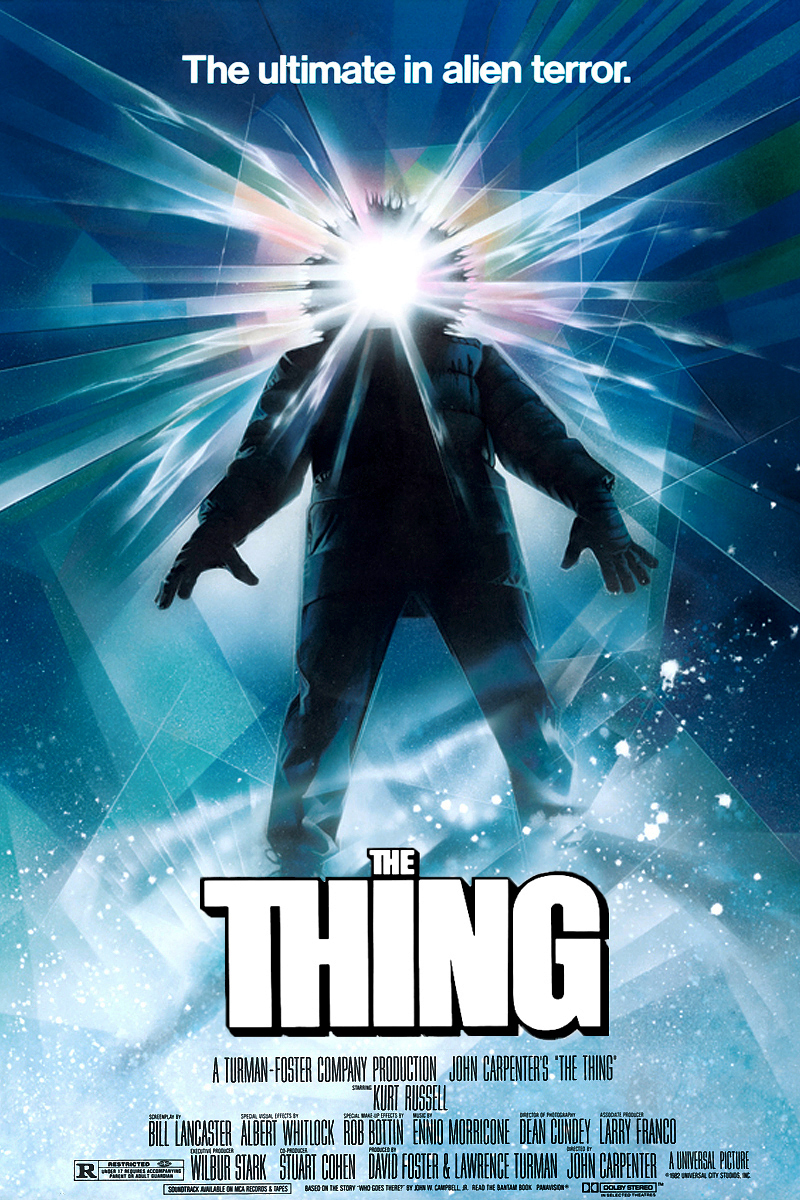
In a curious coincidence, The Thing was released on the same day as Blade Runner. Both have since gone on to become landmark science fiction films, hugely influential to future film makers. Both have scenes that linger in the memory, and have ambiguous endings fans have discussed for decades. Both were also disastrous box office bombs and with negative critical reactions.

The Thing is a creeping masterpiece of sci-fi, body horror and paranoia. On an Antarctic base, an American research team rescues a dog being pursued by two Norwegians from a base close-by (the two Norwegians are both killed, one accidentally, one shot dead after firing at the Americans). Investigating the Norwegian base to see what happened, they find it destroyed and a series of grisly corpses, including one with two faces. Soon it becomes clear the Norwegians fell victim to an alien who has the power to perfectly copy and replace living organisms. The Americans realise they are trapped on the camp, with no idea who them may now be a “Thing” rather than human.

John Carpenter’s creepy, atmospheric horror film is an endlessly gripping thriller that rewards constant rewatching. Its shot with an unnerving simplicity of movement, with the focus getting tighter and tighter. We start with an unsettling helicopter shot taking in the panorama of Antarctica but, before long, the action is confined to single rooms in the American camp, with our leads shouting suspiciously at each other. The whole film is underplayed by an eerie Ennio Morricone score that really gets under your skin with its haunting electronic strains. It’s a classic by any definition of the word, and it never, ever gets old or tired: I’ve seen it a dozen times, and each time new small moments grab me, shots enchant me – and it never fails to be tense, unnerving and scary.

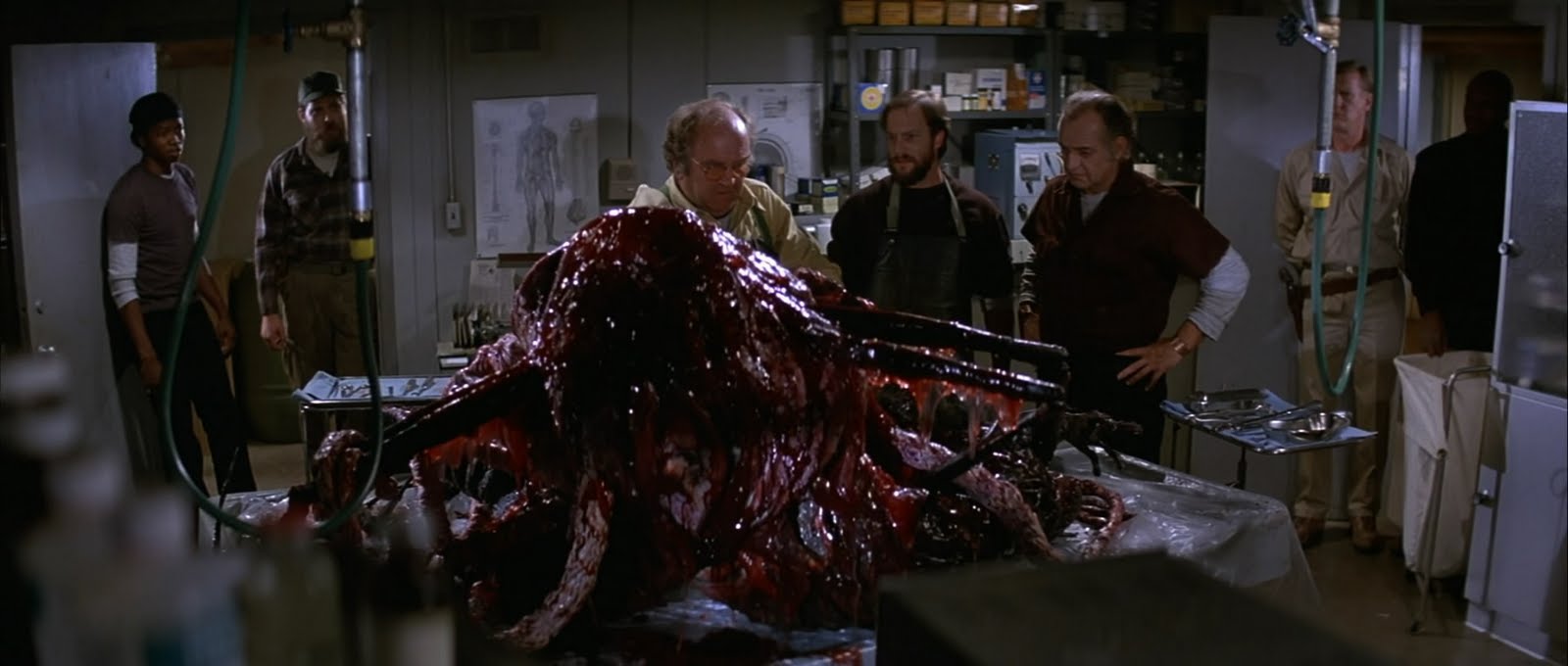
“You’ve got to be fucking kidding” a character states at one point. It’s pretty easy to imagine that this was the reaction of the critics at the time, at the onslaught of body horror. The Thing’s process of absorption is not only disgusting (usually involving flesh and skin peeling back to reveal all sorts of crazy shit), but its defence mechanisms involve similar depths of insane grossness. By the time our heroes are incinerating replacements with a ruthless lack of concern, we’ve already seen chests turn into massive tooth jaws, a dog Thing peel its own face off, and a head of a Thing separate itself from a burning body, grow spider legs and scuttle away. You’ve got to be fucking kidding indeed.

The Thing is pretty much a landmark in prosthetic work (you’ve never seen anything like this before). And the body horror still packs a major punch – I couldn’t eat my sticky bun while the Dog Thing ripped itself apart in the middle of a kennel early on (those poor other dogs by the way…). Some of the most effective stuff is actually the smaller scale moments – there is a great moment where a Thing grabs another character by the face and hand and face merge together. It has a truly yucky feeling to it. It’s all so carefully constructed and inventive that it haunts and fascinates. But if it was just a parade of gross images and nightmare fuel it wouldn’t have lasted. What makes it work is that it has a cracking story and a great set of characters. 

Carpenter collects a terrific group of actors, headlined by Kurt Russell. Russell’s MacReady is the perfect lead for this sort of film, a grizzled maverick slacker who reveals (when the shit hits the fan) the natural charisma of the born leader, the only man there able to make the hard calls. He even has a perfect little introduction scene, playing chess with a computer (whose voice makes it the only female character in the film incidentally). Having narrowly lost the game against a tactically more cunning opponent, he pours his drink into its workings, effectively destroying the game board. That gives you a pretty accurate idea of where the film is going. The whole film is Macready’s struggle against an opponent who is cunning, brilliant and (almost literally) faceless – is it any wonder he decides that destruction could be the only way to win? 

The rest of the cast give a lot of depth to their otherwise trope-based characters. In particular, Dysart, Brimley, David, Hallahan, Moffat and Masur stand out for creating unique feeling characters, each of them feeding into the growing paranoia that infects the camp. Because that’s what makes this film last: it’s a brilliant study of paranoia, suspicion and a group of macho men (to varying degrees) squabbling aggressively with each other in a confined space. Carpenter really captures this sense of twisted group dynamics – establishing plenty of tensions and personality flaws and clashes even before the horror begins. It feels like a real cold war movie: interlopers in our midst, but we don’t know who they are. It’s a slow burn that really pays off when the action explodes in the second half of the movie. 

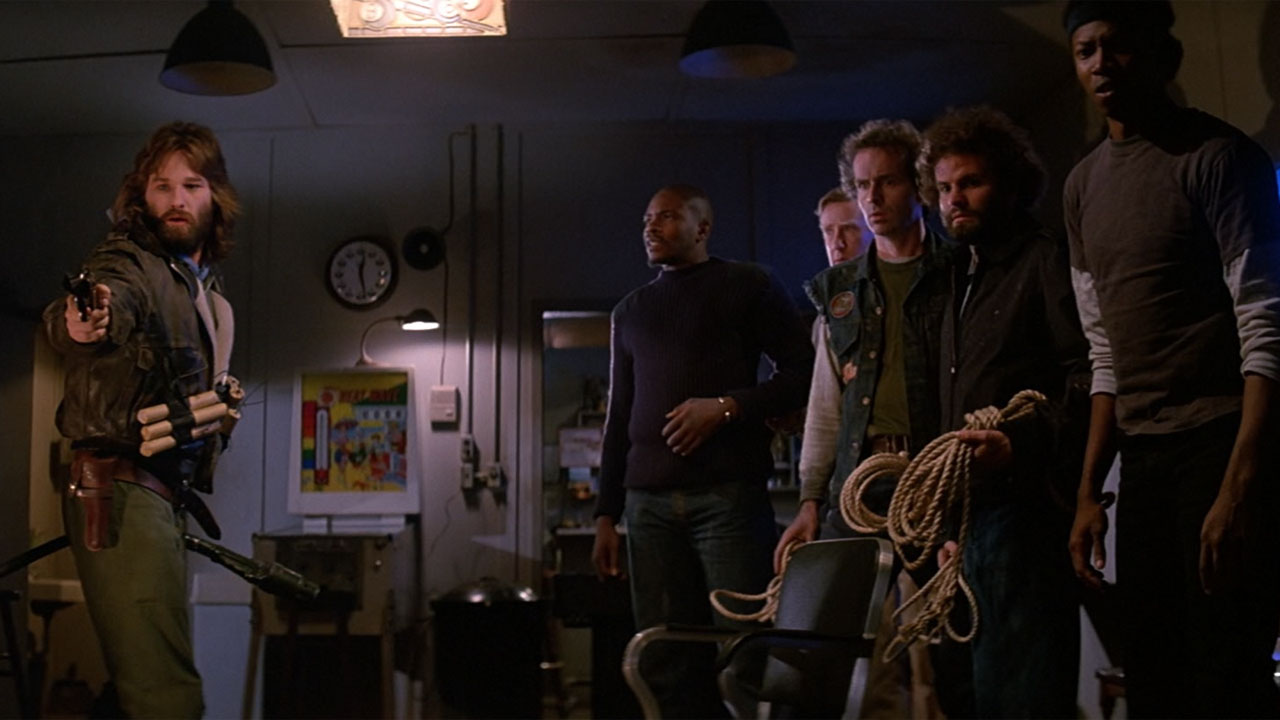
And that pay-off is compelling. A particularly masterful sequence involves a series of blood tests (now a hoary old stable of these things, but at the time something really new). MacReady essentially ties up all the other remaining characters (living and dead) and sticks a scolding hot wire into a blood sample from each man. The idea being the blood of any Thing will react aggressively to the “attack”. Carpenter really lets this scene build slowly – not least because MacReady is holding all the men at dynamite and gun point. The slow build-up reveals a few innocent men, each untied to help Macready. Then just as MacReady (and the audience) begin to relax – someone fails the test and the scene jumps into body horror chaos. Completing the tests after that is a near wordless sequence of jump cuts from test to test, with the number of untied men slowly growing. It’s brilliantly done: slow – quick – slow. Perfect tension drama. It’s the centrepiece of the whole damn movie.

The other thing Carpenter really understands is that set-ups like this are perfect discussion fodder for fans. Just as we love to debate whether Deckard is a replicant or not, there are plenty of similar points in this film. Most of this revolves around Blair, the first to work out the danger the Thing will cause if it reaches civilisation: when does he become infected? How many of his actions are human, how many Thing? At one point MacReady visits him (isolated in a hut) and finds him sitting calmly asking to come back in. Creepily beside him, an unused noose hangs from the roof: it’s not commented on in the scene at all, but it speaks volumes for possible interpretations. This sort of stuff throws itself open to a debate for the ages – the film enigmatically provides enough clues without definitive answers. It does this for a number of events – deaths go unexplained, materials are destroyed and we never find out by whom. The film is full of shady events, of key moments happening off camera, of mysteries going as unanswered for the characters as they do for the audience. Ripe for you to add your own interpretation.

The final scene of the film continues this: the surviving characters sit in the burning wreckage of their base. For all they know, either or neither of them may, or may not, be Things. But it hardly matters: the cold is coming in and we (and they) know anyone left in these conditions will be frozen in a matter of hours. So you get this brilliantly low-key, weary but charged exchange:

Survivor #1: Maybe we shouldn’t.

Survivor #2: If you’re worried about me…

Survivor #1: If we’ve got any surprises for each other, I don’t think we’re in much shape to do anything about it.

Survivor #2: Well, what do we do?

Survivor #1: Why don’t we just… wait here for a little while… see what happens?

So – the question stands? Who is a Thing and who isn’t? It’s a perfect, unsettling, final frame discussion point – and one that has kept feeding debate for years.

The Thing is a nasty, grimy, tense, unsettling, gruesome, gory, yucky, scary, paranoia-inducing masterpiece. It’s easily the best thing John Carpenter ever made (its failure at the box office seemed to break the director’s spirit, as nothing he did ever again reached this). As a slow-burn, cold war flavoured conspiracy and suspicion story it’s out of the top drawer – it captures perfectly the psychosis and fear that can be brought on by trapped isolation. It’s crammed with perfectly formed scenes. It has a terrific, nearly nihilistic feel to it – even the most competent of the men (MacReady) is way out of his depth here. Our alien nemesis is a master of psychology and tactics. So is the film.