
Run-of-the-mill odd-couple buddy movie, that somehow landed a nomination for Best Picture
Director: Lloyd Bacon
Cast: James Cagney (Chesty O’Connor), Pat O’Brien (CPO Biff Martin), Gloria Stuart (Dorothy Martin), Frank McHugh (Wilbur ‘Droopy’ Mullins), Dorothy Tree (Gladys), Willard Robertson (Lieutenant Commander), Eddie Acuff (Orderly), George Irving (Admiral)
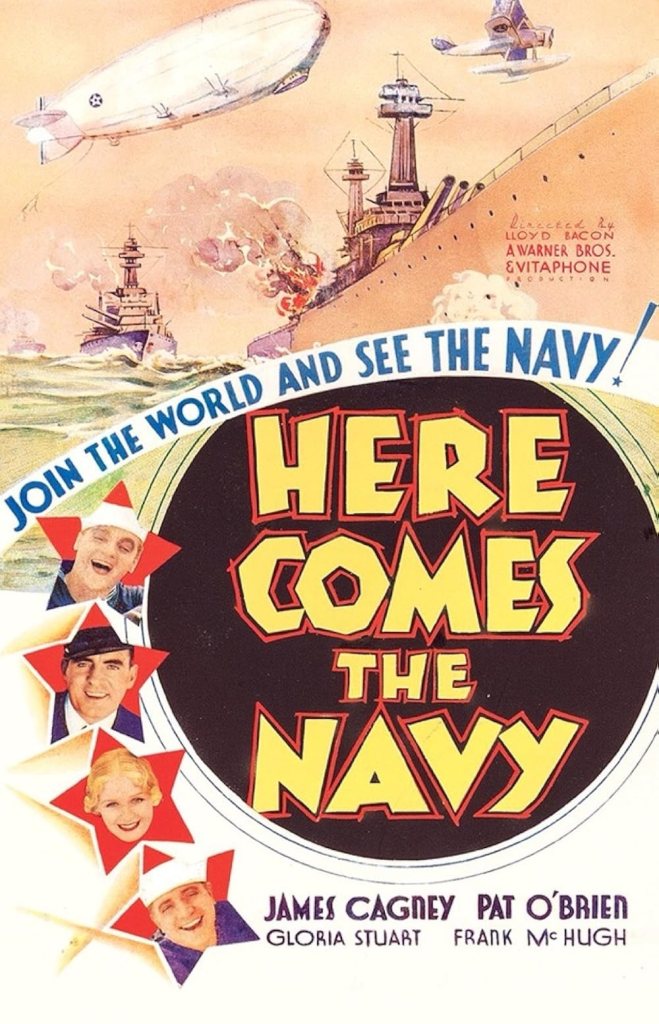
Why did Here Comes the Navy get nominated for Best Picture? The only answer that makes sense why this run-of-the-mill mix of odd-couple buddy movie and flag-waving recruitment piece ended up in such hallowed company is that it was the only contender Warner Brothers had that year and the full company block vote went behind it. Either way, Here Comes the Navy has disappeared as swiftly as a rock dropping to the bottom of the sea.
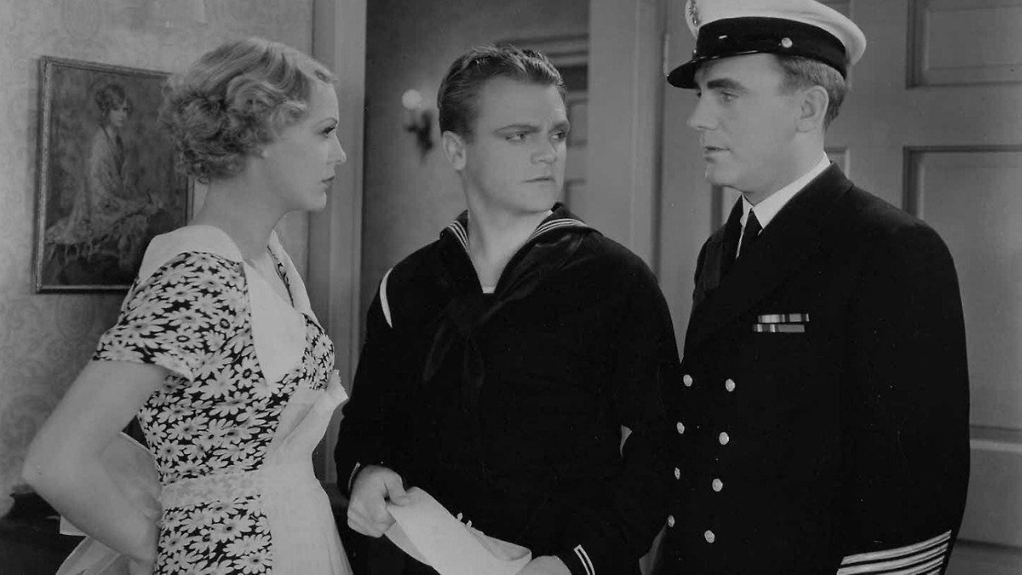
Chesty O’Connor (James Cagney) is a happy-go-lucky builder with a chip on his shoulder who takes it badly when Chief Petty Officer Biff Martin (Pat O’Brien) woos his girl Gladys (Dorothy Tree), wins Chesty’s own dance competition with her and even knocks Chesty down in a fight. Chesty decides the best revenge is to join the navy and get on board Martin’s ship USS Arizona for round two. Unfortunately for him, he finds the navy is harder work than expected, with its rigid discipline. Doesn’t stop Chesty continuing his feud with Martin – especially when he falls for Martins sister Dorothy (Gloria Stuart). But will Chesty find honour, decency and a love of duty in him while serving in the navy?
Since the film was made with the full co-operation of the US Navy, you can be pretty confident he will. Bacon’s film zips along in a pacey 85 mins, hitting every expected beat you would expect. It’s almost completely reliable on the charm and comic timing of Cagney, so it’s just as well he’s on fine form, with just the right level of cheek and cynicism alongside his deadly sin of pride. It further helps that he’s sparking much of his odd couple bickering against long-time real-life pal Pat O’Brien, spot on for the stiffer, less entertaining role of the rule-abiding killjoy who can still win a dance contest and will put up his dukes when needed (but only off duty).
The sparring and bickering between these two – with the inevitable heroic deed that brings them together as feuding best pals – is fairly formulaic but decent enough. That’s par for the whole film, which is all a formula delivered exactly to plan, that barely stands out from hundreds of similar movies. It feels rather like a light-and-jolly B-movie, the sort of thing that might pop up before you watch a more prestige product afterwards.
It gets lifted to A-movie status due to the scale from that Naval investment. Here Comes the Navy’s subtle, military-approved, message is that the atmosphere of the navy, its discipline and the pride in the institution of officers and men can turn even the most unlikely waster into a stand-up pride of the service. With that message firmly in place, the film got enviable access to the USS Arizona, with scenes above and below deck, with Chesty and Droopy polishing guns, swabbing decks, loading and firing the guns, climbing on board… every chance is used and to show the navy equipment (several stock clips shows various ships on practice manoeuvres) and the same thing continues when Chesty is re-assigned to the US Naval Air Service, with vast hangers and airships.
Plot wise, among all this impressive military hardware, there is little to get anyone’s creative juices really flowing. It’s all shot with competent professionalism but no real inspiration (or lasting interest) by Lloyd Bacon. Gloria Stuart gives a perfectly fine performance as Martin’s decent, kind sister. Cagney has almost as much chemistry with her, as he does with the tender bond he displays with Frank McHugh’s quietly amusing Droopy. (There is a hint of a homoerotic bond between Cagney and McHugh, that I am pretty sure must have passed the Navy by when they watched the film).
The shenanigans are all fairly amusing, except perhaps for an unfortunate sequence where Cagney blacks up to slip ashore as part of a ticket-of-leave party. The make-up renders him unrecognisable to Martin (!), but that’s not as bad the Black sailor he purchases the ticket from, who is only a few degrees away from the sort of “yes massa” portrait of dimness and docility that filled out the cast of Gone with the Wind.
Aside from that it’s all fine, in a totally forgettable way (I’d be amazed if Cagney had any memory of making the film). It’s main interest today is the way it captures on film two doomed naval vessels. The airship USS Macon that Chesty serves on was lost at sea (fortunately with only two crewmen lost) less than a year after Cagney’s stunt double shinned down a rope mid-air. Even more tragic, the USS Arizona would be sunk at Pearl Harbor seven years later, with 1,177 officers and crew lost, its carcass still lying at the bottom of the harbour today. It’s a tragic footnote to a film that is itself a footnote in Oscar’s history.
 Movie Musings